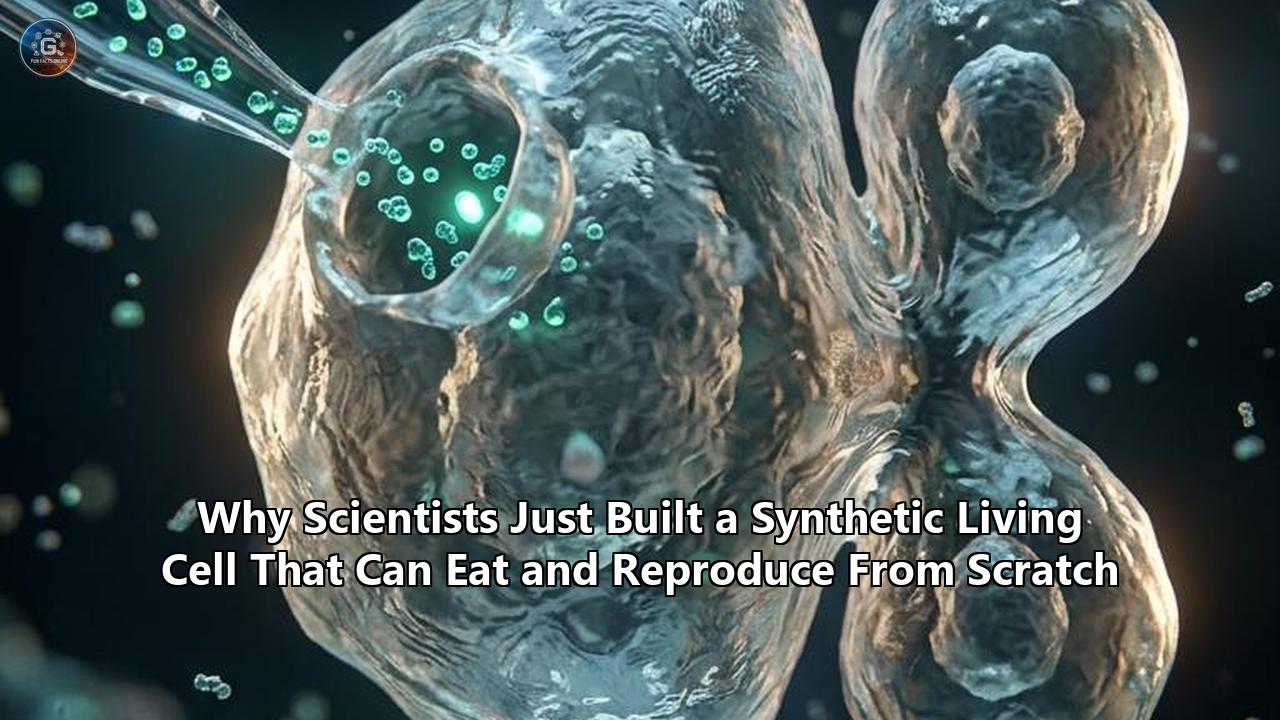
In a historic milestone for synthetic biology, researchers at the University of Minnesota have announced the creation of SpudCell—the world’s first bottom-up synthetic living cell that is capable of completing a full cellular life cycle.
According to a landmark paper released as a preprint on bioRxiv, a team led by synthetic biologists Dr. Kate Adamala and Dr. Aaron Engelhart has successfully assembled a microscopic system from non-living chemical components that can feed, grow, replicate its genetic material, divide, and undergo evolutionary selection.
The cell, which has been nicknamed SpudCell due to its resemblance to a potato under the microscope and as a playful nod to the Soviet satellite Sputnik, is a masterclass in elegant, minimalist bioengineering. Measuring just a few thousandths of a millimeter in diameter, SpudCell consists of a simple lipid membrane enclosing a stripped-down genome of just 90,000 base pairs split across seven modular DNA plasmids. Within its oily membrane sits a translation system that turns genetic instructions into proteins and a metabolic system capable of processing energy.
"We’ve replicated in chemistry what only used to be possible in biology: the complete set of behaviors of a cell," said Dr. Adamala, an associate professor of genetics, cell biology, and development at the University of Minnesota. "It proves that the most fundamental functions of life, like growth and replication, do not need a mysterious magical spark."
The scientific community is calling the achievement a pivotal leap forward. Jack Szostak, a Nobel laureate and origins-of-life researcher at the University of Chicago who was not involved in the work, described it as "an impressive step." He added, "I don’t know of any other effort to put together an artificial cell from biological components that has progressed so far."
While SpudCell is still a primitive and fragile prototype that cannot survive outside highly controlled laboratory conditions, it represents a profound shift. By demonstrating that a cell cycle can be engineered from scratch using a fully defined chemical recipe, the Minnesota team has moved humanity closer than ever to creating artificial life.
Inside the Biochemical Engine: How SpudCell Eats, Grows, and Reproduces
To understand the profound implications of this development, it is first necessary to dissect what makes a synthetic living cell distinct from the bioengineered microbes currently used in industry. Modern biotechnology frequently modifies existing bacteria, like Escherichia coli, by inserting foreign genes to produce pharmaceuticals like insulin. However, these organisms carry billions of years of evolutionary baggage, complex internal systems, and thousands of genes that are not fully understood.
SpudCell, by contrast, was built from the bottom up. The researchers started with lipid bilayers—empty bubbles of fat known as liposomes—and carefully added purified, non-living biomolecules piece by piece. The final construct consists of roughly 150 to 200 distinct molecular components. To make this minimal molecular soup function as a cohesive cellular unit, the researchers had to solve three monumental biological puzzles: feeding, genome replication, and cell division.
                     +---------------------------------------+
                     |         SPUDCELL MEMBRANE             |
                     |                                       |
                     |      +-------------------------+      |
                     |      |     7-Plasmid Genome    |      |
                     |      |        (90,000 bp)      |      |
                     |      +------------+------------+      |
                     |                   |                   |
                     |                   v                   |
                     |      +-------------------------+      |
                     |      |  Translation Machinery  |      |
                     |      |   (Purified Ribosomes)  |      |
                     |      +------------+------------+      |
                     |                   |                   |
                     +-------------------|-------------------+
                                         | (Fusion via pore proteins)
                                         v
                            +-------------------------+
                            |     Feeder Liposome     |
                            |  (Lipids, ATP, Enzymes) |
                            +-------------------------+
The "Predator" Feeding Mechanism
Most living cells maintain their internal environment through complex, energy-intensive active transport networks controlled by hundreds of different membrane proteins. SpudCell lacks the genetic real estate for such machinery. Instead, it feeds through a engineered fusion mechanism that the researchers liken to a predator consuming prey.
The synthetic cell is designed to produce a modified bacterial pore protein that is embedded in its outer lipid membrane. This protein displays a highly specific chemical tag on the cell’s exterior. The researchers float SpudCell in a fluid medium filled with smaller "feeder liposomes" that carry a complementary chemical tag on their surfaces, as well as a rich cargo of lipids, enzymes, and essential small molecules like adenosine triphosphate (ATP).
When SpudCell’s surface tags encounter the matching tags on a feeder liposome, the two membranes latch onto one another and merge. This fusion delivers fresh raw materials directly into SpudCell’s interior, allowing its volume to expand and its membrane surface area to grow. Because SpudCell cannot biosynthesize its own basic building blocks, every single nutrient—from lipids for its membrane to amino acids for protein synthesis—must be acquired through this engineered "eating" process.
Replicating a Modular Genome
While the human genome comprises roughly 3 billion base pairs and E. coli possesses around 4.6 million, SpudCell operates on a highly optimized genome of just 90,000 base pairs. Previously, theoretical biologists estimated that the absolute minimum genome size required to sustain a cellular life cycle was 113,000 base pairs. SpudCell has shattered that theoretical floor.
Rather than arranging its DNA in a single, massive circular chromosome, the Minnesota team split SpudCell’s genetic code across seven separate DNA plasmids. This modular design serves as a "software architecture" for biology. Each plasmid operates like an independent software library, controlling distinct cellular functions:
- Plasmid 1: Encourages lipid fusion and raw nutrient integration.
- Plasmids 2-4: Code for DNA replication enzymes and regulatory proteins.
- Plasmids 5-6: Handle transcription and basic translation regulatory systems.
- Plasmid 7: Encodes the proteins responsible for triggering cell division.
To copy this genome, the cell utilizes a highly efficient DNA polymerase enzyme borrowed from a bacteriophage (a virus that infects bacteria). As SpudCell "eats" and accumulates nucleotides, this polymerase copies the seven plasmids inside the growing membrane, preparing the cell for reproduction.
Ditching the Cytoskeleton for Cell Division
For decades, cell division has been the primary roadblock in bottom-up synthetic biology. In natural cells, division is governed by a highly sophisticated internal skeleton called the cytoskeleton. A network of protein filaments, such as actin and tubulin, must coordinate to precisely locate the cell's center, organize the newly replicated chromosomes, and squeeze the cell membrane shut until it pinches into two.
Attempting to engineer a functional, self-assembling cytoskeleton inside a bottom-up synthetic cell has proved nearly impossible because the process requires the synchronized action of dozens of complex proteins. To get around this, Dr. Adamala made a radical choice: she decided to ditch the cytoskeleton entirely.
Instead of active internal squeezing, SpudCell relies on passive mechanical physics. As the cell transcribes its DNA and synthesizes proteins, specific membrane-binding proteins begin to accumulate on the inner surface of the lipid bilayer. Because these proteins are engineered to crowd together, their physical accumulation alters the surface tension of the membrane, warping it inward.
As the cell continues to grow and more proteins pack onto the membrane, the local mechanical stress becomes so intense that the lipid bubble naturally deforms, elongates, and pinches in half, splitting into two distinct daughter cells.
Demystifying the Synthetic Living Cell: Top-Down vs. Bottom-Up
The quest to build a functional synthetic living cell has historically been divided into two fiercely competitive schools of thought: the "top-down" approach and the "bottom-up" approach. To fully grasp why the creation of SpudCell is such a massive leap forward, it is helpful to contrast these two paradigms.
| Feature | Top-Down Synthetic Cells (e.g., JCVI-syn3.0) | Bottom-Up Synthetic Cells (e.g., SpudCell) |
|---|---|---|
| Starting Point | Existing, highly evolved natural bacteria | Lifeless, chemically defined purified molecules |
| Genome Creation | Chemically synthesized genome transplanted into a hollowed-out natural cell | Synthesized plasmids added directly to a laboratory-made lipid vesicle |
| Complexity | Moderately high (hundreds of genes, many with unknown functions) | Extremely low (36 genes, 150-200 total molecules) |
| Evolutionary Baggage | Retains cellular machinery and structure developed over billions of years | Zero evolutionary heritage; built entirely to human specifications |
| Predictability | High, but limited by unresolved genetic mysteries | Absolute; every single atom and concentration is defined |
| Primary Limitation | Hard to isolate individual systems; background biological "noise" | Fragile, short-lived, and highly dependent on external assistance |
The top-down approach was famously pioneered in 2010 by genomics giant J. Craig Venter and his team at the J. Craig Venter Institute (JCVI). Venter’s team took a naturally occurring bacterium, Mycoplasma mycoides, and systematically stripped away its genes until they arrived at the absolute bare minimum required to keep the organism alive. The result was JCVI-syn3.0, a "minimal cell" running on a completely synthetic, human-designed chromosome.
While JCVI-syn3.0 was a magnificent achievement, it was not built from scratch. It relied on a pre-existing bacterial cellular chassis—complete with natural proteins, ribosomes, and membranes that had been shaped by billions of years of evolution. Furthermore, even with a minimal genome of roughly 473 genes, scientists still did not understand the biological function of nearly a third of those genes.
The bottom-up approach, which yielded SpudCell, is fundamentally different. By starting with nothing but purified chemicals, Adamala and her colleagues have bypassed the evolutionary baggage that complicates top-down research.
Because every single molecule in SpudCell is added by hand, there are no mysteries. Scientists know the exact concentration of every lipid, enzyme, and nucleotide. This makes SpudCell a highly predictable, fully engineerable biological computer.
"Building a cell from scratch means you are no longer tied to the constraints and evolutionary baggage of existing life," explained Dr. Yuval Elani, an associate professor in biochemical technologies at Imperial College London, who was not involved in the study. "It opens up a completely clean slate for design."
Is It Actually "Alive"? The Philosophical and Scientific Boundary
The creation of SpudCell inevitably reignites one of the oldest and most contentious debates in science: what does it actually mean for something to be "alive"?
The classic textbook definition of life relies on a checklist of characteristics: homeostasis, organization, metabolism, growth, adaptation, response to stimuli, and reproduction. SpudCell ticks almost every single one of these boxes. It maintains an internal environment, uses energy, grows in size, replicates its genome, and divides. Yet, both the creators of SpudCell and external experts hesitate to call it fully alive.
"I do not believe SpudCell is alive," Dr. Adamala stated bluntly in an interview with Live Science. Instead, she describes the system as an "incredibly wimpy organism that right now basically does nothing other than to eat and occasionally make a daughter cell."
====================================================================
                        THE GRADIENT OF LIFE
====================================================================

  [ INERT CHEMISTRY ]
          │
          ▼
  [ DYNAMIC MOLECULAR NETWORKS ] (Self-replicating chemical mixtures)
          │
          ▼
  [ SPUDCELL ] <--- (We are here: grows, replicates, divides,
          │          undergoes selection, but requires external ribosomes)
          ▼
  [ AUTONOMOUS SYNTHETIC LIFE ] (Self-sufficient, builds own machinery)
          │
          ▼
  [ NATURAL CELLULAR LIFE ] (Billions of years of evolved complexity)
====================================================================
There are several critical biological thresholds that SpudCell has yet to cross before it can be considered a truly autonomous, living entity:
1. The Ribosome Bottleneck
The ribosome is the universal cellular factory responsible for translating RNA into proteins. It is an extraordinarily complex molecular machine made of dozens of proteins and ribosomal RNA molecules. SpudCell is currently unable to synthesize its own ribosomes.
Because it lacks the genetic code and metabolic machinery required to assemble these complex structures, researchers must harvest ribosomes from E. coli bacteria and manually feed them to SpudCell via the feeder liposomes. Without this external supply of cellular machinery, the synthetic cell’s internal operations would grind to a halt within hours.
2. High-Fidelity Replication vs. Darwinian Evolution
NASA’s official working definition of life is "a self-sustaining chemical system capable of Darwinian evolution." While SpudCell is capable of replication, it does not yet exhibit true, spontaneous Darwinian evolution.
The viral DNA replication enzyme used by SpudCell is highly precise—so precise, in fact, that it introduces almost no spontaneous errors, or mutations, during replication. Without spontaneous mutations arising naturally within the population, the synthetic cells cannot develop new traits on their own.
To demonstrate that evolutionary selection was possible in their system, the Minnesota team had to artificially introduce genetic mutations. They engineered a variant of the cell with a modified promoter gene that caused it to express a higher concentration of the membrane-fusion "eating" protein. When they mixed these modified cells with the original, slower-growing cells and forced them to compete for limited feeder liposomes, the modified cells naturally outcompeted their siblings.
By the fifth generation, the faster-growing variant made up as much as 61% of the total population. While this was a dramatic demonstration of selection, it was a directed experiment rather than a spontaneous evolutionary jump.
3. Cellular Senescence and Decay
Unlike natural bacteria, which can divide indefinitely as long as nutrients are available, SpudCell's lineage is severely limited.
Because the division mechanism relies on passive physical forces rather than an active, precise cytoskeleton, the distribution of genomes during cell division is highly uneven. The researchers found that after five generations, only about 30% of the daughter cells successfully inherited a complete set of the seven essential plasmids. By the tenth generation, the genetic material becomes so fragmented and diluted that the cells lose the ability to function and die off.
Rather than viewing these limitations as failures, scientists see them as proof of how close we are to crossing the boundary. SpudCell sits squarely on the gradient between pure chemistry and active biology, demonstrating that the transition from non-living matter to living systems is not a binary switch, but a spectrum of increasing complexity.
From the Lab to the Bioeconomy: What Can a Programmable Cell Actually Do?
While SpudCell’s current utility is primarily academic, the ultimate goal of the research is not merely to answer existential questions about the origin of life. Instead, scientists are aiming to construct a highly standardized, customizable biological "chassis" that can be programmed to perform specific, high-value tasks.
"We're hoping we’re really starting the true age of the bioeconomy—enabling technology that will let people engineer biology," Dr. Adamala said.
Because a synthetic living cell is built from scratch, it can be designed to perform tasks that are entirely impossible for natural organisms. Evolved microbes have spent billions of years optimizing their systems for survival in harsh environments, making them highly resistant to radical genetic redesign. A synthetic cell, completely free of evolutionary baggage, can be treated like a molecular clean slate.
┌─────────────────────────────────────────────────────────────────────────┐
│                       FUTURE INDUSTRIAL HORIZONS                        │
├───────────────────┬─────────────────────────────────────────────────────┤
│  Biomanufacturing │ Synthesizing complex drugs with non-natural amino  │
│                   │ acids that evolution never utilized.                │
├───────────────────┼─────────────────────────────────────────────────────┤
│  Targeted Medicine│ Nanobots that navigate the human body, consuming    │
│                   │ local lipids to replicate and deliver drugs.        │
├───────────────────┼─────────────────────────────────────────────────────┤
│  Bioremediation   │ Living sensors engineered to absorb environmental   │
│                   │ toxins or capture atmospheric carbon.               │
├───────────────────┼─────────────────────────────────────────────────────┤
│  Biocomputing     │ Molecular logic gates running on DNA plasmids,       │
│                   │ processing information at the cellular level.        │
└───────────────────┴─────────────────────────────────────────────────────┘
1. Advanced Biomanufacturing
Modern pharmaceutical manufacturing relies heavily on living cells to produce complex proteins, such as monoclonal antibodies and insulin. However, these natural cells are limited to using the 20 standard amino acids defined by the universal genetic code.
Because scientists have complete, atom-by-atom control over the transcription and translation machinery inside a synthetic cell, they can reprogram the cell's transfer RNA (tRNA) and ribosomes to utilize synthetic, non-standard amino acids. This would allow the bio-manufacturing of entirely new classes of drugs, materials, and enzymes that have never existed in nature, opening up highly targeted therapeutic pathways for cancer, autoimmune disorders, and genetic diseases.
2. Autonomous, Targeted Medicine
Imagine a microscopic, synthetic cellular "nanobot" injected into a patient's bloodstream. Because the synthetic cell can be programmed to recognize specific chemical markers, it could navigate to the site of a malignant tumor.
Once there, the cell could feed on local lipids and glucose, growing and dividing to amplify its numbers directly at the tumor site. It could then express a highly concentrated dose of chemotherapy drugs directly into the cancer cells before naturally dying off once its programmed generational limit is reached, entirely avoiding the systemic side effects of traditional chemotherapy.
3. Living Carbon Scavengers and Environmental Sensors
In the face of climate change and environmental degradation, synthetic cells could serve as highly specialized environmental clean-up tools. Because synthetic cells do not require a massive genome to maintain a complex metabolism, they can be engineered to perform a single, hyper-focused task with maximum efficiency.
Scientists could design synthetic cells that absorb carbon dioxide directly from the atmosphere and convert it into stable carbon crystals, or create living aquatic sensors that change color when they encounter trace amounts of heavy metals or microplastics in municipal water supplies.
4. Organic Biocomputing
Because SpudCell’s genome is split across seven independent plasmids, it behaves remarkably like a modular software system. Each plasmid can be designed to process distinct biochemical inputs and generate specific outputs, effectively acting as a molecular logic gate (AND, OR, NOT).
By chaining these plasmids together, synthetic biologists can create biological computers capable of processing complex calculations inside living tissue. These living computers could monitor real-time health metrics inside a patient's body and release specific medicines only when a precise combination of biological conditions is met.
The Biosecurity and Bioethical Imperative: Regulating Artificial Life
The creation of a synthetic cell that can grow, divide, and pass on genetic traits inevitably triggers profound bioethical and biosecurity concerns. If humanity succeeds in creating fully autonomous, self-replicating artificial organisms, how do we ensure they do not pose an existential threat to our ecosystems or our species?
Critics and biosecurity experts warn that the very features that make synthetic cells so attractive—their programmability and rapid development cycle—also make them potentially dangerous dual-use technologies.
If the technology to build cells from scratch becomes standardized and widely accessible, it could theoretically be misused to design novel, highly targeted pathogens that bypass existing human immune defenses. Unlike natural viruses and bacteria, which can often be detected and neutralized using existing broad-spectrum antivirals and antibiotics, a fully customized synthetic pathogen might operate on completely alien biological rules, rendering our medical countermeasures useless.
Furthermore, there are serious ecological concerns regarding accidental release. If a synthetic organism capable of consuming environmental resources were to escape a laboratory containment facility, it could theoretically compete with natural microbes, disrupting delicate ecological balances and causing unforeseen cascading effects in soil or aquatic food webs.
                    +---------------------------------------+
                    |      THREE PILLARS OF SYNTHETIC       |
                    |           BIOLOGICAL SAFETY           |
                    +-------------------+-------------------+
                                        |
      +---------------------------------+---------------------------------+
      |                                 |                                 |
      v                                 v                                 v
+-----+---------------+           +-----+---------------+           +-----+---------------+
| PHYSICAL CONTAINMENT|           | NUTRITIONAL TETHER  |           | GENETIC SELF-DESTRUCT|
+---------------------+           +---------------------+           +---------------------+
| Class-III biosafety             | Cell cannot produce |           | Programmed genome   |
| cabinets, negative-             | ribosomes or lipids |           | fragmentation       |
| pressure air filtration         | internally; dies    |           | after 5-10 cell     |
| and strict protocols.           | without lab feed.   |           | divisions.          |
+---------------------------------+---------------------+---------------------------------+
The researchers behind SpudCell are acutely aware of these risks. In their paper, they emphasized that their progress "highlights the urgent need to develop a safety and security framework for future synthetic cell engineering."
Fortunately, SpudCell’s inherent design contains several natural, highly robust "fail-safes" that prevent it from surviving outside the laboratory:
- The Nutritional Tether: SpudCell is entirely dependent on a highly specific, complex, and expensive diet of purified enzymes, lipids, and ribosomes that do not exist in a free state in nature. If SpudCell were to escape the lab, it would find nothing to eat and would disintegrate within minutes.
- Temperature Sensitivity: The synthetic cell is highly fragile and requires a constant, carefully regulated temperature of precisely 30°C (86°F) to grow and replicate. Any significant drop or rise in temperature deforms the lipid membrane, causing the cell to burst.
- Programmed Decay: Because the cell cannot perfectly distribute its plasmids during division, its lineage naturally decays and dies off after 5 to 10 generations, meaning it is physically incapable of establishing an uncontrolled, runaway population.
As the field of synthetic biology progresses toward creating more robust, self-sufficient organisms, the biological security community will need to transition from passive physical containment to active, genetically encoded safeguards. This includes engineering synthetic cells to use "mirror life" proteins and sugars (which are structurally reversed and cannot interact with natural biology) or building absolute genetic kill-switches that trigger cellular self-destruction if the cell detects an unauthorized environmental change.
The "Biotic" Initiative: Building the Operating System of Life
To accelerate the transition from fragile laboratory prototypes to practical, real-world technologies, Dr. Adamala and her collaborators are launching Biotic, a new, international public-benefit research and engineering institution.
One of the greatest bottlenecks currently facing the synthetic biology community is a lack of standardization. Because different research groups around the world utilize wildly different chemical protocols, specialized lipid mixtures, and unique genetic vectors, it is incredibly difficult for scientists to reproduce or build upon each other's work.
"This was exceptionally difficult work to scale," Dr. Adamala explained. "The knowledge in this space is very hard to explain, so we had collaborators on the project fly in for in-person demonstrations just to get particular techniques working. That’s not scalable. Any engineering discipline needs modularity."
                  +-----------------------------------------+
                  |            BIOTIC INITIATIVE            |
                  |     (Open-Source Biological Standards)   |
                  +--------------------+--------------------+
                                       |
       +-------------------------------+-------------------------------+
       |                               |                               |
       v                               v                               v
+------+---------------+       +-------+---------------+       +-------+---------------+
|   MODULAR CHASSIS    |       |   REGULATORY PLUGINS  |       |   SAFETY KERNELS      |
+----------------------+       +-----------------------+       +-----------------------+
| Using SpudCell as    |       | Standardized genetic  |       | Encoded safeguards,   |
| the standard, open-  |       | libraries to swap in  |       | nutrition tethers,    |
| source biological    |       | specialized protein   |       | and self-destruct     |
| foundation.          |       | synthesis.            |       | triggers.             |
+----------------------+       +-----------------------+       +-----------------------+
The mission of the Biotic initiative is to establish a standardized "operating system for life"—a shared, open-source chemical and genetic framework that will allow synthetic biologists worldwide to collaborate seamlessly. Using SpudCell as a foundational "chassis," Biotic plans to develop modular standards for synthetic biological engineering, much like the standardized components that enabled the rapid scaling of the microchip and software industries.
The immediate roadmap for the Minnesota team and the Biotic initiative is highly ambitious, focusing on several key milestones over the coming years:
1. Consolidating the Genome
Currently, SpudCell's genome is fragmented across seven separate DNA plasmids. While this modularity is excellent for adjusting individual cellular functions, it makes the genome highly unstable during division.
Biotic’s first priority is to consolidate these seven plasmids into a single, cohesive circular chromosome. This will ensure that when the cell divides, both daughter cells inherit a complete copy of the genetic programming, extending the cell's lifespan from five generations to an indefinite lineage.
2. Synthesizing the Ribosome
To move closer to true self-sufficiency, synthetic cells must learn to manufacture their own translation machinery.
Researchers are working to integrate the ribosomal RNA genes and protein assembly pathways directly into SpudCell’s genome. If successful, the cell will no longer need to be fed pre-assembled ribosomes, crossing a massive threshold toward true, biological autonomy.
3. Enabling True Darwinian Evolution
To allow the synthetic cells to adapt to changing environments without human intervention, scientists must find a way to safely introduce spontaneous mutations.
By swapping out the high-fidelity viral DNA polymerase for a slightly more error-prone replication enzyme, researchers hope to introduce a controlled, low-level mutation rate. This will allow the cells to naturally evolve, mutate, and adapt across hundreds of generations, marking the definitive transition from engineered chemistry to autonomous biology.
What to Watch Next
As the preprint undergoes rigorous peer-review and scientists around the world begin to digest the Minnesota team's methods, all eyes will be on the newly founded Biotic initiative.
The creation of SpudCell has demonstrated that the fundamental behaviors of cellular life—growth, genetic replication, division, and selection—can be successfully reconstructed from scratch using basic chemistry. It is a powerful reminder that our bodies, our ecosystems, and all life on Earth are ultimately governed by highly complex, but ultimately understandable and programmable, biochemical machines.
Whether SpudCell is ultimately remembered as a clever chemical imitation or the historic ancestor of a new kingdom of human-made life, one thing is certain: the line between the living and the non-living has never been thinner.
The scientific community is now watching for the first peer-reviewed publication of the SpudCell paper, the launch of the first collaborative projects under the Biotic framework, and the inevitable regulatory debates that will follow as humanity learns to write the software of life from scratch.
Reference:
- https://www.straitstimes.com/world/scientists-made-a-cell-with-most-of-the-hallmarks-of-life-heres-what-to-know
- https://www.kotaradio.com/2026/07/02/milestone-scientists-claim-to-build-synthetic-cell-raising-concerns-in-step-toward-artificial-life/
- https://www.healthandme.com/health-news/scientific-breakthrough-us-scientists-create-first-synthetic-cell-that-eats-and-reproduces-article-154846277
- https://www.inc.com/chloe-aiello/scientists-just-created-something-like-artificial-life-and-theyre-releasing-the-blueprints-to-everyone/91368513
- https://twin-cities.umn.edu/news-events/worlds-first-synthetic-cell-complete-life-cycle-could-revolutionize-biological
- https://www.discovermagazine.com/world-s-first-synthetic-cell-with-a-complete-life-cycle-marks-biology-breakthrough-49331
- https://www.sciencefriday.com/segments/artificial-cell-eats-grows-reproduces-life/
- https://www.youtube.com/watch?v=UVtTJo2_ZUs
- https://www.quantamagazine.org/for-the-first-time-a-cell-built-from-scratch-grows-and-divides-20260701/
- https://www.ctvnews.ca/sci-tech/article/scientists-say-they-have-built-a-cell-from-scratch-for-the-first-time/
- https://futurism.com/science-energy/fully-synthetic-cell-eat-reproduce
- https://www.smithsonianmag.com/smart-news/scientists-say-theyve-made-cells-that-feed-grow-and-reproduce-bringing-them-one-step-closer-to-building-life-from-scratch-180989070/
- https://byteiota.com/spudcell-first-synthetic-cell-grows-divides/
- https://www.sci.news/biology/synthetic-cell-14890.html
- https://www.sciencealert.com/for-the-first-time-scientists-say-theyve-built-a-synthetic-cell-from-scratch
- https://thedebrief.org/weve-replicated-in-chemistry-what-only-used-to-be-possible-in-biology-scientists-have-created-the-first-fully-synthetic-cell/
- https://www.techexplorist.com/world-first-synthetic-cell-complete-life-cycle/103451/
- https://www.livescience.com/health/scientists-just-created-the-most-lifelike-cell-ever-made-in-a-lab-heres-what-it-could-accomplish