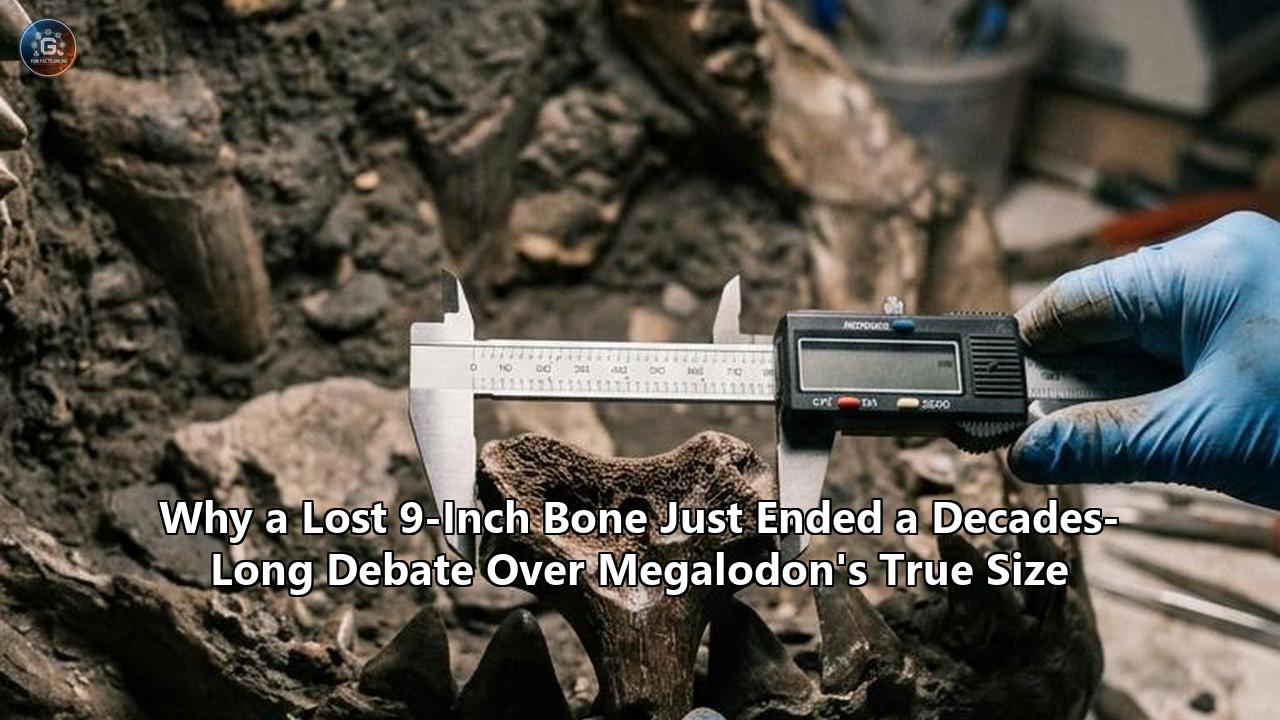
On Monday, June 29, 2026, a international coalition of paleontologists published a study in Palaeontologia Electronica that effectively ended one of the longest-running and most fiercely contested debates in the history of marine biology. Led by Dr. Kenshu Shimada, a professor of paleobiology at DePaul University in Chicago, the research team revealed that they had successfully recovered and reanalyzed a legendary, long-lost fossil: a massive shark vertebra measuring 23 centimeters—just over nine inches—across.
The rediscovery of this single, fragmented specimen, originally unearthed from the Miocene-era clay of Denmark in the late 1970s before vanishing in 1989, provides the first undeniable physical verification that the largest sharks to ever exist reached lengths of up to 24.3 meters (nearly 80 feet).
For nearly four decades, researchers calculating the absolute upper limits of the prehistoric apex predator Otodus megalodon were forced to rely on archival photographs and decades-old notes. The missing bone had been the ultimate "ghost fossil"—a critical mathematical anchor for the species’ maximum size that skeptics argued could have been a mismeasurement, an exaggeration, or a clerical error. With the physical fossil now secured back in museum archives, the scientific community is confronting a dramatically revised picture of ancient marine ecosystems.
This is not just a story about a big fish; it is a behind-the-scenes look at a archival detective story, a masterclass in modern digital reconstruction, and an ecological revelation that reshapes our understanding of how much biomass a single marine predator could consume.
The Tragedy of 1989: How the World's Most Valuable Shark Fossil Ended Up as Rubble
To understand why this nine-inch bone carries such immense scientific weight, one must trace its journey back to 1978, in the damp, commercial clay pits of the Gram Formation in southern Jutland, Denmark. Workers digging for industrial clay struck a sequence of massive, highly mineralized disc-shaped fossils. Paleontologists called to the scene ultimately recovered a sequence of about 20 vertebrae belonging to a single, colossal individual of Otodus megalodon that had died approximately 10.8 million years ago.
Among those recovered vertebrae was a monster. At 23 centimeters (9.05 inches) in diameter, it was—and remains—the largest shark vertebra ever documented, and the largest fish vertebra known to science. It was transported to the Geological Museum of Copenhagen, cataloged, and briefly analyzed by researchers.
Then, disaster struck in 1989.
During a massive, chaotic relocation of the museum's collections, the specimen was dropped, shattering it into hundreds of unrecognizable pieces. Believing the specimen was completely destroyed, or perhaps misplacing the fragments in the post-move disarray, curators recorded the fossil as lost.
[1978: Discovered in Denmark] ──> [1989: Shattered & Lost during Move] ──> [2017: Found in Storage] ──> [2026: Reconstructed & Published]Enter Frank Osbæck, a paleontologist who was present during the aftermath of the 1989 accident. Rather than throwing away the shattered remains, Osbæck swept the fragments into a nondescript cardboard storage box, hoping they could one day be salvaged. Over the next 28 years, as staff retired and museum cataloging systems transitioned to digital databases, that box was pushed to the dark corners of the collection facility, eventually categorized as unidentified rubble.
The breakthrough occurred in 2017 when Bent Erik Kramer Lindow, a vertebrate paleontologist and curator at the Natural History Museum of Denmark, was auditing neglected storage areas. He opened the dusty box and recognized that the gray, highly mineralized fragments within were not common rock debris, but the shattered structural remnants of a legendary giant.
Tallying up the pieces was an excruciatingly slow process. "When I first learned about the vertebral specimen from my Danish collaborators, I was in disbelief," recalls Dr. Kenshu Shimada. "My primary worry was the severe damage the fossil had suffered during the 1989 mishap".
Working with a team that included Danish paleontologist Mette Elstrup and Australian shark expert Mikael Siversson, the researchers began a meticulous, years-long anatomical puzzle-solving effort. The box contained:
- Two partially preserved, large vertebral centra
- At least 185 distinct vertebral fragments
- Multiple rock pieces preserving the physical impressions (casts) of the missing bone structures
By matching the grain of the fossilized cartilage and relying on the high-fidelity internal impressions left in the sediment, the team successfully reconstructed the outermost perimeter of the largest vertebra. The result was undeniable: the centrum’s radius measured precisely 11.5 centimeters, confirming a true, empirical diameter of 23 centimeters.
Why Shark Cartilage Makes "Megalodon True Size" an Academic Battlefield
To appreciate why this verification is so significant, one must understand the unique, frustrating biology of sharks.
Unlike bony fish, dolphins, or whales, sharks belong to the class Chondrichthyes—their skeletons are made entirely of cartilage rather than bone. While bone is rich in calcium phosphate and fossilizes readily, cartilage is soft, collagenous tissue that typically rots away within days of an animal’s death. The only parts of a shark that routinely survive the fossilization process are their teeth, which are protected by ultra-hard enameloid.
As a result, determining megalodon true size has historically been a game of anatomical inference, scaling up from isolated triangular teeth using modern analogs. For generations, the default analog was the modern Great White Shark (Carcharodon carcharias). Researchers assumed that Megalodon was simply a scaled-up, hyper-robust version of a Great White.
However, scaling directly from teeth introduces massive margins of error:
- Positional Variation: A single shark jaw contains teeth of widely varying sizes depending on their position (anterior, lateral, posterior). Scaling a giant lateral tooth as if it were an anterior tooth can result in size estimates that are wildly inflated.
- Species-Specific Proportions: If Megalodon had a proportionally larger head or wider jaw relative to its body than a Great White, tooth-based scaling would systematically overestimate its total length.
- The Cartilage Factor: Without vertebrae, there is no way to verify the actual length of the animal's spinal column, which is the only true physical indicator of an animal's axial length.
Traditional "Great White on Steroids" Model:
[Massive Teeth] ──> scaled directly to ──> [Stocky, Torpedo-shaped Body] ──> Overestimates weight, distorts length.

Modern "Elongated/Slender" Model (Sternes et al., 2024):
[Vertebral Column Length] + [Diameter Ratios] ──> [Slender, Cylindrical Body (Lemon/Mako-like)] ──> More accurate length.
In recent years, the "Great White on Steroids" model has faced severe scientific pushback. A landmark 2024 study led by Dr. Phillip Sternes of the University of California, Riverside, and co-authored by Shimada, demonstrated that Megalodon possessed an unexpectedly slender, elongated body shape, resembling a giant, streamlined version of a modern Mako or Lemon Shark rather than a stocky Great White.
Sternes and his team identified a fundamental mathematical contradiction in previous reconstructions. When researchers tried to model a famous, exceptionally well-preserved string of 141 vertebrae found in Belgium (often called the IRSNB specimen) using Great White proportions, they ran into a physical impossibility. If scaled to Great White proportions, the individual’s total body length should have been around 9.2 meters. Yet, the actual physical length of the fossilized spinal column alone measured 11.1 meters.
This proved that Megalodon had a far more elongated, cylindrical trunk than previously assumed. It was longer, sleeker, and had a less pronounced body taper. But because the Belgian specimen was still incomplete and belonged to a sub-maximal individual, the absolute upper limits of the megalodon true size remained highly speculative. Paleontologists desperately needed a definitive physical anchor for the absolute maximum diameter of a mature Megalodon’s spine. That anchor was the lost 23-centimeter Danish vertebra.
The 24.3-Meter Math: Reconstructing the Spine of an 80-Foot Titan
With the physical Danish vertebra back in the laboratory, the team could perform the rigorous comparative calculations necessary to reconstruct the animal's maximum length.
The mathematical journey from a nine-inch circular disk of fossilized cartilage to an 80-foot active superpredator relies on a method called vertebral scaling, anchored by the more complete Belgian specimen.
The Belgian individual possesses a maximum vertebral centrum diameter of 15.5 centimeters (roughly 6.1 inches). By analyzing the anatomical structure of this column, researchers determined that the trunk portion of this shark’s body spanned 11 meters. Using conservative lamniform ratios—where the head accounts for approximately 16.6% of the body and the tail accounts for 32.6%—the Belgian shark was calculated to have an overall length of 16.4 meters (approx. 54 feet).
To calculate the size of the giant Danish individual, the researchers applied these established ratios to the 23-centimeter centrum.
$$\text{Scaling Factor} = \frac{\text{Danish Centrum Diameter}}{\text{Belgian Centrum Diameter}} = \frac{23\text{ cm}}{15.5\text{ cm}} \approx 1.484$$
$$\text{Estimated Total Length} = 16.4\text{ meters} \times 1.484 \approx 24.3\text{ meters}$$
This simple but incredibly robust calculation yields a total body length of 24.3 meters, or 79.7 feet.
"Although some additional assumptions have gone into the estimated length, the rediscovery of the vertebrae from Denmark eliminates any doubts about the maximum vertebral diameter of 23 centimeters that has been critical for the 24.3-meter length estimate," explained Mette Elstrup, a co-author of the study.
To put a 24.3-meter Megalodon into perspective, the team calculated its estimated mass. Because mass scales cubically relative to length ($L^3$), even a slightly longer shark is exponentially heavier. A 16.4-meter Megalodon is estimated to have weighed roughly 48 metric tons. Scaling this up to 24.3 meters reveals that a maximum-sized Megalodon weighed an astonishing 94 metric tons (approx. 103 short tons).
This mass is comparable to a mature blue whale, yet engineered not for filter-feeding on microscopic krill, but for active, predatory hunting of large marine mammals.
| Metric | Belgian Specimen (IRSNB) | Danish Specimen (Gram Formation) |
|---|---|---|
| Max Centrum Diameter | 15.5 cm (6.1 inches) | 23.0 cm (9.05 inches) |
| Estimated Trunk Length | 11.0 meters (36 feet) | 16.3 meters (53.5 feet) |
| Estimated Head Length | 1.8 meters (6 feet) | 2.7 meters (8.8 feet) |
| Estimated Tail Length | 3.6 meters (12 feet) | 5.3 meters (17.4 feet) |
| Total Body Length | 16.4 meters (54 feet) | 24.3 meters (80 feet) |
| Estimated Body Mass | ~48 metric tons | ~94 metric tons |
Beyond Scale: What Micro-CT Scans Reveal About a 64-Year-Old Titan
While confirming the maximum dimensions of the species was a monumental achievement, the real scientific power of having the physical fossil back in hand lay in the team's ability to apply modern, non-destructive analytical technology. In the decades since the fossil was lost, imaging science has advanced exponentially.
The team subjected the reconstructed core of the Danish vertebra to high-resolution micro-computed tomography (micro-CT) scanning, using high-energy X-rays to peer inside the mineralized cartilaginous matrix without damaging the fragile specimen.
Micro-CT X-Ray Scanning Process:
[Fossilized Centrum] ──> [High-Energy X-Ray Slice Imaging] ──> [3D Density Mapping] ──> [Growth Band Count (64 rings)]
What they found inside the bone was a biological diary of the shark's life.
Like trees, sharks lay down concentric rings of calcified cartilage in their vertebrae as they age, known as growth bands. In many modern lamniform species, these bands are deposited annually, corresponding to seasonal variations in water temperature, nutrient availability, and growth rates.
The micro-CT scans revealed:
- Minimum Age at Death: The scanning software identified at least 64 distinct annual growth bands within the centrum. This proves the individual was a geriatric giant, living more than six decades in the Miocene seas.
- Maximum Theoretical Longevity: By plotting the spacing of these growth rings—which narrow over time as the animal's growth rate plateaus in maturity—the team’s growth model suggested that healthy Megalodons could theoretically reach a lifespan of 96 years.
- Slow, Deliberate Growth: The distance between the early growth bands confirmed that Megalodon was a slow-growing species that invested heavily in longevity and prolonged development. It likely took decades for an individual to reach reproductive maturity, a life-history strategy typical of modern apex predators but one that left the species highly vulnerable to rapid ecological shifts.
These growth patterns also shed light on Megalodon reproduction. The spacing of the very first ring (the "birth band") suggests that Megalodon newborns were already enormous, entering the world at lengths of 3.6 to 3.9 meters (12 to 13 feet). To achieve such massive size in utero, embryos likely engaged in oophagy—a behavior observed in modern sand tiger sharks where developing embryos feed on unfertilized eggs (and potentially their weaker siblings) inside the mother's womb.
A Miocene Crime Scene: The Unsuspected Prey Preserved in the Sediment Matrix
Perhaps the most astonishing behind-the-scenes revelation of the study did not come from the vertebrae themselves, but from the gray, sandy mud that remained adhered to their outer surfaces.
When the fossil was shattered in 1989, much of the surrounding rock matrix was preserved alongside the fragments. In their rush to examine the bone, previous generations of researchers had ignored the sediment. Shimada’s team, however, realized that this ancient clay was a geological time capsule.
Using ultra-fine sieving and microscopic scanning electron microscopy (SEM) on the sediment samples, the team discovered a treasure trove of micro-fossils embedded in the matrix immediately adjacent to the spinal column:
- Dozens of tiny, specialized placoid scales, also known as dermal denticles
- Fragmentary, highly delicate gill-associated structures (gill rakers)
Sediment Matrix Analysis:
[Surrounding Clay] ──> [Microscopic Acid Bath & Sieving] ──> [Discovery of Dermal Denticles & Gill Rakers] ──> [Taxonomic match: Basking Shark (Prey)]
When the team ran taxonomic comparisons on these micro-structures, the results were definitive: they belonged to a prehistoric species of basking shark (Cetorhinus).
Because basking sharks are slow-moving, cold-water filter feeders, the team had to carefully rule out the possibility that the vertebrae themselves belonged to a basking shark. They confirmed that basking shark vertebrae have completely different internal architectural patterning and density profiles, and fossilized basking shark remains are already well-documented as distinct entities within the Gram Clay Pits.
Furthermore, the physical positioning of these delicate gill structures—tucked directly into the recesses of the shattered megalodon vertebrae—led the team to a chilling conclusion: they were looking at the fossilized stomach contents of the giant predator.
"This led us to interpret the basking shark elements to represent the stomach contents of the Megalodon, which is the first direct documentation of diet in the Megalodon fossil record," said study co-author Dr. Mikael Siversson.
While it has long been assumed that Megalodon hunted whales, dolphins, and large seals, this discovery reveals that the Miocene oceans were a brutal "shark-eat-shark" world. A mature basking shark can grow up to 10 meters (33 feet) long, making it a massive predator in its own right. Yet to a 24-meter Megalodon, a basking shark was merely a high-fat, oil-rich snack. The high concentration of squalene oil in the basking shark's massive liver would have provided an immense, concentrated caloric payload for a cruising Megalodon.
Thermodynamic Realities: The Ecological Trap of Being Too Big to Survive
The confirmation of the megalodon true size at 24.3 meters is more than a biological curiosity; it provides the missing piece of the puzzle explaining why this magnificent predator ultimately vanished from the oceans 3.6 million years ago.
Being 80 feet long and weighing 94 tons comes with an extraordinary metabolic price tag.
Using scale morphology, Shimada’s team calculated that a maximum-sized Megalodon cruised at a relatively leisurely speed of 2.1 to 3.5 kilometers (1.3 to 2.2 miles) per hour. This is no faster than a modern Great White, but because of its sheer mass, maintaining this slow cruise required a constant, colossal input of energy.
Megalodon was regionally endothermic (warm-blooded). It maintained an internal body temperature significantly higher than the surrounding seawater, allowing its massive muscle blocks to operate efficiently in cold, deep water while chasing fast marine mammals.
But maintaining warm-bloodedness in a 94-ton frame is a thermodynamic tightrope walk.
The Extinction Loop of a 24.3-Meter Apex Predator:
[Global Cooling (3.6 Ma)] ──> [Whales migrate to Polar regions] ──> [Megalodon restricted to Warm waters] ──> [High metabolic demand cannot be met] ──> [Starvation & Extinction]
During the warm Miocene epoch, the oceans were teeming with small, slow-moving baleen whales that inhabited equatorial waters year-round. This abundant, easily captured prey base kept Megalodon's thermodynamic engine running.
However, as the earth transitioned into the Pliocene epoch, global cooling began to transform ocean circulation. The small, near-shore baleen whales went extinct, replaced by the ancestors of modern giant whales (like the blue and fin whales). These new, larger whales developed a highly efficient migratory lifestyle, traveling to the freezing, nutrient-rich polar regions to feed during the summer, and returning to warmer waters only to calve.
This ecological shift spelled doom for Megalodon:
- Thermal Barrier: While the whales could easily migrate into freezing polar waters, Megalodon's massive size and high surface-area-to-volume ratio made sustained life in near-freezing waters metabolically unsustainable.
- The Caloric Deficit: Locked out of the rich polar feeding grounds, Megalodon was forced to compete for dwindling food resources in the increasingly barren tropical and sub-tropical oceans.
- Low Reproductive Cushion: Because they lived to be nearly a century old, grew slowly, and produced very few offspring, their populations could not recover from the rapid decline in their food supply.
An 80-foot predator is, quite simply, a lot of mouth to feed. The very physical characteristics that allowed Megalodon to dominate the Miocene—its immense size, slow growth, and high metabolic demands—became an evolutionary dead-end when the world's oceans changed.
The Next Frontier: What We Still Don't Know
The paper published on June 29, 2026, represents a massive leap forward, turning a ghost fossil into concrete physical data. Yet, even as this decades-long debate over maximum size concludes, it opens up a raft of new questions for the next generation of paleontologists.
While we now know the diameter of the spine’s largest vertebrae, we still lack a complete, articulated skeleton. Without one, the exact shape of Megalodon's head, the precise positioning of its dorsal and pectoral fins, and the geometry of its tail remain educated reconstructions.
Furthermore, the debate between the "slender" mako-like model and the "robust" great-white-like model continues to simmer. While the physical length of the Belgian vertebral column strongly supports a more elongated body plan, some researchers still argue that regional variations or distinct subspecies of Megalodon might have possessed varying body shapes depending on their primary prey and local water temperatures.
For now, visitors to natural history museums can look at the gaping, reconstructed jaws of Otodus megalodon with a new sense of certainty. The terrifying, 80-foot leviathan of science fiction was not a cinematic exaggeration. It was a real, warm-blooded, slow-growing geriatric titan that once cruised our oceans, swallowing 30-foot sharks whole, until the changing climate finally starved the greatest monster the seas have ever known.
Reference:
- https://particle.news/story/lost-megalodon-vertebrae-confirm-243metre-maximum-length
- https://greekreporter.com/2026/06/30/megalodon-fossils-shark-last-meal/
- https://www.discovermagazine.com/long-lost-megalodon-fossils-confirm-the-giant-shark-could-reach-80-feet-long-49303
- https://nautil.us/what-do-you-do-when-you-lose-gigantic-megalodon-shark-vertebrae-1282295
- https://www.bioscience.com.pk/en/subject/science/the-worlds-largest-megalodon-vertebra-was-lost-during-a-museum-move-for-more-than-30-years-scientists-have-finally-found-it-again
- https://www.surfer.com/news/how-big-megalodon-shark
- https://www.vice.com/en/article/a-megalodon-fossil-lost-for-nearly-30-years-just-confirmed-the-ancient-sharks-terrifying-size/
- https://www.eurekalert.org/news-releases/1133142
- https://www.sciencealert.com/megalodon-fossil-lost-for-decades-confirms-the-monsters-terrifying-size
- https://www.independent.co.uk/news/science/megalodon-true-size-massive-shark-fossil-b3004784.html
- https://www.surfer.com/news/how-big-megalodon-shark
- https://www.fossilguy.com/topics/megsize/megsize.htm
- https://www.sci.news/paleontology/slender-otodus-megalodon-12623.html
- https://jtssharksteeth.com/best-selling-megalodon-shark-teeth/
- https://note.com/lyco_pene/n/n89a8967297d7?hl=en
- https://www.highlandernews.org/89725/research-spotlight-phillip-sternes-megalodon-research-challenges-its-presumed-morphology/
- https://pmc.ncbi.nlm.nih.gov/articles/PMC7616624/
- https://news.ucr.edu/articles/2025/03/09/longer-sleeker-super-predator-megalodons-true-form
- https://www.youtube.com/watch?v=SoNYzCKigzk
- https://www.livescience.com/animals/extinct-species/controversial-study-claims-megalodon-didnt-look-like-a-50-foot-giant-great-white-shark
- https://www.depaul.edu/news/megalodon-study-2025
- https://www.independent.co.uk/news/science/megalodon-true-size-massive-shark-fossil-b3004784.html
- https://pediaa.com/what-is-the-difference-between-megalodon-and-great-white-shark/