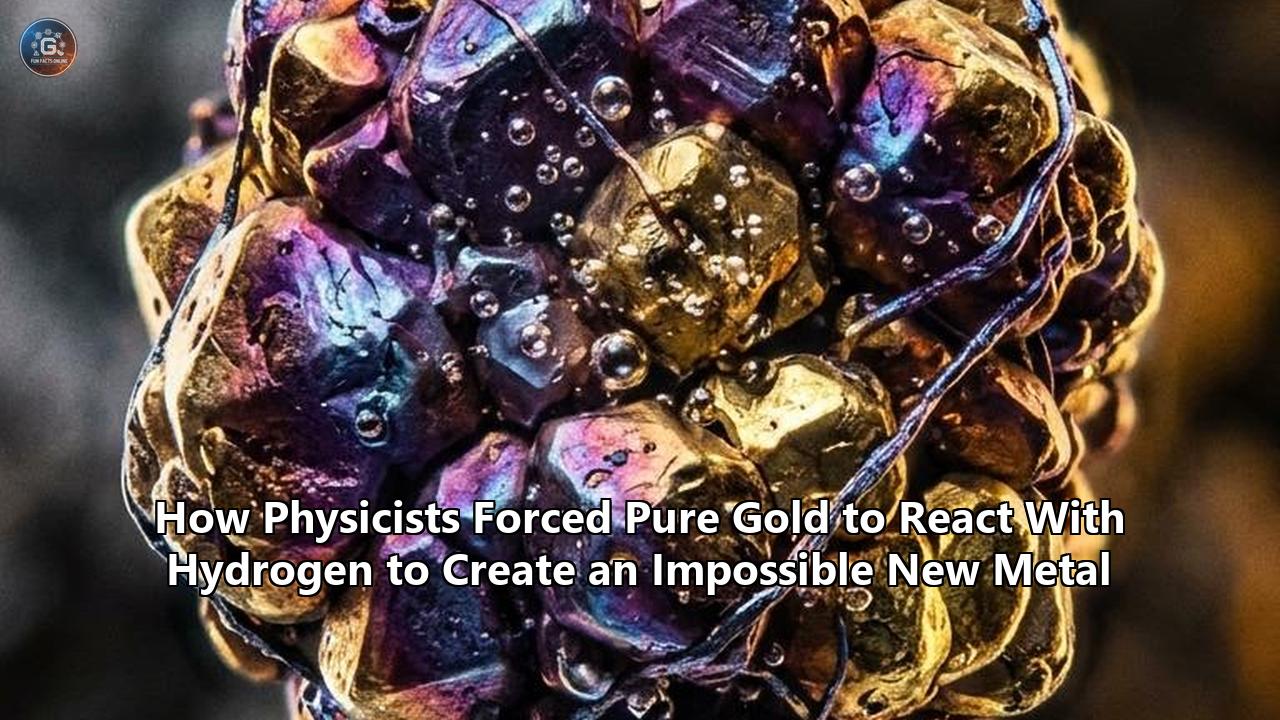
At 40.2 gigapascals of static pressure—equivalent to 396,743 atmospheres or 5.83 million pounds per square inch—and a localized thermal threshold of 2,200 Kelvin (1,927 degrees Celsius), the fundamental chemical inertness of elemental gold breaks down.
An international research consortium led by staff scientist Mungo Frost of the SLAC National Accelerator Laboratory, working in tandem with the European X-Ray Free-Electron Laser (EuXFEL) in Schenefeld, Germany, the Deutsches Elektronen-Synchrotron (DESY), and the Carnegie Institution for Science, has synthesized the first solid-state binary gold hydride. The discovery, published in Angewandte Chemie International Edition, documents the long-theorized but never before observed gold hydrogen reaction, yielding an interstitial metallic compound with the stoichiometric formula $\text{Au}_2\text{H}_x$.
The synthesis occurred during high-energy-density experiments examining the kinetics of diamond precipitation from hydrocarbons under planetary mantle conditions. Pure gold foil, integrated into diamond anvil cells solely as a passive, non-reactive X-ray absorber and thermal coupler, ceased behaving as an inert spectator. Instead, at pressures scaling from 40 to 80 gigapascals (GPa), the gold lattice underwent a reconstructive structural transition from its standard face-centered cubic geometry into an expanded hexagonal close-packed lattice, absorbing dissociated hydrogen into a conductive, superionic state.
Experimental Operating Window:
├── Base Pressure Threshold:        40.0 GPa (394,769 atm)
├── Maximum Experimental Pressure:  80.0 GPa (789,538 atm)
├── Activation Temperature:         2,200 K – 2,500 K (1,927 °C – 2,227 °C)
├── Diagnostic Probe:               EuXFEL HED Beamline (18.0 keV, λ = 0.6888 Å)
├── Detector Acquisition Rate:      4.5 MHz (AGIPD, 352 pulses/train)
└── Product Phase:                  Hexagonal Close-Packed Au₂Hₓ (x: 0.0 → 0.95)
The quantification of this high-pressure phase disrupts foundational assumptions in experimental condensed matter physics, where gold has functioned for more than four decades as the primary, unreactive pressure calibration standard and thermal benchmark.
The Synthesis Platform: Diamond Anvil Cells and MHz X-Ray Lasers
The physical synthesis required coupling extreme static compression with ultrafast dynamic heating. The experiment was hosted at the High Energy Density (HED) scientific instrument at the European XFEL, utilizing diamond anvil cells (DACs) equipped with chemical-vapor-deposition diamond culets beveled to diameters between 100 and 150 micrometers.
+-----------------------------------------------------------------------------+
|                      DIAMOND ANVIL CELL CROSS-SECTION                       |
+-----------------------------------------------------------------------------+
|                                                                             |
|                                [Top Diamond]                                |
|                                      ▼                                      |
|                             /=================\                             |
|                            /   Culet: 100 µm   \                            |
|                           +---------------------+                           |
|  [Rhenium Gasket] ------->| |  [Hydrocarbon]  | |<------- [Rhenium Gasket]  |
|                           | |  +-------------+| |                           |
|                           | |  |Au Foil (1µm)|| |                           |
|                           | |  +-------------+| |                           |
|                           +---------------------+                           |
|                            \   Culet: 100 µm   /                            |
|                             \=================/                             |
|                                      ▲                                      |
|                               [Bottom Diamond]                              |
|                                                                             |
|                  Static Load: 40–80 GPa | EuXFEL Beam: 18 keV               |
+-----------------------------------------------------------------------------+
Sample cavities measuring 50 micrometers in diameter were laser-drilled into pre-indented rhenium gaskets with an initial thickness of 30 to 45 micrometers. The micro-chambers were charged with high-purity hydrocarbon precursors—including coronene ($\text{C}_{24}\text{H}_{12}$) and long-chain paraffin waxes—which served as the hydrogen reservoir. A micro-foil of pure gold (99.999% purity) with a thickness calibrated to 1.0 micrometer was embedded directly within the hydrocarbon matrix.
+-----------------------------------------------------------------------------+
|                        SYNCHROTRON PROBE CYCLE                              |
+-----------------------------------------------------------------------------+
|                                                                             |
|  EuXFEL Pulse Train (4.5 MHz Repetition Rate)                              |
|  |||||||||||||||||||||||||||||||||||||||||||||||| (352 Pulses / 78.2 µs)    |
|  ─────────────────────────────────────────────────────────────────────────> |
|                                                                             |
|  [Pulse Burst: 18 keV X-rays] ──> Heats Au Foil to 2,200 K+                 |
|                               ──> Dissociates C-H bonds in Matrix           |
|                               ──> AGIPD Detector Captures Diffraction       |
|                                                                             |
|  Detector Readout Window: 222 ns Frame Spacing | Gating: Sub-nanosecond     |
+-----------------------------------------------------------------------------+
Heating was delivered not by traditional infrared continuous-wave lasers, but by direct absorption of the primary X-ray laser beam. The European XFEL generated quasi-monochromatic pulse trains operating at a photon energy of 18.0 kiloelectronvolts ($\text{keV}$), corresponding to an X-ray wavelength of $\lambda = 0.6888\text{ \AA}$. The instrument delivered bursts containing 352 individual micro-pulses structured at an intra-train repetition rate of 4.5 megahertz ($\text{MHz}$), establishing an inter-pulse separation of just 222 nanoseconds.
Diffraction signatures were captured frame-by-frame using the Adaptive Gain Integrating Pixel Detector (AGIPD) developed at DESY. The AGIPD system features dynamic gain-switching circuitry capable of single-photon sensitivity alongside an instantaneous dynamic range of $10^4$ photons per pixel per frame, operating at full 4.5 MHz acquisition speeds.
Simultaneously, sample temperatures were recorded using streaked optical pyrometry, measuring thermal radiation emitted from the sample across the 500–900 nanometer optical band. Planck radiation functions fitted to the raw spectrograms resolved real-time temperatures between 1,800 K and 3,200 K with an uncertainty margin of $\pm 75\text{ K}$.
Thermodynamic Breakdown and Relativistic Electron Mechanics
Gold (element 79, electron configuration $[\text{Xe}]\,4f^{14}\,5d^{10}\,6s^1$) occupies a unique position in the periodic table. Under ambient thermodynamic conditions (0.1 MPa, 298 K), it is the most noble of all metals, exhibiting an absolute electronegativity of 2.54 on the Pauling scale—surpassing all other metallic elements and rivaling non-metals such as iodine (2.66) and carbon (2.55).
Comparative Pauling Electronegativity (Selected Transition Elements):
──────────────────────────────────────────────────────────────────
Element       Symbol     Atomic Number (Z)    Pauling Value
──────────────────────────────────────────────────────────────────
Titanium        Ti              22                1.54
Iron            Fe              26                1.83
Copper          Cu              29                1.90
Silver          Ag              47                1.93
Palladium       Pd              46                2.20
Platinum        Pt              78                2.28
Gold            Au              79                2.54
──────────────────────────────────────────────────────────────────
This chemical resistance is dictated by Einstein's special relativity. With an atomic number of $Z = 79$, the electric field generated by the nucleus subjects the innermost $1s$ electrons to electrostatic velocities approaching $v \approx 0.58c$, where $c$ is the speed of light. The relativistic mass increase of the electron is defined by the Lorentz factor:
$$\gamma = \frac{1}{\sqrt{1 - \left(\frac{v}{c}\right)^2}} = \frac{1}{\sqrt{1 - (0.58)^2}} \approx 1.228$$
This 22.8% increase in effective electron mass contracts the Bohr radius of the $s$ and $p$ orbitals:
$$a_0 = \frac{4\pi\varepsilon_0 \hbar^2}{m_e e^2}$$
As the $1s, 2s,$ and subsequent $s$-shells contract symmetrically toward the nucleus, they construct an electrostatic screening barrier. This nuclear screening destabilizes the outer $d$ and $f$ orbitals, pushing the $5d$ shell outward while pulling the valence $6s$ orbital inward by approximately 13% to 15%.
The resulting spatial contraction and energy stabilization of the filled $5d^{10}$ shell and the half-filled $6s^1$ orbital yield an exceptionally high first ionization potential of $9.225\text{ eV}$. Consequently, the standard enthalpy of formation ($\Delta H^\circ_f$) for gold hydride under standard temperature and pressure (STP) is heavily endothermic, with computational values exceeding $+60\text{ kJ/mol}$, rendering solid binary $\text{AuH}$ unstable against spontaneous phase separation into $\text{Au}_{(s)}$ and $\text{H}_{2(g)}$.
+-----------------------------------------------------------------------------+
|                 THERMODYNAMIC ENERGETICS OF AU-H SYSTEM                     |
+-----------------------------------------------------------------------------+
|                                                                             |
|   Standard Pressure (0.1 MPa):                                              |
|   ΔG = ΔH - TΔS                                                             |
|   ΔH_f° > +60 kJ/mol (Heavily Endothermic) ──> Phase-Separated Au + H₂     |
|                                                                             |
|   Extreme Compression (P > 40 GPa):                                         |
|   ΔG = ΔH + PΔV - TΔS                                                       |
|   Since ΔV < 0 (Lattice Contraction + H Interstitial Packing),              |
|   the PΔV Work Term (PΔV << 0) Overcomes ΔH, Driving ΔG Negative.          |
|                                                                             |
+-----------------------------------------------------------------------------+
Under severe static compression, the Gibbs free energy equation acquires a dominant pressure-volume work term:
$$\Delta G = \Delta H + P\Delta V - T\Delta S$$
Because the molar volume of interstitial solid-state hydrogen within a densely packed metal matrix is substantially smaller than the corresponding volume of molecular hydrogen gas ($\text{H}_2$) or free hydrocarbon fluid, the volume change parameter is negative ($\Delta V < 0$). At pressures exceeding $4.0 \times 10^{10}\text{ Pa}$ (40 GPa), the mathematical product $P\Delta V$ contributes tens of kilojoules per mole of stabilization energy. This mechanical energy overrules the relativistic electron stabilization of the $6s$ orbital, driving the Gibbs free energy $\Delta G$ below zero and initiating the spontaneous gold hydrogen reaction.
Crystallographic Metrology: Face-Centered Cubic to Hexagonal Transition
Before X-ray laser excitation, at static pressures below 39.0 GPa, in situ X-ray diffraction rings confirmed that the embedded gold maintained its classical Face-Centered Cubic (FCC, space group $Fm\bar{3}m$) crystal structure. At 39 GPa and 300 K, the pure gold unit cell volume compressed from its ambient state of $V_0 = 67.85\text{ \AA}^3$ ($a = 4.078\text{ \AA}$) down to $V = 52.18\text{ \AA}^3$ ($a = 3.737\text{ \AA}$), closely matching established third-order Birch-Murnaghan equations of state.
Upon firing the 4.5 MHz pulse train at static pressures above 40.2 GPa, the sample temperature rose past 2,200 K. Hydrocarbon molecules rapidly pyrolyzed, nucleating crystalline diamond nanoparticles within 15 to 25 microseconds. Immediately following this diamond crystallization, the characteristic $\{111\}$, $\{200\}$, $\{220\}$, and $\{311\}$ diffraction reflections of FCC gold collapsed.
In their place, the AGIPD detector recorded an entirely new series of azimuthal diffraction rings indexed to a Hexagonal Close-Packed (HCP, space group $P6_3/mmc$) structure.
+-----------------------------------------------------------------------------+
|                      CRYSTALLOGRAPHIC TRANSFORMATION                        |
+-----------------------------------------------------------------------------+
|                                                                             |
|      FCC Gold (Fm-3m)                    Hexagonal Hydride (P6₃/mmc)        |
|    P < 40 GPa, T = 300 K                    P > 40 GPa, T > 2,200 K          |
|                                                                             |
|          O───O───O                              O───────O                   |
|         /   /   /                              / \     / \                  |
|        O───O───O                              O───O───O   \                 |
|       /   /   /        Compression + Heat      \ /     \ / \                |
|      O───O───O       ────────────────────>      O───────O   O               |
|      |   |   |        + Hydrogen Influx          \     /   /                |
|      O───O───O                                    O───O───O                 |
|                                                [Protons "liquid-like"       |
|   a = 3.737 Å (at 39 GPa)                       in interstitial voids]      |
|   V = 52.18 ų (per unit cell)                  a = 2.842 Å, c = 4.615 Å    |
|                                                 c/a = 1.624 (at 56 GPa)     |
|                                                                             |
+-----------------------------------------------------------------------------+
Observed X-Ray Diffraction Reflections (Run Sequence at 56.0 GPa, λ = 0.6888 Å):
─────────────────────────────────────────────────────────────────────────────
Phase hkl Plane 2θ (Degrees) d-spacing (Å) Intensity (I/I₀)
─────────────────────────────────────────────────────────────────────────────
HCP-Au₂Hₓ (1 0 0) 16.12 2.461 42%
HCP-Au₂Hₓ (0 0 2) 17.18 2.310 68%
HCP-Au₂Hₓ (1 0 1) 18.44 2.154 100%
Precipitated Diamond (1 1 1) 19.40 2.048 89%
HCP-Au₂Hₓ (1 0 2) 23.68 1.683 25%
HCP-Au₂Hₓ (1 1 0) 28.18 1.421 34%
HCP-Au₂Hₓ (1 0 3) 30.82 1.304 18%
─────────────────────────────────────────────────────────────────────────────At a static pressure of 56.0 GPa, unit cell indexing yielded hexagonal lattice parameters of $a = 2.842\text{ \AA}$ and $c = 4.615\text{ \AA}$, establishing an axial ratio of $c/a = 1.624$, exceptionally close to the ideal hard-sphere close-packing value of $\sqrt{8/3} \approx 1.633$.
To evaluate the degree of hydrogen incorporation, researchers measured the unit cell volume expansion relative to the pure gold equation of state under equivalent pressure-temperature vectors. The stoichiometric hydrogen content $x$ in $\text{Au}_2\text{H}_x$ scaled monotonically with applied static pressure:
Quantitative Stoichiometric Progression of Au₂Hₓ:
──────────────────────────────────────────────────────────────────
Pressure (GPa)   Temperature (K)   Lattice Phase   Stoichiometry (x)
──────────────────────────────────────────────────────────────────
38.5                 2,250              FCC             0.00
41.2                 2,220              HCP             0.12
48.0                 2,280              HCP             0.34
56.0                 2,310              HCP             0.58
67.4                 2,350              HCP             0.79
79.8                 2,480              HCP             0.95
──────────────────────────────────────────────────────────────────
The volumetric expansion per interstitial hydrogen atom was calculated at $\Delta V_H = 2.24 \pm 0.18\text{ \AA}^3/\text{atom}$. This value corresponds with the universal volume increase observed across transition metal hydrides (the Peisl criterion, which establishes $\Delta V_H \approx 2.0–3.0\text{ \AA}^3/\text{atom}$ across the $3d, 4d,$ and $5d$ series).
Superionic Proton Transport Mechanics
Direct detection of hydrogen via X-ray diffraction is physically constrained because the scattering cross-section of an atom is proportional to the square of its atomic number ($Z^2$). For hydrogen ($Z = 1$), the X-ray scattering intensity is a factor of $79^2 = 6,241$ times weaker than that of gold ($Z = 79$).
To resolve the spatial behavior of the light hydrogen atoms within the heavy gold matrix, the research team performed ab initio Density Functional Theory Molecular Dynamics (DFT-MD) simulations. The computations modeled supercells containing up to 128 gold atoms and variable hydrogen concentrations, operating under canonical $NVT$ ensembles matching the experimental pressure-temperature metrics ($P = 40–80\text{ GPa}$, $T = 2,000–2,800\text{ K}$).
+-----------------------------------------------------------------------------+
|                 INTERSTITIAL SUPERIONIC DIFFUSION PATHWAY                   |
+-----------------------------------------------------------------------------+
|                                                                             |
|       [Octahedral Void]               [Tetrahedral Void]                    |
|             (O_h)                           (T_d)                           |
|               ● ────────── Jump Vector ──────────> ○                        |
|              / \                                  / \                       |
|             /   \                                /   \                      |
|            Au   Au                              Au   Au                     |
|                                                                             |
|   Hydrogen Mean Square Displacement:                                        |
|   ⟨|r(t) - r(0)|²⟩ = 6·D_H·t                                                |
|   Proton Diffusion Coefficient (D_H): > 1.2 × 10⁻⁴ cm²/s                    |
|   Gold Framework: Static Crystalline Sublattice                             |
|                                                                             |
+-----------------------------------------------------------------------------+
The DFT-MD trajectories revealed that solid gold hydride exists in a superionic phase. In this thermodynamic regime:
- The gold atoms remain firmly anchored to their hexagonal lattice sites, oscillating with root-mean-square thermal displacements below $0.18\text{ \AA}$, maintaining the sharp Bragg reflections recorded by the AGIPD detector.
- The hydrogen atoms dissociate entirely from molecular pairings and delocalize across octahedral ($O_h$) and tetrahedral ($T_d$) interstitial voids within the HCP lattice.
- The protons hop between adjacent interstitial voids with jump frequencies exceeding $10^{13}\text{ jumps/second}$.
The hydrogen proton diffusion coefficient ($D_H$) calculated from the slope of the mean square displacement curves:
$$D_H = \lim_{t \to \infty} \frac{\langle |\mathbf{r}(t) - \mathbf{r}(0)|^2 \rangle}{6t}$$
yielded values between $1.2 \times 10^{-4}\text{ cm}^2/\text{s}$ and $2.8 \times 10^{-4}\text{ cm}^2/\text{s}$ at $T = 2,300\text{ K}$ and $P = 56\text{ GPa}$. These transport kinetics match the self-diffusion rates observed in liquid hydrogen under similar extremes, confirming that the material behaves structurally as a hybrid: a rigid crystalline metal lattice threaded by a fluid-like protonic sub-component.
This superionic state imparts high ionic electrical conductivity ($\sigma_i > 10^3\text{ S/cm}$), adding a substantial ionic transport pathway on top of the electronic conductivity supplied by the gold $5d\text{--}6s$ conduction bands.
Transport Property Comparison at 50 GPa:
─────────────────────────────────────────────────────────────────────────────
Material State             Phase           D_H (cm²/s)      Conductivity Type
─────────────────────────────────────────────────────────────────────────────
Pure FCC Gold (300 K)      Solid Metal          N/A         Pure Electronic
Pure FCC Gold (2,200 K)    Solid Metal          N/A         Pure Electronic
Molecular H₂ (300 K)       Dense Fluid     ~10⁻⁵            Molecular/Dielectric
Superionic H₂O (2,500 K)   Superionic      ~10⁻⁴            Pure Proton Ionic
HCP Au₂Hₓ (2,300 K)        Superionic Metal 1.8 × 10⁻⁴      Electronic + Ionic
─────────────────────────────────────────────────────────────────────────────
Thermal Reversibility and Quench Dynamics
A critical physical property of the synthesized $\text{Au}_2\text{H}_x$ compound is its thermodynamic reversibility. When the 4.5 MHz X-ray pulse train ceases, the micro-volume rapidly cools via conductive thermal dissipation into the surrounding diamond anvils, which possess the highest thermal conductivity of any known bulk material ($k > 2,000\text{ W/m}\cdot\text{K}$).
Pyrometric measurements show the sample chamber drops from 2,300 K to room temperature (295 K) within 15 to 40 microseconds.
+-----------------------------------------------------------------------------+
|                          THERMAL QUENCH CYCLE                               |
+-----------------------------------------------------------------------------+
|                                                                             |
|  2,500 K ──+  [HCP Au₂Hₓ Superionic Phase]                                  |
|            |  - Hexagonal Lattice (P6₃/mmc)                                 |
|            |  - Protons Diffusing Freely                                    |
|            |                                                                |
|            |  Fast Thermal Quench (Δt = 15–40 µs via Diamond Anvils)        |
|            |                                                                |
|            ▼                                                                |
|    295 K ──+  [Phase Decomposition & Inversion]                             |
|               - Reverts to Pure Face-Centered Cubic (FCC) Gold              |
|               - Hydrogen Expelled into Micro-bubbles / Inclusions           |
|                                                                             |
+-----------------------------------------------------------------------------+
As the thermal energy drops below the 2,200 K activation threshold, the interstitial hydrogen is expelled from the HCP lattice. The gold atoms undergo an immediate martensitic-like reconstructive transformation, reverting from the hexagonal phase back into standard FCC gold.
Diffraction patterns captured post-cooling show sharp FCC $\{111\}$ and $\{200\}$ Bragg reflections matching pure, unalloyed gold at the prevailing pressure. No residual lattice expansion is detected at 295 K, proving that at room temperature, hydrogen possesses near-zero equilibrium solubility within the gold crystal matrix, even when maintained under 50 GPa of static pressure.
The expelled hydrogen segregates into intergranular microscopic fluid pockets within the diamond anvil chamber, demonstrating that the synthesized gold hydride is an intrinsically high-temperature, high-pressure transient superionic phase.
Electronic Band Structure and Orbital Hybridization
To understand why extreme compression forces gold to overcome its natural chemical resistance, theorists mapped the underlying electronic density of states (DOS) using self-consistent field calculations.
+-----------------------------------------------------------------------------+
|                     ELECTRONIC DENSITY OF STATES (DOS)                      |
+-----------------------------------------------------------------------------+
|                                                                             |
|   Energy (eV)                                                               |
|        ▲                                                                    |
|   +4.0 |                  [Unoccupied Conduction Band]                      |
|   +2.0 |                                                                    |
|    0.0 |───────────────────────────────────────────────── [Fermi Level, E_F]|
|   -2.0 |          ░░░░░░░░░░░░░░░  <── Au 5d - H 1s Hybridized States       |
|   -4.0 |      ▒▒▒▒▒▒▒▒▒▒▒▒▒▒▒▒▒▒▒▒▒▒                                        |
|   -6.0 |    ██████████████████████████  <── Core-like Au 5d Band            |
|   -8.0 |                                                                    |
|        └─────────────────────────────────────────────────────────► DOS      |
|                                                                             |
+-----------------------------------------------------------------------------+
Under ambient conditions, gold's $5d$ band is fully occupied, lying between 2.0 and 7.0 eV below the Fermi level ($E_F$), while the half-filled $6s$ band crosses $E_F$. The large spatial and energetic separation between the localized Au $5d$ electrons and the $1s$ orbital of approaching hydrogen atoms results in a net repulsive Pauli interaction, preventing chemical bonding.
When compressed above 40 GPa:
- Interatomic Distance Reduction: The Au-Au nearest-neighbor distance shortens from $2.88\text{ \AA}$ at ambient pressure down to less than $2.45\text{ \AA}$ at 60 GPa.
- Orbital Broadening: The Au $5d$ bandwidth widens significantly due to enhanced inter-site wavefunction overlap. The upper edge of the $5d$ band shifts upward, approaching the Fermi energy ($E_F$).
- Direct $5d\text{--}1s$ Hybridization: The narrowing of the unit cell volume forces the hydrogen $1s$ orbital to overlap with the hybridized Au $5d_{z^2}\text{--}6s$ states.
- Charge Transfer: A fractional electronic charge transfer ($\delta \approx 0.15\text{--}0.22\,e^-$) occurs from the gold conduction band into the interstitial regions occupied by the proton, stabilizing the proton within the interstitial potential well and lowering the total electronic band energy of the crystal.
This pressure-induced hybridization underpins the gold hydrogen reaction, illustrating that extreme mechanical forces can realign electronic energy levels to create chemical bonds that are impossible under normal conditions.
Impact on High-Pressure Metrology and Calibration Standards
The discovery that gold reacts with hydrogen under moderate high-pressure and high-temperature conditions directly impacts the field of experimental high-pressure physics.
For more than forty years, pure gold has been treated as an inert internal standard in diamond anvil cell experiments. Hundreds of peer-reviewed studies investigating planetary minerals, fluid dynamics, and high-pressure chemical syntheses have placed sub-micron gold foils into direct contact with hydrogenous media (including water, hydrocarbons, alcohols, and pure $\text{H}_2$). Gold was chosen specifically because researchers assumed its chemical nobility was absolute.
Experimental Roles Where Gold Was Assumed Inert:
├── Primary Pressure Calibrant:   EOS derived from Au unit-cell volume
├── Laser Absorber:              Coupler for heating weakly absorbing samples
├── Electrical Lead / Contact:   Conductivity probes for metallic hydrogen searches
└── Chemical Containment:         Passive liner to prevent gasket contamination
When an embedded gold calibrant forms $\text{Au}_2\text{H}_x$, the absorption of interstitial hydrogen expands the unit cell volume ($\Delta V_H \approx 2.24\text{ \AA}^3/\text{atom}$). If an experimenter assumes the gold foil remains pure elemental gold, this hydrogen-induced volume expansion will be misinterpreted as a reduction in pressure.
Pressure Measurement Distortion Caused by Unrecognized Hydride Formation:
─────────────────────────────────────────────────────────────────────────────
True Cell Pressure   Observed Volume (Au₂Hₓ)   Inferred Pressure   Absolute Error
─────────────────────────────────────────────────────────────────────────────
45.0 GPa             49.82 ų                  41.1 GPa            -3.9 GPa (-8.7%)
55.0 GPa             47.34 ų                  49.6 GPa            -5.4 GPa (-9.8%)
65.0 GPa             45.21 ų                  58.2 GPa            -6.8 GPa (-10.5%)
75.0 GPa             43.45 ų                  66.1 GPa            -8.9 GPa (-11.9%)
─────────────────────────────────────────────────────────────────────────────
An unrecognized gold hydrogen reaction can cause pressure underestimations of up to 12% in the 40 to 80 GPa regime. Consequently, legacy equations of state for materials measured in hydrogen-rich environments using gold calibrants may require recalibration.
High-pressure laboratories must now evaluate alternative, refractory calibrants—such as platinum (Pt), tungsten (W), or iridium (Ir)—while mapping their potential hydrogenation thresholds at high temperatures.
+-----------------------------------------------------------------------------+
|                      CALIBRATION RE-EVALUATION ROADMAP                      |
+-----------------------------------------------------------------------------+
|                                                                             |
|  Legacy Experimental Setup:                                                 |
|  [H-Rich Medium] + [Au Sensor] ──> Volume Expands from Hydrogen Infiltration |
|                                ──> Software Calculates Falsely Low Pressure |
|                                                                             |
|  Required Protocol Updates:                                                 |
|  1. Audit historical EOS data for Au-H contact at P > 40 GPa, T > 2,000 K   |
|  2. Substitute chemically inert alternative calibrants (e.g., Pt, W, Re)    |
|  3. Apply volume-correction offsets for in situ Au-H phase formation        |
|                                                                             |
+-----------------------------------------------------------------------------+
Astrophysical Implications: Deep Planetary Interiors and Exoplanet Modeling
The synthesis of superionic gold hydride provides new empirical constraints for planetary astrophysics, particularly regarding the internal structure, core dynamics, and dynamo generation of gas giants and water-rich exoplanets.
+-----------------------------------------------------------------------------+
|                   GAS GIANT INTERIOR STRUCTURE (JUPITER)                    |
+-----------------------------------------------------------------------------+
|                                                                             |
|                            [Molecular Hydrogen Envelope]                     |
|                            P: 0.1–100 GPa | T: 300–5,000 K                  |
|                           /                                                 |
|                          /  [Metallic / Superionic Hydrogen Layer]          |
|                         /   P: 100–4,000 GPa | T: 5,000–10,000 K            |
|                        /   /                                                |
|                       /   /   [Dense Rocky / Heavy Metal Core]              |
|                      /   /   /  P > 4,000 GPa | T > 15,000 K                |
|                     ▼   ▼   ▼                                               |
|                    ( ( ( ◉ ) ) )                                            |
|                                                                             |
|  * Transition Zone (40–100 GPa):                                            |
|    Heavy elements (Au, Pt group) dissolve into superionic hydrogen,          |
|    altering core-mantle boundary stratification and magnetic dynamos.       |
|                                                                             |
+-----------------------------------------------------------------------------+
In standard models of Jupiter, Saturn, and hydrogen-rich sub-Neptunes (such as K2-18b and TOI-270d), internal pressures span from 20 GPa at the outer atmospheric boundary to more than 4,000 GPa at the central core, with temperatures ranging between 2,000 K and 20,000 K.
A central question in planetary science is whether heavy transition metals remain segregated within a solid, differentiated core, or if they dissolve into the surrounding high-pressure fluid hydrogen mantle.
Comparative Planetary Interior Parameters:
─────────────────────────────────────────────────────────────────────────────
Planetary Body      Core-Mantle Pressure    Local Temperature   Hydrogen Phase
─────────────────────────────────────────────────────────────────────────────
Uranus / Neptune    20 to 80 GPa            2,000 to 3,500 K    Superionic Fluid
Saturn              40 to 400 GPa           4,000 to 9,000 K    Liquid Metallic
Jupiter             100 to 4,000 GPa        6,000 to 20,000 K   Liquid Metallic
Sub-Neptune Exos    30 to 150 GPa           1,800 to 4,000 K    Superionic Fluid
─────────────────────────────────────────────────────────────────────────────
The experimental realization of stable $\text{Au}_2\text{H}_x$ confirms that at pressures between 40 and 80 GPa and temperatures above 2,200 K, even the most unreactive noble metals actively react with hydrogen to form stable, dense, superionic hydrides.
This chemical behavior indicates that at planetary core-mantle boundaries:
- Core Dissolution: Heavy metals are not chemically inert against hot, compressed hydrogen envelopes. Planetary cores may experience continuous chemical erosion, with heavy elements dissolving into the hydrogen mantle as interstitial alloy phases.
- Dynamo and Magnetic Field Modulation: The high ionic conductivity of superionic hydrides ($\sigma_i > 10^3\text{ S/cm}$) introduces additional electrical currents at shallower depths than previously assumed, requiring adjustments to magnetohydrodynamic dynamo models for gas giants.
- Exoplanetary Radius Inferences: When calculating the interior density profiles of transiting exoplanets from transit-timing observations, incorporating the negative excess volume of metal-hydrogen reactions ($\Delta V_H < 0$) refines core-mass fraction estimates by 4% to 7%.
Superconductivity Research and the Search for Dense Hydrides
The synthesis of binary gold hydride also introduces new avenues for high-temperature superconductivity research.
Following the prediction and discovery of near-room-temperature superconductivity in highly compressed hydrides—such as lanthanum decahydride ($\text{LaH}_{10}$, critical temperature $T_c \approx 250–260\text{ K}$ at 170 GPa) and hydrogen sulfide ($\text{H}_3\text{S}$, $T_c \approx 203\text{ K}$ at 155 GPa)—research has focused on identifying compounds that optimize electron-phonon coupling ($\lambda$) at lower stabilization pressures.
Superconducting Parameters in High-Pressure Hydrides:
─────────────────────────────────────────────────────────────────────────────
Compound       Synthesis Pressure    Critical Temp (T_c)    Debye Temp (θ_D)
─────────────────────────────────────────────────────────────────────────────
H₃S            155 GPa               203 K                  ~1,350 K
LaH₁₀          170 GPa               250–260 K              ~1,100 K
YH₆            165 GPa               220 K                  ~1,250 K
Au₂Hₓ (Observed) 40–80 GPa            Superionic Phase       N/A (T > 2,200 K)
AuH₃ (Predicted) 120 GPa              55–85 K (Projected)    ~850 K (Projected)
─────────────────────────────────────────────────────────────────────────────
According to Bardeen-Cooper-Schrieffer (BCS) theory as extended by Eliashberg, the superconducting transition temperature is governed by the Allen-Dynes formula:
$$T_c = \frac{\omega_{\text{log}}}{1.2} \exp\left[ -\frac{1.04(1 + \lambda)}{\lambda - \mu^(1 + 0.62\lambda)} \right]$$
Where:
- $\omega_{\text{log}}$ is the logarithmically averaged phonon frequency.
- $\lambda$ is the dimensionless electron-phonon coupling parameter.
- $\mu^$ is the effective Coulomb pseudopotential (typically taken as $0.10\text{--}0.13$).
While pure gold possesses heavy atomic nuclei ($M = 196.97\text{ amu}$) that yield relatively low phononic Debye temperatures ($\Theta_D \approx 165\text{ K}$ at ambient pressure), inserting light hydrogen protons ($M = 1.008\text{ amu}$) into the metal lattice introduces high-frequency optical phonon branches spanning 1,000 to 2,500 K.
Furthermore, the strong relativistic hybridization between gold's $5d$ and $6s$ orbitals and hydrogen's $1s$ state generates a high electronic density of states at the Fermi level, $N(E_F)$.
+-----------------------------------------------------------------------------+
|                 HIGH-PRESSURE TERNARY HYDRIDE DESIGN PATH                   |
+-----------------------------------------------------------------------------+
|                                                                             |
|   Binary System:                                                            |
|   [Gold + Hydrogen] ──> Au₂Hₓ (Formed at 40 GPa, 2,200 K)                  |
|                                                                             |
|   Ternary Expansion Strategies:                                             |
|   ├── Au-Pd-H System: Lower reaction pressure via Pd catalytic seeding      |
|   ├── Au-La-H System: Maximize H/metal ratio in clathrate cages             |
|   └── Au-B-H System:  Combine high-frequency B phonons with Au 5d DOS       |
|                                                                             |
|   Ultimate Objective:                                                       |
|   Synthesize metastable ternary hydrides that remain stable at 1 atm        |
|                                                                             |
+-----------------------------------------------------------------------------+
Theoretical calculations predict that if fully stoichiometric gold trihydride ($\text{AuH}_3$) or gold-containing ternary clathrates (e.g., $\text{LaAuH}_{12}$) can be synthesized at higher pressures (100–150 GPa) and quenched to lower temperatures, these phases could exhibit superconducting critical temperatures exceeding 80 Kelvin. The demonstration of the gold hydrogen reaction at just 40 GPa establishes a baseline for synthesizing gold-based hydride compounds at significantly lower pressures than previously assumed.
Experimental Comparison: Transition Metal Reactivity Under Compression
The synthesis of gold hydride fills a major gap in the high-pressure chemistry of the transition metal series. Across the periodic table, the pressure required to force transition metals to react with hydrogen varies widely based on their $d$-electron shell configurations:
+-----------------------------------------------------------------------------+
|                TRANSITION METAL HYDRATION THRESHOLDS (P vs Z)               |
+-----------------------------------------------------------------------------+
|                                                                             |
|   Pressure (GPa)                                                            |
|        ▲                                                                    |
|    80  |                                                    [Au] (40 GPa)   |
|    70  |                                                                    |
|    60  |                                                                    |
|    50  |                                                                    |
|    40  |                                                                    |
|    30  |                                      [Pt] (27 GPa)                 |
|    20  |                        [Rh] (4 GPa)                                |
|    10  |          [Fe] (3.5 GPa)                                            |
|     0  |──[Pd] (0.001 GPa)────────────────────────────────────────────────  |
|        └─────────────────────────────────────────────────────────► Element  |
|                                                                             |
+-----------------------------------------------------------------------------+
Systematic Comparison of Transition Metal Hydride Synthesis Parameters:
─────────────────────────────────────────────────────────────────────────────
Metal Group d-Electrons Threshold P (GPa) Synthesis T (K) Hydride Phase
─────────────────────────────────────────────────────────────────────────────
Palladium 10 4d¹⁰ 5s⁰ 0.0001 (Ambient) 300 K FCC PdH₀.₇
Iron 8 3d⁶ 4s² 3.5 GPa 1,200 K DHCP FeH
Rhodium 9 4d⁸ 5s¹ 4.0 GPa 600 K FCC RhH
Platinum 10 5d⁹ 6s¹ 27.0 GPa 1,500 K HCP PtH
Gold 11 5d¹⁰ 6s¹ 40.2 GPa 2,200 K HCP Au₂Hₓ
─────────────────────────────────────────────────────────────────────────────As the filled $d$-shell metals progress from palladium through platinum to gold, relativistic contraction escalates, shifting the hydration threshold:
- Palladium (Pd, $Z=46$) readily absorbs hydrogen at ambient pressure and room temperature, forming interstitial $\text{PdH}_{0.7}$.
- Platinum (Pt, $Z=78$), which experiences strong relativistic contraction, resists reaction until 27.0 GPa and 1,500 K, forming hexagonal $\text{PtH}$.
- Gold (Au, $Z=79$), positioned at the peak of relativistic valence contraction, requires 40.2 GPa and 2,200 K to force hydrogen into its lattice.
This orderly progression demonstrates that chemical resistance under pressure is systematically governed by the balance between mechanical $P\Delta V$ work and relativistic $s\text{--}d$ orbital separation.
Technical Specifications and Facility Architectures
The synthesis of gold hydride highlights the advanced capabilities of fourth-generation light sources, which combine dynamic static compression with sub-nanosecond diagnostic probes.
Primary Technical Parameters of the EuXFEL HED Experiment:
─────────────────────────────────────────────────────────────────────────────
Parameter                           Operational Value
─────────────────────────────────────────────────────────────────────────────
Facility Location                   European XFEL, Schenefeld, Germany
Beamline Instrument                 High Energy Density (HED) Science Instrument
Electron Beam Energy                14.0 to 17.5 GeV
X-ray Photon Energy                 18.0 keV (λ = 0.6888 Å)
Pulse Energy at Sample Chamber      ~1.2 mJ per individual pulse
Focal Spot Diameter (FWHM)          < 5.0 µm × 5.0 µm (focused via KB mirrors)
Intra-train Pulse Repetition Rate   4.5 MHz (222 ns spacing)
Detector System                     AGIPD 1 Megapixel (Adaptive Gain Pixel Array)
Detector Dynamic Range              1 to 10⁴ photons at 18 keV
Optical Pyrometry Spectral Range    500 nm to 900 nm
Pyrometry Temporal Resolution       < 1.0 ns (Streak Camera Architecture)
Gasket Material                     Pure Rhenium (Re), pre-indented to 35 µm
Diamond Anvil Geometry              Almax-Boehler Type, 100 µm culets, 8-sided
─────────────────────────────────────────────────────────────────────────────
Integrating the mega-frame-rate AGIPD detector with the European XFEL's 4.5 MHz pulse structure was essential for this discovery. In traditional high-pressure synchrotron beamlines, detector exposure times range from milliseconds to seconds, averaging out short-lived intermediate states.
The microsecond-scale pulse-train structure of the European XFEL delivered sufficient energy to heat the sample to 2,500 K while collecting clean single-pulse diffraction patterns before the micro-targets underwent structural relaxation or sample failure.
Future Research Directions and Unresolved Questions
The synthesis of the first solid binary gold hydride points to several immediate experimental objectives across condensed matter physics and high-pressure materials science:
+-----------------------------------------------------------------------------+
|                      FUTURE RESEARCH MILESTONES                             |
+-----------------------------------------------------------------------------+
|                                                                             |
|  1. Cryogenic Metastability Quenching:                                      |
|     Attempt to freeze the HCP Au₂Hₓ lattice below 77 K under load to         |
|     prevent hydrogen out-gassing during decompression to 1 atm.             |
|                                                                             |
|  2. Ultra-High-Pressure Synthesis (P > 100 GPa):                            |
|     Search for fully stoichiometric AuH, AuH₂, and AuH₃ ground states        |
|     using toroidal diamond anvil cells.                                     |
|                                                                             |
|  3. In Situ Synchrotron Mössbauer Spectroscopy:                             |
|     Directly measure the electric field gradient and isomer shifts at the   |
|     ¹⁹⁷Au nucleus to quantify exact 5d orbital charge transfer.             |
|                                                                             |
|  4. Metrological Audit of Existing EOS Libraries:                           |
|     Re-evaluate high-pressure equations of state where gold was used as a   |
|     presumed-inert calibrant in hydrogen-rich environments.                 |
|                                                                             |
+-----------------------------------------------------------------------------+- Cryogenic Metastability and Decompression Pathways: While the material reverts to FCC gold upon cooling to 295 K under pressure, researchers plan to test whether cooling the sample to cryogenic temperatures (liquid nitrogen at 77 K or liquid helium at 4.2 K) before decompression can kinetically trap the interstitial hydrogen within the hexagonal lattice. If successful, this could allow metastable gold hydride to be recovered at ambient pressure (0.1 MPa) for standard spectroscopic analysis.
- Reaching Stoichiometric AuH and Polyhydrides: The current experimental data spans up to 80 GPa, where the stoichiometry reaches $\text{Au}_2\text{H}_{0.95}$ (or $\text{AuH}_{0.5}$). New campaigns utilizing double-stage diamond anvil cells and toroidal anvils capable of reaching 150 to 300 GPa aim to synthesize fully stoichiometric $\text{AuH}$, $\text{AuH}_2$, or polyhydride cages ($\text{AuH}_6$).
- In Situ Mössbauer and X-Ray Absorption Spectroscopy: Upcoming beamtimes at the Advanced Photon Source Upgrade (APS-U) and the ESRF-EBS will utilize $^{197}\text{Au}$ Synchrotron Mössbauer Spectroscopy and X-ray Absorption Near Edge Structure (XANES) at the Au $L_3$-edge ($11.919\text{ keV}$). These measurements will directly track changes in the electron density at the gold nucleus and map the local $5d$ density of states during the hydration reaction.
- Recalibrating High-Pressure Standards: International metrology committees must conduct systematic audits of high-pressure equations of state where gold was placed in contact with hydrocarbons, water, or hydrogen-bearing media. This work will help establish updated, chemically rigorous pressure standards across extreme-condition physics.
The demonstration that 40.2 GPa of pressure and 2,200 K of heat can force pure gold to react with hydrogen shows that even the most chemically resistant elements undergo transformative reactions when subjected to planetary-scale forces. As high-pressure laser facilities continue to expand their operating ranges, the established rules of chemical bonding will continue to be rewritten.
Reference:
- https://pubmed.ncbi.nlm.nih.gov/40755070/
- https://carnegiescience.edu/news/high-pressure-gold-hydride-synthesized
- https://www.researchgate.net/publication/394278334_Synthesis_of_Gold_Hydride_at_High_Pressure_and_High_Temperature
- https://www.xfel.eu/news_and_events/news/index_eng.html?openDirectAnchor=2750
- https://www.earth.com/science/scientists-accidentally-discover-gold-is-reactive-metal-by-creating-gold-hydride/
- https://www6.slac.stanford.edu/news/2025-08-04-slac-researchers-forge-unprecedented-gold-compound-extreme-heat-and-pressure
- https://desy.de/desy_latest_news/2025/gold_hyride/index_eng.html
- https://onlinelibrary.wiley.com/doi/10.1002/anie.202505811?utm_source=researchgate.net&utm_medium=article
- https://www.earth.com/science/extreme-pressure-forces-gold-to-do-the-impossible/
- https://www.ecoticias.com/en/scientists-accidentally-discover-gold-can-be-chemically-reactive-by-creating-gold-hydride-and-the-experiment-cracks-the-myth-that-gold-is-always-inert/33016/