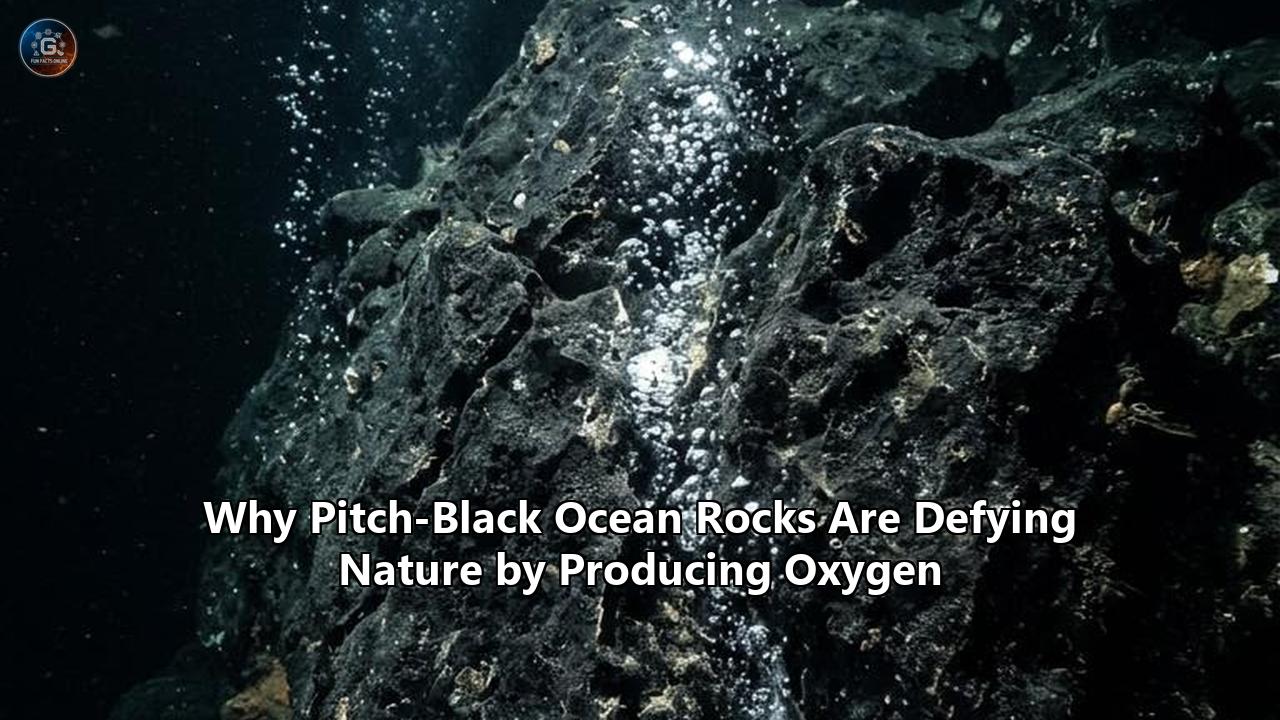
ABYSSAL PACIFIC OCEAN — Four thousand meters beneath the sunlit surface of the Central Pacific, in an ink-black expanse where pressures exceed 400 atmospheres and temperatures hover near freezing, an observation that directly contradicts fundamental tenets of biology and geochemistry has sparked an intense scientific and regulatory conflict.
For more than two centuries, biological science operated under a bedrock assumption: the production of molecular oxygen on Earth requires sunlight. Whether accomplished by surface phytoplankton, ancient cyanobacteria, or terrestrial rainforests, oxygen generation was thought to be inextricably bound to chlorophyll-driven photosynthesis.
That principle fractured when an international research team led by Professor Andrew Sweetman of the Scottish Association for Marine Science (SAMS) and Professor Franz Geiger of Northwestern University confirmed that potato-sized metallic rocks carpeting the abyssal seafloor are producing continuous streams of oxygen in pitch darkness. The phenomenon, detailed in a landmark study published in Nature Geoscience, reveals that polymetallic nodules resting across the Clarion-Clipperton Zone (CCZ) act as natural "geobatteries". Through internal electrical charges, these formations split ambient seawater into hydrogen and oxygen via abiotic electrochemical electrolysis.
The discovery has sent reverberations far beyond academic geology. It arrived at the exact moment multinational mining consortia, sponsored by small island nations and heavily capitalized by venture investors, reached the brink of commercializing deep-sea mining across the international seabed. The nodules that generate this oxygen contain the planet's densest deposits of nickel, cobalt, copper, and manganese—minerals critical for high-capacity electric vehicle batteries, wind turbines, and energy grid storage systems.
Now, the scientific discovery has catalyzed an international dispute spanning the conference halls of the United Nations to the deep waters of the equatorial Pacific. Conservation biologists and a bloc of more than 30 nations are leveraging the findings at the International Seabed Authority (ISA) in Kingston, Jamaica, demanding an immediate moratorium on seafloor extraction. Simultaneously, mining executives and industry-aligned researchers have launched aggressive scientific counter-offensives, labeling the findings thermodynamically impossible and claiming the readings stem from equipment flaws or trapped surface air.
As research teams deploy newly financed robotic expeditions to verify the geochemical process, the scientific community faces an existential question: has humanity stumbled upon a previously unrecognized source of planetary oxygen, or are the bedrock laws of marine biogeochemistry being misinterpreted on the precipice of an industrial frontier?
The Anomaly That Refused to Die: A Decade of Disbelieved Data
The story of how modern oceanography stumbled into this mystery began not as a search for alternative oxygen, but as a routine environmental baseline survey. In 2013, Andrew Sweetman was working aboard research vessels in the Clarion-Clipperton Zone, an oceanic fracture zone spanning roughly 4.5 million square kilometers between Hawaii and Mexico. His task was assessing the benthic respiration of abyssal sediment—measuring how quickly deep-sea life consumes dissolved oxygen.
To measure abyssal metabolism, oceanographers rely on benthic flux chambers deployed via modular titanium landers. Weighted with ballast, these autonomous landers free-fall four kilometers through the water column until they settle onto the abyssal silt. The lander drives cylindrical incubation chambers into the seabed, isolating a discrete volume of sediment and overlying seawater. Highly sensitive optical oxygen sensors, known as optodes, then track the concentration of dissolved oxygen inside the sealed chamber over a multi-day incubation period.
Under every established model of marine ecology, the oxygen reading inside a sealed benthic chamber must decrease. In the deep abyss, where no plant life can survive, biological activity is exclusively catabolic: bacteria, nematodes, and meiofauna consume organic debris filtering down from the photic zone, burning oxygen in the process.
Instead, Sweetman watched the digital readouts move steadily in the opposite direction. Rather than ticking down from ambient concentrations of approximately 150 micromoles per liter, dissolved oxygen inside the CCZ benthic chambers climbed upward, hour after hour.
"When we first got this data, we thought the sensors were faulty because every study ever done in the deep sea has only seen oxygen being consumed rather than produced," Sweetman stated following the publication of his findings. "We would come home and recalibrate the sensors, but, over the course of ten years, these strange oxygen readings kept showing up."
Sweetman’s initial reaction was disbelief. He instructed technicians and graduate students to discard the anomalous sensors, assuming they had succumbed to the immense physical stress of abyssal hydrostatic pressure, which exceeds 6,000 pounds per square inch. The sensors were sent back to their manufacturers in Germany and Scotland for diagnostic testing and recalibration four separate times. Each time, the factory returned the instruments certified as fully functional, with factory errors well below the scale of the observed oxygen spikes.
During subsequent expeditions to the CCZ in 2021 and 2022, Sweetman’s scientific team expanded their experimental protocols. To eliminate the possibility of optical sensor drift or chemical interference on the optode membranes, they introduced wet-chemical Winkler titrations—the definitive analytical gold standard for dissolved oxygen determination devised in 1888. The team extracted physical water samples drawn automatically from inside the chambers at intervals across 47-hour incubation periods.
The Winkler titrations corroborated the digital sensors. Over thousands of square kilometers of abyssal seafloor, sealed lander chambers resting on dense beds of nodules recorded oxygen production rates ranging from 1.7 to 18 millimoles of oxygen per square meter per day. In some chambers, dissolved oxygen concentrations surged to more than triple baseline values. Crucially, when the team deployed control chambers over abyssal sediment where polymetallic nodules were absent, oxygen levels behaved entirely normally: they fell as microbes steadily consumed the gas.
The phenomenon was real, localized, and directly tied to the presence of the metallic rocks resting upon the oceanic sediment.
Cracking the Geobattery: How Deep-Sea Rocks Split Seawater
Once Sweetman established that the oxygen increases were empirical facts rather than sensor artifacts, the mystery turned to mechanism. How could an inert chunk of mineral matter, sitting in lightless water at 2 degrees Celsius, continuously manufacture molecular oxygen without an external power cord?
In the summer of 2023, Sweetman contacted Professor Franz Geiger, an electrochemist at Northwestern University whose research group specializes in charge transport and electrical phenomena at mineral-water interfaces. In previous work, Geiger’s laboratory had demonstrated that extremely thin layers of oxidized metal could generate electrical voltages when exposed to saline fluid flow. Sweetman shipped kilograms of CCZ nodules directly to Geiger’s lab in Evanston, Illinois.
Polymetallic nodules are among the slowest-growing geological structures on Earth. Precipitating out of seawater (hydrogenous accretion) and sediment porewater (diagenetic accretion) atom by atom, they grow around a nucleus—such as a fossilized shark tooth, a whale bone fragment, or a piece of volcanic basalt—at an average rate of 1 to 10 millimeters every million years. Over millions of years, they consolidate into concentric, micro-laminated layers composed primarily of manganese oxides and iron oxyhydroxides, intercalated with elevated concentrations of nickel, cobalt, copper, molybdenum, and lithium.
Geiger's team began examining the electrical properties across the surfaces and cross-sections of the nodules. What they uncovered was an abiotic "geobattery".
Abyssal Electrolysis Mechanism:
[ Deep-Sea Geobattery ]
      |
      |-- Surface Potentials: up to 0.95 Volts per nodule
      |-- Inter-nodule series connections exceed 1.5-Volt electrolysis threshold
      |
      V
[ Electrochemical Water Splitting ]
  2 H2O  ===>  O2 (gas) + 4 H+ + 4 e-
In industrial chemistry, producing oxygen from water requires electrolysis: driving an electric current through water to strip electrons from oxygen atoms. The thermodynamic minimum electrical potential required to split water ($2\text{H}_2\text{O} \rightarrow \text{O}_2 + 4\text{H}^+ + 4e^-$) under standard conditions is 1.23 volts. When kinetic overpotentials and the high electrical resistance of seawater are factored in, standard industrial water electrolysis requires roughly 1.5 volts—the precise voltage of a household AA alkaline battery.
When Geiger’s team placed micro-electrodes onto pristine nodules submerged in electrolyte baths, they recorded surface potentials as high as 0.95 volts across individual specimens.
The voltage originates from the internal structural and chemical heterogeneity of the nodules. Because nodules form through fluctuating environmental conditions over millions of years, the layers within them contain varying oxidation states of manganese (such as $\text{Mn}^{4+}$, $\text{Mn}^{3+}$, and $\text{Mn}^{2+}$) juxtaposed against iron, cobalt, and nickel oxides. This internal chemical composition creates steep chemical potential gradients. The nodules are not electrically uniform; they feature conductive and semi-conductive pathways separated by dielectric barriers, allowing electrons to redistribute across the mineral matrix.
While a single nodule generating 0.95 volts falls slightly short of the 1.23-to-1.5-volt water-splitting threshold, polymetallic nodules on the seafloor rarely exist in isolation. They litter the abyssal plain in dense pavements, touching one another in continuous physical contact.
Geiger observed that when multiple nodules are clustered together, they can act in series—functioning exactly like batteries lined up end-to-end inside a flashlight. By daisy-chaining their electrical potentials, clustered nodules comfortably exceed the 1.5-volt barrier.
This laboratory realization provided a physical mechanism: dark oxygen production is driven by naturally formed electrochemical cells that use internal chemical potential energy to break apart the surrounding polar water molecules, releasing free oxygen gas into the abyssal boundary layer.
The Evolutionary Enigma: Rethinking the Chronology of Life
The realization that metallic seabed formations can generate molecular oxygen without sunlight has reopened longstanding debates in evolutionary biology and astrobiology.
For decades, the historical timeline of Earth’s atmosphere has been anchored to the Great Oxidation Event (GOE), dated to approximately 2.4 to 2.2 billion years ago. Geochemical records, preserved in banded iron formations and mass-independent fractionation of sulfur isotopes, show that Earth’s early oceans and atmosphere were entirely anoxic until photosynthetic ancestors of modern cyanobacteria evolved the biochemical machinery to harness sunlight for water oxidation. Under this classical framework, complex aerobic multicellular life could only have evolved after solar-powered organisms had oxygenated the surface oceans and upper atmosphere over geologic eons.
The identification of non-photosynthetic, abiotic oxygen production at the bottom of the ocean complicates this linear narrative.
"For aerobic life to begin on the planet, there had to be oxygen, and our understanding has been that Earth's oxygen supply began with photosynthetic organisms," Sweetman explained upon the study's release. "But we now know that there is oxygen produced in the deep sea, where there is no light. I think we, therefore, need to revisit questions like: Where could aerobic life have begun?"
Timeline of Planetary Oxygen Paradigms:
Classical Model:
[ Archean Earth: Anoxic ] ===> [ Cyanobacteria (Photosynthesis) ] ===> [ Great Oxidation Event ] ===> [ Aerobic Life Emerges ]

Expanded Geobiological Model:
[ Archean Earth: Anoxic ] ---> [ Abyssal Geobatteries & Radiolytics ] ===> [ Localized Oxygen Oases in Deep Ocean ]
                                                 |
                                                 v
[ Cyanobacteria (Photosynthesis) ] ===> [ Global Atmospheric Oxidation ] ===> [ Diversification of Complex Life ]
If mineralized surfaces were generating oxygen via electrolysis on the ocean floor hundreds of millions of years before cyanobacteria bloomed across the photic zone, deep-sea hydrothermal and abyssal environments may have contained localized, oxygen-rich micro-oases. Such micro-environments could have supported primitive aerobic metabolisms far earlier than the rock record currently indicates.
The implications also reach into planetary science and the search for extraterrestrial biology.
Astrobiologists evaluating habitable zones have traditionally focused on celestial bodies with access to stellar radiation to fuel biological productivity. Yet the outer solar system hosts worlds with liquid water beneath massive ice sheets—most prominently Jupiter’s moon Europa and Saturn’s moon Enceladus. These moons contain global subsurface oceans locked beneath tens of kilometers of ice, entirely insulated from sunlight. Planetary scientists have long wondered how aerobic life could ever exist in such light-deprived environments without atmospheric mixing.
If rocky, mineral-rich ocean floors in contact with saline water naturally drive dark oxygen production, the energetic requirements for supporting complex alien life change substantially. Abiotic electrolysis does not require a star; it requires only water, catalytic transition metals, and internal electrochemical potential.
The Industrial Battleground: The Metals Company vs. The Seafloor Ecologists
The scientific shockwaves of the study were immediately matched by economic and legal friction. The center of this collision is the Clarion-Clipperton Zone itself—not merely a natural laboratory, but the primary target of an emergent multi-billion-dollar deep-sea mining industry.
The deposit in question is colossal. The CCZ is estimated to hold more nickel, manganese, and cobalt than all known terrestrial mineral reserves combined. For clean-tech developers, these nodules represent a massive supply of high-grade, conflict-free battery metals. Mining executives argue that hoovering nodules off the deep ocean floor produces far less carbon, displaces no human communities, and generates none of the toxic tailings dams associated with nickel strip-mining in tropical rainforests like Indonesia or cobalt extraction in the Democratic Republic of Congo.
The leading commercial enterprise pursuing CCZ extraction is The Metals Company (TMC), a Canadian-headquartered entity operating via its subsidiary, Nauru Ocean Resources Inc. (NORI). In a twist of corporate research dynamics, TMC had actually helped finance the scientific expeditions conducted by Sweetman's team as part of its mandatory environmental baseline studies for the International Seabed Authority.
When the Nature Geoscience paper concluded that polymetallic nodules were actively generating oxygen for abyssal ecosystems, TMC launched an immediate counter-offensive against the very scientists it had funded.
"After decades of research using the same methods, no credible scientist has ever reported evidence of 'dark oxygen,'" Gerard Barron, Chief Executive Officer and Chairman of The Metals Company, stated in an official company response. "Extraordinary claims require extraordinary evidence. We're still waiting."
TMC took the unusual step of fielding its own technical team to formally challenge the findings. Led by corporate environmental manager and marine biologist Michael Clarke, five scientists employed by TMC published a detailed formal rebuttal, arguing that Sweetman's data was fundamentally corrupted by experimental errors.
Scientific & Industrial Positions on Dark Oxygen:

Sweetman et al. (Nature Geoscience):
- Benthic chamber dissolved O2 climbed by 1.7 to 18 mmol/m²/day
- Corroborated across independent optode sensors and Winkler titrations
- Single nodule voltages measured up to 0.95 V; series arrays exceed 1.5 V
- Nodules act as abiotic geobatteries driving seawater electrolysis

TMC & Electrocatalytic Critiques (Clarke et al., Cuesta Ciscar et al.):
- Benthic landers trapped atmospheric air bubbles during deployment from surface
- Measured electrical potentials cannot sustainably split water without external energy
- Violates thermodynamic principles (Gibbs free energy change of +237 kJ/mol)
- Prior deep-sea studies using ROVs consistently registered net oxygen consumption
TMC’s rebuttal centers on two arguments:
- The Air Bubble Hypothesis: Clarke and his colleagues claimed that when Sweetman’s massive benthic landers were hoisted off the research ship deck and plunged through the surface chop, micro-air bubbles became trapped within mechanical crevices, plumbing assemblies, and seal rings. As the landers descended into the crushing cold of the abyss, these bubbles supposedly dissolved slowly into the water of the closed chambers, driving up measured oxygen levels. TMC argued this atmospheric contamination meant the reported oxygen originated from the sky above, not the rocks below.
- The Thermodynamic Critique: Independent electrochemists joined the corporate pushback. Angel Cuesta Ciscar, professor of electrochemistry and physical chemistry at the University of Aberdeen, co-authored an analytical critique arguing that Sweetman and Geiger’s proposed geobattery mechanism violated fundamental thermodynamic laws. Water splitting is an endergonic reaction with a standard Gibbs free energy change ($\Delta G^\circ$) of +237 kilojoules per mole. Without a continuous external input of energy, a rock cannot split water indefinitely. Even if internal charge differences existed, critics argued the nodule would discharge in minutes, functioning as a disposable capacitor rather than a self-sustaining oxygen generator.
Sweetman pushed back systematically against the bubble hypothesis, pointing out the extensive engineering designed into the landers. The chambers operate with wide-open top lids as they sink through the water column, allowing thousands of liters of ambient seawater to flush freely through the cylinders until hours after they have penetrated the seafloor silt. The chambers are only sealed by automated hydraulic motors once on the bottom, with vent ports engineered to expel any residual buoyancy gases.
Furthermore, Sweetman noted that if an air bubble were slowly dissolving into a confined volume of water, the rate of dissolution would follow classic Henry's law—producing an asymptotic curve that flattens out as the water reaches gas saturation. Instead, the data logged inside the benthic chambers showed linear, continuous oxygen generation over two days.
"I don't think people realize just how much we tried to refute the data," Sweetman remarked regarding the team's rigorous validation protocols. "We spent years trying to prove ourselves wrong."
The Hidden Abyss: Biodiversity in the Path of the Dredgers
Beyond the laboratory electrochemistry, the controversy directly impacts real-world conservation ecology. The deep seafloor of the Clarion-Clipperton Zone was once characterized as an oceanic desert—a monotonous, desolate expanse of soft mud hosting minimal biology. Modern high-resolution remote sampling has completely overturned that picture.
The CCZ is now recognized as a complex, hyper-specialized ecosystem home to thousands of unique species, between 70% and 90% of which are completely new to science and found nowhere else on the planet.
Polymetallic nodules are the ecological backbone of this environment. In an abyssal plain composed of soft, fine-grained pelagic sediment, nodules represent the only hard substrate available. Without them, an entire trophic guild of sessile fauna could not survive:
- Sessile Invertebrates: Glass sponges (Hexactinellida), soft corals, and deep-sea anemones attach directly to the hard metallic surfaces of the nodules, extending into the slow-moving abyssal currents to filter organic marine snow.
- *The Ghost Octopus (Casper): Discovered in 2016, this pale, unpigmented cephalopod lays its clutches of eggs exclusively onto the stalks of dead sponges that grow rooted to polymetallic nodules. The mother octopus broods her eggs for years in the near-freezing water, guarding them until they hatch.
- Xenophyophores: Giant, single-celled protozoans that can grow up to 20 centimeters across, constructing intricate structural shells out of sediment grains and metal particles. They blanket the nodule fields, creating micro-habitats that shelter juvenile crustaceans, brittle stars, and polychaetes.
Clarion-Clipperton Zone Trophic Web:
[ Pelagic Surface Waters (Photic Zone) ]
                     |
         (Marine Snow / Organic Detritus)
                     |
                     v
[ Abyssal Boundary Layer (~4,000 m Depth) ]
  - Polymetallic Nodules:
      * Provide exclusive hard substrate for Glass Sponges & Anemones
      * Brood anchors for Casper Octopuses
      * Substrate for giant Xenophyophores
      * Geobattery Electrochemical Reactions ==> [ Abyssal Oxygen Flux ]
                     |
                     v
[ Microbial & Meiofaunal Communities ]
  - Benthic nematodes, harpacticoid copepods, isopods
  - Chemolithoautotrophic bacteria utilizing local redox gradients
Until Sweetman’s study, scientists believed these creatures survived solely on oxygen carried downward from polar surface waters via deep oceanic thermohaline circulation (the global "conveyor belt"), which slowly ventilates the Pacific basin with cold, oxygenated Antarctic bottom water over centuries.
The discovery that the nodules themselves may be actively generating oxygen introduces an entirely new ecological paradigm. The boundary layer immediately surrounding the nodules could be a chemically distinct micro-environment, providing a steady baseline of oxygen for meiofauna dwelling within the top centimeters of sediment.
"This study is a good illustration of how little we know about deep-sea processes and how much remains to be discovered," said Dr. Lisa Levin, a biological oceanographer and professor emeritus at the Scripps Institution of Oceanography, who peer-reviewed broader deep-sea research. "It also suggests that human activities that disturb the deep sea are likely to affect processes and functions, as well as species, we haven't even discovered yet."
The extraction technology currently being built to mine the CCZ does not gently lift individual rocks. Industrial operations rely on massive tracked seafloor crawler vehicles—such as Allseas’ 90-ton Hidden Gem collector machine—that churn through the top 10 to 15 centimeters of abyssal mud. The machines scrape up sediment, nodules, and all attached fauna, pulverizing the biogenic layer and discharging immense, choking plumes of particulate mud back into the water column.
Decades-long environmental monitoring demonstrates that the deep sea does not easily recover from such disruption. In 1989, German marine scientists initiated the DISCOL (Disturbance and Recolonization) experiment in the Peru Basin, scraping a 10-square-kilometer area of nodule-rich seabed with a plow harrow to simulate mining impacts.
When research vessels returned to the site nearly 30 years later, the plow tracks remained as crisp and sharp as if they had been carved the previous day. The biogeochemical cycles within the plowed corridors had failed to recover; microbial activity was halved, filter-feeding fauna remained almost entirely absent, and unmined control areas continued to support vastly higher levels of biodiversity.
If nodules also provide an active source of dark oxygen production, scraping them from millions of hectares of seabed would not merely eliminate physical anchors for benthic life—it would permanently alter the chemical equilibrium of the abyssal boundary layer.
Diplomatic Showdown: The Kingston Standoff
The geopolitical fallout from the discovery landed squarely in Kingston, Jamaica, where the International Seabed Authority convenes.
Established under the 1982 United Nations Convention on the Law of the Sea (UNCLOS), the ISA is tasked with a difficult dual mandate: organize and regulate all mineral-related activities in the international seabed Area for the benefit of humankind as a whole, while simultaneously ensuring the effective protection of the marine environment from harmful effects.
For more than a decade, the ISA was locked in technical negotiations over the "Mining Code"—the comprehensive set of rules, environmental regulations, and financial mechanisms needed before commercial extraction licenses can be granted. But that timeline accelerated dramatically in June 2021, when the small Pacific island republic of Nauru triggered a legal provision in UNCLOS known as the "two-year rule."
The ISA Regulatory Chessboard:
- The Two-Year Rule (Article 15, 1994 Agreement):
  Nauru triggered the rule in 2021, compelling the ISA to consider commercial mining
  applications even if the regulatory Mining Code remains unfinished.

- Pro-Mining Bloc:
  Led by The Metals Company, Nauru, and allied industrial contractors aiming to deploy
  heavy nodule collection machines across the CCZ.

- Precautionary Pause Coalition (32+ Nations):
  Led by Germany, France, the UK, Chile, Costa Rica, Palau, and Canada, asserting
  that mining cannot begin while dark oxygen generation and ecosystem dynamics remain unresolved.

- Leadership Shift (August 2024):
  Brazilian oceanographer Leticia Carvalho elected ISA Secretary-General,
  replacing Michael Lodge, signaling a sharp pivot toward environmental transparency.
By invoking the clause, Nauru effectively gave the ISA a 24-month countdown to finalize the Mining Code. If the regulations remained incomplete at the deadline, the Authority would be legally compelled to consider commercial exploitation applications anyway, evaluating them under whatever draft provisions existed at the time.
When the two-year deadline passed with the regulatory code unresolved, environmental delegations seized on the Sweetman study during the ISA's 29th and 30th sessions.
The discovery served as a potent diplomatic lever. Prior to the study's release, arguments against mining focused largely on biodiversity destruction, noise pollution, and sediment plume dispersal. The emergence of dark oxygen added a planetary biogeochemical question to the table: can an international body legally sanction the extraction of a resource that could be driving an entirely unknown planetary oxygen cycle?
The diplomatic momentum shifted visibly. As of early 2026, a coalition of 32 nations—including major economies such as Germany, France, the United Kingdom, Canada, Costa Rica, Palau, Chile, and Austria—has officially called for a precautionary pause, moratorium, or complete ban on commercial deep-sea mining. Several prominent corporate buyers of electric vehicle batteries, including BMW, Volvo, Volkswagen, and Samsung SDI, have publicly committed to excluding deep-sea minerals from their global supply chains until comprehensive environmental studies are complete.
The governance landscape underwent a seismic shift in August 2024 with the election of Leticia Carvalho as the new Secretary-General of the ISA. A Brazilian oceanographer, former environmental regulator, and United Nations Environment Programme (UNEP) official, Carvalho decisively defeated the two-term incumbent, Michael Lodge, whose tenure had drawn criticism from civil society organizations and European delegates for an overly close relationship with deep-sea mining contractors.
Carvalho’s victory brought a renewed commitment to environmental rigor and institutional transparency. Addressing international delegates in Kingston, Carvalho stressed that science must lead policy: "The deep sea needs rules and clear, science-based standards. And that science must be robust, independent, and widely shared."
Yet commercial pressures remain intense. The Metals Company has signaled its determination to formally lodge an application for an exploitation contract under its NORI-D license area, daring the ISA Council either to grant commercial mining rights or face complex international arbitration under UNCLOS dispute mechanisms.
Verifying the Abyss: What Comes Next
With multimillion-dollar mining contracts hanging in the balance and foundational questions of geobiology unresolved, the scientific community is moving to systematically confirm, refine, or debunk the geobattery model.
Independent philanthropic institutions have stepped into the funding vacuum. Following the controversy over mining-backed expeditions, The Nippon Foundation—a major Japanese non-profit marine philanthropic entity—funded a comprehensive, multi-year scientific campaign led by Sweetman. The consortium brings together Sweetman from SAMS, geobiologist Jeffrey Marlow from Boston University, and electrochemist Franz Geiger from Northwestern.
The team is preparing expeditions to the CCZ, deploying advanced robotic instrumentation designed to settle the experimental debate:
- Autonomous Benthic Roamers: To address TMC’s claims that landers trap air bubbles upon surface impact, the 2026 campaign is deploying autonomous seafloor crawlers. These tracked, robotic vehicles do not plunge straight into the seabed; they descend slowly, transit across the bottom, and use manipulator arms to position micro-sensors and incubation chambers directly over nodules in situ*, completely underwater, eliminating any interface with atmospheric air.
- Isotopic Tracers: The researchers are injecting stable isotope-labeled water ($\text{H}_2^{18}\text{O}$) into benthic chambers. If electrolysis is actively splitting the ambient water, the resulting oxygen gas will bear the distinctive $^{18}\text{O}_2$ signature. This provides absolute chemical proof that measured oxygen comes directly from the surrounding liquid, rendering the air-bubble critique mathematically untenable.
- Biological vs. Abiotic Partitioning: Concurrently, researchers in China, the United States, and Europe are investigating whether microbial communities within the nodules' internal pores play a role. Recent preprints indicate that certain abyssal bacteria can drive nitrate reduction pathways that release molecular oxygen as an intermediate metabolic step. The upcoming cruises will assess whether the phenomenon is purely electrochemical, purely biological, or a complex bio-electrochemical symbiosis between mineral surfaces and abyssal microbes.
Upcoming Verification Roadmap (2026 & Beyond):
[ High-Resolution Seafloor Fieldwork ]
  - Autonomous crawling rovers deploy in situ micro-optodes
  - Zero surface-to-seabed bubble contamination risks
  - H2^18O isotopic tracer injections to definitively track water splitting

[ High-Pressure Laboratory Simulation ]
  - Abyssal pressure chambers (400 atm, 2°C) simulate real seabed physics
  - Measuring nodule electrical decay over months (capacitor vs. battery)
  - Isolating microbial contributions (nitrate-driven dismutation)

[ Policy Milestones at the International Seabed Authority ]
  - Council deliberations over the draft Exploitation Regulations
  - Formal review of NORI-D commercial mining application
  - Legal battles over environmental baseline standards & moratorium calls
Scientists in Aberdeen, Germany, and the United States are also running laboratory tests in pressurized vessels to determine how long a polymetallic nodule can sustain an electrical charge. If the nodules function as finite chemical capacitors, their electrical potential must eventually decay as internal redox couples reach equilibrium. If, however, catalytic properties allow them to sustain continuous charge transfer through ambient seawater currents and geothermal gradients, the deep ocean may possess a self-renewing, lightless oxygen engine.
The answers that emerge from these abyssal trenches will do more than update geological textbooks. They will directly determine whether humanity begins industrialized strip-mining of the international seafloor, or permanently designates the deep abyss as a protected planetary commons. For now, four miles beneath the Pacific waves, the dark rocks continue to hum with quiet, inexplicable current—challenging our understanding of how life began, and warning of how little we know of the world we are preparing to exploit.
Reference:
- https://www.kalw.org/npr-news/2024-07-24/scientists-may-have-discovered-dark-oxygen-being-created-without-photosynthesis
- https://www.forbes.com/sites/lesliekatz/2024/07/23/scientists-discover-deep-sea-geobatteries-that-make-oxygen-in-the-dark/
- https://www.livescience.com/planet-earth/rivers-oceans/dark-oxygen-discovery-on-the-seafloor-is-fundamentally-at-odds-with-thermodynamics-and-should-be-retracted-experts-say
- https://legacy.soalliance.org/hubfs/Press%20Release_%20Oxygen%20Production%20in%20the%20Deep%20Ocean.pdf?hsLang=en
- https://www.smithsonianmag.com/smart-news/scientists-who-found-mysterious-dark-oxygen-on-the-ocean-floor-plan-a-new-expedition-hoping-to-settle-disputes-180985889/
- https://www.pew.org/en/research-and-analysis/articles/2024/10/09/nations-discuss-deep-seabed-mining-in-international-waters-amid-growing-concerns
- https://geoscopy.com/dark-oxygen-the-deep-sea-discovery-splitting-science/
- https://www.discovermagazine.com/in-the-deep-ocean-dark-oxygen-may-mysteriously-emanate-from-the-bottom-47399
- https://www.marsonearthproject.org/dark-oxygen-production-at-the-abyssal-seafloor-uncovering-a-new-oceanic-phenomenon
- https://www.frontiersin.org/journals/marine-science/articles/10.3389/fmars.2025.1721853/full
- https://www.newsweek.com/deep-sea-oxygen-produced-nodules-mining-1927768
- https://noduleresearch.com/RUNCLOUD-7G-WAF-BLOCKED
- https://oceanographicmagazine.com/news/scientists-detail-deep-sea-expedition-to-understand-dark-oxygen/
- https://www.youtube.com/watch?v=YtjuF1YDqo8
- https://www.jpi-oceans.eu/en/jpi-oceans-miningimpact3-project-brings-deep-sea-research-isa-negotiations