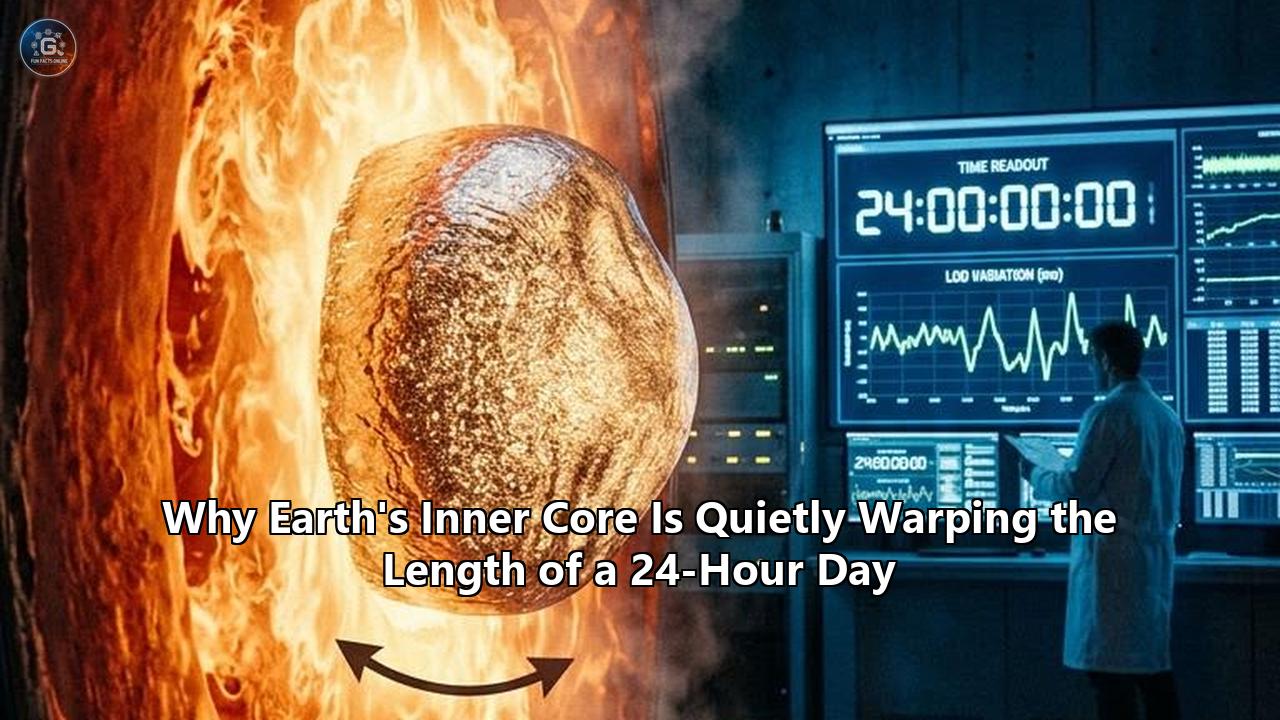
An empirical resolution has emerged for one of geophysics’ most enduring puzzles: why the rotational period of the Earth fluctuates by several milliseconds over multidecadal spans. In a study published in Nature on September 23, 2026, researchers Huifeng Zhang and Mathieu Dumberry of the University of Alberta demonstrated that gravitational torque between Earth’s solid inner core and density anomalies inside the rocky mantle is the primary driver of multidecadal changes in the length of a day (LOD).
The findings resolve a mechanical disconnect that has persisted since core-mantle angular momentum exchanges were first quantified in the late 1980s. While scientists have long measured decadal swings of 3 to 4 milliseconds in the planet’s rotational period, physical models could not reconcile how forces operating across the core-mantle boundary (CMB)—located 2,890 kilometers beneath the surface—transferred sufficient torque to accelerate or decelerate the mantle.
Zhang and Dumberry's quantitative model demonstrates that the solid inner core is not a uniform sphere. Its non-axisymmetric equatorial shape, interacting with deep-mantle structures, exerts a peak gravitational torque capable of driving observed planetary timing variations. Concurrently, electromagnetic and topographic coupling at the core-mantle boundary act in opposite phase, functioning as a mechanical buffer that dampens these swings.
                     PLANETARY ANGULAR MOMENTUM BUDGET
     =================================================================
     Component         Moment of Inertia (kg·m²)    Share of Total
     -----------------------------------------------------------------
     Crust + Mantle    7.04 × 10³⁷                  87.6%
     Liquid Outer Core 0.99 × 10³⁷                  12.3%
     Solid Inner Core  6.00 × 10³⁴                   0.07%
     Atmosphere        1.42 × 10³²                  <0.001%
     Oceans            3.80 × 10³³                  <0.005%
     =================================================================
The mathematical reconciliation shows that for the gravitational torque to match six decades of observational data (1964–2019), the solid inner core must deform viscously on a characteristic relaxation timescale of roughly 10 years, within a constrained range of 2 to 31 years. This places the effective dynamic viscosity of the inner core at an estimated $10^{17}$ to $10^{18}\text{ Pa}\cdot\text{s}$—confirming that the iron sphere at Earth’s center is far softer and rheologically dynamic than classic high-pressure solid-state mechanics assumed.
This core-driven timing variation intersects with an urgent surface-level timekeeping crisis. While the deep interior has transferred angular momentum to the mantle over recent decades—speeding up planetary surface rotation and shaving fractions of a millisecond off daily cycles—anthropogenic mass loss from polar ice sheets has exerted a counter-torque.
The resulting tug-of-war directly dictates when global metrologists must execute the world’s first "negative leap second," an unprecedented temporal adjustment with serious implications for digital telecommunications, high-frequency financial ledgers, and distributed cloud computing systems.
1. The Angular Momentum Budget: Dissecting the Sub-Millisecond Earth
To track how the deep interior alters time, geophysicists evaluate the planet as a closed mechanical system governed by the conservation of total angular momentum ($\vec{L}_{\text{total}}$):
$$\vec{L}_{\text{total}} = \vec{L}_{\text{mantle}} + \vec{L}_{\text{outer\_core}} + \vec{L}_{\text{inner\_core}} + \vec{L}_{\text{atm}} + \vec{L}_{\text{oceans}} + \vec{L}_{\text{hydro}} = \text{constant}$$
Earth’s mean axial moment of inertia ($C$) is approximately $8.04 \times 10^{37}\text{ kg}\cdot\text{m}^2$. The rocky mantle and overlying crust constitute the overwhelming bulk of this inertia:
$$C_m \approx 7.04 \times 10^{37}\text{ kg}\cdot\text{m}^2 \quad (\sim 87.6\%)$$
The liquid iron-nickel outer core comprises:
$$C_{oc} \approx 0.99 \times 10^{37}\text{ kg}\cdot\text{m}^2 \quad (\sim 12.3\%)$$
The solid inner core, a 1,220-kilometer-radius iron-nickel sphere suspended within the molten outer core, accounts for:
$$C_{ic} \approx 6.0 \times 10^{34}\text{ kg}\cdot\text{m}^2 \quad (\sim 0.075\%)$$
Because the mantle is mechanically coupled to the Earth's crust, any change in mantle angular velocity ($\Delta\omega_m$) translates into a direct alteration of the length of day ($\Delta\text{LOD}$). The standard length of a mean solar day is defined by International System of Units (SI) standards as 86,400 seconds (24 hours). The deviation in the length of day is expressed quantitatively as:
$$\Delta\text{LOD} = -86,400 \times \left( \frac{\Delta\omega_m}{\omega_0} \right)$$
where $\omega_0 \approx 7.292115 \times 10^{-5}\text{ rad/s}$ is Earth’s mean sidereal rotation rate.
                               TIMESCALE SPECTRUM OF LOD VARIATIONS
====================================================================================================
Phenomenon                 Timescale            Amplitude (ΔLOD)   Primary Mechanism
----------------------------------------------------------------------------------------------------
Zonal Winds (Jet Streams)  Seasonal (bi-annual) ±1.0 to 2.0 ms     Atmospheric angular momentum (AAM)
Oceanic Tides              Diurnal / Semidiurnal ±0.1 to 0.5 ms    Oceanic mass redistribution & friction
Chandler Wobble / Normal   14 months / 6 years  ~0.2 to 0.3 ms     Gravitational / fluid core coupling
Inner Core Multidecadal    60 to 70 years       3.0 to 4.0 ms      Gravitational & core-mantle torques
Lunar Tidal Friction       Secular (century)    +1.8 to 2.3 ms/cy  Tidal dissipation / Moon recession
====================================================================================================
From this spectrum, the multidecadal variations ($\Delta\text{LOD}_{\text{decadal}}$) stand out. Over intervals spanning 10 to 70 years, astronomical observatories, historical eclipse records, and modern space geodesy—primarily Very Long Baseline Interferometry (VLBI) and Satellite Laser Ranging (SLR)—have cataloged persistent excursions of $\pm 3$ to $4\text{ ms}$.
A change of $1\text{ ms}$ in a single day corresponds to a fractional rotation anomaly of:
$$\frac{\Delta\omega_m}{\omega_0} = \frac{10^{-3}\text{ s}}{86,400\text{ s}} \approx 1.157 \times 10^{-8}$$
To accelerate the colossal mass of the mantle ($4.0 \times 10^{24}\text{ kg}$) to that degree across a decadal timescale requires sustained torques on the order of:
$$\Gamma \approx 10^{18} \text{ to } 10^{19} \text{ N}\cdot\text{m}$$
Atmospheric angular momentum (AAM), dominated by global zonal wind oscillations like the El Niño–Southern Oscillation (ENSO) and the Quasi-Biennial Oscillation (QBO), oscillates rapidly on timescales under five years, lacking the integrated inertial capacity to explain sustained decadal shifts. The mantle's missing momentum partner has always pointed downward into the deep core.
2. Seismic Waveforms Reveal Backtracking Core Dynamics
Establishing that the deep interior is responsible required cracking the rotational kinematics of the inner core itself. In June 2024, a research team led by Wei Wang of the Chinese Academy of Sciences and John Vidale of the University of Southern California published an analysis in Nature demonstrating that Earth's inner core had systematically slowed down and begun to "backtrack" relative to the mantle.
                     RAY PATH GEOMETRY: SOUTH SANDWICH ISLANDS TO ALASKA

                  Surface Earthquakes (South Sandwich Islands)
                                      |
                                      v
                                 [ MANTLE ]
                                      |
                                      v
                           [ LIQUID OUTER CORE ]  <-- PKP Phase (bypasses inner core)
                                      |
                                      v
                           [ SOLID INNER CORE ]   <-- PKIKP Phase (penetrates inner core)
                                 (1,220 km)
                                      |
                                      v
                           [ LIQUID OUTER CORE ]
                                      |
                                      v
                                 [ MANTLE ]
                                      |
                                      v
                       Recording Array: ILAR (Alaska) / YKA (Canada)
Direct measurement of an iron alloy mass under 330 to 360 gigapascals of hydrostatic pressure and temperatures between 5,000 and 6,000 Kelvin is impossible through borehole drilling (the deepest drill hole, the Kola Superdeep Borehole, penetrated only 12.26 kilometers). Seismologists must instead exploit natural acoustic probes: earthquake multiplet waveforms.
Wang and Vidale compiled seismograms from 121 recurring earthquakes occurring along the South Sandwich Islands subduction zone in the South Atlantic between 1991 and 2023. These seismic events occurred at identical coordinates and rupture mechanisms, sending identical acoustic wave trains through the planetary interior. These waves were detected at distant stations: the Yellowknife Array (YKA) in northern Canada and the Eielson Air Force Base Array (ILAR) in Alaska.
Two distinct seismic phases were evaluated:
- PKP waves: Travel through the mantle and liquid outer core, bypassing the solid inner core entirely. These serve as a static calibration baseline.
- PKIKP waves: Penetrate deep through the inner core boundary (ICB), refracting across the central crystalline core before emerging back into the mantle.
If the inner core were rigidly locked in synchronous rotation with the mantle, the differential travel times between PKIKP and PKP waveforms for identical earthquakes would remain identical over decades. Instead, seismologists found continuous travel time variations. Because the inner core possesses structural and seismic anisotropy—its eastern and western hemispheres exhibit divergent P-wave velocity variations ($\Delta V_p \sim 1\text{ to }3\%$) and localized boundary topography—any relative differential rotation shifts these internal heterogeneities through the seismic ray path, systematically warping the emerging waveform shape.
                HISTORICAL INNER CORE DIFFERENTIAL ROTATION PROFILE
====================================================================================================
Epoch Interval     Relative Velocity (dθ/dt)         Directional State     Differential Mode
----------------------------------------------------------------------------------------------------
1970 – 1995        +0.15° to +0.30° per year         Eastward              Super-rotation (Faster)
1996 – 2007        +0.05° to +0.10° per year         Eastward              Decelerating Super-rotation
2008 – 2010        0.00° per year (Null Zone)        Stationary            Synchronous Alignment
2011 – 2024        -0.03° to -0.06° per year         Westward              Sub-rotation (Backtracking)
====================================================================================================
Between 1991 and 2003, the PKIKP arrival times drifted consistently, documenting that the solid inner core was in a state of super-rotation—spinning slightly faster than the mantle by approximately $0.1^\circ$ to $0.3^\circ$ eastward per year. In the mid-2000s, this drift plateaued. Around 2008 to 2010, the seismic waveform signatures reached a turning point.
Following 2010, the process inverted: PKIKP waveforms recorded from earthquakes in 2020 through 2023 matched the specific historical waveform shapes that had been recorded between 2003 and 2008. The inner core had systematically reversed its differential path relative to the mantle. This established that the earth inner core rotation had shifted from an eastward super-rotation to a sub-rotational drift, tracking westward at approximately 2.5 times slower than the rate of its earlier super-rotation.
This seismic backtracking confirmed the multidecadal oscillation proposed in early 2023 by Yi Yang and Xiaodong Song of Peking University. Their team's analysis of repeating seismic doublets dating back to 1964 suggested that the inner core undergoes an approximately 60-to-70-year periodic oscillation relative to the mantle, passing through zero differential rotation points every 30 to 35 years.
Yet while Wang, Vidale, and Song confirmed the geometric kinematics of this internal motion, they left an urgent physical dynamic unexplained: how does an iron sphere, isolated within thousands of kilometers of low-viscosity liquid outer core, transmit enough mechanical torque across the boundary to modulate the rotation of the entire solid planet?
3. The Triaxial Torque: Modeling the Core-Mantle Gravitational Coupler
The September 2026 University of Alberta study by Zhang and Dumberry supplied the missing dynamical mechanics.
The classical assumption in geophysical fluid dynamics was that mechanical forces at the core-mantle boundary (CMB) were dominated by two primary torques:
- Electromagnetic torque ($\Gamma_{em}$): Arising from the interaction of the outer core’s magnetic induction fields ($\vec{B}$) with the electrically conductive lowermost mantle layer ($D''$).
- Topographic torque ($\Gamma_{topo}$): Generated by dynamic pressure variations in fluid outer-core currents pushing against physical boundary bumps (amplitudes of 1 to 3 kilometers) at the CMB.
               CROSS-SECTION: THE THREE COMPETING CORE TORQUE SYSTEMS

                                   [ LOWER MANTLE ]
                       (Heterogeneous density anomalies: LLSVPs)
                                        |
                 ~~~~~~~~~~~~~~~~~~ CMB (2,890 km) ~~~~~~~~~~~~~~~~~~
                 [ Topographic bumps (1-3 km) -> Pressure Torque (Γ_topo) ]
                 [ Electrically conductive D'' layer -> Magnetic Torque (Γ_em) ]
                 ~~~~~~~~~~~~~~~~~~~~~~~~~~~~~~~~~~~~~~~~~~~~~~~~~~~~~
                                        |
                             [ LIQUID OUTER CORE ]
                             (Turbulent zonal flows:
                              10-40 km/yr fluid jets)
                                        |
                 ------------------ ICB (5,150 km) ------------------
                 [ Gravitational Torque (Γ_grav) ]
                 (Acts between triaxial Inner Core & Mantle density anomalies)
                 -----------------------------------------------------
                                        |
                             [ SOLID INNER CORE ]
                             (Triaxial elongation: ε_ic ~ 10⁻⁵)
Zhang and Dumberry constructed an integrated numerical time series from 1964 to 2019. Their models cross-referenced seismic reconstructions of inner core differential rotation with outer-core surface fluid flows derived from geomagnetic secular variations recorded by the International Geomagnetic Reference Field (IGRF) and geomagnetic satellite arrays (such as the European Space Agency's Swarm constellation).
Their calculations identified a phase mismatch: electromagnetic and topographic torques calculated at the CMB are approximately $180^\circ$ out of phase with the observed multidecadal changes in the length of day ($\Delta\text{LOD}$). Instead of driving mantle speed variations, CMB boundary drag actively resists the changes, functioning as a hydrodynamic damper.
The driver was instead tracked to gravitational torque ($\Gamma_g$) linking the solid inner core directly to the mantle.
The inner core is not radially symmetric. Convective crystallisation dynamics, internal deformation, and asymmetric magnetic field pressure impose a non-axisymmetric equatorial ellipticity:
$$\epsilon_{ic} = \frac{a - b}{a} \approx 10^{-5} \text{ to } 10^{-4}$$
where $a$ and $b$ represent equatorial semi-major and semi-minor axes. This yields an elongated, slightly triaxial iron ellipsoid.
Simultaneously, the overlying rocky mantle contains massive internal mass heterogeneities. The most prominent are the Large Low Shear Velocity Provinces (LLSVPs)—two thermochemical structures roughly the size of continents that sit at the base of the mantle beneath Africa and the central Pacific. These anomalous regions, combined with ancient subducted slab material in the "slab graveyard," establish an uneven gravitational potential field ($\Phi_m$) throughout the deep interior.
              TOP-DOWN (EQUATORIAL) VIEW OF GRAVITATIONAL ALIGNMENT

                                 Mantle High-Density
                                      Mass Axis
                                          |
                                          |
                                    /     |     \
                                  /       |       \
                                 |        |        |
                                 |    \   |   /    |
                                 |     \  |  /     |
                                 |      \ | /      |
                               --|-------[+]-------|-- Mantle Gravitational
                                 |      / | \      |   Equilibrium Axis
                                 |     /  |  \     |
                                 |    /   |   \    |
                                 |        |        |
                                  \       |       /
                                    \     |     /
                                          |
                                          |
                                   Inner Core Long
                                 Axis (Tilted by θ)

           [ Gravitational Restoring Torque: Γ_g = -Γ_0 · sin(2θ) ]
When the inner core is aligned with the mantle’s gravitational field, the net axial gravitational torque is zero. However, turbulent convective flows in the liquid outer core exert intense electromagnetic and viscous drag on the inner core, forcing its long axis to drift eastward or westward out of equilibrium by an angle $\theta$:
$$\Gamma_g = -\Gamma_0 \sin(2\theta)$$
The gravitational coupling constant ($\Gamma_0$) between the triaxial inner core and lower mantle anomalies is derived from spherical harmonic integration of the interior density products:
$$\Gamma_0 = \frac{4\pi G C_m C_{ic}}{R_E^5} \sum_{l,m} \frac{2l+1}{2l'+1} \delta\rho_{m, lm} \delta\rho_{ic, lm}$$
where $G$ is the gravitational constant, $R_E$ is Earth's radius, and $\delta\rho$ describes density anomalies. This interaction yields peak gravitational torques reaching:
$$\Gamma_g \sim 10^{19} \text{ to } 10^{20} \text{ N}\cdot\text{m}$$
This magnitude matches what is required to alter mantle velocity and alter the observed length of a day by 3 to 4 milliseconds over multidecadal timescales.
As convective core flows push the inner core out of alignment with the mantle's gravitational axis, gravity pulls back. Because every action generates an equal and opposite reaction, the torque exerted by the mantle on the inner core is reciprocated by a torque exerted by the inner core on the mantle.
When the inner core is displaced eastward, it exerts a westward gravitational torque on the mantle, slowing crustal rotation and lengthening the 24-hour day. Conversely, when the inner core slips into westward sub-rotation—as it has done over the past decade and a half—it applies an eastward gravitational torque on the mantle, pulling the surface along faster and shortening the day.
4. Rheology at 300 Gigapascals: The Viscous Core
The University of Alberta model introduced a fundamental rheological constraint: if the solid iron inner core were completely rigid, the intense gravitational torque from mantle anomalies would permanently lock it in place, preventing differential rotation altogether.
The fact that seismologists can measure differential earth inner core rotation means the inner core must continuously reshape itself to relieve internal mechanical stress.
                     STRESS-STRAIN RELAXATION IN THE INNER CORE

     Gravitational Displacement               Viscous Flow Response
     ==========================               =====================
     Mantle potential pulls on                Iron grains undergo dislocation
     inner core density bulge  ------------>  creep at T = 5,500 K, P = 350 GPa

                                                        |
                                                        v
                                              Characteristic relaxation
                                              timescale: τ_v ≈ 10 years
                                                        |
                                                        v
                                              Relieves elastic strain; allows
                                              periodic 70-year oscillation
Under the extreme pressures of the Earth's center, the body-centered cubic (bcc) or hexagonal close-packed (hcp) iron-nickel crystal structure undergoes sustained plastic deformation via dislocation creep and grain boundary sliding. Zhang and Dumberry represented this mechanical behavior using a Maxwell viscoelastic rheological framework, where total strain rate ($\dot{\varepsilon}$) is partitioned into elastic and viscous components:
$$\dot{\varepsilon} = \frac{1}{\mu} \frac{d\sigma}{dt} + \frac{\sigma}{\eta}$$
where $\mu$ is the shear modulus of iron at core pressures ($\sim 1.6 \times 10^{11}\text{ Pa}$), $\sigma$ is stress, and $\eta$ is effective dynamic viscosity. The viscous relaxation timescale ($\tau_v$) defines how rapidly internal flow relieves stresses induced by gravitational displacement:
$$\tau_v = \frac{\eta}{\mu}$$
             VISCOSITY VS. OBSERVED LOD MATCH: PARAMETRIC SEARCH
====================================================================================================
Viscosity Regime       Relaxation Time (τ_v)   System Response       Model Result
----------------------------------------------------------------------------------------------------
η > 10²¹ Pa·s (Hard)   > 200 years             Rigid elastic locking Fails (Suppresses differential spin)
η ~ 10¹⁷ to 10¹⁸ Pa·s  2 to 31 years (Opt. 10) Viscoelastic flow     Matches observed ΔLOD and seismic data
η < 10¹⁴ Pa·s (Soft)   < 1 month               Fluid equilibrium     Fails (Negligible gravitational torque)
====================================================================================================
Testing this parameter space against 55 years of geodetic Earth-rotation datasets revealed that the best-fitting models consistently centered on an inner core relaxation time of approximately:
$$\tau_v \approx 10 \text{ years (constrained within } 2 \le \tau_v \le 31 \text{ years)}$$
This relaxation rate translates to an effective bulk viscosity of:
$$\eta \approx 10^{17} \text{ to } 10^{18} \text{ Pa}\cdot\text{s}$$
This quantitative determination demonstrates that while the inner core is mechanically solid to short-period seismic Shear ($S$) waves (which pass through it over seconds), it flows like warm asphalt or glacial ice across decadal timescales.
The 60-to-70-year multidecadal period observed in length-of-day records is thus a coupled oscillation governed by a three-part equilibrium:
- Outer core magneto-hydrodynamic flows pushing the inner core out of alignment.
- Gravitational torque pulling the inner core and mantle back toward alignment.
- Viscous dissipation within the ductile inner core continuously relaxing this stress over a 10-year timescale.
5. Planetary Cross-Currents: Inner Core Drag Versus Polar Ice Melt
As researchers isolated the inner core's gravitational engine, the global timing community confronted a counter-intuitive observation: while the planet’s long-term rotation is slowing due to lunar tides, Earth’s crust has accelerated over recent years.
                                 THE ATOMIC TIME GAP

      86,400.002 s -|                                  *  *
                    |                              * *      *
                    |                          * *            *
      86,400.001 s -|                      * *                  *
                    |                  * *                        *
  LOD               |              * *
                    |          * *
      86,400.000 s -|-- * - - * - - - - - - - - - - - - - - - - - - - - - - - - SI 24-Hour Day
                    |       *
                    |      *
      86,399.999 s -|     *    <-- June 29, 2022: Shortest day recorded (-1.59 ms)
                    |    *
                    +--------------------------------------------------------
                        1970      1980      1990      2000      2010      2020
From 1972 to 2016, the International Earth Rotation and Reference Systems Service (IERS) had to insert 27 positive leap seconds into Coordinated Universal Time (UTC). During those four decades, the average astronomical day was roughly 1 to 2 milliseconds longer than the 86,400 SI seconds measured by caesium-133 atomic clocks, requiring an extra second every few years to let the physical Earth catch up.
In 2020, that historical deceleration reversed:
- Earth logged its 28 shortest days since high-precision atomic timekeeping began in the late 1950s.
- On July 19, 2020, Earth completed its rotation in 1.47 milliseconds under 24 hours.
- On June 29, 2022, the planet set a modern instrumental record, spinning a full rotation in 1.59 milliseconds less than 86,400 seconds.
The sub-rotation of the inner core, documented by Wang and Vidale, and the corresponding mantle-accelerating gravitational torque explained by Zhang and Dumberry, show that the deep interior was shifting angular momentum outward into the mantle, speeding up surface rotation and shrinking day length.
Left alone, this core-driven acceleration would have forced timekeepers to execute the world’s first "negative leap second"—a minute containing only 59 seconds—around 2026.
                POLAR MELT INDUCED OBLATENESS AND ANGULAR DECELERATION

             [ Greenland Ice Sheet ]                [ Antarctic Ice Sheet ]
               -280 Gt/yr mass loss                   -150 Gt/yr mass loss
                        \                                      /
                         \                                    /
                          v                                  v
                      Melting freshwater enters ocean circulation
                                          |
                                          v
                      Redistributed toward Equatorial Ocean Bulge
                                          |
                                          v
                      Increases Equatorial Radius: ΔJ₂ Perturbation
                                          |
                                          v
                      Increases Planetary Moment of Inertia (C_m)
                                          |
                                          v
                      Slows Mantle Angular Velocity: ω_m decreases
                      (Delays negative leap second requirement)
This acceleration was interrupted by surface climate dynamics. In a study published in Nature in March 2024, geophysicist Duncan Agnew of the Scripps Institution of Oceanography used satellite gravimetry from the GRACE (Gravity Recovery and Climate Experiment) and GRACE Follow-On missions to quantify how global warming alters Earth's rotation.
The accelerating mass loss of the Greenland and Antarctic ice sheets redistributes water from high latitudes into the global oceans:
- Greenland loses an average of 280 billion metric tons ($280\text{ Gt}$) of ice per year.
- Antarctica loses roughly 150 billion metric tons ($150\text{ Gt}$) per year.
Because this massive volume of meltwater flows off polar landmasses located at latitudes between $60^\circ$ and $90^\circ$ and is redistributed across low-latitude oceanic basins ($0^\circ\text{ to }30^\circ$), mass moves further away from Earth's spin axis.
This mass transport increases the planet’s dynamic form factor, or second-degree zonal geopotential harmonic ($J_2$), altering Earth’s moment of inertia:
$$\frac{dC_m}{dt} = \frac{2}{3} R_E^2 \frac{d(\Delta M_{\text{equator}})}{dt}$$
Conservation of angular momentum dictates that as the moment of inertia increases, angular velocity must decrease:
$$\frac{d\omega_m}{dt} = -\frac{\omega_0}{C_m} \frac{dC_m}{dt}$$
This effect mirrors a spinning figure skater extending their arms to slow down. Agnew's calculations showed that polar ice melting has slowed Earth’s mantle rotation by enough to offset a significant fraction of the core-driven acceleration.
                       PROJECTED TIMING DISCREPANCIES (UT1 - UTC)
====================================================================================================
Scenario Modeling                       Projected Delta (LOD)   Negative Leap Second Date
----------------------------------------------------------------------------------------------------
Core Dynamics Alone (No Polar Melt)     -0.8 to -1.2 ms/day     Mid-2026
Combined: Core Acceleration + Ice Melt  -0.2 to -0.5 ms/day     Deferred to ~2029
Pure Secular Tidal Trend (Historical)   +1.5 to +2.0 ms/day     Never (Only positive leap seconds)
====================================================================================================
By adding mass to the equatorial bulge, polar ice melting has decelerated the planet, pushing the projected date for a negative leap second back from 2026 to approximately 2029.
The length of an Earth day has thus become a battleground between core thermodynamics and anthropogenic climate change: an iron core turning 5,000 kilometers beneath the crust pulling the day shorter, and billions of tons of melting ice on the surface pushing the day longer.
6. The Digital Edge: Systems Risks of the Negative Leap Second
While a millisecond shift is imperceptible to humans, the digital infrastructure underpinning global society operates on strict sub-microsecond precision.
The discrepancy between astronomical time, defined by Earth's physical rotation (Universal Time 1, or UT1), and atomic time, generated by an international ensemble of hundreds of hyper-stable caesium fountain clocks (International Atomic Time, or TAI), is governed by the relation:
$$\text{UTC} = \text{TAI} - \Delta\text{AT}$$
where $\Delta\text{AT}$ is the cumulative total of historical leap seconds added since 1972 (currently 37 seconds).
                      THE ANATOMY OF A NEGATIVE LEAP SECOND

     Standard Positive Leap Second (Occurred 27 Times):
     [ 23:59:59 ]  ----->  [ 23:59:60 ]  ----->  [ 00:00:00 ]
                           (Extra second inserted)

     Unprecedented Negative Leap Second (Projected ~2029):
     [ 23:59:58 ]  -------------------------->   [ 00:00:00 ]
                           [ 23:59:59 DROPPED ]
                           (Second completely deleted)
International agreements dictate that the difference between astronomical rotation and atomic time ($|\text{UT1} - \text{UTC}|$) cannot exceed 0.9 seconds. If planetary rotation outpaces atomic clocks, metrologists must execute a negative leap second: dropping second 23:59:59 entirely from the UTC record so that the clock jumps directly from 23:59:58 to 00:00:00.
While computer software is routinely architected to handle repeated seconds (via NTP "leap smearing," where a positive second is diffused as microsecond fractions across hours), virtually no major commercial network has ever validated a dropped second in production environments:
- POSIX Time Compliance: The IEEE POSIX standard explicitly requires that every day consists of exactly 86,400 integer seconds. Dropping a second breaks the monotonic time requirement fundamental to distributed databases.
- High-Frequency Financial Trading (HFT): European MiFID II regulations require financial order execution timestamps to be accurate to within 100 microseconds of UTC. In modern algorithmic trading, where transactions clear in nanoseconds, a missing second can cause out-of-order execution logic, triggering automated error triggers and portfolio freezes.
- Global Navigation Satellite Systems (GNSS): GPS, Galileo, GLONASS, and BeiDou broadcast precise time tags. A software failure in tracking the UT1-UTC delta can corrupt ephemeris position trilateration, where a single microsecond error ($1\times 10^{-6}\text{ s}$) produces an immediate physical positioning deviation of 300 meters:
$$\Delta x = c \times \Delta t \approx (3.0 \times 10^8 \text{ m/s}) \times 10^{-6}\text{ s} = 300\text{ meters}$$
- Telecommunications and 5G/6G Networks: Cellular transmission nodes rely on Precision Time Protocol (PTP, IEEE 1588) over packet-based backhaul, requiring phase alignment down to $\pm 1.5\text{ microseconds}$ across base stations to avoid carrier interference.
                   CHRONOLOGY OF GLOBAL LEAP SECOND INTERVENTIONS
====================================================================================================
Year / Event         Total Applied   Intervention Type     Status / Impact
----------------------------------------------------------------------------------------------------
1972                 10 (Initial)    Positive step (+1s)   Initialization of UTC/TAI offset
1972 – 1979          9 added         Positive step (+1s)   High insertion frequency (~yearly)
1980 – 1999          13 added        Positive step (+1s)   Consistent deceleration era
2000 – 2016          5 added         Positive step (+1s)   Deceleration began easing; 2016 was last
2022 (CGPM Vote)     —               Policy Decision       Agreed to abolish/widen tolerance by 2035
2026 (Zhang et al.)  —               Scientific Discovery  Gravitational core torque identified
~2029 (Agnew Model)  1 projected     Negative step (-1s)   First drop of 23:59:59 before abolition
====================================================================================================
In November 2022, the 27th General Conference on Weights and Measures (CGPM) voted to eliminate or significantly widen the leap second tolerance by 2035, permitting the gap between UT1 and UTC to expand up to a full minute without manual intervention.
However, because that phase-out takes effect in 2035, the current decade remains vulnerable. If the gravitational torque from earth inner core rotation continues to outpace polar melt rates, the International Bureau of Weights and Measures (BIPM) and the IERS will face a critical decision near 2029: deploy the first-ever negative leap second, or unilaterally modify the UT1-UTC tolerance early to prevent disruption to global networks.
7. The Deep-Earth Observational Frontier
The findings of Zhang, Dumberry, Vidale, and Agnew transform daily millisecond variations from a timekeeping complication into an operational geodetic scanner for probing the inaccessible interior of Earth.
Because multidecadal variations in the length of a day directly register the gravitational torque between the inner core and the mantle, tracking $\Delta\text{LOD}$ using VLBI quasar interferometry provides continuous real-time constraints on physical conditions at the center of the planet:
$$\Gamma_g(t) = -C_m \frac{d\omega_m(t)}{dt} - \Gamma_{\text{boundary}}(t) - \Gamma_{\text{surf}}(t)$$
                        DEEP INTERIOR PHYSICAL CONSTRAINTS
====================================================================================================
Interior Parameter              Empirical Model Value       Direct Physical Significance
----------------------------------------------------------------------------------------------------
Inner Core Viscosity (η)        10¹⁷ to 10¹⁸ Pa·s           Confirms plastic dislocation creep
Characteristic Relaxation (τ_v) ~10 years (2–31 bounds)     Controls non-axial shape realignment
Inner Core Ellipticity (ε_ic)   ~10⁻⁵ to 10⁻⁴               Documents equatorial non-axisymmetry
D'' Conductance (C_D'')         10⁸ to 10⁹ Siemens          Regulates magnetic core-mantle drag
ICB Boundary Growth Rate        ~0.5 to 1.0 mm/year         Thermodynamic geodynamo engine power
====================================================================================================
Several key questions remain unresolved for geophysicists monitoring the planet's deep rotation:
The Six-Year Oscillation Anomaly
Superimposed on the 60-to-70-year multidecadal shift is a well-documented 6-year period oscillation in the length of day, with an amplitude of approximately $0.15\text{ to }0.25\text{ ms}$. Geodetic tracking indicates this 6-year cycle abruptly stalled or became erratic around 2010—the exact moment the inner core halted its super-rotation and slipped into backtracking mode. Researchers are investigating whether this disturbance reflects a sudden disruption of magneto-Coriolis waves in the liquid core or a transient decoupling of gravitational modes.
Geomagnetic Jerks and Torque Pulses
Every few years, ground-based geomagnetic observatories detect sudden step changes in the second time derivative of Earth's magnetic field—phenomena known as "geomagnetic jerks." These events signal rapid, localized reorganizations of fluid velocity within the upper layers of the outer core. High-resolution geodetic modeling is testing whether these pulses produce rapid transient magnetic torques at the core-mantle boundary, generating millisecond-scale variations that precede larger shifts in the earth inner core rotation.
Ultra-Low Velocity Zones (ULVZs)
At the base of the mantle, directly atop the CMB, lie thin patches of dense, partially molten rock up to tens of kilometers thick, known as Ultra-Low Velocity Zones. Because these regions concentrate iron and have high electrical conductivity, their precise distribution determines whether electromagnetic drag resists inner-core torque across localized patches or broadly across the entire mantle base.
                            THE DECADAL OUTLOOK: 2026–2040

    [ 2026 ]  Zhang & Dumberry establish gravitational torque model in Nature.
              Sub-rotation of the inner core continues at ~0.05°/yr westward.
                 |
                 v
    [ 2029 ]  Projected crossroads: Net torque balance dictates whether IERS
              must declare the first-ever negative leap second (-1s).
                 |
                 v
    [ 2035 ]  CGPM mandate takes effect: Leap seconds scheduled for elimination.
              UT1 and UTC permitted to drift apart, decoupling atomic clocks.
                 |
                 v
    [ 2040s ] The 70-year cycle inflection point: Inner core sub-rotation reaches
              its maximum westward displacement, preparing to reverse back eastward.
The 24-hour day is not an unyielding physical constant, but the real-time sum of dynamic planetary mechanics. Modern atomic clocks have removed all doubt: beneath thousands of kilometers of solid rock and liquid iron, the inner core continues its slow, silent rotation, torqueing the planet's mantle and warping human time millisecond by millisecond.
Reference:
- https://thedebrief.org/earths-inner-core-may-be-secretly-changing-the-length-of-our-days/
- http://www.sciencedaily.com/releases/2026/09/260928100540.htm
- https://www.thecooldown.com/green-tech/earth-rotation-changes-canadian-study/
- https://thedebrief.org/earths-inner-core-may-be-secretly-changing-the-length-of-our-days/
- https://allatra.media/news/science-gravitational-torque-length-of-day
- https://economictimes.indiatimes.com/news/international/global-trends/earths-inner-core-may-be-deforming-within-years-scientists-say-its-hidden-movements-could-change-the-length-of-our-days/articleshow/134569476.cms?from=mdr
- https://www.thebrighterside.news/post/earths-inner-core-may-be-quietly-changing-the-length-of-our-days/
- https://www.thebrighterside.news/post/earths-inner-core-may-be-quietly-changing-the-length-of-our-days/
- https://physicsworld.com/a/climate-change-will-affect-how-time-is-corrected-using-negative-leap-seconds/
- https://scripps.ucsd.edu/news/global-warming-influencing-global-timekeeping
- https://www.thejakartapost.com/culture/2024/03/29/climate-change-is-messing-with-how-we-measure-time-study
- https://academic.oup.com/gji/article/243/2/ggaf337/8242745
- https://www.sciencedaily.com/releases/2026/09/260928100540.htm
- https://geoscopy.com/earths-inner-core-reverses-its-spin-learn-why/
- https://english.elpais.com/science-tech/2024-06-19/the-earths-core-is-slowing-down.html
- https://attheu.utah.edu/science-technology/as-the-ball-turns-earths-inner-core-is-backtracking/
- https://www.smithsonianmag.com/smart-news/earths-inner-core-may-be-slowing-its-spin-another-study-suggests-180984622/
- https://www.researchgate.net/publication/414674246_Gravitational_torque_drives_multidecadal_variations_in_length_of_day
- https://www.ualberta.ca/en/news/spotlights/2026/09-sept/earths-deep-secret-why-your-day-isnt-quite-24-hours.html
- https://gizmodo.com/something-deep-inside-earth-keeps-messing-with-the-length-of-our-days-2000816070
- https://en.wikipedia.org/wiki/Leap_second
- https://nautil.us/how-melting-ice-has-altered-time-keeping-582709
- https://economictimes.indiatimes.com/news/international/global-trends/earths-inner-core-may-be-deforming-within-years-scientists-say-its-hidden-movements-could-change-the-length-of-our-days/articleshow/134569476.cms?from=mdr