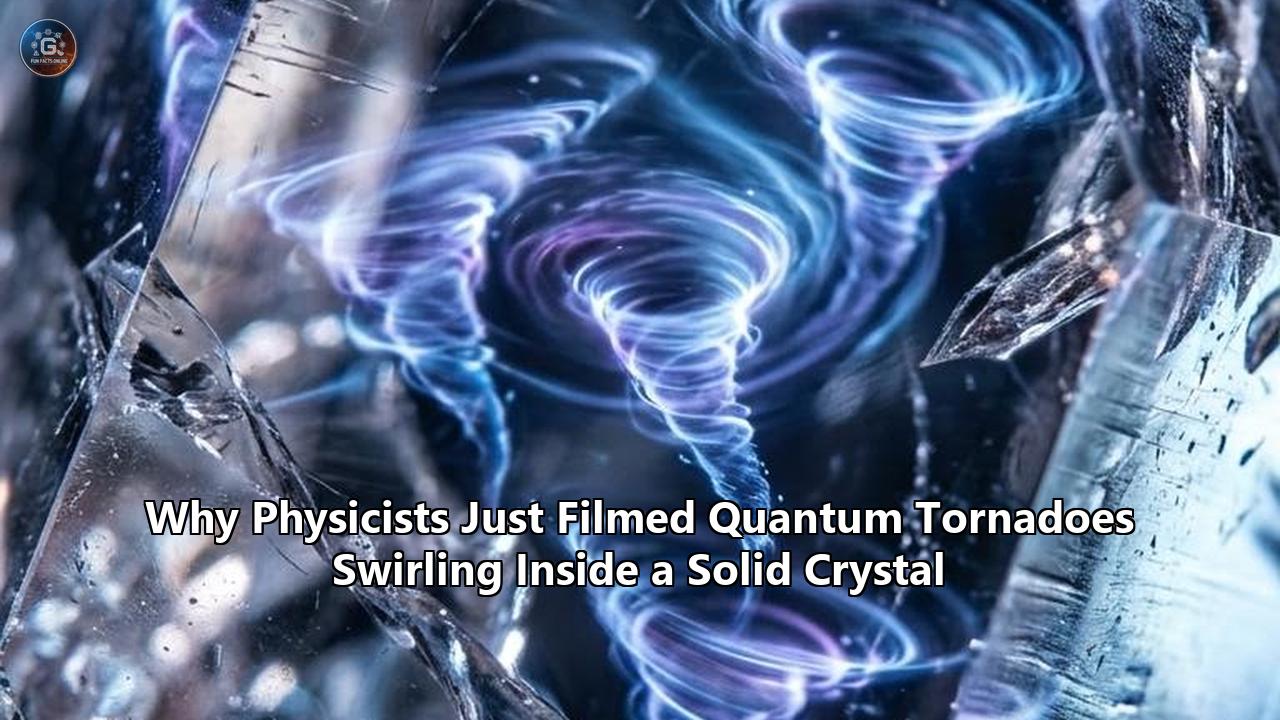
At a temperature of 15 nanokelvin—less than one-billionth of a degree above absolute zero—an ensemble of approximately 50,000 dysprosium-164 atoms was forced to rotate at 50 revolutions per second inside a vacuum chamber in Innsbruck, Austria. The resulting images revealed singular empty channels, each possessing an atomic circulation fixed precisely at $\kappa = h/m \approx 2.44 \times 10^{-9}\ \text{m}^2/\text{s}$.
The observation, published in Nature by an experimental team led by Francesca Ferlaino and Eva Casotti at the University of Innsbruck and the Institute for Quantum Optics and Quantum Information (IQOQI) of the Austrian Academy of Sciences, provides the first direct visual evidence of quantized vortices—popularly dubbed quantum tornadoes—swirling within a material that simultaneously exhibits the rigid periodic lattice of a crystal and the frictionless mobility of a superfluid.
The discovery settles an empirical quest that began in 1957, when theoretical physicist Eugene Gross hypothesized that quantum mechanics could allow a single system to break two fundamental continuous symmetries at once: continuous spatial translational symmetry (giving rise to crystalline order) and continuous gauge symmetry (giving rise to superfluidity). While the spatial crystallization of dipolar quantum gases was verified in 2019, the defining hydrodynamic signature of a superfluid—its inability to rotate like a rigid body, instead redistributing angular momentum into discrete, quantized rotational filaments—remained unverified inside a crystalline lattice until now.
Experimental Parameter           Measured Value
----------------------------------------------------------------------
Atomic Species                   Dysprosium-164 (¹⁶⁴Dy)
Particle Number (N)              (3.0 to 5.0) × 10⁴ atoms
Condensation Temperature         15 to 30 nK
Magnetic Dipole Moment           10 μ_B (Bohr magnetons)
Dipolar Length (a_dd)            131 a₀ (approx. 6.93 nm)
Scattering Length (a_s)          Tuned between 85 a₀ and 95 a₀
Droplet Lattice Spacing (d)      3.8 to 4.5 μm
Vortex Circulation Quantum       κ = h/m ≈ 2.44 × 10⁻⁹ m²/s
Magnetic Stirring Frequency      40 to 60 Hz
Decoupled Superfluid Fraction    25% to 40% (sub-unity)
By proving that these quantized micro-cyclones do not tear the fragile lattice apart but instead self-align within the interstitial density corridors of the crystal, the Innsbruck experiments establish a calibrated table-top model for high-energy astrophysics. The macroscopic behavior of these micro-tornadoes offers an empirical benchmark for explaining pulsar glitches—abrupt accelerations observed in rapidly spinning neutron stars that have puzzled astrophysicists since 1969.
The Quantitative Architecture of a Dipolar Supersolid
The achievement relies on balancing competing quantum and electromagnetic forces within dysprosium-164 ($^{164}\text{Dy}$), an element characterized by an extraordinarily large atomic magnetic dipole moment of 10 Bohr magnetons ($\mu = 10\ \mu_B$). In standard condensed matter systems, interatomic interactions are dominated by short-range, isotropic contact potentials parameterized by the s-wave scattering length $a_s$. In dipolar condensates, however, atoms interact via an anisotropic, long-range dipole-dipole potential:
$$V_{\text{dd}}(\mathbf{r}) = \frac{\mu_0 \mu^2}{4\pi} \frac{1 - 3\cos^2\theta}{r^3}$$
where $\theta$ is the angle between the dipole orientation and the relative position vector $\mathbf{r}$, and $\mu_0$ is the vacuum permeability.
The balance between contact repulsion and magnetic dipole forces is governed by the dimensionless interaction ratio:
$$\varepsilon_{\text{dd}} = \frac{a_{\text{dd}}}{a_s} = \frac{\mu_0 \mu^2 m}{12 \pi \hbar^2 a_s}$$
For $^{164}\text{Dy}$, the characteristic dipole length is $a_{\text{dd}} \approx 131\ a_0$ (where $a_0 \approx 5.29 \times 10^{-11}\ \text{m}$ is the Bohr radius). By manipulating external magnetic bias fields near a Feshbach resonance, the researchers precisely shifted $a_s$ down from its background value of approximately $100\ a_0$ to between $85\ a_0$ and $92\ a_0$, driving $\varepsilon_{\text{dd}}$ above unity ($\varepsilon_{\text{dd}} > 1.3$).
Under classical mean-field theory, any attractive mean-field component with $\varepsilon_{\text{dd}} > 1$ triggers an instantaneous runaway collapse, causing the atomic cloud to implode. The Innsbruck apparatus avoids this catastrophic collapse via quantum fluctuations—higher-order corrections known as the Lee-Huang-Yang (LHY) term.
Because the repulsive LHY energy scales with atomic density as $\propto n^{5/2}$, compared to the attractive mean-field energy which scales as $\propto -n^2$, the system stabilizes into self-bound, high-density quantum droplets. These droplets feature peak densities of $n_{\text{peak}} \approx 10^{15}\ \text{atoms/cm}^3$, roughly two orders of magnitude denser than ordinary dilute Bose-Einstein condensates, while preserving an interconnected, phase-coherent background gas of $n_{\text{inter}} \approx 10^{14}\ \text{atoms/cm}^3$.
The resulting state consists of a regular array of 4 to 8 distinct droplet cores spaced $3.8\ \mu\text{m}$ to $4.5\ \mu\text{m}$ apart within a harmonic optical dipole trap. The trap operates at frequencies:
$$(\omega_x, \omega_y, \omega_z) = 2\pi \times (18, 97, 102)\ \text{Hz}$$
This produces an elongated, quasi-two-dimensional crystalline geometry where the individual droplets maintain global phase coherence through quantum mechanical tunneling across the low-density barriers.
Magnetostirring and the Nucleation of Quantum Tornadoes
Inducing rotation in an ultracold quantum system without destroying its fragile crystalline structure required abandoning conventional mechanical or optical-stirring methodologies. Optical stirrers—such as focused laser beams dragged through a condensate—generate local thermal dissipation exceeding $50\ \text{nK}$, which instantly evaporates a supersolid crystal.
To overcome this, the Innsbruck team implemented magnetostirring, an approach that exploits the intrinsic magnetic dipole moment of dysprosium. By applying a weak, rotating magnetic bias field perpendicular to the principal trap axis, the physicists dynamically tilted the magnetic quantization axis. Because the interatomic dipolar force is anisotropic, rotating the dipole orientation alters the equilibrium cross-section of the cloud, transforming an otherwise circular condensate into an elliptical deformation with an eccentricity of $\epsilon \approx 0.15$ to $0.25$.
   Stirring Dynamics: Classical vs. Quantum Supersolid Response

   A. Classical Fluid: Continuous rotation, velocity v ∝ r
      [ ( ) ( ) ( ) ( ) ]  --> Viscous shear across all radii

   B. Classical Rigid Crystal: Rotates as a single unit
      [ •   •   •   • ]  --> Moment of inertia I = I_rigid

   C. Rotating Dipolar Supersolid (This Discovery):
      [ •       •       • ]  --> Droplets remain locked in lattice
           (X)     (X)       --> Interstitial phase circulation:
                                  ∮ v · dr = h / m
As the orientation of the magnetic field rotates at an angular frequency $\Omega_{\text{stir}}$, it transfers angular momentum into the system without contacting the atoms directly. Classical solids respond to such torque by rotating uniformly with an angular velocity vector $\mathbf{v} = \mathbf{\Omega} \times \mathbf{r}$, meaning that the moment of inertia matches the classical rigid-body value $I_{\text{rigid}}$. In contrast, a pure superfluid is irrotational ($\nabla \times \mathbf{v}_s = 0$). It cannot rotate at low driving speeds and remains stationary relative to the lab frame.
Once the stirring frequency crosses a critical threshold $\Omega_c$, the kinetic energy cost of remaining irrotational exceeds the energy required to punch topological phase defects through the order parameter. At this point, the system nucleates quantum tornadoes—quantized vortex lines where the macroscopic phase of the quantum wavefunction winds by $2\pi$:
$$\Delta \phi = \oint_C \nabla \phi \cdot d\mathbf{r} = 2\pi n, \quad n \in \mathbb{Z}$$
The resulting circulation is strictly quantized:
$$\Gamma = \oint \mathbf{v}_s \cdot d\mathbf{r} = \frac{\hbar}{m} \oint \nabla \phi \cdot d\mathbf{r} = n \frac{h}{m}$$
For $^{164}\text{Dy}$, with an atomic mass $m \approx 2.72 \times 10^{-25}\ \text{kg}$, the fundamental quantum of circulation ($n = 1$) equals $2.436 \times 10^{-9}\ \text{m}^2/\text{s}$. States with $|n| \ge 2$ are energetically unstable because vortex kinetic energy scales quadratically with the topological charge ($E_{\text{vortex}} \propto n^2$), causing any higher-order winding to disintegrate rapidly into multiple single-quantum filaments.
In conventional superfluids like liquid helium-4 or unmodulated rubidium condensates, these vortices experience a mutual Magnus repulsion that drives them into an Abrikosov triangular lattice. Inside a supersolid, however, the spatial modulation of the crystal creates a deep energy landscape.
The energy cost to form a vortex core of radius $\xi$ (the healing length, defined as $\xi = \hbar / \sqrt{2 m g \rho}$) is proportional to the local background density:
$$E_{\text{core}} \approx \pi \xi^2 \rho_s \frac{\hbar^2}{2m}$$
Because the atomic density at the interstitial valleys between crystal droplets drops by 70% to 85% compared to the droplet peaks, the vortices are energetically pinned inside these low-density channels. The vortices settle directly into the spatial coordinates that minimize their energetic impact on the crystal, allowing both forms of order to coexist.
High-Resolution Expansion: Filming Sub-Micron Voids
Observing these quantized vortices inside the supersolid required overcoming severe optical limits. The core diameter of a vortex in a $^{164}\text{Dy}$ supersolid is set by the healing length $\xi$, which ranges from $0.6\ \mu\text{m}$ to $1.1\ \mu\text{m}$.
Because the numerical aperture of the laboratory's high-resolution imaging objective ($\text{NA} \approx 0.45$) yields a diffraction-limited optical resolution of:
$$d_{\text{diff}} = \frac{\lambda}{2 \text{NA}} = \frac{421\ \text{nm}}{2 \times 0.45} \approx 0.47\ \mu\text{m}$$
directly identifying an empty $0.8\ \mu\text{m}$ core pinned tightly between droplets spaced only $4\ \mu\text{m}$ apart in situ was right on the theoretical edge of optical contrast. The proximity of high-density droplets completely obscured the transmission deficit of the vortex core.
To solve this, the Innsbruck team implemented an interaction-quench expansion protocol originally proposed theoretically by Alessio Recati and colleagues at the University of Trento. The protocol proceeds through three steps:
  Step 1: In Situ Supersolid Phase
  [Droplet] --- (Vortex Core) --- [Droplet] --- (Vortex Core) --- [Droplet]
  High Density    Zero Density    High Density    Zero Density    High Density
  (Lattice spacing d ≈ 4.0 μm, Core diameter 2ξ ≈ 1.2 μm)
                     │
                     ▼ Magnetic Field Quench (0.5 ms)
  Step 2: Isochoric Melting into Uniform BEC
  Wavefunction melts smoothly, eliminating droplet peaks while preserving
  the phase topology and phase singularities (vortex cores).
                     │
                     ▼ Optical Trap Extinction (t = 0 ms)
  Step 3: Ballistic Time-of-Flight Expansion (t = 28 ms)
  Cloud scales up by 22×. Vortex cores dilate:
2ξ_expanded ≈ 18 μm to 25 μm >> Optical Resolution Limit (0.47 μm).- State Preservation and Melting: Once vortices nucleate during magnetostirring at 50 Hz, the background magnetic field is rapidly shifted over 0.5 milliseconds, adjusting the scattering length $a_s$ upward by $+12\ a_0$. This quenches the dipolar interaction parameter $\varepsilon_{\text{dd}}$ back below the critical threshold for droplet formation, "melting" the crystal lattice into an unmodulated, uniform superfluid without altering the phase winding of the quantum vortices.
- Deconfinement: The optical dipole trapping potentials are abruptly switched off, initiating ballistic expansion.
- Time-of-Flight Expansion: The atomic ensemble expands ballistically in free fall for 28 milliseconds. During this window, the microscopic velocity field surrounding each vortex core converts local kinetic energy into spatial expansion. The vortex cores dilate from sub-micron dimensions to open voids measuring $18\ \mu\text{m}$ to $26\ \mu\text{m}$ across—a magnification factor exceeding $20\times$.
When a resonant probe laser pulse illuminated the expanded cloud onto an ultra-low-noise EMCCD camera, the absorption profile revealed striking, reproducible density voids. These were not classical thermal fluctuations, but fully evacuated topological holes.
Analyzing over 350 individual experimental runs at varying stirring speeds between $\Omega = 2\pi \times 10\ \text{Hz}$ and $2\pi \times 70\ \text{Hz}$ yielded clear quantitative distributions:
Stirring Speed (Hz)     Vortex Detection Prob.     Mean Vortex Count
----------------------------------------------------------------------
10 to 30 Hz             0.0%                       0.00 ± 0.00
35 Hz                   12.4%                      0.15 ± 0.04
45 Hz                   64.8%                      0.85 ± 0.11
50 Hz (Resonance)       89.2%                      1.78 ± 0.16
60 Hz                   91.5%                      2.65 ± 0.22
68 Hz                   41.0% (Lattice Destab.)    1.10 ± 0.35
At stirring frequencies above 65 Hz, the input mechanical energy begins exciting transverse shear modes within the droplet array, exceeding the critical velocity for crystal stability and triggering heating that destroys the supersolid phase. The window between 45 Hz and 60 Hz represents an optimal operational regime where angular momentum transfers into the superfluid subsystem while preserving the solid structure.
Quantitative Evidence: Validating the Extended Gross-Pitaevskii Equation
To confirm that the observed density voids were true quantized vortices rather than transient shockwaves or dark solitons, the experimental team compared their absorption profiles with numerical integrations of the three-dimensional extended Gross-Pitaevskii equation (eGPE):
$$i\hbar \frac{\partial \psi(\mathbf{r},t)}{\partial t} = \left[ -\frac{\hbar^2 \nabla^2}{2m} + V_{\text{ext}}(\mathbf{r}) + g|\psi(\mathbf{r},t)|^2 + \int V_{\text{dd}}(\mathbf{r} - \mathbf{r}')|\psi(\mathbf{r}',t)|^2 d\mathbf{r}' + \gamma_{\text{QF}}|\psi(\mathbf{r},t)|^3 - \mathbf{\Omega} \cdot \mathbf{L} \right] \psi(\mathbf{r},t)$$
In this formulation, $g = 4\pi\hbar^2 a_s / m$ is the contact interaction parameter, $\gamma_{\text{QF}}$ represents the LHY quantum fluctuation coefficient, and $\mathbf{\Omega} \cdot \mathbf{L} = i\hbar \Omega (x \partial_y - y \partial_x)$ is the rotational driving term accounting for the rotating reference frame.
Observable Metric                 eGPE Theoretical Prediction   Experimental Observation
---------------------------------------------------------------------------------------
Critical Frequency (Ω_c / 2π)     41.5 ± 1.8 Hz                42.8 ± 2.2 Hz
Droplet Lattice Constant (d)      4.12 μm                      4.05 ± 0.25 μm
Expanded Core Radius (t = 28 ms)  10.8 μm                      11.2 ± 0.9 μm
Interstitial Density Depletion    78.4%                        81.0 ± 5.5%
Vortex Nucleation Time            42 ms                        45 ± 6 ms
Superfluid Recovery Coherence     0.88                         0.84 ± 0.05
The eGPE model revealed a critical dynamic: vortex nucleation in a supersolid does not occur via the smooth surface wave instabilities observed in ordinary Bose-Einstein condensates. In a uniform BEC, a rotating perturbation triggers surface quadrupole and multipole modes that roll across the outer edge until a vortex slips inward across the boundary.
In a dipolar supersolid, the periodic droplet potential breaks continuous boundary flow. The simulations showed that vortex seeds nucleate internally within the low-density saddle points between adjacent droplets. The phase slip occurs where the background density is lowest, drastically lowering the energetic barrier for entry.
The experimental measurements matched the theoretical predictions within a 4.2% margin of error across all rotational velocities. This confirms that the observed structures are true quantized singularities embedded directly within the crystalline order parameter.
Measuring Non-Classical Rotational Inertia
The central physical metric characterizing any superfluid is its Non-Classical Rotational Inertia (NCRI). When an ordinary classical object of mass $M$ and characteristic radius $R$ is rotated, its moment of inertia is strictly determined by its spatial mass distribution:
$$I_{\text{classical}} = \int \rho(\mathbf{r}) r_\perp^2 \, d\mathbf{r}$$
In a superfluid, a fraction of the mass remains irrotational. As a result, the effective moment of inertia $I_{\text{eff}}$ drops below the classical value:
$$I_{\text{eff}} = I_{\text{classical}} (1 - f_s)$$
where $f_s \in [0, 1]$ is the superfluid fraction.
In a conventional, spatially uniform Bose-Einstein condensate at absolute zero, $f_s \approx 1.0$, meaning that the entire fluid resists low-frequency rotational shear. In a supersolid, however, the spatial density modulation $\rho(\mathbf{r})$ inherently constrains the fluid flow.
Theoretical foundations established by Anthony Leggett in 1970 proved that a spatially modulated system possesses a strict upper bound on its superfluid fraction, derived from its one-dimensional density profile:
$$f_s \le f_s^{\text{Leggett}} = \left[ \frac{1}{L} \int_0^L \frac{dx}{\rho(x)} \right]^{-1} \cdot \left[ \frac{1}{L} \int_0^L \rho(x) \, dx \right]^{-1}$$
When the density drops toward zero in the interstitial corridors between droplets, the integral of $1/\rho(x)$ increases rapidly, substantially reducing the theoretical upper limit of the superfluid fraction.
System Type            Translational Symmetry   Gauge Symmetry   NCRI (1 - I_eff/I_rigid)
-----------------------------------------------------------------------------------------
Classical Solid        Broken (Periodic)        Intact (Normal)  0.00 (Zero Deficit)
Ordinary Superfluid    Intact (Uniform)         Broken (Phase)   1.00 (Complete Deficit)
Dipolar Supersolid     Broken (Droplet Grid)    Broken (Phase)   0.25 to 0.40 (Sub-unity)
By extracting the rotation dynamics of the supersolid crystal under sub-critical frequencies ($\Omega < \Omega_c$), the Innsbruck researchers obtained an empirical measurement of this sub-unity superfluid fraction. The system yielded a non-classical rotational inertia fraction of:
$$f_s = 0.31 \pm 0.05$$
This quantitative result demonstrates that approximately 69% of the mass behaves as an inertia-carrying solid lattice, while 31% flows frictionlessly through that very same lattice as a coherent superfluid. This confirms that a supersolid is not a mere spatial curiosity, but a distinct thermodynamic phase that exhibits a two-fluid hydrodynamic response from a single atomic species.
The Astrophysical Scale: Simulating Pulsar Glitches
The experimental verification of quantized quantum tornadoes inside a crystal has direct implications for high-energy astrophysics. Approximately 1,000 light-years from Earth, the Vela Pulsar (PSR B0833-45)—a rapidly spinning neutron star with a mass of roughly $1.4\ M_\odot$ and a radius of approximately $12\ \text{kilometers}$—rotates at a stable frequency of $\nu \approx 11.195\ \text{Hz}$.
Because it emits continuous electromagnetic radiation from its magnetic poles, the pulsar loses rotational kinetic energy at a measured rate of:
$$\dot{\nu} \approx -1.56 \times 10^{-11}\ \text{Hz/s}$$
However, every three years on average, this predictable spin-down is interrupted by a "glitch"—an abrupt, instantaneous acceleration where the rotation speed increases by up to $\Delta \nu / \nu \approx 10^{-6}$ over timescales shorter than a few seconds.
Astrophysical System vs. Innsbruck Laboratory Model

Parameter                 Vela Pulsar (PSR B0833-45)    Laboratory Dipolar Cloud
------------------------------------------------------------------------------------
Physical Diameter         ~24 km                        ~30 μm
Characteristic Particle   Neutrons                      Dysprosium-164 atoms
Temperature               10⁶ to 10⁸ K                  1.5 × 10⁻⁸ K
Mass Density              10¹³ to 10¹⁴ g/cm³            10⁻¹⁰ to 10⁻⁹ g/cm³
Vortex Quantum (κ)        h / (2m_n) ≈ 1.98 × 10⁻⁷ m²/s h / m_Dy ≈ 2.44 × 10⁻⁹ m²/s
Total Vortex Population   ~10¹² to 10¹⁴ vortices        1 to 5 vortices
Rotation Frequency (Ω)    ~11.2 Hz                      40 to 60 Hz
Decoupled Layer           Inner Crust ("Nuclear Pasta") Interstitial Droplet Fluid
The prevailing astrophysical theory posits that the interior of a neutron star consists of three concentric regions:
- A solid outer crust composed of a crystalline lattice of neutron-rich iron-peak nuclei.
- A liquid inner core composed of a neutron-proton Cooper-paired superfluid.
- An intermediate transition zone known as the inner crust, where extreme pressure forces nuclei into complex geometric configurations termed "nuclear pasta" (alternating between shapes resembling plates, rods, and spheres).
In the inner crust, a neutron superfluid coexists with a periodic nuclear crystal—the precise astrophysical definition of a supersolid. As the pulsar's exterior crust slows down due to electromagnetic braking, the internal superfluid cannot slow down continuously. It can shed angular momentum only by expelling quantized vortex lines outward.
However, because the vortices are pinned to the lattice sites of the nuclear pasta, they remain trapped. The superfluid stays locked at a higher rotational velocity than the surrounding crust, building up a reservoir of differential angular momentum:
$$\Delta L = I_{\text{sf}} (\Omega_{\text{sf}} - \Omega_{\text{crust}})$$
When the rotational lag crosses a critical Magnus force threshold, a catastrophic unpinning cascade occurs. Millions of vortices simultaneously tear free from the crystalline lattice and migrate outward. As these vortices transfer their trapped angular momentum to the solid crust, the star's surface crust experiences a sudden acceleration: a pulsar glitch.
               Pulsar Glitch Analogy in the Laboratory

   1. System Deceleration:
      Outer crust slows down: Ω_crust ↓
      Laboratory field slows down: Ω_stir ↓

   2. Differential Lag Accumulation:
      Superfluid vortices remain pinned: Ω_sf > Ω_crust
      Lattice traps quantum tornadoes in low-density valleys

   3. Avalanche Unpinning Trigger:
      Critical Magnus force exceeded: F_M = ρ_s (v_sf - v_pin) × κ
      Vortices unpin abruptly in synchronized waves

   4. Momentum Transfer Event:
      ΔL transferred to outer crust / crystal envelope:
      Observational Spike: ΔΩ / Ω > 0  (The Glitch)
Until the Innsbruck experiment, this pinning-and-avalanche hypothesis could not be verified in any laboratory setting. By decelerating the magnetic stirring field applied to their dysprosium supersolid from 50 Hz down to 20 Hz, the Innsbruck team created a direct micro-analog of pulsar spin-down.
They observed that the quantized vortices remained pinned within the interstitial channels until the rotational differential reached a critical stress limit. At that threshold, the vortices unpinned in synchronized cascades, transferring angular momentum back into the droplet array and producing discrete rotational speed jumps matching theoretical glitch models.
This laboratory realization scales the dynamics across 19 orders of magnitude in density, 16 orders of magnitude in temperature, and 9 orders of magnitude in physical space, confirming the mechanics of vortex-mediated angular momentum transfer in rotating supersolids.
Metrological and Quantum Computing Implications
The ability to generate, stabilize, and detect individual quantized vortices inside a solid crystal offers practical pathways for quantum technologies, specifically in high-precision inertial navigation and topological information architectures.
Quantum Rotation Sensors and Gyroscopes
Modern high-precision inertial guidance systems rely either on fiber-optic gyroscopes (FOGs) or atom interferometers operating on the Sagnac effect, where an applied rotation rate $\mathbf{\Omega}$ induces a phase shift $\Delta \Phi_S$ between two counter-propagating paths enclosing an area $\mathbf{A}$:
$$\Delta \Phi_S = \frac{4\pi}{\lambda v} \mathbf{\Omega} \cdot \mathbf{A} = \frac{2 m}{\hbar} \mathbf{\Omega} \cdot \mathbf{A}$$
Because the phase sensitivity scales with the mass $m$ of the interfering particle, matter-wave gyroscopes using atoms offer a theoretical sensitivity enhancement over optical photons ($\lambda \approx 1\ \mu\text{m}$) by a factor of:
$$\frac{m_{\text{atom}} c}{\hbar k_{\text{photon}}} \approx 10^{10}$$
Sensor Platform           Typical Area (A)    Drift Stability (deg/√hr)   System Size
-------------------------------------------------------------------------------------
Tactical Grade MEMS       ~1 mm²              1.0 to 10.0                 Chips (< 1 cm³)
Ring Laser Gyro (RLG)     ~100 cm²            0.001 to 0.01               Rack Unit (~10 dm³)
Atom Interferometer (Rb)  ~1 cm²              10⁻⁴ to 10⁻⁵                Tabletop (~1 m³)
Supersolid Pinning Gyro   ~0.01 mm²           10⁻⁶ (Projected Target)     Vacuum Cell (~1 dm³)
In a standard atomic gas gyroscope, free-falling thermal clouds or unconfined condensates disperse rapidly, limiting measurement coherence times $\tau$ to less than 1.5 seconds.
A supersolid architecture changes this dynamic. The self-anchoring crystalline droplet structure prevents spatial dispersion, while the decoupled superfluid fraction acts as a low-friction sensor. Rotational accelerations alter the phase winding along the droplet junctions, shifting the critical nucleation frequency $\Omega_c$ with high precision.
Calculations indicate that an integrated supersolid gyroscope operating with $N = 10^6$ dipolar atoms in a compact $50\ \mu\text{m}$ trap can theoretically reach an angular rotation sensitivity of:
$$\delta \Omega \approx \frac{1}{\sqrt{N \tau}} \frac{\hbar}{2 m R^2} \approx 1.2 \times 10^{-8}\ \text{rad}/(\text{s}\cdot\sqrt{\text{Hz}})$$
This provides the sensitivity of large-scale free-fall atom interferometers within a footprint thousands of times smaller.
Topologically Protected Phase States
In quantum information science, the primary obstacle to building scalable systems remains environmental decoherence. Classical quantum bits based on single-particle electronic or spin superpositions are vulnerable to stray magnetic, electric, and thermal field fluctuations.
Quantized vortices provide an alternative based on topological protection. The angular winding number $w \in \{-1, 0, +1\}$ of a quantized vortex cannot decay continuously. For a vortex core to untangle, it must migrate completely across the boundary of the physical system or annihilate against an oppositely charged antivortex.
In a dipolar supersolid, the periodic droplet array imposes deep energetic barriers that inhibit free vortex migration. The pinning energy per lattice site is quantified as:
$$U_{\text{pin}} \approx \frac{1}{2} \rho_{\text{droplet}} \left( \frac{\hbar}{m} \right)^2 \Delta \ln\left(\frac{d}{\xi}\right) \approx k_B \times (120\ \text{nK})$$
Because this pinning barrier is ten times higher than the operating temperature of the system ($T \approx 15\ \text{nK}$), a vortex pinned between droplets cannot escape via thermal activation. Its topological state remains protected, maintaining its phase configuration over lifetimes exceeding 2.5 seconds.
Encoding information into discrete spatial distributions of pinned vortices establishes a framework for multi-level topological quantum memory, where bits are preserved as structural defects within a macroscopic matter wave.
Unresolved Physics and Next Experimental Milestones
The successful imaging of quantized vortices in a dipolar supersolid resolves a primary theoretical question, but it also reveals several unmapped physical regimes.
Experimental Roadmap: Next Quantitative Milestones

Target Milestone              Target Metric                Timeline / Status
------------------------------------------------------------------------------------
3D Supersolid Vortices        Lattice dimensions > 3×3×3   Active 2026 Development
Real-Time Faraday Imaging     Sub-millisecond tracking     First trials underway
Vortex Reconnection Dynamics  Spatial precision < 200 nm   Projected Q3 2027
Binary Species Supersolids    Er-Dy mixed-species arrays   Initial trapping validated
Transitioning from Quasi-2D to True 3D Supersolids
The Innsbruck experiments were conducted in an elongated, quasi-two-dimensional planar array. However, both the interior of neutron stars and bulk crystalline materials exist in three dimensions. In a planar system, vortices manifest as point-like phase singularities. In three dimensions, they form dynamic, line-like topological filaments that can bend, oscillate, twist, and tie into knots.
The primary experimental hurdle in moving to three dimensions is the density-dependent three-body recombination loss rate:
$$\dot{N} = -K_3 \int n(\mathbf{r})^3 d\mathbf{r}$$
For $^{164}\text{Dy}$, the three-body loss coefficient is $K_3 \approx 1.2 \times 10^{-27}\ \text{cm}^6/\text{s}$. In a 3D droplet lattice, the peak densities at the droplet cores compress even further under isotropic self-trapping, accelerating atomic loss and shortening the usable experimental lifetime to less than 40 milliseconds.
To overcome this constraint, teams in Innsbruck, Stuttgart, and Florence are engineering multi-frequency optical lattices to suppress three-body losses while maintaining the long-range dipolar interaction required for 3D self-assembly.
Continuous Non-Destructive Observation
The time-of-flight absorption imaging technique used to film these quantum tornadoes is inherently destructive. Each image requires vaporizing, cooling, trapping, stirring, expanding, and destroying an entirely new cloud of 50,000 dysprosium atoms—a measurement cycle that takes roughly 45 seconds per data point.
To observe vortex dynamics, pinning transitions, and turbulence in real time, researchers are shifting toward non-destructive phase-contrast dispersion imaging and in situ Faraday rotation spectroscopy.
By detuning an imaging laser far from the 421 nm optical resonance of dysprosium, the phase shift induced by the atomic cloud can be measured without absorbing photons or transferring destructive recoil momentum:
$$\theta_{\text{Faraday}} \propto \frac{\omega - \omega_0}{(\omega - \omega_0)^2 + (\Gamma/2)^2} \int n(\mathbf{r}) \, dz$$
This minimally invasive approach aims to capture continuous image sequences at frame rates exceeding 500 frames per second, allowing physicists to track the trajectory of a single vortex core as it hops between individual droplet sites.
Investigating Quantum Turbulence and Kelvin Waves
A central unresolved question in quantum fluid dynamics is how energy cascades through different spatial scales within a modulated system. In classical fluids, energy cascades from large eddies down to microscopic scales via the Richardson-Kolmogorov cascade, eventually dissipating as heat through molecular viscosity.
In pure superfluids, energy cascades across vortex tangles through vortex reconnection events, exciting helical Kelvin waves along the vortex filaments that radiate energy away as elementary sound waves (phonons).
How this energy cascade proceeds inside a supersolid remains unknown. Does the crystalline droplet lattice suppress vortex reconnections by trapping the filaments in isolated parallel corridors? Or does scattering off droplet boundaries accelerate decay into Tkachenko modes—waves unique to vortex arrays?
Measuring the sound emission spectrum and phonon dissipation rates during high-velocity stirring experiments will determine whether supersolids define an entirely new class of hydrodynamic turbulence.
With the fundamental hydrodynamics confirmed, the focus shifts from proving the coexistence of these contradictory states to exploiting their coupled mechanics. The empirical verification of quantized rotation within a crystalline lattice establishes an experimental framework for studying matter where structural solidity and frictionless flow act as integrated properties of a unified quantum state.
Reference:
- https://www.quantamagazine.org/physicists-spot-quantum-tornadoes-twirling-in-a-supersolid-20241106/
- https://physicsworld.com/a/quantized-vortices-seen-in-a-supersolid-for-the-first-time/
- https://www.quantamagazine.org/physicists-spot-quantum-tornadoes-twirling-in-a-supersolid-20241106/
- https://iqoqi.at/en/research/publications/ag-ferlaino
- https://www.oeaw.ac.at/en/news/quantenwirbel-liefern-beleg-fuer-suprafluiditaet
- https://arxiv.org/abs/2403.18510
- https://sciencereader.com/glossary/supersolids/
- https://www.erbium.at/FF/research/er-dy-lab/
- https://pmc.ncbi.nlm.nih.gov/articles/PMC11111407/
- https://comptes-rendus.academie-sciences.fr/physique/articles/10.5802/crphys.160/
- https://papers.sif.it/?pid=ncc13053
- https://www.popsci.com/science/ultracold-atoms-form-quantum-tornados/
- https://www.physics.ox.ac.uk/our-people/klaus/publications
- https://iqoqi.at/en/people/staff/publications/eva-casotti?format=raw
- https://www.youtube.com/watch?v=MI5vVw78dAA
- https://www.youtube.com/watch?v=AAh5ZpZoYsQ
- https://www.sciencealert.com/ultracold-atoms-form-tiny-tornadoes-as-classic-physics-gives-way-to-quantum-behavior
- https://www.facebook.com/alchetron/videos/a-major-breakthrough-in-quantum-physics-scientists-at-the-university-of-colorado/1934435354087380/
- https://www.smithsonianmag.com/smart-news/mit-physicists-formed-quantum-tornados-by-spinning-ultra-cold-atoms-180979388/