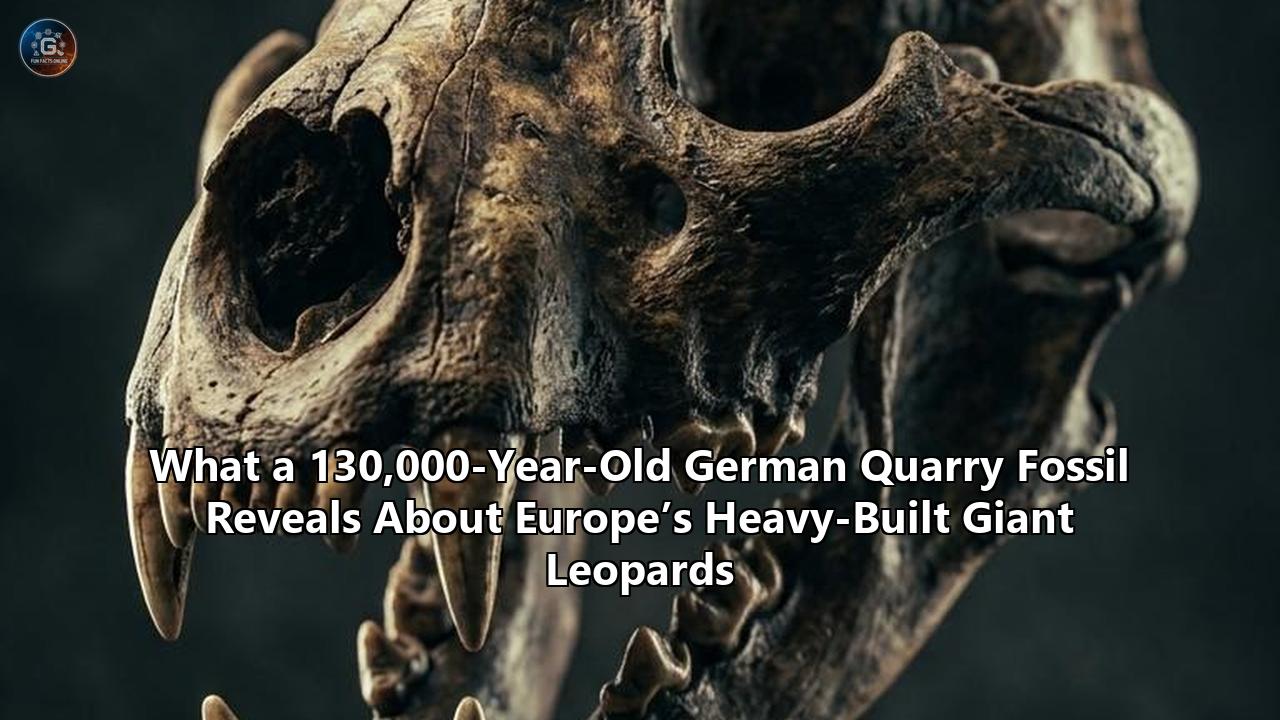
The June 2026 announcement of a newly identified prehistoric feline subspecies has upended traditional understandings of Europe’s Ice Age ecosystems. German paleontologists Helmut Hemmer and Ralf-Dietrich Kahlke published a comprehensive study describing Panthera pardus burgtonnae, a heavily built, giant leopard that roamed Central Europe during the Eemian interglacial period, roughly 130,000 to 115,000 years ago.
The identification of this ancient predator is based on fossil material recovered from the historic Burgtonna travertine quarry in Thuringia, Germany. While these specimens were initially excavated in 1993, decades of meticulous anatomical comparison and taxonomic sorting were required to confirm that they belonged to an entirely distinct, jaguar-like leopard lineage.
The discovery of these giant leopard fossils highlights the remarkable physical and ecological plasticity of the genus Panthera. Rather than resembling the slender, agile leopards that climb trees in modern African savannas, Panthera pardus burgtonnae was stocky, powerful, and built for a ground-dwelling lifestyle in the dense, temperate forests of Pleistocene Europe.
This revelation has sparked a spirited debate within the paleontological community, forcing scientists to weigh competing evolutionary models. Was this massive build the result of rapid convergent evolution, as leopards rushed to fill the ecological niche left vacant by the extinct European jaguar (Panthera onca gombaszoegensis)? Or does it point to a more complex, controversial history of ancient interspecies hybridization and genetic introgression?
Analyzing the tradeoffs between traditional morphometrics and modern paleogenomics reveals how this single fossil discovery is reshaping our understanding of Europe's lost megafauna.
Unearthing Thuringia's Travertine Treasures
The physical evidence for Panthera pardus burgtonnae comes from the Burgtonna travertine deposits in Thuringia, Germany—a fossil-rich site of immense historical significance to Quaternary paleontology. For centuries, travertine mining in Thuringia has unearthed the remains of extinct megafauna, dating back to some of the earliest scientific investigations of the prehistoric world.
In 1696, the German scholar Wilhelm Ernst Tentzel famously interpreted fossilized elephant (mammoth) bones recovered from Burgtonna. This study is widely regarded by science historians as the starting point of Quaternary paleontology in Europe, establishing the region as a crucial zone for understanding Pleistocene environments.
Burgtonna Travertine Quarry (Thuringia, Germany)
  |
  +--> 1696: Wilhelm Ernst Tentzel describes mammoth bones (Quaternary Paleontology begins)
  |
  +--> 1990s: Intensified travertine quarrying reveals massive vertebrate bone beds
  |
  +--> 1993: Collector Andreas Lindner recovers leopard remains in the southern pit
  |
  +--> June 2026: Hemmer & Kahlke officially describe Panthera pardus burgtonnae
During the early 1990s, intensified commercial quarrying in the Burgtonna southern pit opened up massive new geological exposures. Recognizing the scientific value of these outcrops, a dedicated private collector named Andreas Lindner spent years salvaging fossils from the machinery's path.
Over his lifetime, Lindner amassed an extraordinary collection of approximately 2,500 vertebrate specimens, which was eventually transferred to the Senckenberg Research Station of Quaternary Palaeontology in Weimar for curation and analysis.
Tucked within the Lindner Collection were several highly diagnostic feline remains found in 1993, including:
- A well-preserved hemimandible (half of a lower jaw)
- A highly distinct upper carnassial tooth ($P^4$)
- Several postcranial limb bones
Before this study, giant leopard fossils from this specific era had been tentatively lumped into a poorly defined, informal category known to specialists as the "Mosbach/Taubach group". This was a catch-all morphotype used to describe unusually large, robust leopards whose exact taxonomic status remained highly contentious.
The description of Panthera pardus burgtonnae by Hemmer and Kahlke has finally provided this mysterious group with a formal, scientifically validated name and a precise diagnostic profile.
Anatomy of a Forest-Dwelling Giant
To reconstruct the physical profile of Panthera pardus burgtonnae, Hemmer and Kahlke analyzed the metric and morphological traits preserved in the Burgtonna quarry fossils. The fossil lower jaw and dentition belonged to a relatively young individual, as evidenced by the minor, superficial wear on the chewing surfaces of the teeth.
Based on the slender shape of the jaw, the researchers concluded that the animal was likely a female. Yet despite its young age and probable female sex, the skeletal elements painted a picture of an extraordinarily robust animal.
The individual stood approximately 107 to 112 centimeters in head-and-body length and weighed between 35 and 40 kilograms. While these length dimensions are comparable to those of modern adult female African leopards (Panthera pardus pardus), the skeletal robusticity was vastly different.
The limb bones of P. p. burgtonnae were exceptionally thick and heavy, indicating a muscular, stocky build that far exceeds the proportions of any living leopard population.
Physical Proportions and Sexual Dimorphism
In feline biology, sexual dimorphism is highly pronounced. In modern leopard subspecies, males are typically 30% to 50% larger than females. If the 40-kilogram Burgtonna specimen represents a young female, then fully grown male leopards of this subspecies would have been true giants.
Extrapolating from the female's skeletal dimensions, paleontologists estimate that adult males of Panthera pardus burgtonnae likely averaged between 75 and 95 kilograms, with the largest individuals potentially exceeding 100 kilograms.
At this size, these leopards would have comfortably overlapped with the weight ranges of modern female lions and large New World jaguars.
| Feature / Metric | Panthera pardus burgtonnae (Eemian Subspecies) | Modern African Leopard (P. p. pardus) | Modern Jaguar (Panthera onca) |
|---|---|---|---|
| Geological Era | Late Pleistocene (Eemian, ~130,000 BP) | Holocene to Present | Holocene to Present |
| Body Build | Extremely robust, stocky, short-limbed | Slender, gracile, elongated limbs | Extremely stocky, barrel-chested, short-limbed |
| Est. Weight (Female) | 35 – 40 kg (Young adult) | 20 – 40 kg (Fully adult) | 35 – 60 kg (Fully adult) |
| Est. Weight (Male) | 75 – 100+ kg (Fully adult) | 40 – 80 kg (Fully adult) | 60 – 120+ kg (Fully adult) |
| Primary Habitat | Closed, temperate deciduous forests | Open savannas, montane forests, woodlands | Dense rainforests, swamps, riparian corridors |
| Hunting Style | Ground-based, heavy ambush | High-climbing, generalist stalker | Ground-based, crushing bite-force specialist |
To formally quantify this dramatic difference in body shape, Hemmer and Kahlke introduced a new "body mass index" (or robusticity index) designed to compare the cross-sectional density and length proportions of Pleistocene feline bones against modern equivalents.
The results of this metric index were striking. When plotted on a morphological matrix, the skeletal proportions of Panthera pardus burgtonnae did not group with modern gracile leopards.
Instead, they shifted dramatically toward the morphospace occupied by jaguars. This indicates that these ancient European leopards had abandoned the lightweight, climbing-adapted body plan of their African ancestors in favor of a heavily muscled, low-slung, powerful build optimized for terrestrial power.
Taxonomic Shake-up: Organizing Europe's Pleistocene Leopards
The formal naming of Panthera pardus burgtonnae has forced a major taxonomic reorganization of the European fossil record. The evolutionary history of the leopard on the European continent has long been described by specialists as "confused," owing to centuries of sporadic fossil finds, inconsistent naming conventions, and the lack of diagnostic skull material.
Historically, any leopard-sized bone recovered from a Late Pleistocene cave in Germany, France, or Switzerland was typically assigned to Panthera pardus spelaea—the classical "European Ice Age leopard" or "cave leopard" described by Emil Bächler in 1936.
However, Hemmer and Kahlke's study argues that this sweeping classification oversimplifies a highly dynamic, multi-layered evolutionary story.
        PREVIOUS TAXONOMY (Simplified)
        ┌──────────────────────────────────────────────┐
        │  Late Pleistocene: Panthera pardus spelaea   │
        └──────────────────────────────────────────────┘
                               │
                               ▼
        REVISED TAXONOMY (Hemmer & Kahlke, 2026)
        ┌──────────────────────────────────────────────┐
        │  Eemian Interglacial (MIS 5e):               │
        │  Panthera pardus burgtonnae                  │
        ├──────────────────────────────────────────────┤
        │  Last Glacial (Weichselian):                 │
        │  Panthera pardus antiqua                     │
        └──────────────────────────────────────────────┘
The researchers present a new taxonomic division of European Late Pleistocene leopards into two distinct geographic and chronological subspecies:
1. Panthera pardus burgtonnae (The Interglacial Form)
This subspecies, newly defined by the Burgtonna material, represents the leopards of the warm Eemian interglacial period (Marine Isotope Stage 5e) and the cold phases immediately preceding it. It evolved from older Middle Pleistocene European leopards and was widespread from Central Europe down to the Italian (Apennine) Peninsula, occasionally extending into Western Europe.
It is characterized by specific dental markers, including a distinctively broad fourth lower premolar ($P_4$), a relatively narrow first lower molar ($M_1$), and a low paraconid with a shallow notch on the lower carnassial tooth. Its build was exceptionally heavy and jaguar-like.
2. Panthera pardus antiqua (The Glacial Form)
The team taxonomically revised and re-elevated the name Panthera pardus antiqua (originally proposed as Felis antiquus by Georges Cuvier in 1825) to describe the leopards that dominated Central, Western, and Southeastern Europe during the last severe glacial period, the Weichselian.
While also heavily built compared to modern African leopards, P. p. antiqua represents a separate, cold-adapted lineage that successfully survived in the steppe-tundra and subalpine boreal forests.
This taxonomic separation is crucial because it recognizes that Europe's Pleistocene leopards were not a single, unchanging population that persisted for hundreds of thousands of years.
Instead, the continent experienced successive waves of feline migrations, local extinctions, and rapid physical adaptations, with different subspecies evolving in response to the dramatic climatic swings of the Ice Age.
Convergent Adaptation vs. Ancient Hybridization
The central and most exciting debate triggered by the discovery of Panthera pardus burgtonnae revolves around the evolutionary mechanism that produced its heavy, jaguar-like build. How did a species known today for its slender, tree-climbing agility transform into a thick-limbed, ground-dwelling powerhouse?
To answer this, paleontologists are examining two competing scientific theories, each presenting vastly different implications for the field of evolutionary biology.
                     ┌──────────────────────────────────────┐
                     │ THE EVOLUTIONARY CONUNDRUM           │
                     │ Why was P. p. burgtonnae so robust?  │
                     └──────────────────┬───────────────────┘
                                        │
             ┌──────────────────────────┴──────────────────────────┐
             ▼                                                     ▼
┌───────────────────────────┐                         ┌───────────────────────────┐
│ HYPOTHESIS A              │                         │ HYPOTHESIS B              │
│ Ecological Convergence    │                         │ Genetic Introgression     │
├───────────────────────────┤                         ├───────────────────────────┤
│ • Jaguar goes extinct     │                         │ • Coexisted with last     │
│   (~300,000 BP)           │                         │   European jaguars        │
│ • Leopards grow larger    │                         │ • Interspecies mating     │
│   to fill the vacant      │                         │ • Jaguar genes for heavy  │
│   predator niche          │                         │   skeletons enter leopard │
│                           │                         │   gene pool               │
└───────────────────────────┘                         └───────────────────────────┘
Hypothesis A: The Ecological Niche Replacement Model (Convergent Evolution)
The traditional and widely accepted scientific model explains the stocky build of P. p. burgtonnae through the lens of natural selection and ecological niche adaptation. Under this view, the morphology of the European leopard was directly tied to the presence—or absence—of competing large felids.
During the Early and Middle Pleistocene, Europe was home to the European jaguar (Panthera onca gombaszoegensis). This massive, robust cat was the dominant medium-to-large predator of European woodlands, weighing up to 210 kilograms and specialized in hunting heavy, terrestrial prey in forested river valleys.
As long as the European jaguar was abundant, incoming leopards (Panthera pardus) remained incredibly rare, small, and gracile. They were ecologically compressed, forced to stay lightweight and agile to avoid direct, lethal confrontations with the larger jaguars.
However, around 300,000 years ago, Panthera onca gombaszoegensis went extinct in Europe, likely due to intense competition with newly arriving cave lions (Panthera spelaea) and cave hyenas (Crocuta crocuta spelaea), combined with severe environmental fragmentation.
This extinction left a massive, continent-wide ecological vacuum. The niche of a robust, heavy-built, ambush predator specialized in hunting medium-sized herbivores in dense, temperate forests was suddenly empty.
According to the ecological replacement model, European leopards rapidly expanded their geographic range and evolved to fill this vacant role. Over generations, they underwent dramatic physical changes:
- Bergmann’s Rule: They grew larger overall, a common response in mammals adapting to colder, seasonal European environments.
- Mechanical Selection: They developed shorter, thicker, and highly robust limb bones to increase leverage and skeletal strength. This allowed them to grapple with and bring down larger, heavier prey on the forest floor, such as wild boars, fallow deer, and juvenile bison.
- Arboreal Abandonment: Because Europe's temperate forests lacked the massive, specialized tree-dwelling competitors or high-climbing kleptoparasites (like baboons or spotted hyenas) found in Africa, the European leopard had no ecological pressure to remain a lightweight, agile tree-climber. It became a strictly ground-based power-hunter, converging on the body plan of the extinct jaguar.
The key trade-off of this model is its simplicity and reliance on well-documented evolutionary principles. It explains the physical changes in P. p. burgtonnae as a straightforward, functional response to environmental demands and empty ecological space.
Hypothesis B: The Genetic Introgression Model (Ancient Hybridization)
In their 2026 paper, Hemmer and Kahlke propose a much more provocative, alternative hypothesis: they suggest that the jaguar-like build of Panthera pardus burgtonnae may not be entirely due to convergent evolution.
Instead, they argue that we cannot rule out an "introgressive influence" from the last surviving late Middle Pleistocene European jaguars (Panthera onca gombaszoegensis).
In evolutionary genetics, introgression is the transfer of genetic information from one species to another through hybridization and backcrossing. Hemmer and Kahlke point out that during the transition period when the European jaguar was declining and the European leopard was expanding, these two closely related pantherine species would have coexisted in the same European habitats.
As the jaguar population collapsed and individuals became highly isolated, finding mates of their own species would have become increasingly difficult. Under extreme demographic stress, closely related Panthera species are known to hybridize in the wild.
         JAGUAR-LEOPARD HYBRIDIZATION PATHWAY (Theoretical)

   Panthera onca gombaszoegensis           Panthera pardus
        (Extinct Jaguar)                  (Incoming Leopard)
               │                                  │
               └─────────────────┬────────────────┘
                                 ▼
                           F1 Hybrid Cat
                    (50% Jaguar / 50% Leopard)
                                 │
                                 ▼  (Backcrossed with leopards)
                       Panthera pardus burgtonnae
                (Leopard phenotype with jaguar-derived
                   genes for skeletal robusticity)
According to this hybridization model, male jaguars may have mated with female leopards (or vice versa), producing viable hybrid offspring. Over thousands of years, these hybrids backcrossed repeatedly with the expanding leopard population.
While the resulting cats remained behaviorally and anatomically leopards, they may have inherited specific, highly advantageous genetic complexes from their jaguar ancestors.
Most notably, they could have retained the genetic pathways responsible for heavy bone density, wide jaws, and dense muscle attachment points. This genetic "boost" would have immediately pre-adapted the leopards to their new role as Europe's heavy-bodied forest specialists.
This hybridization hypothesis is highly unique because it challenges the clean, branching tree-of-life model of evolution. If true, it means that Panthera pardus burgtonnae was not just an ecological replacement for the European jaguar, but literally a physical carrier of its genetic legacy.
Furthermore, the authors note that these leopards may have also hybridized with European snow leopards (Panthera uncia pyrenaica), suggesting that Pleistocene Europe was a complex, highly dynamic genetic melting pot of giant cats.
Methodological Clash: Morphometrics vs. Paleogenomics
The debate over the origin of Panthera pardus burgtonnae highlights a fundamental methodological tension in modern paleontology: the clash between classical morphometrics and the emerging power of paleogenomics. Each scientific approach has unique capabilities, distinct limitations, and critical trade-offs.
       METHODOLOGY COMPARISON: HOW WE STUDY ICE AGE FELIDS

            CLASSICAL MORPHOMETRICS
            ┌──────────────────────────────────────────────┐
            │ Pros: Works on mineralized bone, accessible  │
            ├──────────────────────────────────────────────┤
            │ Cons: Cannot easily separate convergence     │
            │       from genetic inheritance               │
            └──────────────────────────────────────────────┘
                                  vs.
            ANCIENT DNA (PALEOGENOMICS)
            ┌──────────────────────────────────────────────┐
            │ Pros: Defines exact lineage, proves/disproves│
            │       ancient hybridization events           │
            ├──────────────────────────────────────────────┤
            │ Cons: Highly prone to environmental decay,   │
            │       extremely rare in warm travertine sites│
            └──────────────────────────────────────────────┘
The Morphometric Approach
Helmut Hemmer and Ralf-Dietrich Kahlke’s study is a masterclass in classical morphometrics. This methodology relies on the highly precise, physical measurement of fossil bones and teeth, comparing their shape, size, and mechanical ratios to those of modern and extinct animals.
The primary advantage of morphometrics is its universal applicability. Because bones are durable and fossilize readily under the right conditions, paleontologists have access to thousands of specimens spanning millions of years.
By measuring the width of the lower jaw, the length of the teeth, and the thickness of the limb bones, researchers can reconstruct an animal’s body mass, bite force, locomotive style, and ecological role with high accuracy.
However, the major trade-off of morphometrics is its inability to definitively resolve genetic inheritance. Physical bones are highly sensitive to environmental pressures.
Under a phenomenon known as "phenotypic plasticity," two entirely unrelated species living in similar environments can independently evolve nearly identical skeletal features.
Therefore, morphometrics alone cannot determine whether P. p. burgtonnae acquired its robust, jaguar-like limbs through direct interspecies mating (hybridization) or simply through standard natural selection (convergent evolution).
The Paleogenomic Approach
To truly solve the mystery of the giant leopard's origins, scientists must turn to paleogenomics—the extraction and sequencing of ancient DNA (aDNA). If researchers can successfully extract nuclear DNA from the Burgtonna quarry fossils, they can sequence the animal's entire genome and compare it directly to modern leopards, modern jaguars, and fossil specimens of Panthera onca gombaszoegensis.
A genetic analysis of this level would provide definitive answers:
- The Hybridization Signature: If hybridization occurred, the genome of P. p. burgtonnae will show clear, undeniable blocks of jaguar-derived DNA (called introgressed tracts) interspersed throughout its chromosomes.
- The Divergence Timeline: By analyzing the rate of neutral genetic mutations, paleogenomicians can calculate exactly when the European leopard lineage diverged from African and Asian populations, mapping out the precise pathways of their ancient migrations.
The massive trade-off of paleogenomics is its extreme vulnerability to environmental degradation. DNA is a highly fragile molecule that begins to break down immediately after an animal dies.
Its preservation is entirely dependent on temperature, moisture, and chemical conditions:
- The Ideal Environment: Cold, dry, and stable environments—such as the sub-zero permafrost of Siberia or deep, dry limestone caves—are excellent for preserving DNA, allowing scientists to sequence genomes from bones that are tens of thousands of years old.
- The Travertine Problem: Travertine deposits, like those at Burgtonna, are formed by the rapid chemical precipitation of calcium carbonate from active, mineral-rich, and often warm spring waters. This makes travertine quarries highly hostile environments for ancient DNA. The combination of water, heat, high mineral turnover, and fluctuations in acidity rapidly destroys organic collagen and breaks DNA strands into tiny, unsequenceable fragments.
Thus, while paleogenomics offers the ultimate, definitive proof of P. p. burgtonnae's evolutionary history, the physical reality of the fossil record means that, for now, we are entirely dependent on the highly detailed, anatomical clues provided by morphometrics.
Coexistence and Survival in a Guild of Giants
To truly appreciate what the discovery of Panthera pardus burgtonnae reveals, we must reconstruct the vibrant, highly dangerous world in which this giant leopard lived. The Eemian interglacial period was a warm, lush interval characterized by dense temperate forests of oak, elm, and hazel blanketing Central Europe, with climates occasionally warmer than those of today.
           THE EEMIAN PREDATOR GUILD (Central Europe, ~130,000 BP)

   ┌─────────────────────────────────────────────────────────────┐
   │  APEX MEGA-PREDATORS                                        │
   │  • Cave Lion (Panthera spelaea) - Up to 350 kg              │
   │  • Cave Hyena (Crocuta crocuta spelaea) - Up to 100 kg      │
   └──────────────────────────────┬──────────────────────────────┘
                                  │
          ┌───────────────────────┴───────────────────────┐
          ▼                                               ▼
┌───────────────────────────┐                   ┌───────────────────────────┐
│ MEDIUM-LARGE PREDATORS    │                   │ LARGE HERBIVORE PREY      │
│ • P. p. burgtonnae        │                   │ • Forest Elephants        │
│   (35-100 kg)             │  ◄──────────────  │ • Rhinoceroses            │
│ • European Dhole          │   (Hunts young/   │ • Aurochs & Bison         │
│ • Wolves                  │    vulnerable)    │ • Fallow Deer & Boar      │
└───────────────────────────┘                   └───────────────────────────┘
In this landscape, P. p. burgtonnae was not a solitary king, but part of a highly competitive "predator guild" packed with massive carnivores:
- *The Cave Lion (Panthera spelaea): A colossal cat weighing up to 350 kilograms, the cave lion was the undisputed apex predator of the open glades and floodplains, hunting massive prey like steppe bison, horses, and young mammoths.
- The Cave Hyena (Crocuta crocuta spelaea): Bone-crushing social predators that weighed up to 100 kilograms, hyenas dominated the landscape in highly organized clans, monopolizing carcasses and caves.
- The Cave Bear (Ursus spelaeus): Giant omnivores that, while primarily vegetarian, were highly defensive of their winter dens and would aggressively drive away smaller predators.
- Neanderthals (Homo neanderthalensis): Highly skilled, cooperative human hunters who occupied the same rock shelters and targeted the same medium-to-large game.
The Strategy for Coexistence
How did a giant leopard survive in a forest teeming with giant lions, aggressive hyenas, and spear-wielding Neanderthals? Modern ecology and the fossil record suggest a highly successful strategy based on habitat partitioning and tactical stealth.
Because lions and hyenas preferred more open grasslands, river valleys, and large, spacious caverns, P. p. burgtonnae retreated into the thickest, most tangled parts of the temperate forest.
Their robust, stocky, jaguar-like build was a major asset here. Short, powerful limbs provided exceptional acceleration and turning power over short distances, allowing the leopard to launch explosive ambush attacks from dense undergrowth, rather than relying on long-distance chases.
                     TEMPORAL & HABITAT PARTITIONING

            ┌───────────────────────────────────────────────┐
            │ Open Plains / River Valleys                   │
            │ • Cave Lions (Daytime active)                 │
            │ • Cave Hyenas (Nocturnal active)              │
            └───────────────────────────────────────────────┘
                                   ▲
                                   │  (Habitat partitioning)
                                   ▼
            ┌───────────────────────────────────────────────┐
            │ Dense Forest / Rocky Crags                    │
            │ • P. p. burgtonnae (Ambush, crepuscular)      │
            │ • Deep recess caves used as solitary dens     │
            └───────────────────────────────────────────────┘
Furthermore, while modern leopards famously drag their prey up into trees to protect it from lions and hyenas, tree-caching would have been highly difficult—if not impossible—for a 100-kilogram leopard trying to haul a 150-kilogram deer up a temperate oak tree.
Instead, the fossil record reveals that Europe's giant leopards utilized physical geography. They dragged their kills into the deep, narrow, and inaccessible crevices of small rocky caves.
Lions and cave bears were too large to squeeze into these tight spaces, and hyenas were often reluctant to enter highly confined rock fissures.
By using their brute, jaguar-like strength to haul carcasses into rocky sanctuaries, P. p. burgtonnae effectively protected their hard-earned meals and safely raised their young in the shadows of giants.
What the Quarry Fossil Reveals: Key Takeaways
The study of Panthera pardus burgtonnae is far more than a simple exercise in naming a new prehistoric animal. It has provided scientists with several crucial insights into the broader patterns of evolutionary biology, prehistoric ecology, and the resilience of apex predators.
1. The Dynamic Nature of the Pleistocene Fossil Record
For decades, researchers viewed the European leopard as a static, monolithic species that experienced little change over its long history on the continent.
The identification of P. p. burgtonnae proves that European leopards were highly dynamic, undergoing rapid morphological shifts and diversifying into distinct subspecies in response to changing climates and shifting competitor guilds.
2. The Power of "Ghost Niches"
The stocky build of the Burgtonna leopard highlights how the extinction of one species can fundamentally reshape the evolution of another.
When the European jaguar went extinct, its ecological "footprint" remained. The leopard’s rapid transformation into a heavy-bodied power-hunter demonstrates how species will evolve to fill these vacant "ghost niches," converging on the physical shapes of extinct predecessors.
3. The Prevalence of Ancient Hybridization
The proposal that P. p. burgtonnae carried genetic material from late Middle Pleistocene jaguars adds to a growing scientific consensus: interspecies hybridization was highly common in Earth's history.
Rather than evolution operating as a strict branching tree, it often functions as a complex, braided stream, with genes flowing back and forth between closely related species to produce highly adaptable, resilient new forms.
The Next Frontiers in Pleistocene Feline Research
As paleontology moves forward, several unresolved questions and exciting research avenues remain on the horizon.
                     FUTURE RESEARCH MILESTONES

┌───────────────────────────┐         ┌───────────────────────────┐
│ Travertine Paleogenomics  │         │ Global Morphometric DB    │
├───────────────────────────┤         ├───────────────────────────┤
│ Developing new chemical   │         │ Integrating 3D scans of   │
│ techniques to isolate aDNA│  ◄───►  │ teeth and jaw fossils to  │
│ from highly mineralized   │         │ map feline robusticity    │
│ travertine quarry bones.  │         │ across continents.        │
└───────────────────────────┘         └───────────────────────────┘
The most highly anticipated milestone will be the development of new, highly specialized chemical techniques to isolate ancient DNA from travertine-preserved fossils.
If molecular biologists can overcome the severe mineralization barriers of the Burgtonna specimens, sequencing a complete nuclear genome of Panthera pardus burgtonnae* would provide definitive, genetic proof of jaguar-leopard hybridization. This would representing a major leap forward for the field of paleogenomics.
Furthermore, paleontologists are working to integrate these new European findings into a global database of fossil feline measurements.
By comparing the 3D laser scans of teeth and jaw fossils from Germany, Spain, and Italy, researchers hope to map out exactly how and where the giant, heavy-built leopards of the Pleistocene migrated, interacted, and ultimately faded away, leaving behind the sleek, lightweight survival specialists we know today.
Ultimately, the 130,000-year-old jawbone from the Burgtonna quarry serves as a powerful reminder that our modern natural world is merely a quiet, simplified remnant of a far grander, wilder, and more complex epoch.
In the shadows of Europe's ancient forests, leopards were not just agile tree-climbers—they were heavy-built, jaguar-like giants, ruling their woodland domains with raw, muscular power.
Reference:
- https://www.sci.news/paleontology/panthera-pardus-burgtonnae-14883.html
- https://www.researchgate.net/publication/407027752_Panthera_pardus_burgtonnae_ssp_nov_Mammalia_Carnivora_Felidae_from_the_Eemian_of_Burgtonna_Thuringia_Germany_-_Late_Pleistocene_European_leopards_in_a_new_perspective
- https://twilightbeasts.org/2015/08/06/the-silent-hunter/
- https://www.researchgate.net/publication/395234067_The_European_Ice_Age_Leopard_or_European_Late_Pleistocene_Leopard_Panthera_pardus_spelaea_Bachler_1936
- https://www.researchgate.net/figure/Distribution-area-of-Panthera-pardus-in-Europe-during-the-Lower-and-Middle-Pleistocene_fig7_235711164
- https://en.wikipedia.org/wiki/European_leopard
- https://alchetron.com/European-Ice-Age-leopard
- https://www.reddit.com/r/Naturewasmetal/comments/1u86716/a_large_ice_age_leopard_panthera_pardus/
- https://www.reddit.com/r/pleistocene/comments/1u7h7z7/panthera_pardus_burgtonnae_ssp_nov_mammalia/
- https://www.reddit.com/r/pleistocene/comments/1u7h7z7/panthera_pardus_burgtonnae_ssp_nov_mammalia/
- https://www.researchgate.net/publication/358278788_An_intriguing_find_of_an_early_Middle_Pleistocene_European_snow_leopard_Pantheraunciapyrenaica_ssp_nov_Mammalia_Carnivora_Felidae_from_the_Arago_cave_Tautavel_Pyrenees-Orientales_France
- https://animals.fandom.com/wiki/European_Ice_Age_Leopard
- https://en.wikipedia.org/wiki/European_leopard
- https://www.sci.news/paleontology/panthera-pardus-burgtonnae-14883.html
- https://www.researchgate.net/publication/407027752_Panthera_pardus_burgtonnae_ssp_nov_Mammalia_Carnivora_Felidae_from_the_Eemian_of_Burgtonna_Thuringia_Germany_-_Late_Pleistocene_European_leopards_in_a_new_perspective
- https://www.researchgate.net/figure/ce-Age-leopard-importing-an-ibex-carcass-into-the-former-entrance-rock-shelter-of-the_fig8_260453475
- https://www.researchgate.net/publication/233564290_The_first_record_of_leopard_Panthera_pardus_Linnaeus_1758_from_the_Pleistocene_of_Poland
- https://www.mdpi.com/2571-550X/8/4/65
- https://www.researchgate.net/publication/397315587_New_Records_of_Panthera_gombaszoegensis_Kretzoi_1938_from_Europe
- https://animals.fandom.com/wiki/European_Jaguar
- https://uchytel.com/Panthera-pardus-spelaea
- https://en.wikipedia.org/wiki/Panthera_gombaszogensis
- https://flore.unifi.it/retrieve/55af840f-798c-448d-85fd-0c5f44ca1e61/Prat-Vericat%20et%20al%202025%20JQS%20-%20Pyrenean%20leopards.pdf
- https://pmc.ncbi.nlm.nih.gov/articles/PMC6198532/
- https://www.researchgate.net/scientific-contributions/Ralf-Dietrich-Kahlke-82332862
- https://www.researchgate.net/figure/Baumanns-Cave-in-Ruebeland-with-the-herein-described-leopard-remains-which-were-found-in_fig5_260453475