A viral trend sweeping digital platforms has turned ordinary kitchens into high-voltage physics labs, prompting safety alerts from national agencies and reigniting a long-standing debate over how science is taught. Dubbed the "#ElectricPickleChallenge," the online phenomenon features participants taking ordinary dill pickles, driving metal nails into opposite ends, and connecting them directly to household power outlets via rigged extension cords.
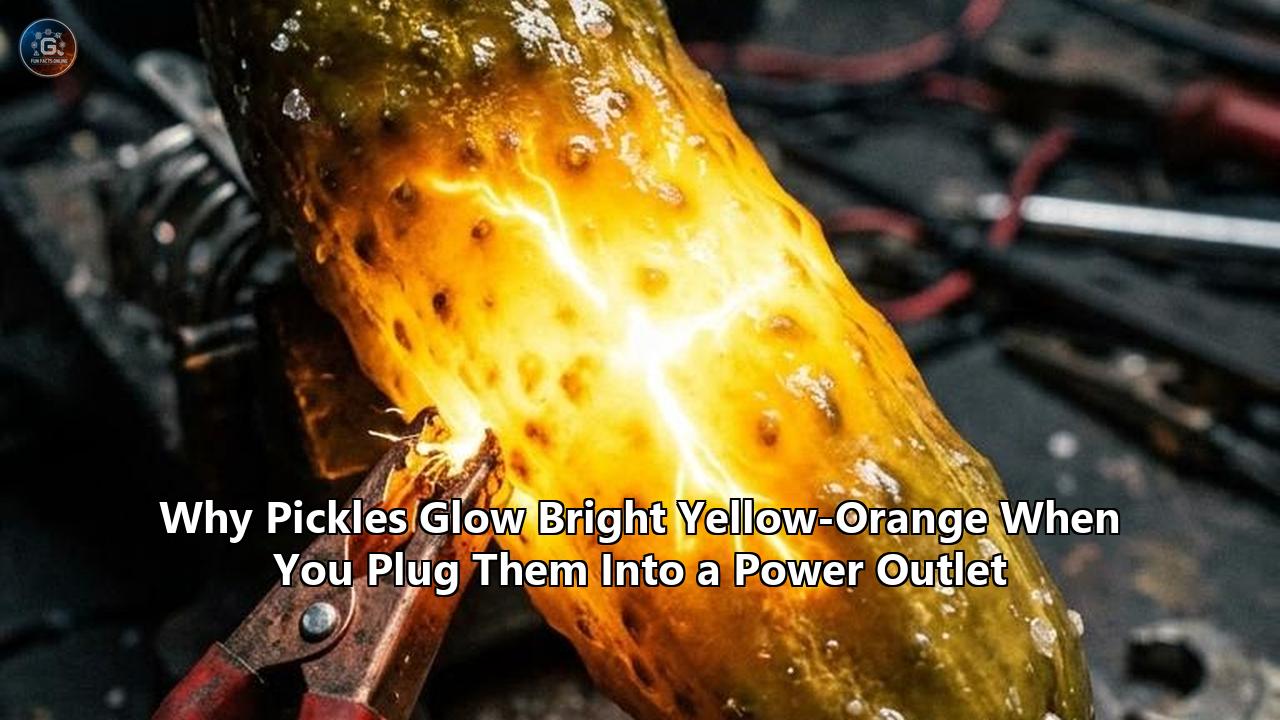
The result is a sudden, dramatic display: the vegetable hisses, spits steam, and suddenly erupts into a bright, flickering yellow-orange luminescence.
In response to a spike in emergency room visits, residential electrical fires, and severe shocks, a joint safety advisory has been issued by the Consumer Product Safety Commission (CPSC) and the National Science Teaching Association (NSTA). The warning urges the public to cease the DIY experiment immediately.
While the striking visual has captivated millions of viewers online, it has also brought a decades-old classroom demonstration into the national spotlight, prompting many to ask: why do pickles glow when subjected to such extreme electrical currents?
What appears to be a simple, lighthearted stunt is actually a complex, violent convergence of electrochemistry, plasma physics, and thermodynamic breakdown. While the demonstration has been used in academic settings for more than 30 years to illustrate the fundamentals of atomic emission, its transition from supervised laboratories to domestic kitchens has sparked serious concerns about the safety of self-guided science education in the digital age.
The Physical Chemistry Behind the Luminescence
To understand why do pickles glow, one must first examine the pickling process itself. Cucumbers are transformed into pickles by soaking them in a concentrated brine solution. This brine is heavily saturated with vinegar (acetic acid) and, most importantly, sodium chloride ($NaCl$), commonly known as table salt.
When salt dissolves in the water content of the cucumber, its crystalline lattice breaks apart. The solid sodium chloride dissociates into freely moving positive sodium ions ($Na^+$) and negative chloride ions ($Cl^-$). This cellular saturation transforms the humble pickle from a non-conductive vegetable into a highly efficient liquid electrolyte—a medium capable of conducting an electric current.
               [120V AC Power Source]
                /                 \
        [Electrode 1]          [Electrode 2]
             |                      |
    +--------v----------------------v--------+
    |  [ NaCl Dissociated: Na+ & Cl- Ions ]  | <-- Wet Pickle
    |                                        |
    |  *Steam Vapor Gap Forms at Hotter End* |
    |  *Dielectric Breakdown & Electric Arc* | --> Yellow-Orange Glow (589 nm)
    +----------------------------------------+
When two metal electrodes, such as iron nails or aluminum strips, are inserted into the ends of the pickle and connected to a standard 120-volt alternating current (AC) household outlet, a complete electrical circuit is established. The voltage difference forces the dissociated ions to migrate: the positive sodium ions are drawn toward the negative electrode (the cathode), while the negative chloride ions migrate toward the positive electrode (the anode). Because household electrical supply uses alternating current, the polarity of the electrodes switches 60 times per second (60 Hz in North America), causing the ions to rapidly oscillate back and forth within the vegetable's moisture channels.
This rapid movement of ions creates electrical resistance. As the current forces its way through the tight cellular structure of the pickle, it generates immense localized heat through a process known as Joule heating (or ohmic heating).
The resistance within the pickle is never perfectly uniform. Consequently, one side of the pickle—often the area surrounding the electrode with slightly less surface contact or higher localized resistance—begins to heat up much faster than the rest of the vegetable.
As the temperature at this high-resistance junction rapidly climbs to 100°C (212°F), the water in the surrounding brine begins to boil violently. This boiling vaporizes the liquid water, creating a thin, insulating pocket of steam (water vapor) directly around the metal electrode.
Because water vapor is a gas, it has a much lower electrical conductivity than the surrounding liquid brine. This sudden change in physical state creates a massive resistance barrier across an incredibly narrow gap.
The 120 volts of electrical potential pressing through the circuit are suddenly concentrated across this micro-thin layer of steam. This voltage is high enough to exceed the dielectric breakdown strength of the vapor layer.
The electricity jumps across the gap, ionizing the steam and forming a sustained electric arc, or micro-plasma discharge. This arc is incredibly hot, reaching temperatures that instantly vaporize the nearby sodium ions suspended in the brine.
This is the exact moment the light is born. The extreme thermal and electrical energy within the plasma arc excites the outer valence electrons of the vaporized sodium atoms, kicking them into higher, unstable energy orbitals.
Because atoms seek thermodynamic stability, these excited electrons almost instantly fall back down to their stable ground-state orbitals. As they relax, they must shed their excess energy. They do so by emitting a photon of light.
Because every element has a unique electronic configuration, the energy difference between the excited state and the ground state is highly specific to the element in question. For sodium, this electronic transition corresponds to a very specific wavelength of electromagnetic radiation: the famous "sodium doublet" (two closely spaced spectral lines at 589.0 nm and 589.6 nm). This precise wavelength falls squarely within the yellow-orange band of the visible light spectrum.
This is the exact same optical mechanism used in the high-pressure sodium vapor streetlights that illuminated highways for decades with a familiar amber glow.
In essence, when you plug a pickle into a wall outlet, you are not simply shocking a vegetable; you are constructing a crude, highly volatile, organic sodium-vapor lamp.
Who is Affected: The Stakeholders of a High-Voltage Crisis
The resurgence of the glowing pickle demonstration, driven by short-form video algorithms, has had a profound impact across several segments of society. No longer confined to blackboards and lab benches, the phenomenon has created ripples among educators, emergency responders, parents, and scientific safety organizations.
1. Curious DIYers and the Social Media Generation
The primary group affected by the viral spread of this experiment consists of teenagers and young adults seeking to replicate eye-catching content. Enticed by the visual payoff and the seemingly simple setup—requiring only a standard dill pickle, some wire, and nails—many attempt the experiment in their bedrooms or kitchens.
These amateur experimenters are exposed to the highest level of direct physical danger. Unlike trained chemistry demonstrators, home users rarely possess variable power supplies (such as Variac transformers) or isolation circuits, meaning they are working directly with uninhibited 120V grid power.
Amateur DIY Setup (Dangerous)
[120V Wall Outlet] ---> [Rigged "Suicide Cord"] ---> [Exposed Nails in Pickle] ---> High Risk of Shock/Fire
                                                          ^ (No insulation, no safety fuse)

Professional Lab Setup (Controlled)
[AC Power Source] ---> [Variac Transformer (variable voltage)] ---> [GFCI Outlet] ---> [Enclosed Safety Shield] ---> Pickle
2. Science Educators and Academic Institutions
For physics and chemistry teachers, the glowing pickle has historically been a crown jewel of classroom engagement—a "gee-whiz" demonstration that never fails to capture student attention. However, the institutional liability landscape has changed dramatically.
With safety bodies like the NSTA cracking down on high-voltage demonstrations that expose students to open circuits, teachers are finding themselves caught between the desire to inspire students and the strict legal mandates of school safety codes.
Many districts have banned the live demonstration altogether, forcing teachers to adapt by using pre-recorded videos or highly restricted, low-voltage alternatives.
3. First Responders and Electrical Utility Inspectors
The rise of home-brewed "pickle lamps" has led to an uptick in localized residential electrical incidents. Fire departments have reported responding to house fires initiated by overloaded power strips, melted extension cords, and combusting vegetables.
Utility workers and electricians have also noted an increase in destroyed household outlets and tripped main breakers caused by the dead-short circuits that can occur if the metal electrodes inside a pickle accidentally touch one another during the experiment.
What Changes: The Move to Restrict High-Voltage DIY Science
The sudden transition of the electric pickle from a harmless, periodic science joke into a hazardous viral trend has triggered significant shifts in safety regulations, educational policies, and platform content moderation.
A Strict Pushback on "Suicide Cords"
In the electrical trade, the rigged wires used to connect the pickle directly to a wall outlet are known colloquially as "suicide cords." These are cords with a standard male plug on one end and raw, exposed copper wire or alligator clips on the other.
The viral spread of instructions on how to manufacture these cords has alarmed electrical safety groups. Retailers and online marketplaces are facing increased pressure to monitor and restrict the sale of loose alligator clip adapters, while safety advocates are calling for broader public education on the lethal nature of 120V household current.
Structural Reforms in the Science Classroom
Within academic institutions, the NSTA has pushed for a rigorous application of the "Hierarchy of Controls" to all classroom demonstrations. This framework ranks safety interventions from most effective to least effective:
- Elimination/Substitution: Replacing the physical, high-voltage pickle experiment with safer alternatives, such as safe flame tests of sodium salts or video demonstrations.
- Engineering Controls: Requiring the use of physical, transparent safety shields (like polycarbonate panels) and conducting the experiment inside a certified fume hood to capture toxic gasses.
- Administrative Controls: Implementing mandatory, written safety assessments and ensuring that only the instructor operates the power source, while students remain at a safe, designated distance.
- Personal Protective Equipment (PPE): Mandating the use of high-dielectric rubber safety gloves, impact-resistant safety goggles, and face shields for anyone in the immediate vicinity.
This structural shift represents a departure from the informal, highly permissive classroom environments of previous generations, signaling a broader movement toward zero-tolerance safety policies in STEM education.
Short-Term Consequences: Fire, Fumes, and immediate Dangers
When an individual plugs a pickle into a standard wall outlet, the immediate physical consequences are rapid, violent, and highly unpredictable. The physical chemistry of the process means that a glowing pickle is not just a light source; it is a highly active chemical reactor producing heat, flammable gasses, and corrosive compounds.
1. High-Voltage Electrical Shock Hazards
The most pressing short-term danger is the risk of electrocution. Dill pickles are highly conductive because of their wet, ionic brine.
When 120V AC is applied across the vegetable, anyone who touches the pickle, the wet plate beneath it, or the exposed metal electrodes becomes an alternate path to ground.
The human body, which is also filled with salty, conductive fluids, will readily conduct the current. A shock from a 120V wall outlet can cause:
- Painful muscular contractions that prevent the victim from letting go of the wire.
- Severe internal and external thermal burns at the points of entry and exit.
- Cardiac arrhythmia or ventricular fibrillation, which can be fatal.
The risk is amplified because the experiment involves liquids. If the pickle drips conductive brine onto the surrounding table or countertop, the entire surface can become electrified, creating an invisible shock zone.
2. Combustion, Steam Explosions, and Fire Risks
As the current heats the pickle, the moisture inside boils rapidly. This can cause pockets of steam to build up high pressure deep within the pickle’s flesh, leading to sudden, violent "pops" that spray boiling-hot pickle juice, charred pulp, and superheated steam outward. If this hot, conductive juice lands on an exposed electrical wire or paper towels used for cleanup, it can instantly ignite a fire.
Furthermore, as the electric arc burns through the organic matter of the cucumber, it creates active combustion. The pickle begins to char and smoke heavily, producing a pungent, offensive odor of burning vinegar, dill, and scorched organic tissue. If left plugged in for more than a minute, the pickle will dry out completely, catch fire, and melt the surrounding plastic apparatus, posing a severe threat to nearby residential structures.
3. The Generation of Toxic Gasses
The chemical reactions occurring at the electrodes are not limited to heating. The passage of direct or alternating current through a sodium chloride solution triggers electrolysis. This electrolytic breakdown of water ($H_2O$) and salt ($NaCl$) produces several hazardous byproducts:
- Chlorine Gas ($Cl_2$): Produced at the positive anode, chlorine is a highly toxic, pale-green gas that severely irritates the respiratory tract, eyes, and mucous membranes. Inhaling chlorine gas in an enclosed space can cause coughing, choking, and chemical pneumonitis.
- Hydrogen Gas ($H_2$): Produced at the negative cathode, hydrogen is an invisible, odorless gas that is highly flammable and explosive when mixed with air and exposed to the heat of the electric arc.
- Sodium Hydroxide ($NaOH$): Commonly known as lye, this highly corrosive alkaline compound forms around the cathode, transforming the liquid dripping from the pickle into a strong chemical irritant that can cause chemical burns upon contact with bare skin.
This toxic cocktail of chemical emissions means that a home kitchen can quickly fill with harmful vapors, presenting a serious inhalation hazard to the experimenter and any household pets.
Long-Term Consequences: Educational Shifts and Scientific Legacy
While the immediate physical hazards of the glowing pickle experiment are clear, its long-term consequences extend deep into the realms of science education, digital culture, and the history of technology.
The Educational Conundrum: The Death of the "Gee-Whiz" Demo?
Historically, spectacular, slightly dangerous science demonstrations were the primary hook used by educators to spark a lifelong interest in STEM fields. However, the rising emphasis on physical safety and liability is slowly phasing out these high-energy live events.
The long-term consequence of this trend is a major shift in how science is demonstrated in schools.
Rather than witnessing live, unpredictable physical reactions, students are increasingly receiving instruction through virtual simulations, pre-rendered animations, and safe, low-energy table-top experiments.
Some educators worry that this "depopularization" of physical chemistry demonstrations might lead to a decline in student engagement, while others argue that the safety benefits far outweigh the loss of classroom spectacle.
A Digital Archive of Hazardous Science
The viral nature of the "#ElectricPickleChallenge" highlights a broader, systemic issue: the persistence of hazardous DIY tutorials on modern social media platforms.
Long after safety agencies issue warnings, videos of glowing pickles remain accessible online, continually discovered by new generations of curious viewers.
This digital footprint has forced tech companies to reevaluate their moderation algorithms, leading to the implemention of warning labels and the removal of videos that demonstrate the construction of high-voltage "suicide cords".
This ongoing struggle between user-generated curiosity and platform responsibility will continue to shape how scientific information is disseminated online.
The Pickle's Surprising Contribution to Solid-State Lighting
Despite its current status as a hazardous internet trend, the glowing pickle occupies a surprisingly prestigious place in the history of optoelectronics.
The first fully documented, peer-reviewed scientific paper on the "glowing pickle" was published in 1989 by researchers at Digital Equipment Corporation’s Western Research Laboratory. Though released as a lighthearted April Fools' Day technical note, the paper detailed serious, rigorous science regarding the phenomenon of electroluminescence.
Evolution of Luminescent Technology:
[Flame Spectroscopy (1800s)]
        |
[The Glowing Pickle (1989)] ---> Illustrated organic/ionic light emission
        |
[Modern OLEDs / QLEDs] ---------> Utilizes similar electron-relaxation principles
The underlying principle of the electric pickle—applying a voltage across a medium to excite electrons, which then release photons of a specific wavelength—is the fundamental concept behind modern solid-state lighting. The science of why do pickles glow serves as a crude, macro-scale analog to the operation of:
- Light Emitting Diodes (LEDs): Where electrons and holes recombine across a semiconductor bandgap to emit precise colors of light.
- Organic Light-Emitting Diodes (OLEDs): Where electric current excites organic molecules to produce high-resolution, vibrant displays for smartphones and televisions.
- Quantum Dot Displays (QLEDs): Which rely on quantum confinement to tune emission wavelengths based on nanoparticle size, mimicking the atomic emission lines of the sodium-doped pickle brine.
By examining how a wet, organic vegetable can be forced to emit light through ionic conduction, early electronic researchers gained intuitive insights into how molecular structures could be engineered to emit light more efficiently.
Thus, the humble pickle helped bridge the conceptual gap between old-world, high-heat incandescent bulbs and the cold, hyper-efficient, solid-state displays that dominate our visual environment today.
Technical Specifications: The Anatomy of the Pickle's Emission
For scientific purists, understanding why do pickles glow requires looking at the exact physical parameters that govern the phenomenon.
Below is a detailed technical summary of the typical physical and chemical metrics observed during a standard electric pickle demonstration:
| Parameter | Value / Range | Scientific Significance |
|---|---|---|
| Input Voltage | $110\text{ V} - 140\text{ V}$ AC | Provides the electrical potential required to initiate Joule heating and overcome the dielectric breakdown of the vapor barrier. |
| Operating Current | $1.5\text{ A} - 4.5\text{ A}$ | High current flow that causes rapid thermal boiling of the internal brine solution. |
| Power Consumption | $150\text{ W} - 600\text{ W}$ | Extremely energy-inefficient; most energy is wasted as heat, steam, and sound, rather than light. |
| Emission Wavelength | $589.0\text{ nm} - 589.6\text{ nm}$ | The "Sodium D-Line" doublet, responsible for the characteristic bright yellow-orange light. |
| Plasma Arc Temp. | $> 1,500\text{ °C}$ | Localized temperature of the micro-plasma arc that vaporizes and excites the sodium atoms. |
| Byproduct Gases | $Cl_2$, $H_2$, $H_2O$ (steam) | Chemical products of the electrolysis of brine and the combustion of organic matter. |
| pH at Cathode | $\approx 12 - 14$ (Highly Alkaline) | Result of the accumulation of sodium hydroxide ($NaOH$) around the negative electrode. |
Exploring Spectral Variations: The Multi-Colored Vegetable Lab
One of the most compelling aspects of the science behind the glowing pickle is its versatility. Because the yellow-orange glow is entirely dependent on the presence of sodium ions from table salt ($NaCl$), researchers and educators have experimented with modifying the pickling process to produce different colors.
By first soaking a fresh cucumber in a hydrogen peroxide or bleach solution to strip away its natural green chlorophyll, scientists can create a neutral, white vegetable canvas.
They can then preserve the vegetable in a custom-made brine containing different metal halide salts. When these custom pickles are plugged into the power outlet, the resulting atomic emission spectra produce a stunning array of alternative colors:
Lithium Chloride ($LiCl$) – Magenta Pink
When a pickle is saturated with lithium chloride, the electrical current vaporizes the lithium atoms. The relaxation of lithium's valence electrons releases photons at a wavelength of approximately 671 nm, resulting in a striking, bright pinkish-red glow.
Strontium Chloride ($SrCl_2$) – Crimson Red
Strontium is famous for its role in fireworks, where it is used to produce deep, vibrant red colors. In a customized pickle, the excitation of strontium electrons produces a brilliant crimson light, radiating at wavelengths between 640 nm and 660 nm.
Potassium Chloride ($KCl$) – Lilac Purple
Soaking a bleached cucumber in a potassium chloride solution (often sold as a salt substitute for individuals on low-sodium diets) yields a soft, pale violet or lilac glow. Potassium’s primary visible emission lines are situated in the violet spectrum at 404 nm, with a secondary near-infrared line at 766 nm.
Barium Chloride ($BaCl_2$) – Pale Apple Green
Soaking the vegetable in barium chloride produces a soft, pale-green luminescence, corresponding to barium's emission lines around 553 nm.
Safety Note: Unlike food-grade table salt, compounds like barium chloride and copper chloride are highly toxic. Pickles made with these industrial salts must never be consumed under any circumstances and require specialized hazardous waste disposal.Safe Alternatives: Teaching the Science Without the Hazard
Because of the high risks associated with plugging organic materials directly into 120V household outlets, science educators have developed highly effective, safe alternatives to demonstrate these exact chemical principles.
These methods allow students to engage with atomic emission and ionic conduction without the risk of electrical shock or toxic gas inhalation.
                     [Safe Classroom Alternatives]
                                   |
         +-------------------------+-------------------------+
         |                                                   |
 [The Classic Flame Test]                         [Low-Voltage Electrolysis]
  - Dip loop in metal salt                         - 9V battery with LED
  - Place over Bunsen burner                       - Shows ionic conduction
  - Safely view emission lines                      - Completely shock-free
1. The Classic Flame Test
Instead of using electricity to excite metal atoms, teachers can use thermal energy from a controlled Bunsen burner. By dipping a clean platinum or nichrome wire loop into various metal salt solutions (such as sodium chloride, copper sulfate, or strontium chloride) and placing it into the flame, the flame will instantly change color.
Students can observe these colors through cheap hand-held diffraction grating glasses to view the distinct, sharp spectral emission lines of each element, completely replicating the physics of the glowing pickle without any electrical hazards.
2. Low-Voltage Ionic Conduction Indicators
To demonstrate how salt water conducts electricity, teachers can construct a simple, low-voltage circuit using a safe 9V battery and a small LED light.
By cutting the wire of the circuit and placing the two exposed ends into a cup of freshwater, the LED remains unlit.
However, as soon as table salt is stirred into the water, the dissociated sodium and chloride ions immediately begin conducting the electricity, and the LED illuminates.
This simple demonstration teaches the exact same concept of electrolyte conductivity without exposing students to dangerous line voltages.
3. Spectroscopic Analysis of Sodium Vapor Lamps
For advanced physics classes, purchasing a sealed, commercially manufactured sodium vapor spectrum tube is a highly effective option. These tubes contain a tiny amount of pure sodium gas sealed within a glass envelope.
When placed into a safe, enclosed, high-voltage spectrum tube power supply, the gas glows with the exact same yellow-orange 589 nm light as the electric pickle.
This setup allows students to use precise spectrometers to measure the sodium doublet with mathematical accuracy, completely free of smoke, fire hazards, or toxic odors.
What to Watch for Next: The Future of Viral Science Safety
As we move forward, the intersection of digital media, public safety, and hands-on science education continues to evolve. Several key milestones and unresolved questions remain on the horizon:
- Platform Liability and Automated Moderation: Will major social media networks implement automated, real-time video detection algorithms to instantly flag or take down dangerous DIY high-voltage content? The success of these algorithms could set a new standard for online safety and digital citizenship.
- The Evolution of STEM Safety Standards: Will state education departments implement stricter regulations on the types of physical chemistry demonstrations allowed in public schools? The ongoing transition toward virtual reality (VR) laboratories could soon make physical, high-voltage science demonstrations a relic of the past.
- Innovations in Consumer Safety Devices: Will future residential building codes mandate the installation of smarter, more sensitive Arc-Fault Circuit Interrupters (AFCIs) and Ground-Fault Circuit Interrupters (GFCIs) capable of immediately detecting when a non-standard, organic load (like a pickle) is drawing power from an outlet, cutting the current before a fire or shock can occur?
Ultimately, the glowing pickle stands as a brilliant, cautionary monument to the laws of nature. It reminds us that even the most mundane household items—a simple green cucumber, preserved in salty water—contain the fundamental secrets of light and energy.
But as science continues to move out of the textbook and into our lives, the responsibility to treat these natural forces with respect remains our most important lesson. While the question of why do pickles glow can be beautifully answered by the elegant dance of relaxing sodium electrons, the danger of the experiment remains a stark reminder that electricity is a force that does not tolerate casual curiosity.
Reference:
- https://partner.projectboard.world/oas/project/glowing-pickle-ljmrdv
- https://astrocamp.org/blog/electric/
- https://sciencenotes.org/glowing-pickle-or-electric-pickle-experiment/
- https://grokipedia.com/page/glowing_pickle_demonstration
- https://wp.optics.arizona.edu/oscoutreach/electric-pickle/
- https://shlomostrauss.com/post/why-a-pickle-glows-yellow-when-electric-current-passes-through-it
- https://www.nsta.org/blog/being-shielded-avoid-safety-pickle
- https://en.wikipedia.org/wiki/Glowing_pickle_demonstration
- https://mse.engin.umich.edu/internal/demos/luminescence-as-displayed-in-a-glowing-pickle
- https://www.youtube.com/watch?v=LFefJyQhw0c
- https://www.youtube.com/watch?v=aab8VjzuXyM
- https://blog.susnano.wisc.edu/2017/09/07/electrocuting-pickle/
- https://thinkenergy.libsyn.com/what-do-pickles-electrical-safety-have-in-common
- https://www.instructables.com/Glowing-Pickle/
- https://theowlteacher.com/electricity-pickles/
- https://www.youtube.com/watch?v=f03WQHm2jSQ
- https://www.youtube.com/watch?v=5FO0IKUTkJ0
- https://www.youtube.com/watch?v=n8NI_KMpqAY
- https://mse.engin.umich.edu/internal/demos/luminescence-as-displayed-in-a-glowing-pickle