July 2026: The Stone that Bent Right
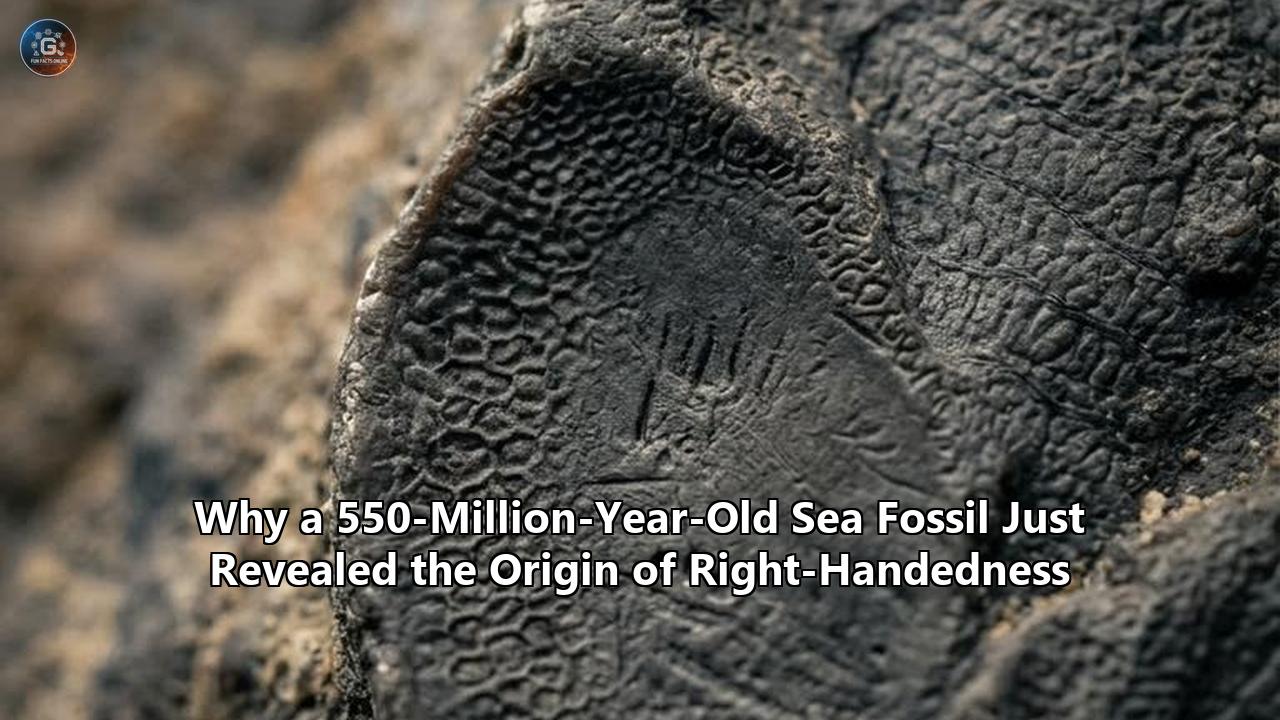
On July 9, 2026, a study published in the peer-reviewed journal Scientific Reports quietly upended our understanding of the deep history of the animal mind. An international research consortium led by Dr. Scott Evans, assistant curator of invertebrate paleontology at the American Museum of Natural History and Florida State University, announced a revelation hidden inside the sandstone of South Australia. A tiny, segmented, marine creature named Spriggina floundersi, which lived 550 million years ago, consistently chose to bend to its right side while crawling across the primeval seafloor.
In the language of modern evolutionary biology, this simple rightward curve is the oldest known evidence of population-wide behavioral lateralization. It is the ancient precursor to what we now call the origin of right-handedness.
               [ Ancient Seafloor, 550 Ma ]
                            │
               *Spriggina floundersi* crawls
             with a systematic rightward bias
                            │
              (Fossilized as leftward bends
             due to mirror-image preservation)
                            │
                            ▼
         [ Earliest Behavioral Lateralization ]
When modern humans write with a pen, throw a ball, or reach for a tool, they participate in a behavioral preference shared by roughly 90 percent of the global population. For centuries, science treated this right-hand dominance as a relatively recent evolutionary trait—perhaps a byproduct of hominin tool use, bipedalism, or the development of language centers in the left hemisphere of the brain.
The discovery of Dr. Evans and his coauthors—including Jenson Webb and William Parker of Florida State University, Ian V. Hughes of Harvard University, and Dr. Mary Droser of the University of California, Riverside—proves that the biological foundation of this bias was laid down hundreds of millions of years before the first hands, legs, or true brains even existed.
"When we talk about being right- or left-handed, most people likely think about how they hold a pencil or kick a soccer ball," Dr. Evans explained in a statement accompanying the release of the paper. "But our research shows that an animal without hands or feet, living over 500 million years ago, may have had its own version of handedness."
By demonstrating that Spriggina possessed a systematic, population-level preference for turning in one direction, the team has pushed the evolutionary timeline of brain asymmetry back to the dawn of multicellular life. It suggests that the split-brain processing strategy—where different halves of the nervous system specialize in distinct cognitive and motor tasks—is not a sophisticated, modern luxury. Instead, asymmetric thinking evolved alongside the very first bilateral bodies.
1946–1958: Unearthing the Ghostly Biota of the Flinders Ranges
To understand how a tiny marine fossil could resolve a mystery regarding human neurological architecture, we must return to a scorching afternoon in 1946 in the South Australian outback. Reginald Claude Sprigg, a young government geologist, was exploring the low, weathered hills of the Flinders Ranges. Specifically, he was surveying the old mining district of the Ediacara Hills for abandoned lead and copper workings.
During a lunchtime rest, Sprigg began overturning slabs of fine-grained quartzite. Imprinted on the undersides of these ancient stones were strange, circular, and leaf-like impressions. They looked like soft-bodied jellyfish, sea pens, and segmented worms, but they were preserved in sandstone—a geological medium normally hostile to the delicate structures of soft tissues.
       [ 1946: Reg Sprigg's Outback Discovery ]
                          │
          Discovers strange soft-bodied molds
             on weathered quartzite slabs
                          │
                          ▼
       [ 1958: Martin Glaessner's Description ]
                          │
           Formally names *Spriggina floundersi*
           using three highly distorted fossils
Sprigg recognized that these organisms were incredibly old, likely predating the Cambrian explosion—the famous geological event roughly 541 million years ago when complex, shell-bearing animals first burst into the fossil record. However, when he presented his findings to established paleontological circles, his claims were met with deep skepticism. At the time, the scientific consensus held that macroscopic life before the Cambrian was an impossibility; the pre-Cambrian Earth was believed to have been home only to microscopic algae and bacteria.
The tide began to turn in 1958 when Martin Glaessner, a paleontologist at the University of Adelaide, formally described several of Sprigg’s fossils. Among them was a bizarre, slender organism about three to five centimeters long. It possessed a smooth, horseshoe-shaped head shield and an elongated body made of overlapping, chevron-shaped segments. Glaessner named the genus Spriggina in honor of its discoverer. The specific epithet, floundersi, was chosen to honor Ben Flounders, an enthusiastic amateur fossil collector who helped secure key specimens.
Yet, with only three highly distorted specimens at his disposal, Glaessner could do little more than guess at what Spriggina actually was. He tentatively classified it as an early annelid worm or perhaps a primitive trilobite ancestor. For the next several decades, Spriggina remained an enigmatic curiosity, a flat outline pressed into South Australian stone, its biology and behavior entirely mysterious.
1959–2010: The Battle Over Bilateral Symmetry
As more Ediacaran fossils were discovered across the globe—from the desolate coasts of Newfoundland to the cliffs of the White Sea in Russia—paleontologists entered a decades-long debate over how to classify these ancient organisms. The central question was whether these creatures were the direct ancestors of modern animals or simply a failed "evolutionary experiment" that went entirely extinct before the Cambrian.
In the 1980s, the influential German paleontologist Adolf Seilacher proposed the "Garden of Ediacara" hypothesis. He argued that the Ediacaran biota did not belong to any modern animal groups. Instead, he claimed they were unique, compartmentalized, water-filled mattresses that lacked mouths, guts, or active locomotion, relying instead on passive absorption or symbiotic microbes for nutrition. Under Seilacher’s view, Spriggina was not a scurrying worm or a trilobite precursor, but a static, leaf-like organism stuck to the ancient seafloor.
However, as imaging technology and anatomical modeling advanced in the late 1990s and early 2000s, a different picture emerged. Researchers began to analyze the architectural symmetry of Spriggina with greater mathematical rigor.
   [ The Symmetry Spectrum ]

   Radial Symmetry (e.g., Jellyfish)
   - Multi-directional sensory input
   - No dedicated front, back, left, or right

   Bilateral Symmetry (e.g., *Spriggina*, Humans)
   - One central axis of symmetry
   - Distinct front (anterior) and back (posterior)
   - Distinct left and right sides
   - Correlated with forward movement & sensory concentration
Anatomical analysis revealed that Spriggina was one of the earliest known animals with true bilateral symmetry. Unlike radial organisms like jellyfish, which perceive and interact with their environment equally from all sides, a bilaterian has a clear orientation:
- A front end (anterior) where sensory structures are concentrated
- A rear end (posterior)
- A dorsal (top) and ventral (bottom) side
- A distinct left and right side
This basic structural layout is the exact body template shared by humans, insects, fish, and birds today.
This realization changed everything. If Spriggina was a mobile bilaterian, it meant it was actively navigating its environment, likely grazing on the thick microbial mats that covered the late Neoproterozoic seafloor.
Yet, even as Spriggina was elevated to the status of an evolutionary pioneer, the idea that it held clues to the origin of right-handedness was still far beyond the scientific horizon. Behavioral asymmetry was still widely believed to be an exclusive development of complex, brained animals that arose hundreds of millions of years later.
2011–2025: Excavating Nilpena's Storm Snapshots
The key to unlocking the behavioral secrets of Spriggina lay not in finding a single, perfect fossil, but in gathering a massive, statistically viable population. This became possible through the establishment of the Nilpena Ediacara National Park in South Australia.
Nilpena preserves a unique geological phenomenon: "storm snapshots." Half a billion years ago, this region was a shallow, sandy marine shelf lined with thick microbial mats. Periodically, massive underwater storms would whip up vast clouds of fine sand, instantly burying entire seafloor communities.
These rapid burial events acted like a prehistoric polaroid camera. They captured the marine organisms in their exact, real-time positions and configurations at the moment of ecological catastrophe.
                 [ Prehistoric Storm Burial ]
                              │
                 Seafloor community is active
                (e.g., *Spriggina* crawling)
                              │
                Underwater storm deposits sand
             instantly smothering the community
                              │
                              ▼
                [ Fossilized Bed Excavation ]
                              │
               Entire seafloor layer is lifted,
               revealing real-time behaviors
Under the leadership of Dr. Mary Droser, paleontologists from around the world spent over a decade conducting meticulous bed-scale excavations at Nilpena. Instead of chipping isolated fossils out of random rocks, the researchers painstakingly mapped and lifted entire sandstone beds, some the size of tennis courts.
By flipping these slabs over, they could examine the underside of the sandstone layers. This revealed the molded impressions of thousands of soft-bodied creatures frozen in their original ecological context.
Through these intensive excavations, the sample size of Spriggina floundersi grew from Glaessner’s original three specimens to over a hundred exceptionally preserved individuals. Some fossils were straight, some were gently curved, and others were deeply bent.
With this robust dataset in hand, Dr. Scott Evans and his colleagues realized they were no longer looking at static anatomical specimens. They were looking at a prehistoric track record of active, real-time movement.
The Core Scientific Pivot: Understanding Behavioral Lateralization
To appreciate the leap from a curved fossil to the origin of right-handedness, it is necessary to examine why modern animals exhibit side preferences in the first place.
In modern biology, behavioral lateralization refers to the preferential use of one side of the body over the other. In humans, this manifests most obviously as handedness. But lateralization is ubiquitous across the animal kingdom:
- Parrots show a consistent preference for grasping food with their left or right foot.
- Toads prefer to strike at prey located in their right visual field.
- Dolphins systematically tilt their heads to one side when searching for fish using echolocation.
- Cuttlefish display lateral biases when choosing which direction to escape from predators.
This lateralization is not a minor biological quirk; it is a physical manifestation of a highly organized, asymmetric nervous system. If an animal's body and brain were perfectly symmetrical, both sides of the nervous system would process the exact same information in the exact same way at the exact same time. This would lead to cognitive redundancy, slower reaction times, and potential behavioral paralysis when an animal is forced to make a rapid decision.
             Perfect Bilateral Symmetry (Symmetrical Brain)
             ┌─────────────────────────┴─────────────────────────┐
             ▼                                                   ▼
     Left eye sees predator                             Right eye sees food
     Left brain processes escape                        Right brain processes capture
             │                                                   │
             └─────────────────────────┬─────────────────────────┘
                                       ▼
                             Cognitive Conflict!
                        Slower decisions / Paralysis
By dividing cognitive tasks between the left and right halves of the brain, a lateralized animal gains a massive survival advantage. In vertebrates, the left hemisphere of the brain typically specializes in routine behaviors under familiar conditions, such as foraging and manipulating food. The right hemisphere remains vigilant for unexpected environmental changes, managing spatial orientation, social interactions, and escape responses to predators.
Before the July 2026 study, the prevailing theories for the origin of right-handedness pinned its development to much more recent evolutionary history:
- The Hominin Tool-Use Hypothesis: This theory proposed that as early humans began to craft and use stone tools roughly 2.5 million years ago, the fine motor skills required for tool manipulation became concentrated in the left hemisphere of the brain (which controls the right side of the body), driving the global population toward right-handedness.
- The Bipedalism/Gestural Hypothesis: This argument suggested that when our ancestors stood upright, freeing their hands for communication, gestural language developed in the left hemisphere alongside vocal language, pulling manual dominance along with it.
- The Cambrian Predator-Prey Arms Race: Some paleontologists pointed to asymmetric predation scars on Cambrian trilobites (such as those from the Olenellus zone, dating back 520 million years) as the earliest evidence of lateralized escape behavior, suggesting that handedness emerged as a defensive response to active predators.
Dr. Evans’ analysis of Spriggina floundersi bypassed all of these timelines. By looking back 550 million years, his team sought to discover whether behavioral lateralization was already present when the very first bilateral animals began to crawl.
2026: Cracking the Mirror-Image Code
To test whether Spriggina floundersi exhibited a genuine, population-level side preference, Evans and his team gathered data from more than 100 exceptionally preserved specimens. These fossils were sourced from both the pristine beds of the Nilpena Ediacara National Park and the permanent archives of the South Australian Museum in Adelaide.
The team needed to prove that the curves observed in these fossils were the result of the living animal's active muscle contractions rather than random geological distortion, water currents, or tectonic squeezing. To do this, they used a series of morphometric techniques:
- Landmark Analysis: They plotted six primary anatomical landmarks (labeled L1 through L6) along the main axis of each fossil. These landmarks mapped the horseshoe-shaped head, the central axial midline, and the tips of the lateral segments.
- Principal Component Analysis (PCA): By running the landmark coordinates through PCA, they quantified the overall shape variations. They discovered that geological forces could not account for the specific, highly localized curvature of the body segments.
- Bed Alignment Check: If underwater currents had bent the animals after they died, all the Spriggina fossils preserved on the same sandstone bed would have been bent in the same geographical direction. Instead, the researchers found specimens lying side-by-side that were bent in entirely different directions, proving that the curvature was an intrinsic, biological characteristic of each individual organism.
Once they established that the bends were biological, they counted the direction of the curves. The team made an unexpected discovery: roughly twice as many fossil specimens were bent to the left in the stone as to the right.
This is where the physics of Ediacaran fossilization became critical. Ediacaran fossils at Nilpena are preserved as "negative relief" molds. When Spriggina crawled along the sticky microbial mat on the seafloor, its body pressed downward into the mud. When sandstorm sediment covered the creature, it filled this depression.
Over millions of years, the sand hardened into sandstone, preserving a reversed, mirror-image impression of the animal's underside on the bottom of the rock layer.
           [ Living Animal ]                  [ Fossil Impression ]

             Bends RIGHT                          Coves LEFT

                ) ) )                                ( ( (
               ( ( (                                  ) ) )
              ( ( (                                    ) ) )
Because of this mirror-image preservation, a leftward bend in the hard sandstone represents a living animal that had bent its body to the right while crawling.
The statistics were clear:
- Over 70 percent of the examined Spriggina fossils displayed a distinct lateral bend.
- Of those bent specimens, approximately two-thirds were curved to the left in the rock.
- This translates to a 2:1 ratio of living animals that preferentially chose to flex their bodies and turn to the right as they navigated their ancient home.
"The dominance of bends to the left in fossils of Spriggina suggests a preference for right turns in life and represents the oldest evidence of behavioural handedness among animals," the researchers wrote in their paper.
The Neurological Frontier: Split-Brain Evolution
The discovery that a 550-million-year-old marine organism possessed a clear rightward bias has profound implications for modern neuroscience and our understanding of the origin of right-handedness. It suggests that the biological division of labor between the left and right halves of the brain is not a late-stage evolutionary development.
Instead, brain asymmetry appears to be an immediate, functional consequence of bilateral symmetry itself.
                [ The Bilaterian Package Deal ]

                   Bilateral Symmetry (Anatomy)
                                ┼
                 Directional Movement (Behavior)
                                │
                                ▼
                   Asymmetric Processing (Neural)
                                │
                                ▼
                  Population-Wide Handedness
When an organism transitions from a simple, radial body plan (like a sponge or coral) to a bilateral, forward-moving body plan, it enters a highly complex relationship with its environment. Moving forward means the animal is constantly encountering new sensory stimuli—food, obstacles, or varying chemistry—at its front end first.
To make sense of this incoming information, the animal’s nervous system must organize itself to process inputs and coordinate muscle outputs.
If the animal's nervous system is perfectly symmetrical, it faces a fundamental design flaw. For example, if a Spriggina encountered a microbial barrier directly ahead, a symmetrical nervous system might send equal, competing signals to both its left and right sides to turn. This would result in wasted energy and delayed movement.
By introducing a slight biological bias—a default neural pathway that favors turning to the right—the organism’s nervous system avoids this cognitive conflict, streamlining its decision-making process.
The fact that this bias is observed at the population level (meaning the majority of the species, rather than just isolated individuals, favored the right side) is also highly significant. If lateralization were completely random, you would expect a 50/50 split of right-turning and left-turning individuals in the fossil population.
In modern evolutionary biology, population-level lateralization is thought to be driven by social coordination and ecological interactions. For instance, if a group of animals all turn in the same direction when startled, they can maintain school or herd cohesion, reducing the chances of individuals being singled out by predators.
While Spriggina did not face complex, fast-moving predators in the late Ediacaran, they did live in highly dense, multi-species benthic communities on the seafloor. A shared, population-wide directional bias may have allowed these early animal communities to coordinate their foraging patterns, avoiding overlapping paths and maximizing their grazing efficiency on the microbial mats.
Furthermore, this discovery suggests that Spriggina possessed a far more advanced nervous system than previously believed. For decades, Ediacaran organisms were dismissed as simple, brainless, evolutionary dead-ends.
Now, the presence of systematic, lateralized behavior suggests they possessed a centralized, cord-like nervous system capable of asymmetric sensory integration and coordinated motor control.
Beyond South Australia: What Lies Ahead for Paleoneuroscience
The discovery of Dr. Evans and his colleagues has set a new benchmark for the field of paleoneuroscience—the study of brain and nervous system evolution through the fossil record. By pushing the origin of right-handedness back 550 million years, this study opens up several new avenues of research.
                     [ Next Frontiers ]
                             │
     ┌───────────────────────┼───────────────────────┐
     ▼                       ▼                       ▼
Trace Fossil Matching   Genetic Synteny         Expanded Ediacaran Taxa
Do we see matching      Do Hox/Nodal genes      Are other organisms
fossilized trails?      show ancient origin?    like *Yorgia* asymmetric?
1. Matching Trails to Body Curves
One of the most immediate next steps for researchers at Nilpena will be to match the physical bodies of Spriggina with their trace fossils—the actual crawling trails they left behind in the sediment.
While body fossils show the animal’s shape at the moment of burial, trace fossils preserve their active, ongoing behavior over minutes or hours. If researchers can find a Spriggina body fossil fossilized directly at the end of its own crawling trail, they can verify if the physical curves in the body match a continuous, right-leaning trajectory in the stone.
2. Investigating Genetic Symmetry-Breakers
Modern developmental biology has shown that the left-right asymmetry of animal bodies is controlled by a highly conserved suite of genes and signaling pathways, most notably the Nodal signaling pathway and certain Hox genes. These genetic switches are responsible for ensuring that our hearts develop on the left side of our chests and that our brains develop asymmetric hemispheres.
Following the July 2026 discovery, genomic researchers will likely look closer at primitive living bilaterians—such as simple marine flatworms and acoels—to see if the genetic machinery that breaks left-right symmetry was already active in the common ancestor we shared with Spriggina.
3. Testing Other Ediacaran Organisms for Laterality
Spriggina floundersi is not the only mobile organism preserved in the sandstone of Nilpena. Other early bilaterians, such as the flat, circular Yorgia or the segmented Yilingia, are also preserved in large numbers. [ Evolutionary Timeline ]
550 Ma 520 Ma 1.8 Ma Present
│ │ │ │
*Spriggina* Trilobite *Homo habilis* Modern Humans
Right-turning Predation Scars Dental Cuts 90% Right-handed
(Earliest Handedness) (Cambrian) (Pleistocene)Now that Dr. Evans' team has proven that population-level behavioral biases can be extracted from fossil populations, paleontologists will likely apply these same morphometric and statistical techniques to other Ediacaran species.
If they find similar rightward or leftward biases in other ancient groups, it will confirm that the split-brain strategy was a universal, foundational feature of early animal life rather than a quirk unique to Spriggina.
Ultimately, the sandstone beds of the Australian outback have revealed a profound truth about what it means to be human. The simple act of favoring our right hand when we reach for a tool is not a unique triumph of human culture or primate intelligence. It is a deep, ancient echo of a biological choice made by a tiny, worm-like creature wriggling its way across a dark, silent seafloor, 550 million years ago.
Reference:
- https://www.sci.news/paleontology/ediacaran-handedness-14908.html
- https://neurosciencenews.com/right-handed-evolution-31033/
- https://timesofindia.indiatimes.com/etimes/animals/a-550-million-year-old-fossil-may-reveal-the-worlds-oldest-right-handed-animal-suggesting-the-trait-evolved-long-before-humans-dinosaurs-or-mammals/amp_articleshow/132310159.cms
- https://timesofindia.indiatimes.com/etimes/animals/a-550-million-year-old-fossil-may-reveal-the-worlds-oldest-right-handed-animal-suggesting-the-trait-evolved-long-before-humans-dinosaurs-or-mammals/amp_articleshow/132310159.cms
- https://neurosciencenews.com/right-handed-evolution-31033/
- https://phys.org/visualstories/2026-07-ancient-fossil-reveal-animal-kingdom.amp
- https://jhanley.biostat.mcgill.ca/bios601/CandHchapter06/HistoryGeographyHumanHandedness.pdf
- https://en.wikipedia.org/wiki/Handedness
- http://www.lukemastin.com/handedness/history_prehistory.html
- https://adc.bmj.com/content/109/Suppl_1/A220.3
- https://neurosciencenews.com/right-handed-evolution-31033/
- https://neurosciencenews.com/right-handed-evolution-31033/
- https://www.ctvnews.ca/sci-tech/article/this-worm-like-ancient-creature-may-be-the-oldest-right-handed-animal/
- https://www.eurekalert.org/news-releases/1135136
- https://en.wikipedia.org/wiki/Spriggina
- http://www.righthandlefthand.com/pdf/NOTESALLCHAPTERSv2.pdf
- https://www.researchgate.net/publication/325497766_The_evolution_and_diversification_of_life
- https://www.researchgate.net/publication/408638483_Earliest_evidence_of_behavioural_handedness_in_the_Ediacaran_motile_bilaterian_Spriggina_floundersi
- https://www.amnh.org/explore/news-blogs/right-handedness-animals
- https://www.sci.news/paleontology/ediacaran-handedness-14908.html
- https://www.sci.news/paleontology/ediacaran-handedness-14908.html
- https://nautil.us/was-this-fossil-creature-the-first-right-hander-ever-1282619
- https://en.socportal.info/en/news/even-before-the-advent-of-hands-an-ancient-limbless-animal-turned-out-to-be-right-handed/
- https://alchetron.com/Yorgia
- https://pmc.ncbi.nlm.nih.gov/articles/PMC2666079/
- https://en.wikipedia.org/wiki/Yorgia
- https://www.popsci.com/science/first-right-hander-fossil/
- https://www.thebrighterside.news/post/550-million-year-old-fossil-may-reveal-first-ever-right-handedness-in-the-animal-kingdom/
- https://timesofindia.indiatimes.com/etimes/animals/a-550-million-year-old-fossil-may-reveal-the-worlds-oldest-right-handed-animal-suggesting-the-trait-evolved-long-before-humans-dinosaurs-or-mammals/articleshow/132310159.cms
- https://www.researchgate.net/publication/395213754_Quantifying_movement_Expanding_the_Ichnologist_toolkit
- https://www.mdpi.com/2073-8994/17/4/527
- https://royalsocietypublishing.org/rsos/article/11/7/240465/92962/Brain-asymmetry-as-minimization-of-free-energy-a
- https://pmc.ncbi.nlm.nih.gov/articles/PMC5472687/
- https://dokumen.pub/the-hand-and-the-brain-from-lucys-thumb-to-the-thought-controlled-robotic-hand-9781447153337-9781447153344-1447153332-1447153340.html
- https://www.researchgate.net/publication/250948947_The_Chengjiang_Biota_Record_of_the_Early_Cambrian_Diversification_of_Life_and_Clues_to_Exceptional_Preservation_of_Fossils
- https://www.eurekalert.org/news-releases/1135136
- https://english.cas.cn/newsroom/news/201909/t20190906_217133.shtml