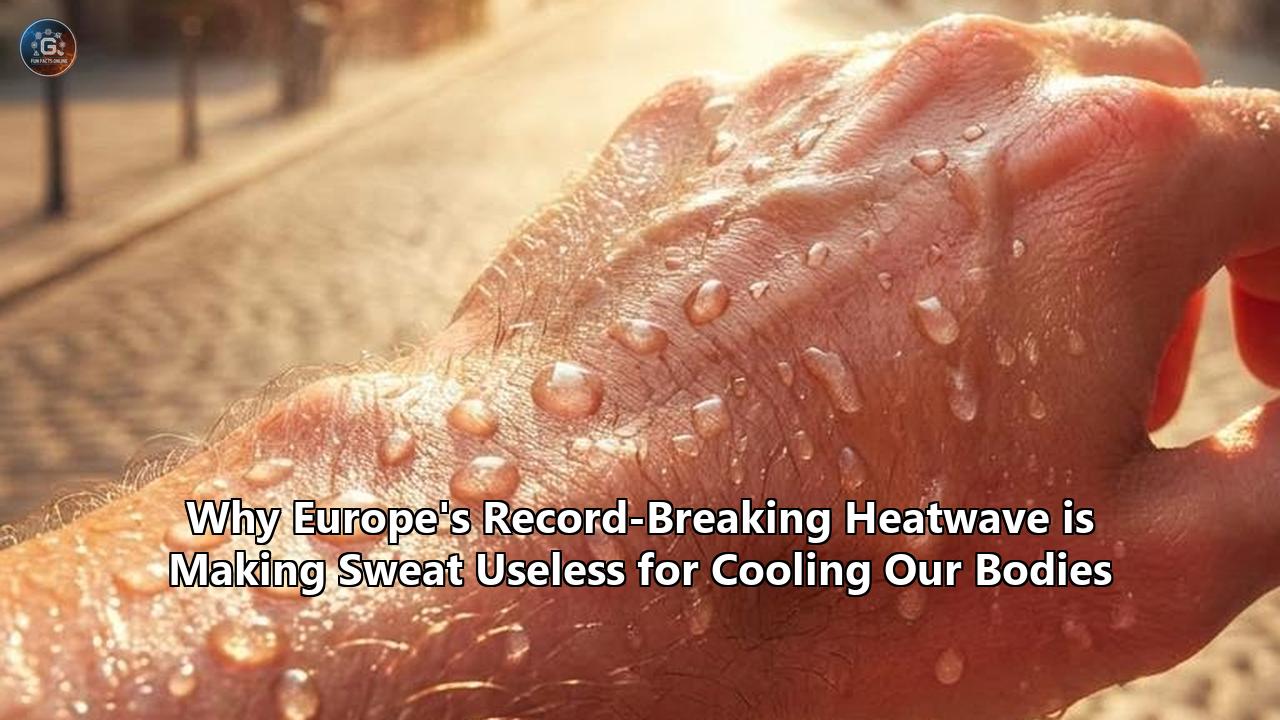
Under a slate-gray sky thick with unyielding humidity, Milan's northern industrial suburbs did not offer a breeze, only a heavy, damp weight that seemed to cling to the chest. It was late June 2026. On the asphalt of the Via Melchiorre Gioia, courier Marco Rossi adjusted the strap of his delivery pack, his shirt saturated with a dark, heavy circle of sweat. Under normal circumstances, that dampness would be his salvation—the bodily fluid designed to dry in the wind and carry away the rising heat of his working muscles.
Instead, the sweat simply pooled, dripping from his chin onto the hot handlebars of his bicycle. The air, thick with moisture carried by southerly winds blowing over a record-warm Mediterranean Sea, was already so full of water vapor that it refused to accept any more from Rossi’s skin. Rather than cooling him down, his sweat was behaving like a useless, warm film, trapping his body heat inside. Within two hours, Rossi’s heart rate had climbed to 140 beats per minute while he was merely standing still, his vision blurring at the edges of a historic, suffocating meteorological event.
This is the reality of the record-shattering June 2026 European heatwave. A massive high-pressure system, colloquially dubbed a "heat dome," has locked over Western and Central Europe, transporting superheated, humid air from North Africa directly into some of the continent's most populated urban centers. While previous European heatwaves, such as the deadly dry summers of 2003 and 2022, were characterized by parched winds and baking soils, the summer of 2026 has introduced a far more insidious threat: extreme humidity.
In a rapid attribution study released on June 26, 2026, by the World Weather Attribution (WWA) network, researchers revealed that an astonishing 45% of 854 European cities analyzed broke or were projected to break their all-time June heat-stress records. This stress is not measured by dry-bulb thermometers alone, but by Wet-Bulb Globe Temperature (WBGT)—a sophisticated index that accounts for air temperature, humidity, wind speed, and solar radiation to determine the true physiological load on the human body.
As temperatures soared to an all-time high of 41.9°C in Czechia, 41.7°C in Germany, and a staggering 45.1°C in Andújar, Spain, the accompanying humidity has effectively neutralized the human body's primary defense mechanism against heat. When sweat cannot evaporate, the complex biological systems we rely on for heatwave body cooling break down.
The result is a silent medical emergency unfolding across the continent. In France, emergency medical calls have spiked by 20%. In the United Kingdom, hospital systems have declared critical incidents due to surging admissions of patients suffering from heat-induced cardiovascular collapse. This investigative deep-dive explores the physiological, thermodynamic, and climatological mechanics behind why the June 2026 heatwave is rendering human sweat useless, pushing our species past the hard limits of its evolutionary design.
The Thermodynamics of Sweat: A Masterpiece of Evolutionary Engineering Stalls
To comprehend why Europe's current atmospheric state is so deadly, one must first appreciate the elegant physics of human thermoregulation. Homo sapiens are, in the words of evolutionary biologists, "sweating apes." Unlike most mammals, which rely on panting or dense coats of fur to buffer thermal shifts, humans shed their protective hair millions of years ago, paving the way for a highly dense network of eccrine sweat glands.
We possess between two million and five million of these microscopic glands distributed across our skin. When our internal core temperature rises even a fraction of a degree above its tightly regulated baseline of 37.0°C (98.6°F), the preoptic area of the hypothalamus acts as a biological thermostat. It fires neural signals down the sympathetic nervous system, releasing acetylcholine to stimulate the eccrine glands. The glands pull water, sodium, chloride, and trace minerals from the surrounding interstitial fluid and pump them onto the skin's surface.
       [Hypothalamus Detects Core Temp > 37°C]
                         │
                         ▼
        [Sympathetic Nervous System Activation]
                         │
                         ▼
         [Eccrine Sweat Glands Stimulated]
                         │
                         ▼
     [Water/Electrolytes Pumped onto Skin Surface]
                         │
        ┌────────────────┴────────────────┐
        ▼                                 ▼
[Vapor Pressure Gradient]       [Saturated Air / No Gradient]
        │                                 │
        ▼                                 ▼
   Evaporation                      Sweat Pools on Skin
        │                                 │
        ▼                                 ▼
[Heat Stripped from Body]      [No Evaporative Cooling]
        │                                 │
        ▼                                 ▼
 [Core Temp Stabilized]        [Core Temp Rises Uncontrollably]
However, a fundamental misunderstanding exists regarding how sweating actually cools us. Sweat itself is not cold; it is secreted at skin temperature, which is typically around 33°C to 35°C. The process of heatwave body cooling is not achieved by the mere presence of moisture on the skin, but through the physical transition of that liquid water into water vapor—a phase change governed by thermodynamics.
This phase change requires energy, specifically known as the latent heat of vaporization. To convert one gram of liquid sweat into vapor, the body must expend roughly 2,400 joules of thermal energy. When sweat evaporates from the skin, it absorbs this kinetic heat directly from the blood circulating in the superficial capillaries just beneath the dermis. The cooled blood then returns to the body's core, lowering internal temperatures. It is a highly efficient, closed-loop liquid-cooling system.
But this thermodynamic miracle relies on a single, unyielding physical variable: the atmospheric vapor pressure gradient.
For liquid sweat to transition into a gaseous state, the air directly adjacent to the skin must have a lower concentration of water vapor than the skin itself. In dry climates—such as the deserts of North Africa or the American Southwest—the air is thirsty. The vapor pressure gradient is steep. Sweat evaporates almost instantly upon reaching the skin, providing maximum cooling efficiency even in temperatures exceeding 45°C.
In the humid heatwave gripping Europe in June 2026, however, the air is already saturated. When relative humidity climbs alongside high temperatures, the vapor pressure of the atmosphere rises. As the gap between the vapor pressure of the sweat on the skin and the vapor pressure of the surrounding air shrinks to near zero, evaporation slows to a crawl and eventually stops.
"Without a gradient, the physical transition of water from a liquid to a gas cannot occur," says Dr. Rachel Cottle, an exercise physiologist who has spent years researching human heat limits. "The sweat glands keep pumping, driven by the brain's desperate commands to cool down. But that moisture has nowhere to go. It pools on the skin, drips off, and carries almost no heat with it. You are dehydrating yourself to produce liquid that is physically incapable of cooling your body."
When sweat becomes useless, the body's primary pathway for heat dissipation is severed. The thermal energy generated by basic metabolic processes, coupled with the radiant heat absorbed from the blazing European sun and the hot ambient air, begins to accumulate inside the body's core. The physiological engine is running, but the radiator is entirely blocked.
Dismantling the 35°C Myth: The Penn State H.E.A.T. Investigations
For over a decade, the international scientific community, along with organizations like the Intergovernmental Panel on Climate Change (IPCC), operated under a comforting theoretical assumption. Based on a seminal 2010 modeling study by climatologists Steven Sherwood and Matthew Huber, it was widely accepted that the absolute human survivability limit was a wet-bulb temperature of 35°C (95°F).
A wet-bulb temperature is measured by wrapping a wet wick around the bulb of a thermometer and exposing it to the air. It represents the lowest temperature to which an object can be cooled through evaporative cooling alone. A wet-bulb temperature of 35°C is equivalent to a dry-bulb temperature of 35°C at 100% relative humidity, or 46°C (115°F) at 50% humidity. The theory held that at this exact threshold, even a perfectly healthy, naked human resting in front of a powerful fan in the shade would eventually overheat and die after six hours, because sweat could no longer evaporate.
The problem with this 35°C limit was that it was entirely theoretical. It was based on idealized thermodynamic equations of heat balance, assuming a highly efficient, passive exchange of heat between a static human body and its environment. It did not account for the messy, real-world physiological responses of actual human beings.
To bridge this gap between climate models and human flesh, the Pennsylvania State University Human Environmental Age Thresholds (H.E.A.T.) project was launched. Led by Dr. W. Larry Kenney, a professor of physiology and kinesiology, alongside researchers S. Tony Wolf, Daniel Vecellio, and Rachel Cottle, the team set out to put real humans inside custom-built environmental chambers to find the true, empirical limits of human heat tolerance.
                 [The Old Myth vs. The Empirical Reality]

  OLD THEORETICAL LIMIT (Sherwood & Huber, 2010):
  ┌─────────────────────────────────────────────────────────┐
  │ 35°C Wet-Bulb Temperature                               │
  │ (Equivalent to 35°C / 95°F at 100% Humidity)            │
  │ Based on static mathematical models, naked/resting body │
  └─────────────────────────────────────────────────────────┘
                             VS.
  NEW EMPIRICAL LIMIT (PSU H.E.A.T. Project):
  ┌─────────────────────────────────────────────────────────┐
  │ 31°C Wet-Bulb Temperature (Young, Healthy Adults)       │
  │ (Equivalent to 31°C / 87°F at 100% Humidity)            │
  │ 26°C - 28°C Wet-Bulb Temperature (Older Adults)         │
  │ Based on real human subjects performing basic activity  │
  └─────────────────────────────────────────────────────────┘
The protocol was rigorous and carefully controlled. Young, healthy male and female subjects—many of them in peak physical condition—swallowed tiny, telemetric capsule pills equipped with internal radio transmitters. These "smart pills" continuously broadcasted the subjects' internal gastrointestinal temperature ($T_{gi}$), providing a highly accurate, real-time measurement of their core body temperature.
The subjects were then placed inside an environmental chamber where the air temperature and humidity could be precisely manipulated. To mimic the light, inevitable movements of daily life—such as cooking, vacuuming, or walking down the street—the subjects performed minimal physical activity, such as slowly walking on a treadmill or moving their arms in light patterns.
As the researchers slowly increased either the dry-bulb temperature or the humidity inside the chamber, they watched the subjects' vital signs, skin temperatures, and gastrointestinal temperatures. Under normal conditions, as the environment warmed, the subjects' core temperatures remained completely flat. Their bodies were successfully compensating for the heat through sweating and increased skin blood flow—a state known as compensable heat stress.
But then, as the humidity or temperature crept higher, every single subject reached a definitive, sharp tipping point. Suddenly, their core temperatures stopped being flat and began to curve sharply upward. They had crossed into uncompensable heat stress—the point where the body's heatward output can no longer match environmental heat gains.
The findings, published in the Journal of Applied Physiology, sent shockwaves through both the medical and climatological communities. Not a single subject reached the theoretical 35°C wet-bulb limit.
"What we discovered was that the actual, real-world limit for human adaptability is much lower than anyone had previously modeled," Dr. Larry Kenney explained during an interview detailing the project. "For young, healthy subjects, the critical wet-bulb temperature at which heat stress becomes uncompensable is actually around 31°C. That is 31°C wet-bulb, which equates to 31°C (88°F) at 100% relative humidity, or 38°C (100°F) at 60% humidity. Once you cross that threshold, your body can no longer prevent its core temperature from rising."
The Penn State team did not stop there. They continued their investigations to look at older adults, who represent the vast majority of casualties during extreme heat waves. The physiological changes that accompany aging—including a diminished density of active sweat glands, a reduced ability to pump blood to the skin, and a compromised cardiovascular system—further compress these thresholds.
For adults over the age of 65, the critical wet-bulb temperature limit dropped even lower, to between 26°C and 28°C wet-bulb. This means that in a humid environment, an elderly person sitting in a room at 28°C (82°F) with 100% relative humidity, or 34°C (93°F) with only 60% relative humidity, is already experiencing uncompensable heat stress. Their bodies are actively heating up, their sweat glands are failing to cool them, and their hearts are working at maximum capacity just to keep them alive.
Uncompensable Heat Stress: The Physiological Point of No Return
To understand what is happening inside the bodies of millions of Europeans during the June 2026 heatwave, we must look closely at the math of uncompensable heat stress. Once a person crosses their critical wet-bulb threshold, the body's homeostatic mechanisms are no longer in control. The core temperature does not merely elevate to a slightly higher, stable set point; it rises progressively and continuously.
In the PSU H.E.A.T. clinical trials, once subjects entered uncompensable heat stress, their core temperatures rose at an average rate of 0.74°C per hour during minimal activity. For those performing light ambulatory activities—such as walking at a leisurely pace of 2.2 miles per hour—the rate of core warming accelerated to between 0.87°C and 0.93°C per hour.
Let us trace the physical progression of this warming on an individual. Imagine a delivery worker, a construction laborer, or an elderly person trapped in an upper-floor Parisian apartment without air conditioning during the current heatwave. The ambient indoor wet-bulb temperature has breached 31°C.
Hour 0: Core Temp = 37.0°C (Baseline)
The environment is uncompensable. Sweat is produced in massive quantities but cannot evaporate; it simply runs down the skin, offering zero thermal relief.

Hour 1: Core Temp = 37.9°C (Mild Hyperthermia)
The brain registers a significant thermal threat. The heart rate climbs as it attempts to maintain blood pressure while dilation of blood vessels in the skin is at maximum capacity. Sweat production remains elevated, leading to rapid fluid loss.

Hour 2: Core Temp = 38.8°C (Moderate Hyperthermia)
The individual experiences profound lethargy, headache, and nausea. Cognitive processing slows. Blood flow to the kidneys, stomach, and intestines is severely restricted (splanchnic vasoconstriction) as the body desperately prioritizes pumping blood to the skin for heat dissipation.

Hour 3: Core Temp = 39.7°C (Severe Hyperthermia / Heat Exhaustion)
The cardiovascular system is severely strained. Blood volume has dropped due to uncompensated fluid loss from useless sweating. Heart rate exceeds 150 bpm. The lining of the gastrointestinal tract, starved of oxygenated blood, begins to break down.

Hour 4: Core Temp = 40.6°C+ (Heat Stroke / Organ Failure)
The critical threshold of 40.2°C is crossed. The cellular proteins within the brain and vital organs begin to denature, much like the white of an egg turning solid when cooked. The sweating mechanism may shut down entirely as the central nervous system fails. The individual loses consciousness. Seizures, multi-organ failure, and death follow shortly thereafter if external cooling is not immediately applied.
The terrifying reality of uncompensable heat stress is its mathematical certainty. Once the physical limits of evaporative cooling are exceeded, survival becomes a race against the clock. If an individual cannot find an air-conditioned space, submerge their limbs in cool water, or access external cooling, they will inevitably reach fatal core temperatures within a matter of hours.
This is not a chronic disease that takes weeks to kill; it is an acute physical crisis that unfolds in real-time, rewriting the boundaries of what we consider habitable environments on our planet.
The Meteorology of the June 2026 Heatwave: A Humid Monster
The sheer scale of the June 2026 European heatwave has stunned meteorologists. Historically, Europe's worst heatwaves were driven by dry, continental air masses originating from the Sahara Desert, which baked the soil and created extremely hot, but relatively dry conditions. However, the current atmospheric configuration has combined extreme North African heat with a unprecedented amount of oceanic moisture.
Throughout May and early June 2026, sea surface temperatures across the Mediterranean Sea and the North Atlantic Ocean hovered at record-high levels, up to 3°C above seasonal averages. This warm water acted as a giant humidifier, pump-priming the lower atmosphere with vast columns of water vapor.
In mid-June, a massive, slow-moving high-pressure system—a atmospheric block—stalled over Western Europe, centered over France and western Germany. Under this heat dome, air sinks and compresses, heating up dynamically. But instead of sweeping away coastal moisture, the southerly flow of this system began drawing in the highly humid air from the warm Mediterranean basin and the subtropical Atlantic.
                 [The Anatomy of the June 2026 Heat Dome]

                   HIGH-PRESSURE BLOCK (HEAT DOME)
                     Sinking, Compressing Air
                                │
         ┌──────────────────────┴──────────────────────┐
         ▼                                             ▼
[North African Winds]                       [Record-Warm Sea Surfaces]
• Superheated air flows north               • Med & North Atlantic warm
• Spikes dry-bulb temps (40°C+)              • Pumps vast water vapor into air
         │                                             │
         └──────────────────────┬──────────────────────┘
                                ▼
                   [EXTREME HUMID COUPLING]
                   • High Temp + High Relative Humidity
                   • Extreme Wet-Bulb Globe Temperatures
                   • Sweat cooling is rendered useless
"This is a structurally different beast than what we saw in 2003," says Dr. Theodore Keeping, an extreme weather research associate at Imperial College London. "In 2003, the air was dry enough that if you stayed in the shade and drank water, your body's sweat cooling could keep you reasonably stable. But in June 2026, we are seeing relative humidities of 65% to 75% coinciding with ambient dry-bulb temperatures of 36°C to 40°C. That pushes wet-bulb temperatures straight into the uncompensable zone of 31°C to 32°C across almost half of the major metropolitan areas in Europe."
The World Weather Attribution analysis highlighted several key anomalies that make this event historically unprecedented:
- Rapidity of the Wet-Bulb Rise: Across France, Germany, Italy, Spain, and southern England, wet-bulb globe temperatures surged by 5°C to 12°C above historical baselines within a 48-hour window, leaving zero time for physiological acclimatization.
- Nighttime Humidity Traps: Because warm, humid air retains heat far better than dry air, nighttime temperatures failed to drop. In coastal and urban areas of Spain, Italy, and France, overnight temperatures remained locked above 25°C to 28°C with near 90% humidity. This meant that even indoors, at night, the human body remained in a continuous state of heat stress, with no opportunity for cardiovascular recovery.
- The Velocity of Warming: The hottest daytime temperatures are warming at roughly three times the rate of global warming, while nighttime temperatures are warming at twice the rate.
This atmospheric humidifying of European heatwaves represents a critical inflection point in the climate crisis. The continent is transitionally moving from a climate where heatwaves were merely uncomfortable and dehydrating, to a climate where they physically challenge the biological limits of human existence.
Inside the Failing Engine: The Medical Realities of Cardiovascular Collapse
When the body enters uncompensable heat stress and sweat becomes useless, the brain is forced to mobilize its secondary thermal defense mechanism: cardiovascular shunting.
To move heat from the deep interior of the body to the outer envelope of the skin, where it can theoretically be radiated away, the brain commands the blood vessels in the skin to dilate massively. In a cool environment, skin blood flow is minimal, representing about 5% of our cardiac output. Under extreme, uncompensable heat, however, the body can shunt up to 60% of its total blood volume—as much as four liters of blood per minute—directly to the skin.
This creates a profound physiological conflict of interest within the cardiovascular system. To keep four liters of blood circulating through the dilated capillaries of the skin, the heart must beat dramatically faster and contract with far more force. Cardiac output must double or even triple.
Yet, at the exact same moment that the heart is working at its absolute limit, the body's total blood volume is actively shrinking. Even though the sweat is not evaporating, the eccrine glands continue to pull fluid from the blood plasma to produce it. This uncompensated sweating leads to rapid dehydration. As blood plasma volume drops, the blood becomes thicker, more viscous, and harder to pump.
"The heart is being forced to run a marathon while its fuel tank is leaking and its oil is turning to sludge," explains Dr. Larry Kenney. "For a young athlete with a pristine cardiovascular system, this is an immense strain. For an older adult with pre-existing coronary artery disease or stiffened arteries, it is a frequent death sentence. The heart simply cannot keep up with the demand to pump blood to both the vital organs and the skin. It fails, resulting in classic cardiovascular collapse."
But the damage of sweat failure is not restricted to the heart. When the body shunts blood to the skin, it must restrict blood flow to other parts of the body to maintain blood pressure. It does this by aggressively constricting the blood vessels feeding the gastrointestinal tract—a process known as splanchnic vasoconstriction.
Under normal conditions, this is harmless for short periods. But during hours of uncompensable heat stress, the cells lining the stomach and intestines are starved of oxygen and nutrients. The cellular junctions that hold the intestinal wall together begin to pull apart, a phenomenon known as "leaky gut."
           [Uncompensable Heat Stress Sustained]
                            │
                            ▼
        [Massive Blood Shunting to Skin Vessels]
                            │
                            ▼
     [Severe Vasoconstriction of Gastrointestinal Tract]
                            │
                            ▼
             [Intestinal Cell Oxygen Starvation]
                            │
                            ▼
        [Tight Junctions of Intestinal Wall Fail]
                            │
                            ▼
      [Pathogenic Bacteria & Endotoxins Leak into Blood]
                            │
                            ▼
     [Systemic Inflammatory Response Syndrome (SIRS)]
                            │
                            ▼
      [Disseminated Intravascular Coagulation (DIC)]
                            │
                            ▼
       [Multi-Organ Failure & Cardiovascular Collapse]
When these intestinal barriers break down, the millions of pathogenic bacteria and highly toxic lipopolysaccharide endotoxins that reside inside our guts leak directly into the bloodstream. Once in the blood, these toxins trigger a massive, uncontrolled immune response known as Systemic Inflammatory Response Syndrome (SIRS).
This is the exact same biological pathway that occurs during clinical sepsis. The body's immune system, recognizing a massive bacterial invasion, releases a cascade of inflammatory cytokines that cause blood vessels throughout the entire body to dilate and leak. Blood pressure plummets.
Simultaneously, the high core temperature directly damages the endothelial cells lining the blood vessels, triggering a catastrophic clotting disorder called Disseminated Intravascular Coagulation (DIC). Microscopic blood clots form throughout the capillaries, blocking blood flow to the kidneys, liver, and brain, while simultaneously consuming the body's clotting factors, leading to spontaneous internal bleeding.
By the time a patient reaches this state of exertional or classic heat stroke, they are no longer merely "hot." They are suffering from a complex, multi-system poisoning. Their organs are failing not just from the physical heat, but from an autotoxic cascade triggered because their skin was unable to evaporate sweat.
Concrete Ovens: Why European Architecture Multiplies the Threat
The physiological crisis of sweat failure is being dramatically amplified by the physical environment of Europe's cities. Unlike regions of the world where extreme heat is a historically expected seasonal norm—such as the Middle East or parts of South Asia—Europe's urban centers and residential buildings were designed for a entirely different climatic reality.
For centuries, European architecture was optimized to solve a single, vital problem: how to capture and retain heat during cold winters.
Throughout cities like Paris, London, Brussels, and Munich, residential buildings are constructed of heavy, uninsulated masonry, brick, and stone. These materials possess high thermal mass. They absorb thermal energy slowly, but they also release it incredibly slowly. In the winter, this is highly efficient, keeping homes warm.
In the summer of 2026, however, this high thermal mass has turned residential buildings into passive thermal radiators. During consecutive days of 40°C+ heat, the massive stone and brick walls of these buildings absorb immense amounts of solar energy. At night, when the ambient outdoor air temperature drops slightly, the hot masonry begins to radiate that absorbed heat inward, directly into the living spaces.
Furthermore, European apartments frequently feature:
- Large, Single-Paned Windows: Designed to maximize natural light during dark winter months, these windows act as solar collectors in the summer, trapping heat indoors via the greenhouse effect.
- A Complete Lack of Mechanical Air Conditioning: Across Western and Northern Europe, less than 10% of residential homes are equipped with mechanical air conditioning. In countries like the UK and Germany, that figure drops below 3%.
- The Urban Heat Island (UHI) Effect: High concentrations of asphalt, concrete, and dark roofs, combined with the heat discarded by vehicles and industrial processes, keep European city centers up to 5°C to 10°C hotter than surrounding rural areas.
This architectural configuration creates a deadly indoor microclimate. During the June 2026 heatwave, the World Weather Attribution group noted that indoor wet-bulb globe temperatures (indoor-WBGT) in top-floor apartments frequently exceeded outdoor values.
                     [The Indoor Heat Radiator Effect]

         Blazing June Sun (Direct Solar Radiation)
                            │
                            ▼
  [Heavy Stone/Brick Masonry Walls of European Buildings]
       (Acts as a giant thermal battery during the day)
                            │
                            ▼
    [Nighttime: Heat Radiated Inward into Apartments]
                            │
                            ▼
     [High Indoor Relative Humidity + Lack of AC]
                            │
                            ▼
   [Indoor Wet-Bulb Globe Temperatures Exceed 31°C]
                            │
                            ▼
     [Sweating Fails to Cool Occupants Even While Asleep]
"Many people believe they are safe if they simply stay indoors and out of the sun," says Dr. Daniel Vecellio, a climatologist who co-authored the PSU H.E.A.T. studies. "But during a humid heatwave, staying inside an unconditioned brick apartment can be more dangerous than being outside. The air inside is completely stagnant, which eliminates any convective heat loss. The relative humidity rises as people breathe and cook, and the hot walls keep radiating heat directly onto their bodies. Your skin is wet, your apartment is a humid oven, and your body is slowly, silently boiling."
This indoor-WBGT crisis explains why the death tolls of European heatwaves are so highly concentrated among the elderly and the socially isolated. They are not dying on the streets; they are dying quietly in their beds, inside homes that have been physically transformed into heat traps from which they cannot escape.
The Social and Economic Divide of Sweat
As the biological limits of sweating are breached across Europe, a stark, uncomfortable truth is emerging: the ability to cool oneself has become a major socioeconomic marker.
Historically, heat was often viewed as a democratic nuisance—something that made everyone equally uncomfortable. But in a world where the combination of high temperatures and humidity makes sweat physically useless for cooling, access to active, mechanical cooling is no longer a luxury. It is a baseline requirement for biological survival.
This divide is most visible in the labor market. For white-collar office workers, the 2026 heatwave has been an exercise in remote-work adaptation. They transition from air-conditioned offices to air-conditioned homes, their physiological systems protected from the uncompensable zone by the hum of compressor units.
For outdoor and manual laborers, however, there is no such shield. Across Europe, delivery couriers, agricultural workers, construction crews, and warehouse staff have been forced to continue working in conditions that are biochemically hostile to human life.
In the agricultural fields of southern Spain and France, where temperatures have peaked above 44°C with high coastal humidity, workers are experiencing exertional heat stress. When a person performs hard physical labor, their muscles generate massive amounts of metabolic heat—up to 600 to 1,000 watts of energy.
In a compensable environment, a worker can dissipate this metabolic heat through heavy sweating. But when the wet-bulb temperature breaches the 31°C limit, the body is already incapable of dissipating even its resting metabolic heat of 100 watts. Adding 800 watts of muscular heat to this equation is akin to pouring gasoline onto a fire.
"We are seeing young, incredibly fit farmworkers collapse in the fields within 45 minutes of starting their shifts," says Brenda Jacklitsch, a health scientist specializing in occupational heat stress. "Their bodies simply cannot shed the combination of environmental heat and metabolic heat because their sweat is doing nothing. We have crossed the point where safety can be managed by just telling workers to drink more water. Dehydration is a massive problem, yes, but drinking water does not change the laws of physics. If the air is too humid, you can drink ten liters of water and you will still overheat and collapse because that water cannot evaporate from your skin."
                 [The Socioeconomic Cooling Divide]

  WHITE-COLLAR WORKERS:
  ┌────────────────────────────────────────────────────────┐
  │ Air-conditioned offices & homes                        │
  │ Continuous protection from uncompensable heat          │
  │ Zero metabolic heat production from physical labor     │
  └────────────────────────────────────────────────────────┘
                             VS.
  MANUAL/OUTDOOR LABORERS:
  ┌────────────────────────────────────────────────────────┐
  │ Exposed to solar radiation and ambient humidity        │
  │ Muscle activity generates 600W - 1000W of internal heat│
  │ Sweat fails to evaporate; core temp surges rapidly     │
  └────────────────────────────────────────────────────────┘
This physical reality has triggered intense labor disputes across the continent. In France, major trade unions have demanded the immediate implementation of a legally binding "Right to Stop Work" when wet-bulb temperatures exceed 28°C. In Spain, regional governments have faced lawsuits for failing to enforce bans on outdoor physical labor during red-alert heat events.
Meanwhile, the economic costs are mounting. The surging demand for air conditioning has pushed Europe's electrical grids to their absolute limits, with power prices jumping by 29% in late May as utility companies scramble to import expensive energy to cover the cooling load. For low-income families, the cost of running even a simple portable air conditioner has become prohibitively expensive, forcing them to make a choice between financial insolvency and physiological danger.
Beyond the Physiological Boundary: Redefining Human Habitability
The June 2026 European heatwave is not a temporary statistical anomaly; it is a window into a highly altered climatic future. For decades, humanity has discussed climate change in abstract, planetary terms—millimeters of sea-level rise, gigatons of carbon dioxide, and fractions of a degree of global average temperature.
But the research emerging from the Penn State H.E.A.T. project and the grim realities of this summer's European death toll bring the crisis down to the scale of human biology. The ultimate limit to climate change is not economic or political; it is physiological. It is the temperature at which the wet, salty water produced by our eccrine glands can no longer transition into vapor.
As we look toward the mid-21st century, several key milestones and questions remain unresolved:
- The Obsolescence of Traditional Weather Alerts: The standard "heat index" or "dry-bulb temperature" warnings used by meteorological agencies are dangerously inadequate for assessing risk in a humidifying world. Governments must rapidly transition to warning systems based on Wet-Bulb Globe Temperature (WBGT) and empirical physiological limits. A dry-bulb temperature of 32°C (90°F) looks harmless on a weather map, but at 85% relative humidity, it is a biological killer.
- Urban Retrofitting and Green Infrastructure: Modern European cities must undergo a massive architectural transformation. This includes the implementation of passive cooling strategies, such as green roofs, reflective white paints, urban tree canopies to reduce the heat island effect, and the mandatory integration of external window shutters to block solar radiation before it hits glass.
- The Limits of Active Cooling: Relying entirely on mechanical air conditioning is a fragile strategy. It strains power grids, increases global greenhouse gas emissions, and creates "cooling islands" that leave those without AC even more vulnerable during power outages. If a major city experiences a grid failure during a 31°C wet-bulb heatwave, the resulting loss of life would match that of a major natural disaster.
The physics of sweat are unyielding. We cannot adapt our biology to bypass the laws of thermodynamics; we cannot force water to evaporate into saturated air. The record-breaking heatwave of June 2026 has shown that if we continue to alter the composition of our atmosphere, we will inevitably reach a point where our own sweat—the very fluid that allowed our ancestors to run down prey on the African savannah—will become completely useless, turning our own bodies into the heat traps that destroy us.
Comparative Data of the June 2026 Heatwave
To illustrate the unprecedented scope of the June 2026 event, the following data highlights the meteorological and physiological conditions recorded across key European cities during the peak of the heatwave between June 18 and June 26, 2026.
| City | Peak Dry-Bulb Temp (°C) | Peak Relative Humidity (%) | Peak Wet-Bulb Temp (°C) | Physiological Status (For Healthy Adults) | Critical Impacts Reported |
|---|---|---|---|---|---|
| Andújar, Spain | 45.1°C | 38% | 31.8°C | Uncompensable (All populations) | Complete ban on outdoor labor; agricultural collapse |
| Paris, France | 40.9°C | 52% | 31.1°C | Uncompensable (All populations) | Emergency medical calls up 20%; school closures |
| Milan, Italy | 40.0°C | 58% | 31.6°C | Uncompensable (All populations) | Hospital critical incidents; power grid blackouts |
| Munich, Germany | 37.5°C | 64% | 30.2°C | Uncompensable (Vulnerable populations) | Train track warping; surge in elderly admissions |
| London, UK | 36.7°C | 68% | 30.5°C | Uncompensable (Vulnerable populations) | East Surrey Hospital critical incident declared |
This data underscores the reality that the threshold of uncompensable heat stress is no longer a distant projection. It is a physical state that has arrived in the major cities of Europe, turning the simple act of breathing in the summer air into a direct test of the limits of human biology.
Reference:
- https://en.wikipedia.org/wiki/2026_European_heatwaves
- https://www.worldweatherattribution.org/fossil-fuel-emissions-have-rapidly-worsened-european-heatwaves-in-just-a-few-decades/
- https://earth.org/ongoing-european-heatwave-most-severe-ever-recorded-virtually-impossible-50-years-ago-study/
- https://www.psu.edu/news/research/story/humans-cant-endure-temperatures-and-humidities-high-previously-thought
- https://www.psu.edu/news/health-and-human-development/story/qa-who-most-danger-during-heatwave
- https://www.theguardian.com/environment/2026/jun/26/europe-heatwave-impossible-without-climate-crisis-scientists
- https://www.carbonbrief.org/media-reaction-how-climate-change-intensified-europes-record-breaking-june-heat/
- https://www.preventionweb.net/news/summer-heat-wave-pummels-us-expert-warns-about-dangers-humidity-particularly-toddlers-young
- https://pubmed.ncbi.nlm.nih.gov/34913738/
- https://pubmed.ncbi.nlm.nih.gov/36049058/
- https://pubmed.ncbi.nlm.nih.gov/34913735/
- https://www.cbsnews.com/news/new-heat-stress-standard-humidity/
- https://www.expressnews.com/san-antonio-weather/article/wet-bulb-temperature-human-survivability-19435656.php
- https://www.inquirer.com/health/heat-humidity-penn-state-20220719.html
- https://dubanya.com/tpost/hbnb5h0fb1-how-it-works-the-contrast-of-heat-and-co
- https://www.inquirer.com/health/heat-humidity-penn-state-20220719.html