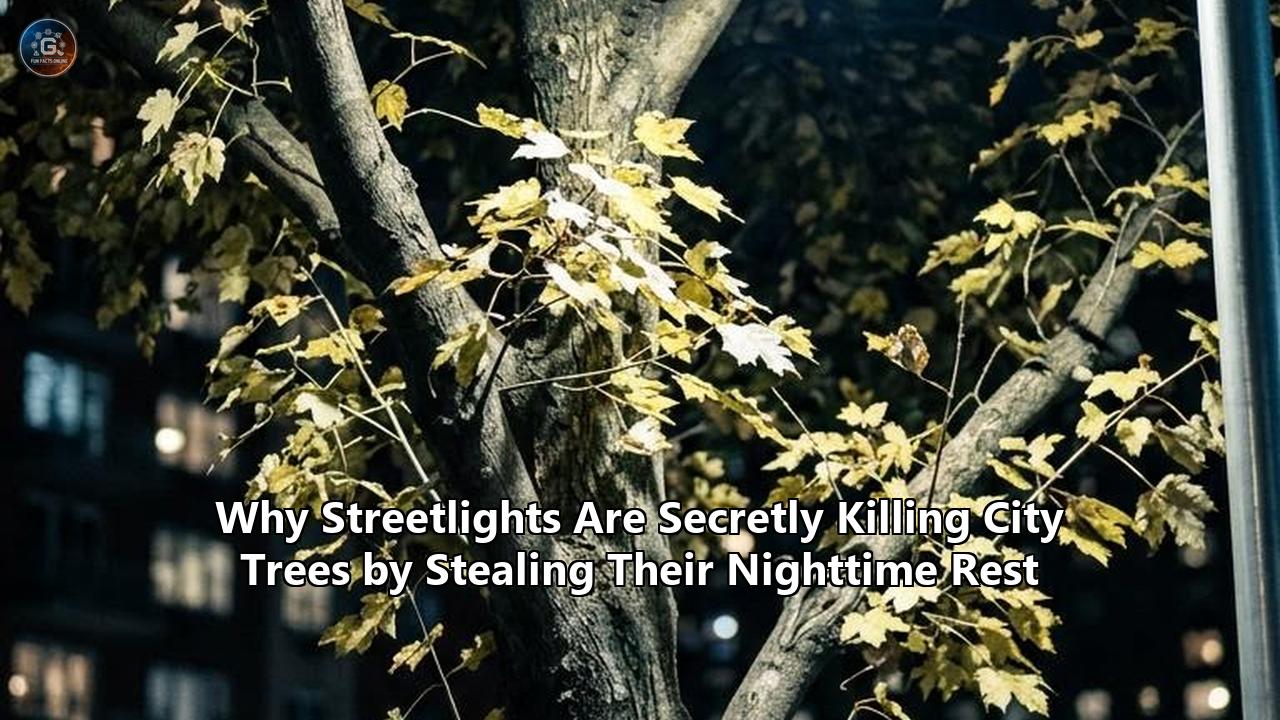
Across hundreds of metropolitan areas in the Northern Hemisphere, municipal arborists have been confronted by a puzzling phenomenon every autumn: city trees standing directly under bright streetlamps refuse to shed their leaves. While neighboring trees in dark parks go dormant, street-adjacent plane trees, maples, and oaks remain green late into November and December, breaking into bud weeks ahead of schedule every spring.
What was long dismissed as an oddity of urban landscaping has now been exposed as a severe physiological crisis. A series of global satellite and ecological studies—including landmark research published in Nature Cities and PNAS Nexus analyzing more than 400 cities—has revealed that artificial light at night (ALAN) is actively disrupting the biological clocks of urban forests. By depriving trees of nighttime darkness, streetlights are forcing city canopies into a state of chronic metabolic exhaustion, keeping them active when they urgently need to rest.
The culprit is not just light in general, but the widespread transition to energy-efficient, high-intensity light-emitting diode (LED) streetlamps. Deployed across the globe to slash electricity bills and cut municipal carbon emissions, these bright white LEDs emit high concentrations of short-wavelength blue light—the exact spectrum that plant photoreceptors use to detect daylight. The result is a photo-biological trap: urban trees are being tricked into a perpetual summer, leaving them vulnerable to unseasonal frosts, structural damage, chemical depletion, and early death.
NATURAL NIGHT-DARKNESS CYCLE vs. URBAN LED ILLUMINATION

Natural Cycle:
  [Daylight] Photosynthesis & Carbon Capture ──> [Darkness] Cellular Repair, Starch Storage & Dormancy Prep

LED Streetlight Exposure:
  [Daylight] Photosynthesis ──> [Midnight LED] Continuous Photoperiod Signal ──> Delayed Senescence & Exhaustion
The Urban Canopy Under Siege
The damage inflicted by artificial lighting is not distributed evenly across city ecosystems. Deciduous canopy species planted along lit transportation corridors—such as the London plane (Platanus × acerifolia), green ash (Fraxinus pennsylvanica), silver birch (Betula pendula), sycamore maple (Acer pseudoplatanus), and red maple (Acer rubrum)—are on the front lines of this exposure.
Researchers analyzing urban foliage have found that trees growing within a few meters of 24-hour artificial lighting experience extended growing seasons that are nearly three weeks longer than their rural counterparts. A global analysis led by researchers Lin Meng and Huidong Li demonstrated that city vegetation leafed out up to 12 days earlier in spring and delayed leaf senescence by up to 11 days in autumn. Crucially, the study proved that nighttime illumination often exerts a stronger influence on autumn leaf retention than the urban heat island effect—upending decades of scientific assumption that warmer city temperatures were the sole driver of altered plant timing.
               SHIFT IN URBAN GROWING SEASON DYNAMICS

Rural Baseline:    |-- Spring Leaf-Out -- Summer -- Autumn Senescence -- Dormancy --|

Lit Urban Zone:   <-- 12 Days Earlier -- Summer -- 11 Days Later --> [Rest Reduced]
                  └─────────────────────────────────────────────────┘
                            Extended Season: ~23 Days
Understanding the broader light pollution effect on trees requires examining both native and cultivated canopy species. While shade-tolerant species with high photo-sensitivity show extreme physical responses—such as holding green leaves directly in a illuminated cone while the unlit backside of the tree drops its leaves—light-sensitive deciduous species suffer systemic internal stress.
This ecological strain extends far beyond the individual tree. Municipal forestry departments, already struggling with tight budgets and climate-driven heatwaves, are seeing urban canopy lifespans plummet. Trees intended to provide shade, absorb stormwater, and clean urban air for upwards of 80 to 100 years are showing signs of systemic decay after just two or three decades. City dwellers lose critical protection against intense summer heat, while taxpayers absorb the rising costs of premature tree removal and replanting.
The Biological Mechanism of Tree "Insomnia"
To understand why constant illumination is deadly to trees, one must look at how plants perceive their environment. Trees do not possess eyes, but they are covered in sophisticated light-sensing proteins called phytochromes and cryptochromes. These photoreceptors act as biological switches, measuring the precise ratio of red, far-red, and blue light to calculate the length of the day—a process known as photoperiodism.
In natural conditions, shortening autumn days signal to the tree that winter is approaching. This trigger initiates a carefully choreographed sequence of physiological changes:
- Chlorophyll Breakdown: The tree stops producing green chlorophyll, revealing yellow and red pigments (carotenoids and anthocyanins).
- Nutrient Resorption: Nitrogen, phosphorus, and essential sugars are drawn out of the leaves and stored safely in the trunk and root system.
- Abscission Zone Formation: A specialized layer of cells forms at the base of each leaf stem, allowing the leaf to drop cleanly without leaving an open wound.
- Dormancy and Cold Hardening: Cell sap thickens with sugars acting as a natural antifreeze, protecting plant tissue from freezing temperatures.
STEPS OF NATURAL AUTUMN SENESCENCE
┌────────────────────────────────────────────────────────┐
│ 1. Shortening Days Detected by Phytochromes           │
└───────────────────────────┬────────────────────────────┘
                            ▼
┌────────────────────────────────────────────────────────┐
│ 2. Chlorophyll Breakdown & Nutrient Resorption to Roots│
└───────────────────────────┬────────────────────────────┘
                            ▼
┌────────────────────────────────────────────────────────┐
│ 3. Abscission Zone Sealing & Leaf Drop                 │
└───────────────────────────┬────────────────────────────┘
                            ▼
┌────────────────────────────────────────────────────────┐
│ 4. Cold Hardening & Cellular Antifreeze Production     │
└────────────────────────────────────────────────────────┘
When high-intensity LED streetlamps shine on a tree all night, they pollute this signals-based timing system. Modern white LEDs feature a sharp peak emission wavelength around 450 nanometers (blue light), which matches the absorption spectrum of plant cryptochromes. The photoreceptors register continuous day length, tricking the tree into acting as if it is mid-summer.
Physiological testing of streetlamp-illuminated foliage reveals severe internal imbalances. In studies evaluating trees such as the London plane and broad-leaved lime (Tilia platyphyllos), illuminated leaves exhibited abnormally high chlorophyll levels late into the year, but suffered a sharp decline in carbon dioxide assimilation rates at dawn. Furthermore, illuminated leaves maintained significantly lower starch reserves than non-illuminated control trees.
Because the trees are driven to synthesize structural compounds overnight rather than banking non-structural carbohydrates (starches), their long-term energy balances fall into deficit. They are essentially running a perpetual daylight engine on empty tanks.
      PHYSIOLOGICAL PROFILE OF LED-ILLUMINATED vs. NATURAL LEAVES
┌───────────────────────────┬───────────────────────────┬───────────────────────────┐
│ Physiological Parameter   │ Natural Nighttime Darkness│ Continuous LED Exposure   │
├───────────────────────────┼───────────────────────────┼───────────────────────────┤
│ Nighttime Stomatal Status │ Closed (Water Saved)      │ Partially Open / Active   │
│ Autumn Chlorophyll Level  │ Declining Normal          │ Artificially Elevated     │
│ Starch Accumulation       │ High (Winter Reserves)    │ Depleted / Low            │
│ Leaf Toughness / Structure│ Standard                  │ Abnormally Tough/Leathery │
│ Cold Hardening Timing     │ Prompt                    │ Critically Delayed        │
└───────────────────────────┴───────────────────────────┴───────────────────────────┘
The disruption is not limited to energy storage; it fundamentally transforms leaf chemistry. A comprehensive study published by researchers at the Chinese Academy of Sciences analyzed thousands of leaves from street trees across urban environments. They discovered that trees under constant night light produced leaves that were significantly tougher, leathery, and laden with defense-oriented chemical compounds. The artificial light forced plants to allocate energy toward structural toughness, rendering the leaves unpalatable to local herbivorous insects.
Short-Term Consequences: Frost Traps and Broken Ecosystems
The immediate light pollution effect on trees creates physical vulnerabilities that manifest within a single growing season. The most acute danger occurs during the transition into winter.
1. The Early Freeze Trap
When trees fail to drop their leaves because artificial light has delayed senescence, they are caught unprepared by early winter cold snaps. In a healthy tree, living cells have evacuated water and accumulated protective sugars before the temperature drops below freezing. In an illuminated tree, fluid-filled living cells remain active in stems and branches when the first hard frost strikes.
The result is severe cellular rupturing. Water inside the vascular tissue (xylem and phloem) freezes and expands, causing trunk splitting, localized dieback of major limbs, and severe frost burns across the canopy. Entire branches that remained lush and green in late October can suffer total vascular collapse overnight after an early November freeze.
THE FROST DAMAGE MECHANISM IN LIGHT-CONFUSED TREES

  Continuous LED Light ──> Delayed Abscission & High Water Content
                                    │
                                    ▼
                         Unseasonal Hard Freeze
                                    │
                                    ▼
       Internal Water Freezes & Expands ──> Cell Walls Rupture
                                    │
                                    ▼
           Trunk Splitting, Cambium Death & Limb Collapse
2. Structural Load Failures
Leaves are designed to capture solar radiation, but they also act as catchments for precipitation. Deciduous trees shed their leaves in autumn partly to reduce their aerodynamic profile against winter winds and to prevent snow buildup.
When streetlights force trees to retain full foliage into late autumn or early winter, heavy wet snowstorms or freezing rain cling to the fully leafed canopy. The weight overburden can reach several thousand pounds per tree, leading to severe branch breakages, split trunks, and fallen limbs that damage power lines, crush vehicles, and endanger pedestrians.
3. Starving Urban Food Webs
While urban residents might view tough, undamaged foliage as a visual benefit, altered leaf chemistry creates an ecological dead zone. The Chinese Academy of Sciences study demonstrated that leaves altered by artificial light suffered dramatically less insect feeding.
Insects—particularly caterpillars and plant-eating larvae—are the fundamental foundation of terrestrial food webs. Songbirds rely almost exclusively on caterpillars to feed their nestlings during early spring. When streetlights alter leaf composition, making foliage inedible, caterpillar populations plummet. This collapse ripples up the urban food chain, starving local bird populations, predatory insects, and urban mammals.
            TROPHIC COLLAPSE INSIDE LIT CANOPIES

   LED Light Exposure
          │
          ▼
   Tougher, Chemically Altered Foliage
          │
          ▼
   Insect Larvae / Caterpillars Cannot Feed
          │
          ▼
   Songbird Nestlings Starve / Local Biodiversity Drops
Long-Term Consequences: Chronic Exhaustion and Canopy Collapse
While short-term frost damage and broken branches are visually striking, the long-term light pollution effect on trees is insidious and fatal. The cumulative toll of years without nightly rest leads to chronic physiological decline.
Depletion of Metabolic Reserves
A tree requires period of dark rest to regulate its metabolic processes, repair cellular damage, and convert photosynthesized sugars into durable starches. Under continuous illumination, the tree is driven into a permanent state of heightened metabolic activity.
Over several consecutive seasons, this exhaustion empties the tree’s root storage of non-structural carbohydrates. Without these vital reserves, the tree cannot effectively recover from secondary environmental stressors such as summer droughts, soil compaction, or intense heatwaves.
ANNUAL ENERGY DEFICIT ACCUMULATION

Year 1: High LED exposure ──> Starch reserves drop 15% ──> Minor leaf retention
Year 2: Starch reserves drop 30% ──> Reduced root growth ──> Vulnerability to drought
Year 3: Starch reserves drop 50% ──> Cambium dieback ──> Pest invasion (e.g., borers)
Year 4+: Exhaustion Threshold ──> Crown Dieback & Systemic Failure
Vulnerability to Opportunistic Pathogens
A metabolically exhausted tree cannot defend itself. Healthy trees produce complex defense chemicals—such as phenolics, tannins, and resin compounds—to fend off wood-boring insects, fungal spores, and bacterial infections.
As light pollution drains a tree’s carbohydrate reserves, its ability to synthesize these protective compounds drops. Pests such as the emerald ash borer (Agrilus planipennis), bark beetles, and opportunistic fungal pathogens like Armillaria rot target these weakened urban specimens. Pathogens that a healthy forest tree would easily seal off inside its wood tissue spread rapidly through a light-stressed urban tree, causing swift vascular collapse.
Urban Heat Island Amplification
One of the primary reasons cities invest millions of dollars in urban forestry is to combat the urban heat island effect. Mature tree canopies cool surrounding neighborhoods through direct shade and evapotranspiration—the process by which trees release water vapor into the air to cool themselves and their surroundings.
However, trees suffering from chronic light-induced stress shut down their stomata prematurely during hot summer days to prevent desiccation, drastically reducing evapotranspiration cooling. As these stressed trees experience crown dieback and early death, urban canopy cover declines. Instead of cooling the city, dead and sparse tree canopies expose asphalt and concrete to direct sunlight, compounding urban heat risks for human residents.
                 HEAT ISLAND FEEDBACK LOOP

               LED Light & Night Stress
                          │
                          ▼
             Loss of Evapotranspiration
                          │
                          ▼
            Reduced Canopy & Canopy Death
                          │
                          ▼
     Increased Ambient Temperatures & Heat Exposure
The Technological Trap: Why the LED Transition Backfired
To understand how cities unwittingly created this environmental crisis, one must trace the history of outdoor illumination technology.
For much of the late 20th century, municipal lighting was dominated by High-Pressure Sodium (HPS) lamps. These fixtures produced a deep golden-amber glow. While HPS lights were far from ideal, their light spectrum was concentrated in the longer yellow and orange wavelengths (580 to 620 nanometers). Plants are relatively insensitive to these amber wavelengths, meaning older streetlamps had a smaller biological impact on tree photoperiodism.
LIGHTING SPECTRUM VS. PLANT RECEPTOR SENSITIVITY

High-Pressure Sodium (Legacy):
  [Peak: Yellow/Amber ~600nm] ──> Low plant cryptochrome activation ──> Lower stress

Cold White LED (Modern):
  [Peak: High-Intensity Blue ~450nm] ──> High plant cryptochrome activation ──> High stress
Beginning in the late 2000s and accelerating through the 2010s and 2020s, cities worldwide launched massive retrofit programs to replace HPS fixtures with LEDs. The economic argument was compelling:
- Energy Reduction: LEDs consume up to 60–70% less electricity than HPS fixtures.
- Longevity: LED fixtures last 10 to 15 years, drastically reducing maintenance costs.
- Visibility: Bright white light improves color rendering for drivers and pedestrians.
However, early LED adoption prioritized cold-white fixtures rated between 4000K and 5000K Correlated Color Temperature (CCT). These fixtures contain a massive emission spike in the blue spectrum.
Engineers and urban planners designed these installations around photopic human vision and energy efficiency metrics (lumens per watt), completely ignoring plant biology and ecosystem health. Dark-sky initiatives warned about light spill into the atmosphere, but the biological impact on urban vegetation remained an unconsidered variable in municipal contracts.
CRITICAL DIFFERENCES IN LIGHTING TECHNOLOGIES
┌───────────────────────────┬───────────────────────────┬───────────────────────────┐
│ Feature / Impact          │ High-Pressure Sodium (HPS)│ Broad-Spectrum White LED  │
├───────────────────────────┼───────────────────────────┼───────────────────────────┤
│ Dominant Wavelength      │ Yellow/Orange (580–620nm) │ High Blue Peak (450nm)    │
│ Plant Cryptochrome Impact │ Minimal                   │ Extreme Activation        │
│ Energy Efficiency         │ Moderate                  │ Very High                 │
│ Dormancy Disruption       │ Low to Moderate           │ High                      │
│ Autumn Leaf Retention     │ Slight                    │ Severe (Up to +11 Days)   │
└───────────────────────────┴───────────────────────────┴───────────────────────────┘
The consequence was a rapid, global transformation of the nighttime light environment. As millions of high-blue LED lamps were mounted directly above street trees, the nocturnal light environment shifted to match the precise wavelengths that trigger plant physiological activity.
Mitigation and Policy Solutions: Reclaiming the Night
The damage inflicted by artificial light is not irreversible. Recent satellite data from cities that have implemented targeted dark-sky and urban lighting policies shows that ecosystem recovery can happen quickly when light exposure is corrected.
Comparative satellite analysis published in PNAS Nexus evaluated nighttime light profiles and plant phenology across four major U.S. cities. The study revealed that when Washington, D.C. and New York City enacted smart-lighting policies—lowering overall brightness and reducing blue-wavelength emissions—nighttime light pollution dropped measurably. Correspondingly, plant growing seasons in those cities shifted back toward natural seasonal patterns, whereas neighboring cities without light policies (such as Newark and Philadelphia) experienced rising light pollution and continued ecological disruption.
                     POLICY IMPACT COMPARISON

Light-Reduction Cities (e.g., Washington D.C., NYC):
  Policy Enacted ──> Blue Light Drops ──> Plant Phenology Normalizes

Unregulated Cities (e.g., Newark, Philadelphia):
  No Policy ───────> Light Levels Rise ──> Tree Rest Loss Continues
To protect urban canopies while maintaining public safety, urban planners, lighting engineers, and arborists are implementing four core strategies:
1. Spectral Tuning and Amber LEDs
Cities are moving away from harsh 4000K white LEDs toward warm-spectrum fixtures rated at 2200K or lower, as well as specialized Narrowband Amber (NBA) LEDs. These fixtures eliminate the high-energy blue peak (450nm) while maintaining adequate visibility for pedestrians and vehicles. By removing blue wavelengths, cities can illuminate streets without triggering cryptochrome receptors in nearby trees.
                   SPECTRAL OPTIMIZATION STRATEGY

  Harsh 4000K LED [High Blue Spike at 450nm] ──> Triggers Plant Receptors
                                    │
                                    ▼
  Warm 2200K / Amber LED [Blue Filtered Out] ──> Safe for Urban Trees
2. Directional Shielding and Cut-Off Fixtures
Unshielded streetlamps cast light in all directions, spilling hundreds of lumens upward into the canopy. Installing full-cutoff fixtures directs light downward onto roads and sidewalks, preventing light from penetrating foliage above the lamp.
DIRECTIONAL SHIELDING FIXTURE DESIGN

Unshielded Lamp:                     Full-Cutoff Lamp:
     \  |  /                              |
   --- LAMP ---  <-- Spills into        [LAMP]  <-- Light directed ONLY
     /  |  \         Canopy               |         downwards to street
   [Tree Foliage Exposed]               [Foliage Remains in Shade]
3. Smart Dimming and Motion Sensing
Modern municipal lighting grids can be integrated with smart controllers programmed to dim streetlights by 30% to 50% during off-peak hours (e.g., between midnight and 5:00 AM). Reducing light intensity during the deepest hours of the night gives trees a window of functional darkness to perform essential cellular maintenance and stomatal closure.
4. Eco-Centric Urban Design and Zone Planting
Urban forestry departments are redesigning planting guidelines based on light sensitivity:
- Zone Buffers: Establishing minimum setback distances (e.g., 5 to 8 meters) between high-intensity streetlamps and broad-leaf canopy species.
- Species Selection: Planting light-insensitive species (such as certain conifers or shade-adapted understory trees) directly adjacent to required light poles, while placing sensitive deciduous species like maples and plane trees in darker micro-zones.
LIGHTING-AWARE URBAN TREE PLACEMENT

  [Streetlamp] <─── 3–5m Buffer ───> [Low-Sensitivity Species] <─── 8m+ ───> [High-Sensitivity Species]
                                     (e.g., Conifers/Understory)            (e.g., Maple, Oak, Plane)
What to Watch Next
As the impact of artificial light on urban forestry becomes clear, the intersection of lighting technology and urban ecology is entering a pivotal phase. Several key developments will shape how cities address this environmental issue over the next several years:
1. Advanced Satellite Tracking and Micro-Mapping
Scientists are combining satellite platforms like NASA's Black Marble with high-resolution localized drone imagery to build predictive models of light-induced tree stress. These systems allow city arborists to identify light-stressed canopy zones before visible branch dieback or tree death occurs.
               NEXT-GEN URBAN CANOPY MONITORING

  [NASA Black Marble Satellite] + [Local Thermal Drones]
                               │
                               ▼
  [AI Phenology Mapping Engine] ──> Identifies High-Risk Canopy Zones
                               │
                               ▼
  [Targeted Retrofits] ───────> Replaces High-Blue Fixtures Near Vulnerable Trees
2. Spectral Ordinance Mandates
Municipalities worldwide are updating light pollution ordinances to explicitly include ecological protection alongside dark-sky provisions. Expect more cities to mandate maximum blue-light emission thresholds (e.g., less than 1% blue light output) for outdoor fixtures installed near parks, urban forests, and residential tree lines.
3. Climate Change Synergies
Researchers are turning their attention to how light pollution interacts with climate change. Unusually warm autumns combined with constant streetlamp illumination create a compound stressor. Understanding whether warm temperatures exacerbate light-induced delays in tree dormancy will be critical for managing urban forests through changing weather patterns.
               COMPOUND STRESSOR INTERACTION

    [Artificial Light (ALAN)]  +  [Elevated Autumn Temperatures]
                 │                            │
                 └──────────────┬─────────────┘
                                ▼
         Extremely Delayed Dormancy & Starch Depletion
                                │
                                ▼
         Catastrophic Susceptibility to Sudden Winter Freezes
The evidence is undeniable: streetlights have been quietly draining the vitality of urban trees. Reclaiming the night through smarter, warmer, and directed lighting design is essential to protecting urban canopy health.
Reference:
- https://www.thinkglobalhealth.org/article/light-pollution-reshapes-growing-seasons
- https://www.vanderbilt.edu/evolution/city-lights-are-rewriting-the-calendar-vanderbilt-researchers-show-artificial-light-extends-urban-growing-seasons/
- https://pubmed.ncbi.nlm.nih.gov/36581265/
- https://studyfinds.com/city-light-plant-growing/
- https://www.ornl.gov/project/tes-sfa
- https://www.nationalgeographic.com/environment/article/artificial-night-sky-light-pollution-trees-insects
- https://www.researchgate.net/publication/398904590_Phenological_effects_of_artificial_light_at_night_on_urban_trees_A_case_study_on_microclimate_and_light_pollution
- https://www.researchgate.net/publication/366605921_Shedding_light_on_the_effects_of_LED_streetlamps_on_trees_in_urban_areas_Friends_or_foes
- https://www.usanpn.org/news/article/its-not-just-climate-warming-artificial-light-shifting-phenology