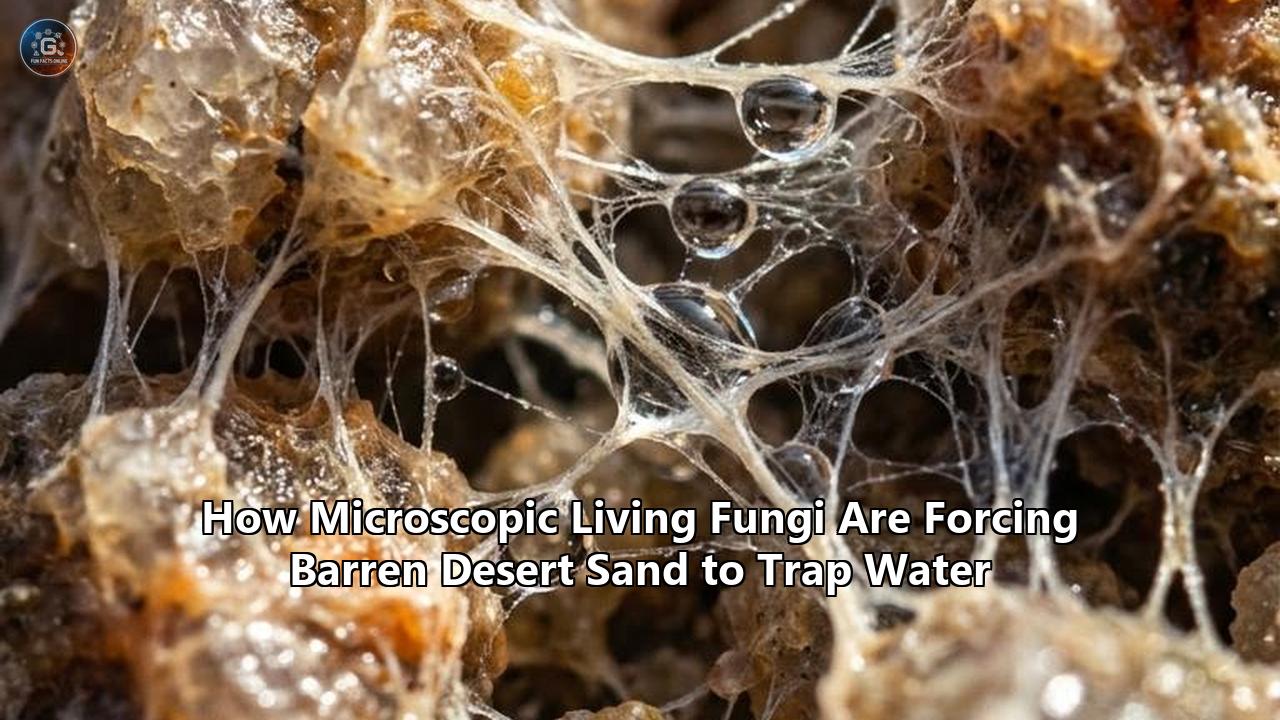
In a research facility on the edge of the Arabian Desert, a cylinder of coarse dune sand was submerged directly into a beaker of water. Under normal conditions, unsecured desert sand loses its structural integrity the moment it is immersed, collapsing instantly into a formless silt heap at the bottom of the glass. Instead, this sample held its sharp edges, maintaining a rigid, vertical silhouette against the liquid.
The structural bond was not produced by synthetic cement or industrial petroleum polymers. It was woven by microscopic, living fungal hyphae and bacterial fibers.
The experimental demonstration—published in the journal Carbohydrate Polymers by an international research team from Khalifa University in Abu Dhabi, the Swiss Federal Laboratories for Materials Science and Technology (Empa), and ETH Zurich—marks a decisive turning point in dryland soil mechanics. By cultivating specific filamentous fungi and cellulose-synthesizing microbes directly inside loose sand collected from dunes near Al Ain in the United Arab Emirates, researchers transformed barren, water-repelling grains into a cohesive matrix called "living sand".
The mechanical and hydrological changes are stark. In standardized lab tests, untreated desert sand allows moisture to flush straight down through interstitial voids, losing surface hydration almost immediately. Sand reinforced with microbial fibers cut the speed of water drainage sixfold. When the researchers introduced microbially grown nanocellulose sheets between sand strata, water permeability plummeted by a factor of 28.
"This approach allows us to introduce organic matter and water into the sand and stabilize it somewhat," said Gustav Nyström, head of Empa’s Cellulose and Wood Materials laboratory and one of the principal researchers on the study. "Ideally, this will then enable the growth of further microorganisms and plants, thereby initiating the process of making the soil more resilient and fertile".
The development arrives as hyper-arid regions confront compounding agricultural crises. In the United Arab Emirates, where less than 5% of the land area is arable and domestic growers supply only 10% to 15% of the food supply, agricultural expansion is strangled by hydrology: desert sand cannot trap water, and standard irrigation evaporates or drains before root systems can access it. Globally, drylands encompass roughly 40% of the terrestrial surface, home to over two billion people.
The creation of "living sand" is not an isolated laboratory curiosity. It represents the culmination of a half-century scientific journey—a steady escalation from obscure ecological field observations to advanced microbial bioengineering, unlocking how micro-fungi physically compel sand grains to trap, redirect, and retain moisture.
1978–1989: The Inert Grain Dogma and the First Clues
For the better part of the twentieth century, agronomy and civil engineering viewed desert sand through a strictly abiotic lens. Sand was categorized as inert silicon dioxide ($SiO_2$)—a loose assortment of coarse, weathered mineral grains ranging from 0.05 to 2.0 millimeters in diameter. Because quartz grains lack the negative surface electrical charges found on clay particles, they have zero cation exchange capacity and no natural cohesion. Gravity rules supreme: when water hits sand, capillary forces fail, and liquid cascades rapidly through the large pore spaces (macropores) beyond the reach of plant roots.
Efforts to reclaim arid sands during the mid-20th century relied almost exclusively on heavy, brute-force engineering. Governments and oil companies sprayed chemical asphalt emulsions, polyvinyl acetates, or synthetic polyacrylamides over mobile sand dunes to halt wind erosion. These treatments were expensive, frequently toxic, and did nothing to restore natural hydrological cycling. Sand was widely viewed as a dead substrate that could only be managed through continuous mechanical and chemical intervention.
The first cracks in this orthodoxy appeared far from the Sahara or the Arabian Empty Quarter. In March 1978, Canadian soil scientists K.S. Clough and J.C. Sutton published a study in the Canadian Journal of Microbiology detailing their examination of sand dunes along the shores of Lake Huron. Using transmission and scanning electron microscopy, Clough and Sutton observed something that defied prevailing mechanical models: loose sand grains were firmly bound together in clusters.
Threading through those sand grains was an extensive external mycelium produced by mycorrhizal fungi belonging to the genus Glomus. Under high magnification, the researchers discovered an amorphous deposit coating the contact zones between the sand surfaces and the fungal hyphae. Histochemical staining revealed that this biological coating was rich in complex polysaccharides.
The fungus was not merely living adjacent to the sand; it was secreting an organic glue that aggregated the grains into cohesive micro-structures. Despite Clough and Sutton’s work, the broader implications for global desert greening and water retention were largely ignored. Agronomists continued to dismiss fungi as fragile, moisture-loving organisms that could play no meaningful role in extreme, sun-scorched environments.
1996–2005: Uncovering the "Desert Skin" and Glomalin
The narrative escalated dramatically in 1996 when Dr. Sara Wright, a soil scientist with the United States Department of Agriculture (USDA) Agricultural Research Service, identified an elusive biological substance that changed the field of pedology: glomalin.
Wright discovered that arbuscular mycorrhizal fungi (AMF) produce an extraordinarily tough, hydrophobic glycoprotein on their hyphal walls. Glomalin was not easily degraded; it resisted heat, biological decay, and acid bath extractions, persisting in soil matrices for decades. While Wright initially studied glomalin in temperate agricultural fields, arid-zone ecologists soon noticed that related glycoproteins and extracellular polymeric substances (EPS) were operating in the world’s most hostile deserts.
Concurrently, researchers like Dr. Jayne Belnap of the U.S. Geological Survey (USGS) and Dr. Ferran Garcia-Pichel at Arizona State University began mapping what field scientists termed "the desert’s skin"—biological soil crusts, or biocrusts. Biocrusts are complex communities of cyanobacteria, lichens, micro-fungi, and bryophytes forming a fragile carpet over barren arid landscapes.
Throughout the late 1990s and early 2000s, field data confirmed that biocrusts were not ecological novelties; they accounted for roughly 12% of the Earth’s total terrestrial surface. In pristine zones of the Sonoran, Mojave, and Negev deserts, researchers discovered that intact biocrusts transformed the top layer of sand. Instead of rain flushing downward into deep subterranean aquifers or washing away topsoil in flash floods, the biocrust absorbed moisture like a sponge.
Microscopic analysis revealed that while filamentous cyanobacteria (such as Microcoleus vaginatus) provide initial physical stabilization, microscopic fungi in desert sand form the three-dimensional structural lattice beneath the surface. These micro-fungi, dominated by resilient Ascomycota and dark septate endophytes, survive surface temperatures exceeding 60°C (140°F) by packing their cell walls with protective black melanin.
As these fungi thread their hyphae between sand grains, they do two things simultaneously:
- Physical mesh creation: A single gram of desert soil was found to contain tens of meters of fungal hyphae, forming a microscopic basket that physically prevents loose sand from shifting.
- Capillary pore alteration: By occupying the gaping macropores between sand grains, the fungal filaments create narrow, sub-millimeter channels. Under Laplace’s laws of surface tension, these micro-pores generate intense capillary pressure, pulling water into the sand matrix and holding it against the downward tug of gravity.
Suddenly, desert sand was no longer understood as an inert mineral dump. It was an ecosystem whose hydrological mechanics were actively regulated by a microscopic fungal web.
2011–2020: The Biocrust Crisis and the Threat of Total Desiccation
The initial optimism surrounding natural biological soil crusts gave way to urgency as global climatic shifts accelerated. Between 2011 and 2020, ecological monitoring across arid regions revealed that the planet’s fungal and cyanobacterial sand crusts were dying at an alarming rate.
A multi-decade study conducted by the USGS across the Colorado Plateau, published in Proceedings of the National Academy of Sciences (PNAS), tracked 12 permanent field plots over two decades. The findings were devastating: higher average temperatures and prolonged summer droughts were breaking down the microbial fabric. Lichens and mosses were vanishing first, followed by the deep hyphal networks of native fungi in desert sand.
The physical destruction was compounded by anthropogenic disturbance. Off-road vehicles, military maneuvers, industrial infrastructure, and livestock grazing pulverized the paper-thin crusts. A single vehicle track across a desert dune could shatter a biological soil network that had taken 50 to 100 years to assemble.
Once the fungal and microbial bonds were broken, the desert’s hydrology collapsed:
- Sand dunes reactivated, destabilizing terrain and causing immense dust storms that swept across North Africa, the Middle East, and the American Southwest.
- Rainfall infiltration efficiency dropped precipitously. Flash rains no longer soaked into the upper 10 centimeters of sand; instead, water produced aggressive surface runoff that carved erosion channels and swept barren sand away.
- Residual soil organic carbon and nitrogen reserves plummeted by more than 40%, stripping the sand of the biological foundation required to support seed germination.
"Biocrusts are the keystone element of the landscape," observed Sue Bellagamba, Canyonlands Regional Director for The Nature Conservancy, during a regional restoration review. "If we lose our biocrusts, we could see major impacts on soil stability, vegetation and wildlife".
Scientists faced a daunting timeline. In nature, passive biocrust regeneration is glacial. Waiting for fungal hyphae to naturally re-colonize drifting desert dunes takes generations—time that agricultural sectors and arid communities do not have. The crisis shifted the scientific imperative: rather than merely observing how fungi protect natural soils, laboratories began exploring how to artificially cultivate, accelerate, and optimize these fungal systems to force dry sand to hold water on demand.
2021–2023: The Hyphal Hydrology Pivot
Between 2021 and 2023, the discipline crossed from passive ecological conservation into active biophysical experimentation. Researchers zeroed in on an unresolved question: Could living fungi modify the hydrological retention curves of sand independently of plant root systems?
In a landmark paper published in Mycorrhiza in 2023, soil physicists and mycologists tested how arbuscular mycorrhizal fungi (Rhizophagus irregularis) affected unsaturated hydraulic conductivity in contrasting soil profiles. They set up specialized hyphal compartments using 20-micrometer nylon mesh screens, which allowed microscopic fungal hyphae to expand into root-free soil volumes while completely excluding plant roots.
The results demonstrated a striking environmental divergence:
- In fine-textured loam soils, fungal ingrowth actually encouraged water drainage, preventing the soil from becoming soggy and waterlogged.
- In coarse, uniform quartz sand, the presence of the fungus produced the exact opposite effect: water retention capacity surged without altering the bulk density of the sand.
The fungal hyphae were functioning as dynamic biological soil conditioners. At low moisture levels—the baseline state of hyper-arid deserts—the hyphal network exerted a strong influence over soil matric potential. The fungal network reduced unsaturated hydraulic conductivity in sand, effectively tightening the hydraulic grip of the substrate and slowing down gravity-driven drainage.
Simultaneously, researchers working with polyextremotolerant fungi isolated from the hyper-arid Atacama Desert in Chile found that these species could harvest moisture directly from atmospheric humidity and micro-droplets of desert fog. The fungi synthesized hydrophilic sugar matrices that functioned as natural desiccant traps, absorbing ambient moisture and funneling it inward toward their hyphal core.
The physics was settled: microscopic fungi possessed the innate machinery to turn free-draining sand into a water-retention matrix. The remaining hurdle was engineering: How could scientists scale this biological mechanism rapidly, using living organisms that could survive searing heat and be applied to real desert environments?
2024–2026: The Abu Dhabi Breakthrough and "Living Sand"
The turning point arrived when material scientists from Europe teamed up with desert engineers in the Persian Gulf. Researchers from Switzerland’s Empa institute and ETH Zurich joined forces with scientists at Khalifa University in Abu Dhabi to tackle a localized crisis with global implications: the agricultural vulnerability of the UAE’s desert interior.
Instead of utilizing slow-growing, fragile wild biocrust strains, the joint team investigated whether fast-growing, robust microorganisms could synthesize an artificial biological web within dune sand in days rather than decades.
The team, whose experimental results were published in Carbohydrate Polymers, designed a rigorous comparative trial. They collected wild desert sand from the sweeping dune fields near Al Ain, an inland city in Abu Dhabi characterized by extreme arid conditions, alongside standardized laboratory test sand.
                               THE SAND RETENTION EXPERIMENT

  Untreated Sand                 Mycelial Network Sand         Layered Nanocellulose Sand
  [ Khalifa Univ / Empa ]        [ Schizophyllum commune ]     [ Komagataeibacter Sheet ]

  +-------------------+          +-------------------+         +-------------------+
  |   Water Applied   |          |   Water Applied   |         |   Water Applied   |
  |         |         |          |         |         |         |         |         |
  |         v         |          |         v         |         |         v         |
  |  . . . . . . . .  |          |  .-.-.-.-.-.-.-.  |         |  . . . . . . . .  |
  |  . . . . . . . .  |          |  -(Fungal Mesh)-  |         |  ================ |
  |  . . . . . . . .  |          |  .-.-.-.-.-.-.-.  |         |  (Bacterial Sheet)|
  |         |         |          |         |         |         |  ================ |
  |         v         |          |         v         |         |         |         |
  +-------------------+          +-------------------+         +-------------------+
    Instant Drainage             6x Slower Drainage            28x Slower Drainage
    Zero Cohesion                Holds Shape in Water          High Tensile Strength
The scientists sterilized the sand to eliminate native background contaminants, loaded it into cylindrical molds, and inoculated the grains with nutrient solutions and specific microbial cultures:
- The Fungal Candidates: Two distinct strains of Schizophyllum commune, a resilient, wood-decaying basidiomycete fungus renowned for its aggressive hyphal branching and high production of schizophyllan, a viscous, water-soluble extracellular beta-glucan.
- The Bacterial Candidate: Komagataeibacter medellinensis, an acetic acid bacterium famed for producing pure, crystalline nanocellulose fibrils.
The microbes were fed simple carbohydrate nutrient broths, incubated at controlled temperatures, and allowed to colonize the empty spaces between the dune grains.
Within just seven days, the biological transformation was complete. Scanning electron microscopy captured an intricate architectural sight: the smooth, disconnected Al Ain quartz grains were encased in a dense, pale biological web. Filamentous fungal hyphae had snaked around individual sand particles, anchoring them together like cables on a suspension bridge. Simultaneously, the bacterial nanocellulose had spun an ultra-fine mesh that physically bridged adjacent grains.
The team then subjected their "living sand" to hydraulic stress testing. They poured water into sand columns and precisely recorded drainage velocities.
The raw data established a major leap forward in arid soil manipulation:
- Drainage Deceleration: The presence of direct microbial networks slowed the downward percolation velocity of water by six times compared to untreated desert dune sand.
- Layered Nanocellulose Barriers: In a second approach, researchers grew thin sheets of bacterial nanocellulose separately and inserted them as horizontal biocomposite layers between sand strata. This approach slashed water permeability by 28-fold.
- Water Retention Elevation: The total moisture-holding capacity of sand embedded with microbial networks rose from a baseline of 20.2% to 25.5%.
- Mechanical Stability Under Saturation: When de-molded and placed directly into water, the untreated sand instantly disintegrated. The microbially fortified cylinders remained fully intact, exhibiting structural cohesion that withstood shear forces underwater without shedding particles.
The implications of establishing cultured strains of fungi in desert sand are immense: rather than waiting decades for natural cryptobiotic crusts to settle, directed biological inoculation could consolidate loose, water-shedding dunes in a matter of days.
The Biomechanical Anatomy: How Micro-Fungi Trap Moisture
The physics underlying how microscopic living fungi force sand to trap water involves an intricate interplay between geometry, biochemistry, and fluid dynamics.
In pure, barren desert sand, the space between grains is dominated by large voids known as macropores, which typically measure greater than 50 micrometers in diameter. Liquid water is subject to the capillary equation:
$$h = \frac{2\gamma \cos\theta}{\rho g r}$$
Where $h$ is the height of capillary rise, $\gamma$ is the surface tension of the fluid, $\theta$ is the contact angle, $\rho$ is water density, $g$ is gravitational acceleration, and $r$ is the pore radius.
In coarse dune sand, because the radius $r$ is extraordinarily large, capillary lift $h$ is virtually zero. When rain falls, gravity overwhelms surface tension, pulling water straight down past the root zone within minutes.
                          MICROSCOPIC PORE TRANSFORMATION

       Barren Desert Sand                       Fungi-Infiltrated Sand
    (Uncontrolled Drainage)                     (Capillary Water Trapping)

       O                 O                     O                 O
        \               /                       \   ~-~-~-~-~   /
         \   Macropore /                         \ (Fungal EPS)/
          \  (r > 50µm)                         --\-----------/--
           \     |     /                           (Hyphal Net)
            \    |    /                             /    |    \
             \   v   /                             /  Mesopores\
              \  |  /                             /  (r = 5µm)  \
               \ v /                             /       |       \
                \ /                             /        v        \
                 O                                       O
         Capillary Lift = ~0                    Capillary Suction Spikes
      Water Drains to Aquifer                  Water Trapped in Micro-Pores
When filamentous fungi colonize these pores, they physically re-engineer the substrate geometry:
1. The Mesopore Transition
Individual fungal hyphae measure between 2 and 10 micrometers in diameter. As the fungus branches out, its hyphal network subdivides the open macropores into thousands of micro- and mesopores (0.2 to 30 micrometers in diameter). By drastically reducing the effective radius $r$, the capillary suction inside the sand skyrockets. Water is pinned inside these microscopic channels, preventing gravitational drainage while remaining loose enough for plant root hair absorption.
2. Viscoelastic Polysaccharide Hydrogels
Microscopic fungi do not exist as bare cellular tubes; they are enveloped in an extracellular matrix composed of beta-glucans, chitins, and glycoproteins. These polymers act as natural superabsorbent hydrogels.
When fungal hyphae grow through dune sand, their secreted exopolysaccharides coat the smooth silica surfaces. When water touches these polymers, they swell to several times their dry volume, binding free water molecules in a gelatinous matrix. This process drastically lowers the hydraulic conductivity of the sand, preventing water from sinking away. During subsequent periods of heat and drought, this hydrated matrix releases its stored water slowly, keeping the surrounding grain micro-environment moist.
3. Vapor Harvesting and Hydraulic Redistribution
Fungal hyphae alter how sand interacts with atmospheric phase changes. In hyper-arid regions, the temperature differential between day and night produces significant surface condensation and dew formation.
Loose quartz sand rapidly sheds surface condensation as vapor as soon as the sun rises. By contrast, the high surface area of fungal networks acts as a condensation wick. The presence of filamentous fungi in desert sand creates a continuous hydraulic conduit: moisture condensed on the surface at night is pulled by osmotic gradients through the hyphal filaments down into the subsurface root zone, sheltering the water from blistering daytime evaporation.
Technical Obstacles and Field Limitations
Despite the dramatic results achieved by the Khalifa University, Empa, and ETH Zurich researchers, formidable technical barriers stand between successful Petri dish experiments and the greening of open desert landscapes.
The authors of the Carbohydrate Polymers study emphasized that their tests were strictly controlled laboratory trials. Transitioning to open-environment agriculture presents major biological and physical hurdles:
The Oxygen Gradient Problem
In laboratory sand columns, microbial growth was not uniform. Because both Schizophyllum commune and Komagataeibacter medellinensis require oxygen to metabolize and produce biopolymers, growth concentrated heavily near the exposed surfaces. Sand sections deeper in the experimental columns exhibited significantly weaker mechanical consolidation and lower fiber density because oxygen could not readily penetrate the dense substrate. For agricultural topsoils, an uneven biopolymer profile could lead to surface crusting while failing to stabilize the subsoil where deep taproots develop.
The Carbon and Nutrient Supply Chain
Microbes cannot spin cellulose or weave mycelial cables out of thin air; they require an external energy source of sugars, nitrogen, and phosphorus. In sterile sand, these nutrients do not exist.
The research team pointed out that industrial scaling would require thousands of tons of nutrient feedstocks. To make the process ecologically and economically sustainable, researchers are investigating agricultural waste streams, such as date palm processing byproducts, discarded fruit residues, and municipal food waste, to supply the sugars required for fungal cultivation. If localized waste cannot be repurposed efficiently, the carbon footprint and financial cost of culturing fungi across hectares of desert would make broad implementation unfeasible.
Open-Air Extremes vs. Autoclaved Sand
The laboratory tests utilized sterilized sand and precisely regulated incubation temperatures. The open desert is far more punishing.
Direct solar ultraviolet (UV) radiation breaks down unprotected organic matter; wind shear can scuff away nascent fungal colonies before they can aggregate sand grains; and temperatures on the surface of Arabian dunes frequently exceed 60°C (140°F). The fungi must either be introduced beneath a sacrificial protective layer or genetically and phenotypically adapted to withstand hyper-salinity, extreme heat, and wild microbial competition from native desert archaea and bacteria.
The Arid Frontier: What Happens Next
The transition from benchtop mechanics to agricultural deployment is entering its next phase.
The Khalifa University and Empa research consortium is expanding testing from sterile plastic tubes to specialized greenhouse trials. The upcoming phase will evaluate whether plants—specifically drought-resilient crops like sorghum, pearl millet, and date palm seedlings—can successfully expand their root networks through the reinforced living sand without choking on the dense microbial biopolymers.
At the same time, large-scale cultivation approaches developed for native biocrust restoration are merging with fungal bioengineering. In the American Southwest, USGS biogeochemist Dr. Sasha Reed and multi-agency consortia have proven that whole biocrust communities can be cultivated on biodegradable textiles in specialized farm nurseries and rolled out across degraded desert sites.
By marrying these agricultural fabric systems with fast-acting fungal inoculants, scientists hope to develop deployable biological geotextiles. Instead of spraying chemical stabilizers, land managers could install pre-inoculated fungal sheets that anchor shifting dunes, trap seasonal moisture, and slowly biodegrade into rich, organic compost as real crops establish permanent root systems.
Field scientists are also monitoring several critical milestones over the next 24 to 36 months:
- Greenhouse Yield Trials: The first peer-reviewed datasets tracking the biomass accumulation, water-use efficiency, and fruit set of crops grown directly in microbial living sand versus conventional fertilized sand.
- Nutrient Waste Integration: Pilot projects in the UAE testing whether discarded date syrup processing wastewater can serve as the primary liquid nutrient broth to feed fungal inoculants in outdoor sand plots.
- Durability Testing: Field monitoring stations deployed in the Al Ain dunes to track the degradation rate of microbial cellulose and fungal hyphae under unconditioned, open-sky desert conditions, establishing whether the biological sponge persists long enough for crops to mature.
The long-held view that the world's expanding deserts are dead, irremediable landscapes of stone and silica is disintegrating. By decoding and amplifying the biomechanics of microscopic living fungi, researchers are fundamentally rewriting how water behaves in the world’s driest soils—turning drifting sands into living structures engineered to hold onto every drop of water that falls.
Reference:
- https://www.sciencealert.com/scientists-find-a-way-to-turn-desert-sand-into-living-sand-that-holds-water-six-times-longer
- https://pubmed.ncbi.nlm.nih.gov/206331/
- https://yacak.com/scientists-find-a-way-to-turn-desert-sand-into-living-sand-that-holds-water-six-times-longer-sciencealert/
- https://newatlas.com/good-thinking/bacteria-fungi-living-sand-growing-crops/
- https://www.frontiersin.org/journals/ecology-and-evolution/articles/10.3389/fevo.2025.1524202/full
- https://www.instagram.com/p/Ddbmayhj-ae/
- https://www.mdpi.com/2071-1050/15/1/863
- https://pubmed.ncbi.nlm.nih.gov/27509763/
- https://usnature4climate.org/canyonlands-research-center-biocrust-restoration/
- https://en.wikipedia.org/wiki/Biological_soil_crust
- https://peoplesdispatch.org/2022/04/14/desert-biocrust-struggles-to-survive-under-climate-change/
- https://academic.oup.com/femsre/article/39/2/203/636020
- https://rootbiome.tamu.edu/wp-content/uploads/sites/38/2015/07/2012-Pointing-and-Belnap-Mic-Colonization-and-controls-in-dryland-systems-Nat-rev-Micro2831.pdf
- https://www.researchgate.net/profile/Nina-Gunde-Cimerman
- https://pmc.ncbi.nlm.nih.gov/articles/PMC12605657/
- https://www.researchgate.net/publication/384147671_Biocrust-reduced_soil_water_retention_and_soil_infiltration_in_an_alpine_Kobresia_meadow
- https://pmc.ncbi.nlm.nih.gov/articles/PMC10244285/
- https://pubmed.ncbi.nlm.nih.gov/36976365/
- https://www.sciencealert.com/scientists-find-a-way-to-turn-desert-sand-into-living-sand-that-holds-water-six-times-longer
- https://pmc.ncbi.nlm.nih.gov/articles/PMC12652361/
- https://www.youtube.com/watch?v=sxObVZxE6AA
- https://www.zmescience.com/science/news-science/soil-fungus-freeze-water/
- https://www.mdpi.com/1999-4907/15/9/1631