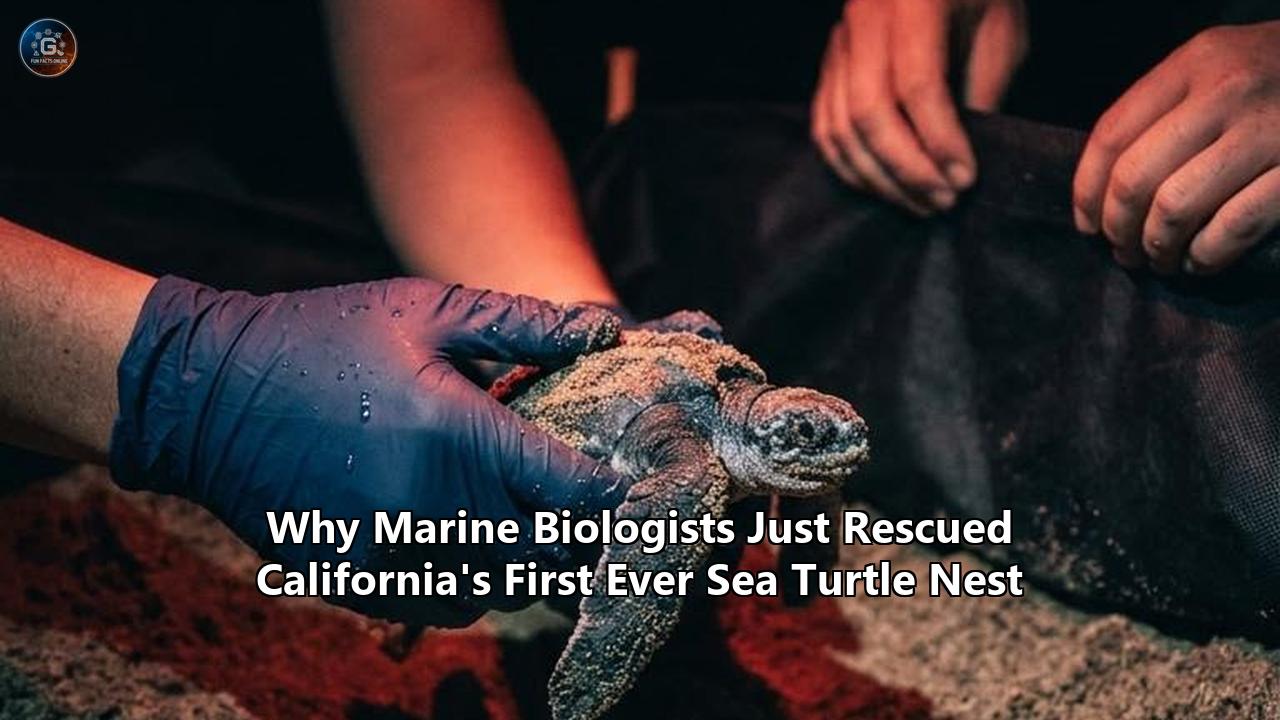
At dawn on September 25, 2026, a specialized team of federal biologists and wildlife veterinarians crouched over two small patches of sand in Orange County, California, delicately clearing away grains with brushes and gloved fingers. Beneath the surface lay 204 spherical, leathery white eggs—the first documented naturally occurring clutches ever laid by sea turtles on the Pacific coast of the United States.
Within hours, those eggs were inside temperature-regulated, sand-lined coolers, resting on the laps of federal scientists driving northward along the Pacific Coast Highway toward the Aquarium of the Pacific in Long Beach.
The decision to excavate and relocate the clutches came after an emergency inter-agency assessment concluded that leaving them in place guaranteed their destruction. A rare convergence of dual eastern Pacific tropical storms, late-September king tides, scheduled heavy municipal earth-moving operations, and an impending seasonal temperature plunge left marine authorities with no passive options.
The sudden arrival of two nesting olive ridley sea turtles (Lepidochelys olivacea) on urbanized Southern California beaches—one at Seal Beach on September 16, and another eight miles south near the Huntington Beach Pier on September 19—stunned the marine scientific community. Historically, the northernmost reproductive limit for olive ridleys in the eastern Pacific terminates at the southern tip of the Baja California Peninsula near Todos Santos and Magdalena Bay, more than 700 miles to the south.
This historic biological milestone presented wildlife managers with a complex conservation dilemma. The successful rescue operation at Seal Beach and Huntington Beach resolved the immediate life-or-death crisis for more than 200 developing embryos. Simultaneously, it exposed a pressing ecological reality: climate-driven marine anomalies are pushing endangered species into heavily developed, sub-optimal habitats where natural survival is nearly impossible without direct human intervention.
    PACIFIC OCEAN
          │
          ▼
┌──────────────────┐     Sept 16: First nest laid (Seal Beach)
│  Orange County   │     Sept 19: Second nest laid (Huntington Beach Pier)
│    Coastline     │     Sept 21: Hurricanes Polo & Odalys generate heavy swells
└─────────┬────────┘     Sept 24: King tides approach; airshow & sand berm work loom
          │
          ▼
┌──────────────────┐
│ Emergency Rescue │ ──► 204 eggs extracted into sand-cushioned coolers
│  Sept 25, 2026   │     Transported via car to minimize vibration
└─────────┬────────┘
          │
          ▼
┌──────────────────┐
│ Aquarium of the  │ ──► Climate-controlled incubation at 29.5°C
│  Pacific, Long   │     Target: 45–60 day gestation; balanced sex ratio
│   Beach Facility │     Post-hatch: Controlled release onto original natal beaches
└──────────────────┘
The Immediate Crisis: King Tides, Distant Hurricanes, and Urban Crowds
When the first female crawled out of the surf onto Seal Beach in broad daylight around 3:00 p.m. on September 16, local lifeguards could scarcely process what they were witnessing. Olive ridleys are among the smallest sea turtles, rarely exceeding 100 pounds, but they possess a distinctive heart-shaped carapace and powerful, paddle-like flippers built for oceanic migrations. Three days later, on September 19, a second female was spotted after dusk near the Huntington Beach Pier. Photographic analysis of carapace scute morphology and barnacle distributions by federal researchers quickly confirmed that the clutches belonged to two distinct individuals, ruling out the hypothesis of a single disoriented animal.
NOAA Fisheries and the U.S. Fish and Wildlife Service (USFWS) initially installed protective wire mesh cages, erected perimeter fencing, and posted explanatory signage to shield the nests from human disturbance. The initial plan was passive conservation: monitor the nests in situ through their standard 45-to-60-day incubation window and allow nature to take its course.
Within 72 hours, maritime weather models shattered that strategy.
Off the western coast of Mexico, two tropical weather systems—Hurricanes Polo and Odalys—strengthened simultaneously. Forecasters at the National Weather Service and NOAA warned that long-period southerly swell generated by the dual storms was tracking directly toward the Southern California Bight. Compounding the threat, the astronomical calendar scheduled bimonthly perigean spring tides, colloquially known as king tides, for the exact final weekend of September.
The physical mechanics of sea turtle nests make them extraordinarily vulnerable to prolonged inundation. Unlike avian eggs, reptilian eggshells are porous and flexible, relying on gas exchange through dry, aerated sand grains. If a clutch is submerged by storm surges or high tide lines for more than an hour or two, embryonic respiration fails, suffocating the developing turtles inside their shells.
Local beach infrastructure posed a parallel set of catastrophic risks:
- Wave action and inundation: Both nests sat low on the active berm slope, directly in the path of predicted 6-to-8-foot breaking swells atop high-tide baselines.
- Winter flood defenses: The Seal Beach clutch lay squarely inside the operational zone where city contractors were scheduled to begin bulldozing sand berms to protect the low-lying Surfside community from seasonal winter flooding.
- Heavy human foot traffic: The Huntington Beach clutch was located on a section of sand designated for infrastructure staging for the Pacific Airshow, an event that draws hundreds of thousands of spectators and relies on heavy utility equipment traversing the beachfront.
"We had to make some quick decisions," said Jonathan Snyder, a senior wildlife biologist with the U.S. Fish and Wildlife Service. "This is dynamic beach management, and you cannot afford to wait until water is actively washing over an endangered species nest. Moving the eggs was the decision that was made, and it was the only realistic option for species recovery".
Why a California Sea Turtle Nest Is an Ecological Paradox
The discovery of a California sea turtle nest is an unprecedented geographical anomaly that underscores the disruptive effects of marine heating.
Olive ridleys are circumtropical reptiles. Their evolutionary life history centers on warm equatorial and subtropical currents. In the eastern Pacific, major nesting aggregates occur along the coastlines of Costa Rica, Nicaragua, and southern Mexico, with the renowned arribada events—where tens of thousands of females haul out en masse over several nights—concentrated on beaches like Playa Ostional and La Escobilla.
The waters off Southern California, governed by the cold, south-flowing California Current, are typically far too chilly to support the reproductive cycles of tropical sea turtles. While adult green turtles (Chelonia mydas) have maintained foraging populations in San Diego Bay and the warm-water discharge canals of the San Gabriel River, they do not nest there. Finding reproductive olive ridleys as far north as latitude 33.7° N represents a range anomaly of staggering magnitude.
HISTORICAL LATITUDINAL LIMITS (Eastern Pacific Olive Ridley)
━━━━━━━━━━━━━━━━━━━━━━━━━━━━━━━━━━━━━━━━━━━━━━━━━━━━━━━━━━━━
33.7° N  │ Huntington Beach & Seal Beach, CA ──► [2026 Emergency Rescue]
32.5° N  │ US-Mexico Maritime Border
24.5° N  │ Magdalena Bay, Baja California Sur ──► Historical Stray Nests
23.5° N  │ Todos Santos / Los Cabos ────────────► Consistent Northern Limit
15.8° N  │ La Escobilla, Oaxaca ────────────────► Primary Arribada Rookery
"All sea turtles are incredible ancient mariners," observed Dr. Jeffrey Seminoff, leader of NOAA’s Marine Turtle Ecology and Assessment Program at the Southwest Fisheries Science Center in La Jolla. "They can cover thousands of open-ocean miles navigating by geomagnetic cues and thermal gradients. But whether these females were actively scouting expanded range due to warm water anomalies, or whether they committed a serious navigational blunder, remains the critical scientific question".
The primary catalyst for this shift was ocean temperature. During late summer 2026, an intense coastal marine heatwave linked to an active El Niño cycle pushed sea surface temperatures in the Southern California Bight past 72°F (22.2°C), creating subtropical surface corridors extending from the Baja Peninsula into Los Angeles County. For a pelagic sea turtle migrating northward while following food sources like pelagic red crabs (Pleuroncodes planipes) and pyrosomes, Southern California suddenly looked, felt, and tasted like northern Mexico.
Yet, the presence of a California sea turtle nest unmasks a biological trap. A coastline may present warm surface waters to adult turtles, but its terrestrial environment can remain entirely unsuitable for embryonic development.
What Went Wrong at the Origin: Thermal Feminization and Sand Temperature Physics
The appearance of these two turtles in Orange County is intimately linked to the growing environmental pressures degrading their traditional southern rookeries. To understand why sea turtles are prospecting so far to the north, marine scientists point toward compounding thermal crises across Central American and Mexican beaches.
Sea turtles exhibit Temperature-dependent Sex Determination (TSD), a reproductive mechanism where the ambient temperature of the surrounding sand dictates the biological sex of developing embryos:
- Pivotal Temperature: For olive ridleys, the pivotal balance point hovers between 29.0°C and 30.0°C (84.2°F to 86.0°F).
- The "Cool Dudes / Hot Chicks" Spectrum: Temperatures below this range produce male hatchlings; temperatures above it produce female hatchlings.
- Lethal Thermal Threshold: Sand temperatures exceeding 34.0°C (93.2°F) disrupt embryonic organogenesis, leading to thermal arrest and 100% clutch mortality.
INCUBATION TEMPERATURE PROFILE (°C)
┌───────────────┬───────────────────┬───────────────────┬───────────────┐
│  Below 26°C   │    26°C – 29°C    │    30°C – 33°C    │  Above 34°C   │
├───────────────┼───────────────────┼───────────────────┼───────────────┤
│ Developmental │    Male Bias      │   Female Bias     │ Lethal Arrest │
│    Halt /     │  ("Cool Dudes")   │  ("Hot Chicks")   │  (Embryonic   │
│  Suffocation  │                   │                   │   Mortality)  │
└───────────────┴───────────────────┴───────────────────┴───────────────┘
                                ▲
                                │
                    Aquarium Target: 29.5°C
                    (Balanced Sex Distribution)
At core Pacific nesting grounds in Michoacán, Oaxaca, and Costa Rica, severe heatwaves driven by rising baseline temperatures routinely push sand environments into lethal territory. Marine scientists have documented localized sex ratios skewing higher than 95% to 99% female across multiple Pacific rookeries, severely altering the demography of young cohorts. Furthermore, intense tropical storm seasons driven by superheated surface waters regularly scrub away traditional nesting spits, forcing mature females to disperse along unfamiliar coastal margins to deposit their heavy egg loads.
However, the thermal challenge operates in reverse once turtles migrate into Southern California.
While Orange County beaches can be hot during midday in August and September, the subterranean sand temperatures at a depth of 18 to 24 inches—where a female olive ridley deposits her eggs—drop sharply as Autumn arrives. Without artificial incubation, California's late-autumn coastal sand temperatures rapidly fall below 24°C (75°F). At that low threshold, embryonic metabolic rates stall entirely. Had the eggs remained in the sand through October and November, the clutch would have suffered hypothermic developmental failure, even if high tides and storm swells had spared the nests.
The Delicate Mechanics of the Rescue Operation
Faced with these compounding threats, the joint response team had to execute an intricate salvage operation. Moving sea turtle eggs is fraught with biological hazard, demanding precise biomechanical control to avoid killing the very embryos the operation is mounted to save.
EXTRACTION ──► 1. Vertical axis marked with graphite
               2. Zero rotation / tilt maintained
               3. Placed into sterile, native sand layers

TRANSPORT  ──► 1. Hand-cradled on human laps inside vehicles
               2. Shock-absorbing suspension routing
               3. Transit along Pacific Coast Highway

INCUBATION ──► 1. Bio-secure chamber at Aquarium of the Pacific
               2. Substrate held at constant 29.5°C
               3. 85% relative humidity monitored via probes
The Biology of Vitelline Attachment
In sea turtle development, the early-stage embryo is suspended inside a delicate blastodisc on the upper surface of the yolk. Within roughly 12 to 24 hours of oviposition, the vitelline membrane chemically adheres to the inner wall of the porous shell. Once this attachment forms, any sudden rotation, tilt, or mechanical shock will tear the membrane, drowning the embryo in its own albumen or separating it from its nutrient supply.
Because both nests had been in the sand for nearly a week—nine days for Seal Beach and six days for Huntington Beach—the membranes were fully locked in place.
The Extraction Protocol
Working under federal permits granted by USFWS, biologists used soft excavation brushes to expose the clutches egg by egg.
- Axis Orientation: Before lifting an egg from the sand chamber, scientists marked the exact top-center axis of the shell with an inert graphite pencil to ensure it remained precisely oriented during transit.
- Moisture Control: Handling each egg with powder-free nitrile gloves, biologists placed them into custom-molded, heavy-duty polystyrene incubation coolers.
- Substrate Packing: Eggs were bedded in layers of native sand collected from the original egg chambers, maintaining the ambient moisture levels and chemical environment of the nest.
Vibration-Dampened Transit
Vehicle transit posed a severe threat to embryonic stability. Road vibrations from engine oscillation and highway pavement joints can easily rupture early vascular networks inside delicate reptile eggs.
To eliminate vehicle chassis vibrations, the team rejected placing the coolers on the flatbeds of agency trucks. Instead, scientific staff members held the coolers on their laps in passenger seats, utilizing their own bodies as shock absorbers during the 15-mile drive to the Aquarium of the Pacific.
Upon arrival in Long Beach, the 204 eggs were transferred to a dedicated, climate-controlled rehabilitation room. Biologists calibrated the artificial incubation substrate to 29.5°C (85.1°F) and maintained an 85% relative humidity level. This target temperature was intentionally selected to balance sex ratios—ensuring the resulting hatchlings do not emerge exclusively as one sex, while keeping them safely below the lethal thermal threshold.
The Natal Imprinting Dilemma and the Founding Event
Rescuing the eggs solved the immediate threat of embryo mortality, but it created a complicated ecological puzzle for their eventual release.
Sea turtles are famous for natal philopatry—the biological drive to return, as mature adults, to the exact geographical region where they entered the ocean as hatchlings. This behavior is governed by geomagnetic imprinting, supported by olfactory signatures absorbed from the local sand and seawater.
Hatchling Emergence
        │
        ▼
Sand Locomotion (Beach Crawl)
  • Absorbs local mineral scent & chemical signatures
  • Mechanical exercise initiates vigorous flipper stroke
        │
        ▼
Geomagnetic Calibration
  • Microscopic magnetite crystals in the brain align to local magnetic field
  • Registers inclination angle and magnetic intensity of Orange County coast
        │
        ▼
Pelagic Oceanic Drift (12–15 Years)
  • Migrations across the wider Pacific gyre
        │
        ▼
Adult Natal Homing
  • Sexually mature female uses magnetic map to navigate back to Orange County
As hatchlings push out of the egg chamber and crawl down the sloping beach face into the surf, microscopic magnetite crystals embedded in their brains register the Earth’s local magnetic field intensity and inclination angle. Simultaneously, the chemical composition of the run-off water and sand particles imprints on their olfactory nerves.
If scientists were to incubate the eggs, drive the hatchlings onto an offshore vessel, and drop them directly into deep blue water off Santa Catalina Island, that crucial sensory imprinting loop would break. The turtles would lack the spatial coordinate system required to complete their adult life cycles.
"Importantly, this is a potential founding event," explained NOAA wildlife officials during the operation's briefing. If these hatchlings survive to adulthood—a challenging journey with odds of roughly one in one thousand—they will mature in approximately 12 to 15 years. Guided by the geomagnetic imprinting formed during their crawl across the beach, surviving females would naturally return to Southern California waters to breed and nest.
To preserve that evolutionary potential, USFWS, NOAA, and the Aquarium of the Pacific developed a strict release plan. As the 45-to-60-day incubation concludes in late October or November, newly hatched turtles will be transported back to the exact stretches of Seal Beach and Huntington Beach where their mothers laid them. Under strict monitoring by federal biologists and local lifeguards, the hatchlings will be placed at the high-tide line and permitted to crawl across the sand into the Pacific waves under their own power.
By completing that physical crawl across Southern California sand, the hatchlings will calibrate their internal compasses to Orange County's magnetic coordinates, preserving the biological mechanism for a future California sea turtle nest.
Bridging the Regulatory Chasm: Urban Coasts as Novel Wildlife Refuges
The discovery and subsequent evacuation of the nests exposed a fragmented regulatory framework along California's shoreline. Highly developed coastal zones like Orange County are heavily engineered for human leisure, residential safety, and event revenue, not for threatened marine reptiles.
               ┌────────────────────────────────────────────────────────┐
               │         INTER-AGENCY JURISDICTION MATRIX               │
               └────────────────────────────────────────────────────────┘
                                            │
               ┌────────────────────────────┴───────────────────────────┐
               ▼                                                        ▼
┌─────────────────────────────┐                          ┌─────────────────────────────┐
│   MARINE ZONE (Below MHW)   │                          │  TERRESTRIAL ZONE (Sand)    │
├─────────────────────────────┤                          ├─────────────────────────────┤
│ Agency: NOAA Fisheries      │                          │ Agency: USFWS               │
│ Role: Swimming turtles,     │                          │ Role: Eggs, crawling        │
│       ocean stranding       │                          │       turtles, nests        │
└──────────────┬──────────────┘                          └──────────────┬──────────────┘
               │                                                        │
               └────────────────────────────┬───────────────────────────┘
                                            │
                                            ▼
                       ┌────────────────────────────────────────┐
                       │       MUNICIPAL & STATE OVERLAY        │
                       ├────────────────────────────────────────┤
                       │ • CA Coastal Commission (Access)      │
                       │ • City Lifeguards (First Response)    │
                       │ • Public Works (Berms, Grooming)      │
                       │ • Public Aquaria (Rescue Facilities)  │
                       └────────────────────────────────────────┘
The split jurisdictional framework governing sea turtle conservation complicates response logistics:
- NOAA Fisheries: Governs all sea turtles in the aquatic marine environment, below the Mean High Water (MHW) line.
- U.S. Fish and Wildlife Service: Assumes primary jurisdiction the second a marine turtle crawls above the wet tide line onto the dry sand.
- The California Coastal Commission: Regulates public beach access, commercial events, and development along the coastal boundary.
- Local Municipalities: Cities like Huntington Beach and Seal Beach employ marine safety departments and beach maintenance crews focused on visitor safety, trash removal, and coastal erosion defense.
When the first turtle crawled ashore, there was no active West Coast protocol for a natural California sea turtle nest. On the Atlantic and Gulf coasts of Florida, Georgia, and the Carolinas, local municipalities have developed seasoned networks of turtle patrol volunteers, regulated beachfront lighting ordinances, and strict moratoria on mechanical sand grooming during nesting seasons.
California had none of these systems in place.
Mechanical grooming tractors routinely comb the sand of Orange County beaches multiple nights per week, sifting through the top 12 inches to remove trash, plastics, and debris. While this keeps recreation areas clean, an industrial rake passing over an unmarked sea turtle nest can crush the eggs or alter the sand density, suffocating the clutch below.
Furthermore, urban coastal lighting creates severe phototaxis challenges. In Florida, bright artificial lighting is heavily regulated because sea turtle hatchlings naturally orient toward the brightest horizon—which, in an undisturbed wilderness, is the open ocean reflecting moonlight and starlight. On an urban shoreline like Huntington Beach, the brightest horizon points inland: toward neon boardwalk signs, Pacific Coast Highway streetlights, beachfront resort developments, and coastal sports complexes.
Unchecked, emerging hatchlings will crawl inland toward traffic rather than into the ocean surf.
The rescue at Huntington Beach and Seal Beach forced an ad-hoc coalition of federal scientists, local lifeguards, and city administrators to craft protective measures within days. The California Coastal Commission coordinated with Huntington Beach event planners to adjust the physical boundary lines for the Pacific Airshow, while public works departments adjusted winter sand-berm construction schedules to safeguard the shoreline habitat.
What Experts and Leaders Are Doing: Strategic Solutions for a Shifting Coast
The rescue of these 204 eggs marks an inflection point for wildlife managers along the eastern Pacific rim. State, federal, and non-profit conservation groups are transitioning from an emergency salvage posture to proactive structural planning.
Leaders are executing several foundational initiatives to manage future nesting activity:
1. Genomic Mapping of the Southern Lineage
Biologists have gathered tissue and genetic samples from unviable eggs in the clutches. Geneticists at the Southwest Fisheries Science Center are sequencing these samples to trace the exact natal lineage of the two mother turtles.
Identifying whether these females belong to the endangered Eastern Pacific population of Mexico or the larger populations of Costa Rica will tell scientists whether this was a regional expansion driven by local conditions or a massive trans-oceanic displacement.
2. Shoreline Temperature and Substrate Monitoring
To evaluate whether future clutches could ever incubate naturally in Southern California, researchers are installing subterranean data loggers along beaches from San Diego to Santa Barbara.
These sensor arrays measure sand temperature at standardized nesting depths of 18, 24, and 30 inches throughout the late summer and autumn. The resulting data will map out any localized microclimatic thermal refuges—such as protected, dark-sand pocket beaches—that might support natural in situ incubation in the coming decades.
       NOVEL WEST COAST MANAGEMENT INITIATIVES
       ═══════════════════════════════════════

 ┌──────────────────────┐       ┌──────────────────────┐
 │   GENOMIC TRACKING   │       │   SAND THERMAL ARRAYS│
 ├──────────────────────┤       ├──────────────────────┤
 │ Map parental origin  │       │ Subterranean loggers │
 │ and genetic lineage  │       │ track incubation     │
 │ of displaced turtles │       │ viabilities (18-24") │
 └──────────────────────┘       └──────────────────────┘
            │                              │
            ▼                              ▼
 ┌──────────────────────┐       ┌──────────────────────┐
 │ MUNICIPAL PROTOCOLS  │       │ COMMUNITY SURVEILLANCE│
 ├──────────────────────┤       ├──────────────────────┤
 │ Alter night grooming │       │ Train ocean guards   │
 │ and lighting near    │       │ and surfers to spot  │
 │ prospective nesting  │       │ emergent tracks      │
 └──────────────────────┘       └──────────────────────┘
3. Revising Municipal Beach Maintenance Charters
NOAA and USFWS are partnering with Orange, Los Angeles, and San Diego County coastal agencies to integrate turtle protocols into standard lifeguard training and public works operations.
- Tractor Protocols: Updating seasonal guidelines for mechanical sand-grooming tractors, training operators to recognize turtle tracks—the distinctive "tractor-tread" flipper patterns left in the sand.
- Rapid Response Hotlines: Directing public safety personnel to contact NOAA’s West Coast Stranding Network immediately upon spotting sea turtles on dry land, ensuring rapid perimeters are established.
- Lighting Adjustments: Exploring low-wavelength amber LED fixtures for coastal installations near beaches that could host future nesting activity, minimizing disorientation risks for wild hatchlings.
"As animals adapt in unexpected ways to changes in their natural world, humans will need to adapt and make space to ensure endangered and threatened species are given a fighting chance," said Jeff Flocken, President and CEO of the Aquarium of the Pacific. "If these hatchlings make it, these baby turtles may one day return to nest on the very sands where this journey began".
The Horizon: A New Reality for California's Marine Life
The emergency rescue of California's first documented sea turtle clutches is not an isolated curiosity. It is an early signal of widespread biological shifts unfolding across the Pacific Ocean.
As global ocean currents absorb excess heat and historical wind patterns shift, the clear line separating subtropical ecosystems from temperate waters is blurring. Southern California beachgoers have grown accustomed to seeing pelagic red crabs washing ashore in crimson tides, yellowtail tuna appearing in surf breaks, and hammerhead sharks patrolling offshore kelp forests during strong El Niño years.
The appearance of reproductive sea turtles extends this ecological migration directly onto the terrestrial shoreline.
ECOLOGICAL TRAJECTORY (SOUTHERN CALIFORNIA BIGHT)
━━━━━━━━━━━━━━━━━━━━━━━━━━━━━━━━━━━━━━━━━━━━━━━━━━━━━━━━━━━━
HISTORICAL (Cold Temperate)   │ PRESENT (Episodic Subtropical)│ FUTURE (Persistent Novelty)
─────────────────────────────┼───────────────────────────────┼────────────────────────────
• Giant Kelp Forests        │ • Marine Heatwave Spikes      │ • Range-Shifting Nesters
• Cold Upwelling Regimes     │ • Seasonal El Niño Intrusions │ • Thermal Habitat Loss
• Non-Reproductive Foragers  │ • 1st Ever Olive Ridley Nests │ • Engineered Incubations
Whether these two nests remain a historical anomaly or signal the arrival of a permanent regional breeding population will become clear over the next fifteen years. That is when the hatchlings leaving Long Beach will reach maturity, guided across thousands of ocean miles by the imprint of the Southern California coast locked in their brains.
For now, the survival of this historic cohort rests inside climate-controlled incubators in Long Beach. By stepping in to extract those 204 eggs from the path of rising tides and industrial machinery, marine scientists gave a fragile clutch of ocean travelers a fighting chance—and offered the world a clear look at how coastal conservation must evolve as wildlife moves across a rapidly changing planet.
Reference:
- https://www.latimes.com/science/story/2026-09-25/biologists-move-unprecedented-orange-county-sea-turtle-eggs-to-protect-them-from-hurricane-driven-waves
- https://www.fisheries.noaa.gov/feature-story/first-ever-olive-ridley-sea-turtle-nests-california
- https://www.goodnewsnetwork.org/first-ever-recorded-sea-turtle-nests-on-americas-west-coast/
- https://event-newsenterprise.com/30323-2/
- https://www.zmescience.com/ecology/animals-ecology/sea-turtles-nest-california/
- https://www.fisheries.noaa.gov/feature-story/first-ever-olive-ridley-sea-turtle-nests-california