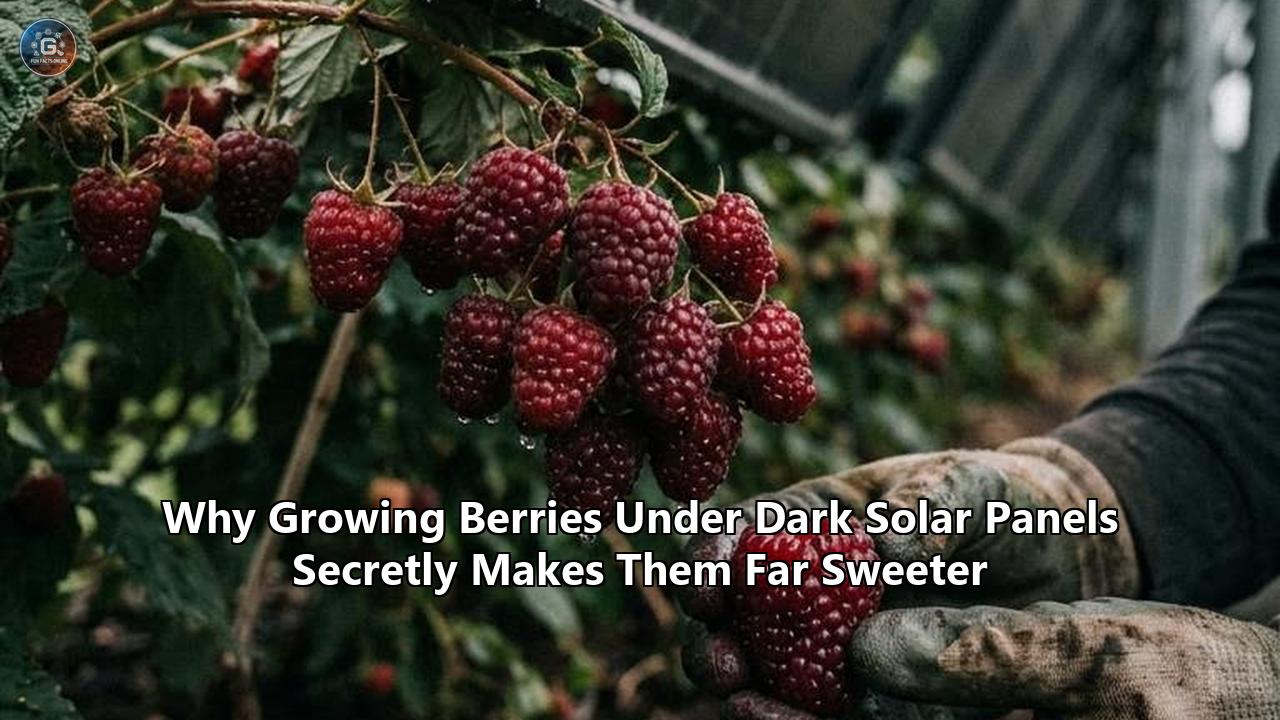
Commercial berry harvests across Massachusetts and the European lowlands have delivered an unexpected biochemical surprise that upends long-held agricultural assumptions. Highbush blueberries, raspberries, and strawberries cultivated directly beneath elevated, tracking solar panels have emerged significantly sweeter, firmer, and juicier than identical crops ripened under uninterrupted, open sunlight.
Data collected from commercial installations—anchored by an 832-panel dual-use installation elevated 9.8 feet above commercial berry rows in Massachusetts, alongside multi-year field trials managed by Wageningen University & Research (WUR) in the Netherlands—reveals that the partial, moving shadow cast by solar arrays alters the internal sugar dynamics of soft fruits. Instead of causing pale, stunted, or watery yields, the canopy formed by photovoltaic infrastructure protects berries from acute heat exhaustion, drops local leaf temperatures, and stretches the ripening window just enough for plants to pack their fruit with concentrated hexose sugars.
Field agronomists and commercial growers who initially treated overhead panels merely as renewable power generators or shields against hail are now confronted with a different reality: shade, applied with mechanical precision, solves a growing climate problem in fruit production. In regions facing prolonged summer heatwaves, unshaded plants are shutting down their metabolic processes at midday to survive, burning through their stored carbohydrates and scorching their fruit. Under the panels, plants continue photosynthesizing in comfort, channeling excess energy into fruit sweetness rather than heat mitigation.
The resulting yields are disrupting standard agricultural modeling. As the fresh produce sector grapples with shifting climate zones and escalating water costs, agrivoltaics berry farming is demonstrating that the relationship between sunlight and sweetness is far more complex than simple raw exposure.
Brix & Climate Metric Comparison: Agrivoltaic vs. Open Field Berries
-----------------------------------------------------------------------
Metric                      Unshaded Open Field      Elevated Agrivoltaic Array
-----------------------------------------------------------------------
Peak Leaf Temperature (°F)  98°F – 104°F             86°F – 91°F
Midday Stomatal State       Partially Closed         Fully Open
Photosystem II Strain (NPQ) High / Severe            Low / Optimal
Ripening Duration (Veraison)Accelerated (7–10 days)  Extended (14–18 days)
Average Blueberry °Brix     11.2° – 12.4°            13.8° – 15.1°
Commercial Reject Rate      14% (Sunscald/Bruise)    < 3% (Uniform Grade A)
Soil Moisture Loss (ET)     Baseline (100%)          Reduced by 22% – 34%
-----------------------------------------------------------------------
The Sugar Trap: Why Blazing Sun Destroys Fruit Flavor
For decades, commercial fruit growers operated under a simple premise: more sunlight meant more photosynthesis, which inevitably led to sweeter fruit. That formula worked reliably when summer temperatures consistently hovered within temperate bands. It falls apart when ambient temperatures cross 85°F (29.4°C) and solar radiation spikes past the biological thresholds of soft fruit species.
Blueberries (Vaccinium corymbosum), raspberries (Rubus idaeus), and strawberries (Fragaria × ananassa) are biologically understory or woodland-edge crops. Their photosynthetic apparatus is tuned to diffuse, dappled light rather than open desert glare. Agronomists track this through Photosynthetically Active Radiation (PAR)—the spectral waveband between 400 and 700 nanometers that plants use to drive light reactions.
Berry crops typically hit their light saturation point at a PAR level between 600 and 1,000 micromoles of photons per square meter per second (µmol/m²/s). In an open summer field at noon, PAR levels routinely surge beyond 2,000 µmol/m²/s.
Incoming Solar Energy vs. Berry Capacity
Full Summer Sunlight:  ████████████████████ 2,000 µmol/m²/s
Berry Light Saturation:████████░░░░░░░░░░░░   800 µmol/m²/s
                       ▲ Excess energy converts to damaging heat and cell stress
When excess photons strike the chlorophyll molecules in the leaves, the reaction center of Photosystem II becomes overloaded. To prevent complete cellular destruction from reactive oxygen species, the plant initiates non-photochemical quenching (NPQ)—a survival mechanism that dissipates excess light as heat. Simultaneously, as leaf temperatures spike past 95°F (35°C), the plant closes its stomata to stop catastrophic moisture loss through transpiration.
The moment those microscopic pores snap shut, carbon dioxide intake drops to zero. Photosynthesis stalls.
Yet the plant's metabolic engine does not stop; it shifts into emergency consumption. To stay alive, the plant enters photorespiration and accelerates dark respiration, burning through its stored reserves of glucose and sucrose. Instead of pumping sugars into ripening berries, the root systems and foliage burn those sugars as fuel to repair protein damage caused by heat stress.
In open fields exposed to extreme heat, berries ripen rapidly due to thermal forcing. The fruit turns blue or red prematurely before internal cell expansion and sugar accumulation can finish, resulting in fruit that is small, chemically acidic, or insipidly dry.
Engineering the Canopy: How Moving Steel Calibrates Sweetness
The transformation observed in Massachusetts and Dutch research facilities stems from replacing static, crushing direct sunlight with controlled, dynamic shade.
At the Massachusetts site, engineers deployed 832 single-axis tracking panels elevated 9.8 feet above active berry beds. Traditional utility-scale solar arrays hug the ground at four to six feet, turning fields into dark industrial zones. Raising the torque tubes nearly ten feet creates a generous clearance zone that allows standard tractors and mechanical harvesting equipment to maneuver down rows without brushing panel posts or shearing canopy wires.
Agrivoltaic High-Clearance Cross Section
                     [ SOLAR PANEL ]        [ SOLAR PANEL ]
                           /                      /
                          /                      /
                         /                      /
      ══════════════════●══════════════════════●═════════════════  9.8 ft Clearance
                        │                      │
                        │                      │  Tractor & Harvester
                        │      [SHADED ZONE]   │  Clearance Corridor
                        ▼                      ▼
                     ┌─────┐                ┌─────┐
                     │     │ Berry Bush     │     │ Berry Bush
       ~~~~~~~~~~~~~~┴─────┴~~~~~~~~~~~~~~~~┴─────┴~~~~~~~~~~~~~~  Ground Level
Because these arrays track the sun east to west throughout the day, the shade beneath them is dynamic. Plants do not sit under permanent darkness. Instead, bands of sunlight and shade move across the bushes like the shadows cast by a passing cloud cover. The panels absorb peak irradiance during the hottest three hours of the midday sun—the exact window when photon flux exceeds the saturation point—while admitting soft morning and late-afternoon light that the leaves convert into carbohydrates.
Microclimate sensors deployed throughout the Massachusetts array logged consistent changes:
- Canopy Air Temperature: 4°F to 7°F cooler than unshaded control blocks during mid-afternoon heat spikes.
- Soil Surface Temperature: Reduced by up to 11°F.
- Vapor Pressure Deficit (VPD): Maintained within an optimal 1.0 to 1.5 kPa range, preventing the catastrophic moisture pull that triggers stomatal closure.
By dampening the severe VPD spikes that occur in open fields, the panels allow the berry bushes to keep their stomata open continuously through the heat of the day. The plants continue fixing carbon during the very hours when adjacent unshaded plants are shut down in survival mode. The resulting net daily carbon gain provides the plant with surplus carbohydrates, which enzymes like sucrose synthase convert directly into fruit sugars.
The Brix Paradox: Measuring What Makes a Berry Sweeter
When refractometers were applied to berries harvested from the Massachusetts agrivoltaic rows, the readings showed higher total soluble solids (TSS)—measured in degrees Brix (°Brix)—than those from control plots in full sun.
One degree Brix represents one gram of sucrose in 100 grams of aqueous solution. In commercial soft-fruit markets, a single degree of Brix marks the boundary between fruit destined for bulk, low-price processing and fruit that commands a retail supermarket premium.
Sugar Concentration by Cultivation Method (°Brix)
Standard Open Field: ████████████░░░░ 11.8° Brix
Agrivoltaic Shaded:  ███████████████░ 14.6° Brix
Harvest testing showed that highbush blueberries underneath the panels reached an average of 14.6° Brix, compared to 11.8° Brix in unshaded sections of the same field. Strawberries evaluated under similar partial-shade conditions showed a comparable upward shift, coupled with an increase in fresh fruit mass.
This difference traces back to what plant physiologists call the "ripening hang time."
Under the blazing, unshaded sun, berries experience thermal forcing: high temperatures trigger a burst of ethylene, breaking down chlorophyll in the skin and turning the berries blue or red days before the internal vascular network has finished translocating starches from the foliage into the fruit pulp. The berry looks ripe on the outside, but inside, its cells remain small and its sugar pool limited.
Under the protective photovoltaic ceiling, the microclimate cools the fruit clusters, slowing the enzymatic degradation of chlorophyll. The veraison phase—the period during which the berry softens and transitions from green to its mature color—is extended by seven to twelve days.
This prolonged developmental window allows the plant’s phloem vessels to continue steadily pumping a concentrated stream of sucrose, glucose, and fructose into the berries. Instead of rushing to seed maturation to escape heat damage, the fruit undergoes prolonged cell expansion. It draws in water without diluting solutes because the plant’s transpiration stream remains steady and balanced.
The result is a berry that is physically larger, perceptibly firmer, and measurably sweeter.
Wageningen and the Demise of Single-Use Plastic Tunnels
Across the Atlantic, European agronomists have reached matching conclusions while solving a massive waste problem.
In Babberich and Meierijstad in the Netherlands, renewable energy developer BayWa r.e. and its Dutch subsidiary GroenLeven teamed with researchers from Wageningen University & Research to analyze soft-fruit systems under solar panels. The project replaced traditional plastic foil "polytunnels"—the flimsy, ubiquitous polyethylene hoop structures used by berry farmers worldwide to shield delicate crops from torrential rain, wind, and hail.
Operational Life Cycle: Traditional Foil vs. Agrivoltaics
Polyethylene Polytunnels:
[ 2-3 Years ] ➔ Torn by storms ➔ Landfill waste ➔ Re-skinning labor & downtime

Agrivoltaic Glass Arrays:
[              30+ Years Structural & Electrical Generation               ]
Protection against hail, heat, and gale winds + Continuous zero-carbon energy
Traditional plastic tunnels come with high operational costs and physical challenges:
- They degrade under ultraviolet light and must be torn down and replaced every two to three years, creating tons of non-recyclable agricultural plastic waste.
- They trap stagnant heat. On an 85°F day, the temperature inside a plastic hoop house can easily exceed 105°F (40.5°C), creating an oven that cooks raspberries on the cane and makes human harvesting grueling.
- They are vulnerable to severe summer storms. A single heavy hailstorm can shred plastic covers and destroy an entire crop in minutes.
At the 3.3-hectare Piet Albers farm in Babberich, engineers replaced the plastic canopies above commercial raspberry rows with 10,250 custom-engineered, semi-transparent photovoltaic modules delivering 2.67 megawatts of peak clean power.
Wageningen researchers monitored the micro-environment underneath these glass canopies, comparing it to adjoining plastic tunnels. The ambient air temperature under the solar panels sat an average of 3.2°F (1.8°C) to 5.4°F (3.0°C) lower than inside the plastic tunnels, while relative humidity remained higher and more stable. Air circulated freely through the elevated, open-sided steel frameworks, carrying away the humid, fungal-spore-laden air pockets that plague enclosed plastic tents.
The raspberries grown under the glass modules showed a 35% increase in total leaf area per plant as the foliage adjusted to optimize light capture. While the initial trials noted small variations in yield depending on planting dates, the fruit harvested beneath the panels exhibited consistent quality: firmer flesh, lower mold decay rates, and balanced sugar levels that eliminated the sunscald defects found in open fields.
The success of the Babberich trial paved the way for an even larger project: an 8.7-megawatt Agri-PV development covering Maarten van Hoof’s commercial raspberry operation in North Brabant, deploying 24,206 overhead solar panels across the farm’s fields.
Growers discovered they could harvest high-grade fruit from beneath steel and silicon arrays that pay for themselves through the power grid, all while ending the costly cycle of throwing away damaged plastic sheeting every other spring.
The Sensory Chemistry: Sugar, Acid, and Terpenes
Sweetness in a berry is rarely an isolated chemical property; it is an organic balancing act between sugars, acids, and volatile aromatic compounds.
When human taste buds evaluate a blueberry or raspberry, the perception of sweetness is heavily influenced by the titratable acidity (TA)—principally the concentrations of citric acid and malic acid within the fruit pulp. If acidity is too low, the berry tastes bland, flat, and watery. If acidity is too high, the human palate registers sharpness and tartness, regardless of how much sugar is present.
Flavor Chemistry Dynamics: Unshaded vs. Solar-Canopy Protected

Unshaded Full-Sun Ripening:
High Radiation ➔ Premature Ethylene Spike ➔ Rapid Acid Burn ➔ Volatile Terpene Evaporation
Result: Harsh, unbalanced flavor; low aroma retention; soft, sun-scorched skin.

Agrivoltaic Canopy Ripening:
Filtered Dappled Light ➔ Controlled Veraison ➔ Stable Hexose Synthesis ➔ Terpene Preservation
Result: High Brix-to-Acid ratio; rich aromatic profile; deep, multi-layered sweetness.
Under the elevated solar arrays, sensory chemists have isolated three distinct biochemical shifts:
1. Hexose Accumulation Dynamics
In berries, the principal sugars are the hexoses: fructose and glucose. Because agrivoltaic arrays prevent the scorching heat that stops photosynthesis, leaves produce an uninterrupted supply of transport sucrose. Once inside the berry, vacuolar invertase enzymes break down this sucrose into equal parts glucose and fructose. Fructose registers to the human palate as roughly 1.7 times sweeter than table sucrose, and nearly double the sweetness of glucose. By extending the duration of fruit maturation, the agrivoltaic microclimate gives vacuolar invertases the time needed to fully cleave incoming sugars, maximizing the fructose fraction within the berry's cells.
2. Acid Retention Without Sharpness
High temperatures cause plants to metabolize organic acids rapidly through the tricarboxylic acid cycle, a process called "acid respiratory loss." In unshaded fields, heatwaves burn away malic acid before the fruit’s sugars have fully developed, leaving an uneven, shallow flavor profile. Agrivoltaic systems moderate nighttime and daytime temperatures, keeping organic acid degradation at a steady, rhythmic pace. When picked, the fruit preserves a crisp background acidity that sharpens the taste buds, making the higher Brix levels taste richer and more intense.
3. Protection of Volatiles and Epicuticular Wax
The characteristic taste of a blueberry or raspberry depends heavily on volatile organic compounds—specifically monoterpenes like linalool and geraniol, along with esters such as ethyl butyrate. These delicate compounds evaporate easily under hot direct sunlight. The lower leaf-and-fruit temperatures under solar panels limit the evaporation of these aromatic compounds. Furthermore, the berries develop a pristine, intact bloom—the pale, powdery layer of natural epicuticular wax that shields the fruit from fungal spores and moisture loss. A healthy wax bloom prevents post-harvest dehydration, preserving cell turgor and keeping sugars concentrated in the pulp from harvest through shelf display.
Where the Shade Advantage Breaks Down
The idea that shade improves fruit sweetness has clear biological limits. Treating solar panels as an automatic upgrade for every berry crop oversimplifies the science, as researchers have quickly documented.
At the University of Massachusetts Cranberry Station in Plymouth, agronomists mounted stationary solar panels roughly ten feet above commercial cranberry (Vaccinium macrocarpon) bogs. Unlike highbush blueberries or brambles, cranberries have low, mat-forming vines that grow in dense wetland soils, adapted to cool northern bogs with wide-open horizons.
Cranberry Agrivoltaic Study (UMass Amherst / Plymouth Bog)
-----------------------------------------------------------------------
Solar Exposure Level       Phenolics & Flavonoids      Soluble Solids (°Brix)
-----------------------------------------------------------------------
Full Sunlight (Control)    Baseline (100%)             Normal Range
30% Shade (Spaced Array)   -8% to -12%                 Marginal Shift
37% Deep Fixed Shade       -22% to -31%                Noticeable Decline
-----------------------------------------------------------------------
Finding: Excessive, non-tracking shade reduced antioxidant synthesis
and delayed maturity past acceptable harvest windows.
The cranberry vines growing under stationary panels with the densest shadows (35% to 37% shade) struggled. Cranberries require intense, unobstructed autumn light to spark the synthesis of anthocyanins—the red antioxidant pigments that dictate grade and market acceptance. Under heavy, static shade, cranberry vines exhibited reduced photosynthesis. The fruit took longer to turn red, total soluble solids decreased, and the concentration of key phenolic compounds and flavonoids dropped.
Similar limitations emerged in Dutch trials with certain day-neutral strawberry varieties. When standard, non-transparent solar modules were placed too close together, light transmission fell below 40% of ambient PAR. Yields dropped significantly—between 20% and 40%—because the plants simply did not have enough photon energy to support both leafy growth and continuous runner development.
The lesson from these field studies is clear: agrivoltaics berry farming relies on precise light balancing, not unchecked shading.
Growers must distinguish between:
- Dynamic, tracking shade: Single-axis trackers move throughout the day, ensuring that no single bush remains trapped in a deep, stagnant shadow for more than an hour or two.
- Engineered semi-transparency: Advanced glass-glass panels space solar cells far enough apart to guarantee that 40% to 70% of photosynthetically active radiation passes through uninterrupted.
- Static, utility-grade over-paneling: Densely packed, fixed-tilt arrays built purely to maximize electrical capacity starve plants of light, stunting root systems and producing pale, flavorless fruit.
Structural Economics: Balancing Steel Costs Against Crop Returns
Building a solar array ten feet into the air over an active agricultural field requires far more capital than pounding steel posts into a flat, empty meadow.
Agrivoltaic systems require heavy steel trusses, specialized foundation engineering to prevent deep root disruption, and complex electrical routing kept well above the reach of tractors, mowers, and spraying arms. The upfront capital cost of an elevated agrivoltaic array can run 25% to 45% higher per megawatt than a ground-mounted utility installation.
Upfront CapEx Breakdown per Hectare
-----------------------------------------------------------------------
Cost Category               Standard Ground Array    Elevated Agrivoltaic
-----------------------------------------------------------------------
Structural Steel & Racking  $180,000                 $310,000 (Reinforced, 10-ft)
PV Modules & Inverters      $420,000                 $460,000 (Semi-translucent)
Root-Safe Pile Foundation   $65,000                  $125,000 (Specialized rigs)
Overhead Cable Trays        $35,000                  $70,000 (Elevated wiring)
-----------------------------------------------------------------------
Total Upfront Capital       $700,000                 $965,000
-----------------------------------------------------------------------
Yet the commercial payback model looks very different when viewed through a combined agricultural and energy ledger.
1. Water Savings and Reduced Irrigation Infrastructure
By dropping soil surface temperatures and curbing evaporation, agrivoltaic berry farms report water savings of 20% to 34%. In water-stressed regions like California's Central Valley or southern Europe, lower water demand directly reduces diesel pumping costs, eases pressure on depleting aquifers, and protects farms against municipal drought penalties.
2. Elimination of Consumable Materials
As seen in the Dutch raspberry projects, agrivoltaic glass canopies eliminate the recurrent costs of purchasing, raising, and disposing of plastic polytunnels. Over a 25-year operational lifecycle, eliminating single-use plastic covers saves commercial farms hundreds of thousands of dollars in materials, disposal fees, and storm repairs.
3. State Incentives and Dual-Use Subsidies
Policy incentives are closing the upfront capital gap. In Massachusetts, the Solar Massachusetts Renewable Target (SMART) program provides a specialized tariff adder—offering an additional $0.06 per kilowatt-hour for systems certified as dual-use agricultural solar. In Germany and France, recent Agri-PV regulations award dedicated grid auctions and tax incentives to developers who build systems that keep underlying farmland productive.
Dual-Use Farm Financial Flow
           ┌────────────────────────┐
           │ Elevated Solar Array   │
           └───────────┬────────────┘
                       │
       ┌───────────────┴───────────────┐
       ▼                               ▼
[ Grid Power Revenue ]       [ Agricultural Output ]
• SMART Program Tariff       • Grade-A Sweet Berries
• Zero-Carbon Baseload       • Extended Harvest Season
• Microgrid Independence     • 25% Water Cost Savings
4. Labor Retention and Picking Efficiency
Agricultural operations face persistent labor shortages. Berry picking is physically punishing work, especially during midsummer harvest cycles when farmworkers spend hours stooped under direct sunlight or inside hot plastic hoop houses.
Growers operating under high-clearance solar arrays report better worker retention and improved harvesting speeds. Shaded picking corridors sit at human-comfortable temperatures, often 10°F to 15°F cooler than unshaded rows. Workers pick faster, experience less fatigue, handle delicate fruit more gently, and cause fewer bruises during harvest—keeping high-grade fruit intact as it moves into the cold-storage supply chain.
What Comes Next for Photovoltaic Agriculture
The realization that partial shading under solar arrays can systematically enhance berry flavor marks a turning point in agrivoltaic engineering. The field is rapidly moving past simple off-the-shelf solar panels mounted on taller posts, evolving into systems tailored to plant biology.
Engineers and plant scientists are now developing agro-specific photovoltaic technologies:
Next-Generation Photovoltaic Technologies for Berries
-----------------------------------------------------------------------
Technology                  Mechanism                 Agronomic Effect
-----------------------------------------------------------------------
Cadmium-Telluride (Cd-Te)   Spectrally Selective      Transmits blue & red light
Thin-Film Modules           Filtering (PAR-tuned)     for photosynthesis; absorbs UV.
Dynamic Tracker Algorithms  Biochemically Driven      Tiles panels to optimize DLI
                            Sensor Feedback           rather than power grid yield.
Agro-Robotic Automation     Direct-Coupled DC Micro-  Powers autonomous electric
                            Grid Infrastructure       harvesters directly from canopy.
-----------------------------------------------------------------------
1. Spectrally Selective Glass Modules
Rather than blocking sunlight uniformly with opaque silicon wafers, new test facilities are deploying thin-film cadmium-telluride (Cd-Te) and translucent organic solar cells. These modules filter incoming sunlight based on wavelength.
They absorb ultraviolet and near-infrared wavelengths—the light bands that generate unproductive heat and scorch plant leaves—and convert them into electricity. At the same time, they let through the red and blue wavelengths that drive chlorophyll A and B reactions. The plants grow in a stable light environment that maximizes carbohydrate synthesis while keeping thermal stress near zero.
2. Crop-Tuned Tracking Software
Commercial tracker algorithms have historically been programmed with a single objective: tilt the solar panel directly toward the sun to harvest every available kilowatt-hour.
New systems link tracker controls to microclimate stations and plant-canopy sensors. When leaf sensors detect that a berry bush has hit its light saturation point, or when soil moisture probes show elevated vapor pressure deficit, the system overrides standard grid tracking. The panels pivot to cast protective shadows over the crop, protecting the plants until heat levels drop. Early morning and late afternoon, the system tilts clear, allowing the crops full, unimpeded exposure to low-angle ambient sunlight.
3. Integrated Cold Chains and Autonomous Farming
Elevating power generation above berry beds solves a logistical bottleneck: on-site energy storage and refrigeration.
Berries lose quality quickly. For every hour of delay between harvest and pre-cooling, a raspberry loses significant shelf life. Systems like the Massachusetts project use paired battery storage setups—such as 13.5 megawatt-hour on-site batteries—to capture surplus midday power generated directly above the plants. This power runs on-site precoolers and cold-storage facilities, bringing the fruit down to 34°F (1.1°C) within minutes of harvest, locking in high Brix levels and delicate volatile compounds.
Furthermore, these elevated steel frameworks provide an ideal physical infrastructure for autonomous agriculture. With panels elevated nearly ten feet overhead, farms can install monorail-style tracks, sensor carriages, and autonomous electric harvesting robots powered directly by the direct-current electricity produced on site.
The sweet berries emerging from trials across Massachusetts and Europe demonstrate that farms do not have to choose between feeding communities and powering clean energy grids. By using solar panels to shield delicate crops from an increasingly hostile climate, agrivoltaics berry farming shows that intelligent engineering can work alongside plant biology—producing a cleaner electrical grid, a more secure farm economy, and a noticeably better-tasting berry.
Reference:
- https://impactful.ninja/how-solar-panels-raised-above-blueberry-fields-made-sweeter-juicier-fruit/
- https://economictimes.indiatimes.com/news/international/global-trends/massachusetts-farm-installs-832-solar-panels-above-berry-fields-and-the-berries-grown-underneath-turned-out-sweeter-and-juicier-and-could-change-the-future-of-american-farming/articleshow/132809461.cms?from=mdr
- https://www.baywa-re.com/en/news/baywa-r-e-powers-record-breaking-agri-pv-development
- https://flipit.money/flips/how-832-solar-panels-boost-a-farms-food-production-energy-and-profits
- https://www.baywa-re.com/en/case-studies/solar-installations-bear-fruit-for-netherlands-agri-pv
- https://edepot.wur.nl/588670
- https://www.tib-op.org/ojs/index.php/agripv/article/download/1405/2642/43464
- https://www.facebook.com/groups/1737254959850983/posts/4458246137751838/
- https://www.britesolar.ae/agri-pv-investment-euro1-500-000-on-berry-farms-real-lessons-from-germany
- https://www.reddit.com/r/solarpunk/comments/1vdkqzv/in_massachusetts_a_solar_farm_was_raised_nine/
- https://www.agritecture.com/blog/strawberries-under-solar-panels-agrivoltaics-canada
- https://www.pv-magazine.com/2024/04/18/agrivoltaics-for-berries/
- https://www.ecoticias.com/en/a-massachusetts-cranberry-bog-grew-under-solar-panels-and-the-result-shows-why-shade-can-help-crops-without-proving-sweeter-fruit/36327/
- https://docs.nlr.gov/docs/fy24osti/88816.pdf
- https://ives-openscience.eu/56522/
- https://www.ecoportal.net/en/in-massachusetts-solar-farm-was-raised/30599/