The golden treasures recovered from the tomb of Tutankhamun, raised from the deep-sea wreckage of Spanish galleons, or passed down through generations of families share a singular, arresting quality: they emerge from the passage of centuries completely untouched by the elements. While iron reddens and flakes away into dust, copper is slowly swallowed by a green carbonate crust, and silver turns a dull, shadowy black, gold remains defiantly, pristinely yellow. For centuries, the scientific consensus regarded this as a passive characteristic. Gold was simply labeled a "noble metal"—chemically aloof, holding its valence electrons so tightly that it refused to interact with the oxygen molecules circulating in the air around it.
That elegant, static textbook explanation has just been dismantled.
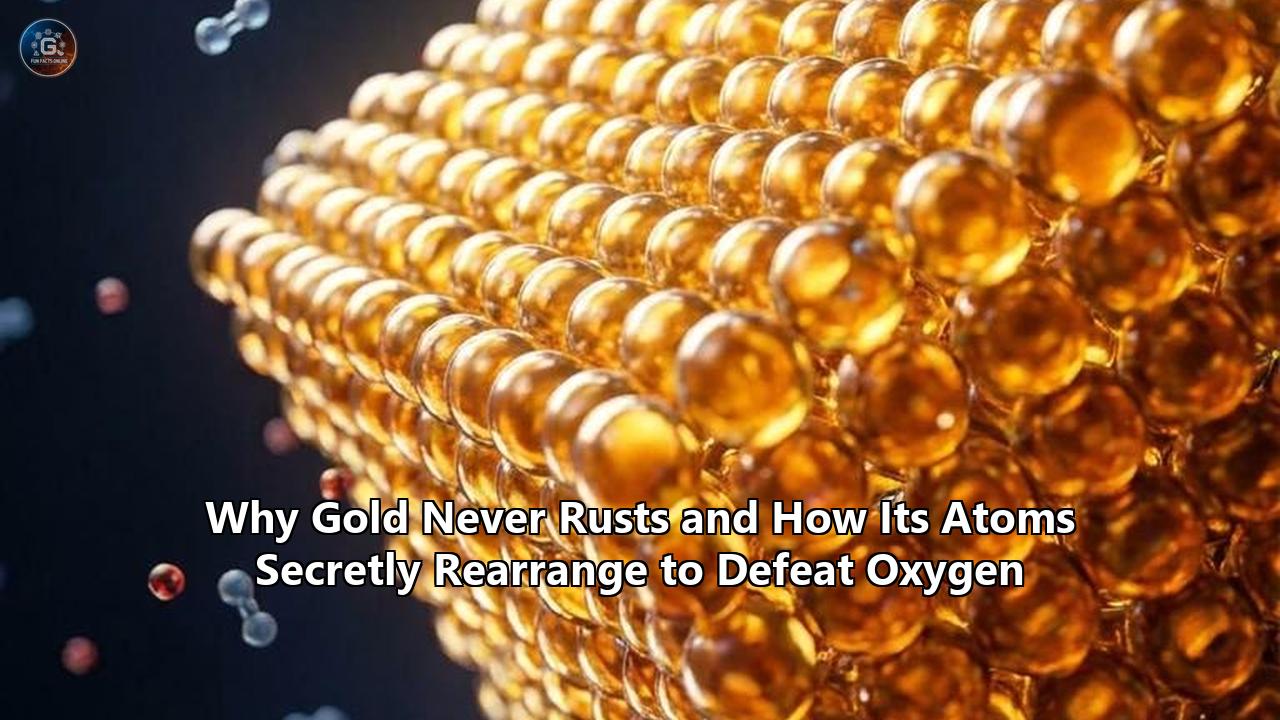
In a study published in the journal Physical Review Letters, computational chemists Santu Biswas and Matthew M. Montemore of Tulane University revealed that gold’s legendary resistance to oxidation is not a mere passive refusal to react. Instead, gold preserves its luster through a dynamic, lightning-fast self-defense mechanism that occurs at the atomic level. Using quantum mechanical simulations, the researchers demonstrated that when a fresh gold surface is exposed to the elements—whether through a scratch, a cut, or the formation of a new crystal facet—its surface atoms do not sit idly by. Within a fraction of a second, they actively rearrange themselves, shifting from their default square configuration into a tightly packed, rigid hexagonal pattern.
This process, known in crystallography as "surface reconstruction," behaves as a microscopic shield. The Tulane team’s calculations yielded a staggering discovery: once this atomic rearrangement takes place, the rate of oxygen reactions on the gold surface drops by a factor of one billion to one trillion. Without this rapid structural pivot, gold surfaces would begin to oxidize under ambient conditions within seconds.
This revelation does more than solve a fundamental, centuries-old chemical mystery. It exposes a deep paradox that has long frustrated chemical engineers: the very atomic rearrangement that keeps a gold ring gleaming also severely limits gold's potential as an industrial catalyst. By understanding the exact quantum-mechanical mechanics of this atomic dance, scientists are now gaining an insider-level blueprint to "trick" gold, opening the door to highly selective, next-generation catalysts for green energy, pollution control, and advanced plastics manufacturing.
The Relativistic Twist: The Classic Chemistry of Nobility
To appreciate why the Tulane discovery is so significant, it is first necessary to examine the classical theories of chemistry and physics that have historically attempted to explain why gold does not rust.
In secondary school chemistry, students are introduced to the reactivity series of metals. At the bottom of this hierarchy sit the noble metals—platinum, palladium, and gold—characterized by their low chemical reactivity and high resistance to oxidation and corrosion. Rusting, in the strictest chemical sense, is the oxidation of iron into hydrated iron(III) oxides in the presence of water and oxygen. Broadly speaking, however, "rusting" is used colloquially to describe any atmospheric oxidation of a metal.
For a metal to oxidize, a thermodynamic and kinetic threshold must be met. The metal atoms must surrender valence electrons to oxygen atoms, which have a high electronegativity (3.44 on the Pauling scale) and a strong appetite for electrons. Iron oxidizes readily because its valence electrons (located in the 4s and 3d subshells) are relatively loosely held, making the thermodynamic drive to form iron oxides ($Fe_2O_3$, $Fe_3O_4$) incredibly strong.
[Atmospheric Oxygen: O₂]
       │
       ▼  (In iron: high thermodynamic drive, electrons surrender easily)
[Unprotected Iron Surface] ───► [Iron Oxide / Rust Layer (Porous & Flaky)]
In contrast, gold has the highest electronegativity of any metal, sitting at 2.54 on the Pauling scale—closer to metalloids and non-metals like carbon and sulfur than to typical metals like sodium or calcium. It also boasts an exceptionally high first ionization energy (890 kJ/mol). Historically, when people asked why gold does not rust, the standard textbook response was that gold's valence electrons are simply bound too tightly to the atomic nucleus for oxygen to strip them away.
But this explanation only scratches the surface. To truly understand why gold holds onto its outer electrons with such unprecedented tenacity, we must look to Albert Einstein’s Theory of Special Relativity.
Gold is a heavy element, possessing an atomic number of 79. Its nucleus contains 79 highly attractive protons. Because the electrostatic pull of this massive positive charge is immense, the inner-shell electrons (particularly the 1s, 2s, and 3s orbitals) are drawn extremely close to the nucleus. To avoid spiraling into the nucleus under this extreme electrostatic force, these inner-shell electrons must travel at velocities approaching 58% of the speed of light ($c$).
According to Einstein’s special relativity, as an object's velocity approaches the speed of light, its relativistic mass increases. In the case of gold’s inner electrons, this mass increase is roughly 23%. This gain in relativistic mass causes a cascade of orbital contractions throughout the atom, a phenomenon known in quantum chemistry as relativistic contraction.
- The 6s Orbital Contraction: Because the s-orbitals (and to a lesser extent, p-orbitals) have high probability densities near the nucleus, they contract significantly. The outermost 6s orbital of gold, which holds its single valence electron, shrinks closer to the nucleus. This places the valence electron in a much deeper potential energy well, binding it tightly and shielding it from external chemical reactants like oxygen.
- The 5d Orbital Expansion: Conversely, because the s-orbitals contract and shield the nuclear charge more effectively, the d- and f-orbitals experience less electrostatic pull. They undergo relativistic expansion, shifting farther from the nucleus and rising in energy.
- The Color of Gold: This contraction of the 6s orbital and expansion of the 5d orbital dramatically narrows the energy gap between them. In silver (atomic number 47), where relativistic effects are much weaker, the energy transition between the d- and s-orbitals requires high-energy ultraviolet light, meaning silver reflects all visible light and appears silver-white. In gold, the reduced energy gap matches the energy of blue light. Gold absorbs blue and violet light, reflecting back only the reds and greens, which combine to produce its warm, characteristic golden-yellow glow.
Silver (Ag) Energy Levels:
[5s Orbital]  ▲
             │  (Large UV Gap - Absorbs Ultraviolet, Reflects All Visible Light)
[4d Orbital]  ▼

Gold (Au) Energy Levels (Relativistically Contracted):
[6s Orbital (Lowered)] ▲
                      │  (Narrower Gap - Absorbs Blue Light, Reflects Yellow/Gold)
[5d Orbital (Raised)]  ▼
While this relativistic contraction provides the quantum-mechanical foundation for gold's chemical "aloofness," the recent Tulane study reveals a glaring mathematical deficit in this classic description. If electronic structure and relativistic contraction were the only lines of defense, gold would still show significantly higher rates of oxygen interaction than it actually does under real-world conditions.
When fresh, clean gold surfaces are computationally simulated without allowing the surface atoms to move, molecular oxygen ($O_2$) can still adsorb to the gold and, under certain conditions, split apart into individual oxygen atoms. If this were the end of the story, bulk gold would eventually develop a thin, visible film of gold oxide ($Au_2O_3$) when exposed to the air.
The fact that it does not is because of a dynamic, structural defense: surface reconstruction.
The Microscopic Shield: Crystallography and Surface Reconstruction
To understand how gold's atomic rearrangement works, we must zoom in on the atomic lattice of a solid metal.
In bulk gold, the atoms are arranged in a highly ordered, repeating three-dimensional pattern known as a face-centered cubic (FCC) crystal lattice. In this bulk environment, every single gold atom is surrounded by 12 neighboring gold atoms (a coordination number of 12). This maximum packing density distributes the electrostatic binding forces evenly, creating a state of thermodynamic stability.
However, when a piece of gold is cut, scratched, or fractured, this perfect symmetry is abruptly broken.
The gold atoms at the newly created surface find themselves in a precarious chemical position. They are exposed to the open air on one side, meaning their coordination number is suddenly slashed. Depending on how the crystal is cleaved, a surface atom might only have 8 or 9 neighbors instead of 12. These surface atoms are left with "dangling bonds"—unshared electrostatic forces pointing outward into empty space.
Bulk Lattice (Highly Stable):
   [Au] ── [Au] ── [Au]
    │       │       │
   [Au] ── [Au] ── [Au]  (Coordination Number = 12)
    │       │       │
   [Au] ── [Au] ── [Au]

Freshly Cut Surface (Unstable, Tensile Stress):
   [Au]    [Au]    [Au]  ◄── Exposed "Dangling Bonds" Pointing Upward
    │       │       │
   [Au] ── [Au] ── [Au]
    │       │       │
   [Au] ── [Au] ── [Au]
This structural asymmetry generates a massive localized thermodynamic force known as surface free energy. Because the surface atoms are pulled inward by their underlying neighbors but have no corresponding pull from above, the surface experiences an intense, native tensile stress.
To minimize this surface free energy and relieve the crushing tensile stress, the atoms on the surface must find a way to densify and self-satisfy their bonding requirements. They do this through surface reconstruction. Within seconds of exposure to room-temperature air, the surface atoms physically shift, slide, and buckle, reorganizing themselves into a completely different crystallographic pattern than the bulk lattice beneath them.
In surface science, these crystal facets are categorized by their Miller indices, such as Au(111), Au(100), and Au(110). Each facet behaves differently, yet they all share a common, hidden objective: to defeat oxygen by shifting into a denser, hexagonal geometry.
The Famous Au(111) Herringbone Reconstruction
The Au(111) facet is naturally the most stable and packed surface of gold, but even it is not immune to tensile stress. To relieve this stress, the outermost layer of Au(111) undergoes a globally unique rearrangement known as the $22 \times \sqrt{3}$ "herringbone" reconstruction.
Au(111) Herringbone Reconstruction (Schematic of Top Layer):
Bulk Spacing:  [Au]   [Au]   [Au]   [Au]   [Au]   [Au]   [Au]  (22 Units Wide)
Reconstructed: [Au][Au][Au][Au][Au][Au][Au][Au][Au][Au][Au]  (Compressed: 23 Atoms Packed In!)
                \   /  \   /  \   /  \   /  \   /  \   /
                 ▼▼▼    ▼▼▼    ▼▼▼    ▼▼▼    ▼▼▼    ▼▼▼   (Soliton Elbows / Herringbone Pattern)
In the top layer of this facet, gold atoms compress laterally along the $[1\bar{1}0]$ crystallographic direction. This compression forces 23 gold atoms to squeeze into a surface area that would normally accommodate only 22 bulk gold atoms.
This 4.5% compression causes the surface layer to lose perfect alignment with the second layer of atoms. As a result, the surface layer transitions back and forth between two different types of sub-surface stacking:
- Face-Centered Cubic (fcc) Stacking: The standard, highly stable bulk registry.
- Hexagonal Close-Packed (hcp) Stacking: A slightly less stable bulk registry.
These alternating fcc and hcp domains are separated by transition zones called soliton walls (or dislocation lines). To minimize the energy of these walls, they regularly bend and change direction, forming a periodic, zig-zag elbow pattern that looks exactly like a herringbone textile weave when viewed under a Scanning Tunneling Microscope (STM). This magnificent, self-assembled nanostructure reduces the surface's intrinsic tensile stress by approximately 22%.
The Au(100) and Au(110) Quasi-Hexagonal Reconstructions
While the herringbone reconstruction of Au(111) is chemically famous, the Tulane study by Biswas and Montemore focused heavily on the Au(100) and Au(110) surfaces. These are the surfaces that, if left unreconstructed, would make gold vulnerable to rapid chemical attack.
- The Unreconstructed Au(100) Surface: In its raw, bulk-terminated state, the Au(100) surface exhibits a simple square lattice symmetry (a $1 \times 1$ pattern). The atoms are laid out in a checkerboard-like grid, leaving relatively large open gaps between them.
- The Reconstructed Au(100)-hex Surface: Because the square symmetry leaves too much empty space and too many dangling bonds, it is highly unstable. Within seconds of exposure, the surface gold atoms shift from this square grid into a tightly packed, quasi-hexagonal (hex) arrangement. The atoms pack closely together, effectively squeezing an extra row of atoms into the surface layer. This hexagonal layer sits on top of the square bulk lattice underneath, creating a complex, mismatching moiré pattern.
- The Au(110) Reconstruction: Similarly, the Au(110) surface—which naturally has a highly open, rectangular "missing row" structure—reorganizes its outermost atomic coordinates into a dense, quasi-hexagonal geometry to minimize its interaction with the surrounding environment.
It is here that the dynamic answer to why gold does not rust lies.
The atomic rearrangement from a loose square lattice to a dense hexagonal lattice acts as a literal quantum-mechanical shield. Without this rapid reconstruction, the open square structure of gold would offer atmospheric oxygen a direct gateway to initiate chemical degradation.
The Quantum Barrier: Why Hexagonal Lattices Defeat Oxygen
How, exactly, does a tiny shift from a square atomic pattern to a hexagonal atomic pattern slow down chemical oxidation by a factor of up to one trillion?
To answer this, we must examine the molecular orbital dynamics of oxygen activation.
Oxygen in our atmosphere exists as diatomic oxygen ($O_2$). In this state, the two oxygen atoms are held together by a strong covalent double bond, consisting of one $\sigma$ (sigma) bond and one $\pi$ (pi) bond, with a high bond dissociation energy of 498 kJ/mol. This is a formidable energy barrier. Before any metal can oxidize or rust, it must first act as a catalyst to split this $O_2$ molecule apart. The metal surface must grab the $O_2$ molecule, weaken its internal double bond, and break it into two highly reactive, individual oxygen atoms ($O$) that can then bond with the metal to form an oxide.
Dissociative Adsorption of Oxygen (Oxidation Step 1):
Step 1: O₂ Molecule Adsorbs  ──►  Step 2: Molecule Stretches  ──►  Step 3: Bond Splits (Dissociation)
         [O═O]                      [O ─ ─ ─ O]                         [O]       [O]
         /   \                       /       \                           │         │
      [Metal Surface]             [Metal Surface]                  [Metal]───[Metal]
This initial step is called dissociative adsorption. The efficiency of this process depends entirely on the spatial arrangement and electronic states of the metal atoms on the surface.
The Square Lattice: An Unintentional Catalyst Trap
On an unreconstructed, clean square gold surface (like the hypothetical $1 \times 1$ Au(100) plane), the spacing between gold atoms is relatively wide and matches the molecular dimensions of an $O_2$ molecule beautifully.
When $O_2$ approaches this square lattice, it can easily find a hollow site bounded by four gold atoms. As the molecule settles into this site:
- $\pi$-Backdonation: Gold’s relativistic d-orbitals, which have expanded outward, are perfectly positioned to overlap with the empty, antibonding $\pi^$ orbitals of the $O_2$ molecule.
- Bond Weakening: Gold feeds electron density into these antibonding orbitals. This acts as a chemical wedge, rapidly weakening the oxygen-oxygen double bond.
- Spontaneous Splitting: Because the square geometry provides ample physical space for the two oxygen atoms to move apart, the $O_2$ molecule easily splits into two separate oxygen atoms, which then bind to the adjacent gold sites.
If gold were locked in this square configuration, the energy barrier to split oxygen would be remarkably low. Oxygen would split, bind, and—even though gold oxides are thermodynamically unstable and easily decomposed—a thin, steady, and visible layer of gold oxide would continuously cover the surface. Under high temperatures or humid conditions, this would cause the gold to tarnish and lose its brilliant shine.
The Hexagonal Lattice: The Tight-Packed Fortress
When the gold surface reconstructs into a quasi-hexagonal geometry, the physical landscape changes completely.
Square Lattice vs. Hexagonal Lattice Oxygen Interaction:

Square Lattice (Unreconstructed):
   [Au] ──── [Au]
    │  \    /  │   ◄── Ample space for [O═O] molecule to adsorb,
    │   [O═O]  │       stretch, and split into [O] and [O]
    │  /    \  │
   [Au] ──── [Au]

Hexagonal Lattice (Reconstructed):
     [Au] ── [Au]
    /    \  /    \  ◄── Tightly packed. No open hollow sites.
  [Au] ── [Au] ── [Au]  [O═O] molecule bounces off; cannot fit or split.
    \    /  \    /
     [Au] ── [Au]
In the hexagonal reconstruction, the gold atoms are packed as tightly as mathematically possible, leaving virtually no open hollow sites. The surface is highly smooth and dense.
When an $O_2$ molecule approaches this reconstructed hexagonal shield, it encounters two massive obstacles:
1. Spatial and Geometric Constraints
Because the gold atoms are packed so tightly, there are no spacious coordination sites for the oxygen molecule to nestle into. The empty antibonding $\pi^$ orbitals of the $O_2$ molecule cannot achieve the proper geometric overlap with gold’s 5d orbitals.
2. The Distortion Energy Barrier
For a tightly packed hexagonal gold surface to split an $O_2$ molecule, the surface gold atoms would first have to physically distort back into a square-like arrangement to create the necessary space and orbital overlap.
This creates a massive energetic barrier. In transition state theory, the path from reactants ($O_2$ on hexagonal gold) to the transition state (distorted gold with a stretched $O-O$ bond) requires an enormous input of activation energy ($E_a$).
According to the Arrhenius equation:
$$k = A e^{-\frac{E_a}{R T}}$$
Where:
- $k$ is the rate constant of the reaction.
- $A$ is the pre-exponential frequency factor.
- $E_a$ is the activation energy.
- $R$ is the universal gas constant.
- $T$ is the temperature.
Because the activation energy $E_a$ required to distort the hexagonal lattice back to a square shape is so high, the exponential term $e^{-E_a / RT}$ becomes vanishingly small at room temperature.
The quantum mechanical simulations by Biswas and Montemore proved that the rate of oxygen splitting on the reconstructed, hexagonal gold surfaces is $10^9$ to $10^{12}$ times slower than on the unreconstructed square surfaces.
To put a "one trillion times slower" reaction rate into perspective: if an unreconstructed square gold surface could be stabilized in a laboratory and exposed to air, it would begin to interact with oxygen and show initial chemical changes in just one second. Under the exact same atmospheric conditions, the reconstructed hexagonal surface of a standard piece of bulk gold would take 31,700 years to undergo the equivalent level of oxygen interaction.
This is the hidden key to why gold does not rust. Gold does not merely rely on its relativistic orbital contraction to passively ignore oxygen. It actively, instantly, and dynamically reorganizes its outer atoms into a dense hexagonal fortress that denies oxygen the physical and orbital space required to split apart. By blocking the very first step of the oxidation reaction—the dissociation of the diatomic oxygen molecule—the gold surface ensures that oxidation never gets a chance to start.
The Nanoparticle Paradox: When Inert Gold Becomes a Super-Catalyst
The revelation of this dynamic defense system sheds immediate light on one of the most perplexing mysteries in modern chemistry: the gold nanoparticle paradox.
For more than a century, industrial chemists completely ignored gold. In chemical manufacturing, catalysts are the engine of progress; they speed up reactions, lower energy costs, and minimize unwanted byproducts. An ideal catalyst must temporarily bind to reactant molecules (like $O_2$ or $CO$), activate them by weakening their internal bonds, allow them to react with other molecules, and then release the products, leaving the catalyst itself unchanged.
Because bulk gold is so chemically inert and refuses to activate oxygen, it was long assumed to be completely useless as a catalyst. Platinum, palladium, and rhodium became the darlings of the automotive and petrochemical industries, used in everything from catalytic converters to fuel cells.
But in 1987, a Japanese chemist named Masatake Haruta made a discovery that shocked the scientific community.
Haruta found that if you shrink bulk gold down to ultra-small nanoparticles (less than 5 nanometers in diameter) and disperse them onto transition metal oxide supports (such as titanium dioxide, $TiO_2$), the gold ceases to be inert. Instead, it becomes an incredibly active, highly efficient catalyst. In fact, these gold nanoparticles can catalyze the oxidation of highly toxic carbon monoxide ($CO$) into non-toxic carbon dioxide ($CO_2$) at temperatures well below freezing (down to -70°C)—a feat that even platinum struggles to match.
Haruta's Carbon Monoxide Oxidation:
         [CO]  +  [O₂]  ──────►  [CO₂]  (At -70°C!)
                       ▲
                [Au Nanoparticles]
How could the most inert metal on Earth suddenly become a hyper-active chemical catalyst simply by being ground down into tiny particles?
This also sheds light on why gold does not rust in bulk but can act as a highly active catalyst when shrunk to the nanoscale. The answer is directly tied to the geometric constraints of surface reconstruction.
Bulk Gold vs. Gold Nanoparticle Structural States:

Bulk Gold:
┌──────────────────────────────────────────────┐
│  Hexagonal Reconstructed Surface (FORTRESS)  │  ◄── Atoms easily shift into hexagons.
├──────────────────────────────────────────────┤      Oxygen cannot split. No rust. No catalysis.
│  Face-Centered Cubic Bulk Lattice            │
└──────────────────────────────────────────────┘

Gold Nanoparticle (< 5 nm):
       [Au]     ◄── Sharp Corners & Edge Atoms (Low coordination, highly reactive)
      /    \
   [Au] ── [Au] ◄── Highly curved facets. Atoms locked in square/rectangular
   /          \     geometries; cannot shift into hexagonal reconstruction!
[Au] ───────── [Au] ◄── Unreconstructed "Hotspots" easily split O₂ for catalysis.
When a gold crystal is large (bulk gold), its surface terraces are vast and flat, containing millions of atoms. These surface atoms have the physical freedom to slide, compress, and smoothly rearrange into the highly stable, hexagonal herringbone patterns that block oxidation.
But when gold is confined to a nanoparticle of less than 5 nanometers, its geometry changes drastically:
- High Surface Curvature: A nanoparticle is not flat; it is a tiny, highly curved polyhedron consisting of facets, sharp edges, and highly exposed corner atoms.
- Geometric Trapping: On these tiny facets, there is simply not enough continuous space or a sufficient number of adjacent atoms for the gold to undergo its standard surface reconstruction. The rigid, curved boundaries of the nanoparticle lock the gold atoms in place, preventing them from shifting into the protective, dense hexagonal pattern.
- Persistent Active Sites: Because the gold atoms on nanoparticles cannot reconstruct, they are trapped in open, loose, square-like and rectangular configurations. These non-reconstructed regions, combined with the low-coordination atoms at the sharp edges and corners, act as permanent, highly reactive "hotspots".
When diatomic oxygen ($O_2$) encounters these non-reconstructed hotspots on a gold nanoparticle, it easily adsorbs to the open square-like structures, receives backdonated electrons from gold's 5d orbitals, and dissociates into reactive oxygen atoms at incredibly low temperatures.
This represents the beautiful, double-edged sword of gold chemistry. The very same atomic rearrangement that protects a gold necklace from the air also renders bulk gold industrially inactive. Shrink that gold down, disable its ability to rearrange, and you unleash a chemical beast capable of driving reactions that are vital to green chemistry.
Engineering the Surface: "Tricking" Gold for Green Chemistry
The implications of the Tulane University study extend far beyond theoretical chemistry. By showing that gold’s nobility is not an unchangeable, static property but rather a "selectable end-state" resulting from its adjustable surface structure, the research provides a direct guide for materials scientists to engineer advanced catalysts.
"If you can trick gold into dissociating oxygen, it can actually become a very effective catalyst for certain reactions," Matthew Montemore explained. "Our work suggests a new strategy for potentially doing that by preventing or reversing these surface rearrangements."
Until now, the industrial use of gold catalysts has been heavily restricted by cost and stability issues. Because nanoparticles are thermodynamically unstable, they have a natural tendency to migrate and clump together (coalesce) over time when subjected to heat, a process known as sintering. Once the nanoparticles merge into larger bulk-like particles, they regain their ability to undergo hexagonal reconstruction, immediately shutting down their catalytic activity.
Sintering of Gold Catalysts (Loss of Activity):
  [Active Nanoparticles]              [Merged Large Particle]
    [Au]   [Au]   [Au]                 ┌───────────────────────┐
    (No Reconstruction)   ──► Heat ──► │Hexagonal Reconstruction│ (Inert Fortress)
    (Active Catalysis)                 └───────────────────────┘ (Catalysis Dies!)
To prevent this, chemical engineers have traditionally tried to stabilize gold nanoparticles by mixing them with other metals to form alloys (like gold-palladium) or anchoring them onto complex oxide supports. However, these methods are difficult to control, expensive, and rely on precise, hard-to-scale manufacturing techniques.
The Tulane study points to an entirely different, elegant route: surface geometry control of bulk or micro-structured gold. Rather than relying on fragile nanoparticles, scientists can now focus on stabilizing active square or rectangular surface configurations directly on larger, structurally robust gold architectures.
Several cutting-edge strategies are currently being developed in laboratories worldwide to achieve this level of control:
1. Electrochemical Switching and Charge Tuning
One of the most promising avenues is the use of external electric fields to control surface reconstruction. Density functional theory (DFT) calculations have shown that the surface energy of different gold phases is highly sensitive to localized electrical charge.
Surface Energy Phase Crossover of Au(100):
  Neutral Surface:      Hexagonal Reconstruction is the Ground State (Inert)
  Positively Charged:   Square Lattice becomes the Ground State (Active!)
When a gold surface is electrically neutral, the quasi-hexagonal reconstruction is the thermodynamic ground state. However, when a positive electric charge is applied to the gold surface (such as in an electrochemical cell), there is a distinct crossover point. The positive charge alters the electron density in the surface layer, making the non-reconstructed square lattice ($1 \times 1$) the new thermodynamic ground state.
This means that by placing gold in an electrochemical environment and applying a precise, tunable voltage, scientists can physically force the surface atoms to shift back and forth between the hexagonal "inert" state and the square "active" state. This could allow for the creation of switchable catalysts that can be turned on and off with the flick of a microchip switch.
2. Ligand-Induced Reconstruction Lifting
Another strategy involves using specific chemical molecules, or ligands, to "pull" the gold atoms back into their active configurations.
For example, when sulfur-containing organic molecules (like thiols) or transition metal dichalcogenides (like molybdenum disulfide, $MoS_2$) are deposited onto a reconstructed gold surface, they form strong covalent gold-sulfur bonds. These chemical interactions generate localized stresses that can overcome the native tensile stress of the gold surface.
Under the right conditions, the adsorption of these molecules "lifts" the hexagonal reconstruction, forcing the gold atoms to relax back into square or rectangular symmetries. By carefully designing a monolayer of organic ligands, chemists can keep the gold surface permanently locked in its active, oxygen-dissociating state without needing to shrink the metal down to nanoparticles.
Ligand-Induced Lifting of Reconstruction:
[Inert Hexagonal Gold] + [Thiol / Sulfur Ligands] ──► [Stable Active Square Gold-Sulfur Interface]
3. Strain Engineering of Thin Films
In materials science, applying physical strain to a crystal lattice can dramatically alter its properties. By growing ultra-thin films of gold (just a few atomic layers thick) on top of substrate materials with different crystal lattices (such as silicon, sapphire, or nickel), engineers can introduce epitaxial strain.
If the underlying substrate has a square lattice spacing that is slightly larger than gold’s bulk spacing, it will physically stretch the gold film. This tensile stretch prevents the gold atoms from compressing laterally, making it physically impossible for them to pack into the dense hexagonal herringbone pattern. The gold film is effectively forced to maintain a persistent, square geometry, making it highly reactive to oxygen.
Clean Energy, Plastics, and Pollution Control
If these surface engineering techniques can be scaled up successfully, the industrial impact will be profound. Gold's unique chemical profile—a metal that is highly selective, extremely stable, and resistant to many forms of poison that typically ruin other catalysts—makes it a dream material for several critical industrial applications.
- Production of Vinyl Acetate: Currently, gold-palladium catalysts are widely used to manufacture vinyl acetate, a vital monomer used in the production of plastics, adhesives, paints, and coatings. Controlling the surface reconstruction of the gold component could drastically increase the efficiency of this process, lowering the cost of everyday materials.
- Eliminating Carbon Monoxide from Vehicle Exhaust: Platinum-group metals are the primary active components in automotive catalytic converters. However, they are expensive, prone to sulfur poisoning, and inefficient when a car's engine is first started and cold. Engineered gold catalysts that can split oxygen at room temperature could replace or supplement platinum, cleaning up vehicle emissions far more effectively during the critical "cold start" phase.
- Green Synthesis of Propylene Oxide: Propylene oxide is a massive-volume industrial chemical used to produce polyurethane plastics. Traditional manufacturing methods are highly polluting and generate massive amounts of waste. Gold catalysts have shown incredible potential to selectively oxidize propylene into propylene oxide using hydrogen and oxygen directly, a much cleaner and greener chemical pathway.
- Hydrogen Fuel Cells and Clean Energy: In hydrogen fuel cells, the Oxygen Reduction Reaction (ORR) is the slowest, most inefficient step, requiring large amounts of expensive platinum. Stabilized, active gold surfaces could offer a highly selective, durable alternative, driving down the cost of clean, hydrogen-powered transportation and grid storage.
Summary of the Structural Defense of Gold
To synthesize these complex, overlapping concepts, let's map out how gold compares to other common metals across these newly discovered criteria:
| Metal | Bulk Lattice | Surface Structure in Air | Oxygen Dissociation Barrier | Atmospheric Oxidation Rate | Typical Corrosion Product |
|---|---|---|---|---|---|
| Iron (Fe) | Body-Centered Cubic (BCC) | Unreconstructed, open lattice | Extremely Low | High | Hydrated Iron(III) Oxide (Red Rust) |
| Copper (Cu) | Face-Centered Cubic (FCC) | Unreconstructed, square bulk registry | Low | Moderate | Basic Copper Carbonate (Green Patina) |
| Silver (Ag) | Face-Centered Cubic (FCC) | Mildly reconstructed, highly susceptible to sulfur | Low | Slow (reacts with sulfur) | Silver Sulfide (Dark Tarnish) |
| Gold (Au) | Face-Centered Cubic (FCC) | Reconstructed quasi-hexagonal / herringbone | Extremely High (Requires Distortion) | Virtually Zero (Trillions of times slower) | None (Remains pristine) |
A New Era of Active Nobility
The long-held mystery of why gold does not rust has officially evolved from a passive tale of electronic aloofness to a dynamic story of atomic-scale self-defense.
For thousands of years, humans have prized gold for its unchanging, immutable nature. We forged it into wedding bands to symbolize eternal love, stamped it into coins to serve as a reliable store of value across centuries, and draped it over our most sacred monuments, confident that it would look as brilliant to our descendants as it did to our ancestors. We did this believing that gold was a static, quiet element that simply refused to interact with the chaotic, reactive world around it.
Now, we know the truth is far more fascinating.
Every time a gold ring is scratched, every time a gold coin is polished, and every time a gold artifact is exposed to the wind, its surface atoms engage in a quiet, rapid, and coordinated dance. Within milliseconds, they slide and lock together into a dense, hexagonal armor that utterly defeats the most abundant oxidizer on Earth. Gold does not survive the ages by standing still; it survives by changing its shape to keep the world at bay.
[The Dynamic Defense of Gold]
Scratch/Exposure ──► Unstable Square Lattice ──► Lightning-Fast Reconstruction ──► Dense Hexagonal Shield ──► Oxygen Bounces Off
As material scientists move forward with this knowledge, the challenge is no longer just to admire this defense, but to conquer it. By learning how to prevent this atomic rearrangement, we are on the verge of turning the most chemically inert metal into one of our sharpest tools for environmental and industrial progress. The golden shine that has illuminated human history for millennia may soon power the clean-energy systems of our future.
Unresolved Scientific Frontiers to Watch
As researchers build upon the Tulane team’s breakthrough, several key questions remain on the horizon:
- Real-time Atomic Imaging: While computer simulations have mapped this reconstruction with incredible precision, can ultra-fast scanning transmission electron microscopy (TEM) capture the dynamic, millisecond-by-millisecond transition of gold atoms from squares to hexagons in real-time as a surface is being cut?
- Commercial Viability of Charged Catalysts: Will chemical engineers successfully design a scalable, commercial reactor that uses electrical fields to continuously cycle gold catalysts between active and inert states?
- Alternative Noble Metals: Does this newly understood mechanism play a similar, unrecognized role in the chemical behavior of platinum and iridium, and can their surface reconstructions be manipulated in the same way?
Reference:
- https://www.zmescience.com/science/news-science/why-gold-never-rusts/
- https://timesofindia.indiatimes.com/science/scientists-finally-discover-why-gold-never-loses-its-shine-after-thousands-of-years/articleshow/131265209.cms
- https://greekreporter.com/2026/05/23/gold-never-rust/
- https://quantumzeitgeist.com/gold-atoms-rearrange-block-oxidation/
- https://www.sciencealert.com/scientists-found-the-atomic-reason-that-gold-refuses-to-rust
- https://www.techexplorist.com/gold-never-rusts/103076/
- https://quantumzeitgeist.com/gold-atoms-rearrange-block-oxidation/
- https://en.clickpetroleoegas.com.br/scientists-discover-why-gold-remains-unrusted-for-thousands-of-years-and-reveal-atomic-reorganization-that-reduces-reaction-with-oxygen-by-u-flpc96/
- https://www.sciencenews.org/article/physics-explains-gold-shiny-oxidize
- https://www.iflscience.com/golds-atomic-structure-may-be-the-secret-behind-its-eternal-shine-83597
- https://www.iflscience.com/golds-atomic-structure-may-be-the-secret-behind-its-eternal-shine-83597
- https://www.drishtiias.com/daily-updates/daily-news-analysis/science-behind-golds-resistance-to-rusting
- https://www.iflscience.com/gold-looks-the-way-it-does-because-of-a-relativistic-effect-77594
- https://edu.rsc.org/feature/is-relativity-creating-cracks-in-the-periodic-table/2000091.article
- https://www.reddit.com/r/chemistry/comments/5wdvr7/can_anybody_eli5_relativistic_effects_in_heavy/
- https://en.wikipedia.org/wiki/Relativistic_quantum_chemistry
- https://pmc.ncbi.nlm.nih.gov/articles/PMC7610521/
- https://www.fkf.mpg.de/51437/kk68.pdf
- https://www.sciencedaily.com/releases/2022/10/221006121142.htm
- https://www.physics.rutgers.edu/~dhv/pubs/local_copy/sn_au.pdf
- https://www.researchgate.net/publication/235600481_First-principles_studies_of_Au100-hex_reconstruction_in_an_electrochemical_environment
- https://www.researchgate.net/publication/225736898_Influence_of_the_herringbone_reconstruction_on_the_surface_electronic_structure_of_Au111
- https://pubs.acs.org/doi/10.1021/acs.jpcc.1c00267
- https://www.zmescience.com/science/news-science/why-gold-never-rusts/
- https://pubs.acs.org/doi/10.1021/prechem.4c00018
- https://www.politesi.polimi.it/retrieve/1dae9070-8755-4e07-b90f-986a238bd61e/2025_04_Gasperi_Tesi.pdf
- https://greekreporter.com/2026/05/23/gold-never-rust/
- https://www.sciencenews.org/article/physics-explains-gold-shiny-oxidize