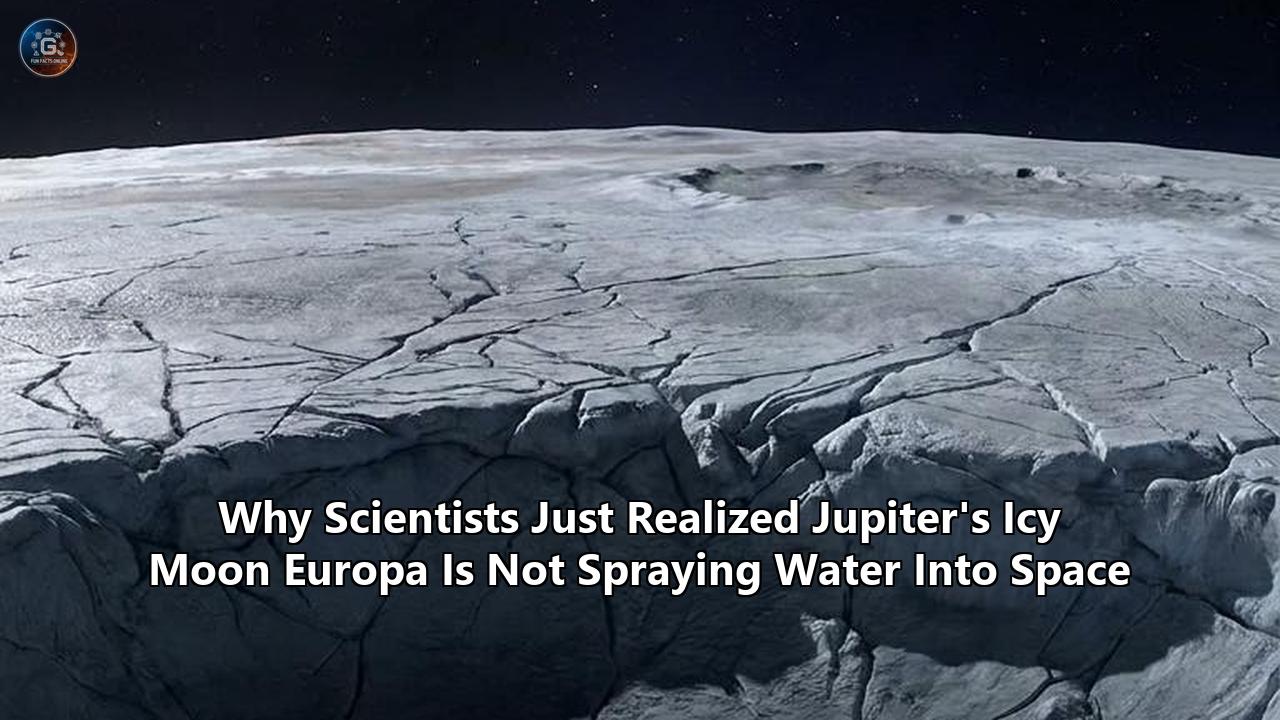
The iconic water vapor plumes of Europa—once considered the "gold rush" target for searching for life in the outer solar system without drilling—have vanished under rigorous reanalysis. In a study published on May 5, 2026, in the journal Astronomy & Astrophysics, a team of planetary scientists from the Southwest Research Institute (SwRI) and the KTH Royal Institute of Technology in Sweden revealed that the decade-long scientific consensus regarding active water vapor venting on Jupiter’s icy moon is likely based on a statistical illusion.
By re-examining 14 years of ultraviolet data collected by the Hubble Space Telescope’s Space Telescope Imaging Spectrograph (STIS), researchers demonstrated that the initial 2014 discovery of these water vapor plumes was almost certainly an artifact of geometric misalignment and a poorly understood atmospheric haze. The team's original confidence level of 99.9% in the plumes’ existence has plummeted to less than 90%. In the demanding world of astrophysics, where a 10% chance of random noise is fatal to any claim of discovery, this reduction effectively erases the only direct empirical evidence that Europa’s subsurface ocean is actively spraying its contents into the vacuum of space.
This sudden shift has sent shockwaves through the planetary science community. For over a decade, the design, instrumentation, and mission profiles of multi-billion-dollar outer-planet missions—most notably NASA's Europa Clipper—were heavily influenced by the expectation of flying through these active geysers. The realization that Europa may be silent and sealed presents a massive challenge to how we explore ocean worlds, forcing scientists and engineers to pivot from passive high-altitude sampling to far more sophisticated, in-situ reconnaissance techniques.
The Problem: The Iron Grip of the Cryogenic Crust
To appreciate why this development is so disruptive, one must understand the formidable engineering barrier that Europa's icy shell presents.
   EUROPA'S INTERIOR SYSTEM (SCHEMATIC)

   [   Space Vacuum / Magnetosphere   ]
   =====================================   <-- Surface (100 K, Hard Vacuum)
   |                                   |
   |      SOLID ICE SHELL              |   <-- 15 to 30 km Thick
   |      (Brittle & Ductile Layers)   |       (Formidable Barrier)
   |                                   |
   =====================================   <-- Ice-Ocean Interface
   |~~~~~~~~~~~~~~~~~~~~~~~~~~~~~~~~~~~|
   |                                   |
   |      SUBSURFACE OCEAN             |   <-- 100 km Deep
   |      (Liquid Saltwater)           |       (Twice Earth's Ocean Volume)
   |                                   |
   |~~~~~~~~~~~~~~~~~~~~~~~~~~~~~~~~~~~|
   =====================================   <-- Seafloor (Hydrothermal Activity?)
   [         Silicate Mantle           ]
Europa, the fourth largest moon of Jupiter, is one of the most promising astrobiological targets in our solar system. Beneath a fractured, geologically young crust of water ice lies a global subsurface saltwater ocean. Heated from within by tidal forces—the result of a gravitational tug-of-war between Jupiter, Io, and Ganymede—this ocean is estimated to be roughly 100 kilometers deep, containing more than twice the liquid water volume of all Earth’s oceans combined.
However, this ocean is sealed beneath an ice shell estimated to be between 15 and 30 kilometers thick. This cryogenic shield presents an almost insurmountable barrier to exploration:
- Surface Extremes: The surface temperature at Europa’s equator never rises above 100 Kelvin ($-173^\circ\text{C}$), and drops even lower near the poles. The ice at these temperatures behaves like terrestrial granite—extremely hard, rigid, and highly resistant to structural failure.
- Radiation Environment: Europa lies deep within Jupiter’s inner magnetosphere, a region of space continuously swept by high-energy electrons and ions accelerated to relativistic speeds by Jupiter’s immense magnetic field. Any robotic lander descending to the surface would be subjected to a lethal, frying dose of ionizing radiation, limiting its operational lifespan to days or weeks.
- The Drilling Conundrum: Designing a robotic drilling rig capable of landing in a hard vacuum, surviving extreme radiation, and melting or mechanical-boring through tens of kilometers of cryogenic ice to reach the ocean is a technological feat decades beyond current aerospace capabilities.
The Oceanic Shortcut
Because of these barriers, the 2014 announcement that Europa was periodically ejecting Europa water plumes up to 200 kilometers into space was hailed as a monumental shortcut. If the moon was venting its subsurface ocean directly into the vacuum, a spacecraft would not need to land or drill.
Instead, a probe could execute a series of rapid, low-altitude flybys, sweeping through the plumes to capture and analyze fresh, uncontaminated samples of the subsurface ocean. Mass spectrometers and dust analyzers could search for complex organic molecules, lipid membranes, amino acids, and isotopic ratios that serve as biosignatures—the chemical fingerprints of life.
The realization that these plumes likely do not exist in any persistent, easily detectable form strips away this elegant shortcut. It leaves planetary scientists facing the original, brutal reality of Europa: an ocean locked behind an incredibly thick, unyielding vault of solid ice.
The Enceladus Mirage and the Blueprint of a Myth
The scientific community’s eagerness to embrace the Europa plume hypothesis was driven in large part by "the Enceladus illusion".
In 2005, NASA’s Cassini spacecraft made a staggering discovery at Saturn's tiny moon Enceladus. Emerging from deep parallel fractures near the moon's south pole—nicknamed "tiger stripes"—were massive, brilliant geysers continuously venting water vapor, ice grains, sodium salts, silica nanoparticles, and complex carbon-compounds into space.
               ENCELADUS                         EUROPA
         (Continuous Venting)             (Sealed and Silent?)

              \   |   /                          |       |
             -- Plumes --                        |       |  No Active
              /   |   \                          |       |  Plumes
             ===========                         =========
             Icy Crust (~5km)                    Icy Crust (15-30km)
             -----------                         ---------
             Ocean                               Ocean
Enceladus' plumes are spectacular, photogenic, and permanent. They vent roughly 200 kilograms of material every second, generating enough ice particles to feed Saturn's expansive E-ring. This continuous cryovolcanism is made possible by Enceladus’ exceptionally weak surface gravity ($0.113 \text{ m/s}^2$) and an ice shell that thins to less than 5 kilometers at the active south pole.
The Faulty Parallel
When tentative signs of ultraviolet emission were detected around Europa in 2012, researchers immediately drew a parallel to Enceladus. It was assumed that Europa was simply a larger version of Enceladus—an active, breathing ocean world venting its interior secrets through cracks in its shell.
However, this comparison overlooked critical geodynamical differences:
- Surface Gravity: Europa’s surface gravity ($1.315 \text{ m/s}^2$) is more than ten times stronger than that of Enceladus. To escape into space, any vapor plume on Europa must erupt with significantly higher velocity and thermal energy.
- Crustal Thickness: While Enceladus possesses a thin, highly localized crustal hotspot, Europa’s ice crust is thick, structurally rigid, and lacks a single, obvious thermally active volcanic province.
- Hydrostatic Suppression: Inside a thick ice shell, the tremendous weight of the ice creates lithostatic pressure that acts to squeeze fractures closed. Liquid water rising through a deep fissure will tend to freeze and plug the conduit long before it reaches the vacuum of the surface, a process known as thermal choking.
Despite these physical hurdles, the desire to find an accessible pathway to Europa's ocean created a powerful cognitive bias. When the Hubble Space Telescope pushed its instruments to their absolute physical limits to capture faint ultraviolet spectral emissions from Europa, the scientific community was primed to interpret the results as active geysers.
Anatomy of a Spectral Error: Why Hubble Was Deceived
The claim that Europa was venting water vapor rested on a highly complex, indirect measurement method. To understand how the original discovery was made—and how it was subsequently dismantled—we must look at the physics of ultraviolet spectroscopy and the specific engineering limits of the Hubble Space Telescope.
The Mechanics of the Lyman-alpha Emission
When water molecules ($H_2O$) are exposed to space, they do not remain intact for long. They are subjected to photo-dissociation by solar ultraviolet photons and electron-impact dissociation by charged particles trapped in Jupiter’s magnetic field. This process breaks the water molecules apart into their constituent atoms:
$$\text{H}_2\text{O} \xrightarrow{h\nu \text{ or } e^-} \text{H} + \text{OH} \xrightarrow{h\nu \text{ or } e^-} \text{H} + \text{H} + \text{O}$$
To detect this process from Earth, astronomers focus on the spectral signatures of these liberated hydrogen and oxygen atoms. The primary target is the Lyman-alpha (Ly$\alpha$) emission line.
The Lyman-alpha line, occurring at a vacuum ultraviolet wavelength of exactly 121.6 nanometers, represents the transition of an electron in a hydrogen atom from the $n=2$ excited state to the $n=1$ ground state. When solar UV light hits neutral hydrogen atoms, the atoms absorb and then re-emit photons at this precise wavelength—a phenomenon known as resonant scattering.
     LYMAN-ALPHA RESONANT SCATTERING

     Solar Photon (121.6 nm) ----> [ Hydrogen Atom (n=1) ]
                                            |
                                  (Excitation to n=2)
                                            |
                                            v
     Scattered Photon <----------- [ Hydrogen Atom (n=1) ]
       (121.6 nm)
In 2013, a team led by Dr. Lorenz Roth utilized Hubble’s STIS instrument to observe Europa in the far-ultraviolet spectrum. They reported a localized, statistically significant excess of Lyman-alpha and oxygen emissions concentrated over Europa’s southern hemisphere. This excess was interpreted as a transient cloud of hydrogen and oxygen atoms produced by the dissociation of water vapor erupting from two 200-kilometer-high plumes.
The team calculated a 99.9% confidence level that this localized excess was real and not a random statistical fluctuation of the background sky, which is flooded with geocoronal Lyman-alpha emission from Earth's own upper atmosphere.
The May 2026 Reanalysis: Two Pixels That Changed Everything
Between 2015 and 2020, Roth and his colleagues observed Europa repeatedly with Hubble, hoping to capture the plumes in action again. Each time, they pointed the telescope at the predicted times when tidal stresses on Europa’s cracks were expected to be at their maximum, which should have opened the vents.
The result was a baffling, persistent silence. No localized emissions were detected. The plumes had seemingly vanished.
This lack of reproducibility forced the team to conduct an exhaustive, multi-year reanalysis of 14 years of Hubble STIS data, culminating in their May 2026 paper. Their investigation revealed two fundamental errors in the original data reduction that completely undermine the plume hypothesis:
1. The Geometric Center Offset
At a distance of more than 600 million kilometers, Europa is an incredibly small target for Earth-orbiting observatories. On the $1024 \times 1024$ pixel detector of the Hubble Space Telescope's STIS instrument, Europa’s physical disk occupies only a tiny fraction of the imaging area.
Because the ultraviolet emissions are extremely faint, determining the exact boundaries of the moon's disk and aligning it with the coordinates of the raw data is a monumental computational challenge. Hubble's Fine Guidance Sensors keep the telescope incredibly stable, but tiny, sub-pixel drifts occur due to thermal changes in the telescope's structure and orbital motion.
     ORIGINAL vs. CORRECTED ALIGNMENT ON STIS DETECTOR

     [Original 2014 Centering]            [Corrected 2026 Centering]

         +---------------+                    +---------------+
         |    .......    |                    |    .......    |
         |  ..       ..  |                    |  .  * * *  .  | <-- "Plume" signal
         | .           . |                    | .  *     *  . |     now aligns
         | .           . |                    | .  *     *  . |     perfectly with
         |  ..       ..  | * *                |  .  * * *  .  |     global exosphere
         |    .......    | * *  <-- "Plume"   |    .......    |     and disk edges
         +---------------+  (Artifact)        +---------------+
The 2026 reanalysis revealed that the original alignment was off by two pixels horizontally and one pixel vertically. While a two-pixel offset seems trivial, at this extreme resolution, it was catastrophic.
When the raw data was re-aligned with the corrected geometric center of Europa’s disk, the localized "excess" emissions over the southern hemisphere suddenly shifted. The concentrated plume signature smeared out, aligning perfectly with the boundaries of Europa’s limb, indicating that the emission was not a localized jet but a global, diffuse atmospheric effect.
2. The Global Hydrogen Exosphere
The second major error stemmed from an incomplete model of Europa’s space environment. In 2014, our understanding of Europa’s tenuous atmosphere was highly simplistic.
Over the last decade, observations by missions like NASA’s Juno spacecraft have revealed that Europa is enveloped in a persistent, global exosphere of neutral hydrogen and oxygen. This exosphere is not produced by volcanic venting, but by a continuous process called magnetospheric sputtering.
     MAGNETOSPHERIC SPUTTERING PROCESS

     High-Energy Jovian Ions (S+, O+)
            |
            v  (Impact at High Velocity)
     =============================
     [  Europa's Water-Ice Crust ]
     =============================
            |
            +--> Dissociation & Ejection of H and O2
            |
            v
     [ Diffuse Global Hydrogen Exosphere ]
Jupiter’s magnetosphere is filled with energetic sulfur and oxygen ions blasted from the volcanic moon Io. These ions are swept along by Jupiter’s rapidly rotating magnetic field and smash into Europa’s water-ice surface at high speeds. These high-energy impacts physically break apart the surface ice molecules and eject neutral hydrogen and oxygen into space, creating a thin, global shroud of gas.
In their 2026 study, Roth and his co-authors constructed a sophisticated new physical model that accounts for this global hydrogen exosphere, including how it resonantly scatters solar Lyman-alpha light. When they applied this exosphere model to the re-aligned Hubble data, they found that the observed Lyman-alpha emissions matched the global exosphere perfectly.
There was no localized excess left to explain. The "plumes" were simply the global, sputtering-induced hydrogen exosphere, misidentified due to a minor alignment glitch in Hubble’s processing software.
As Dr. Lorenz Roth bluntly summarized in May 2026:
"Our reanalysis took our original 99.9% confidence in the plumes' existence and reduced it to less than 90% confidence. That's simply not enough evidence to support the certainty of claims we made at the time."
The Geodynamical Reality of an Unforgiving World
This reanalysis is more than just a correction of an astronomical measurement; it is a fundamental shift in our understanding of the geodynamics and habitability of Europa.
The lack of active venting points to a moon that is far more geologically locked and insulated than previously believed. This has profound implications for both planetary physics and astrobiology:
1. The Suppression of Cryovolcanism
The absence of plumes suggests that Europa’s thick ice shell is highly effective at sealing its interior ocean.
For cryovolcanism to occur, liquid water must travel from the high-pressure environment of the subsurface ocean through up to 30 kilometers of ice to reach the vacuum of space. Physically, this requires fractures to remain open across the entire thickness of the shell.
However, ice is a viscoelastic material. Under the crushing pressures found deep within Europa's crust, the ice in the lower portion of the shell becomes ductile. Instead of cracking, it flows like warm asphalt, rapidly sealing any fractures that attempt to penetrate to the ocean.
     THERMAL AND MECHANICAL PROFILE OF EUROPA'S ICE SHELL

     [ Vacuum / Space ]  -173°C
     ====================================
     |  BRITTLE LID                     | <-- Fractures can occur here, but
     |  (Cold, rigid ice)               |     cannot penetrate deeply.
     ====================================
     |  DUCTILE CONVECTIVE LAYER        | <-- Warm ice behaves like a plastic,
     |  (Viscoelastic, flowing ice)      |     viscous fluid. Flow seals
     |                                  |     cracks (Thermal Choking).
     ====================================
     [ Subsurface Ocean ]  ~0°C
Without an extraordinary local thermal anomaly—such as a massive, focused mantle plume or tidal heating hotspot far greater than anything predicted by current models—liquid water simply cannot maintain an open pathway to the surface.
2. Astrobiological Isolation: The Oxygen Starvation Problem
For life to exist and thrive in Europa’s subsurface ocean, it requires a source of chemical energy. Because the ocean is completely dark, photosynthesis is impossible. Any life must rely on chemosynthesis—chemical reactions driven by the interaction of electron donors (reductants) and electron acceptors (oxidants).
On Europa, this energy balance is highly dependent on surface-to-ocean transport:
- The Source of Oxidants: Europa’s ice surface is continuously bombarded by Jupiter's harsh radiation, which breaks down water molecules to produce highly reactive oxidants such as oxygen gas ($O_2$), hydrogen peroxide ($H_2O_2$), and carbon dioxide ($CO_2$).
- The Sinking Mechanism: For these oxidants to power life in the ocean, they must somehow migrate downward through the thick ice shell.
- The Role of Vents: It was hoped that active plume venting was part of a dynamic, two-way plumbing system. If fractures were constantly opening and closing, tidal pumping could draw oxidant-rich surface brines down into the ocean while ejecting ocean water to the surface.
The realization that the ice shell is sealed and silent suggests that Europa's ocean may be chemically isolated from its surface. Without a mechanism to transport surface oxidants downward, the subsurface ocean may be highly suboxic or entirely anoxic.
This isolation dramatically lowers the energy budget available for potential life, likely restricting any Europan ecosystem to primitive, low-metabolism anaerobic microbes clustered around isolated hydrothermal vents on the deep seafloor.
The Solution: How Space Agencies Are Engineering Around the Silence
The loss of the "plume shortcut" has forced space agencies to rethink their strategies, but it has not halted the exploration of Europa. Instead, it has triggered a profound shift in how we intend to study this enigmatic world.
Rather than relying on the hope of flying through giant, convenient geysers, scientists and engineers are utilizing a suite of highly sophisticated, direct observation technologies to probe the moon’s interior from orbit.
                THE MULTI-LAYERED RECONNAISSANCE STRATEGY

         [ Spacecraft: Europa Clipper / JUICE ]
            |
            +---> [ Ice-Penetrating Radar (REASON / RIME) ] ----> Maps Internal Brine Pockets
            |
            +---> [ Surface Dust Analyzer (SUDA) ] -----------> Sniffs Impact Ejecta Grains
            |
            +---> [ High-Res Mass Spectrometry (MASPEX) ] ----> Detects Ultra-Faint Gases
The frontline of this new strategy is defined by two major interplanetary missions currently en route to the Jovian system: NASA's Europa Clipper and ESA's JUICE (Jupiter Icy Moons Explorer).
1. NASA’s Europa Clipper: Probing the Sealed Ice
Launched in October 2024 and scheduled to arrive in the Jovian system in April 2030, Europa Clipper is NASA's flagship mission designed specifically to evaluate Europa's habitability.
Because of the intense radiation environment, Clipper will not orbit Europa directly. Instead, it will orbit Jupiter on a highly elliptical path, dipping close to Europa for 50 rapid, low-altitude flybys before retreating to a safer distance to transmit its data back to Earth.
Even though the Hubble evidence for plumes has vanished, Europa Clipper’s instrument payload is perfectly equipped to bypass the silent crust and map the ocean beneath:
REASON (Radar for Europa Assessment and Sounding: Ocean to Near-surface)
This dual-frequency ice-penetrating radar is the ultimate tool for overcoming a sealed ice shell. REASON will transmit radio waves at 9 MHz and 60 MHz directly into Europa's crust.
As these waves travel through the ice, they will reflect off internal boundaries, mapping the subsurface structure in three dimensions down to a depth of 30 kilometers.
     REASON RADAR OPERATION

     [ Spacecraft ]
        |
        |  )))  Radio Waves (9 MHz & 60 MHz)
        v
     ===================================  <-- Surface
     |                                 |
     |   Ice Shell                     |  <-- Detects shallow brine pockets
     |   [ Brine Pocket ] <------------+      (potential sources of transient eruptive events)
     |                                 |
     ===================================  <-- Ice-Ocean Interface
     |~~~~~~~~~~~~~~~~~~~~~~~~~~~~~~~~~|      Definitively measures thickness
     |   Liquid Ocean                  |      of the global crust
REASON will definitively measure the thickness of the ice crust and search for shallow "brine reservoirs"—pockets of liquid water trapped within the ice shell just a few kilometers beneath the surface.
Even if the main ocean cannot breach the surface, these shallow reservoirs could undergo localized, episodic eruptions, providing a target for high-altitude sampling.
SUDA (Surface Dust Analyzer)
SUDA is a high-impact mass spectrometer that offers an elegant solution to the lack of active plumes.
Even if Europa is not actively spraying water into space, its surface is continuously struck by high-speed micrometeorites. These tiny cosmic dust grains strike the hard water-ice surface with enough kinetic energy to blast millions of tiny ice crystals and dust grains into low-altitude orbits.
     SUDA IMPACT EJECTA SAMPLING

     Micrometeorite Impact --->  *  (Surface of Europa)
                                / \
                               /   \  Ice & Dust Grains Blasted Into Orbit
                              v     v
                         [ Spacecraft / SUDA Instrument ]
As Europa Clipper executes its close flybys (some as low as 25 kilometers above the surface), SUDA will collect these ejected surface grains. Because these grains are composed of the local surface material, SUDA can perform direct compositional analysis of Europa’s crust.
If subsurface water has seeped up through cracks and dried on the surface, SUDA will "sniff" the chemical residues—including salts, sulfur compounds, and heavy organic molecules—allowing us to study the chemistry of the hidden ocean without ever needing a plume to carry it.
MASPEX (Mass Spectrometer for Planetary Exploration)
MASPEX is arguably the most sensitive mass spectrometer ever sent into deep space. It is capable of separating molecules with nearly identical masses, allowing scientists to distinguish between carbon monoxide ($CO$), nitrogen gas ($N_2$), and various organic molecules with absolute precision.
If Europa does possess extremely weak, transient, or low-altitude venting that Earth-based telescopes cannot detect, MASPEX will easily sniff these ultra-faint gases as the spacecraft screams through its closest approach.
MASPEX will also characterize the global hydrogen exosphere, validating the physical models developed during the 2026 reanalysis.
UVS (Ultraviolet Spectrograph)
To resolve the spatial alignment issues that plagued the Hubble observations, Clipper carries its own ultraviolet spectrograph.
Operating from just dozens of kilometers away rather than 600 million kilometers, UVS will map the ultraviolet emissions of Europa’s exosphere with a spatial resolution millions of times sharper than Hubble. This will allow scientists to map the precise distribution of hydrogen and oxygen atoms around the moon, definitively separating the diffuse, sputtering-induced exosphere from any genuine, localized gas vents.
| Instrument | Objective | Technical Capability | Scientific Value |
|---|---|---|---|
| REASON | Radar sounding of the ice shell | Dual-frequency (9 MHz & 60 MHz) | Measures ice thickness, maps subsurface brine pockets |
| SUDA | In-situ analysis of dust/ice grains | Traps high-velocity impact ejecta | Sniffs surface chemistry and subsurface ocean residues |
| MASPEX | High-precision gas mass spectrometry | Parts-per-trillion sensitivity | Distinguishes complex volatile organic compounds |
| UVS | Localized ultraviolet mapping | High-resolution far-UV spectroscopy | Resolves exosphere structure and localizes transient vents |
2. ESA’s JUICE: The Jovian Environmental Scout
Launched in April 2023 and arriving in the Jovian system in July 2031, the European Space Agency’s JUICE mission is designed to conduct a comprehensive survey of Jupiter’s Galilean moons, with a primary focus on Ganymede, but including two close flybys of Europa.
                     JUICE COOPERATIVE RECONNAISSANCE

     [ Jupiter Magnetosphere ] ---> Sweeps through Europa's exosphere
            ^
            |  PEP Instrument: Measures charged ions & neutral atoms
            |  SWI Instrument: Measures submillimeter thermal emissions
            |
         [ JUICE Spacecraft ] (Arriving 2031)
JUICE carries its own advanced instrumentation to verify Europa’s environmental profile:
- PEP (Particle Environment Package): This instrument will directly sample the plasma, neutral gas, and energetic ions surrounding Europa. PEP will provide the most precise measurements of the magnetospheric particles bombarding the moon's surface, helping scientists understand the exact rate at which sputtering generates the global hydrogen exosphere.
- SWI (Submillimeter Wave Instrument): Operating in the high-frequency radio spectrum, SWI is designed to measure the thermal properties and chemical composition of the extremely thin atmospheres of the icy moons. It can detect trace amounts of water vapor, carbon monoxide, and other key volatiles with unmatched spectral resolution, providing an independent check on any transient, localized venting on Europa.
Juno's Clues: The Case for Ephemeral Eruptions
While the spectacular, continuous geysers of Enceladus may not exist on Europa, scientists have not ruled out the possibility of highly localized, transient, or episodic surface eruptions. The evidence for this comes not from distant telescopes, but from close-up images captured by NASA’s Juno spacecraft during its flyby on September 29, 2022.
During this encounter, Juno swept within 355 kilometers of Europa's surface—the closest any spacecraft had come since the Galileo mission in 2000. The images captured by its Stellar Reference Unit (SRU) and JunoCam revealed several geologically striking features that hint at past active cryovolcanism:
     JUNO'S RECONNAISSANCE OF "THE PLATYPUS" REGION

         [ Double Ridge Feature ] (Runs East-West)
         =========================================
               \  *  /
                \ * /  <-- Dark, asymmetrical stains
                 \*/       (Suspected cryovolcanic deposits)
             ===========
             |         |
             |  [+]    |  "The Platypus" Chaos Terrain
             |         |  (Ice shell disruption from brine upwelling)
             ===========
The "Platypus" Chaos Terrain
Located in Europa’s southern hemisphere, the "Platypus" is an area of intense crustal disruption spanning 20 by 50 kilometers. Here, the typical linear ridge systems of Europa have collapsed into a chaotic jumble of tilted ice blocks, steep-walled depressions, and hummocky terrain.
For the Juno science team, the Platypus is strong evidence of a "warm" ice shell. This is a region where pockets of warm, salty brine from the subsurface ocean have risen near the surface, weakening the brittle upper crust and causing it to fracture and collapse.
Cryovolcanic Plume Stains
Just north of the Platypus, Juno’s high-resolution camera captured a set of prominent double ridges flanked by dark, asymmetrical stains. These dark deposits run parallel to the fractures, covering the surrounding bright ice with a layer of low-albedo material.
In terrestrial volcanology, such asymmetrical deposits are classic indicators of venting. On Europa, these dark stains are highly suspected to be cryovolcanic deposits—salts and sulfur-rich minerals erupted from the fractures during a transient, low-altitude blowout.
The dark color is likely due to radiolysis: when underground salts are erupted onto the surface, they are bombarded by Jupiter's intense radiation, which alters their crystal structures and turns them dark brown or red.
These Juno observations suggest a different model for Europa’s activity:
- Not Continuous Geysers: Europa does not possess permanent, self-sustaining geysers like Enceladus.
- Highly Episodic Blowouts: Instead, Europa may experience rare, highly localized, and brief eruptive events. A localized build-up of pressure in a shallow brine pocket might occasionally rupture the surface, venting a brief cloud of vapor and brine before freezing solid and sealing the vent for centuries.
What to Watch For Next
The realization that Europa’s iconic water plumes were a mirage is not a failure of science; it is a profound demonstration of the scientific method in action. True science progress is marked not by holding onto convenient assumptions, but by having the courage to dismantle them when confronted with better data.
As we look toward the next decade of deep space exploration, the timeline of discovery is clearly marked by several critical milestones:
                  CHRONOLOGY OF OUTER SYSTEM RECONNAISSANCE

     Launch                               Arrival             JUICE Orbit
     (Oct 2024)                           (April 2030)        Ganymede
       |                                     |                   |
  -----+-------------------------------------+-------------------+-----> (2034+)
                                             |
                                          Europa Clipper
Flyby Campaign- April 2030 (Europa Clipper Arrival): This will be the defining moment for Europa science. Within its first few flybys, the spacecraft’s REASON radar and SUDA dust analyzer will resolve the structure of the ice shell and settle the question of active venting once and for all.
- July 2031 (JUICE Arrival): The arrival of the European Space Agency’s probe will provide a secondary, complementary suite of measurements, particularly mapping the plasma environment and the sputtering processes that feed the global hydrogen exosphere.
- 2034 (JUICE Enters Ganymede Orbit): As JUICE transitions to orbit Ganymede—the solar system's largest moon—it will provide a crucial comparative baseline, helping scientists understand how different ice-shell geodynamics function on a world with a distinct magnetic field and crustal structure.
The search for life in the outer solar system has undoubtedly become more difficult. The realization that Europa’s ocean is sealed means we cannot simply fly through space and scoop up the answers.
But in planetary science, the hardest path is often the most rewarding. By forcing us to design instruments capable of sounding the ice, mapping the surface dust, and analyzing trace chemical exospheres, the silence of Europa has not stopped our exploration. It has simply made us smarter explorers.
Reference:
- https://www.sciencenews.org/article/europa-moon-no-water-plumes-space
- https://earthsky.org/space/europas-water-vapor-plumes-hubble-space-telescope-swri/
- https://skyandtelescope.org/astronomy-news/evidence-of-water-plumes-from-jupiters-moon-europa-vanishes/
- https://www.universetoday.com/articles/it-looks-like-europa-doesnt-have-plumes-of-water-vapour-after-all
- https://www.space.com/astronomy/solar-system/hubble-telescope-watched-jupiters-moon-europa-for-14-years-and-now-scientists-arent-sure-if-its-ejecting-water-after-all
- https://www.forbes.com/sites/jamiecartereurope/2026/05/26/scientists-may-have-been-wrong-about-europas-water-plumes/
- https://www.jpl.nasa.gov/news/are-water-plumes-spraying-from-europa-nasas-europa-clipper-is-on-the-case/
- https://www.mps.mpg.de/jupiters-moon-europa-new-evidence-of-watery-plumes
- https://universemagazine.com/en/new-data-casts-doubt-on-the-existence-of-vapor-plumes-on-europa/
- https://earthsky.org/space/images-of-europa-juno-jupiter-nasa/
- https://www.jpl.nasa.gov/news/nasas-juno-provides-high-definition-views-of-europas-icy-shell/