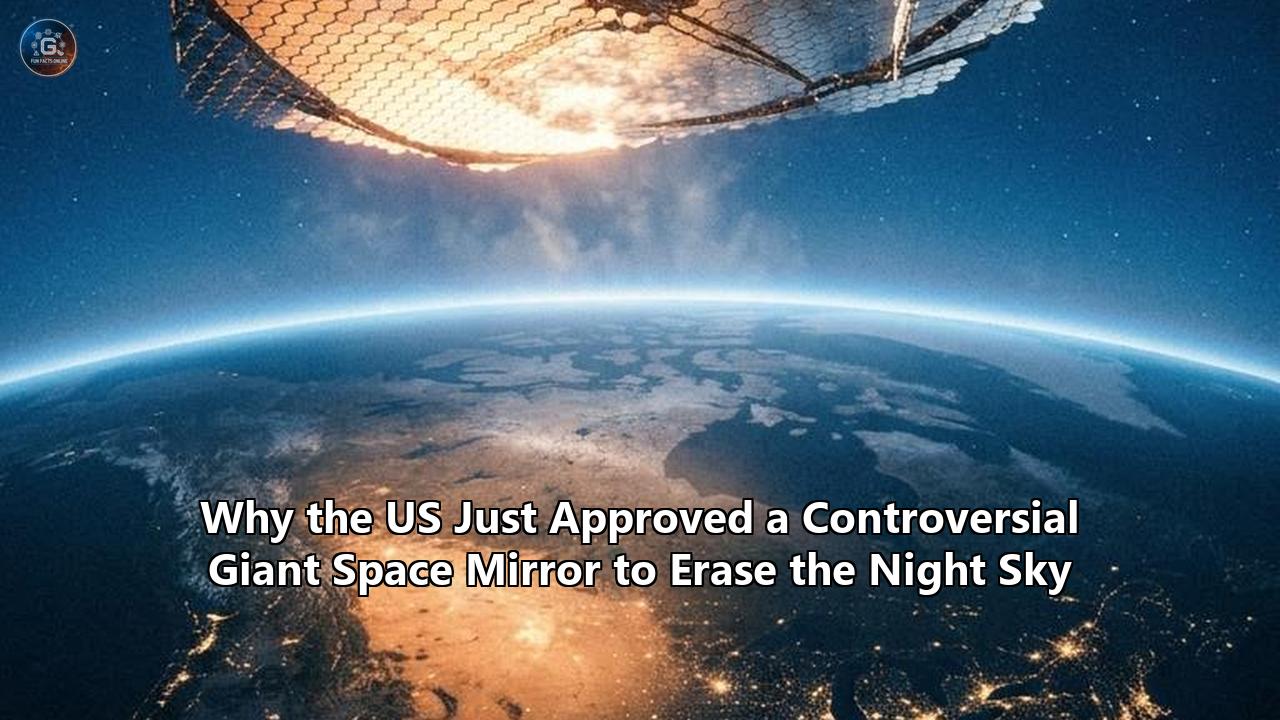
The night sky has always been humanity’s most enduring, unchanging canvas. But on July 9, 2026, the United States government quietly issued a regulatory decision that could soon rewrite the physics of darkness.
With the stroke of a pen, the Federal Communications Commission (FCC) authorized Reflect Orbital Inc., a California-based startup, to construct, launch, and operate Eärendil-1—a demonstration satellite equipped with an 18-meter (59-foot) steerable, highly reflective thin-film mirror. Its mission: to catch the sun’s rays from 625 kilometers in orbit and redirect them down to designated spots on Earth, bringing "sunlight on demand" to a sleeping planet.
The announcement has triggered a firestorm among scientists, environmentalists, and skywatchers. To its proponents, the giant space mirror project is a brilliant, market-driven innovation that could supercharge solar energy production after dark, aid search-and-rescue teams, and light up disaster zones. To its critics, it is an ecological disaster waiting to happen—an artificial star system capable of blinding pilots, confusing wildlife, and permanently blinding the sensitive telescopes that astronomers use to study the cosmos.
But behind the sensational headlines of "erasing the night sky" lies a complex web of regulatory gaps, untested engineering, and geopolitical gamble. By examining how this controversial license was secured, how the technology actually works, and why the current legal frameworks were powerless to stop it, we can understand the reality of this new era of orbital light.
The Genesis of "Sunlight on Demand": The FCC’s Quiet Precedent
The approval of Eärendil-1, filed under ICFS File No. SAT-LOA-20250701-00129, marks the first time a dedicated sunlight-redirection satellite has cleared a major U.S. regulatory hurdle. For months, the application sat in a legal and public-comment purgatory, drawing intense scrutiny from scientific bodies and drawing over 1,800 public comments—the vast majority of them fiercely negative.
The startup at the center of the storm is Reflect Orbital, based in Hawthorne, California. Founded by entrepreneur Ben Nowack, the company has pitched a remarkably simple yet disruptive concept: instead of relying on expensive battery storage to keep solar grids running through the night, why not just move the sun?
By launching a fleet of mirror-equipped satellites into Sun-synchronous orbits, Reflect Orbital plans to sell "beams" of sunlight to utility companies, industrial sites, and agricultural operations. While Eärendil-1 is a single, short-lived demonstration satellite, the company’s long-term roadmap is staggering. It envisions deploying:
- 1,000 mirrors by the end of 2028
- 5,000 mirrors by 2030
- A constellation of 50,000+ satellites by 2035
Reflect Orbital Constellation Roadmap:
[2026: Eärendil-1 (1 Test Mirror)] ---> [2028: 1,000 Mirrors] ---> [2030: 5,000 Mirrors] ---> [2035: 50,000+ Mirrors]
To understand the scale of this ambition, consider that there are currently around 10,000 active satellites in orbit. If Reflect Orbital achieves its ultimate goal, it will single-handedly quintuple the number of objects orbiting Earth, turning low Earth orbit (LEO) into a swirling, reflective cage.
How the Giant Space Mirror Project Works: The Physics of Orbital Illumination
The engineering of Eärendil-1 is a study in doing more with less. The core satellite bus is roughly the size of a standard dormitory refrigerator, packed with reaction wheels, magnetorquers, and cold-gas thrusters for precise attitude control. The star of the show, however, is a tightly folded, ultra-thin polymer membrane coated with a highly reflective aluminum layer.
Eärendil-1 Target Illuminating Geometry:

            [ Sun ]
               \
                \
                 v
         [ Eärendil-1 ] (625 km Orbit)
                 \
                  \  (Reflected Sunlight Beam)
                   v
               /=======\
              /         \
             |  Target   | (5 km Wide Spot on Earth)
              \=========/
Once the satellite reaches its operational altitude of 625 kilometers, it will command a motorized carbon-fiber truss system to unfurl. The resulting mirror will be a flat, square sail measuring 18 meters (roughly 60 feet) on each side.
The physics governing how this sail reflects light involves several critical parameters:
1. The Sun-Synchronous Polar Orbit
Eärendil-1 will fly at an inclination near 88 degrees. This near-polar orbit is essential. Because the Earth is roughly oblate, an orbit at this specific angle can be designed to precess at the same rate that the Earth orbits the Sun. This keeps the satellite in a continuous cycle of "daylight" at 625 kilometers up, even when the ground directly below is shrouded in the deep shadow of midnight.
2. High-Speed Targeting and Repointing
At 625 kilometers, Eärendil-1 will hurtle through space at approximately 7.5 kilometers per second. It does not hover over a target; instead, it must continuously rotate its reflective sail to keep the sun’s reflection pinned to a specific coordinates on the ground.
Because of the extreme geometry of a fast-moving LEO satellite tracking a stationary ground station, the mirror will require continuous, high-torque repointing every four minutes. The reflected spot of light on the ground is projected to span approximately 5 kilometers (3.1 miles) in diameter.
3. Lux and Brightness Scaling
The company states that the light delivered by Eärendil-1's 18-meter mirror will range between 0.8 and 2.3 lux. To put those numbers in perspective, consider the standard measurements of environmental light:
| Light Source | Typical Illumination (Lux) |
|---|---|
| Overcast Night Sky | 0.0001 |
| Clear Night (No Moon) | 0.002 |
| Full Moon (Clear Sky) | 0.05 to 0.3 |
| Eärendil-1 Target Spot | 0.8 to 2.3 |
| Residential Street Lighting | 5 to 15 |
| Sunrise/Sunset | 400 |
| Direct Sunlight | 100,000 |
This means the beam from a single, relatively small demonstration mirror will be four to eight times brighter than a full moon.
However, this is only the beginning. According to Reflect Orbital’s filings, the future production satellites deployed in the giant space mirror project will feature reflectors stretching up to 55 meters (180 feet) wide. These larger mirrors are engineered to beam light equivalent to 100 full moons directly down to the Earth's surface.
Behind the Business Model: The Elusive Economics of Nighttime Solar Power
Why would a venture-capital-backed startup spend millions of dollars to build, test, and launch an orbital mirror? The answer lies in the structural inefficiencies of the global transition to renewable energy.
The solar energy market is currently plagued by the "duck curve"—a deep imbalance between peak solar power generation (which occurs midday) and peak consumer demand (which occurs in the late afternoon and early evening as people return home). Because there is currently no cheap, grid-scale battery technology capable of storing gigawatt-hours of midday solar power for nighttime use, massive amounts of clean energy are routinely wasted through a practice known as curtailment.
The Grid's "Duck Curve" Problem:
Power Demand / Production
  ^
  |      /---\             <-- Peak Evening Demand (6 PM - 9 PM)
  |     /     \  _
  |    /  __   \/ \_
  |   /  /  \       \
  |  /  /    \       \____ <-- Traditional Solar Generation Peak (Noon)
  +--+--+----+--+----+----> Time of Day
    12 AM   Noon   12 PM
Reflect Orbital’s value proposition is that it can bypass the battery problem entirely. By reflecting sunlight directly onto large utility-scale solar farms at dawn, dusk, and during peak evening hours, a constellation of mirrors could theoretically allow solar plants to continue generating zero-carbon electricity long after the sun has set below the horizon.
"If you can shine a beam of sunlight onto a 5-kilometer solar farm for just an extra two hours a day, you radically alter the economics of that facility," says one energy analyst familiar with the project's pitches. "You are turning a volatile, intermittent asset into a highly predictable baseload generator."
The Multi-Use Monetization Matrix
Beyond utility-scale energy arbitrage, Reflect Orbital has designed a highly diversified suite of commercial, civic, and military offerings:
- Disaster Relief and Search-and-Rescue: In the wake of earthquakes, hurricanes, or floods, power grids are often wiped out. A steerable space mirror could illuminate vast rescue zones, allowing emergency crews to work through the night without relying on noisy, fuel-hungry ground generators.
- Industrial Construction: Infrastructure projects—such as building bridges, paving highways, or constructing remote pipelines—could run 24-hour schedules with continuous, high-altitude floodlighting that eliminates ground shadows and reduces industrial accidents.
- Agricultural Manipulation: By artificially extending daylight hours ("photoperiods") over specific crop fields, industrial agricultural operations could potentially speed up plant growth, prevent frost damage during sudden cold snaps, and maximize seasonal yields.
- Defense and Tactical Operations: The ability to instantly cast a highly concentrated, 2.3-lux beam of light onto a specific coordinate is of immense interest to military planners. It could illuminate border crossings, expose enemy movements, or provide tactical lighting for nighttime operations without revealing the positions of friendly ground forces.
Despite these grand promises, the basic financial math of a low-orbiting mirror remains highly speculative. Because a single satellite in LEO passes over any given spot on Earth in just a matter of minutes, a customer cannot simply buy continuous sunlight from Eärendil-1.
To get even one hour of uninterrupted nighttime illumination, a client would need a continuous, relay-like succession of dozens of satellites passing overhead, each hand-off requiring flawless orbital coordination and microsecond-perfect mirror repointing. The capital expenditure required to build and launch such a constellation is estimated to run into the billions of dollars.
Shadows in the Dark: The Alarm Raised by Astronomers and Ecologists
The scientific community’s reaction to the FCC's approval has been nothing short of apocalyptic. Ground-based astronomers, who have spent the last decade fighting a losing battle against the light pollution caused by communication megaconstellations like SpaceX’s Starlink, view the giant space mirror project as an existential threat to their field.
"It is terrifying to me that one country can change the night sky for everybody in the world," warned Samantha Lawler, an astronomer at the University of Regina. Lawler, along with Aaron Boley of the University of British Columbia, has been at the forefront of the academic pushback against rapid orbital commercialization.
Frying the Eyes of the Earth
Modern astronomical observatories do not use the human eye to look through telescopes. Instead, they rely on ultra-sensitive, cryogenically cooled Charge-Coupled Devices (CCDs) that are designed to capture the incredibly faint, ancient photons traveling from the edge of the observable universe.
These detectors are so sensitive that even the diffuse metallic glint of a standard Starlink satellite can leave a bright, ruined streak across an exposure. If a 18-meter mirror reflecting direct sunlight sweeps across the field of view of a major research facility—such as the Vera C. Rubin Observatory in Chile—it will not just ruin the image; it could physically overload and permanently fry the millions of dollars worth of custom-engineered silicon sensors inside the camera.
Astronomical CCD Exposure Under Megaconstellations:

[Normal Deep Space Exposure]        [Exposure Ruined by Space Mirror]
+--------------------------+        +--------------------------+
|  *     .      *          |        |  *    /================/ | <-- Blinding, 2.3-Lux Streak
|       .     .       *    |   -->  |      /                /  |     Overloads and Fries
|    *       .      .      |        |     /================/   |     CCD Sensors
+--------------------------+        +--------------------------+
In a formal petition to deny filed with the FCC, the American Astronomical Society (AAS) highlighted that Eärendil-1 could compromise the work of federally funded astronomical facilities, rendering years of public investment useless.
The Danger of Flash Blinding
The AAS also sounded the alarm on a more immediate, terrestrial safety hazard: flash blinding.
Because the satellite's mirror must adjust its angle every four minutes to maintain its ground lock, any slight mechanical jitter, sensor error, or calibration drift could cause the 2.3-lux beam to wild-point. If this high-intensity beam accidentally sweeps across a busy interstate highway or an airport approach corridor, it could temporarily blind truck drivers, motorists, or commercial airline pilots, potentially causing catastrophic accidents.
Mirror Misalignment Flash-Blind Risk:

       [ Eärendil-1 ]
         /        \
        / (Intended\ Beam)
       v            v
  [Solar Farm]     [Airport Approach Corridor] <-- Accidental Sweeps
                    * PILOT BLINDED *
Decimating the Biosphere
For biologists, the prospect of a night sky dotted with artificial suns is a nightmare. Life on Earth has evolved over three billion years under a strict, unyielding circadian cycle of light and dark. This cycle regulates the physiological behavior, hormone production, and genetic expression of almost every living organism.
- Avian Disruption: Millions of migratory birds navigate at night using the stars and the Earth's magnetic field. High-intensity orbital light beams can disorient these birds, causing them to fly off-course, exhaust themselves, or collide with buildings.
- Pollination Collapse: Many of the world’s key pollinators—including bats, moths, and certain species of beetles—are strictly nocturnal. Introducing localized patches of daytime-level light after dark disrupts their feeding and mating patterns, which could have cascading consequences for local agricultural yields and wild ecosystems.
- Melatonin Suppression: In humans, exposure to artificial light at night suppresses the production of melatonin, a hormone critical for sleep regulation, immune system function, and cancer prevention. A neighbor purchasing "sunlight on demand" to light up their backyard or farm could inadvertently expose an entire surrounding community to chronic, health-damaging light spillover.
The Great Regulatory Loophole: How the Giant Space Mirror Project Slipped Through
If the potential environmental, safety, and scientific harms of Eärendil-1 are so well-documented, how did Reflect Orbital manage to secure its operating license? The answer reveals a staggering regulatory loophole in how the United States governs commercial activities in outer space.
When the FCC issued its July 9 order, it did so with a highly controversial legal disclaimer:
"We find that grant of Reflect Orbital's application for a single demonstration satellite serves the public interest... and that petitioners and commenters' concerns do not warrant either denial or additional conditions on this authorization."
Crucially, the Commission added that the "risks of harm raised on the record regarding Reflect Orbital's solar reflector are unrelated to the Commission's role in authorizing use of radiofrequency spectrum."
This is the ultimate behind-the-scenes reality of space law: no single government agency has the explicit statutory authority to regulate light pollution from space.
The Balkanized U.S. Space Regulatory Landscape:

      [ FCC ]                 [ FAA ]                [ NO CLEAR AGENCY ]
         |                       |                            |
         v                       v                            v
Radio Spectrum &        Launch Safety, Rocket       Visual Light Pollution,
Debris Mitigation        Trajectories, & Range      Environmental Impact of
                                                      Orbital Reflectors
The FCC's "Spectrum-Only" Shield
Under the Communications Act of 1934, the FCC's primary mandate is to manage the electromagnetic spectrum to prevent radio stations (and satellites) from causing harmful interference to one another.
When Reflect Orbital applied for its license, it was not asking for permission to "reflect light." Legally, it was asking for permission to use specific radio frequencies—specifically UHF, S-band, and X-band frequencies—to send telemetry and command signals to and from the Eärendil-1 spacecraft.
Because Reflect Orbital's communications hardware met all technical radio-frequency standards and did not interfere with existing satellite networks, the FCC felt legally obligated to approve the application. To deny a license based on visual or environmental impacts would, in the FCC’s view, exceed its statutory authority and invite a swift, devastating lawsuit from the company's corporate lawyers.
The NEPA Dodge
In the United States, the National Environmental Policy Act (NEPA) requires federal agencies to assess the environmental impacts of their actions before issuing permits or licenses. However, for decades, the FCC has maintained a "categorical exclusion" for satellite licensing, arguing that launching objects into space does not have a significant effect on the human environment on Earth.
While environmental groups and the Government Accountability Office (GAO) have repeatedly challenged this categorical exclusion—arguing that the chemical pollution from rocket launches, the accumulation of orbital debris, and the light pollution from satellite constellations are classic environmental impacts—the FCC has steadfastly refused to conduct full Environmental Impact Statements (EIS) for commercial satellite approvals.
By classifying the concerns of astronomers and ecologists as "hypothetical" and outside its regulatory purview, the FCC effectively bypassed NEPA, leaving the door wide open for the giant space mirror project to proceed.
The FAA's Narrow Mandate
Other federal agencies are similarly handcuffed. The Federal Aviation Administration (FAA) regulates commercial space transportation, but its authority is strictly limited to launch and reentry safety.
The FAA's job is to ensure that the rocket carrying Eärendil-1 does not explode over a populated area or collide with a commercial airliner during ascent. Once the satellite is safely deployed in orbit, the FAA's regulatory jurisdiction ends.
The result is a wild-west regulatory landscape where a private company can launch a highly disruptive optical system into orbit, provided their radio transmitter is tuned to the right frequency and their rocket doesn't crash.
Echoes of the Cold War: Russia’s Failed "Znamya" Experiments
While Reflect Orbital’s project has been treated by modern media as a novel, sci-fi concept, the quest to control the night sky from orbit is actually a direct descendant of Cold War-era space engineering.
In the late 1980s and 1990s, scientists in the collapsing Soviet Union—and later, the Russian Space Agency—embarked on a remarkably similar project called Znamya (Russian for "Banner"). The driving force behind Znamya was a desperate economic need: Russia’s vast, resource-rich Siberian territories were locked in darkness and freezing temperatures for most of the winter, making mining, construction, and logging incredibly difficult and expensive.
Comparison of Historical and Modern Orbital Mirror Projects:

=============================================================================================
Project        Year    Sponsor             Mirror Diameter    Orbit/Type        Result
=============================================================================================
Znamya 2       1993    Russian Space Ag.   20 meters (65 ft)  Mir Space Station Success (Brief 5 km
                                                              Deployment        spot across Europe)
---------------------------------------------------------------------------------------------
Znamya 2.5     1999    Russian Space Ag.   25 meters (82 ft)  Progress Cargo    Failure (Mirror snagged
                                                              Ship Deploy       on antenna; torn)
---------------------------------------------------------------------------------------------
Eärendil-1     2026    Reflect Orbital     18 meters (59 ft)  Sun-Sync LEO      Approved; Pending Launch
                                                              (Autonomous)
=============================================================================================
Znamya 2: The First Light
On February 4, 1993, the Russian space station Mir deployed a 20-meter, ultra-lightweight Mylar reflector from the Progress M-15 cargo ship.
As the mirror unfurled, it caught the sun and beamed a 5-kilometer-wide spot of light across the night side of Europe, traveling from southern France into Russia at a speed of several kilometers per second. While heavy cloud cover prevented many ground observers from seeing the beam, several people reported seeing a distinct, bright flash in the sky, comparable to the brightness of a full moon. Znamya 2 was hailed as a major technical triumph.
Znamya 2.5: The Catastrophe that Killed the Dream
Encouraged by their success, the Russian team designed Znamya 2.5, which featured a larger, 25-meter mirror capable of producing a beam equivalent to several full moons.
On February 4, 1999—exactly six years after the first test—the crew of Mir attempted to deploy the mirror from the Progress M-40 spacecraft. However, as the automated deployment sequence began, the fragile Mylar sail caught on one of Mir's protruding communication antennas.
The thin film ripped instantly, snarling the deployment mechanism. Despite desperate attempts by ground controllers to free the mirror, the mission was a total loss. With Russia facing severe economic crises and Western partners expressing deep concern over orbital light pollution, the Znamya program was permanently shuttered, and its successor, the massive 50-meter Znamya 3, was canceled.
Why Reflect Orbital Thinks This Time is Different
Reflect Orbital is attempting to succeed where the Russian Space Agency failed by leveraging thirty years of advancements in aerospace materials, robotics, and flight software:
- Active Metrology and Smart Materials: Instead of relying on passive, unguided Mylar sheets that can easily snarl or warp, the giant space mirror project utilizes advanced shape-memory polymers and tensioning systems that can dynamically adjust the flatness of the mirror surface in response to thermal changes in space.
- Autonomous GNC (Guidance, Navigation, and Control): Eärendil-1 is equipped with high-precision star trackers, GPS receivers, and reaction wheels that calculate pointing vectors in real time. This allows for a level of steering accuracy that Russian engineers in the 1990s could only dream of.
- Decentralized Constellation Architecture: If a single Znamya mirror failed, the entire program died. Reflect Orbital’s business model relies on cheap, mass-produced "smallsats." If one Eärendil-class satellite fails to deploy, the company can simply deorbit it and launch a replacement on the next rideshare mission, treating satellites as disposable hardware.
The Geopolitical Horizon: Who Owns the Sun?
The FCC's unilateral approval of Eärendil-1 raises profound international law and geopolitical questions that go far beyond the boundaries of U.S. domestic policy.
If the United States can authorize a private company to beam sunlight onto its territory, what prevents China, Russia, or any other spacefaring nation from launching their own massive fleets of orbital reflectors?
The Outer Space Treaty of 1967
The foundational document of space law is the Outer Space Treaty of 1967, signed by more than 100 nations, including the U.S., Russia, and China. Article II of the treaty explicitly states:
"Outer space, including the moon and other celestial bodies, is not subject to national appropriation by claim of sovereignty, by means of use or occupation."
For decades, this article was interpreted to mean that no country could claim physical territory on the Moon or Mars. But as megaconstellations crowd Low Earth Orbit, legal scholars are arguing that "use or occupation" is occurring in real-time.
By launching tens of thousands of satellites, a single country or corporation can effectively "occupy" key orbital altitudes, forcing other nations to navigate around them or forfeit their own space ambitions.
Geopolitical Flashpoints of Space-Based Reflection:

[ Sovereignty Violations ]  -->  Beaming high-intensity light into a foreign
                                 nation's airspace without permission.

[ Gray-Zone Harassment ]   -->  Shining continuous light over an adversary's
                                 military bases or agricultural fields.

[ Orbital Congestion ]     -->  Monopolizing Sun-synchronous orbits, blocking
                                 allies and rivals from launching payloads.
When it comes to space mirrors, the legal crisis is even more acute. If a U.S.-licensed mirror satellite shines a 2.3-lux beam of light onto a target near a sensitive international border, the light will inevitably spill over into neighboring countries.
Does this constitute a violation of national sovereignty? Does a nation have a legal right to the natural darkness of its own airspace?
Under current international law, there are absolutely no treaties, bilateral agreements, or codifications governing light pollution or environmental modification originating from space. If a foreign adversary decides to park a giant mirror over Washington, D.C., and turn the nation's capital into a perpetual, 24-hour daylight zone, the U.S. has no clear legal recourse other than to treat it as an act of gray-zone aggression.
The Road Ahead: Eärendil-1’s Demonstration Flight and Beyond
With the FCC license officially in hand, Reflect Orbital is moving at breakneck speed to finalize the launch details for Eärendil-1. While the exact launch vehicle and launch site have not been publicly disclosed, the company is targeting a launch in late 2026, likely utilizing a commercial rideshare mission to place the satellite into its high-inclination orbit.
What to Watch For Next
As the launch window approaches, there are several key technical and regulatory milestones that space industry analysts, astronomers, and policy experts will be watching closely:
- The Deployment Sequence: Once Eärendil-1 reaches its 625-km orbit, the motorized deployment of its 18-meter thin-film mirror will be the ultimate test of Reflect Orbital's mechanical design. If the mirror fails to unfurl cleanly, or if it tears like its Znamya predecessors, the project could suffer a devastating setback.
- Ground-Truth Calibration Tests: Once deployed, the company will conduct a series of highly controlled test "sweeps" over designated, unpopulated desert test sites in the western United States. Ground-based radiometers, cameras, and drones will measure the exact intensity, spillover, and shape of the reflected light beam to see if it matches the predicted 0.8 to 2.3 lux profile.
- The Astronomical Monitoring Campaign: A global coalition of professional observatories and amateur stargazers is already preparing to track Eärendil-1 from the moment it enters orbit. Scientists plan to meticulously document the satellite's brightness, its "flashing" behavior during mirror repointing, and the extent to which it disrupts astronomical research cameras.
- The Legal Backlash: Environmental defense organizations and scientific groups are currently reviewing their options for challenging the FCC’s approval in federal court. A lawsuit accusing the FCC of violating NEPA by failing to conduct an environmental review for Eärendil-1 could freeze the license and force a major, precedent-setting legal battle over the future of space environmental law.
A Switch in the Sky
For the first time in human history, the boundary between day and night is no longer determined solely by the rotation of the Earth. If Eärendil-1 succeeds, it will prove that a private corporation, operating under a narrow, radio-frequency license from a single government, can install a physical "light switch" in the sky.
Whether this represents a brilliant step forward for clean energy or a tragic, shortsighted act of environmental vandalism remains to be seen. But as Eärendil-1 sits in its cleanroom, waiting for its ride into the upper atmosphere, one thing is clear: the battle for the night sky has officially begun, and the darkness we have taken for granted for millennia may soon become a luxury of the past.
Reference:
- https://newspaceeconomy.ca/2026/07/11/what-does-the-reflect-orbital-fcc-approval-mean-for-space-mirrors/
- https://orbital-intel.com/news/reflect-orbital-fcc-license-earendil-1-space-mirror/
- https://www.zmescience.com/science/news-science/night-into-day-satellite/
- https://gvwire.com/2026/07/10/fcc-approves-test-of-space-mirror-to-light-night-sky-despite-outcry/?nocache=1
- https://www.expressnews.com/news/article/sunlight-on-demand-u-s-approves-test-of-giant-22343886.php
- https://timesofindia.indiatimes.com/world/us/sunlight-on-demand-us-approves-plans-to-build-60-foot-mirror-in-space/articleshow/132325964.cms
- https://earthsky.org/space/giant-space-mirror-approved-reflect-orbital-low-earth-orbit-concerns/
- https://www.fastcompany.com/91572626/the-fcc-just-approved-a-test-of-a-giant-mirror-in-space
- https://humanprogress.org/fcc-approves-test-of-space-mirror-to-light-night-sky/
- https://gizmodo.com/this-startup-wants-to-use-space-mirrors-to-light-up-earth-at-night-feds-said-go-ahead-2000784980
- https://www.reddit.com/r/space/comments/1uw6isv/the_us_approves_the_launch_of_a_mirror_satellite/
- https://www.pcmag.com/news/fcc-approves-reflect-orbitals-giant-mirror-satellite-that-astronomers-hate
- https://news.ubc.ca/2026/07/the-u-s-just-approved-a-giant-space-mirror-to-test-sunlight-on-demand-low-earth-orbit-is-getting-weird/
- https://www.iflscience.com/fcc-approves-extremely-controversial-space-mirror-satellite-that-could-flash-blind-drivers-and-ruin-astronomy-84071
- https://docs.fcc.gov/public/attachments/DA-26-706A1.pdf
- https://payloadspace.com/faa-ends-part-450-transition-period/