The quiet coastal town of Forrest Beach, a sleepy enclave of roughly 2,500 residents north of Townsville in North Queensland, became the epicenter of an international aerospace investigation. Over a weekend of escalating tension, local authorities and federal scientists scrambled to contain and analyze six highly robust, metallic silver spheres that washed ashore.
The incident, which began on the afternoon of Friday, July 3, 2026, sparked a frantic emergency response, with local residents finding what have been dubbed the mysterious space balls australia has encountered on its shores this week.
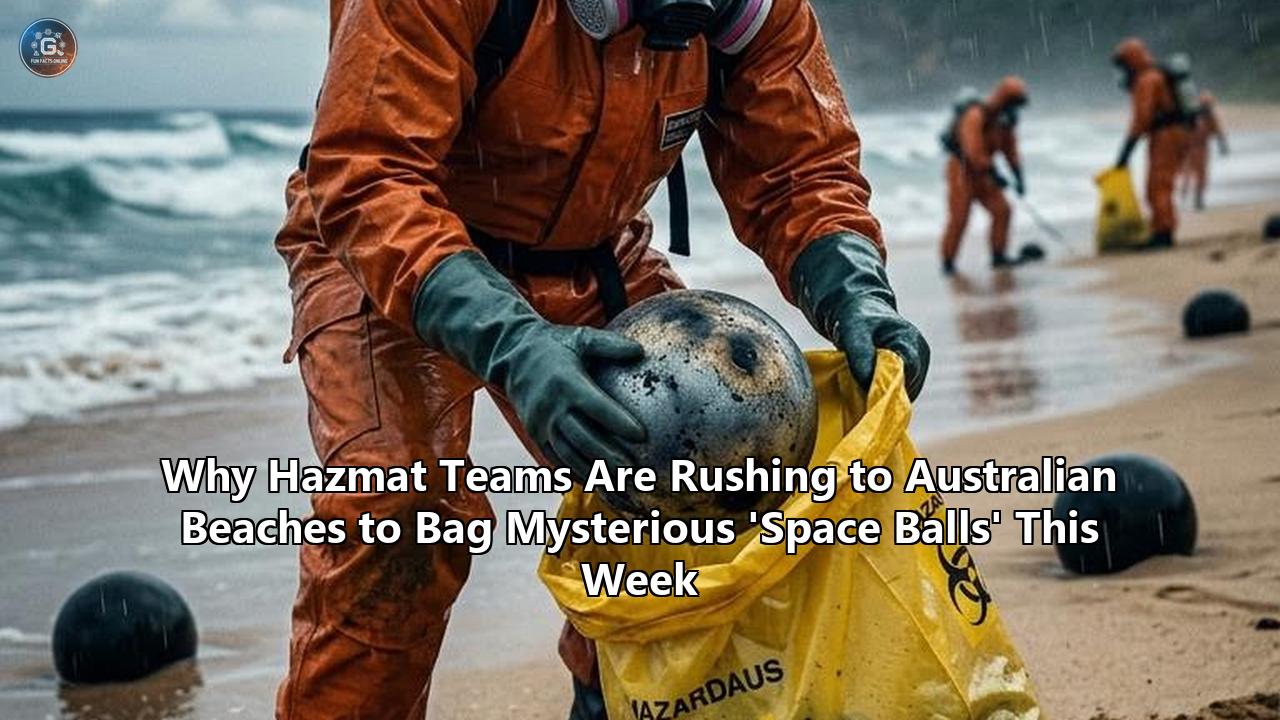
Specialist scientific crews from the Queensland Fire Department (QFD), wearing heavy chemical-resistant hazmat suits, descended on the beach to secure the objects. They established a strict 50-meter exclusion zone around each sphere, initially cordoning off large sections of the beach under the Public Safety Preservation Act (PSPA) due to fears of toxic chemical contamination.
By Monday, July 6, 2026, the Australian Space Agency (ASA) broke its silence, confirming that the objects are highly likely "pressure vessels from a foreign space launch vehicle" that recently plunged back to Earth.
While the immediate environmental and chemical threat has been downgraded, the rapid recovery effort, the potential presence of lethal spacecraft propellants, and the unresolved question of which country launched these spheres have thrust Forrest Beach into the global spotlight. This event highlights a growing, systemic hazard: as Earth's orbit becomes increasingly congested, the debris of the space age is returning to Earth with alarming frequency.
Chronology of a Beachfront Intrusion
The mystery began on Friday afternoon when a beachgoer spotted three large, highly polished metallic spheres resting on the sand just north of the Forrest Beach boat ramp. The spheres, measuring roughly half a meter in diameter, appeared structurally pristine. They bore no obvious signs of the scorched, carbonized scarring typically associated with objects that have survived the thousands of degrees of atmospheric re-entry.
Puzzled by their weight and high-tech appearance, the finder contacted local Queensland Police. Recognizing the potential hazard of unidentified marine or industrial debris, officers arrived at the scene around 2:30 PM. By Saturday morning, a fourth sphere had been located further down the coastline.
By Sunday, as tides shifted, two more spheres washed ashore, bringing the total to six.
Timeline of the Forrest Beach Incident:
┌───────────────────────────┬────────────────────────────────────────────────────────┐
│ Date (2026)               │ Event / Action Taken                                   │
├───────────────────────────┼────────────────────────────────────────────────────────┤
│ Friday, July 3 (2:30 PM)  │ Three metallic spheres discovered; police arrive.      │
│ Saturday, July 4          │ Fourth sphere discovered; PSPA declared.              │
│ Sunday, July 5            │ Two more spheres found (6 total); hazmat teams secure  │
│                           │ five spheres in drums; PSPA revoked, 50m cordons set.  │
│ Monday, July 6            │ Australian Space Agency identifies foreign rocket      │
│                           │ body as the likely source of the pressure vessels.    │
└───────────────────────────┴────────────────────────────────────────────────────────┘
Due to the unknown nature of the objects, Queensland Fire and Rescue Service (QFRS) activated its specialized Scientific Branch. Fearing that the spheres were pressurized propellant tanks holding highly reactive, volatile fuels, emergency services initially declared an emergency zone under the Public Safety Preservation Act, blocking all vehicular and pedestrian access to the beach.
Teams in bright yellow, fully encapsulated hazmat suits operated under police guard. Using specialized sniffing equipment to detect volatile organic compounds and toxic gases, the scientific teams meticulously checked each sphere for leaks.
Once verified as stable, five of the spheres were carefully lifted and secured inside heavy-duty, sealed hazardous material drums. The sixth sphere was rendered safe on-site on Sunday afternoon. While the overarching public safety declaration was revoked late Sunday, 50-meter exclusion zones remain active around the temporary recovery sites as the ASA coordinates the final removal.
Why "Space Balls" Terrify First Responders: The Chemistry of Rocket Fuel
The extreme caution exercised by the Queensland authorities was not an overreaction. In the aerospace community, finding intact, spherical pressure vessels on the ground is a scenario treated with the utmost gravity because of what these spheres are designed to hold.
In modern rocketry, spherical tanks—often colloquially termed "space balls"—are typically utilized as propellant tanks or auxiliary pressure vessels. To feed fuels into a rocket engine at the extreme flow rates required for flight, rocket systems rely on high-pressure gases, usually helium, to force the liquid propellants out of their main tanks and into the combustion chambers. These spherical tanks are built to withstand immense internal pressures, often exceeding several hundred atmospheres.
The primary terror for first responders is not the pressure itself, but the chemical residue that may remain trapped inside. Many upper rocket stages and satellite propulsion systems utilize hydrazine ($\text{N}_2\text{H}_4$) or its derivatives, such as Monomethylhydrazine (MMH) and Unsymmetrical Dimethylhydrazine (UDMH), as hypergolic fuels.
Hydrazine Risk Profile:
• State: Clear, colorless liquid with an ammonia-like odor.
• Toxicity: Extremely toxic via inhalation, skin absorption, or ingestion.
• Physical Effects: Severe chemical burns, blindness, pulmonary edema (fluid in lungs).
• Long-Term Hazards: Severe liver and kidney damage, central nervous system depression, highly carcinogenic.
• Reactivity: Hypergolic (ignites spontaneously upon contact with oxidizers like nitrogen tetroxide).
Hydrazine is a notoriously dangerous substance. It is a highly toxic, corrosive, and volatile liquid. Exposure to even minuscule vapor concentrations can destroy human respiratory tracts, cause permanent neurological damage, and lead to severe chemical burns upon skin contact. Because it is highly stable in the absence of oxygen and does not readily decompose when sealed inside an airtight titanium tank, any residual hydrazine inside a washed-up pressure vessel can remain fully potent.
"These round objects often contain extremely dangerous and reactive gases and fuels like helium and hydrazine," explained Dr. Sara Webb, an astrophysicist at Swinburne University of Technology. "So, it's crucial that if they are found out in the wild they remain untouched and the local authorities are notified to remove the debris safely."
If a beachgoer had attempted to open, puncture, or salvage one of these spheres using standard tools, the release of pressurized toxic gas or concentrated hydrazine liquid could have resulted in immediate, localized fatalities.
Metallurgical Marvels: Surviving the Plunge
The physical appearance of the six spheres has drawn significant attention from aerospace metallurgists and space archaeologists. The lack of intense carbonization or melted deformation on the spheres' surfaces initially puzzled onlookers, leading to some speculation that the objects might have been marine in origin, such as deep-sea mooring buoys.
However, the lack of thermal degradation is entirely consistent with the metallurgy of advanced space-grade pressure vessels. These spheres are almost certainly constructed from titanium alloys, specifically $\text{Ti-6Al-4V}$ (Titanium, 6% Aluminum, 4% Vanadium), or high-strength carbon-fiber composite overwraps.
Titanium Alloy (Ti-6Al-4V) Properties:
• Density: 4.43 g/cm³ (Lightweight)
• Tensile Strength: 950 MPa (Extremely strong)
• Melting Point: 1,660°C (3,020°F)
• Corrosion Resistance: Exceptional, particularly in saltwater environments.
Titanium is favored in aerospace engineering because it possesses an incredibly high melting point (approximately 1,660°C or 3,020°F) and retains its structural integrity at both cryogenic and extremely elevated temperatures.
When a rocket body re-enters the Earth's atmosphere at velocities exceeding 27,000 kilometers per hour, atmospheric compression generates temperatures that easily melt and vaporize aluminum structural panels. However, the spherical shape of these tanks—which distributes thermal and mechanical loads perfectly—combined with the extreme heat resistance of titanium, allows them to survive re-entry completely intact.
Associate Professor Alice Gorman, a space archaeologist and space junk expert at Flinders University, analyzed the initial visual data of the objects. She noted that the absence of heavy burn marks points to a specific stage of a rocket's journey.
"This suggests they might be from a rocket stage—perhaps a first or second stage—that has fallen back to Earth while the rest of the stage goes on to deliver a payload into space," Gorman said. "They look to be consistent with what you find as part of a fuel system. They are pressurized fuel vessels made of titanium alloys, which have very high melting points."
If the spheres fell from a lower rocket stage, they would have been discarded at a much lower altitude and speed than an orbital payload. Consequently, they would not have experienced the extreme orbital re-entry heating that leaves charred, black melted crusts on space debris, explaining their shiny, silver appearance.
Alternatively, if they did fall from orbit, they may have been shielded within the interior of an upper stage or spacecraft during the initial, hottest phase of re-entry, only breaking free in the upper atmosphere once the outer hull had disintegrated.
Hunting the Source: Russian Fregat or Indian PSLV?
With the discovery of these mysterious space balls australia's federal space agency is now scrambling to identify their exact origin. In its formal public release on Monday, the Australian Space Agency confirmed that early orbital tracking data and structural characteristics point directly to a foreign space agency.
"The recovered objects appear to be pressure vessels from a space launch vehicle," the ASA statement read. "The Agency has identified the likely source. The objects' location and characteristics are consistent with debris from a foreign rocket body that recently re-entered the atmosphere from orbit."
The agency added that it is actively collaborating with international partners and counterpart space agencies to formally confirm the launching state and the specific launch vehicle.
Prime Suspects for the Forrest Beach Debris:
┌───────────────────────────────┬───────────────────────────────┬───────────────────────────────┐
│ Feature                       │ Russian Fregat Upper Stage    │ Indian PSLV Fourth Stage (PS4)│
├───────────────────────────────┼───────────────────────────────┼───────────────────────────────┤
│ Propellant Type               │ Nitrogen Tetroxide / UDMH     │ MMH / Nitrogen Oxides         │
│ Pressurant Gas                │ Helium                        │ Helium                        │
│ Tank Metallurgy               │ Titanium Alloy (Spherical)    │ Titanium (Spherical/Ellipsoid)│
│ Core Geometry                 │ Torospherical clustered       │ Four distinct spherical       │
│                               │ spheres                       │ pressure vessels              │
└───────────────────────────────┴───────────────────────────────┴───────────────────────────────┘
While the ASA has not yet named the foreign entity, space analysts and researchers have narrowed the field to two prime candidates.
Candidate 1: The Russian Fregat Upper Stage
The Fregat is a highly versatile, autonomous upper stage developed by the Russian aerospace firm NPO Lavochkin. It is used extensively on Soyuz and Zenit launch vehicles to inject satellites into precise, high-altitude orbits.
The structural core of the Fregat is a monoblock configuration consisting of six welded spherical tanks arranged in a ring. Four of these spheres act as propellant tanks (holding UDMH and Nitrogen Tetroxide), while the remaining spheres contain flight instruments and high-pressure helium tanks.
The diameter, metallic composition, and quantity of the spheres discovered on Forrest Beach align closely with the clustered titanium sphere architecture of a Fregat stage. Furthermore, Fregat upper stages routinely perform de-orbit burns after payload deployment, leading to high-speed re-entries over the Pacific and Indian Oceans.
Candidate 2: The Indian Polar Satellite Launch Vehicle (PSLV)
The fourth stage of India’s PSLV (designated PS4) utilizes liquid propellants (Mono-Methyl Hydrazine and Mixed Oxides of Nitrogen) stored in spherical titanium tanks.
These tanks, manufactured using advanced $\text{Ti-6Al-4V}$ alloy welding techniques by companies like Hindustan Aeronautics Limited (HAL), are built to withstand high structural and thermal loads.
Australia has a direct history with PSLV debris: in 2023, a massive, copper-colored metallic dome washed ashore on a beach near Green Head in Western Australia. That object was later officially confirmed by the Indian Space Research Organisation (ISRO) to be a third-stage motor casing from a PSLV rocket.
Australia: The World's Accidental Space Junk Magnet
The arrival of these mysterious space balls australia has highlighted the country's unique geographical vulnerability to falling space debris. Due to its massive, sparsely populated landmass and its positioning beneath several highly active orbital inclination corridors, Australia has historically served as a literal landing pad for some of the world's most famous space junk.
"Space junk most commonly flies in over the sea, but Australia is a very big land mass, so we do get a reasonable amount of space junk," noted Associate Professor Alice Gorman.
Major Space Debris Incidents in Australian History:
• 1979: NASA's Skylab space station breaks up over Esperance, Western Australia.
• 2022: SpaceX Crew Dragon trunk debris lands in the Snowy Mountains, NSW.
• 2023: ISRO PSLV rocket dome washes up on Green Head beach, Western Australia.
• 2026: Six titanium rocket pressure vessels wash up on Forrest Beach, Queensland.
The Skylab Incident (1979)
The most famous re-entry event in space history occurred on July 11, 1979, when NASA’s first space station, the 77-ton Skylab, underwent an uncontrolled orbital decay. Debris rained down across a vast swath of the southeastern Indian Ocean and Western Australia’s Goldfields-Esperance region.
Among the recovered items were massive, intact oxygen tanks and structural beams. In a legendary display of dry Australian humor, the Shire of Esperance issued NASA a $400 fine for littering. The fine remained unpaid for three decades until 2009, when a US radio host raised the funds from his listeners and paid the debt on NASA's behalf.
The SpaceX Snowy Mountains Fall (2022)
In July 2022, sheep farmers in the Snowy Mountains of New South Wales were startled to discover several charred, jagged carbon-fiber obelisks wedged vertically into their paddocks.
The Australian Space Agency, working alongside SpaceX engineers, confirmed that the pieces were parts of a SpaceX Crew Dragon trunk. The trunk, which is intentionally discarded before the spacecraft's re-entry with astronauts, was supposed to burn up entirely over the Pacific Ocean. Instead, high-strength composite materials allowed large, multi-meter fragments to survive and impact rural farmland.
The Green Head PSLV Dome (2023)
In July 2023, beachgoers near Green Head, a coastal town 250 kilometers north of Perth, discovered a giant, barnacle-encrusted metal dome.
Initially treated as a maritime mystery, the object was quickly identified as an ISRO PSLV third-stage propellant casing. The object had floated in the Indian Ocean for months, if not years, before ocean currents finally pushed it onto the Western Australian coast.
The Legal and Geopolitical Tangle of Space Salvage
The recovery and ultimate disposition of the six Forrest Beach spheres are governed by a complex web of international space treaties, which Australia takes very seriously as a key signatory.
The primary legal instrument is the 1967 Treaty on Principles Governing the Activities of States in the Exploration and Use of Outer Space, including the Moon and Other Celestial Bodies, more commonly known as the Outer Space Treaty.
Under Article VIII of the Outer Space Treaty, a State Party to the treaty on whose registry an object launched into outer space is carried retains jurisdiction and control over such object, and over any personnel thereof, while in outer space or on a celestial body. Crucially, the treaty dictates that ownership of space objects, including components found on Earth, is never lost.
"It's the most widely accepted space treaty where the launching state retains ownership of the launch material," said Alice Gorman. "This means the nation that launched them owns those pressure vessels."
International Space Law Framework:
1. Outer Space Treaty (1967): Establishes that the launching state retains permanent ownership of any debris, wherever it lands.
2. Liability Convention (1972): Dictates that launching states are absolutely liable for damage caused by their space objects on the surface of the Earth.
3. Rescue Agreement (1968): Requires nations to safely secure space debris found within their territory and return it to the launching state upon request.
This leads to a highly delicate diplomatic protocol. Australia cannot simply sell, dispose of, or put these titanium spheres in a museum without the explicit authorization of the launching nation.
Once the Australian Space Agency formally identifies the launching state (such as Russia or India), they will officially notify their diplomatic counterparts. Under the 1968 Rescue Agreement, Australia is obligated to take "practicable steps" to recover the space object and, upon request, return it to the launching authority. However, the launching state is also financially responsible for the costs incurred in recovering, securing, and transporting the hazardous material.
If the debris is determined to have caused environmental damage or physical harm, the 1972 Liability Convention comes into play. This treaty states that a launching state is absolutely liable to pay compensation for damage caused by its space object on the surface of the Earth. Fortunately, because the spheres landed on an open beach without hitting any structures or people, no liability claims are expected.
Remarkably, despite the thousands of tons of space junk that have fallen to Earth over the last 70 years, there is only one recorded instance of a human being struck by falling space debris. In 1997, Lottie Williams of Tulsa, Oklahoma, was struck on the shoulder by a small piece of a US Delta II rocket. Because the fragment was extremely lightweight and had slowed to terminal velocity, she escaped without injury.
The Broader Threat: A Crowded Sky and Uncontrolled Re-entries
While the Forrest Beach incident has resolved without injuries or environmental damage, scientists warn that the event is a symptom of a rapidly escalating orbital crisis. The sheer volume of material we are placing into orbit is pushing the environment to a breaking point.
According to European Space Agency (ESA) estimates, there are currently more than 130 million pieces of space debris orbiting Earth. While the vast majority of these are smaller than a centimeter (such as paint flecks, solid rocket motor slag, and frozen coolant drops), there are over 30,000 tracked objects larger than 10 centimeters. These include dead satellites, spent rocket stages, and structural adapters.
The root of the problem is the exponential acceleration of space launches.
"We've had more space launches in the last five years than in the whole of history," Alice Gorman warned.
This boom is driven by the transition from expensive, state-sponsored scientific missions to commercial mega-constellations. Companies like SpaceX, Amazon, and OneWeb are launching thousands of small satellites into Low Earth Orbit (LEO) to provide global broadband internet.
While these constellations bring immense connectivity benefits, they also vastly increase the frequency of rocket launches. Every satellite launched requires a multi-stage rocket, and although modern rocket companies are increasingly focusing on reusability, many rocket components—especially upper stages, payload fairings, and dual-satellite adapters—are still discarded in orbit.
The Low Earth Orbit Explosion:
• Active Satellites in 2010: ~1,000
• Active Satellites in 2026: ~12,000+
• Debris Objects Orbiting Earth: ~130 Million+
• Annual Launch Rate: Exceeding 200 launches per year.
These discarded upper stages eventually fall victim to orbital decay. Even at altitudes of several hundred kilometers, a trace amount of Earth's atmosphere exists. This atmosphere creates drag, slowly robbing the defunct space objects of their velocity.
As solar activity increases—such as during the peak of Solar Cycle 25/26—the upper atmosphere expands, increasing drag and causing hundreds of pieces of space junk to plunge back to Earth in an uncontrolled manner.
This congestion poses a dual threat. In orbit, the high density of objects increases the risk of the Kessler Syndrome—a theoretical scenario proposed by NASA scientist Donald J. Kessler in 1978. In this cascade event, a single collision between two large objects creates a cloud of debris that triggers a chain reaction of subsequent collisions, eventually rendering specific orbital planes entirely unusable for generations.
On the ground, it means that the sight of hazmat teams recovering titanium propellant spheres from beaches and paddocks will shift from a rare curiosity to a routine local government municipal task.
Out-of-This-World Humor: How Forrest Beach Welcomed the Aliens
Despite the high-stakes coordination between state emergency services, federal space scientists, and international diplomats, the local community of Forrest Beach met the high-tech intrusion with classic, dry Australian humor.
Forrest Beach is usually a remarkably quiet town where very little of international significance occurs. The sudden arrival of flashing police lights, hazmat teams in protective suits, and international news crews provided a massive spike of local excitement.
"It's very quiet, not a lot happens here. So having a lot of extra activity – that definitely created a little bit of excitement," Lisa Scobie, the owner of the local Forrest Beach Takeaway shop, told reporters.
To capitalize on the town’s sudden influx of tourists, journalists, and government personnel, Scobie quickly updated her shop’s menu. The takeaway shop began selling a limited-edition "Space Junk Snack Box".
Forrest Beach Takeaway Specials:
┌────────────────────────────────────────────────────────────────────────┐
│                        SPACE JUNK SNACK BOX                            │
│                                                                        │
│   "Unlike some stuff that washes up on our beach, you'll actually      │
│                be able to identify these objects!"                     │
│                                                                        │
│   Includes: Tempura battered "orbs", planetary potato cakes, and       │
│             rocket-fuel dipping sauce.                                 │
└────────────────────────────────────────────────────────────────────────┘
The shop’s chalkboard proudly proclaimed: "Unlike some stuff that washes up on our beach, you'll be able to identify these objects." The marketing move became a hit on social media, with locals and visiting journalists posting photos of themselves eating the themed snack boxes right outside the active 50-meter police exclusion zone.
Moving Forward: What to Watch for Next
As the immediate drama of the beachfront recovery winds down, several key legal, scientific, and political developments are set to unfold over the coming days and weeks:
1. Official Identification of the Launching State
The Australian Space Agency is expected to release a formal declaration identifying the specific country of origin and the exact rocket launch associated with the six spheres. If the spheres are confirmed as Russian or Indian in origin, it will initiate the formal treaty-based diplomatic transfer of the material back to its sovereign owners.
2. Upgraded Tracking and De-Orbit Regulations
This high-profile incident will likely add fuel to the ongoing debate at the United Nations Committee on the Peaceful Uses of Outer Space (COPUOS) regarding uncontrolled re-entries. There is growing international pressure on spacefaring nations to mandate that all rocket upper stages be equipped with enough reserve fuel to execute a controlled, targeted de-orbit burn into the "Spacecraft Cemetery"—a remote area of the southern Pacific Ocean known as Point Nemo.
3. The Search for More Debris
Queensland Fire and Rescue teams have warned that additional debris from the same rocket body could wash up along the North Queensland coastline in the coming days as ocean currents and tides continue to push floating wreckage ashore. Beachgoers between Townsville and Cairns have been urged to remain vigilant and avoid touching any unusual metallic items.
For now, the mysterious space balls australia has pulled from the sands of Forrest Beach remain securely sealed inside steel drums, awaiting their final journey back to whichever country left them in the sky. The incident serves as a stark, physical reminder that the boundaries between Earth and space are becoming increasingly porous—and that what we send up into orbit will, eventually, find its way back down to our shores.
Reference:
- https://www.independent.co.uk/news/world/australasia/queensland-australia-beach-space-balls-b3009575.html
- https://ground.news/article/australia-probes-mystery-space-balls-that-washed-up-on-beach_052f0d
- https://www.theguardian.com/australia-news/2026/jul/06/mysterious-space-balls-queensland-beaches-origin-source-australia
- https://universemagazine.com/en/mysterious-spheres-from-space-have-fallen-on-the-beach-people-are-asked-to-stay-away/
- https://www.jpost.com/omg/article-901520
- https://www.hinchinbrooklife.com/article/mystery-space-debris-washes-up-at-forrest-beach
- https://www.thenews.com.pk/latest/1408174-mysterious-debris-found-on-australian-beaches-could-be-space-balls
- https://www.express.co.uk/news/world/2226093/australia-beach-space-balls/amp
- https://www.theguardian.com/australia-news/2026/jul/05/mysterious-debris-found-on-queensland-beaches-could-be-space-balls-and-may-contain-toxic-rocket-fuel
- https://www.indailysa.com.au/news/just-in/2026/07/06/mystery-orbs-found-on-beach
- https://qazinform.com/news/mysterious-space-balls-discovered-on-australian-beaches-c045fa
- https://newscord.org/article/australian-space-agency-investigates-six-metallic-spheres-found-on-forrest-beach--Story_20260707_Australiaprobesmyste2e311940
- https://www.google.com/search?q=time+in+Australia
- https://www.skyatnightmagazine.com/news/strange-space-balls-australian-beaches-debris-from-rocket-launches
- https://www.researchgate.net/publication/390411306_Materials_and_Manufacturing_of_Performance_Critical_Liquid_Propulsion_Systems_for_PSLV-C57Aditya-L1_Mission
- https://www.freepressjournal.in/world/mysterious-debris-on-queensland-beaches-may-be-space-balls-expert
- https://grokipedia.com/page/Fregat
- https://www.newindianexpress.com/states/karnataka/2012/Jul/19/hal-makes-rocket-fuel-tank-for-isro-388628.html
- https://www.ndtv.com/world-news/mysterious-spheres-wash-up-on-australian-beach-could-be-rocket-space-balls-11731857/amp/1
- http://gklaunch.ru/en/news/photo-report-from-lavochkin-scientific-and-production-association-one-day-at-fregat-upper-stage-manufacturing-facility/
- https://www.ciihive.in/Attachments/Exhibitor/49351_PSLVBROCHURE.pdf
- https://www.hindustantimes.com/world-news/what-are-mysterious-balls-found-on-australian-beach-asa-space-agency-has-an-answer-101783325534069.html
- https://www.theguardian.com/australia-news/2026/jul/06/mysterious-space-balls-queensland-beaches-origin-source-australia