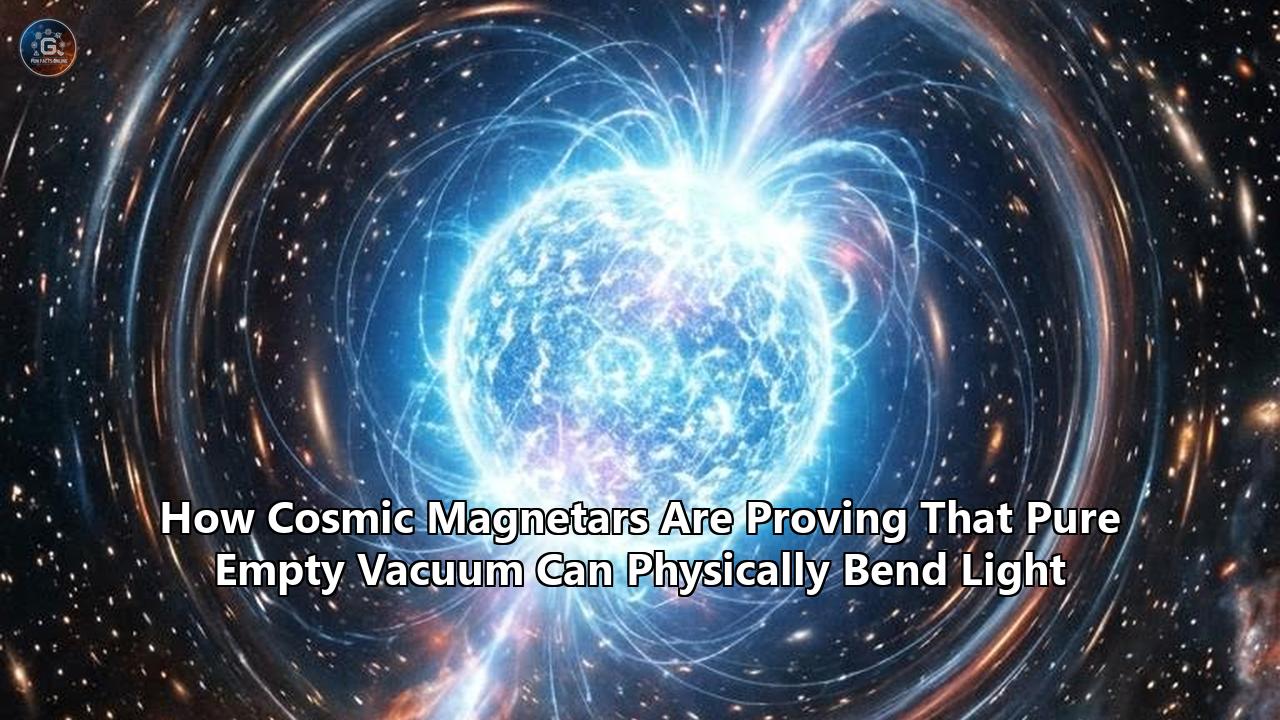
A coordinated multi-observatory campaign spanning NASA’s Imaging X-ray Polarimetry Explorer (IXPE), the International Space Station’s NICER payload, and CSIRO’s Murriyang radio telescope in Australia has delivered observational evidence of vacuum birefringence in the magnetized envelope of the radio magnetar 1E 1547.0-5408. The findings, published in Nature by a global team led by Marcus Lower and Rachael Stewart, confirm a foundational prediction of quantum electrodynamics (QED) first formulated in 1936 by Werner Heisenberg and Hans Heinrich Euler: under extreme electromagnetic fields, the absolute vacuum ceases to be empty and inert, acquiring physical refractive properties that polarize and refract passing electromagnetic waves.
Measuring polarization degrees as high as 65% to 80% at soft X-ray energies (around 2 keV), the campaign tracked the way ultra-dense magnetic fields force virtual electron-positron pairs out of quantum fluctuation and into macroscopically observable alignments. This field-induced modification of empty space generates distinct refractive indices for different light polarizations. The resulting phenomena show magnetars bending light not through the classical spacetime curvature of general relativity alone, but via the non-linear optical properties of quantum vacuum polarization.
This astronomical confirmation establishes an empirical baseline for strong-field QED, but it also accentuates a divide in fundamental physics: the reliance on distant, messy astrophysical phenomena versus the ongoing push to detect vacuum non-linearities in tightly controlled terrestrial laser laboratories.
The Quantum Vacuum as a Non-Linear Prism
Classical electromagnetism, described by James Clerk Maxwell’s linear field equations, posits that electromagnetic waves pass through one another in a vacuum without interaction. In Maxwell’s vacuum, the refractive index is identically $n = 1$ for all frequencies, directions, and polarization states. Superposition holds universally: empty space is completely isotropic, linear, and devoid of structure.
Quantum electrodynamics dismantles this classical assumption. In the QED framework, the vacuum is a dynamic medium populated by virtual electron-positron ($e^+e^-$) pairs that continuously fluctuate into existence and annihilate within the limits of the Heisenberg uncertainty principle. Under ordinary laboratory conditions, these fluctuations cancel out on macroscopic scales, leaving Maxwellian linearity intact.
When an external magnetic field approaches or exceeds the Schwinger critical field limit:
$$B_{\text{cr}} = \frac{m_e^2 c^3}{e \hbar} \approx 4.41 \times 10^{13} \text{ Gauss } (4.41 \times 10^9 \text{ Tesla})$$
the electromagnetic energy density alters the behavior of these virtual pairs. The external field separates and aligns virtual charges, polarizing the vacuum itself.
   [ Classical Maxwellian Vacuum ]            [ Magnetized QED Vacuum (B >> B_cr) ]

       Photon Path (Linear)                       Virtual Electron-Positron Loops
   ─────────────────────────────►                  ┌───(+)          (+)───┐
     n = 1.000... (All Modes)                      │     ▲          ▲     │
     No mode separation                            ▼     │   B-Field│     ▼
     No vacuum refraction                          └───(-)   Vector └───(-)
                                                           │          │
                                                  O-Mode:  n_||  = 1 + (8α/45π)(B/B_cr)² sin²θ
                                                  X-Mode:  n_perp = 1 + (14α/45π)(B/B_cr)² sin²θ

                                                  Differential index forces vacuum birefringence,
                                                  splitting ray trajectories and locking polarization.
The effective dynamics are governed by the Euler-Heisenberg Lagrangian, which incorporates one-loop quantum corrections into the Maxwell action:
$$\mathcal{L}_{\text{EH}} = -\frac{1}{4} F_{\mu\nu} F^{\mu\nu} + \frac{\alpha^2}{90 m_e^4} \left[ (F_{\mu\nu} F^{\mu\nu})^2 + \frac{7}{4} (F_{\mu\nu} \tilde{F}^{\mu\nu})^2 \right]$$
Here, $\alpha \approx 1/137$ is the fine-structure constant, $m_e$ is the electron mass, $F_{\mu\nu}$ is the electromagnetic field tensor, and $\tilde{F}^{\mu\nu}$ is its dual.
As a direct consequence of these non-linear terms, passing photons interact with the background field via virtual loop interactions (effective photon-photon scattering). The magnetized vacuum splits incoming radiation into two distinct normal propagation modes:
- Ordinary Mode (O-mode / $\parallel$): The electric field vector oscillates within the plane defined by the propagation vector $\mathbf{k}$ and the external magnetic field $\mathbf{B}$.
- Extraordinary Mode (X-mode / $\perp$): The electric field vector oscillates perpendicular to the $\mathbf{k}\text{–}\mathbf{B}$ plane.
Each mode experiences a different effective index of refraction:
$$n_\parallel \approx 1 + \frac{8\alpha}{45\pi} \left(\frac{B}{B_{\text{cr}}}\right)^2 \sin^2\theta$$
$$n_\perp \approx 1 + \frac{14\alpha}{45\pi} \left(\frac{B}{B_{\text{cr}}}\right)^2 \sin^2\theta$$
Because $n_\perp > n_\parallel$, the vacuum behaves as a birefringent uniaxial crystal. Light with orthogonal polarizations propagates at different phase velocities. In spatial gradients of magnetic field intensity or orientation, these differing indices alter the wavefronts, meaning that magnetars bending light occurs not merely as a consequence of their immense mass warping spacetime, but because their ultra-strong fields physically refract light through empty space.
Astrophysical Observation vs. Terrestrial Laser Synthesis
The discovery of vacuum birefringence has crystallized an ongoing debate regarding how best to test fundamental physical laws in the non-linear regime. Physicists have split into two camps: those who use magnetars as natural astrophysical laboratories, and those building terrestrial ultra-intense laser and cavity interferometry facilities.
Each methodology carries distinct trade-offs in field strength, environmental control, systematic uncertainty, and experimental reproducibility.
| Experimental Parameter | Astrophysical Observatories (IXPE, NICER, eXTP) | Terrestrial Laser Facilities (LUXE, ELI-NP, PVLAS) |
|---|---|---|
| Achievable Magnetic Field ($B$) | $10^{14} \text{ to } 10^{15} \text{ Gauss } (\sim 10 \text{ to } 100 \times B_{\text{cr}})$ | $10^5 \text{ to } 10^6 \text{ Gauss (static)}; \sim 10^{10} \text{ Gauss equivalent (optical)}$ |
| Normalized Field Parameter ($\xi = eE / m_e c \omega$) | Domain of extreme static field ratios ($B/B_{\text{cr}} \gg 1$) | Non-perturbative laser regimes ($\xi > 1$ up to $\xi \approx 10$) |
| Propagation Path Length ($L$) | $10^2 \text{ to } 10^4 \text{ km}$ across magnetosphere | Millimeters to optical cavity folds ($\sim \text{kilometers effective}$) |
| Experimental Control | Zero control over source parameters, spin, geometry, or flares | Complete control over laser pulse duration, intensity, wavelength, and timing |
| Systematic Errors | Geometry degeneracies, plasma contamination, atmospheric composition | Thermal noise, optical mirror birefringence, detector dark currents |
| Measurement Observable | Phase- and energy-resolved Stokes parameters ($I, Q, U, V$) | Ellipticity $\psi$, polarization rotation $\Delta \theta$, pair creation rates |
| Primary Physical Target | Adiabatic polarization rotation, vacuum resonance mode conversion | Direct photon-photon scattering, Schwinger pair production |
The Astrophysical Case: Nature’s Over-Critical Laboratories
Magnetars are isolated neutron stars packing up to two solar masses into a sphere roughly 20 kilometers in diameter, generating surface magnetic fields of $10^{14}$ to $10^{15}$ Gauss. These fields comfortably exceed the Schwinger critical threshold ($B_{\text{cr}}$) by factors of 10 to 100.
In this environment, vacuum birefringence is not a subtle perturbation; it dominates radiation transport. As X-ray photons leave the stellar surface, their polarization modes decouple and adiabatically track the orientation of the local magnetic field out to a large distance known as the polarization-limiting radius ($R_{\text{PL}}$):
$$R_{\text{PL}} \approx 100 \, R_{\text{NS}} \left( \frac{B}{10^{14}\text{ G}} \right)^{2/5} \left( \frac{E}{1\text{ keV}} \right)^{1/5}$$
Because $R_{\text{PL}}$ sits dozens to hundreds of stellar radii away from the surface, the polarization vector seen by distant telescopes reflects the large-scale dipolar structure of the magnetosphere rather than canceling out across localized surface irregularities.
Without vacuum birefringence, surface thermal radiation emitted across different patches of the neutron star would average out when integrated over the visible hemisphere, leaving an observed linear polarization degree of less than 5% to 10%. With vacuum birefringence active, the polarization vectors are aligned as they propagate through the magnetosphere, resulting in net observed polarization levels exceeding 60%.
The trade-off is observational complexity. Astronomers cannot modify the source. They must infer physical processes across interstellar distances while contending with interstellar dust scattering, plasma effects within the magnetar magnetosphere, and complex geometries defined by viewing angles and magnetic inclinations.
                     Astrophysical Propagation Pathway

   Magnetar Surface          Magnetosphere                   Decoupling Radius (R_PL)       Observer
   ┌──────────────┐     ┌───────────────────────┐            ┌───────────────────────┐    ┌──────────┐
   │ Thermal/Non- │────►│ Strong-Field Vacuum   │───────────►│ Modes decouple from   │───►│ IXPE     │
   │ Thermal X-ray│     │ Polarization Vectors  │            │ local B-field;        │    │ Detectors│
   │ Emission     │     │ Track Field Lines     │            │ Stokes vectors frozen │    │ (PD>60%) │
   └──────────────┘     └───────────────────────┘            └───────────────────────┘    └──────────┘
                              ▲                                          ▲
                              └────── B >> B_cr Domain ──────────────────┘
The Terrestrial Case: Controlled Precision at Extreme Limits
Faced with the uncertainties of deep-space astrophysics, laboratory physicists have pursued high-precision terrestrial tests using high-power lasers and optical resonators.
Experiments like PVLAS (Polarizzazione del Vuoto con Laser) in Italy and BMV (Biréfringence Magnétique du Vide) in France have utilized high-finesse Fabry-Pérot cavities embedded in static laboratory magnetic fields of 2.5 to 14 Tesla. A linearly polarized probe laser passes thousands of times through the cavity, accumulating a minute phase difference between polarization states.
Because terrestrial static fields are orders of magnitude below $B_{\text{cr}}$ ($B_{\text{lab}} / B_{\text{cr}} \sim 10^{-9}$), the induced ellipticity $\psi$ across an optical path $L$ is exceptionally small:
$$\psi = \pi \frac{L}{\lambda} \Delta n = \pi \frac{L}{\lambda} \left( \frac{2\alpha}{15\pi} \right) \left( \frac{B}{B_{\text{cr}}} \right)^2 \sin^2\theta \sim 10^{-11} \text{ radians}$$
Isolating a phase shift of $10^{-11}$ radians requires shielding the apparatus against seismic noise, thermal fluctuations, residual gas ionization, and intrinsic mirror birefringence. Despite decades of refinements, static cavity experiments have only set upper bounds on vacuum birefringence rather than definitive detections.
To overcome this, next-generation projects like the LUXE (Laser Und XFEL Experiment) at DESY/European XFEL and high-intensity petawatt-scale laser facilities (such as the Extreme Light Infrastructure, ELI-NP) use a dynamical approach. LUXE collides a 16.5 GeV electron beam with a high-intensity optical laser pulse. In the rest frame of the relativistic electron, the experienced electric and magnetic fields are boosted by the Lorentz factor $\gamma \approx 3.2 \times 10^4$:
$$E^ = \gamma (E + v \times B) \sim E_{\text{cr}}$$
This dynamic boost brings the interaction into the critical strong-field QED regime, allowing researchers to study non-linear Breit-Wheeler pair production and vacuum polarization under precise laboratory timing.
                     Terrestrial Collision Pathway (LUXE)

   EuXFEL Accelerator         Relativistic Collision         High-Energy Detectors
   ┌───────────────────┐     ┌────────────────────────┐     ┌───────────────────────┐
   │ 16.5 GeV Electron │────►│ Laser Pulse Focus      │────►│ Gamma Spectrometers & │
   │ Beam (γ ~ 3.2x10⁴)│     │ E* = γ(E + v x B) ~ E_cr│    │ Cherenkov Counters    │
   └───────────────────┘     └────────────────────────┘     └───────────────────────┘
                                         ▲
                             Controlled Lab Environment
The trade-off here is duration and state configuration. While magnetars provide static, large-scale, continuous macroscopic fields exceeding $B_{\text{cr}}$, terrestrial experiments rely on transient sub-picosecond laser pulses or relativistic particle frames where non-perturbative effects are brief and difficult to isolate from background collision dynamics.
The Disputed Data: Competing Interpretations of IXPE Observations
While the August 2026 Nature paper on 1E 1547.0-5408 presents a strong observational case for vacuum birefringence, the astrophysical community remains engaged in active debate regarding alternative interpretations.
The central challenge in magnetar polarimetry is that space telescopes do not measure the vacuum directly; they record Stokes parameters ($I, Q, U, V$) of arriving photons. To conclude that magnetars bending light via vacuum polarization is responsible for the observed polarization patterns, researchers must rule out several competing astrophysical mechanisms.
                  ┌─────────────────────────────────────────────────────────┐
                  │ Observed Magnetar Polarimetric Signal (IXPE Data)       │
                  │ High Linear Polarization (60-80%) + Energy-Phase Shifts │
                  └─────────────────────────────────────────────────────────┘
                                               │
             ┌─────────────────────────────────┼────────────────────────────────┐
             ▼                                 ▼                                ▼
  [ Mechanism A: QED Vacuum ]      [ Mechanism B: Surface State ]   [ Mechanism C: BSM Physics ]
  • Vacuum Birefringence           • Condensed iron/bare surface    • Axion-Like Particle mixing
  • Mode conversion at resonance   • Atmospheric plasma dichroism   • Non-standard photon couplings
  • High-altitude mode freezing    • Geometric cancellation bypass  • Energy-dependent conversion
1. The QED Vacuum Birefringence and Atmosphere Resonance Model
Championed by Matthew Baring, Dong Lai, and the IXPE magnetar working group, this model argues that the observed polarization patterns reflect QED vacuum propagation coupled with atmospheric plasma resonances.
In a magnetar’s thin atmosphere, plasma and QED vacuum effects compete. The plasma contribution to the dielectric tensor makes the ordinary mode have a higher refractive index than the extraordinary mode, whereas QED vacuum polarization does the exact opposite ($n_{\perp, \text{vac}} > n_{\parallel, \text{vac}}$). At a specific density—the vacuum resonance density $\rho_V$—the two opposing effects cancel out:
$$\rho_V \approx 0.964 \, Y_e^{-1} \left( \frac{B}{10^{14}\text{ G}} \right)^2 \left( \frac{E}{1\text{ keV}} \right)^2 \text{ g/cm}^3$$
When an X-ray photon travels outward through this density layer, it can undergo resonant mode conversion (analogous to the Mikheyev-Smirnov-Wolfenstein, or MSW, effect in neutrino oscillations).
- The Signature: High polarization degrees at soft energies ($\sim 2 \text{ keV}$), followed by a sharp drop or a 90-degree swing in the polarization angle at intermediate energies ($3\text{--}5 \text{ keV}$), recovering at higher energies ($>6 \text{ keV}$).
- The Evidence: Observed across both 4U 0142+61 and 1E 1547.0-5408. In 1E 1547.0-5408, the polarization degree drops steeply from 65% at 2 keV to lower values between 2 and 4 keV before stabilizing, aligning with theoretical vacuum resonance predictions.
2. The Condensed Surface and Atmosphere-Free Hypothesis
A competing model, advanced in The Astrophysical Journal* by Roberto Taverna, Roberto Turolla, Silvia Zane, and collaborators, argues that high linear polarization could instead be produced by a condensed solid surface without requiring strong magnetospheric vacuum polarization signatures.
Under extreme magnetic fields and relatively low surface temperatures, hydrogen and helium atmospheres can be stripped away, leaving a condensed metallic lattice (such as iron).
- The Mechanism: A condensed surface emits thermal radiation that is intrinsically polarized in the X-mode due to the anisotropic dielectric properties of condensed matter in strong magnetic fields.
- The Counter-Argument: Taverna et al. demonstrated that if the magnetar’s emission comes from localized hot spots with specific emission geometries, high polarization fractions can reach the detector without relying on vacuum birefringence to align the vectors across the entire stellar surface.
They contend that because the geometry (the inclination angle $\alpha$ between the magnetic dipole and rotation axis, and the viewing angle $\zeta$) is derived from model fitting rather than direct spatial imaging, geometric degeneracies allow condensed surface models to fit portions of the data without invoking QED modifications.
3. Axion-Like Particle (ALP) Oscillation
A third perspective considers physics beyond the Standard Model. If hypothetical axion-like particles (ALPs) exist, photons traveling through the magnetar's strong magnetic field can oscillate into ALPs via the Primakoff-like interaction term $\mathcal{L}_{a\gamma\gamma} = -\frac{1}{4} g_{a\gamma\gamma} a F_{\mu\nu} \tilde{F}^{\mu\nu}$.
- The Mechanism: Because only photons with polarization parallel to the magnetic field ($\parallel$ mode) couple to scalar/pseudoscalar axions, O-mode photons are selectively removed from the beam as they convert into invisible ALPs.
- The Trade-Off: This selective depletion creates an effective dichroism that can mimic high linear polarization degrees. However, ALP conversion features sharp, energy-dependent dips that differ from the smooth adiabatic rotation caused by Euler-Heisenberg vacuum birefringence. Recent IXPE spectro-polarimetry places strict upper bounds on the photon-axion coupling constant ($g_{a\gamma\gamma} < 10^{-11} \text{ GeV}^{-1}$ for light ALPs), narrowing the parameter space for this alternative.
The Breakthrough: Multi-Wavelength Geometry Resolution
The critical factor that enabled the 1E 1547.0-5408 campaign to break through the geometric degeneracies that stalled earlier studies was the target's radio-loud nature.
Earlier IXPE observations targeted persistent anomalous X-ray pulsars such as 4U 0142+61 and 1RXS J170849.0-400910. While both targets showed polarization signatures consistent with QED, both are radio-silent. Without radio pulses, astronomers could not independently fix the star’s geometric orientation in space. Every model had to fit four free parameters simultaneously:
- Magnetic inclination angle ($\alpha$).
- Observer line-of-sight angle ($\zeta$).
- Surface atmospheric composition/state (condensed vs. gaseous).
- QED vacuum birefringence strength.
Because multiple parameter combinations could yield similar phase-averaged polarization fractions, critics could argue that classical geometry variations accounted for the observations.
                     Breaking the Geometric Degeneracy

   [ Radio Data: Murriyang Telescope ]          [ X-ray Data: IXPE & NICER ]
   • Radio pulsed profile                       • Phase-resolved Stokes (Q, U)
   • Rotating Vector Model (RVM)                • Energy-dependent polarization degree
   • Fixes Angles: α ≈ 15°, ζ ≈ 160°            • Measures thermal & non-thermal emission
                      │                                       │
                      └───────────────────┬───────────────────┘
                                          ▼
                      [ Constrained Magnetospheric Model ]
                      • Geometric parameters fixed
                      • Classical models fail to produce PD > 60%
                      • Requires QED vacuum birefringence to match data
By observing 1E 1547.0-5408, an active radio-emitting magnetar, the research team combined X-ray polarimetry with simultaneous phase-coherent radio polarimetry from the 64-meter Parkes/Murriyang radio telescope.
Radio emission originates further out in the magnetospheric open field line zones, where linear polarization follows the classical Rotating Vector Model (RVM). By tracking the sweeping polarization angle of the radio pulses across the star’s 2.1-second rotational period, the team determined the orientation angles $\alpha$ and $\zeta$ independently of the X-ray data.
When those fixed geometric parameters were inserted into atmospheric radiation transport codes (such as MAGTHOMSCATT, which tracks complex electric field vectors through magnetized electron scattering atmospheres), non-refractive classical models could not reproduce the observed X-ray polarization.
The classical models predicted a phase-averaged polarization degree of less than 20% due to cross-hemispheric vector cancellation. Only simulations incorporating strong-field vacuum birefringence—where the vacuum forces polarization vectors to track the field up to $R_{\text{PL}}$—matched the observed 65% to 80% polarization levels.
Methodological Trade-offs: Space Observatories vs. Next-Gen Lasers
The validation of vacuum polarization through cosmic magnetars marks a major milestone for observational astrophysics, but it also highlights the distinct operational trade-offs between space missions and ground-based experimental facilities.
   ┌─────────────────────────────────────────────────────────────────────────┐
   │                  Methodological & Strategic Trade-offs                  │
   └─────────────────────────────────────────────────────────────────────────┘
          │                                                   │
          ▼                                                   ▼
   [ Space Astropolari-                                [ Terrestrial High-Power
     metry Missions ]                                    Laser Facilities ]

   Strengths:                                          Strengths:
   + Natural B-fields up to 10¹⁵ G                     + Precise experimental timing
   + Large macroscopic interaction lengths             + Controllable target materials
   + Direct test of over-critical QED                  + High shot repetition rates

   Challenges:                                         Challenges:
   - High launch and mission costs                     - Extreme optical noise floors
   - Multi-year development timelines                  - Limited to sub-critical static fields
   - Reliance on uncontrollable cosmic bursts          - Relies on dynamic Lorentz boosts
Space Polarimetry: High Signal, Low Control
Space-based X-ray polarimetry relies on gas pixel detectors (GPDs). Inside the detector, an incoming X-ray photon undergoes photoelectric absorption in a gas mixture (such as dimethyl ether and helium), emitting a photoelectron along the direction of the photon’s electric field vector. By tracking thousands of these photoelectron ionization tracks using ASIC readouts, the instrument measures the linear polarization degree and angle.
- Capital and Operational Costs: Dedicated astrophysics missions such as IXPE cost between \$200 million and \$400 million, while larger flagship proposals like the enhanced X-ray Timing and Polarimetry mission (eXTP) run into the billions.
- Risk and Operational Lifetimes: Space instruments must survive orbital degradation, cosmic ray hits, and detector gas aging over operational lifetimes typically limited to 3 to 10 years.
- Target Availability: Active radio-emitting magnetars are rare; only a handful exist within our galaxy. If a target goes quiescent or enters a bursting state, observational plans must adapt on the fly.
Terrestrial Laser Systems: Low Signal, High Precision
Conversely, terrestrial laser systems rely on high-repetition-rate optical and particle physics infrastructure.
- Scalability and Upgrades: A facility like LUXE leverages existing high-energy particle accelerators (the European XFEL at DESY) paired with commercial petawatt-class titanium-sapphire laser systems. Upgrading the laser from 100 TW to 350 TW or 1 PW can be performed iteratively without launching replacement hardware into orbit.
- Systematic Precision: Laboratories can alter polarizations, reverse magnetic field polarities, introduce deliberate background contaminants, and execute millions of shots to isolate systematic errors down to parts per billion.
- Field Limits: Even at optical laser intensities reaching $10^{23} \text{ W/cm}^2$, the equivalent electric field ($E \sim 10^{15} \text{ V/m}$) remains well below the static Schwinger field ($E_{\text{cr}} \approx 1.32 \times 10^{18} \text{ V/m}$). Terrestrial experiments must therefore use ultra-relativistic particle beams to probe the strong-field regime dynamically.
The Broader Landscape of Vacuum Refraction
The realization that intense magnetic fields force empty space to act as a refractive medium extends beyond the study of magnetars. It directly impacts high-energy astrophysics, non-linear optics, and general relativity.
1. Modifying Black Hole and Neutron Star Shadow Geometries
In traditional general relativity, the shadow of a compact object and the bending of surrounding light rays are determined by the spacetime metric (e.g., the Schwarzschild or Kerr geometry). However, around magnetars or magnetically arrested accretion disks orbiting black holes, the electromagnetic energy density contributes an additional optical effect.
Because the quantum vacuum has an index of refraction $n > 1$ that varies with field strength and orientation, photon trajectories deviate from classical null geodesics. In strong magnetic field gradients, vacuum birefringence deflects ray paths, shifting the size and shape of the observed photosphere and modifying radiation beaming patterns.
2. High-Energy Gamma-Ray Propagation and Vacuum Breakdown
When photon energies approach the threshold for electron-positron pair creation ($E_\gamma \gtrsim 2 m_e c^2 / \sin\theta$), vacuum birefringence transitions from a purely dispersive phenomenon (altering phase velocity) into an absorptive one. This is known as photon splitting ($\gamma \rightarrow \gamma \gamma$) and one-photon pair production ($\gamma \rightarrow e^+ e^-$).
In a magnetar magnetosphere, these processes prevent high-energy gamma-ray photons from escaping along certain magnetic trajectories, extinguishing high-energy emission and powering the dense electron-positron pair cascades that generate magnetar fast radio bursts (FRBs) and giant flares.
       Photon Energy (E) / Field Strength (B)
       │
High   │        [ Absorptive Regime: Vacuum Breakdown ]
       │        • One-photon pair production (γ → e⁺e⁻)
       │        • Photon splitting (γ → γγ)
       │        • Pair plasma cascades & FRB generation
       │
       │──────────────────────────────────────────────────── [ Critical Threshold ]
       │
       │        [ Dispersive Regime: Vacuum Birefringence ]
       │        • Real refractive index shifts (n_perp ≠ n_||)
       │        • Adiabatic polarization locking
       │        • Macroscopic light deflection
Low    │
       └────────────────────────────────────────────────────► Field Strength (B / B_cr)
Upcoming Milestones and Unresolved Questions
The demonstration of vacuum birefringence using 1E 1547.0-5408 provides empirical evidence for Euler-Heisenberg QED, but it also raises new questions for observational physics to answer over the coming decade.
1. Resolving the 4U 0142+61 Anomaly with Next-Gen Spacecraft
The anomalous 90-degree polarization angle swing detected in 4U 0142+61 remains an active topic of research. While atmospheric vacuum resonance offers an explanation, confirming this requires spectro-polarimeters with broader energy coverage and higher effective collection areas.
- eXTP (enhanced X-ray Timing and Polarimetry): Led by China in collaboration with European institutes, eXTP will carry the Polarization Alternative Detections Experiment (PADX), providing an order of magnitude greater collecting area than IXPE.
- GoSOX (Globe Orbiting Soft X-ray Polarimeter): A proposed mission dedicated to the 0.2–2 keV soft X-ray band aimed at mapping the precise atmospheric resonance point where plasma and vacuum effects cross over.
2. Terrestrial Direct Observation at LUXE and ELI-Beamlines
While space observatories have provided evidence of vacuum polarization in static astrophysical fields, terrestrial facilities are nearing the precision required to detect the effect under controlled laboratory conditions.
The LUXE experiment at DESY is moving toward its initial operating phases, aiming to record non-linear Breit-Wheeler pair production and field-induced vacuum birefringence in laser-electron collisions. Simultaneously, the 10-petawatt beamlines at ELI-NP in Romania and Apollon in France are deploying high-precision cavity polarimeters to measure vacuum birefringence with high-power optical lasers alone.
                     Strong-Field QED Roadmap (2026-2035)

   Astrophysical Polarimetry                  Terrestrial Laser Synthesis
   ┌────────────────────────────────┐         ┌────────────────────────────────┐
   │ • IXPE Mission Operations      │         │ • LUXE Phase 1 at DESY         │
   │ • Radio-X-ray Multi-Wavelength │         │ • ELI-NP 10-PW Experiments     │
   │   Target Campaigns             │         │ • High-finesse Cavity Tests    │
   └────────────────┬───────────────┘         └────────────────┬───────────────┘
                    │                                          │
                    ▼                                          ▼
   ┌────────────────────────────────┐         ┌────────────────────────────────┐
   │ Next-Gen Missions:             │         │ Next-Gen Terrestrial:          │
   │ • eXTP Launch                  │         │ • LUXE Phase 2 (Higher Lumin.) │
   │ • GoSOX Soft X-ray Polarimetry │         │ • Exawatt-class Laser Systems  │
   └────────────────┬───────────────┘         └────────────────┬───────────────┘
                    │                                          │
                    └───────────────────┬──────────────────────┘
                                        ▼
             Cross-Validation of Non-Perturbative Quantum Electrodynamics
3. Testing Higher-Loop Corrections and Axion Couplings
Current calculations rely heavily on the one-loop Heisenberg-Euler approximation. At fields exceeding $10 \times B_{\text{cr}}$, two-loop and higher-order radiative corrections may introduce non-linearities that diverge from standard one-loop predictions.
Future high-precision polarimetry of ultra-magnetized sources like SGR 1806-20 ($B \gtrsim 10^{15} \text{ G}$) will test whether higher-order QED resummations remain theoretically robust. Furthermore, tighter spectro-polarimetric bounds will continue to constrain the viable parameter space for axion-like particles and light dark matter candidates.
By coordinating space-based polarimeters with terrestrial radio telescopes, researchers have transformed magnetars from astrophysical anomalies into working testbeds for fundamental physics. The observation that empty space around a neutron star can bend and polarize light confirms that the quantum vacuum is a dynamic, responsive medium—a finding whose full implications for fundamental physics are only beginning to be explored.
Reference:
- https://www.futura-sciences.com/en/this-bizarre-star-is-defying-physics-scientists-stunned-by-unexplained-quantum-effect_37650/
- https://www.space.com/astronomy/stars/is-empty-space-really-empty-this-magnetic-star-may-finally-solve-a-90-year-old-mystery
- https://arxiv.org/html/2509.19446
- https://arxiv.org/pdf/2607.06422
- https://arxiv.org/abs/2509.19446
- https://www.npl.washington.edu/av/altvw196.html
- https://www.mdpi.com/2075-4434/12/5/53
- https://scitechdaily.com/empty-space-may-not-be-empty-after-all-magnetar-reveals-a-bizarre-quantum-effect/
- https://luxe.desy.de/
- https://casrai.org/news/magnetar-vacuum-birefringence-ixpe-contested-evidence-2026
- https://pubmed.ncbi.nlm.nih.gov/37071677/
- https://publications.rwth-aachen.de/record/828203/files/828203.pdf
- https://indico.cern.ch/event/882870/contributions/3720001/attachments/1974963/3286730/The_LUXE_GG_Seminar.pdf
- https://www.pnas.org/doi/10.1073/pnas.2216534120