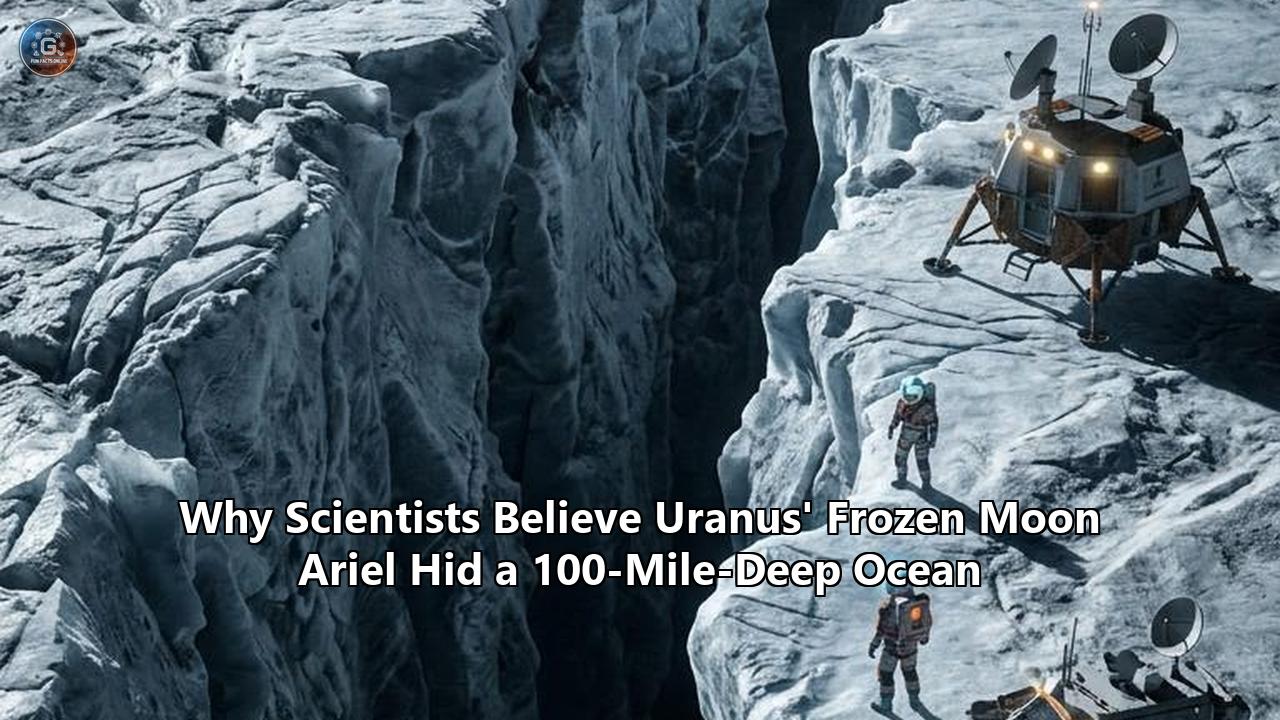
Planetary scientists analyzing the structural scars etched across Uranus’s moon Ariel have determined that the frozen world likely concealed an interior ocean more than 100 miles (170 kilometers) deep. The study, published in the planetary science journal Icarus by researchers from the University of North Dakota, the Planetary Science Institute, and the Johns Hopkins Applied Physics Laboratory (APL), demonstrates that Ariel’s intricate network of massive canyons, cracked ridges, and smooth volcanic plains could only have formed if the moon was once kneaded by fierce gravitational tides that melted its interior into a vast liquid layer.
The scale of this proposed reservoir challenges standard assumptions about small bodies in the outer solar system. Ariel measures just 720 miles (1,159 kilometers) across—a diameter roughly equal to the distance between Salt Lake City and Tucson. A subterranean ocean extending 100 miles downward means that liquid water once comprised nearly a third of the moon’s total radius. By comparison, Earth’s Pacific Ocean averages roughly 2.5 miles in depth. Proportionally, Ariel held an oceanic layer roughly 40 times deeper than Earth’s deepest ocean basin, encased within a body only one-tenth the diameter of Earth.
The discovery shifts our understanding of where liquid water can endure in deep space. Uranus orbits nearly 1.8 billion miles from the Sun, a frigid realm where surface temperatures hover around minus 350 degrees Fahrenheit (60 Kelvin). Sunlight at that distance is 400 times weaker than on Earth, offering no thermal energy to sustain open water. Yet the geological scars recorded on Ariel point to an internal heat engine driven by gravitational mechanics rather than solar radiance.
"Ariel is pretty unique in terms of icy moons," said study co-author Alex Patthoff, a senior scientist at the Planetary Science Institute. "Either Ariel harbored a massive ocean covered by a relatively thin ice shell, or a smaller ocean paired with stronger orbital stresses. But either way, we need an ocean to be able to create the fractures that we are seeing on Ariel's surface".
The findings build directly on recent modeling of Miranda—Ariel’s smaller neighboring moon—which similarly revealed evidence of a lost interior ocean. Together, the results suggest that Uranus’s satellite system may not be an assortment of inert ice balls, but rather a dynamic family of ocean worlds whose evolutionary history was shaped by orbital gymnastics and deep hydrochemistry.
The Scale of an Interior Sea
To grasp what a 100-mile-deep water layer means on a moon the size of Ariel, one must look at planetary architecture. Earth is a water-rich planet, but its oceans form a mere film on its rocky crust. Earth's hydrosphere represents less than 0.05 percent of its total mass and only 0.1 percent of its volume.
Ariel presents the opposite extreme. If an ocean spanned 100 miles (170 kilometers) beneath an exterior ice shell between 20 and 40 miles thick, water would account for a colossal proportion of the moon's overall mass and volume. Despite being smaller than Earth's Moon, Ariel could have contained hundreds of millions of cubic miles of liquid water—exceeding the liquid volume of all Earth’s oceans combined.
Cross-Sectional Architecture of Ancient Ariel (Hypothesized Model)

Surface: -350°F (-212°C) Vacuum
┌────────────────────────────────────────────────────────┐
│  BRITTLE ICE SHELL: 20–40 miles (30–60 km) thick       │  <- Extensional faulting & grabens
├────────────────────────────────────────────────────────┤
│                                                        │
│  SUBSURFACE LIQUID OCEAN: ~100 miles (170 km) deep     │  <- Rich in ammonia & dissolved salts
│  (Direct contact with silicate mantle; no dense ice)  │
│                                                        │
├────────────────────────────────────────────────────────┤
│  SILICATE ROCKY CORE: ~200–250 miles radius            │  <- Serpentinization & radiogenic heat
└────────────────────────────────────────────────────────┘
The physical conditions inside Ariel differ radically from those inside Jupiter's massive ocean-bearing moons, Ganymede and Callisto. Those moons are planetary titans, larger than the planet Mercury. Because of their immense mass, the hydrostatic pressure inside their deep layers is immense. At depths exceeding 100 miles on Ganymede, water is forced into exotic, dense crystalline states—such as Ice III, Ice V, and Ice VI—which sink to the bottom. Consequently, Ganymede’s liquid ocean is trapped in a frozen vice, sandwiched between normal ice above and high-pressure ice phases below, sealing the water off from the rocky floor.
Ariel possesses a surface gravity of just 0.27 meters per second squared—barely 3 percent of Earth's gravity. Because its gravitational pull is so gentle, internal pressure builds at a slow rate. At the floor of a 100-mile-deep ocean on Ariel, the hydrostatic pressure would only reach around 40 to 50 Megapascals (roughly 400 to 500 atmospheres of pressure).
At those modest pressures, water cannot freeze into dense high-pressure ice phases. Liquid water would have remained in direct, intimate contact with the moon’s silicate rocky core. In planetary science, direct water-rock interfaces are prime environments for astrobiology. They permit hydrothermal circulation, mineral leaching, and serpentinization reactions that release dissolved hydrogen, minerals, and chemical energy into the water column.
The Crime Scene: What Voyager 2 Left Behind
Every piece of physical imagery scientists possess of Ariel comes from a single afternoon: January 24, 1986. NASA’s Voyager 2 spacecraft, flying past the Uranian system at more than 40,000 miles per hour, executed a flyby that captured images of Ariel’s southern hemisphere.
Because Uranus was near its southern summer solstice during the 1986 encounter, its rotational axis was pointed almost straight at the Sun. The northern hemispheres of Uranus and its moons were cloaked in decades-long polar darkness, meaning Voyager 2 could map only 35 percent of Ariel’s total surface.
Even from that partial view, Ariel stood out as the most geologically altered of Uranus’s five major satellites. While moons like Umbriel and Oberon appeared ancient, dark, and littered with impact craters dating back 4 billion years, Ariel told a different story.
Voyager 2’s narrow-angle camera revealed a chaotic terrain sliced by an expansive global network of canyons, ridges, and scarps:
- Extensional Grabens: Massive rift valleys where tectonic forces pulled the moon’s icy shell apart, allowing central blocks of crust to drop downward. Some of these chasms measure up to 15 miles across and plunge more than 6 miles deep—dwarfing Earth's Grand Canyon.
- Ridge Systems: Long, parallel belts of deformed ice flanking the rift valleys, demonstrating horizontal crustal compression alongside extension.
- Smooth Resurfaced Plains: Vast stretches of terrain where ancient impact craters had been erased.
- Medial Grooves: Winding, trench-like features running right down the centers of the deepest canyon floors, filled with smooth material that appeared to have welled up as viscous slush before freezing.
Planetary geologists realized decades ago that Ariel had experienced widespread resurfacing and tectonic tearing. But because Ariel is small and distant, determining what powered that activity remained an enduring debate. Small icy bodies should lose their primordial formation heat quickly, freezing solid within a few hundred million years of their birth.
To explain why Ariel cracked wide open long after it should have cooled, researchers had to model the mechanics of its crust and orbit.
Mapping Tectonic Stresses to Uncover Hidden Water
The study led by Caleb Strom, a planetary scientist who carried out the work across the University of North Dakota and the Planetary Science Institute, utilized advanced numerical modeling to resolve the fracture puzzle.
Planetary crusts do not fracture at random. When an icy world is squeezed, stretched, or torqued by gravitational tides, stress fields accumulate throughout the brittle outer layer. If those stresses exceed the tensile or shear strength of the ice, the crust fails, creating fractures, strike-slip faults, and grabens whose orientations reflect the directions of the underlying forces.
Strom and his collaborators mapped every major tectonic feature visible in the Voyager 2 imaging mosaics of Ariel’s southern hemisphere. They logged the coordinates, orientations, widths, and lengths of dozens of grabens and scarps. Next, they constructed a geophysical computer model simulating how Ariel’s ice shell would deform under different orbital and interior scenarios.
       ORBITAL TIDAL FORCES
                 │
                 ▼
     CYLICAL CRUSTAL FLEXING
                 │
                 ▼
  ACCUMULATED MECHANICAL STRESS
                 │
                 ▼
       EXCEEDS 1.0 MPa LIMIT?
        │                │
       YES               NO
        │                │
        ▼                ▼
Extensional Faults   No Surface Cracks
 (Observed Grabens)   (Model Rejected)
The team tested two primary variables:
- Orbital Eccentricity: The degree to which Ariel’s path around Uranus deviated from a perfect circle. A circular orbit ($e = 0$) subjects a moon to a uniform gravitational pull. An eccentric, oval-shaped orbit constantly alters the distance between the moon and the planet, subjecting the satellite to cyclic stretching and squeezing.
- Interior Structure: Whether the moon was a completely frozen solid block of rock and ice, or whether it contained a mechanically decoupled shell floating over a liquid ocean.
The model yielded unambiguous mathematical outcomes. If Ariel had always been a solid, frozen sphere without a subsurface liquid layer, the gravitational tides exerted by Uranus could not produce stresses large enough to break the crust. Cryogenic water ice at temperatures below 100 Kelvin is as hard and brittle as granite. To rip that rock-solid ice crust apart and generate the observed fault networks, internal stresses had to reach approximately 1 Megapascal (MPa).
A completely frozen Ariel would have experienced stresses far below that 1 MPa threshold. Because a solid interior resists deformation, the surface would have barely flexed.
However, when the researchers introduced a liquid layer—an ocean decoupling the rocky core from the outer ice shell—the mechanical behavior transformed completely. With a liquid layer underneath, the icy shell was free to flex, stretch, and buckle in response to Uranus's gravity. The stress simulations matched the exact orientations, distribution, and geometry of the grabens observed by Voyager 2.
The simulations demonstrated that generating those stresses required an ancient Ariel moon ocean reaching up to 100 miles (170 kilometers) in depth, paired with an orbit roughly 40 times more eccentric than it is today.
The Mechanics of Tidal Flexing: Squeezing Heat from Gravity
Where did the heat come from to melt 100 miles of ice so far from the Sun? The answer lies in orbital mechanics and tidal dissipation.
Every moon orbiting a massive planet experiences a gravitational gradient. The side of Ariel facing Uranus feels a stronger gravitational pull than the side facing away. This differential pull stretches the moon into a slightly elongated shape—a tidal bulge.
If a moon moves along a perfectly circular orbit at a constant speed, this tidal bulge stays fixed in size and position. The moon becomes tidally locked, showing the same face to its host planet perpetually (just as Earth's Moon does). In this balanced state, tidal forces do not generate ongoing heat.
CIRCULAR ORBIT (Modern Ariel)
Distance is constant:
[Uranus] <──────── Fixed Distance ────────> (Ariel: Bulge is static, no tidal heat)

ECCENTRIC ORBIT (Ancient Ariel)
Apoapsis (Furthest point):
[Uranus] <──────────────── Long Distance ────────────────> (Ariel: Bulge relaxes / spherical)
Periapsis (Closest point):
[Uranus] <───── Short Distance ─────> (Ariel: Bulge stretched / football-shaped)
          ▲
          └─ Constant shape-shifting creates internal friction & melts ice
If the moon's orbit becomes eccentric (elliptical), the physics changes drastically:
- At Periapsis (closest approach): The moon speeds up, and the gravitational pull of Uranus intensifies. The tidal bulge is pulled outward, stretching the moon into an elongated, football-like shape.
- At Apoapsis (farthest approach): The moon slows down, and the gravitational pull weakens. The tidal bulge relaxes, and the moon springs back toward a more spherical shape.
As Ariel orbited Uranus every 2.5 days, its entire body was continuously stretched and squeezed. This cyclic deformation creates friction inside the moon’s interior—a phenomenon known as tidal dissipation.
Just as bending a metal paperclip back and forth repeatedly causes the joint to grow hot to the touch, gravitational kneading converted Ariel’s orbital energy into internal thermal energy.
The research team found that Ariel once possessed an orbital eccentricity of approximately 0.04. While 0.04 might seem like a small decimal, in orbital dynamics it is immense. Ariel’s modern orbital eccentricity is a nearly imperceptible 0.0012.
An eccentricity of 0.04 made ancient Ariel's orbit roughly 40 times more eccentric than it is today, and four times more eccentric than Jupiter’s moon Europa. Europa is famous for having an ocean kept liquid entirely by tidal flexing. Subjecting ancient Ariel to four times that orbital deformation would have unleashed tidal heating powerful enough to melt interior ice, thin the outer crust, and drive deep mantle convection.
The Orbital Dance: How Ariel Entered Resonance
Moons do not change their orbits on their own. For Ariel to have reached an orbital eccentricity of 0.04, it had to be pushed into that state by its neighbors.
Over hundreds of millions of years, moons slowly migrate outward from their parent planets due to tidal interactions, similar to how Earth's Moon drifts outward by roughly 1.5 inches each year. Because inner moons move faster than outer moons, migrating moons can catch up to one another in gravitational resonance.
A mean-motion orbital resonance occurs when two orbiting bodies have orbital periods that form an exact integer ratio—such as 2:1, 3:1, or 5:3. Every few orbits, the two moons align at the exact same point in space, delivering a periodic gravitational kick.
Mean-Motion Resonance Kick (e.g., 2:1 Resonance)

  Orbit 1: Moon A completes 2 laps while Moon B completes 1 lap
  Alignment: [Uranus] ─── (Inner Moon) ─────── (Outer Moon)
                               ▲                   ▲
                               └─ Gravitational ───┘
                                  Tug Every 2 Laps

  Result: Repeated gravitational tugs pump orbital eccentricity (e -> 0.04)
Planetary scientists believe that between 1 and 2 billion years ago, Ariel fell into a mean-motion resonance with one of its sister moons—most likely Miranda or Umbriel.
Each time Ariel and its neighbor passed one another, their mutual gravity gave Ariel an orbital nudge. These nudges accumulated over millions of orbits, stretching Ariel's circular path into an eccentric oval.
This orbital pumping initiated a runaway thermal process:
- The increasing eccentricity amplified tidal flexing.
- Tidal flexing generated heat, which began melting the deep ice layers into a nascent ocean.
- The appearance of a liquid ocean decoupled the shell, allowing the crust to deform far more easily.
- Increased flexing generated even more friction, causing the ocean to expand until it reached over 100 miles in depth.
Eventually, the orbital resonance broke. As tidal heating dissipated orbital energy, the moons shifted their relative positions until they slipped out of their resonant rhythm. Without the periodic gravitational nudges, Uranus’s tidal drag began circularizing Ariel's orbit once more.
As the eccentricity decayed toward its modern value of 0.0012, the tidal heat engine throttled down.
Antifreeze Chemistry and Cryovolcanic Resurfacing
Once tidal heating subsided, Ariel’s massive ocean should have started to freeze. But the chemical composition of the Uranian system introduced a crucial factor: natural antifreeze.
The outer solar system formed from a nebula rich in volatile chemicals, including water ($H_2O$), carbon dioxide ($CO_2$), methane ($CH_4$), and ammonia ($NH_3$). In 2023, a comprehensive modeling study led by Julie Castillo-Rogez of NASA’s Jet Propulsion Laboratory examined the interior makeup of Uranus's large moons. The work demonstrated that ammonia, chlorides, and salts were almost certainly incorporated into the moons during their initial accretion.
FREEZING POINT SUPPRESSION VIA CHEMICAL ANTIFREEZE

Pure Water (H2O):
Freezes at 32°F (0°C / 273 K)
─────────────────────────────────────────────

Water + Chlorides (Salts):
Freezes at ~-6°F (-21°C / 252 K)
─────────────────────────────────────────────

Water + Ammonia (NH3 Eutectic Mixture):
Remains liquid down to -143°F (-97°C / 176 K)
─────────────────────────────────────────────
Ammonia is a potent freezing point depressant. A mixture of water and ammonia at eutectic concentrations remains completely liquid down to minus 143 degrees Fahrenheit (176 Kelvin)—nearly 175 degrees colder than the freezing point of pure water.
The presence of dissolved salts and ammonia fundamentally alters an ocean's lifespan. Instead of freezing solid as soon as tidal flexing dwindled, an ammonia-rich Ariel moon ocean would have remained liquid over extended geologic epochs, cooling at a much slower rate.
This chemical mixture also provides the driving force for cryovolcanism—ice volcanism.
When water freezes, it expands by roughly 9 percent in volume because ice crystals possess a lower density than liquid water. As Ariel’s 100-mile-deep ocean slowly froze from the outer ice shell inward, the freezing water expanded inside an enclosed sphere. This expansion exerted immense hydraulic pressure on the remaining liquid below.
The pressurization forced briny, ammonia-rich liquid—often referred to as cryomagma—upward through the deep extensional faults created by tidal flexing.
When this icy slurry reached the surface, it poured out into the canyon bottoms. The smooth, crater-free floors of Ariel’s grabens and the broad, flat plains observed by Voyager 2 are the frozen remnants of cryolava flows. Over time, these eruptions covered older impact craters and paved the valley floors with fresh ice.
Recent observations by modern space observatories reinforce this chemical picture. Data collected by the James Webb Space Telescope (JWST) and ground-based spectrographs have detected significant deposits of carbon dioxide ice, carbon monoxide, and ammoniated species concentrated on Ariel's surface.
Because cosmic radiation and magnetospheric ions rapidly break down exposed ammonia and organic molecules in space, finding them on Ariel today indicates that these compounds arrived on the surface in geologically recent times—either through late-stage cryovolcanic venting or recent exposure along active fault lines.
The Miranda Connection: Twin Ocean Worlds
The new findings regarding Ariel do not stand in isolation. They form part of an emerging reassessment of the entire Uranian moon system.
In late 2024, the same team of researchers—Strom, Patthoff, and Tom Nordheim of the Johns Hopkins Applied Physics Laboratory—published a study detailing the tectonic history of Miranda. Miranda is the smallest and innermost of Uranus’s five major satellites, measuring only 290 miles (470 kilometers) in diameter.
Voyager 2 revealed that Miranda has one of the most rugged, bizarre landscapes in the solar system, dominated by massive, trapezoidal terrains called "coronae" crisscrossed by giant fault canyons up to 12 miles deep.
Strom's team demonstrated that Miranda's dramatic features were caused by an ancient subsurface ocean that existed roughly 100 to 500 million years ago, sustained by an orbital resonance with Umbriel or Ariel.
"We are finding evidence that the Uranus system may harbor twin ocean worlds," said Tom Nordheim, a space scientist at APL and principal investigator of the research project.
Uranus's Primary Inner Moon System (Comparative Radii & Status)

Moon       Diameter       Past Ocean Evidence               Antifreeze Indicators
────────────────────────────────────────────────────────────────────────────────────────
Miranda    290 miles      Confirmed (Coronae stress models)  Ammonia/hydrated salts
Ariel      720 miles      Confirmed (100-mile-deep model)    CO2 ice, ammonia deposits
Umbriel    727 miles      Under Study (Thermal models)       Dark organic carbon coatings
Titania    980 miles      Under Study (Radiogenic retained)  Endogenous CO2 release
Oberon     946 miles      Under Study (Radiogenic retained)  Extensional faults
If both Miranda and Ariel hosted deep liquid layers, it implies that orbital resonances swept through the Uranian system, systematically activating interior oceans across multiple moons at different times.
Furthermore, because Ariel is much larger than Miranda (having roughly 15 times Miranda's mass), it was far better equipped to retain heat. While Miranda’s ocean likely froze completely once its resonance ended, scientists cannot yet rule out whether a remnant of the Ariel moon ocean survives today.
If Ariel accreted sufficient concentrations of ammonia and salts, and if its silicate rocky core continues to generate warmth through radioactive decay of uranium, thorium, and potassium, a thin, hyper-saline liquid layer may still persist at the base of its icy crust.
Astrobiological Implications: Expanding the Habitable Zone
For decades, the search for life beyond Earth was constrained by the concept of the circumstellar habitable zone—the "Goldilocks Zone." This is the orbital band around a star where solar radiation is just right to keep liquid water stable on a planet's surface.
The exploration of the outer solar system has shown that definition to be incomplete. Moons like Jupiter's Europa and Saturn's Enceladus demonstrated that tidal forces can maintain habitable oceans billions of miles outside the solar habitable zone.
Ariel takes that lesson a step further. Unlike Europa and Enceladus, which orbit massive gas giants (Jupiter and Saturn) that generate ferocious tidal forces, Ariel orbits an ice giant. Uranus has only 14.5 times the mass of Earth—far less massive than Saturn (95 Earth masses) or Jupiter (318 Earth masses).
Discovering that an ice giant with modest mass can still drive enough tidal energy to melt an ocean 100 miles deep reshapes the conditions required for astrobiological habitats.
To evaluate the habitability of the ancient Ariel ocean, scientists assess three primary criteria:
1. Liquid Water
The mathematical models confirm that liquid water was present in immense quantities. For hundreds of millions of years, an ocean exceeding the depth of any marine trench on Earth decoupled Ariel's outer shell from its core.
2. Chemical Ingredients
Ariel accreted from the cold outer solar nebula, where carbon, nitrogen, oxygen, phosphorus, and sulfur condensed into solid ices and dust grains. JWST detections of carbon-bearing molecules and ammonia ice on Ariel's surface prove that the fundamental building blocks of organic chemistry were present within the system.
3. Usable Energy Sources
Because sunlight could never penetrate a 20-mile-thick ice shell, life in an interior ocean relies entirely on chemical energy (chemotrophy). On Ariel, this energy would have emerged at the ocean floor. Because the low hydrostatic pressure permitted liquid water to circulate directly through the warm silicate mantle, serpentinization reactions would have oxidized iron-rich rocks, releasing heat, molecular hydrogen ($H_2$), and methane—the same biochemical fuel that supports microbial life at hydrothermal vents in Earth’s deep ocean floor.
While researchers do not yet have evidence that life ever emerged on Ariel, the physical and chemical conditions present during its high-eccentricity phase met the core prerequisites that planetary scientists look for when screening ocean worlds for habitability.
The Next Step: Exploring the Ice Giant
Validating whether the Ariel moon ocean has entirely frozen or still retains a liquid layer will require visiting Uranus directly.
Humanity has flown past Uranus only once, for mere hours, nearly four decades ago. Every conclusion drawn about the planet and its moons relies on low-resolution 1980s data, space telescope spectroscopy, and computer simulations.
"Ultimately, we just need to go back to the Uranus system and see for ourselves," Nordheim noted.
Instruments Planned for a Uranus Orbiter to Study Ariel

[ Magnetometer ]
Measures induced secondary magnetic fields generated by a salty, conductive ocean
       │
[ Ice-Penetrating Radar ]
Beams high-frequency radio waves through the crust to detect the ice-water interface
       │
[ Radio Science / Gravity Mapping ]
Tracks micro-Doppler shifts in the spacecraft's signal to measure tidal bulge flexing
       │
[ High-Resolution Stereo Imaging ]
Maps the unseen northern hemisphere and measures fault slip geometries
       │
[ Neutral & Ion Mass Spectrometer ]
Sniffs exospheric vapors or plumes venting from surface fissures
The planetary science community has formally recognized this imperative. In the National Academies of Sciences, Engineering, and Medicine’s Origins, Worlds, and Life: Planetary Science and Astrobiology Decadal Survey 2023–2032, scientists ranked the Uranus Orbiter and Probe (UOP) as NASA’s highest-priority new Flagship mission.
The recommended mission architecture envisions a dedicated orbiter accompanied by an atmospheric probe to drop into Uranus’s cloud decks. Over a planned multi-year orbital tour, the spacecraft would make repeated close flybys of the major moons, including Ariel.
A modern spacecraft could settle the question of Ariel’s ocean using several complementary techniques:
1. Induced Magnetic Field Detection
This was the technique used by NASA’s Galileo spacecraft to prove the existence of Europa's ocean. Uranus possesses an unusual magnetic field: it is tilted 59 degrees away from the planet’s rotational axis and is offset from the planet’s physical center by a third of its radius.
As Uranus rotates every 17 hours, its magnetic field sweeps past Ariel in an asymmetrical, oscillating wave. If Ariel contains a liquid ocean of salty, conductive water, that sweeping magnetic field will induce electrical currents within the sea. Those currents, in turn, will generate a secondary, induced magnetic field that a magnetometer on an orbiting spacecraft can detect. A solid, frozen moon cannot produce this distinct magnetic echo.
2. Ice-Penetrating Radar Sounding
Similar to the REASON instrument flying aboard NASA’s Europa Clipper mission, a radar sounder could transmit high-frequency radio waves directly down through Ariel’s icy crust. Radio waves travel easily through cold, clean water ice but reflect strongly when they encounter a boundary with liquid water. Radar data would directly measure the thickness of the ice shell and pinpoint the exact depth of any surviving water table.
3. Laser Altimetry and Gravity Science
By measuring subtle Doppler shifts in the radio transmissions between the spacecraft and Earth during close flybys, mission scientists can map Ariel’s gravity field with millimetric precision. Combining gravity data with laser altimeter scans of the moon’s topography would reveal how much Ariel's crust flexes during its orbit, providing a direct measurement of the interior structure’s rigidity.
4. Exploring the Unseen Northern Hemisphere
Voyager 2 saw only the southern hemisphere, leaving the northern half of Ariel completely unmapped. Because Uranus takes 84 Earth years to orbit the Sun, seasons in the Uranian system are prolonged, with each pole enduring 42 years of continuous sunlight followed by 42 years of continuous darkness.
Alex Patthoff emphasized the importance of launch timing for any future flagship mission: arriving during a Uranian equinox—when both the northern and southern hemispheres receive sunlight—would allow cameras to map the entire globe. Mapping the northern hemisphere will determine whether the rift systems form a true global network, testing the predictions made by Strom’s tidal stress models.
A Window into the Most Common Worlds in the Galaxy
The realization that Ariel once hosted a 100-mile-deep ocean extends far beyond our solar system.
Over the past two decades, exoplanet surveys conducted by space observatories like Kepler and TESS have discovered thousands of planets orbiting other stars. The single most common type of exoplanet identified in our galaxy is not a rocky world like Earth or a gas giant like Jupiter, but an intermediate class: planets between 1.5 and 4 times Earth's radius, commonly categorized as mini-Neptunes and ice giants.
Distribution of Exoplanet Sizes Across the Galaxy

[ 1x Earth Radius ]       Rocky Terran Worlds (Moderately Common)
[ 1.5x - 4x Earth Radius] ICE GIANTS & SUB-NEPTUNES (Most Common in Galaxy)
[ 10x Earth Radius ]      Gas Giants / Jupiters (Relatively Rare)
The solar system’s ice giants—Uranus and Neptune—are our closest local analogs to the galaxy's most common planetary population.
If modest ice giants routinely possess moon systems that develop deep interior oceans through orbital resonances, then hidden oceans may be far more numerous throughout the Milky Way than surface oceans like Earth’s. Subsurface seas protected by miles of insulating ice are shielded from stellar flares, atmospheric stripping, and radiation hazards that threaten surface environments.
The evidence pointing to a massive, long-lost ocean inside Ariel shows that worlds on the solar system’s outer edge were not always frozen in silence. They were shaped by dynamic orbital interactions, fractured by tidal forces, and thawed from within by gravitational energy.
As mission planners chart trajectories for humanity's return to Uranus, Ariel has transformed from a dim, frozen crescent in a 1986 photograph into one of the most compelling targets for exploration in the outer solar system.
Reference:
- https://scitechdaily.com/we-need-to-go-back-uranus-moon-may-have-harbored-a-colossal-100-mile-deep-ocean/
- https://www.space.com/astronomy/uranus/a-hidden-ocean-may-have-once-existed-on-uranus-moon-ariel
- https://mashable.com/article/uranus-moon-ariel-deep-ocean
- https://www.reddit.com/r/spaceporn/comments/1nu6by5/scientists_just_announced_evidence_of_a_past_deep/
- https://www.seti.org/news/the-hidden-ocean-of-ariel-tidal-forces-and-the-case-for-a-watery-past/
- https://www.facebook.com/spacecom/posts/scientists-believe-a-moon-of-uranus-may-have-once-had-a-subsurface-ocean/1159006202756729/
- https://www.nasa.gov/centers-and-facilities/jpl/new-study-of-uranus-large-moons-shows-4-may-hold-water/