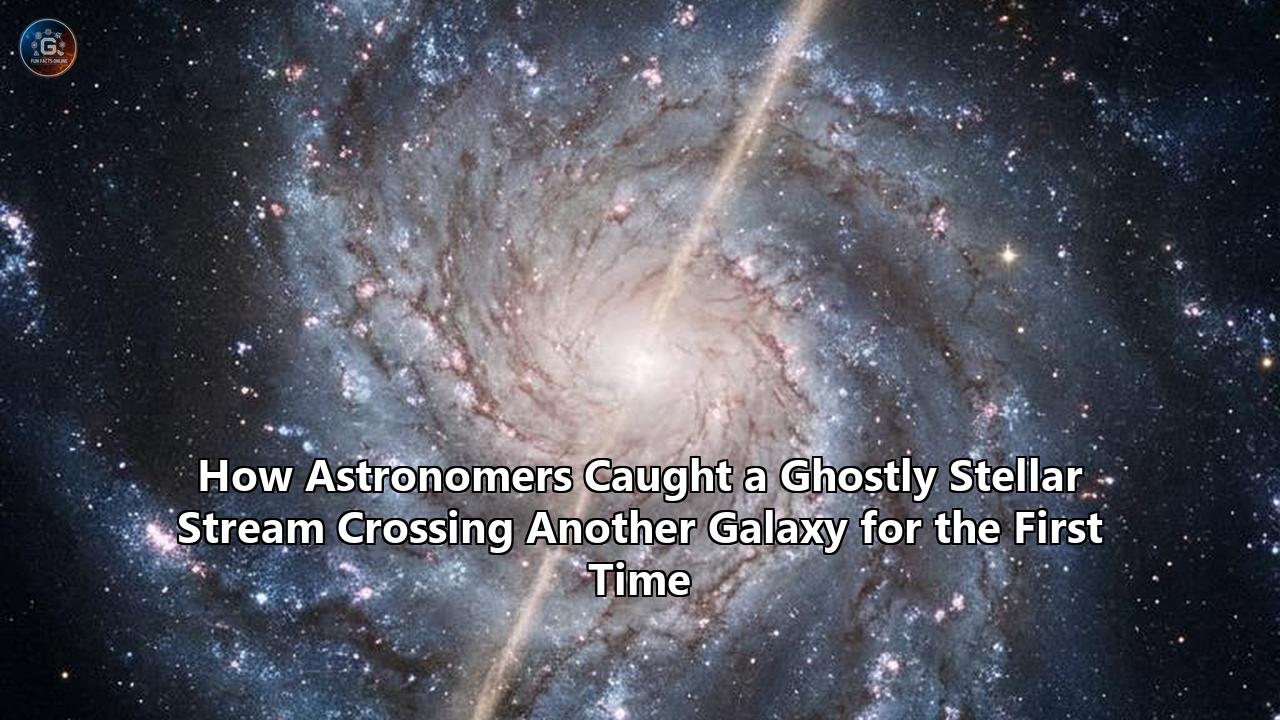
On August 12, 2026, an international team of astrophysicists published findings in Nature confirming the first-ever detection of a globular cluster stellar stream crossing an external galaxy. Located approximately 115 million light-years from Earth in the ultra-diffuse galaxy UGC 9050-Dw1, the faint, coherent arc of stars measures roughly two kiloparsecs in length. For decades, tidal ribbons generated by the slow gravitational destruction of star clusters had only been observed within the immediate confines of the Milky Way and its closest neighbors. By piercing through the observational barrier that previously kept extragalactic star streams hidden, the discovery provides empirical proof that these fragile structures can survive in external galaxies and act as direct gravitational probes of distant dark matter.
The observation, co-led by Julie Kiel Holm of the Niels Bohr Institute at the University of Copenhagen and Sarah Pearson of DTU Space at the Technical University of Denmark, resolves a persistent roadblock in galactic dynamics. Until now, astrophysics has suffered from a single-galaxy sample bias: the laws governing the disruption of star clusters, the clumping of dark matter subhalos, and the tidal fields of galactic halos were calibrated almost entirely on Milky Way data. The detection in UGC 9050-Dw1 demonstrates that the field of stellar stream detection can finally operate on extragalactic scales, opening a new pathway to weigh invisible halos and test fundamental physics across diverse cosmic environments.
+-----------------------------------------------------------------------------+
|                          KEY DISCOVERY METRICS                              |
+-----------------------------------------------------------------------------+
| Host System           | UGC 9050-Dw1 (Ultra-Diffuse Galaxy)                 |
| Distance from Earth   | ~115 million light-years (~35 Megaparsecs)          |
| Stream Progenitor     | Dissolving Globular Cluster                         |
| Stream Physical Span  | ~2 kiloparsecs (~6,500 light-years)                 |
| Primary Data Source   | Hubble Space Telescope (ACS / WFC3 Archival Data)   |
| Independent Validation| Canada-France-Hawaii Telescope (CFHT)               |
| Inferred Halo Mass    | ~10^10 to 10^11 Solar Masses (Dark Matter Dominated)|
| Published In          | Nature (August 12, 2026)                            |
+-----------------------------------------------------------------------------+
The Challenge: The Single-Galaxy Sample Bias and the Dark Matter Dilemma
The fundamental problem confronting modern near-field cosmology is not a lack of theoretical models, but a severe limitation in observational diversity. For nearly a century, since Fritz Zwicky first postulated the existence of missing mass in the Coma Cluster and Vera Rubin confirmed flat galactic rotation curves, astronomers have understood that visible baryonic matter makes up less than 15% of the total matter in the universe. The remaining 85% is dark matter—a collisionless, non-luminous substance whose distribution governs the formation and evolution of every galaxy.
To test the leading cosmological model, known as Lambda Cold Dark Matter ($\Lambda\text{CDM}$), researchers need ultra-sensitive gravitational dynamometers. Standard rotation curves and velocity dispersion measurements provide coarse estimates of a galaxy’s total mass, but they lack the structural precision required to map the three-dimensional geometry of dark matter halos or detect the tiny dark clumps predicted by theory.
                  THE PROBLEM-SOLUTION TRAJECTORY

+-------------------------------------------------------------+
|                        THE CHALLENGE                        |
|  - Single-galaxy bias: Models restricted to the Milky Way   |
|  - Extreme faintness: Streams dimmer than night-sky limits  |
|  - Dark matter ambiguities in Ultra-Diffuse Galaxies (UDGs) |
+------------------------------+------------------------------+
                               |
                               v
+-------------------------------------------------------------+
|                       THE SYSTEM CRISIS                     |
|  - Galactic noise: Milky Way disc disrupts stream coherence |
|  - Resolution limits: External stars blend into diffuse glow|
|  - Instrument limits: Narrow field-of-view telescopes       |
+------------------------------+------------------------------+
                               |
                               v
+-------------------------------------------------------------+
|                    THE NOVEL BREAKTHROUGH                   |
|  - Discovery in UGC 9050-Dw1 using archival Hubble data     |
|  - Low-background contrast of an Ultra-Diffuse Galaxy       |
|  - Dynamical modeling with X-Stream potential sampler       |
+------------------------------+------------------------------+
                               |
                               v
+-------------------------------------------------------------+
|                   THE SCALABLE SOLUTIONS                    |
|  - Wide-field space telescopes: Roman & Euclid              |
|  - High-cadence ground observatories: Vera C. Rubin (LSST)  |
|  - AI-driven automated stream-finding algorithms            |
+-------------------------------------------------------------+
The Limitations of Milky Way Tracers
Over the past two decades, astronomers turned to stellar streams inside the Milky Way as the ultimate precision tools. When a dense globular cluster—composed of hundreds of thousands of gravitationally bound stars—orbits a host galaxy, the galaxy’s tidal forces slowly pull stars away from the cluster at its outer Lagrange points ($L_1$ and $L_2$). Escaped stars drift into lead and trail orbits that trace nearly identical paths through space. Because these stars share nearly the same energy and angular momentum, they form long, razor-thin ribbons that wrap around the galaxy.
These ribbons act as natural cosmic accelerometers. Any asymmetry in the host galaxy’s gravitational field, any flattening of its dark matter halo, or any encounter with an invisible dark matter subhalo leaves an indelible structural scar on the stream:
- Curvature and Precession: Traces the overall depth, flattening, and triaxial shape of the host galaxy's dark matter halo.
- Stream Gaps and Underdensities: Pinpoints where an unseen dark matter subhalo punched through the stellar ribbon.
- Stellar Spurs and Off-Axis Kinks: Marks the gravitational deflection of stars caused by close-range subhalo flybys.
- Velocity Dispersion Spread: Reveals the mass and density profile of the dissolving progenitor cluster.
However, relying entirely on the Milky Way creates severe scientific risks. The Milky Way is an active, dynamically complex barred spiral galaxy. Its rotating stellar bar, churning spiral arms, and dense interstellar gas clouds inject massive gravitational perturbations that scatter stellar streams over time. When an astronomer identifies a gap in a Milky Way stream such as GD-1 or Palomar 5, it is exceedingly difficult to determine whether the disturbance was caused by a genuine dark matter subhalo or merely by a chaotic encounter with a giant molecular cloud or a galactic bar resonance.
Furthermore, testing $\Lambda\text{CDM}$ requires observing how dark matter behaves across different galactic morphologies—from giant ellipticals to dwarfs and low-surface-brightness systems. By restricting thin stellar stream analysis to our own galactic backyard, cosmologists have been forced to draw universal conclusions from a sample size of one.
The Enigma of Ultra-Diffuse Galaxies
The need for external dynamic tracers is acute in Ultra-Diffuse Galaxies (UDGs). Discovered in large numbers over the past decade in clusters such as Coma and Virgo, UDGs are dwarf-mass systems with physical sizes as broad as the Milky Way, yet they contain only a tiny fraction of our galaxy's stars. Their existence sparked intense debate within astrophysics:
- "Failed Milky Ways": Systems that formed inside massive, standard dark matter halos ($M_{\text{halo}} \sim 10^{11}–10^{12} M_\odot$) but lost their star-forming gas early in cosmic history, leaving an ultra-faint stellar population inside an enormous dark matter envelope.
- "Puffed-Up Dwarfs": Genuine dwarf galaxies ($M_{\text{halo}} \sim 10^9–10^{10} M_\odot$) whose stars were structurally expanded by internal feedback mechanisms, such as repeated supernova outbursts, or mild tidal heating.
- "Dark-Matter-Free Galaxies": Anomalous systems like NGC 1052-DF2 and DF4, where velocity dispersion measurements suggested an almost complete absence of dark matter, challenging standard galaxy formation paradigms.
Resolving this controversy required a reliable, direct way to measure the gravitational potential inside UDGs. Yet because these systems possess so few stars, standard spectroscopic velocity mapping suffers from huge statistical uncertainties. Astronomers needed a coherent dynamical tracer inside an external UDG—a requirement that appeared technologically out of reach until now.
The Observational Impasse: Why Extragalactic Streams Evaded Detection
To understand why this discovery took decades to achieve, one must examine the physics of astronomical surface brightness and the limits of modern detectors.
+-----------------------------------------------------------------------------+
|                  SURFACE BRIGHTNESS COMPARISON LANDSCAPE                     |
+-----------------------------------------------------------------------------+
| Structure / Feature                   | Surface Brightness (mag/arcsec^2)   |
+---------------------------------------+-------------------------------------+
| Typical Spiral Galaxy Center          | ~18.0 - 20.0                        |
| Darkest Night Sky (Ground Telescopes) | ~22.0 - 22.5 (V-band)               |
| Milky Way Disc Edge                   | ~25.0 - 26.0                        |
| Dwarf Galaxy Tidal Plumes / Tails     | ~26.5 - 28.5                        |
| Ultra-Diffuse Galaxy Background       | ~27.0 - 29.0                        |
| Globular Cluster Stellar Streams      | ~30.0 - 33.5 (Extremely Faint)      |
+-----------------------------------------------------------------------------+
When a dwarf galaxy undergoes tidal disruption, it deposits hundreds of millions of stars across a wide swath of space, producing thick tidal tails with surface brightnesses typically ranging between 26 and 28.5 magnitudes per square arcsecond ($mag/\text{arcsec}^2$). Giant structures of this type, such as the loops around NGC 5907 or the recently discovered 1.7-million-light-year Giant Coma Stream, involve enormous quantities of stellar mass.
In contrast, a globular cluster contains only $10^4$ to $10^6$ stars. When those stars are drawn out into a narrow orbital trail several kiloparsecs long, the resulting stellar stream has an integrated surface brightness between 30 and 34 $mag/\text{arcsec}^2$.
Surface brightness in astronomy is expressed logarithmically:

  \mu = m + 2.5 \log_{10}(A)

Where:
  \mu = Surface brightness in magnitudes per square arcsecond
  m   = Integrated apparent magnitude of the source
  A   = Angular area of the source on the sky in square arcseconds
Because this scale is logarithmic, a feature at 32 $mag/\text{arcsec}^2$ is roughly 10,000 times fainter than the natural background light of the night sky measured from the best ground-based observatories on Earth (which typically hovers around 22 $mag/\text{arcsec}^2$ in the optical V-band).
The Fourfold Observational Barrier
Capturing an extragalactic globular cluster stream requires overcoming four major physical hurdles:
                      THE FOURFOLD OBSERVATIONAL BARRIER

     [ 1. Distance & Resolution ]        [ 2. Background Contrast ]
     Individual stars blur into a        Host galaxy starlight drowns out
     continuous, ultra-faint streak      faint tidal features (>30 mag/arcsec²)
                  \                                    /
                   \                                  /
                    +--------------------------------+
                    |    EXTRAGALACTIC DETECTION     |
                    |           IMPASSE              |
                    +--------------------------------+
                   /                                  \
                  /                                    \
     [ 3. Point Spread Scattering ]      [ 4. Galactic Cirrus & Noise ]
     Instrumental glare and PSF wings    Milky Way dust reflections mimic
     create false stellar artifacts      external low-surface structures
1. The Distance and Unresolved Star Problem
Within the Milky Way, stellar stream detection relies on identifying individual stars via astrometry and color-magnitude filtering using space missions like ESA's Gaia. Astronomers isolate stream members by matching their precise parallaxes, proper motions, and positions on the Hertzsprung-Russell diagram.
At a distance of 115 million light-years (35 Megaparsecs), even the brightest red giant stars cannot be individually isolated with reasonable exposure times. The entire stellar stream merges into an unresolved, continuous surface brightness anomaly that spans only a few fractions of an arcsecond across the focal plane.
2. Host Galaxy Stellar Background Glare
In standard elliptical or spiral galaxies, the inner stellar halo and disc emit an overwhelming bath of background light. A faint stream with a surface brightness of 31 $mag/\text{arcsec}^2$ superimposed against a galactic disc glowing at 22 $mag/\text{arcsec}^2$ represents a signal-to-noise contrast problem of less than 0.1%. Subtraction of the galaxy's light profile inevitably leaves residual errors that completely mask the stream.
3. Point Spread Function (PSF) Scatter
Telescope optics and atmospheric turbulence scatter light from bright foreground stars and galactic cores into wide optical wings, governed by the instrument's Point Spread Function (PSF). In deep exposures, the scattered light from a 12th-magnitude foreground star can create faint, extended optical halos and radial spikes that closely mimic the appearance of a thin stellar stream, leading to high rates of false-positive detections.
4. Galactic Cirrus Contamination
Interstellar dust clouds located inside our own Milky Way, known as galactic cirrus, reflect the collective optical light of the Milky Way disc. These diffuse, filamentary structures appear across high galactic latitudes with surface brightnesses between 26 and 30 $mag/\text{arcsec}^2$. Distinguishing an extragalactic stellar ribbon at 35 Megaparsecs from a foreground wisps of Milky Way dust requires complex multi-band infrared and optical cross-matching.
The Breakthrough: How UGC 9050-Dw1 Cracked the Code
The discovery of the extragalactic stream in UGC 9050-Dw1 occurred when researchers took advantage of a unique astrophysical scenario: an ultra-diffuse galaxy providing an exceptionally dark canvas.
Archival Sleuthing and Independent Confirmation
The discovery originated from an exhaustive re-examination of high-resolution archival imaging obtained by the Hubble Space Telescope’s Advanced Camera for Surveys (ACS) and Wide Field Camera 3 (WFC3). Astronomers David Sand and Catherine Fielder of the University of Arizona, working in collaboration with David Hendel, were analyzing the structural parameters of dwarf systems when Hendel identified a faint, narrow, curvilinear structure extending across the body of UGC 9050-Dw1.
+-----------------------------------------------------------------------------+
|                UGC 9050-Dw1 DISCOVERY: KEY OBSERVATIONAL PHASES             |
+-----------------------------------------------------------------------------+
| Phase 1: Archival Identification                                            |
|   - Hubble Space Telescope (ACS/WFC3) optical imaging reveals a thin,        |
|     continuous arc stretching across UGC 9050-Dw1.                          |
|                                                                             |
| Phase 2: Artifact & Cirrus Elimination                                      |
|   - Cross-referencing against independent imaging from the Canada-France-   |
|     Hawaii Telescope (CFHT) on Mauna Kea.                                   |
|   - Color index analysis (g-r / V-I) rules out foreground cirrus, detector  |
|     charge bleed, diffraction spikes, and background high-z mergers.        |
|                                                                             |
| Phase 3: Progenitor Identification                                          |
|   - Detection of a compact, partially disrupted globular cluster core at     |
|     the apex of the leading and trailing arms.                              |
|                                                                             |
| Phase 4: Dynamical Orbit Modeling                                           |
|   - Execution of the X-Stream Bayesian potential engine to map stream       |
|     curvature directly to the dark matter halo potential \Phi(r).           |
+-----------------------------------------------------------------------------+
To verify that this faint structure was not an optical artifact, cosmic ray residual, or background lensed galaxy, the team obtained independent ground-based imaging from the Canada-France-Hawaii Telescope (CFHT) atop Mauna Kea. The stream was clearly visible in both datasets, matching in morphology, position angle, and photometric color.
"When we started to realize that we had found a globular cluster stellar stream beyond our galaxy, it was very exciting," said co-lead author Julie Kiel Holm of the Niels Bohr Institute. "And then we sort of looked at each other and asked, 'Where do we go from here?'"
                                  HST ACS/WFC3
                                [Archival Data]
                                       |
                                       v
                     +-----------------------------------+
                     | Visual Detection of Narrow Arc in |
                     |           UGC 9050-Dw1            |
                     +-----------------------------------+
                                       |
                                       +-----------------------+
                                       |                       |
                                       v                       v
                        +----------------------+    +----------------------+
                        | CFHT Ground Imaging  |    | Multi-band Color     |
                        | (Independent Check)  |    | Diagnostics (g-r/V-I)|
                        +----------------------+    +----------------------+
                                       |                       |
                                       +-----------+-----------+
                                                   |
                                                   v
                                    +------------------------------+
                                    | Confirmed: Real Globular     |
                                    | Cluster Stream at ~35 Mpc    |
                                    +------------------------------+
The Low-Surface-Brightness Advantage
The critical factor enabling this detection was the host galaxy itself. UGC 9050-Dw1 is an ultra-diffuse galaxy. Because its stars are spread thinly across thousands of light-years, its central surface brightness is exceptionally low ($\mu_V \sim 27.5\text{ mag/arcsec}^2$).
In a standard spiral galaxy, the dense glow of millions of disc and bulge stars would have obliterated the fragile signal of the stream. But in UGC 9050-Dw1, the galaxy’s sparse stellar population functioned as a semi-transparent, dark background. The stream stood out with enough contrast for researchers to track its trajectory, map its width, and pinpoint the dissolving globular cluster progenitor that was actively shedding stars.
"At the same time, these ultra-diffuse galaxies are thought to be very massive, and you need to be massive in order to actually pull out stars from that parent cluster," explained co-lead author Sarah Pearson of DTU Space. The survival and morphology of the stream proved that the host galaxy possessed sufficient gravitational force to execute tidal stripping while maintaining a low-density background that made the structure visible to space-based optics.
Dynamical Forensics: Reconstructing the Invisible Dark Matter Halo
Once the stellar stream was confirmed, the research team transformed the observational image into a laboratory for gravitational physics. Because stars stripped from a cluster travel along nearly the same orbital trajectory, a stellar stream provides an integrated history of the gravitational forces that governed its motion over hundreds of millions of years.
                 TIDAL STRIPPING AND STREAM GENERATION

                           Leading Arm (Lower Energy)
                             <------- * * * * *
                                              \
                                   +--------+  \
             Host Galaxy Center <--| Cluster|---x  (Lagrange Point L2)
                                   +--------+    \
                                              * * * * * ------>
                                            Trailing Arm (Higher Energy)
The Mathematics of Tidal Stripping
As a globular cluster of mass $M_c$ orbits within the gravitational potential $\Phi_{\text{host}}(r)$ of a host galaxy at a distance $r$, its outer stars experience a combination of the cluster's internal gravitational pull, the host galaxy's tidal field, and centrifugal forces. The boundary where the cluster can no longer retain its stars is defined by its Jacobi radius (or tidal radius) $r_J$:
r_J \approx r \left( \frac{M_c}{3 M_{\text{host}}(<r)} \right)^{1/3}When stars inside the cluster drift beyond $r_J$ through the Lagrange points $L_1$ (facing the galactic center) and $L_2$ (facing away from the galactic center), they escape into the host galaxy's potential:
- $L_1$ Escapers: Lose angular momentum relative to the cluster, falling into a slightly tighter, faster orbit ahead of the progenitor, forming the leading arm.
- $L_2$ Escapers: Gain angular momentum, moving into a slightly wider, slower orbit behind the progenitor, forming the trailing arm.
Because the energy dispersion $\Delta E$ of the escaping stars is exceptionally small—governed by the cluster’s internal velocity dispersion $\sigma_v \sim 1–5\text{ km/s}$—the stars remain locked within an ultra-thin orbital tube for multiple orbital periods.
\Delta E \approx \left. \frac{\partial \Phi}{\partial r} \right|_{r_c} r_J \approx \frac{G M_{\text{host}}(<r_c)}{r_c^2} r_JThis narrow energy distribution means that any physical curvature, width broadening, or deflection along the stream maps directly back to the gradient of the gravitational potential $\nabla \Phi(r)$.
The X-Stream Modeling Architecture
To extract the physical properties of UGC 9050-Dw1 from the observed arc, the researchers utilized X-Stream, an advanced Bayesian inference and orbit-fitting computational sampler. The software generates millions of synthetic stellar streams across parameter spaces containing varying:
- Total Halo Mass ($M_{200}$): The mass enclosed within a sphere where the mean density is 200 times the critical density of the universe.
- Halo Concentration ($c$): The ratio of the virial radius $r_{200}$ to the scale radius $r_s$ in a standard Navarro-Frenk-White (NFW) dark matter profile.
- Halo Geometry / Triaxiality ($q_x, q_y, q_z$): The axial ratios determining whether the dark matter distribution is spherical, oblate, or prolate.
- Orbital Eccentricity and Incline ($e, i$): The kinematic parameters of the dissolving cluster.
+-----------------------------------------------------------------------------+
|                      X-STREAM SIMULATION WORKFLOW                           |
+-----------------------------------------------------------------------------+
|                                                                             |
|   +-----------------------+           +---------------------------------+   |
|   | Prior Halo Parameters |           | Observed Stream Geometry (HST)  |   |
|   |  - M_200, c, q_z/q_x  |           |  - Arc length: ~2 kpc           |   |
|   |  - Progenitor M_c     |           |  - Width & Curvature Path       |   |
|   +-----------+-----------+           +----------------+----------------+   |
|               |                                        |                    |
|               v                                        |                    |
|   +-----------------------+                            |                    |
|   | N-Body Orbit Engine   |                            |                    |
|   | (Streak Generation)   |                            |                    |
|   +-----------+-----------+                            |                    |
|               |                                        |                    |
|               v                                        |                    |
|   +-----------------------+                            |                    |
|   | Synthetic Stream Mesh | <--------------------------+                    |
|   +-----------+-----------+                                                 |
|               |                                                             |
|               v                                                             |
|   +-----------------------+                                                 |
|   | MCMC Likelihood Eval  |                                                 |
|   | (P(Data | Parameters))|                                                 |
|   +-----------+-----------+                                                 |
|               |                                                             |
|               v                                                             |
|   +-------------------------------------------------------------+           |
|   | Output Posterior: Confirmed Dark Matter Halo ~10^10-10^11 M_o|          |
|   +-------------------------------------------------------------+           |
+-----------------------------------------------------------------------------+
"The stars in a stellar stream all travel along nearly the same orbit, and that orbit is shaped by the galaxy's gravity," said study co-author Tjitske Starkenburg, a research assistant professor at Northwestern University's Center for Interdisciplinary Exploration and Research in Astrophysics (CIERA). "By modeling that gravity, we can estimate the galaxy's total mass. We already know roughly how much of that mass comes from visible matter like stars, so the rest must be dark matter."
The results proved conclusive: UGC 9050-Dw1 is enveloped in an intact, massive dark matter halo with a total mass estimated between $10^{10}$ and $10^{11} M_\odot$. This dynamic measurement firmly rules out the hypothesis that this ultra-diffuse galaxy is a stripped, dark-matter-free dwarf remnant. Instead, it confirms that UGC 9050-Dw1 is a genuine "failed galaxy"—a system that formed inside a normal dark matter halo but had its star formation quenched before developing a bright stellar disc.
Probing Sub-Galactic Physics: What Stellar Streams Reveal About Dark Matter
The ability to detect and model stellar streams in external galaxies unlocks new ways to investigate the microphysics of dark matter. While the broad curvature of a stream reveals the macro-structure of a galaxy's dark matter halo, localized perturbations along the stream can test whether dark matter is truly cold, self-interacting, or wave-like.
+-----------------------------------------------------------------------------+
|               DARK MATTER MODELS AND STELLAR STREAM SIGNATURES              |
+-----------------------------------------------------------------------------+
| Dark Matter Candidate     | Subhalo Cutoff Mass | Expected Stream Impact    |
+---------------------------+---------------------+---------------------------+
| Cold Dark Matter (CDM)    | ~10^-6 M_sun        | High number of narrow     |
| (e.g., WIMPs)             |                     | gaps and sharp spurs      |
+---------------------------+---------------------+---------------------------+
| Warm Dark Matter (WDM)    | ~10^7 - 10^8 M_sun  | Free-streaming erases     |
| (e.g., Sterile Neutrinos) |                     | small subhalos; few gaps  |
+---------------------------+---------------------+---------------------------+
| Self-Interacting (SIDM)   | ~10^6 - 10^7 M_sun  | Core-collapse creates     |
| (Self-scattering cross-sec|                     | dense subhalos with deep, |
|  \sigma/m ~ 1-10 cm^2/g)  |                     | localized gaps/kinks      |
+---------------------------+---------------------+---------------------------+
| Fuzzy Dark Matter (FDM)   | ~10^8 M_sun         | Quantum wave interference |
| (Ultralight Axions        |                     | creates granulations and  |
|  m ~ 10^-22 eV)           |                     | broad stream fluctuations |
+-----------------------------------------------------------------------------+
The Subhalo Gap Mechanism
Standard Cold Dark Matter ($\Lambda\text{CDM}$) simulations predict that every galactic halo should contain tens of thousands of low-mass dark matter "subhalos" ($10^5$ to $10^8 M_\odot$) that never captured enough gas to form stars. These completely invisible, dark clumps drift through the host galaxy like invisible bullets.
When a dark subhalo flies near a dynamically cold stellar stream, its gravitational pull imparts a velocity kick $\Delta \mathbf{v}_\perp$ to the stream stars nearest the point of closest approach:
\Delta \mathbf{v}_\perp \approx \frac{2 G M_{\text{sub}}}{b \, v_{\text{rel}}} \hat{\mathbf{b}}Where:
- $M_{\text{sub}}$ is the total mass of the passing dark subhalo.
- $b$ is the impact parameter (distance of closest approach).
- $v_{\text{rel}}$ is the relative encounter velocity between the subhalo and the stream.
- $\hat{\mathbf{b}}$ is the unit vector pointing toward the subhalo trajectory.
This localized velocity kick alters the orbital energy of the affected stars. Over subsequent orbital cycles, stars that gained energy move outward and decelerate, while stars that lost energy drop inward and accelerate. This causes the affected region to evacuate, forming an observable gap flanked by a high-density stellar spur.
                        SUBHALO IMPACT CHRONOLOGY

 1. Encounter (t = 0)
    ----------------------*--*--*--*--*--*--*---------------------> Stream
                                ^
                                |  Impact Parameter (b)
                            [Subhalo] (M_sub, v_rel)

 2. Velocity Perturbation (t = 100 Myr)
    ----------------------*---*--- \ / ---*---*------------------->
                                    X  (Differential Velocity Kick)
                                   / \

 3. Fully Formed Gap & Spur (t = 500 Myr)
    -------------*--*--*--*                 *--*--*--*------------>
                           \               /
                            \--- [GAP] ---/
                             * * * (Spur)
In the Milky Way, researchers have identified candidate gaps in streams like GD-1, but debate persists because tidal interactions with Giant Molecular Clouds (GMCs) and spiral arms can create similar features.
By taking stellar stream detection to dwarf and ultra-diffuse galaxies—systems that lack dense molecular discs, rotating stellar bars, and massive spiral structures—astronomers obtain a clean environment where any detected stream gap can be attributed directly to a dark matter subhalo encounter.
The Solution: Next-Generation Observatories and Automated Search Pipelines
Capturing the stream in UGC 9050-Dw1 required manual identification in archival data. To transition from a singular discovery to systematic extragalactic surveys, the astronomical community is deploying a combination of wide-field space telescopes, ground-based optical arrays, and artificial intelligence architectures.
+-----------------------------------------------------------------------------+
|               NEXT-GENERATION STELLAR STREAM OBSERVING SUITE                |
+-----------------------------------------------------------------------------+
| Facility / Survey   | Aperture & Field of View | Primary Stream Capability  |
+---------------------+--------------------------+----------------------------+
| Nancy Grace Roman   | 2.4 m                    | 100x Hubble field-of-view; |
| Space Telescope     | 0.28 deg^2 (WFI)         | resolved red-giant streams |
| (NASA)              |                          | out to 10–15 Mpc           |
+---------------------+--------------------------+----------------------------+
| Euclid Space        | 1.2 m                    | Wide-area high galactic    |
| Telescope           | 0.53 deg^2 (VIS/NISP)    | latitude survey; deep low- |
| (ESA)               |                          | surface-brightness imaging |
+---------------------+--------------------------+----------------------------+
| Vera C. Rubin       | 8.4 m (Simonyi)          | 10-year co-added stacks;   |
| Observatory (LSST)  | 9.6 deg^2 (LSSTCam)      | \mu_r ~ 30.5 mag/arcsec^2  |
|                     |                          | across the Southern Sky    |
+---------------------+--------------------------+----------------------------+
| Dragonfly Telephoto | Multi-lens array         | Refractive design removes  |
| Array               | (Sub-aperture composite) | PSF scatter; reaches       |
| (Dunlap / Yale)     |                          | \mu_g ~ 32 mag/arcsec^2    |
+---------------------+--------------------------+----------------------------+
Space-Based Engines: Roman and Euclid
The primary limitation of the Hubble Space Telescope was its narrow field of view. Hubble’s Advanced Camera for Surveys (ACS) covers approximately $3.4 \times 3.4$ arcminutes—equivalent to viewing the sky through a drinking straw. A stellar stream extending across an external galaxy often sprawls across dozens of arcminutes, requiring dozens of individual Hubble pointings to assemble a complete mosaic.
- The Nancy Grace Roman Space Telescope: Equipped with the Wide Field Instrument (WFI), Roman matches Hubble’s angular resolution while capturing a field of view 100 times larger in a single exposure. For galaxies within 10 to 15 Megaparsecs, Roman will resolve individual red giant branch (RGB) and asymptotic giant branch (AGB) stars, enabling statistical star-count filtering that eliminates background galaxy contamination entirely.
- The Euclid Space Telescope: Designed to map cosmic shear and large-scale structure across 15,000 square degrees, Euclid’s optical instrument (VIS) operates with an extremely sharp and stable space-based PSF. Its wide-area survey is expected to identify hundreds of previously unseen low-surface-brightness stellar streams and tidal bridges around nearby and intermediate-distance galaxies.
                       FIELD OF VIEW COMPARISON

  Hubble ACS (0.003 sq deg)   [ ]

  Roman WFI (0.28 sq deg)     [           ]
                              [           ]

  Rubin LSSTCam (9.6 sq deg)  [=========================================]
                              [=========================================]
                              [=========================================]
Ground-Based Ultra-Deep Systems: Rubin and Dragonfly
Complementing space observatories are specialized ground-based facilities optimized for low-surface-brightness imaging:
- The Vera C. Rubin Observatory: Conducting the 10-year Legacy Survey of Space and Time (LSST), Rubin’s 8.4-meter Simonyi Survey Telescope will repeatedly image the entire southern sky. By co-adding thousands of individual exposures over a decade of observations, LSST will reach optical surface brightness limits deeper than $\mu_r \sim 30.5\text{ mag/arcsec}^2$. This will expose the faint tidal halos, dwarf accretion streams, and globular cluster ribbons around thousands of external galaxies.
- The Dragonfly Telephoto Array: Engineered specifically to eliminate the light-scattering limitations of traditional mirror telescopes, Dragonfly utilizes multiple commercial Canon 400mm $f/2.8$ telephoto lenses coated with sub-wavelength anti-reflective nanostructures. By bypassing internal mirror reflections, Dragonfly suppresses wide-angle PSF wings by an order of magnitude, reaching surface brightness limits as faint as $\mu_g \sim 32\text{ mag/arcsec}^2$.
Computational Strategies: Machine Learning and Stream Inversion
The flood of data from Roman, Euclid, and Rubin presents a new challenge: raw data volume. The Legacy Survey of Space and Time alone will generate approximately 20 terabytes of raw image data every night. Astronomers can no longer rely on visual identification in individual archival frames.
+-----------------------------------------------------------------------------+
|             MACHINE LEARNING PIPELINE FOR STREAM DETECTION                  |
+-----------------------------------------------------------------------------+
|                                                                             |
|  [Raw Telescope Images] ---> [Automated Pre-Processing]                     |
|                                - Sky Background & Cirrus Modeling           |
|                                - Multi-Scale Matched Wavelet Filter         |
|                                         |                                   |
|                                         v                                   |
|                              [Deep Learning Engine]                         |
|                                - Mask R-CNN / YOLOv8 Detection              |
|                                - Vision Transformer (ViT) Segmentation      |
|                                - Trained on FIRE & IllustrisTNG Sims        |
|                                         |                                   |
|                                         v                                   |
|                              [Candidate Verification]                       |
|                                - Hough Transform Curvature Verification     |
|                                - Photometric Color-Consistency Check        |
|                                         |                                   |
|                                         v                                   |
|                              [Scientific Output]                            |
|                                - Automated Cataloging of Extragalactic      |
|                                  Stellar Streams and Progenitor Cores       |
+-----------------------------------------------------------------------------+
Advanced Algorithmic Architectures
To process these vast datasets, astrophysics teams are building automated computer vision pipelines designed for stellar stream detection:
- Multi-Scale Matched Filtering: Algorithms convolve calibrated astronomical images with tubular and curvilinear kernels of varying widths, enhancing low-contrast linear features while suppressing isotropic stellar profiles and background elliptical galaxies.
- Deep Convolutional Neural Networks (CNNs) & Vision Transformers (ViTs): Neural network architectures trained on synthetic cosmological simulations (such as the FIRE and IllustrisTNG datasets) learn to identify the subtle morphology of tidal streams embedded in realistic instrument noise.
- Hough Transform Trackers: Parametric transform algorithms convert pixel coordinates into parameter spaces that identify continuous arcs and orbital paths, allowing software to detect streams that are fragmented into isolated patches of light.
- Differentiable Potential Modeling: Machine learning frameworks are being integrated directly into orbit-fitting engines. By utilizing automatic differentiation, codes can optimize the parameters of a host galaxy’s dark matter halo in minutes, compared to weeks of traditional Markov Chain Monte Carlo (MCMC) compute time.
Roadmap: Milestones for Extragalactic Stream Astronomy
The detection in UGC 9050-Dw1 marks the start of a broader research effort. Over the next decade, a succession of planned telescope operational phases, public data releases, and computational initiatives will expand extragalactic stream astronomy into a comprehensive discipline.
+-----------------------------------------------------------------------------+
|                  STRATEGIC MILESTONE TIMELINE (2026–2035)                   |
+-----------------------------------------------------------------------------+
| Timeline    | Milestone Target                                              |
+-------------+---------------------------------------------------------------+
| Late 2026   | - Commissioning of wide-field stream pipelines for Euclid     |
|             |   Data Release surveys.                                       |
|             | - Deployment of deep neural network stream-finding pipelines  |
|             |   on archival HST and JWST deep fields.                       |
+-------------+---------------------------------------------------------------+
| 2027–2028   | - Nancy Grace Roman Space Telescope launches and begins       |
|             |   High Latitude Wide Area Survey.                             |
|             | - Vera C. Rubin Observatory delivers LSST Data Release 1      |
|             |   (DR1), establishing southern-sky surface brightness maps.   |
+-------------+---------------------------------------------------------------+
| 2029–2031   | - First statistical catalog of >100 extragalactic globular    |
|             |   cluster streams published across diverse galaxy classes.    |
|             | - Cross-matching of stream gaps with high-resolution Roman    |
|             |   imaging to constrain subhalo mass functions down to 10^6 M_o|
+-------------+---------------------------------------------------------------+
| 2032–2035   | - Direct cosmological constraints on Cold vs. Self-          |
|             |   Interacting Dark Matter (SIDM) derived from extragalactic   |
|             |   stream perturbation statistics.                             |
|             | - Integration of Extremely Large Telescopes (ELT, TMT) to     |
|             |   obtain high-precision radial velocities of stream members.  |
+-----------------------------------------------------------------------------+
The Next Scientific Frontiers
As these observatories begin operations, research efforts will focus on several outstanding questions in galactic dynamics:
- Determining the Global Population of Globular Cluster Streams: Establishing whether the discovery in UGC 9050-Dw1 was a rare alignment or if globular cluster streams are common features around ultra-diffuse and dwarf galaxies.
- Measuring Dark Matter Halo Triaxiality: Using dozens of intersecting streams within individual external galaxies to reconstruct the full three-dimensional, non-spherical shapes of dark matter halos.
- Testing Alternative Gravitational Theories: Determining whether the orbital dynamics of extragalactic streams conform to standard dark matter halo potentials or display the specific mathematical signatures predicted by Modified Newtonian Dynamics (MOND) and emergent gravity models.
- Pinpointing the Subhalo Mass Function Cutoff: Measuring the abundance of stream gaps to confirm whether dark matter subhalos exist down to $10^5 M_\odot$, a critical threshold for confirming the cold dark matter hypothesis.
Directing Observational Physics Beyond the Local Group
The discovery of the globular cluster stellar stream inside UGC 9050-Dw1 demonstrates that the dynamical remnants of star cluster disruption are not exclusive to our own galactic environment. By showing that an ultra-diffuse galaxy can act as a natural optical canvas, the discovery opens a reliable pathway to measure the mass and structure of invisible dark matter halos across the broader universe.
                     THE NEW COSMOLOGICAL PARADIGM

   MILKY WAY RESTRICTION (Past)         EXTRAGALACTIC HORIZON (Future)
  +-----------------------------+      +-----------------------------+
  |  - Sample size: N = 1       |      |  - Sample size: N = Hundreds|
  |  - Disc & bar contamination | ===> |  - Clean dwarf environments |
  |  - Localized inferences     |      |  - Universal dark matter    |
  |  - High background noise    |      |    profiling across space   |
  +-----------------------------+      +-----------------------------+
With the Nancy Grace Roman Space Telescope, the Euclid mission, and the Vera C. Rubin Observatory coming online, extragalactic stellar stream detection is transitioning from serendipitous discoveries into an empirical science. As automated search pipelines analyze petabytes of ultra-deep optical data, the faint stellar trails crossing distant galaxies will provide the precision measurements needed to test dark matter models and chart the gravitational architecture of the cosmos.
Reference:
- https://www.eurekalert.org/news-releases/1139598
- https://www.thebrighterside.news/post/2-kiloparsec-trail-of-stars-could-reveal-how-dark-matter-shapes-galaxies/
- https://news.northwestern.edu/stories/2026/08-2/cosmic-breadcrumb-trail-reveals-hidden-dark-matter
- https://madhyamamonline.com/science/faint-stellar-stream-beyond-milky-way-discovered-by-nasas-hubble-telescope-1546147
- https://earthsky.org/space/1st-giant-stream-of-stars-between-galaxies-giant-coma-stream/
- https://hothardware.com/news/trail-of-stars-reveals-new-way-to-hunt-hidden-dark-matter
- https://www.sciencealert.com/scientists-discover-a-stunning-river-of-stars-flowing-through-space
- https://www.iac.es/en/outreach/news/huge-stream-stars-discovered-coma-cluster
- https://www.universetoday.com/articles/a-rare-extragalactic-stellar-stream-reveals-hidden-dark-matter
- https://localnews8.com/cnn-other/2026/08/13/a-cosmic-breadcrumb-trail-leads-astronomers-to-a-discovery-in-another-galaxy/
- https://www.youtube.com/watch?v=LywbmSB-DCk
- https://kvia.com/cnn-other/2026/08/13/a-cosmic-breadcrumb-trail-leads-astronomers-to-a-discovery-in-another-galaxy/
- https://ground.news/article/a-cosmic-breadcrumb-trail-leads-astronomers-to-a-discovery-in-another-galaxy_85c61b