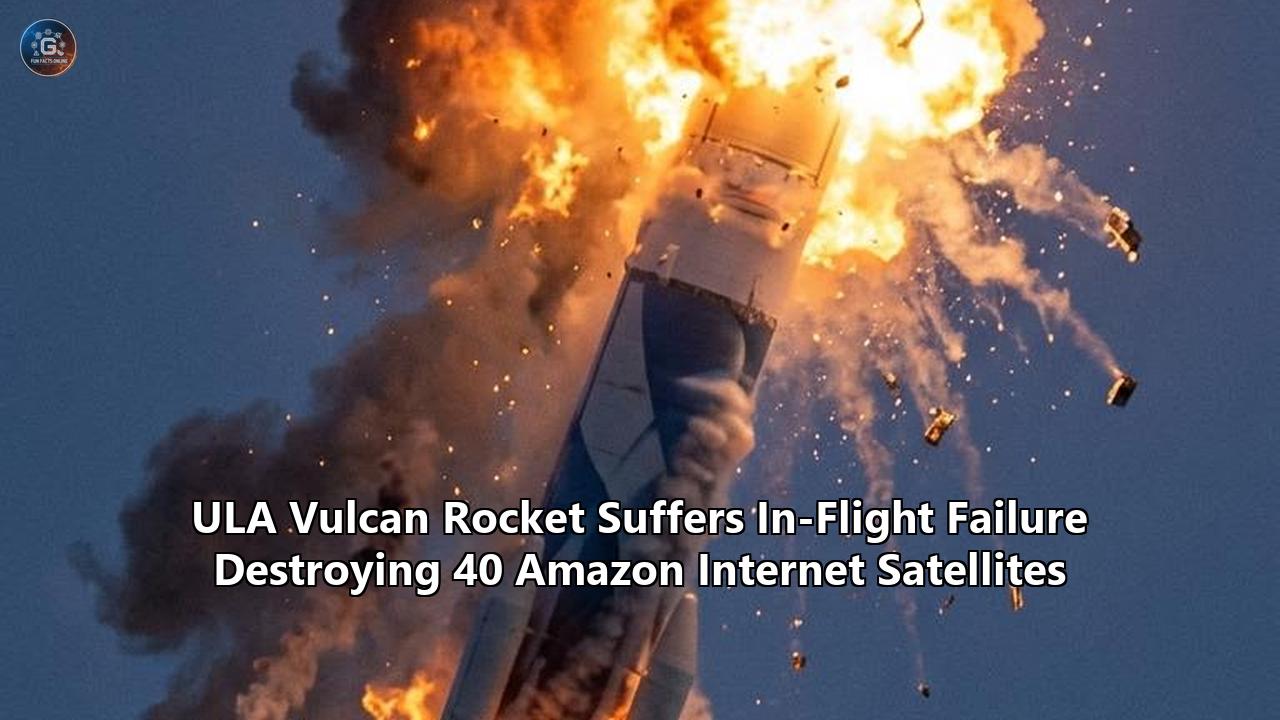
A United Launch Alliance (ULA) Vulcan Centaur rocket malfunctioned approximately ten minutes after liftoff from Space Launch Complex 41 at Cape Canaveral Space Force Station on Sunday, November 15, 2026, failing to reach orbit and destroying 40 Amazon Leo internet satellites. The mission, designated Leo Vulcan 1 (LV-01), marked the inaugural flight of a 38-launch contract between Amazon and ULA, and carried the heaviest commercial payload ULA had ever attempted to lift.
The disaster represents the first total mission loss in the 20-year history of United Launch Alliance since the joint venture was established by Boeing and Lockheed Martin in December 2006.
Liftoff occurred at 12:40 p.m. EST (1740 UTC) following a two-day delay caused by ground network issues and a technical hold called with just 20 seconds remaining on the countdown clock. While the rocket’s six strap-on solid rocket boosters fired cleanly and separated without incident, the flight encountered fatal trouble during the burn of the Centaur V upper stage. Approximately 50 minutes after liftoff, ULA confirmed the loss in an official statement: "Based on data received by our Launch Director, we confirm that the Vulcan vehicle launched from Space Launch Complex 41 suffered an anomaly 10 minutes into the flight and failed to deliver the Amazon mission to orbit. We will work closely with our customer and other appropriate organizations to find the cause, determine the appropriate corrective action, and return to flight as quickly as possible".
Amazon Leo, the tech giant's multi-billion-dollar satellite broadband initiative formerly known as Project Kuiper, released a statement acknowledging the disaster: "There is risk with any launch, and that’s especially true for inaugural missions like LV-01. ULA has been a trusted partner for Amazon, and we believe they’ll learn from this mission and deliver on their long-term plans for Vulcan".
Beneath the corporate composure lies an acute operational and industrial crisis. The loss vaporized roughly $100 million in bespoke satellite hardware, abruptly halted Amazon's deployment timeline against SpaceX's dominant Starlink network, exposed Amazon to compounding regulatory penalties from the Federal Communications Commission (FCC), and instantly grounded the United States Space Force’s primary alternative launch vehicle. The catastrophic ULA Vulcan rocket failure transforms an already strained global launch market into an acute bottleneck, leaving critical commercial constellations and national security assets competing for dwindling slots on a single operational American rocket fleet.
The Flight Profile: Anatomy of a Centaur Upper-Stage Breakdown
Sunday’s launch was configured as a Vulcan Centaur VC6L—designating the heavy-lift core vehicle flanked by six Northrop Grumman GEM 63XL solid rocket boosters, a dual-engine Centaur V upper stage, and a lengthened 5.4-meter-diameter composite payload fairing manufactured by Beyond Gravity. The mission was conceived as a high-visibility return to flight. Vulcan had been grounded for nine months following a February 2026 military launch where an SRB nozzle burned through during ascent, mirroring an identical nozzle issue during Vulcan's second certification flight in October 2024.
Engineering teams from ULA and Northrop Grumman had spent the intervening months redesigning the carbon-phenolic nozzle throats to eliminate thermal erosion vulnerabilities. For the first two minutes of flight, that remediation appeared fully validated. The six boosters ignited simultaneously at T-0, producing a combined 2.7 million pounds of thrust alongside the core stage. At T+1 minute and 38 seconds, all six boosters completed their burns and cleanly peeled away into the Atlantic Ocean.
Trouble surfaced deeper into the flight regime. The Vulcan booster core, powered by twin liquefied natural gas and liquid oxygen BE-4 engines built by Blue Origin, propelled the vehicle out of the sensible atmosphere. However, telemetry monitoring stations and launch tracking data indicated that the BE-4 engines burned for several seconds longer than the nominal timeline dictated by pre-flight flight dynamics models.
Stage separation occurred at approximately five minutes after liftoff. The booster jettisoned, and the Centaur V upper stage ignited its twin RL10C-1-1 engines, manufactured by L3Harris Technologies' Aerojet Rocketdyne division, for what was intended to be a 12-minute, 15-second orbital insertion burn.
The Centaur V used on LV-01 was flying in a specialized low Earth orbit configuration. Unlike the extended tanks used for high-energy geostationary transfer or interplanetary missions, this Centaur featured a shortened propellant tank structure engineered specifically to maximize payload lift capacity into low Earth orbit. Stacked above it were 40 Amazon Leo spacecraft, mounted inside a custom multi-satellite dispenser. The entire payload stack weighed over 22,700 kilograms (50,000 pounds), establishing a record for the heaviest mission ever mounted on a ULA vehicle.
Early into the upper-stage burn, telemetry broadcast visuals showed the Centaur V making aggressive, off-nominal attitude adjustments. The twin RL10 engines appeared to gimbal continuously, attempting to correct a pronounced deviation in pitch and yaw. At approximately T+10 minutes—less than three minutes before scheduled engine cutoff—the stage experienced an abrupt, catastrophic anomaly. Forward tracking stations in the Atlantic basin lost vehicle telemetry, and velocity figures froze far short of the ~7.6 kilometers per second required to attain a stable low Earth orbit. The stage and its 40-satellite payload disintegrated upon re-entering the upper atmosphere, showering debris into a remote corridor of the ocean.
Investigators examining the ULA Vulcan rocket failure have zeroed in on three interrelated phases:
- First-Stage Trajectory Hand-Off: Whether the prolonged burn of the BE-4 engines exhausted propellant unevenly or introduced an attitude rate error that placed the Centaur V at an unrecoverable insertion angle prior to stage separation.
- Centaur V Pneumatic and Structural Dynamics: The shortened Centaur V airframe altered the structural resonance and slosh dynamics of the cryogenic liquid hydrogen and liquid oxygen inside the paper-thin stainless-steel balloon tanks.
- RL10 Upper-Stage Propulsion: Whether one of the two RL10C engines suffered an uncontained turbopump failure, combustion instability, or loss of electromechanical thrust-vector control actuation during the terminal phase of the burn.
Whatever the root cause, the mishap immediately halted all Vulcan operations, leaving ULA, Amazon, and the United States military to confront systemic secondary impacts.
Amazon Leo: Constellation Timelines, Production Lines, and Spectrum Deadlines
The destruction of 40 satellites on LV-01 strikes at the core of Amazon’s capital-intensive strategy to create a viable competitor to Starlink. Internally branded as Project Kuiper before a high-profile rebrand to Amazon Leo in late 2025, the program represents a planned capital expenditure in excess of $10 billion.
Prior to Sunday's disaster, Amazon had established a tentative orbital footprint. Between April 2025 and July 2026, the company launched 396 operational satellites across 14 missions, utilizing a mix of ULA Atlas V, Arianespace Ariane 64, and SpaceX Falcon 9 vehicles. The program had reached its zenith of deployment velocity in April 2026, launching 90 satellites across three missions within 26 days. However, the Atlas V manifest reached retirement in July 2026, exhausting Amazon's access to ULA’s legacy workhorse and leaving the mega-constellation entirely dependent on unproven heavy-lift rockets: ULA's Vulcan, Blue Origin's New Glenn, and Europe's Ariane 6.
Amazon Leo Fleet Architecture & Launch Pipeline
├── Total Planned Gen-1 Constellation: 3,232 satellites (across 98 orbital planes)
├── Satellites In-Orbit Prior to LV-01: 396 satellites
├── Satellites Destroyed on LV-01: 40 satellites
├── Active Factory Production (Kirkland, WA): ~4 to 5 satellites/day (1,000+ completed)
└── Contracted Launch Allocation:
    ├── United Launch Alliance (Vulcan Centaur): 38 launches (0 completed, 1 failed)
    ├── Blue Origin (New Glenn): 24 launches (0 completed; fleet grounded)
    ├── Arianespace (Ariane 64): 18 launches (3 completed)
    └── SpaceX (Falcon 9): Contracted fill-in missions (3 completed)
The physical loss of the 40 satellites is easily absorbed by Amazon's industrial manufacturing engine. In September 2026, Amazon announced that its state-of-the-art satellite manufacturing facility in Kirkland, Washington, had completed its 1,000th production satellite. The factory operates at an output rate of up to five satellites per day, supported by automated component placement, precision robotic testing, and in-house phased array antenna fabrication. Amazon has hundreds of fully tested satellites stockpiled in cleanrooms, awaiting integration.
The existential vulnerability for Amazon is not hardware fabrication; it is orbital lift capacity and regulatory compliance.
The FCC Regulatory Trap
Under the original terms of Amazon's 2020 license from the Federal Communications Commission (FCC) and associated International Telecommunication Union (ITU) filings, the company was legally mandated to deploy 50% of its authorized 3,232-satellite constellation—exactly 1,616 spacecraft—into operational orbits by July 30, 2026.
When global rocket shortages made meeting that milestone mathematically impossible, Amazon petitioned the FCC for a two-year extension. On June 5, 2026, the FCC issued an order granting Amazon a conditional waiver, but with severe, unprecedented operational restrictions:
- Loss of Spectrum Priority: All Amazon Leo satellites launched after July 30, 2026, lost their original 2020/2021 processing round spectrum priority in the Ka-band. Under international radio regulations, this shifts the entire burden of interference mitigation onto Amazon. If an Amazon Leo satellite causes radio frequency interference with an existing constellation—principally SpaceX Starlink—Amazon must alter power levels, throttle transmission, or vacate frequencies.
- The Priority Restoration Gate: Amazon can only recover its top-tier spectrum priority once it successfully deploys and operates 1,616 satellites, or automatically in March 2028 if Amazon proves it has the physical hardware built and contractually secured.
- The Absolute 2029 Hard Stop: The FCC preserved the mandatory deadline requiring all 3,232 satellites to be fully operational in their designated orbital planes by July 30, 2029. Failure to meet the 2029 deadline results in the automatic reduction of Amazon's authorized constellation size to whatever number of satellites is actively flying on that date, permanently undermining the economic capacity of the network.
Sunday's failure directly threatens Amazon’s pathway out of this regulatory subordination. The Vulcan VC6L was engineered to carry between 40 and 45 satellites per launch. Across the 38 contracted Vulcan launches, Amazon intended to orbit roughly 1,600 satellites—virtually half of the entire constellation.
Amazon had spent tens of millions of dollars building proprietary ground infrastructure at Cape Canaveral to support Vulcan. The company funded and constructed a dedicated Vertical Integration Facility (VIF-A) adjacent to SLC-41, as well as a second mobile launch platform, designed specifically to allow ULA to process two Vulcan rockets concurrently and sustain an operational cadence of one launch every 14 to 21 days.
The second Vulcan Leo flight, LV-02, had already completed structural stacking in VIF-A and was scheduled to launch within three weeks of LV-01. That mission is now indefinitely postponed. With Vulcan grounded, Blue Origin's New Glenn sidelined since an uncontained BE-4 engine valve explosion destroyed a test stand in May 2026, and Arianespace managing a heavy back-catalog for Ariane 6, Amazon's deployment rate has flatlined.
Every month of delay deepens the competitive asymmetry with Starlink, which currently operates more than 6,500 active satellites, serves over 10 million subscribers worldwide, and captures prime enterprise, aviation, and defense communication contracts while Amazon's operational fleet remains stuck at under 400 spacecraft.
United Launch Alliance: The Loss of Invulnerability
For two decades, United Launch Alliance rested its corporate identity, customer marketing, and premium pricing models on a single pillar: absolute mission success. Formed during the height of the Evolved Expendable Launch Vehicle (EELV) program, ULA executed more than 160 consecutive successful missions across its Atlas V, Delta II, and Delta IV rocket families. Even during anomalous events—such as the 2016 Atlas V OA-6 mission where the RD-180 booster shut down six seconds early due to a fuel mixture ratio valve fault—the Centaur upper stage possessed enough performance reserve to burn longer and insert the Cygnus spacecraft into its nominal orbit.
The ULA Vulcan rocket failure ends that legacy. It is the company's first outright mission loss, and it arrives at the absolute nadir of ULA’s operational redundancy.
United Launch Alliance Fleet Architecture: 2006 vs. 2026
┌────────────────────────────────┬────────────────────────────────┐
│   Operational Fleet in 2006    │   Operational Fleet in 2026    │
├────────────────────────────────┼────────────────────────────────┤
│ • Delta II (Active Workhorse)  │ • Delta II (Retired 2018)      │
│ • Delta IV Medium (Active)     │ • Delta IV Medium (Ret. 2019)  │
│ • Delta IV Heavy (Active)      │ • Delta IV Heavy (Ret. 2024)   │
│ • Atlas V (Active Workhorse)   │ • Atlas V (Retired/Allocated)  │
│                                │ • Vulcan Centaur (GROUNDED)    │
└────────────────────────────────┴────────────────────────────────┘
During the 2010s, ULA had multiple operational launch vehicles. If an Atlas experienced an anomaly, Delta could step in, ensuring continuous access to space. Today, ULA has no backup. The Delta IV Heavy was retired in early 2024. The Atlas V production lines in Decatur, Alabama, have ceased; the few remaining Atlas V cores are contractually dedicated to Boeing's CST-100 Starliner missions and cannot legally or technically be re-manifested for commercial or national security payloads.
Vulcan is ULA’s entire business. The company's future revenue, debt financing, and long-rumored sale process—joint owners Boeing and Lockheed Martin have spent over two years attempting to divest or find private equity buyers for the joint venture—hinged on demonstrating that Vulcan could rapidly transition from development to a high-cadence, highly profitable commercial launcher.
Instead, Vulcan’s operational track record is now fraught with engineering compromises:
- Flight 1 (Cert-1, January 2024): Flawless booster and upper-stage performance, delivering the commercial Peregrine lunar lander to trans-lunar injection.
- Flight 2 (Cert-2, October 2024): Thirty-five seconds into flight, a nozzle on one of the two Northrop Grumman GEM 63XL solid boosters experienced structural burn-through and sheared off. The core stage BE-4 engines and Centaur V burned longer to compensate, successfully reaching orbit, but the vehicle sustained significant localized damage.
- Flight 3 (USSF-106): Space Force mission; achieved nominal insertion, but telemetry raised concerns regarding upper-stage pressurization dynamics.
- Flight 4 (USSF-87, February 2026): A second SRB nozzle burn-through occurred during ascent. While the payload was safely deployed, the United States Space Force intervened, temporarily pausing future national security task orders until ULA and Northrop Grumman could conclusively resolve the nozzle carbon-phenolic bonding issue.
- Flight 5 (LV-01, November 15, 2026): Return-to-flight mission with redesigned SRB nozzles. Boosters performed nominally, but the vehicle suffered an anomaly at T+10 minutes, destroying the payload.
The financial exposure for ULA is immediate and severe. Launch contracts of this scale incorporate stringent milestone payments and performance holdbacks. With 38 Vulcan launches booked by Amazon, hundreds of millions of dollars in capital expenditure tied to the Decatur manufacturing facility, and the SLC-41 dual-pad infrastructure idling, ULA faces severe cash-flow strains while funding an exhaustive mishap investigation. Furthermore, the launch insurance market—already hardened by aerospace supply chain inflation—will significantly revise underwriting terms, elevating insurance premiums for future Vulcan missions and erasing the cost advantages ULA sought to offer commercial operators.
National Security Space Launch: The Pentagon's Strategic Dilemma
For national security planners, the ULA Vulcan rocket failure revives uncomfortable questions about access to space. Under United States law—specifically Title 10, United States Code, Section 2273—the Department of Defense is legally mandated to maintain "assured access to space." This statutory directive requires the Pentagon to maintain at least two independent, commercially viable launch vehicle families with distinct supply chains, architectures, and manufacturing infrastructures, ensuring that a systemic failure in one family does not compromise the nation’s ability to loft intelligence, surveillance, reconnaissance, and military communication assets.
Under the National Security Space Launch (NSSL) Phase 2 procurement structure, the Space Systems Command divided military launch task orders between two certified providers: SpaceX received 60% of launch requirements using Falcon 9 and Falcon Heavy, while ULA received 40% with Vulcan.
U.S. National Security Space Launch (NSSL) Architecture Under Duress
┌────────────────────────────────────────────────────────────────────────┐
│ Statutory Requirement (10 U.S.C. § 2273): Assured Access to Space     │
│ Mandate: Two independent, non-interchangeable launch vehicle systems   │
├───────────────────────────────────┬────────────────────────────────────┤
│ Provider A: SpaceX                │ Provider B: United Launch Alliance │
├───────────────────────────────────┼────────────────────────────────────┤
│ • Hardware: Falcon 9 / Heavy      │ • Hardware: Vulcan Centaur         │
│ • Engine: Merlin 1D (RP-1/LOX)    │ • Engine: BE-4 (Methane) / RL10    │
│ • Status: FULLY OPERATIONAL       │ • Status: GROUNDED / UNDER REVIEW  │
│ • Fleet Utilization: High         │ • Active Missions: Indefinitely On │
│   Cadence (Commercial/Military)   │   Hold Pending Mishap Board        │
└───────────────────────────────────┴────────────────────────────────────┘
The Space Force had already paused Vulcan national security flights following the February 2026 solid booster nozzle burn-through. ULA had hoped that a flawless commercial flight on LV-01 would demonstrate the maturity of the redesigned boosters and persuade the Space Force to clear Vulcan for a rapid succession of backlogged defense missions, including critical payloads for the National Reconnaissance Office (NRO) and the Space Development Agency's (SDA) Proliferated Warfighter Space Architecture.
The LV-01 failure terminates that path. Space Systems Command will now establish its own independent accident investigation board alongside the Federal Aviation Administration (FAA) mishap review.
This leaves the United States defense apparatus in an alarming operational position: complete, 100% de facto dependence on SpaceX.
Every top-secret reconnaissance satellite, next-generation missile tracking sensor, and GPS III positioning spacecraft scheduled for launch over the next 12 to 18 months must either wait indefinitely for Vulcan's recertification or transition to SpaceX’s Falcon 9 or Falcon Heavy. Re-manifesting a classified military payload from Vulcan to Falcon is neither simple nor immediate. Spacecraft structural adapters, electrical harnesses, flight software, and environmental vibration profiles are engineered for years to match the specific acoustic and mechanical envelope of a particular rocket fairing. Cross-manifesting requires months of structural re-qualification, costly hardware modifications, and significant schedule disruption.
The Phase 3 NSSL procurement framework, which expands launch awards into multi-tier "Lane 1" (risk-tolerant commercial missions) and "Lane 2" (high-value, heavy-lift defense missions), is also disrupted. The Space Force had envisioned an environment where Vulcan, New Glenn, and SpaceX would compete intensely to drive down launch costs. With Vulcan grounded and New Glenn still working to recover from its May static test pad explosion, the Department of Defense faces a temporary launch monopoly that completely undermines its long-term competitive procurement strategy.
Supply Chain Interdependencies: The BE-4 and RL10 Industrial Axis
The commercial ripple effects of the ULA Vulcan rocket failure extend far beyond ULA and Amazon, casting an unsparing spotlight on the high-performance propulsion supply chain that powers modern American rocketry.
Vulcan VC6L Propulsion & Component Supply Architecture
├── First-Stage Propulsion:
│   └── 2x Blue Origin BE-4 Engines (Staged-combustion; Methane/LOX)
│       └── Status Check: Did prolonged burn contribute to off-nominal trajectory?
├── Boost Propulsion:
│   └── 6x Northrop Grumman GEM 63XL Solid Rocket Motors (Hydroxyl-terminated polybutadiene)
│       └── Status Check: Performed nominally; carbon-phenolic nozzle throat fixes held.
└── Upper-Stage Propulsion:
    └── 2x L3Harris / Aerojet Rocketdyne RL10C-1-1 Engines (Expander cycle; LH2/LOX)
        └── Status Check: Focus of investigation; gimballing anomalies at T+10m.
1. Blue Origin and the BE-4 Conundrum
Vulcan's first stage is powered by two BE-4 engines, designed and produced by Jeff Bezos' Blue Origin in Huntsville, Alabama. The BE-4 is an oxygen-rich staged combustion engine burning liquefied natural gas (methane) and liquid oxygen, producing roughly 550,000 pounds of thrust per unit.
While telemetry suggests the primary failure event occurred during the Centaur upper-stage burn, the BE-4 engines remain a focal point of investigation. If the BE-4 engines experienced early mixture ratio shifts, throttle anomalies, or ran longer than programmed to compensate for flight dynamics errors, they may have delivered the Centaur V to the stage separation point at an anomalous attitude, altitude, or velocity.
This scrutiny arrives at a devastating time for Blue Origin. In May 2026, an uncontained test-stand explosion at Blue Origin’s Launch Complex 36 facility in Cape Canaveral destroyed an integrated New Glenn booster during pre-launch qualification testing. That catastrophic explosion was traced back to a faulty high-pressure liquid oxygen valve within one of the seven BE-4 engines powering the New Glenn first stage. Blue Origin was forced to ground its New Glenn launch debut to implement fleet-wide valve retrofits. If the Vulcan mishap investigation uncovers any secondary anomalies in the BE-4’s turbomachinery, transient shutdown sequencing, or propellant utilization systems, the corrective actions could further delay New Glenn’s commercial debut—compounding Amazon’s inability to activate its 24-launch contract with Blue Origin.
2. Aerojet Rocketdyne / L3Harris and the RL10 Legacy
The RL10 is an institution of American space exploration. First flown in 1963, the liquid hydrogen/liquid oxygen expander cycle engine has powered versions of the Centaur upper stage for over six decades, sending Apollo precursors, planetary probes (Voyager, New Horizons, Cassini), and hundreds of high-value satellites into space. The engine is renowned for its vacuum efficiency (specific impulse exceeding 450 seconds) and operational reliability.
However, the RL10 variant used on Vulcan Centaur—the RL10C-1-1—features an enlarged, lightweight carbon-carbon or 3D-printed nozzle extension designed to maximize expansion efficiency in vacuum conditions. Integrating two of these high-thrust engines into a wide-body, 5.4-meter Centaur V tank structure introduces complex fluid-structure interaction dynamics. Because Sunday's failure occurred approximately ten minutes into flight—deep within the planned Centaur firing sequence—investigators will scrutinize:
- RL10 propellant supply line cavitation or chill-down failures.
- Failure of the pneumatic helium pressurization system maintaining structural rigidity and propellant feed pressure in the Centaur V tanks.
- An electromechanical actuator failure that prevented the engines from vectoring thrust correctly to overcome vehicle disturbances.
- Mechanical failure within the common bulkhead dividing the ultra-cold liquid hydrogen tank (-253°C) from the liquid oxygen tank (-183°C). A structural breach in the common bulkhead would cause catastrophic propellant freezing, tank de-pressurization, and immediate thrust termination.
Market Distortions: The Widening Launch Monopoly
The failure of Vulcan flight LV-01 dramatically alters the macroeconomic structure of the commercial space industry. In the post-2022 launch market, commercial satellite operators faced a systemic supply deficit driven by the retirement of the European Ariane 5, the withdrawal of Russian Soyuz rockets from the international market following sanctions, and delays in next-generation heavy-lift platforms (Vulcan, Ariane 6, New Glenn).
Over the past four years, SpaceX has operated as an effective monopoly for Western orbital transport. The Falcon 9 family flew over 130 times in 2025 alone, offering unmatched cadence, rapid reusability, and rock-bottom marginal launch costs.
Amazon’s multi-billion-dollar commercial launch procurement in 2022—booking 83 launches across ULA, Blue Origin, and Arianespace—was explicitly designed to foster a diversified, multi-polar launch ecosystem and avoid subsidizing its direct rival, SpaceX.
Global Heavy-Lift Commercial Manifest Status (Post-LV-01 Failure)
┌──────────────────────┬──────────────────────┬───────────────────────────┐
│ Launch System        │ Primary Backlog      │ Operational Status        │
├──────────────────────┼──────────────────────┼───────────────────────────┤
│ SpaceX Falcon 9/Hvy  │ Starlink, NSSL, Comm │ Operational (Peak Cadence)│
│ ULA Vulcan Centaur   │ Amazon Leo, NSSL     │ GROUNDED (Mishap Review)  │
│ Blue Origin New Glenn│ Amazon Leo, Commercial│ Grounded (May Explosion)  │
│ Arianespace Ariane 6 │ Amazon Leo, Galileo  │ Active (Capacity Saturated)│
└──────────────────────┴──────────────────────┴───────────────────────────┘
The Vulcan grounding shatters this industrial hedge. With Vulcan unavailable for months, New Glenn grounded, and Ariane 6 booked to capacity for years, Amazon faces a grim commercial paradox: to save the Amazon Leo constellation from regulatory forfeiture, it may have no choice but to purchase dozens of additional launches from Elon Musk’s SpaceX.
Amazon previously swallowed its corporate pride in late 2023 by contracting three Falcon 9 launches to keep its satellite deployment schedule alive, flying several dozen satellites throughout late 2025. Now, with the FCC’s conditional waiver ticking toward its next enforcement checkpoint and 40 spacecraft lost at sea, Amazon executives may be forced to negotiate a massive, multi-launch contract with SpaceX.
Such a move would hand SpaceX a profound geopolitical and financial triumph: Amazon would be pouring capital directly into the balance sheet of its chief broadband competitor, funding the very Starship and Starlink architectures designed to make Amazon Leo obsolete. Furthermore, SpaceX has finite Falcon 9 capacity; accommodating dozens of Amazon launches would require SpaceX to either bump other commercial customers or prioritize Amazon over its own internal Starlink deployment, a trade-off Musk would price at an absolute premium.
Short-Term Repercussions: Grounding, Audits, and Hardware Quarantines
Over the next three to six months, the fallout from the ULA Vulcan rocket failure will unfold along rigid regulatory and technical pathways:
- FAA Oversight and Mishap Board Activation: The Federal Aviation Administration’s Office of Commercial Space Transportation has formally opened a mishap investigation. The FAA will oversee the investigation board led by ULA, with participation from Amazon, the Space Force, and NASA. Vulcan’s commercial launch license is suspended by operation of law. The vehicle cannot return to flight until the FAA accepts the final mishap investigation report and certifies that all corrective actions have been fully implemented.
- Quarantine of Hardware at Decatur and the Cape: ULA engineers have impounded all telemetry, physical manufacturing logs, and quality assurance documentation associated with the LV-01 vehicle. At ULA's 1.6-million-square-foot production plant in Decatur, Alabama, assembly of subsequent Vulcan boosters has been halted pending determination of whether the failure was an isolated hardware defect or a systemic manufacturing flaw. The second Amazon mission (LV-02), currently sitting encapsulated in VIF-A at Cape Canaveral, will undergo complete de-stacking and destructive inspection of its upper-stage propellant systems.
- Space Force Independent Review Team: Space Systems Command will deploy an Independent Readiness Review Team (IRRT) to examine telemetry data in parallel with ULA. The Space Force holds distinct certification thresholds; even if the FAA clears Vulcan to resume commercial flights, the military will not clear classified national security payloads until its own technical branch validates the flight margin across every dynamic flight regime.
- Immediate Spectrum Penalty Realization: Amazon must now formally report the loss of 40 satellites to the FCC International Bureau. Because Amazon failed to reach its initial deployment quota by July 30, 2026, every day that passes without reaching 1,616 active satellites solidifies its degraded spectrum status, exposing its early commercial service rollout—planned for late 2026—to severe performance degradation in markets where Starlink holds primary frequency rights.
Long-Term Outlook: Strategic Realignment and Key Milestones to Watch
The November 15 launch failure is an inflection point for the aerospace industrial complex. It lays bare the fragile underpinnings of Western space access, where the retirement of legacy rocket systems outpaced the maturation of their replacements, leaving global telecommunications and military readiness vulnerable to a single point of failure.
As United Launch Alliance engineers comb through gigabytes of Centaur V telemetry, the trajectory of both ULA and Amazon Leo hinges on specific technical and commercial milestones over the coming months:
- Telemetry Attribution (Weeks 1–4): The critical first indicator will be ULA’s public release of the failure domain. If the anomaly is isolated to an electrical or actuation issue on an RL10 engine gimbal, corrective actions can be implemented via software or discrete hardware swaps within four to six months. If the investigation reveals an uncontained failure of the Centaur V structural tankage, common bulkhead, or acoustic resonance under high-payload mass, redesign and re-testing at Marshall Space Flight Center could ground Vulcan for 12 to 18 months.
- Amazon’s Manifest Reallocation (Q1 2027): Industry observers must watch whether Amazon exercises option clauses to book massive Falcon 9 manifests or attempts to secure priority slots on Europe's Ariane 6. If Amazon commits hundreds of millions of dollars to SpaceX, it signals deep institutional skepticism regarding Vulcan’s rapid return to flight.
- Space Force NSSL Phase 2 Adjustments (Mid-2027): The Space Force will face critical decisions regarding backlogged national security missions. If ULA cannot guarantee flight readiness by mid-2027, the Pentagon will be forced to officially re-allocate Phase 2 missions originally awarded to Vulcan over to SpaceX Falcon Heavy, formalizing SpaceX’s monopoly over the nation’s most sensitive orbital defense assets.
- The Fate of ULA’s Ownership: The grounding will directly impact ULA’s valuation and sale negotiations. Prospective buyers will not close a transaction with an uncertified, grounded launch vehicle facing unquantified remediation costs and regulatory penalties. Boeing and Lockheed Martin may be forced to inject emergency capital into the joint venture to sustain operations through an extended stand-down.
Sunday's catastrophic event off the Florida coast dismantled two decades of historical invulnerability in ten short minutes. Restoring that reputation will require more than finding a cracked valve, a software timing bug, or an errant turbopump. It demands that United Launch Alliance prove it can master the unforgiving physics of heavy cryogenic rocketry under intense commercial pressure, while Amazon races against a regulatory clock that pauses for no one.
Reference:
- https://www.geekwire.com/2026/amazon-loses-40-leo-satellites-as-ula-vulcan-launch-failure-deals-setback-to-tech-giants-starlink-rival/
- https://spaceflightnow.com/2026/11/15/ula-suffers-first-total-mission-failure-with-loss-of-vulcan-rocket-carrying-40-amazon-leo-satellites/
- https://www.aboutamazon.com/news/amazon-leo/amazon-leo-vulcan-satellites-launch
- https://aerospaceglobalnews.com/news/40-amazon-broadband-satellites-lost-after-ula-vulcan-suffers-first-mission-failure/
- https://shattered.io/vulcan-hardware-suspects-40-satellites-lost-zero-confirmed-causes/
- https://datasciencelearningcenter.substack.com/p/united-launch-alliance-ula-vulcan-rocket-failure-november-15-2026
- https://www.space.com/space-exploration/launches-spacecraft/ula-vulcan-centaur-return-to-flight-amazon-leo-internet-satellite-launch
- https://spacelaunchnow.app/launch/vulcan-vc6l-amazon-leo-lv-01/
- https://www.youtube.com/watch?v=fIWWrZOFWnI
- https://www.cbsnews.com/news/vulcan-rocket-40-amazon-leo-internet-satellites-launch-mishap/
- https://qz.com/fcc-amazon-leo-satellite-deployment-deadline-waiver-060926
- https://orbital-intel.com/news/amazon-kuiper-fcc-deployment-waiver-spectrum-conditions/
- https://app.govly.com/public/signals/222833
- https://www.spacelaunchschedule.com/launch/vulcan-vc6l-amazon-leo-lv-01/
- https://cosmiclog.com/2026/06/08/fcc-gives-amazon-leo-more-leeway-on-satellite-schedule/
- https://ukrmedia.news/en/world/amazon-leo-avariia-vulcan-centaur/
- https://orbitalradar.com/satellite-internet/kuiper-launch-schedule
- https://www.reddit.com/r/technology/comments/1xx7xlz/vulcan_rocket_fails_destroying_40_amazon_leo/
- https://www.cfpublic.org/space/2026-11-16/ula-investigating-vulcan-rockets-failure-to-deliver-amazon-payload