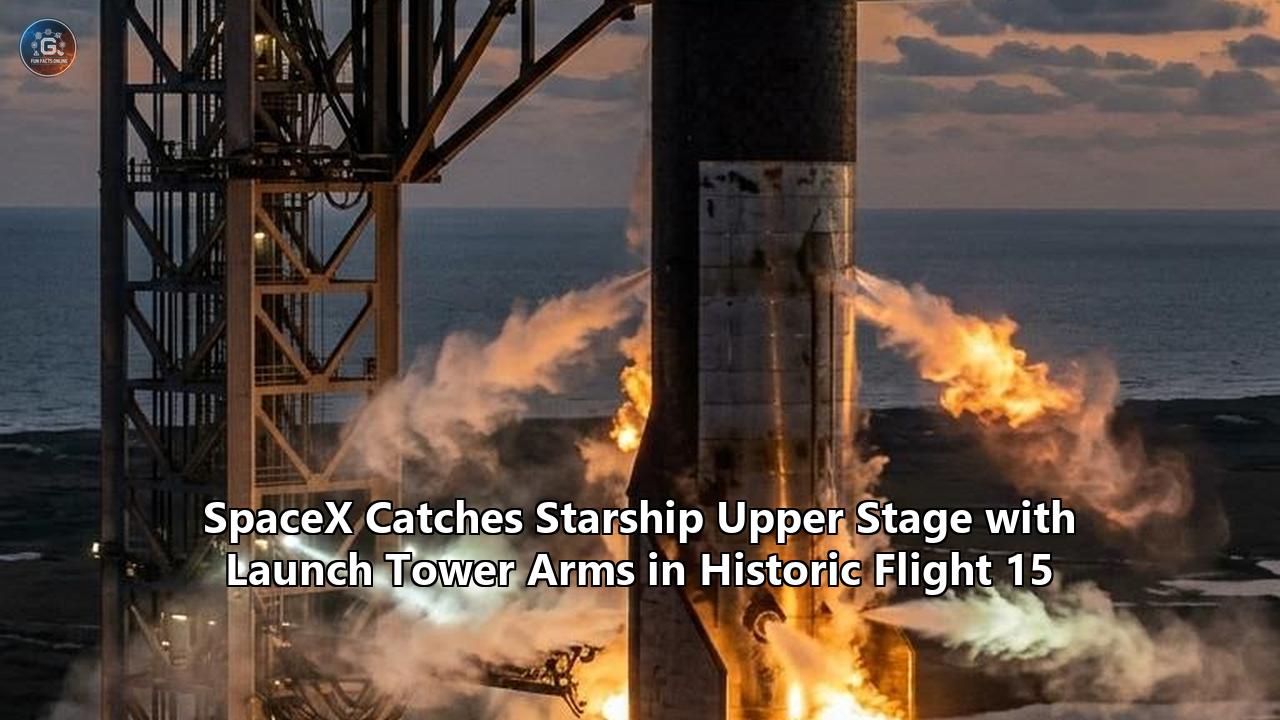
BOCA CHICA, Texas — In a display of aerospace precision that rewrote the physics of rocket recovery, SpaceX’s giant Mechazilla launch tower caught a descending Starship spacecraft out of the South Texas sky on Saturday afternoon. The capture marked the first time in spaceflight history that an orbital rocket's second stage returned from low Earth orbit directly to its launch pad to be snared mid-air by mechanical arms.
The historic capture of Ship 42 occurred at 3:20:03 p.m. CST (21:20:03 UTC) at Starbase, culminating a 22-hour, 32-minute orbital test flight that began Friday evening. Falling through low clouds over the Gulf of Mexico after completing 14 laps around the globe, the 52-meter-tall (171-foot) stainless steel spacecraft ignited three of its Raptor engines, pitched from a horizontal belly-flop into a vertical stance, and hovered between the tower’s twin steel "chopstick" arms. As the engines throttled down, the mechanical arms clamped shut beneath the vehicle’s forward lifting pins, arresting its descent dozens of meters above the coastal salt flats.
"That was the missing link," said SpaceX Communications Manager Dan Huot during the live broadcast, his voice breaking with emotion as thousands of company employees erupted into cheers. "That was the holy grail of spaceflight, plummeting through fire to be snatched out of the air by steel. We caught a Starship, and now everything changes."
The breakthrough during Flight 15 completes the central architecture of SpaceX’s long-sought goal: full, rapid reusability for the largest flying machine ever constructed. While the company had previously caught three first-stage Super Heavy boosters at the launch tower, the upper stage presents a fundamentally harder problem. Unlike boosters that operate on suborbital arcs, the Starship upper stage must survive orbital velocities exceeding 26,000 kilometers per hour, withstand reentry plasma temperatures topping 2,600 degrees Fahrenheit (1,425 degrees Celsius), and decelerate without landing legs to an exact geographic coordinate.
The mission was not without setback. Roughly six and a half minutes after liftoff on Friday, the first stage, Super Heavy Booster 22, aborted its own tower catch after an automated engine diagnostic flagged a propellant anomaly during the boostback burn. The booster steered away from the coastline and ditched into the Gulf of Mexico, where its flight termination system triggered an offshore explosion. Yet the recovery of the orbital ship overshadowed the booster’s loss, demonstrating that an orbital spacecraft can return intact to the pad that launched it without requiring ocean recovery vessels or runway touch downs.
========================================================================================
STARSHIP FLIGHT 15: MISSION PROFILE & SPECIFICATIONS
========================================================================================
Launch Date:             Friday, November 13, 2026 | 4:47:36 p.m. CST (22:47:36 UTC)
Landing Date (Ship 42):  Saturday, November 14, 2026 | 3:20:03 p.m. CST (21:20:03 UTC)
Mission Duration:        22 hours, 32 minutes, 32 seconds
Launch Site:             Orbital Launch Pad 2 (OLP-2), Starbase, Boca Chica, Texas
Vehicle Pair:            Booster 22 (Super Heavy Block 3) / Ship 42 (Starship Block 3)
Orbital Altitude:        276 km perigee x 278 km apogee (30.5° inclination)
Orbits Completed:        14 full revolutions
Payload:                 26 Starlink V3 broadband satellites (Starlink Group 31-2)
Recovery Outcome:        Booster 22: Aborted catch, offshore disposal in Gulf of Mexico
                         Ship 42: Caught by Mechazilla chopstick arms at OLP-2
========================================================================================
The 22-Hour Marathon of Flight 15
Flight 15 lifted off from Orbital Launch Pad 2 (OLP-2) at 4:47:36 p.m. CST on Friday, November 13, 2026, piercing an evening haze under the power of 33 Raptor 3 engines. Generating approximately 17 million pounds of thrust, the 121-meter-tall stack cleared the launch mount and rolled east-southeast over the waters of the Gulf.
Two minutes and 42 seconds into the flight, at an altitude of roughly 69 kilometers, the stack performed its signature hot-stage separation. Ship 42 lit its three center sea-level Raptors and three outer vacuum-optimized Raptors while still tethered to the booster, pushing away through a vented interstage ring. The vehicle performed flawlessly through its second-stage burn, shutting down its engines at T+8 minutes and 32 seconds to enter a circular parking orbit at an altitude of 276 by 278 kilometers with an inclination of 30.5 degrees.
While Ship 42 settled into orbital coast, drama unfolded back at Starbase. Booster 22 reversed its velocity with a boostback burn aimed at returning to Orbital Launch Pad 2. However, telemetry broadcast on the mission stream revealed that only 32 of the booster's 33 engines ignited for the burn. As the 71-meter rocket descended back toward the Texas coast, automated algorithms inside its guidance, navigation, and control (GNC) computer detected an insufficient propellant mass margin in the header tanks.
SpaceX mandates strict commit criteria for any catch attempt: if vehicle health sensors detect any deviance in engine chamber pressure, attitude control, or landing propellant, the rocket must divert away from the tower to protect ground infrastructure. Booster 22 executed an autonomous divert maneuver, arced away from the shoreline, and executed a simulated landing burn over open water several miles offshore before its onboard flight termination system destroyed the vehicle.
"GNC triggered that abort," Huot explained shortly after the booster's water impact. "It was doing what it was supposed to do. It detected that the booster was not in the exact required configuration to proceed safely with the catch. The tower is safe, Pad 2 is intact, and our focus turns to Ship 42 in orbit."
Free of the booster's anomaly, Ship 42 initiated its primary commercial objective: deploying 26 next-generation Starlink V3 satellites from its payload bay door. Over a 42-minute deployment window ending at T+1 hour, 17 minutes, the ship ejected the flat-panel satellites into low Earth orbit. Each V3 spacecraft introduces an estimated one terabit per second of downlink capacity, with the 26-satellite manifest matching the payload mass equivalent of roughly ten Falcon 9 launches.
Crucially, three of the deployed satellites carried specialized optical inspection cameras. Maneuvering slightly above and below Ship 42's flight path, these camera-equipped satellites transmitted high-definition imagery of the ship's underbelly back to engineers in Hawthorne, California, and Boca Chica. The visual survey confirmed that the craft’s thermal protection system—a mosaic of approximately 18,000 hexagonal silica tiles—had weathered the violent acoustics of liftoff without shedding critical tiles along its forward flaps or belly seams.
Armed with positive thermal scans, mission directors formally ruled out contingency ocean ditching options off the coasts of Hawaii and Chile, clearing Ship 42 to proceed with its 14-orbit endurance coast and attempt the return to launch site.
Surviving the Orbital Firestorm
Returning an upper stage from orbit is an order of magnitude more demanding than landing a booster. A first-stage booster separates at approximately Mach 7 to Mach 8 and reaches an apogee of 100 to 120 kilometers, carrying negligible horizontal velocity. By contrast, an upper stage returns from an orbital speed of roughly 7,300 meters per second (Mach 25), packing kinetic and potential energy that must be shed through atmospheric drag.
Ship 42—bearing the phrase "Don't Panic" stenciled near its forward flaps in homage to Douglas Adams’s The Hitchhiker’s Guide to the Galaxy—began its entry sequence over the southern Indian Ocean. At T+21 hours and 42 minutes, the ship commanded a single vacuum-optimized Raptor engine to execute a targeted deorbit burn, dipping its perigee deep into Earth's upper atmosphere.
========================================================================================
REENTRY & LANDING TIMELINE: SHIP 42 (FLIGHT 15)
========================================================================================
T+21:42:00  | Deorbit Burn Ignition (Single Vacuum Raptor fires over Indian Ocean)
T+21:44:30  | Deorbit Burn Shutdown; Trajectory committed to South Texas corridor
T+22:01:00  | Atmospheric Entry Interface (120 km altitude, Velocity: ~26,300 km/h)
T+22:08:15  | Peak Aerodynamic Heating (Skin temps hit 2,600°F; Plasma blackout avoided via Starlink)
T+22:18:40  | Max Q / Peak Deceleration (Vehicle transitions across Baja Peninsula)
T+22:27:00  | Subsonic Transition (Northern Mexico airspace; Four flaps initiate belly-flop glide)
T+22:31:10  | The "Swoosh" & Flip (Altitude: 800m; Three center Raptors ignite; Vertical pitch)
T+22:31:50  | Final Descent & Throttle Down (Ship hovers between Mechazilla chopstick arms)
T+22:32:32  | TOWER CATCH CONFIRMED (Mechazilla arms clamp structural pins; Engines off)
========================================================================================
The ship hit entry interface at an altitude of 120 kilometers while traveling at 26,300 kilometers per hour. For early human spacecraft, atmospheric entry brought protracted radio blackouts caused by the envelope of superheated ionized gas encasing the hull. Ship 42, however, streamed uninterrupted, multi-angle telemetry and 4K external video throughout its descent, routing data through its top-mounted Starlink user terminals to satellites orbiting above the plasma field.
As the spacecraft descended through 70 kilometers, ambient temperatures on the windward side spiked to 2,600 degrees Fahrenheit. Glowing streams of orange and violet plasma sheared across the hull, licking at the aerodynamically redesigned flap hinges.
On earlier flights—most notably Flight 4 in June 2024—scorching reentry plasma chewed through the forward flap seals, melting internal structural ribs. For Flight 15's Block 3 configuration, SpaceX moved the forward flaps farther leeward, shrunk their surface area, and integrated secondary ceramic-fiber seals alongside overlapping tile skirts. Onboard cameras showed the revised hinges weathering peak thermal stress intact, with structural sensors registering nominal temperatures across the hydraulic actuators.
Slowing rapidly through peak dynamic pressure over the Baja Peninsula and northern Mexico, Ship 42 traded kinetic energy for atmospheric compression waves, creating double sonic booms heard across rural Tamaulipas and lower Cameron County. By the time the vehicle crossed the Rio Grande, it had scrubbed 99 percent of its orbital velocity, falling at terminal velocity in a horizontal belly-flop orientation governed by autonomous micro-adjustments of its four control flaps.
At an altitude of 800 meters above the Gulf of Mexico, the flight computers executed the most aggressive maneuver in rocketry: the flip-and-catch sequence. Three sea-level Raptor engines lit in rapid succession, drinking liquid methane and liquid oxygen fed from isolated header tanks in the nosecone and inter-tank bulkheads.
Gimballing violently through high-pressure hydraulic actuators, the engines kicked the ship’s aft section downward, pitching the 100-ton dry mass from horizontal to vertical in less than four seconds. The vehicle translated laterally toward the beach, slid into alignment with Orbital Launch Pad 2, and descended between the open steel framework of the launch tower’s mechanical arms.
A localized roar shook the pad as the center engines throttled back to equilibrium, counteracting gravity with pinpoint precision. The ship hovered momentarily between the extended carriage arms. With acoustic sensors and optical LiDAR calculating closure rates down to the millimeter, the chopsticks closed inward. The ship's reinforced forward load points settled onto the arm carriages, the Raptors shut down with a puff of venting gas, and Ship 42 hung suspended over the launch mount.
Over the Starbase audio system, engineers cued up Player’s 1977 soft-rock track "Baby Come Back," an inside nod to the spacecraft returning to the exact piece of concrete it had vacated a day prior.
The Physics of the Tower Snatch
The structural architecture behind the catch mechanism—colloquially dubbed "Mechazilla"—stems from a calculated gamble SpaceX made late in 2020.
Traditional rocketry dictates that any vehicle attempting a vertical propulsive touchdown must carry dedicated landing gear. Falcon 9 relies on four deployable carbon-fiber legs with internal crush cores; Apollo's Lunar Module used crushable aluminum honeycomb; and early Starship prototypes, from SN8 through SN15, relied on stubby, internal steel legs that often deformed or crumpled upon impact.
For an upper stage designed to haul 100 to 150 metric tons of cargo to orbit, landing legs impose a devastating performance penalty. Deployable legs, along with their associated latches, hydraulic deployment systems, thermal protection skirts, and local structural reinforcement, add an estimated 10 to 15 metric tons of parasite dry mass to the spacecraft. Because of the exponential nature of the Tsiolkovsky rocket equation, every single kilogram of unneeded structural weight on an upper stage reduces orbital payload capacity on a nearly one-to-one basis.
THE DRY MASS DILEMMA: LANDING LEGS VS. TOWER ARMS
-----------------------------------------------------------------------------------------
TRADITIONAL UPPER STAGE (WITH LEGS):
• Landing Legs, Dampers, & Hydraulics:       +10,000 to +12,000 kg
• Thermal Protection Skirts for Gear:         +1,500 to  +2,500 kg
• Local Hull Structural Reinforcement:        +1,500 to  +2,000 kg
-----------------------------------------------------------------------------------------
TOTAL WEIGHT PENALTY ON VEHICLE:             ~13,000 to 16,500 kg
RESULTING PAYLOAD CAPACITY TO ORBIT:          Reduced by ~13 to 16 metric tons

MECHAZILLA CATCH ARCHITECTURE:
• Hardened External Lift/Catch Pins:          +200 to +400 kg
• Internal Ring Frame Tie-Ins:                +300 to +500 kg
-----------------------------------------------------------------------------------------
TOTAL WEIGHT PENALTY ON VEHICLE:             ~500 to 900 kg
RESULTING PAYLOAD CAPACITY TO ORBIT:          Maximized; preserves >100 tons net payload
-----------------------------------------------------------------------------------------
By offloading the landing gear to ground infrastructure, SpaceX relocated the mass penalty to a fixed launch tower where weight does not matter. The Mechazilla tower at Orbital Launch Pad 2 stands 146 meters tall, assembled from structural steel trusses anchored into deep concrete pilings driven into the coastal bedrock.
The tower’s two carriage arms move along vertical rails via high-speed cable hoist systems powered by central electric drawworks. The arms do not merely squeeze the rocket; they act as a precision cradle. Ship 42 features two primary forward catch pins—solid steel lugs protruding from the ship's skin just beneath the forward flap hinges, directly tied into the vehicle's internal circumferential ring frames. Two secondary alignment pads near the aft skirt provide stabilization to prevent pendulum swinging.
During the terminal phase of the descent, the spacecraft’s flight control software does not target the ground. It targets a spatial coordinate floating roughly 60 meters in the air, situated directly between the open arms. As the vehicle's velocity drops below five meters per second, laser altimeters and optical photogrammetry cameras on the tower arms track the ship's catch pins.
Hydraulic dampening cylinders built into the carriage arms articulate in real-time, matching the ship's lateral drift. The moment the catch pins make contact with the energy-absorbing rails, pressure switches trigger the arms to close slightly, capturing the vehicle. The ship's engines extinguish instantly, and the combined kinetic and gravitational energy of the descending craft is absorbed by the ground-based hydraulic dampers.
The historic achievement marked the first successful SpaceX Starship catch involving the orbital upper stage, proving that the structural margins of a lightweight, thin-walled stainless steel vehicle can withstand the dynamic shock of being caught mid-air without buckling.
The Hardware Evolution: Block 1 to Block 3
Ship 42's success was built on the wreckage of its predecessors. The flight marked the fourth mission of the Block 3 Starship iteration, an overhaul that replaced earlier structural prototypes with production-grade space hardware.
========================================================================================
STARSHIP UPPER STAGE ITERATIVE DESIGN PROGRESSION
========================================================================================
GENERATION / FLIGHTS  | STRUCTURAL TRAITS            | PROPULSION & THERMAL INTEGRATION
========================================================================================
Suborbital Prototypes | • 304L cold-rolled steel      | • Early Raptor 1 / 1.5 engines
(SN8 through SN15)    | • Crude forward/aft flaps     | • Partial hand-glued tiles
                      | • Fragile internal legs       | • Multiple landing burn failures
----------------------------------------------------------------------------------------
Block 1 Operational   | • 4mm thick stainless alloy   | • Raptor 2 engines (230 tons thrust)
(Flights 1 through 6) | • Bulky forward flaps         | • Mechanical tile studs on wool
                      | • Basic hot-stage ring        | • Flap burn-through on Flight 4
----------------------------------------------------------------------------------------
Block 2 Transition    | • Refined nosecone stamping   | • Raptor 2 vacuum variants
(Flights 7 through 11)| • Slimmer aft aero-surfaces   | • Secondary ablative sub-layer
                      | • Propellant transfer valves  | • Tile retention vastly improved
----------------------------------------------------------------------------------------
Block 3 Maturation    | • Stretched propellant tanks  | • Raptor 3 (simplified plumbing)
(Flights 12 to 15)    | • Relocated leeward flaps     | • Fully automated tile matrix
                      | • Integrated catch hardpoints | • No landing legs; dual-port venting
========================================================================================
The transition from Block 1 (which flew on early integrated test flights) to Block 3 involved significant engineering redesigns:
Flap Repositioning and Aerodynamic Optimization
On early prototypes, the forward flaps were mounted broadside, perpendicular to the cylindrical body. During hypersonic entry, these forward surfaces acted as thermal scoops, channeling blistering plasma directly into the mechanical hinge gaps.
Block 3 rotated these flap assemblies backward toward the leeward side of the vehicle. This repositioning hides the mechanical linkages in the aerodynamic shadow of the hull during entry, reducing thermal loading by several hundred degrees while preserving sufficient control authority for the subsonic belly-flop maneuver.
Raptor 3 Propulsion Maturation
Ship 42 flew equipped with Raptor 3 engines, representing an extreme reduction in complexity compared to the Raptor 1 and Raptor 2 engines that flew on early flights.
In Raptor 3, external plumbing lines, sensors, and ignition systems were integrated directly into internal cast and 3D-printed channels within the engine housing. This eliminated the need for heavy, drag-inducing thermal shields around the engine bay. The sea-level engines on Block 3 feature regenerative cooling loops capable of sustaining repeated relights without nozzle degradation, and they provide deeper throttle capability—down to 40 percent of maximum thrust—which is required to match tower closure dynamics.
Thermal Protection System (TPS) Architecture
Early Starship test flights were plagued by shedding tiles. During Flight 1 and Flight 2, hundreds of black ceramic tiles detached under acoustic vibrations during ascent, leaving bare steel exposed to entry heating.
By Flight 15, SpaceX had implemented an automated robotic application process for the tile studs, paired with an underlying ceramic-fiber felt blanket (Saffil) that buffers the mismatch in thermal expansion rates between the ceramic tiles and the expanding stainless steel tanks. The successful imagery beamed down from the Starlink V3 satellites prior to reentry verified that tile loss had been reduced to near-zero across the critical windward skin.
Why Booster 22 Was Cast Away
While SpaceX teams celebrated the upper-stage capture, the failure of Super Heavy Booster 22 to return to the pad served as a sharp reminder of the razor-thin margins governing orbital rocketry.
The abort sequence began shortly after stage separation at T+2 minutes and 42 seconds. To reverse course toward Starbase, Super Heavy initiates a boostback burn, relighting the inner cluster of 13 gimbaling Raptor engines and an outer ring of 10 engines. Telemetry data confirmed that one of these outer engines failed to achieve chamber pressure verification within its startup window, prompting the flight software to shut it down and extend the burn duration on the remaining 32 engines to compensate.
While the booster had sufficient total impulse to make it back to South Texas, the extended burn altered fuel consumption metrics. During high-g maneuvers, liquid methane and liquid oxygen experience dynamic slosh inside the cavernous tanks. To guarantee that the engines do not ingest vapor bubbles during the violent landing flip, fuel is drawn from isolated, high-pressure header tanks situated in the booster’s center.
Telemetry indicated an anomalous pressure drop inside the oxygen header tank, triggering a software threshold flag. The GNC system assessed that the booster had breached its conservative landing reserve margins.
========================================================================================
SUPER HEAVY COMMIT CRITERIA: CATCH ATTEMPT VS. OFFSHORE ABORT
========================================================================================
PARAMETER               | CATCH COMMIT THRESHOLD       | BOOSTER 22 FLIGHT 15 STATUS
========================================================================================
Raptor Relight Health   | 100% of designated cluster    | FAIL (32 of 33 engines ignited)
Header Tank Pressure    | Minimum nominal delta-P      | FAIL (Anomalous drop in LOX tank)
Propellant Mass Margin  | > 4.5% reserve at touch      | FAIL (Depleted below safe pad gate)
Attitude / Slew Error   | < 0.2° from landing track    | PASS (Guidance track nominal)
Tower Communications    | Redundant fiber/RF link      | PASS (Pad 2 systems GO)
========================================================================================
AUTOMATED FLIGHT CONTROL ACTION: GNC autonomous landing abort triggered at T+4:12.
Booster steered to offshore ditch corridor; flight termination triggered at hover.
========================================================================================
Had SpaceX attempted to bring Booster 22 into the tower arms with degraded fuel reserves, any premature engine flameout would have transformed the 200-ton rocket into an unguided missile traveling at hundreds of miles per hour directly toward the launch complex. Orbital Launch Pad 2, complete with its tank farm, propellant chillers, and Mechazilla tower, represents an investment of hundreds of millions of dollars. A catastrophic impact would have grounded Starship operations for over a year.
Instead, the vehicle's guidance computer executed its programmed fail-safe. It diverted its approach vector three miles off the coast of Boca Chica Beach. Observers on South Padre Island watched the booster descend into the ocean mist, fire its landing engines over open water, and subsequently explode as remaining propellants ignited and the onboard automated flight termination system severed the tanks.
Engineers are currently reviewing telemetry logs to determine whether the header tank pressure drop was caused by a valve failure, nitrogen pressurization leaks, or cryogenic cavitation inside the propellant downcomers.
Rewriting the Commercial Space Economy
The recovery of Ship 42 represents the moment SpaceX crossed the boundary between partial reusability and full reusability.
For nearly a decade, the commercial launch sector has operated under the economics defined by the Falcon 9. By recovering and reusing Falcon 9 first-stage boosters—some of which have flown more than 25 times—SpaceX slashed the baseline price of delivering payloads to low Earth orbit. However, Falcon 9 remains an inherently partially reusable system. Every time a Falcon 9 launches, its second stage, powered by a vacuum-optimized Merlin engine, burns up in the upper atmosphere.
Building, testing, and expending that second stage costs SpaceX an estimated $10 million to $12 million per flight. Even if the booster, payload fairings, and ground operations cost next to nothing, the expendable upper stage sets an absolute economic floor beneath which Falcon 9 launch prices cannot drop.
========================================================================================
LAUNCH VEHICLE ECONOMIC COMPARISON: PER-FLIGHT REALITIES
========================================================================================
METRIC                   | FALCON 9         | SPACE SHUTTLE     | STARSHIP (FLIGHT 15 ERA)
========================================================================================
Reusability Model        | Partial (Booster)| Partial (Orbiter) | Full (Booster + Ship)
Expendable Hardware      | Second Stage     | External Tank     | None (Target Architecture)
Marginal Hardware Loss   | ~$10M - $12M     | ~$150M - $200M    | $0 (When both stages caught)
Estimated Marginal Cost  | ~$28M - $30M     | ~$450M - $1.2B    | ~$10M (Targeting <$3M)
Payload to LEO           | 17.5 metric tons | 24.5 metric tons  | 100 - 150 metric tons
Cost Per Kilogram to LEO | ~$1,600 / kg     | ~$40,000 / kg     | Target: <$100 / kg
========================================================================================
The Space Shuttle attempted to solve this issue in the 1970s, but it suffered from systemic design flaws. The Shuttle orbiter was reusable, but its solid rocket boosters required maritime salvage, and its massive external fuel tank was discarded on every mission. Furthermore, the Shuttle’s delicate, hand-glued silica tiles and toxic hydrazine reaction control thrusters necessitated months of labor-intensive, multi-million-dollar overhauls inside the Orbiter Processing Facility between flights.
The mechanics of the SpaceX Starship catch relied on an intricate ballet of ground infrastructure and vehicle guidance precisely to avoid the pitfalls of the Shuttle program. By catching the vehicle out of the air, SpaceX bypasses the corrosive marine environment of ocean landings, eliminates landing gear weight, and preserves the stainless steel structure for rapid re-flight.
By executing an intact SpaceX Starship catch from orbit, the company removed the single greatest question mark hanging over its economic model. Elon Musk has repeatedly stated that Starship’s architecture is designed to drop the marginal launch cost to roughly $2 million to $3 million per mission, mostly consisting of liquid methane and liquid oxygen propellants.
Even if initial refurbishment operations push early marginal costs to $10 million or $15 million per launch, Starship’s ability to haul over 100 metric tons to orbit means the cost-per-kilogram to space will plunge into double-digit territory.
This dramatic reduction will reshape the broader space economy:
- Mega-Constellation Deployment: SpaceX can launch hundreds of high-throughput Starlink satellites per week, saturating global direct-to-cell connectivity markets.
- Commercial Space Stations: Companies developing private orbital outposts—such as Vast, Axiom Space, and Starlab—no longer face stringent mass constraints. Single modules spanning eight meters in diameter can be orbited in a single launch.
- Deep-Space Probes: Scientific missions that previously required nuclear electric propulsion or complex planetary gravity assists can launch fully fueled with massive chemical stages, cutting transit times to Jupiter and Saturn in half.
For international and domestic launch competitors, the operational demonstration of Flight 15 poses an acute challenge. Europe’s Ariane 6, the United Launch Alliance Vulcan Centaur, and Japan’s H3 were conceived as partially expendable or fully expendable lifters designed to compete with the Falcon 9. With Starship demonstrating upper-stage recovery, those expendable architectures risk operating at costs that are fundamentally uncompetitive. Even Blue Origin’s New Glenn, while designed with a reusable first-stage booster, still discards its hydrogen-fueled upper stage on every flight.
Artemis and the Lunar Refueling Imperative
Beyond orbital satellite economics, Flight 15's upper-stage capture provides vital technical validation for NASA’s Artemis program.
Under a series of contracts valued at over $4 billion, NASA selected Starship as the Human Landing System (HLS) for the Artemis III and Artemis IV missions, which aim to return American astronauts to the lunar surface. The architecture of Lunar Starship, however, hinges upon an operational capability that has never been attempted: large-scale cryogenic fluid transfer in orbit.
A Starship modified for lunar landing cannot reach the Moon directly from Earth's surface with landing fuel to spare. The vehicle must launch into low Earth orbit essentially empty of propellants. Once in orbit, it must rendezvous with a dedicated propellant storage depot.
To fill that depot before the crew arrives, SpaceX must launch a rapid succession of "tanker" Starships, each ferrying roughly 100 to 150 metric tons of liquid methane and liquid oxygen into orbit.
========================================================================================
THE ARTEMIS CRYOGENIC TANKER ARCHITECTURE
========================================================================================
                                    [Propellant Depot]
                                            ▲
      ┌──────────────────┬──────────────────┼──────────────────┬──────────────────┐
      │                  │                  │                  │                  │
[Tanker Flight 1]  [Tanker Flight 2]  [Tanker Flight 3]  [Tanker Flight ...] [Tanker Flight 12]
      │                  │                  │                  │                  │
      ▼                  ▼                  ▼                  ▼                  ▼
[Pad 2 Catch]      [Pad 2 Catch]      [Pad 2 Catch]      [Pad 2 Catch]      [Pad 2 Catch]
----------------------------------------------------------------------------------------
MISSION REQUIREMENT:
To send Lunar Starship to the Moon, SpaceX must execute an estimated 10 to 16 tanker flights
in rapid succession to load ~1,200 metric tons of cryogenic propellant into the orbital depot.

WITHOUT SHIP REUSABILITY:  Requires building 10-16 disposable upper stages per Moon landing.
WITH SHIP REUSABILITY:     A small fleet of 2-3 tankers can cycle between orbit and pad.
========================================================================================
Independent technical assessments estimate that a single Artemis lunar landing will require between 10 and 16 tanker launches to fully fuel the depot and the HLS lander. If the upper-stage tanker were expendable, SpaceX would have to construct, test, and discard 16 massive spacecraft just to execute a single lunar landing mission—an operational pace that would collapse NASA's Artemis budget and schedule.
With Flight 15 proving that an upper-stage vehicle can return from orbit and land directly on its launch tower, the tanker cadence shifts from a theoretical logistical hurdle to an achievable operational pipeline. A small stable of three to four tanker ships could launch, transfer fuel, reenter, be caught by the tower arms, be placed back on a booster, refueled, and launched again within days.
"There were plenty of critics who argued that cryogenic orbital refueling was dead on arrival because you could never recover the tankers fast enough or cheaply enough," said space industry analyst Laura Forczyk, executive director of Astralytical. "By catching Ship 42, SpaceX proved that their tanker fleet doesn't need to be manufactured by the dozens; it can be recycled in real time. That should bring enormous relief to NASA managers tracking Artemis milestones."
Global Geopolitical Reactions
The sight of Mechazilla catching an orbital spaceship drew immediate reactions across the international aerospace landscape.
Famed biographer Walter Isaacson, who spent years shadowing Elon Musk inside Starbase, noted the realization of an engineering concept that had once been dismissed by outside aerospace contractors. Isaacson reflected on early design meetings where Musk pushed his propulsion team to abandon landing legs entirely in favor of an external mechanical catch tower, a proposal that at the time seemed counter-intuitive to conventional rocket engineering.
In Washington, senior defense and civil space officials monitored the flight closely. The U.S. Space Force has invested in SpaceX's Rocket Cargo program, an initiative exploring whether Starship can be utilized to transport up to 100 tons of military supplies and humanitarian aid anywhere on the planet within 90 minutes.
While landing a 50-meter spacecraft in an unprepared combat zone remains impractical, the ability of Starship to return from orbit and land precisely inside a fixed, controlled military installation without an airfield runway provides defense planners with a direct logistical pathway for point-to-point suborbital freight.
In Beijing, state aerospace media and engineers at the China Aerospace Science and Technology Corporation (CASC) noted the catch with keen interest. China has spent the past three years developing its own next-generation, methane-fueled launch vehicles, including the Long March 9 and private systems from firms like LandSpace and Space Pioneer. Several of these Chinese programs have already shifted their design blueprints away from ocean barges and legs toward tower-catch prototypes, underscoring how SpaceX’s iterative trials continue to set the design cadence for global rocketry.
The launch also drew scrutiny on the domestic regulatory front. Flight 15 received its amended launch license from the Federal Aviation Administration (FAA) on the day of launch, concluding weeks of safety reviews centered around public hazard calculations.
Because Ship 42 was designed to reenter over Mexican airspace and South Texas, federal regulators required extensive risk modeling to verify that an in-flight breakup would not endanger populated areas in Brownsville or the lower Rio Grande Valley. The successful execution of the flight's guidance gates and fail-safes will likely streamline regulatory licensing for upcoming Starship missions throughout 2027.
The Immediate Road to Flight 16
Hours after Ship 42 was secured in Mechazilla’s grip, ground crews at Starbase mobilized mobile cranes and work platforms to conduct the post-flight inspection.
The primary task now facing engineers is not celebrating the catch, but dismantling its data. Crews are performing structural laser scans across the hull to check for internal buckling or plastic deformation around the forward catch pins. Specialists are peeling away sections of the thermal protection system to evaluate whether heat soaked into the underlying 304L stainless steel tanks, while propulsion teams are scoping the Raptor 3 combustion chambers for signs of nozzle erosion, turbopump cavitation, or coking in the methane cooling channels.
========================================================================================
WHAT TO WATCH NEXT: SPACEX'S UPCOMING MILESTONES
========================================================================================
1. SHIP 42 INSPECTION RESULTS:
   Detailed metallurgical analysis of catch pins and structural ring frames to verify
   whether the spacecraft can be certified for re-flight without major depot repairs.

2. BOOSTER 22 ANOMALY INVESTIGATION:
   Root-cause determination of the header tank pressure drop and Raptor relight issue
   that caused the automated offshore landing abort.

3. DUAL-TOWER OPERATIONS AT STARBASE:
   Completion of Orbital Launch Pad 1 upgrades and full activation of Pad 2 to enable
   back-to-back launches and eventual dual-catch operations.

4. STARSHIP FLIGHT 16 (EARLY 2027):
   The next integrated test flight, targeting the first synchronized double catch:
   recovering both the Super Heavy booster and the Starship upper stage at Starbase.

5. SHIP-TO-SHIP PROPELLANT TRANSFER DEMONSTRATION:
   A critical orbital test for NASA's Artemis program, scheduled to validate fluid
   dynamics and docking mechanisms between two orbiting Starship vehicles.
========================================================================================
At Orbital Launch Pad 2, structural engineers are inspecting the Mechazilla chopstick arms, their hydraulic shock absorbers, and the cable drawworks to gauge the wear sustained during the catch. Meanwhile, construction crews across the complex are accelerating work on a second launch tower, ensuring that Starbase has redundant catch and launch facilities should an anomaly damage a single pad.
Further east, at NASA's Kennedy Space Center in Florida, identical Mechazilla catch towers are rising at Launch Complex 39A and Space Launch Complex 37, laying the groundwork for East Coast Starship operations that will ultimately carry commercial crews and interplanetary missions.
SpaceX has already staged the hardware for its next mission. Booster 23 and Ship 43 are undergoing cryogenic proof testing at the Massey’s test site, preparing for the next flight test, where a dual SpaceX Starship catch will once again top the flight manifest.
When Flight 15 lifted off on Friday, catching a spaceship returning from orbit remained an unproven theory. By the time Ship 42 cooled in the humid evening air of South Texas on Saturday, surrounded by the steel arms that snatched it from the sky, full rocket reusability had crossed from conjecture into reality. The space industry now faces an era where reaching orbit no longer requires throwing the rocket away.
Reference:
- https://payloadspace.com/spacex-successfully-catches-starship-upper-stage/
- https://edition.cnn.com/2026/11/13/science/live-news/spacex-starship-flight-15-ship-catch
- https://en.wikipedia.org/wiki/Starship_flight_15
- https://www.space.com/space-exploration/launches-spacecraft/spacex-chopsticks-catch-starship-upper-stage-flight-14
- https://www.spacex.com/launches/starship-flight-15
- https://www.youtube.com/watch?v=bGf3E8wihLI
- https://spaceflightnow.com/2026/11/13/live-coverage-starship-flight-15-attempts-to-recover-full-vehicle-in-double-launch-pad-catch/
- https://www.teslarati.com/spacex-starship-flight-15-how-to-watch-the-double-catch-attempt/
- https://www.engadget.com/2316926/watch-spacex-attempt-to-catch-the-starship-upper-stage-for-the-first-time/