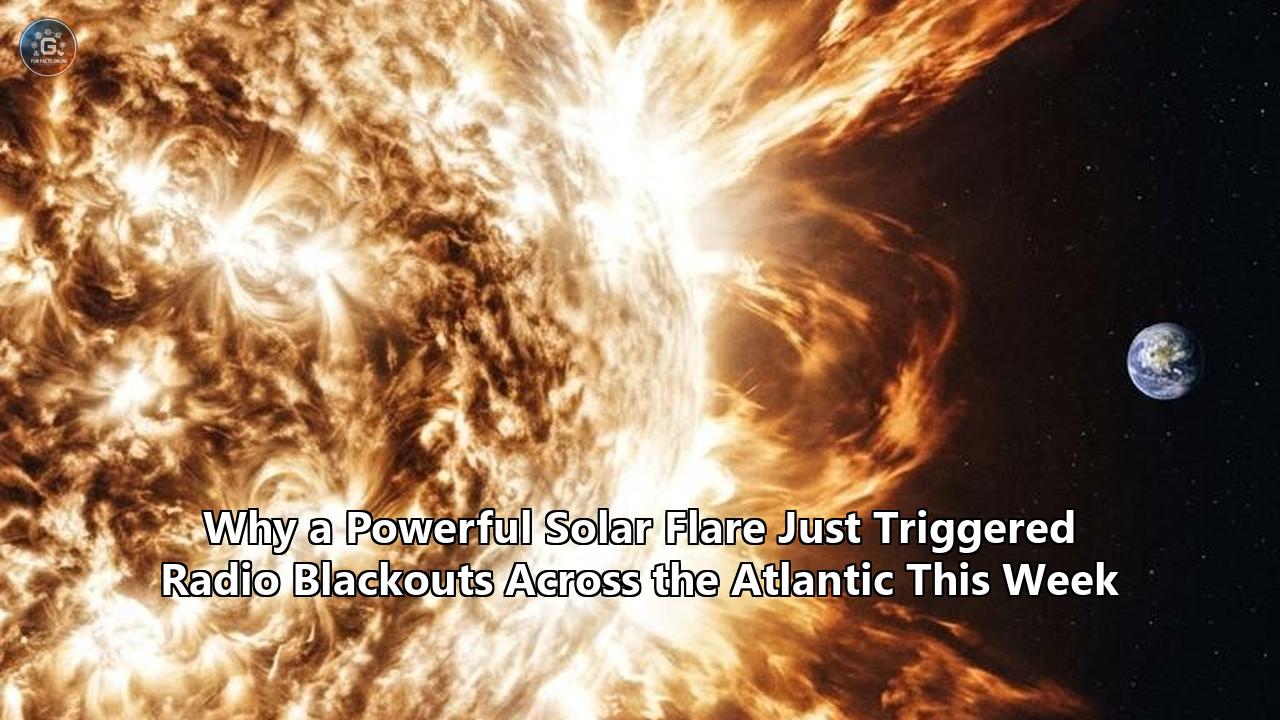
A sudden blast of high-energy radiation erupted from a magnetically tangled sunspot complex on the Sun’s surface this week, hurtling across 93 million miles of interplanetary space in just over eight minutes and striking the sunlit side of Earth. Peaking as a powerful X-class eruption—the strongest designation on the solar scale—the event triggered an immediate, widespread solar flare radio blackout across the Atlantic Ocean basin, severing high-frequency (HF) radio signals used by commercial transatlantic aviation, maritime shipping routes, emergency emergency networks, and military installations across Europe, Africa, and the Eastern Americas.
Data captured by the National Oceanic and Atmospheric Administration’s (NOAA) Space Weather Prediction Center (SWPC) and NASA’s Solar Dynamics Observatory (SDO) confirmed that soft X-ray and extreme ultraviolet (EUV) flux spiked dramatically within minutes. The sudden surge of ionizing radiation penetrated Earth’s upper atmosphere, heavily altering the electrical profile of the ionosphere and turning the lower atmospheric layers into an impenetrable wall for shortwave radio propagation.
For roughly an hour, long-distance HF communications across frequencies spanning 3 to 30 megahertz (MHz) degraded sharply or dropped into silence across oceanic corridors. Air traffic controllers managing transatlantic routes between North America and Europe faced intermittent signal loss, oceanic cargo vessels lost primary voice contact with shore stations, and amateur radio operators tracking emergency frequencies reported widespread "dead air."
While the immediate electromagnetic flash has passed, the event highlights a broader reality: Solar Cycle 25 is operating at its maximum phase, producing frequent, high-intensity eruptions that test modern communication, navigation, and power infrastructure.
+-----------------------------------------------------------------------------+
|                          SOLAR ERUPTION TO BLACKOUT                         |
|                                                                             |
|  [ SUN ] ===( X-rays & EUV @ Speed of Light: 8.3 min )===> [ EARTH IONOSPHERE ]
|     |                                                              |        |
|  Active Sunspot                                                    |  D-Layer
|  Magnetic Reconnection                                             |  Hyper-Ionized
|                                                                    v        |
|                                                         HF Radio Absorbed   |
|                                                         (3-30 MHz Blackout) |
|                                                                    |        |
|  [ Atlantic Corridor ] <-------------------------------------------+        |
|  - Transatlantic Air Flights (Shanwick / Gander Oceanic)                    |
|  - Maritime Shipping (GMDSS / High Seas Fleet)                              |
|  - Military Tactical Networks & GPS Scintillation                           |
+-----------------------------------------------------------------------------+
What Transatlantic Aviators and Mariners Experienced
The blackout hit when the Atlantic Ocean was directly beneath the midday sun, receiving the full brunt of incoming solar photon flux. Unlike terrestrial weather storms that roll in over hours, space weather events driven by electromagnetic radiation provide zero warning time between observation and atmospheric impact. The radiation travels at the speed of light ($c \approx 300,000\text{ km/s}$), meaning the instant satellites detect the X-ray spike, Earth's upper atmosphere is already absorbing the energy.
+-----------------------------------------------------------------------+
|                 ATMOSPHERIC IMPACT REGION (SUB-SOLAR POINT)           |
|                                                                       |
|                     / \                                               |
|                    /   \        Direct Radiation Shock                |
|                   /  *  \  <--- 100% Absorption Core                  |
|                  /       \      (Mid-Atlantic Corridor)               |
|                 / Europe  \                                           |
|                / & Africa  \                                          |
|               /             \   Secondary Attenuation                 |
|              / Eastern US &  \  (Degraded 10-30 MHz)                  |
|             /  South America  \                                       |
|            +-------------------+                                      |
+-----------------------------------------------------------------------+
The Transatlantic Air Corridors
Over the North Atlantic Tracks—the heavily congested airway corridors linking hubs such as London, Paris, and Frankfurt with New York, Boston, and Chicago—hundreds of widebody airliners cruise through oceanic airspace every hour. Out over open ocean water, aircraft fly far beyond the line-of-sight reach of land-based Very High Frequency (VHF) radio repeaters and ground-based primary radar systems.
To maintain contact with oceanic air traffic control centers—such as Shanwick Oceanic Control in Prestwick, Scotland, and Gander Oceanic Control in Newfoundland, Canada—pilots rely heavily on High Frequency (HF) radio networks alongside satellite-based data links:
- HF Voice Drops: When the solar flare struck, pilots attempting HF check-ins encountered heavy static or total carrier-wave attenuation.
- Controller Workarounds: Air traffic controllers relied on Controller-Pilot Data Link Communications (CPDLC) and Automatic Dependent Surveillance-Contract (ADS-C) satellite channels to verify aircraft positions and preserve safe oceanic separation buffers.
- Buffer Expansion Protocols: Standard operational guidelines mandate that when primary HF communications fail, separation standards between consecutive flights must be widened if satellite links exhibit latency, introducing operational delays and extra fuel consumption.
Commercial Shipping and Maritime Distress
In maritime sectors, the sudden blackout swept across the mid-Atlantic shipping lanes, affecting commercial container ships, bulk carriers, and long-range fishing vessels operating under the Global Maritime Distress and Safety System (GMDSS):
- High-Frequency SSB Silence: Ship-to-shore and ship-to-ship Single Sideband (SSB) HF radio channels went dead across the 4 MHz, 8 MHz, 12 MHz, and 16 MHz maritime bands.
- NAVTEX Disruption: Automated NAVTEX marine safety broadcasts transmitted on intermediate and high frequencies suffered severe packet loss and corrupt text decodes across coastal receiver stations.
- Secondary Satellite Fallback: Crews were forced to rely exclusively on satellite communications systems like Inmarsat and Iridium, which operate at higher microwave frequencies that penetrate the disturbed ionosphere without suffering equivalent absorption.
Anatomy of an X-Class Solar Flare
To understand why this solar flare radio blackout occurred, one must look at the magnetic forces operating within the Sun’s outer atmosphere, the corona.
+-------------------------------------------------------------------------+
|                  MAGNETIC RECONNECTION IN THE SOLAR CORONA              |
|                                                                         |
|     Opposing Magnetic Field Lines        Reconnection & Energy Release  |
|             (Sunspot Group)                                             |
|                                                                         |
|            |             ^                         \     /              |
|            |  Magnetic   |                          \   /               |
|            |  Shear &    |        ======>            \ /   <-- Plasma   |
|            v  Stress     |                           / \       Heating  |
|                                                     /   \  <-- Relativistic
|                                                    /     \     Particles
|                                                                         |
|     Stored Potential Energy           Accelerated Electrons -> X-rays   |
+-------------------------------------------------------------------------+
Magnetic Reconnection in Active Sunspot Regions
The Sun is not a solid sphere; it is a dynamic ball of turbulent, ionized plasma governed by magnetohydrodynamics (MHD). Because the Sun rotates differentially—faster at the equator (roughly 25 days) than at the poles (nearly 35 days)—its internal magnetic field lines become twisted, stretched, and sheared over time.
These intense magnetic loops rise to the solar surface (the photosphere), creating sunspots—dark, cooler regions characterized by magnetic field strengths thousands of times stronger than Earth’s magnetic field.
When complex, multi-polar sunspots (classified magnetically as $\beta$-$\gamma$-$\delta$ configurations) cluster together, opposing magnetic field lines are forced into close proximity under extreme tension. When the shear stress exceeds the plasma’s containment threshold, the magnetic field lines break and snap into lower-energy configurations.
This process, known as magnetic reconnection, converts immense quantities of stored magnetic potential energy into:
- Thermal Energy: Heating coronal plasma to temperatures exceeding 10 to 30 million Kelvin.
- Kinetic Energy: Accelerating electrons, protons, and heavier ions to relativistic speeds (approaching significant fractions of the speed of light).
- Electromagnetic Radiation: Generating high-intensity emissions across the entire electromagnetic spectrum, from radio waves to optical light, ultraviolet, soft X-rays, and hard X-rays.
The Physics of the Flare Classification System
NOAA categorizes solar flares based on their peak soft X-ray flux (radiant power per unit area) measured in the 0.1 to 0.8 nanometer (nm) wavelength band by the X-ray Sensor (XRS) aboard the Geostationary Operational Environmental Satellite (GOES) series. The scale is logarithmic, where each letter class represents a tenfold increase in energy output:
+-------+-----------------------------+------------------------------------+
| Class | Peak Flux Range (W/m²)      | Terrestrial Ionospheric Impact     |
+-------+-----------------------------+------------------------------------+
|   A   | 10⁻⁸ to < 10⁻⁷              | Background solar noise; no impact  |
|   B   | 10⁻⁷ to < 10⁻⁶              | Minimal; imperceptible on Earth    |
|   C   | 10⁻⁶ to < 10⁻⁵              | Minor; negligible radio effects    |
|   M   | 10⁻⁵ to < 10⁻⁴              | Moderate; minor-moderate blackouts |
|   X   | 10⁻⁴ and higher             | Severe; strong to extreme blackouts|
+-------+-----------------------------+------------------------------------+
Each letter is accompanied by a linear numerical multiplier from 1.0 to 9.9 (and beyond for X-class flares). An X2.0 flare is twice as powerful as an X1.0 flare and twenty times more powerful than an M1.0 flare. Extreme flares can surpass X10 or even X20; the historic Halloween storms of 2003 produced an estimated X28 to X45 flare that saturated the GOES detectors.
This week’s flare crossed into the X-tier, releasing radiant energy equivalent to millions of simultaneous hydrogen bomb detonations within a span of minutes.
Why High-Frequency Radio Signals Vanish
The reason an X-class solar flare knocks out shortwave communications lies in the physics of Earth’s upper atmosphere. Terrestrial shortwave communications rely on bouncing radio waves off the ionosphere to reach destinations beyond the visual horizon.
+-------------------------------------------------------------------------+
|                  SKYWAVE PROPAGATION: NORMAL VS. FLARE                  |
|                                                                         |
|   NORMAL CONDITIONS:                                                    |
|   F-Layer (Reflector)  -----------------\--------------------------     |
|                                          \                              |
|   E-Layer (Thin Ionization)               \                             |
|                                            \  Signal Refracted Back     |
|   D-Layer (Low Density)   - - - - - - - - - \ - - - - - - - - - - -     |
|                                              \                          |
|   Ground Transmitter   ====== Signal ======>  \=====> Ground Receiver   |
|                                                                         |
| ----------------------------------------------------------------------- |
|                                                                         |
|   SOLAR FLARE CONDITIONS (D-REGION ABSORPTION):                         |
|   F-Layer              --------------------------------------------     |
|                                                                         |
|   E-Layer              ~~~~~~~~~~~~~~~~~~~~~~~~~~~~~~~~~~~~~~~~~~~~     |
|                                                                         |
|   D-Layer (HYPER-IONIZED)  ========================================     |
|                            | | | | | | | | | | | | | | | | | | | |      |
|                            Radio Waves Absorbed by Collision Energy     |
|   Ground Transmitter   ===> X (SIGNAL DESTROYED IN D-LAYER)             |
+-------------------------------------------------------------------------+
The Layered Architecture of the Ionosphere
The ionosphere is a region of Earth’s upper atmosphere extending from roughly 37 miles (60 km) to over 600 miles (1,000 km) altitude, where solar ultraviolet and X-ray radiation constantly strips electrons from neutral nitrogen and oxygen atoms, creating a sea of free electrons and positive ions.
The ionosphere is structured into distinct horizontal layers based on altitude and ionization density:
- D-Layer (37 to 56 miles / 60 to 90 km): The lowest, densest region of the ionosphere. Atmospheric gas pressure here is relatively high, meaning neutral air molecules are densely packed. Under normal conditions, the D-layer only exists during daylight hours and possesses relatively weak ionization.
- E-Layer (56 to 93 miles / 90 to 150 km): A moderately ionized mid-tier layer that assists in day-to-day radio refraction and short-range skip communications.
- F-Layer (93 to 300+ miles / 150 to 500 km): The primary refracting layer for long-distance skywave communications. At these high altitudes, atmospheric density is extremely low. Free electrons persist for hours without recombining with ions, allowing radio signals to bend (refract) smoothly and bounce back down to Earth thousands of miles away.
Skywave (Skip) Radio Propagation
When a high-frequency transmitter sends a signal toward the sky, the radio wave interacts with free electrons in the ionosphere. The oscillating electric field of the radio wave forces these free electrons to vibrate.
In the high-altitude F-layer, where ambient neutral gas atoms are sparse, the vibrating electrons re-radiate the electromagnetic wave without losing energy to physical collisions. The wave gradually bends along a curved trajectory until it points back toward Earth’s surface. This mechanism—known as skywave propagation or "skip"—enables global, over-the-horizon shortwave broadcasting, long-distance military links, and transoceanic aviation communications without underwater cables or orbital satellites.
+--------------------------------------------------------------------+
|                   MATHEMATICAL BASIS OF ABSORPTION                 |
|                                                                    |
|   Collision Frequency:                                             |
|   nu_en = n_n * sigma_en * sqrt( (8 * k_B * T_e) / (pi * m_e) )    |
|                                                                    |
|   Attenuation Coefficient:                                         |
|   alpha = (e^2 / (2 * epsilon_0 * m_e * c)) *                      |
|           ( (N_e * nu_en) / (omega^2 + nu_en^2) )                  |
|                                                                    |
|   Where:                                                           |
|   - N_e = Free electron density (spikes 100x during flare)         |
|   - nu_en = Electron-neutral collision frequency                   |
|   - omega = Angular operating frequency of radio wave (2*pi*f)     |
|   - Attenuation scales inversely with frequency squared (1 / f^2)  |
+--------------------------------------------------------------------+
The Mechanism of D-Region Absorption (DRAP)
During a major solar eruption, the physics reverses. High-energy soft X-rays ($0.1\text{ to }0.8\text{ nm}$) possess short wavelengths and immense penetrating power. Unlike lower-energy UV photons that are absorbed high up in the F and E layers, hard and soft X-rays plunge deep into the atmosphere, ionizing the dense neutral gas within the D-layer.
This sudden surge in D-layer electron density causes immediate problems for radio waves:
- Elevated Collision Frequency: Because the D-layer sits at lower altitudes where atmospheric pressure is high, the mean free path between gas molecules is short. The electron-neutral collision frequency ($\nu_{en}$) is very high—approaching tens of millions of collisions per second.
- Kinetic Energy Loss: When an HF radio wave enters this hyper-ionized D-layer, its electric field sets the free electrons in motion. However, before these electrons can re-radiate the radio signal upward toward the F-layer, they collide with neutral nitrogen ($N_2$) and oxygen ($O_2$) molecules.
- Thermal Dissipation: Each collision transfers the electron's kinetic energy into thermal energy within the neutral gas.
- Signal Extinction: Instead of passing through the D-layer to bounce off the F-layer, the HF radio signal is absorbed and converted into heat.
This process, termed Sudden Ionospheric Disturbance (SID) or D-Region Absorption, creates a total fadeout across HF frequencies. As shown in the attenuation formula, absorption is inversely proportional to the square of the operating frequency ($\alpha \propto 1/f^2$). Lower frequencies (3 to 10 MHz) are absorbed almost instantly, while higher frequencies (15 to 30 MHz) suffer varying degrees of attenuation depending on the flare's strength.
The NOAA Space Weather Scales: Quantifying Radio Blackouts
To communicate space weather risks clearly to critical infrastructure operators, military commands, and civil aviation authorities, NOAA established three primary space weather scales:
- R-Scale: Radio Blackouts (driven by solar flare X-rays)
- S-Scale: Solar Radiation Storms (driven by energetic solar protons)
- G-Scale: Geomagnetic Storms (driven by coronal mass ejection plasma clouds)
The R-Scale ranges directly from R1 (Minor) to R5 (Extreme), mapped strictly to the peak soft X-ray flux measured by geostationary satellites:
+-------+----------------+--------------+------------------+------------------------------------+
| Scale | Classification | GOES X-Ray   | HF Radio Impact  | Typical Transatlantic Aviation     |
| Level | Severity       | Peak Flux    | Frequency Span   | Consequences                       |
+-------+----------------+--------------+------------------+------------------------------------+
|  R1   | Minor          | M1 (10⁻⁵)    | Weak degradation | Minor loss of low-band HF on       |
|       |                |              | at low HF freqs  | sunlit routes; minimal disruption. |
+-------+----------------+--------------+------------------+------------------------------------+
|  R2   | Moderate       | M5 (5×10⁻⁵)  | Limited loss     | Noticeable signal drop on 3-10 MHz;|
|       |                |              | (tens of mins)   | pilots step up to higher bands.    |
+-------+----------------+--------------+------------------+------------------------------------+
|  R3   | Strong         | X1 (10⁻⁴)    | Wide-area loss   | Extensive blackout across daylight |
|       |                |              | (1 to 2 hours)   | hemisphere; oceanic ATC rerouting. |
+-------+----------------+--------------+------------------+------------------------------------+
|  R4   | Severe         | X10 (10⁻³)   | Total blackout   | Complete HF communication loss for |
|       |                |              | for 1-2 hours    | hours; SATVOICE/CPDLC saturated.   |
+-------+----------------+--------------+------------------+------------------------------------+
|  R5   | Extreme        | X20 (2×10⁻³) | Complete failure | Complete daylight hemisphere radio |
|       |                |              | for entire event | shutdown; severe GPS positioning   |
|       |                |              |                  | errors and transoceanic halts.     |
+-------+----------------+--------------+------------------+------------------------------------+
This week’s event reached the R3 (Strong) threshold, causing an extensive solar flare radio blackout that affected shortwave frequencies up to 20–25 MHz across the sub-solar point and adjacent Atlantic sectors.
Flares vs. Coronal Mass Ejections: Disentangling Light from Plasma
One common source of confusion in space weather reporting is the distinction between a solar flare and a Coronal Mass Ejection (CME). While both phenomena originate from magnetic instabilities in active solar regions and often occur simultaneously, they represent fundamentally different physics, travel at vastly different velocities, and interact with Earth through entirely distinct mechanisms.
+-----------------------------------------------------------------------------+
|                      FLARE VS. CORONAL MASS EJECTION (CME)                  |
|                                                                             |
|  CHARACTERISTIC     | SOLAR FLARE                 | CORONAL MASS EJECTION   |
|  -------------------+-----------------------------+-----------------------  |
|  Composition        | Photons (X-rays, EUV light) | Ionized Plasma (Protons,|
|                     |                             | Electrons, Helium ions) |
|  Velocity           | Speed of Light (c)          | 300 to 3,000 km/s       |
|  Transit Time       | 8.3 Minutes                 | 15 to 72 Hours          |
|  Earth Target Zone  | Sunlit Daylight Hemisphere  | Magnetosphere & Poles   |
|  Primary Impact     | Ionospheric Ionization &    | Geomagnetic Induction & |
|                     | Radio Blackouts (R-Scale)   | Power Grid Storms (G)   |
|  Duration of Event  | Minutes to a Few Hours      | Hours to Multiple Days  |
+-----------------------------------------------------------------------------+
+-------------------------------------------------------------------------+
| TIMELINE OF A COMPLETE SOLAR STORM EVENT |
| |
| T = 0 min T = 8.3 min T = 20-60 min T = 15-72 hr |
| Eruption on Sun X-Ray Flash Solar Protons CME Arrives |
| Strikes Earth Arrive (SEP) at Earth L1 |
| |
| [Reconnection] ==> [ R-Scale ] ======> [ S-Scale ] =====> [ G-Scale ] |
| Coronal explosion D-Layer Ionized Polar Cap Magnetosphere|
| Atlantic Radio Absorption; Compressed; |
| Blackout Satellite Damage Power Grids |
| & Auroras |
+-------------------------------------------------------------------------+The 8.3-Minute Photonic Shock
A solar flare consists purely of electromagnetic energy. It cannot be deflected by Earth’s geomagnetic field because photons carry no electric charge.
The moment the magnetic field lines reconnect in the solar corona, the burst of X-rays and ultraviolet light spreads radially outward across space. It reaches Earth at $T + 8.3\text{ minutes}$, acting exclusively on the illuminated half of the planet. It does not induce currents in long-distance electrical power grids on the ground, nor does it generate polar auroral displays. Its primary disruption is immediate ionization of the upper atmosphere and the resulting degradation of radio signals.
The 1-to-3-Day Plasma Bulk
A Coronal Mass Ejection, by contrast, is a massive expulsion of physical matter: billions of tons of magnetized coronal plasma hurled into the interplanetary medium.
Because plasma consists of physical particles with mass, it travels far slower than light—typically between 1 million and 5 million miles per hour ($400\text{ to }2,200\text{ km/s}$). A CME takes anywhere from 15 to 72 hours to traverse the Sun-Earth distance.
When a CME strikes Earth:
- It interacts directly with Earth’s geomagnetic field, compressing the sunward magnetopause and driving strong electrical currents through the magnetosphere and ionosphere.
- This triggers Geomagnetic Storms (G-Scale), generating brilliant auroras at lower latitudes, inducing geomagnetically induced currents (GICs) in high-voltage electrical transmission grids, and degrading pipeline monitoring systems.
- The flare produces the instant radio blackout; the accompanying CME produces the delayed geomagnetic storm.
Critical Sectors Vulnerable to Radio Blackouts
Modern infrastructure relies on the continuous availability of the electromagnetic spectrum. When a solar flare radio blackout suppresses shortwave propagation, vulnerabilities emerge across multiple economic and operational sectors.
+-----------------------------------------------------------------------------+
|                      SECTORS HIT BY HIGH-FREQUENCY BLACKOUTS                |
|                                                                             |
|  +-----------------------------------------------------------------------+  |
|  | COMMERCIAL AVIATION                                                   |  |
|  | - Loss of transoceanic HF voice links (Shanwick, Gander, Santa Maria)  |  |
|  | - Mandatory increases in flight separation buffers                     |  |
|  | - Costly rerouting away from polar and oceanic routes                  |  |
|  +-----------------------------------------------------------------------+  |
|  | MARITIME SHIPPING                                                     |  |
|  | - Drop in GMDSS long-range distress channels (4-16 MHz SSB)           |  |
|  | - Interruption of high-seas weather facsimile (WEFAX) broadcasts      |  |
|  | - Automated safety information (NAVTEX) corruption                    |  |
|  +-----------------------------------------------------------------------+  |
|  | DEFENSE & TACTICAL NETWORKS                                           |  |
|  | - Disruption of Over-The-Horizon (OTH) radar surveillance networks    |  |
|  | - Degradation of beyond-line-of-sight HF tactical military data links |  |
|  | - Secondary GPS signal scintillation and carrier slip lock            |  |
|  +-----------------------------------------------------------------------+  |
|  | EMERGENCY SERVICES & DISASTER RESPONSE                                 |  |
|  | - Ham radio emergency networks silenced during hurricane responses    |  |
|  | - Secondary shortwave backup infrastructure failures                  |  |
|  +-----------------------------------------------------------------------+  |
+-----------------------------------------------------------------------------+
1. Transatlantic Commercial Aviation Logistics
Under International Civil Aviation Organization (ICAO) standards, aircraft traversing oceanic or remote continental airspaces must maintain continuous two-way communication with regional air traffic control centers.
When an R3-level radio blackout occurs over the North Atlantic:
- HF Voice Congestion: As lower-frequency channels (5.6 MHz, 8.8 MHz) drop out, pilots attempt to switch to higher frequencies (13.3 MHz, 17.9 MHz) simultaneously, causing severe channel congestion and stepped-on transmissions.
- Oceanic Separation Penalties: Under standard procedural separation, aircraft without reliable direct communication must be spaced further apart. Instead of flying closely packed fuel-efficient flight tracks, aircraft may be held on ground stops or diverted to less efficient altitudes.
- Fuel Consumption Costs: Diverting off optimized transatlantic tracks adds flight time, burning thousands of pounds of extra jet fuel per flight. When scaled across the hundreds of flights traversing the Atlantic daily, a multi-hour space weather disruption creates significant operating expenses for commercial airlines.
2. High-Seas Maritime Operations
Under the International Maritime Organization (IMO) Safety of Life at Sea (SOLAS) convention, commercial vessels operating outside coastal VHF range rely on the Global Maritime Distress and Safety System (GMDSS).
During severe D-region absorption events:
- Safety Broadcasts Down: High-seas weather facsimile (WEFAX) broadcasts, which transmit live weather maps and storm warnings to ships via shortwave, become illegible due to signal dropout.
- Digital Selective Calling (DSC): Automated HF distress monitoring stations experience packet decode failures, reducing distress alert reliability for non-satellite-equipped vessels.
3. Tactical Defense and Over-the-Horizon Radar
Modern defense architectures rely heavily on high-frequency Over-The-Horizon Radar (OTHR) arrays (such as the United States' ROTHR and Australia's Jindalee Operational Radar Network).
These systems transmit high-power HF signals into the ionosphere, bouncing them back down over the horizon to detect maritime surface vessels, low-flying cruise missiles, and aircraft thousands of miles away.
During an R3 to R5 blackout:
- The ionosphere's lower boundary becomes an absorbing sponge rather than a coherent reflector.
- Over-the-horizon radar screens can go completely blind over the daylight operating sector, degrading situational awareness across thousands of square miles of ocean.
4. Coincident Natural Disasters and Space Weather
The risks of radio blackouts increase dramatically when space weather events coincide with severe terrestrial weather events.
A well-documented historical example occurred in September 2017, when Category 5 Hurricane Irma swept through the Caribbean Sea. While emergency response teams and amateur radio disaster networks (such as the Hurricane Watch Net) were coordinating medical evacuations and search-and-rescue efforts, the Sun unleashed a series of massive X9.3 and X2.2 solar flares.
The resulting solar flare radio blackout silenced shortwave frequencies for hours across the disaster zone, severing vital communication links for first responders on islands where terrestrial cellular and power grids had already been destroyed.
Satellite Infrastructure, GPS Scintillation, and Orbital Drag
While solar flares primarily target high-frequency radio waves, their energy inputs propagate throughout the entire upper atmospheric column, creating secondary hazards for space-based systems, global navigation constellations, and low-Earth-orbit (LEO) satellites.
+--------------------------------------------------------------------+
|               SECONDARY IMPACTS ON SATELLITE SYSTEMS               |
|                                                                    |
|  1. IONOSPHERIC TOTAL ELECTRON CONTENT (TEC) PERTURBATION          |
|     Solar Flare Photon Blast ===> Extreme Ionization in F-Layer    |
|     ===> Rapid Shifts in Electron Density Along Raypath            |
|     ===> GPS/GNSS Signal Phase Advance & Group Delay               |
|     ===> Positioning Drift & Loss of Carrier Lock                  |
|                                                                    |
|  2. THERMOSPHERIC HEATING & DENSITY EXPANSION                      |
|     EUV Absorption ===> Neutral Atmosphere Heats up to 1,500 K     |
|     ===> Upper Atmosphere Expands Upward into Space                |
|     ===> Increased Aerodynamic Drag on LEO Satellites              |
|     ===> Orbital Altitude Decay & Tracking Conjunction Alerts      |
+--------------------------------------------------------------------+
Global Navigation Satellite System (GNSS) Errors
Global Positioning System (GPS), Galileo, GLONASS, and BeiDou satellites do not operate on HF shortwave bands; they transmit ultra-high-frequency microwave signals ($L_1$ at 1575.42 MHz, $L_2$ at 1227.60 MHz, and $L_5$ at 1176.45 MHz) designed to pass cleanly through the ionosphere.
However, the rapid influx of EUV radiation during a major flare causes sudden spikes in the ionosphere’s Total Electron Content (TEC)—the total number of free electrons along a cylinder of one square meter cross-section stretching from the satellite down to the receiver on Earth.
+-------------------------------------------------------------------------+
|                  GPS SIGNAL PERTURBATION DURING A FLARE                 |
|                                                                         |
|     GPS Satellite (20,200 km)                                           |
|            \                                                            |
|             \   Microwave Carrier Wave (1.575 GHz)                      |
|              \                                                          |
|      ~~~~~~~~~\~~~~~~~~~~~~~~~~~~~~~~~~~~~~~~~~~~~~~~~~~~               |
|      F-Layer   \  IONOSPHERIC SCINTILLATION                             |
|                 \ - Rapid TEC gradients introduce signal delay          |
|      ~~~~~~~~~~~~\~~~~~~~~~~~~~~~~~~~~~~~~~~~~~~~~~~~~~~~               |
|                   \                                                     |
|      ==============\=====================================               |
|      D-Layer        \ - Rapid phase variations                          |
|      ================\===================================               |
|                       \                                                 |
|                        v                                                |
|               Receiver on Earth (Aviation / Precision Ag)               |
|               * Uncorrected position errors jump from cm to meters      |
|               * Receiver loses carrier lock (cycle slips)               |
+-------------------------------------------------------------------------+
These sudden TEC gradients disrupt GPS signals in several ways:
- Ionospheric Group Delay: The signal slows down as it interacts with the altered electron density, introducing pseudo-range errors that degrade position fixes from sub-meter accuracy to tens of meters if single-frequency receivers cannot correct for it.
- Ionospheric Scintillation: Rapid, localized fluctuations in electron density act like optical turbulence, causing the microwave radio signal to refract and scatter irregularly. This causes the signal amplitude and phase to fluctuate rapidly, causing receivers to lose lock on satellite carrier waves.
- Precision Applications at Risk: Precision agriculture operations using real-time kinematic (RTK) positioning, automated maritime port container cranes, and offshore oil drilling platforms relying on dynamic positioning systems experience loss-of-lock alerts during major solar flares.
Thermospheric Neutral Density Inflation and Orbital Drag
The energy deposited by a major solar flare does not simply disappear; it heats the neutral upper atmosphere (the thermosphere), raising its temperature by hundreds of degrees.
As the thermosphere heats, it expands outward into space like a thermal balloon. Altitudes of 250 to 500 miles (400 to 800 km)—where thousands of commercial LEO satellite constellations (such as SpaceX’s Starlink) and the International Space Station orbit—experience sudden increases in atmospheric density.
This elevated neutral density produces noticeable orbital effects:
- Elevated Aerodynamic Drag: Satellites encounter increased resistance, slowing their orbital velocity.
- Unpredicted Altitude Decay: Satellites drop out of their expected orbital tracks faster than ground-tracking models anticipate.
- Conjunction Risk: Satellite operators must spend additional propulsion propellant firing thrusters to raise altitude, while space-tracking radars must update orbital element sets to prevent potential collisions among thousands of closely spaced objects.
Solar Cycle 25: Why Eruptions Are Multiplying
The high-intensity solar activity observed this week is a direct result of the Sun’s natural 11-year magnetic cycle, known as the Schwabe Cycle.
+-------------------------------------------------------------------------+
|                    THE 11-YEAR SCHWABE SOLAR CYCLE                      |
|                                                                         |
|   Active Sunspot                                                        |
|   Count                                                                 |
|     ^                                                                   |
|     |                     SOLAR MAXIMUM (2024 - 2026)                   |
| 200 |                          /\     /\                                |
|     |                         /  \   /  \    <-- Current Activity       |
| 150 |                        /    \ /    \       (Cycle 25 Peaks)       |
|     |          /\           /      V      \                             |
| 100 |         /  \         /               \                            |
|     |        /    \       /                 \                           |
|  50 |       /      \     /                   \                          |
|     |  ____/        \___/                     \____                     |
|   0 +------------------------------------------------------------> Time |
|       2019          2021          2024-2026         2030                |
|     Solar Min                 Cycle 25 Maximum    Solar Min             |
+-------------------------------------------------------------------------+
The Solar Dynamo and Polarity Inversion
Every 11 years, the Sun’s internal magnetic field completely flips; its magnetic north pole becomes the south pole, and vice versa. This transition is governed by the solar dynamo—the physical process by which the kinetic energy of circulating plasma deep in the convection zone is converted into magnetic energy.
- Solar Minimum: The solar magnetic field is orderly and dipolar, resembling a simple bar magnet. Sunspots are rare, and solar flares are virtually absent.
- Solar Maximum: As differential rotation twists the magnetic field lines over years, the solar magnetic architecture becomes chaotic. Hundreds of sunspots erupt across the solar surface, creating tangled magnetic field regions capable of triggering major X-class solar flares and fast-moving coronal mass ejections.
The Trajectory of Solar Cycle 25
When Solar Cycle 25 began in December 2019, consensus panels initially forecasted a relatively mild cycle, comparable to the subdued activity of Solar Cycle 24.
However, observed reality outpaced those initial models. The monthly smoothed sunspot count has consistently exceeded NOAA and NASA baseline predictions, producing high numbers of M-class and X-class flares alongside large, complex sunspot groups (such as active regions AR3664 and AR3697).
Scientists anticipate that the Sun will continue producing frequent high-intensity flares and space weather disturbances throughout this peak phase before activity begins a gradual decline toward the next solar minimum around 2030.
Historical Precedents: Lessons from Past Storms
Extreme solar eruptions are natural features of solar physics. Reviewing historical space weather events underscores how technological evolution continually increases our vulnerability to these storms.
+-----------------------------------------------------------------------------+
|                     CHRONOLOGY OF MAJOR SPACE WEATHER STORMS                |
|                                                                             |
|  [1859] CARRINGTON EVENT                                                    |
|  - Largest documented solar flare (~X40-X50 equivalent)                     |
|  - Telegraph systems sparked; operators shocked; papers caught fire         |
|  - Global auroral displays visible in the tropics                           |
|                                                                             |
|  [1989] QUEBEC HYDRO-QUÉBEC COLLAPSE                                        |
|  - Major X15-class flare followed by an extreme CME                         |
|  - Induced ground currents tripped grid relays in 92 seconds                |
|  - 6 million people lost power for over 9 hours                             |
|                                                                             |
|  [2003] HALLOWEEN SOLAR STORMS                                              |
|  - Series of intense flares including an historic X28-X45 event             |
|  - GOES X-ray sensors saturated; aircraft rerouted; Swedish grid failed     |
|  - FAA's WAAS GPS navigation system disabled for roughly 30 hours           |
|                                                                             |
|  [2017] HURRICANE IRMA COINCIDENCE                                         |
|  - X9.3 solar flare triggered hours-long HF radio blackout                  |
|  - Critical emergency response communications silenced across Caribbean     |
+-----------------------------------------------------------------------------+
The 1859 Carrington Event
In September 1859, British astronomers Richard Carrington and Richard Hodgson independently observed the first recorded solar flare—a blinding white-light flash bursting from a massive sunspot cluster.
Eighteen hours later, an immense CME struck Earth's magnetosphere, producing the most intense geomagnetic storm in recorded history:
- Telegraph networks across North America and Europe shorted out; operators reported electric shocks, sparks flew from transmission equipment, and some telegraph lines functioned entirely on induced atmospheric currents with their batteries disconnected.
- Auroral skies glowed bright enough to read newspapers at midnight as far south as the Caribbean and Hawaii.
- If an event of Carrington magnitude occurred today, the simultaneous loss of satellites, high-voltage transformers, and global communication networks would present catastrophic risks to modern electrical and digital infrastructure.
The 1989 Hydro-Québec Blackout
In March 1989, an X15 solar flare accompanied by a fast CME slammed into Earth, driving strong telluric currents through North American bedrock:
- The geomagnetically induced currents (GICs) saturated high-voltage power transformer cores in Canada, causing harmonic distortion that tripped safety breakers in 92 seconds.
- The entire Hydro-Québec electrical grid collapsed, leaving six million people without electricity for nine hours in freezing temperatures.
- In space, the storm caused over-the-horizon military tracking radars to lose thousands of orbital objects due to sudden atmospheric drag expansion.
The 2003 Halloween Storms
During late October and early November 2003, the Sun unleashed a series of massive flares, culminating in an eruption estimated between X28 and X45:
- The intense X-ray flash saturated the detectors on the GOES-11 satellite, driving them off the chart.
- The FAA's Wide Area Augmentation System (WAAS)—which provides precision GPS navigation signals for commercial aviation—was disabled for approximately 30 hours due to severe ionospheric scintillation.
- Commercial airliners avoided polar routes due to radiation concerns and total high-frequency radio loss, while power networks in Malmö, Sweden, suffered transformer burnouts and blackouts.
Engineering Resilience: How Modern Systems Mitigate Space Weather
Because society cannot prevent the Sun from erupting, engineering standards, operational protocols, and communication designs must be built to withstand sudden ionospheric disruptions.
+-------------------------------------------------------------------------+
|                  RESILIENCE ARCHITECTURES FOR RADIO BLACKOUTS           |
|                                                                         |
|  TECHNIQUE                     | OPERATIONAL MECHANISM                  |
|  ------------------------------+--------------------------------------  |
|  Automatic Link Establishment  | Radios rapidly scan 2 to 30 MHz to     |
|  (ALE 2G / 3G / 4G)            | lock onto remaining usable frequencies.|
|                                |                                        |
|  Dual-Frequency GNSS           | Receivers combine L1/L2/L5 signals     |
|  (L1 + L2 / L5 Processing)     | to mathematically cancel out delay.    |
|                                |                                        |
|  Multi-Constellation LEO       | High-frequency Ku/Ka-band links        |
|  Satellite Data Relays         | bypass D-region absorption entirely.   |
|                                |                                        |
|  Real-Time Space Weather       | Automated warnings trigger rerouting   |
|  Monitoring & Alerting         | protocols before critical steps fail.  |
+-------------------------------------------------------------------------+
+--------------------------------------------------------------------+
| HOW DUAL-FREQUENCY GNSS CANCELS DELAY |
| |
| First-order ionospheric delay equation: |
| Delta_t = (40.3 * TEC) / (c * f^2) |
| |
| By measuring the arrival time difference between two separate |
| frequencies (f_1 and f_2): |
| |
| Delta_t_1 - Delta_t_2 = (40.3 * TEC / c) * (1/f_1^2 - 1/f_2^2) |
| |
| Receiver isolates and eliminates the variable TEC term, |
| removing ~99% of ionospheric delay errors automatically. |
+--------------------------------------------------------------------+1. Automatic Link Establishment (ALE)
Modern military and emergency shortwave transceivers avoid relying on fixed radio frequencies. Instead, they use standardized protocols known as Automatic Link Establishment (MIL-STD-188-141D / STANAG 4538):
- ALE-equipped radios continuously scan across pre-programmed high-frequency channels, transmitting brief handshake signals and measuring the Signal-to-Noise Ratio (SNR) and Bit Error Rate (BER) on each channel.
- When a solar flare radio blackout hits the lower HF frequencies (e.g., 3 to 10 MHz), the ALE system detects the sudden signal degradation and automatically shifts the radio network to higher, less attenuated frequencies (e.g., 20 to 28 MHz) within seconds, maintaining connectivity without manual operator intervention.
2. Dual-Frequency Ionospheric Cancellation
To prevent solar flare-driven TEC variations from degrading satellite navigation, modern aviation receivers, military systems, and contemporary smartphones use multi-band GNSS chips:
- Because ionospheric delay is inversely proportional to the square of the frequency ($\Delta t \propto 1/f^2$), transmitting two separate frequencies ($L_1$ and $L_2$, or $L_1$ and $L_5$) allows the receiver to compare the slight arrival time difference between the two signals.
- The receiver calculates the exact Total Electron Content along its line of sight and mathematically subtracts the delay, eliminating up to 99% of flare-induced positioning errors in real time.
3. Redundant Satellite Data Links (SATVOICE and CPDLC)
Commercial aviation continues transitioning away from exclusive reliance on analog HF voice channels over remote oceanic routes:
- CPDLC via Satcom: Controller-Pilot Data Link Communications transmit digital text instructions (altitudes, headings, weather deviations) directly via geostationary and low-Earth-orbit satellites using L-band, Ku-band, and Ka-band frequencies (1 to 30 GHz).
- Microwave Immunity: At these higher microwave frequencies, the energy passes cleanly through the ionized D-layer without suffering significant absorption, providing a reliable communication path when shortwave bands go dark.
The 72-Hour Outlook: What Scientists and Operators Are Watching
Following an X-class solar flare and the immediate solar flare radio blackout it produces, the operational focus shifts from the initial light flash to potential subsequent impacts over the following 24 to 72 hours.
+-------------------------------------------------------------------------+
|                  THE 72-HOUR SPACE WEATHER WATCH PROTOCOL               |
|                                                                         |
|  PHASE 1: (T + 0 to 2 Hours) - THE LIGHT FLASH                          |
|  - GOES detects soft X-ray flux peak.                                   |
|  - NOAA SWPC issues immediate R-Scale (Radio Blackout) alert.           |
|  - Atlantic HF communication channels absorb and drop out.              |
|  - [STATUS: COMPLETED THIS WEEK]                                        |
|                                                                         |
|  PHASE 2: (T + 20 Minutes to 24 Hours) - THE PROTON STORM               |
|  - Relativistic solar protons arrive along interplanetary field lines.  |
|  - Polar Cap Absorption (PCA) events disrupt transpolar flights.        |
|  - Satellite solar arrays experience memory bit flips and degradation.  |
|  - [STATUS: ACTIVE MONITORING]                                          |
|                                                                         |
|  PHASE 3: (T + 15 to 72 Hours) - THE CME SHOCKWAVE                      |
|  - SOHO/LASCO and STEREO coronagraphs confirm Earth-directed CME mass.  |
|  - L1 monitors (DSCOVR, ACE) track magnetic field orientation (Bz).     |
|  - Power grid operators brace for induced ground currents (G-Scale).    |
|  - [STATUS: APPROACHING EARTH]                                          |
+-------------------------------------------------------------------------+
1. Solar Energetic Particle (SEP) Events (S-Scale)
When a powerful flare erupts alongside a CME, relativistic shockwaves accelerate free protons and ions to near-light speeds, producing a Solar Radiation Storm:
- Guided by Earth's geomagnetic field lines, these charged protons funnel directly into the polar upper atmosphere, causing Polar Cap Absorption (PCA) events that silence high-frequency communications on polar aviation routes.
- Space agencies monitor these particle streams because high-energy protons can penetrate satellite shielding, causing Single Event Upsets (SEUs)—logic errors and memory corruptions in orbital avionics—and posing radiation risks to astronauts aboard the International Space Station.
2. Tracking Coronal Mass Ejections via Coronagraphs
Scientists at NOAA SWPC and international space agencies rely on space-based coronagraphs—such as the Large Angle and Spectrometric Coronagraph (LASCO) aboard the ESA/NASA SOHO spacecraft and NASA's STEREO-A satellite:
- Coronagraphs use an occulting disk to block the blinding light of the Sun's disk, revealing faint plasma ejections expanding into space.
- If coronagraph imagery reveals a halo CME—a growing ring of plasma expanding symmetrically around the occulting disk—it confirms that the plasma cloud is traveling directly along the Sun-Earth line.
+--------------------------------------------------------------------+
|                  THE CRUCIAL L1 TRIPWIRE (DSCOVR / ACE)            |
|                                                                    |
|   Sun =========> CME Plasma Wave (450-1,200 km/s)                  |
|                                  |                                 |
|                                  v                                 |
|                         [ L1 Lagrange Point ]                      |
|                         1 Million Miles from Earth                 |
|                         (DSCOVR / ACE Satellites)                  |
|                                  |                                 |
|             Measures: - Velocity and Density of Plasma             |
|                       - Magnetic Vector Direction (Bz)             |
|                                  |                                 |
|                                  v                                 |
|                   Earth Gets 15-45 Minute Early Warning            |
|                   Before Magnetospheric Impact                     |
+--------------------------------------------------------------------+
3. The L1 Early-Warning Tripwire
Located approximately one million miles (1.5 million km) sunward of Earth at the First Lagrange Point ($L_1$), monitoring satellites like NOAA's Deep Space Climate Observatory (DSCOVR) and the Advanced Composition Explorer (ACE) serve as an early-warning tripwire.
When a CME passes over the $L_1$ monitor:
- Direct Measurement: The satellite's onboard plasma instruments directly measure the solar wind velocity, density, temperature, and magnetic field vector.
- The $B_z$ Determinant: Forecasters analyze the north-south direction ($B_z$) of the CME's internal magnetic field. If the magnetic field points southward (opposing Earth's northward-pointing magnetic field), it undergoes rapid magnetic reconnection with Earth's magnetosphere, channeling energy into the upper atmosphere and triggering a major Geomagnetic Storm (G-Scale).
- Actionable Lead Time: The measurements at $L_1$ provide high-voltage power grid operators, satellite flight dynamics teams, and pipeline controllers a crucial 15 to 45-minute tactical warning window to reconfigure systems, place backup generators on standby, and safeguard critical networks before the plasma shockwave strikes Earth's magnetosphere.
Looking Ahead
This week's solar flare and the resulting radio blackout over the Atlantic Ocean highlight the dynamic connection between solar magnetic physics and modern ground and space systems. The event followed a classic space weather sequence: a rapid magnetic reconnection event in the solar corona generated an intense flash of X-rays and EUV photons that ionized the upper atmosphere in just over eight minutes, temporarily disrupting HF radio communications across the sunlit side of the planet.
As Solar Cycle 25 continues through its peak phase, infrastructure operators are tracking space weather data with renewed focus. High-frequency aviation and maritime channels, GPS navigation links, and low-Earth-orbit satellite networks will remain exposed to sudden solar disruptions over the coming years.
Forecasting centers around the globe—including NOAA’s Space Weather Prediction Center, the European Space Agency’s Space Safety Programme, and scientific monitoring stations worldwide—continue monitoring the Sun's active regions around the clock, providing timely alerts as our technological society navigates the ongoing rhythms of our nearest star.
Reference:
- https://www.spaceweather.gov/phenomena/solar-flares-radio-blackouts
- https://www.hindustantimes.com/world-news/us-news/xclass-solar-flare-triggers-radio-blackout-across-the-us-see-map-101750440313966.html
- https://www.cbsnews.com/news/x-class-solar-flares-radiation-storms-possible-july-17/
- https://news.agu.org/press-release/solar-flares-disrupted-radio-communications-during-september-2017-atlantic-hurricane-relief-effort/
- https://www.space.com/stargazing/sun-unleashes-powerful-x-class-solar-flare-and-earth-bound-cme-that-could-spark-northern-lights-for-july-4-weekend
- https://www.newsweek.com/x-class-solar-flare-radio-blackout-sunspots-sun-america-1981516