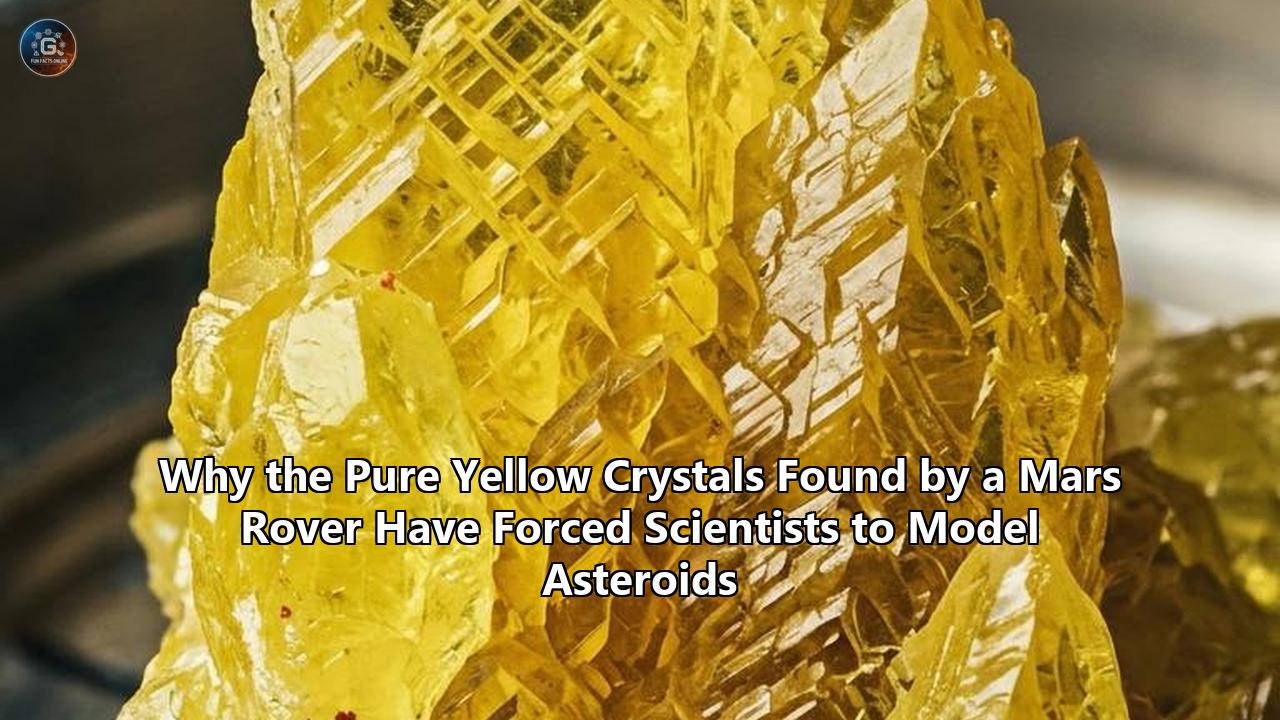
When NASA’s Curiosity rover rolled over a fragile, dusty rock in Gale Crater on May 30, 2024, the heavy machine accidentally crushed it under its 899-kilogram frame. The split rock, later nicknamed "Convict Lake," spilled open to reveal glittering, bright yellow sulfur crystals Mars researchers had never seen before in native, elemental form.
While sulfates—salts containing sulfur bound to oxygen and other minerals—are incredibly common on the Martian surface, pure native sulfur is an entirely different geological beast. On Earth, elemental sulfur deposits typically require highly active geothermal environments, volcanic vents, or specialized microbial ecosystems to form. Yet, the region surrounding Curiosity's find, the Gediz Vallis channel, shows no evidence of active volcanic activity during the era when these deposits were laid down.
For two years, this discovery remained one of the most frustrating enigmas of modern planetary science. Now, a study published in the journal Icarus by planetary scientist Dr. Luca Maggioni and an international team of researchers has proposed a solution. Millions of years ago, a massive asteroid slammed into a sulfur-rich underground deposit uphill from Gediz Vallis. The extreme heat of the impact melted the sulfur, turning it into a highly fluid, liquid river that cascaded down the mountain slopes, pooled behind rock barriers, and cooled into the pristine crystalline deposits observed today.
But testing this hypothesis was not simple. To prove that a meteor strike could have acting as a massive geological refinery, Maggioni’s team had to run advanced computer simulations of the impact. In doing so, they exposed a glaring gap in our fundamental understanding of planetary materials: scientists do not possess a high-pressure physical model for sulfur.
The effort to decode the yellow sulfur crystals Mars holds in its crust has forced physicists and planetary modelers to confront this missing data, driving an urgent initiative to model how volatile, non-silicate materials behave under the extreme shock conditions of cosmic collisions.
The Chemical Conundrum of Gale Crater
To appreciate why this discovery baffled researchers, it is necessary to understand the distinct chemical differences between the sulfur compounds previously found on Mars and the pure, elemental crystals Curiosity exposed.
Since the Viking landers of the late 1970s, scientists have known that Martian soil is exceptionally rich in sulfur. However, this sulfur is almost exclusively found bound to oxygen and metals in the form of sulfates, such as:
- Gypsum (calcium sulfate dihydrate)
- Epsomite (magnesium sulfate heptahydrate)
- Kieserite (monohydrated magnesium sulfate)
These sulfates act as chemical diaries of Mars' wet past. They formed billions of years ago when liquid water flowed across the surface, leaching sulfur and other elements from volcanic basalts. As the Martian climate shifted and the water evaporated, these dissolved salts precipitated out of solution, leaving behind thick sedimentary beds. Curiosity spent years climbing the lower slopes of Mount Sharp—a 5-kilometer-tall mountain in the center of Gale Crater—specifically to study these sulfate-rich layers, which document the drying of the ancient Martian climate.
Sulfates (Abundant on Mars)             Native Sulfur (Found in 2024)
[Sulfur + Oxygen + Metals/Water]         [Pure Sulfur Atoms Only (S8)]
Formed by: Water evaporation            Formed by: Volcanism, Hydrothermal
                                                   Vents, or Shock Melting
Pure, native sulfur ($S^0$), however, consists entirely of pure sulfur atoms bound to one another in ring-like $S_8$ molecular structures. It is highly volatile, chemically reactive, and unstable over long periods when exposed to cosmic radiation and atmospheric oxidation.
On Earth, finding a field of pure native sulfur is rare. It is usually restricted to the highly active vents of volcanic fumaroles, such as those found on the flanks of Mount Etna in Italy or the Kawah Ijen crater lake in Indonesia, where superheated hydrogen sulfide ($H_2S$) and sulfur dioxide ($SO_2$) gases react in the air to deposit solid, crystalline sulfur. Alternatively, it can form biogenically, where anaerobic bacteria in oxygen-poor environments metabolize sulfates, converting them into elemental sulfur.
Gale Crater possesses none of these obvious candidates. It is a massive impact basin, and Mount Sharp is a giant mound of sedimentary lakebed deposits. There are no volcanic calderas, geothermal geysers, or active hot springs in the vicinity. While Mars was once volcanically active, those major eruptions occurred billions of years ago, far predating the erosion that carved the Gediz Vallis channel where the crystals were found.
Without an obvious heat source or a biological engine to concentrate the element, the presence of these yellow sulfur crystals Mars revealed on the surface of Mount Sharp seemed to violate the known geological history of the region.
The Topography of a Cosmic Melt Flow
The breakthrough in explaining the mystery came not from analyzing the chemical composition of the crystals, but from mapping the topography of Mount Sharp’s rugged valleys.
The yellow sulfur crystals Mars hosts are located in the Gediz Vallis channel, a steep, debris-filled gorge that runs down the side of Mount Sharp. This channel was carved during a late, chaotic phase of Martian history by violent mudslides and torrents of water that transported large boulders from high up on the mountain down into the crater floor.
Using high-resolution imagery captured by the High Resolution Imaging Science Experiment (HiRISE) camera on board NASA's Mars Reconnaissance Orbiter, Maggioni and his colleagues mapped the area upstream from where Curiosity found the crushed sulfur rock.
                                [THE IMPACT SITE]
                         390m-wide Breached Crater
                         (In Yardang Unit uphill)
                                     |
                                     v  (Impact melts sulfur-rich ground)
                             [MOLTEN SULFUR FLOW]
                        Flows 2.5 to 4 km downhill
                        through natural channels
                                     |
                                     v
                           [GEDIZ VALLIS CHANNEL]
                        Pools behind rock debris,
                        cools, and crystallizes
                                     |
                                     v
                        [CURIOSITY'S DISCOVERY SITE]
                        Rover crushes "Convict Lake"
Approximately 2.5 to 4 kilometers (1.5 to 2.5 miles) uphill from the sulfur deposits, nestled within a geological formation known as the "light-toned yardangs unit," sits a small, partially collapsed crater. The crater is roughly 390 meters (1,280 feet) in diameter and 80 meters (262 feet) deep. Crucially, the downhill-facing lip of this crater is breached, featuring a deep notch that aligns perfectly with a natural drainage pathway leading directly into the head of the Gediz Vallis channel.
This topography suggested a dramatic dynamic process. If an asteroid struck the yardang unit, the energy of the collision would have instantly vaporized and melted the surrounding bedrock. If that bedrock was pre-enriched with volcanic sulfur, the resulting impact melt would have behaved very differently from typical silicate lava.
Elemental sulfur has a remarkably low melting point of just $115.21^\circ\text{C}$ ($239.38^\circ\text{F}$). Between its melting point and approximately $159^\circ\text{C}$ ($318^\circ\text{F}$), liquid sulfur is highly fluid. It has a viscosity comparable to water, meaning it can flow with incredible speed through narrow channels, filling tiny cracks and crevices.
If a meteor impact melted a vast reservoir of sulfur within the yardangs, a massive volume of yellow liquid would have pooled on the crater floor. The pressure of this liquid pool, combined with the structural instability of the newly formed crater, would have breached the downhill wall. A torrent of molten yellow sulfur would have roared out of the crater, coursing down the mountain slopes before collecting in the natural depression of the Gediz Vallis channel.
Once settled, the liquid sulfur would have slowly cooled from the bottom up, crystallizing into the pure native deposits that Curiosity eventually stumbled upon millions of years later.
Enter iSALE: How Scientists Simulated the Impact
To transition this narrative from a plausible theory to a scientifically defensible model, the researchers had to recreate the physics of the collision. They turned to a specialized piece of software known as the iSALE shock-physics code.
The iSALE (impact-SALE) hydrocode is a world-class simulation tool developed specifically to model the extreme physics of planetary impacts. It is based on the older Simplified Arbitrary Lagrangian Eulerian (SALE) code, but has been heavily modified over decades to include complex constitutive models, porosity compaction algorithms, and multi-rheology behaviors unique to geological materials. iSALE is regularly used to simulate everything from the formation of giant, multi-ring impact basins on Earth to the tiny craters peppered across the surfaces of metal-rich asteroids.
+-------------------------------------------------------------------+
|                     iSALE Simulation Inputs                       |
+-------------------+-----------------------------------------------+
| Projectile Type   | Dunite (Dense Olivine Rock)                   |
+-------------------+-----------------------------------------------+
| Projectile Radius | 10 meters, 12 meters, or 14 meters            |
+-------------------+-----------------------------------------------+
| Impact Velocity   | 5 km/s, 7 km/s, and 10 km/s                   |
|                   | (Approx. 11,000 to 22,000 mph)                |
+-------------------+-----------------------------------------------+
| Target Bedrock    | Volcanic Basalt (Approximated)                |
+-------------------+-----------------------------------------------+
Using iSALE, Maggioni's team set up a series of two-dimensional, axially symmetric simulations to model the creation of the 390-meter-wide uphill crater. They designed the simulations using the following physical parameters:
- The Projectile: They modeled the incoming space rock as a dunite projectile—a dense, olivine-rich rock that represents a common composition for rocky asteroids.
- The Sizes: To reproduce a crater of the exact dimensions observed on Mount Sharp, the team had to test three different sizes of asteroids paired with different velocities: a 10-meter, 12-meter, and 14-meter radius projectile.
- The Speeds: They modeled vertical impacts at velocities of 5 kilometers per second, 7 kilometers per second, and 10 kilometers per second (roughly 11,000 to 22,000 mph). These speeds are consistent with the typical gravitational velocities of asteroids crossing Mars’ orbit.
- The Target: The target ground was modeled as Martian basaltic crust.
As the virtual asteroid struck the simulated Martian surface, the iSALE code calculated the propagation of the primary shock wave, the plastic deformation of the target rocks, and the ultimate excavation of the crater. By tracking millions of individual virtual "tracer particles" embedded in the simulated target ground, the researchers could reconstruct the precise pressure, temperature, and shock history of every cubic meter of rock involved in the collision.
The simulations confirmed that an impact of this scale would indeed generate a massive, localized thermal spike. However, they also revealed a major dynamic complication: the violent mechanics of crater excavation.
When an asteroid collides with a planet, the resulting explosion does not simply melt material in place; it violently ejects it. The shock wave compresses the target rock, which then decompresses rapidly, generating a massive upward and outward spray of debris known as the ejecta blanket.
The iSALE simulations demonstrated that only about 20% to 25% of the sulfur melted by the impact would actually remain inside the crater floor to form a stable, liquid melt pool. The remaining 75% to 80% would either be blasted out of the crater into the surrounding highlands or entirely vaporized into the thin Martian atmosphere.
To account for this loss and still produce a melt pool large enough to match the estimated volume of the Gediz Vallis sulfur deposits—estimated to be on the order of $1.3 \times 10^7$ kilograms (nearly 13,000 metric tons)—the target ground itself had to be incredibly sulfur-rich. The researchers calculated that the pre-existing rock in the yardangs unit must have been composed of at least 50% native sulfur prior to the asteroid's arrival.
The Missing Physics: Why Sulfur Has Stumped Shock Physics
While the iSALE simulations provided a compelling, logically consistent narrative for the origin of the yellow sulfur crystals Mars revealed to Curiosity, they also exposed a significant technical barrier. The researchers had to confess a major limitation in their study: they could not directly simulate sulfur in their impact models.
In the field of computational shock physics, simulating how a material behaves when struck by an asteroid requires a mathematical framework known as an Equation of State (EOS).
                     +---------------------------+
                     |  What is an Equation of   |
                     |         State (EOS)?      |
                     +-------------+-------------+
                                   |
           +-----------------------+-----------------------+
           |                                               |
           v                                               v
[Thermodynamic Relationship]                     [Shock Physics Application]
Relates Pressure (P), Specific                  Calculates how a material changes
Volume (V), and Internal Energy (e)              density, temperature, and phase
under a given set of conditions.                 under gigapascal (GPa) pressures.
An Equation of State is a thermodynamic blueprint. It allows a computer program like iSALE to calculate exactly how a substance changes its pressure, density, temperature, and physical phase (solid, liquid, or gas) when subjected to extreme forces.
When modeling planetary collisions, scientists rely heavily on highly sophisticated EOS databases like ANEOS (Analytical Equation of State) or the Tillotson EOS. Over decades of cold-war research and planetary exploration, scientists have painstakingly constructed precise, multi-phase EOS tables for the most common materials in the solar system:
- Metals: Iron, nickel, aluminum, copper
- Silicate Minerals: Quartz, olivine, pyroxene, plagioclase feldspar
- Volatiles: Water ice, carbon dioxide, methane
- Rocks: Basalt, granite, dunite
To calibrate these equations, physicists perform high-pressure shock compression experiments on Earth. Using massive, two-stage light-gas guns, they fire high-velocity metal projectiles at material samples. By measuring the speed of the shock wave moving through the sample and the speed of the particles behind it, they map out a curve known as the Hugoniot—the locus of all possible shock states for that material. This Hugoniot data is then combined with thermodynamic principles (such as the Mie-Grüneisen relation) to construct a complete Equation of State.
However, because elemental sulfur ($S^0$) is highly volatile, melts at a very low temperature, and has historically been viewed as a minor planetary trace element rather than a major crust-building material, no high-pressure, multi-phase Equation of State exists for sulfur. There is no ANEOS table for sulfur.
               [SULFUR COMPRESSION MODELING WORKAROUND]

        [Martian Crust]                   [Computer Simulation]
   Actual Target: Basalt mixed              iSALE Model: 100% Basalt
      with 50% Native Sulfur               Bedrock (No Sulfur Table)
                 \                                     /
                  \                                   /
                   v                                 v
            [Asteroid Impact] ---------------> [Calculates Shock Pressures]

                                                       |
                                                       | (Apply Tracer Particles)
                                                       v
                                            [Reconstructed Pathways]
                                            Extract pressure-temperature
                                            history for millions of points
                                                       |
                                                       v
                                            [A Posteriori Calculation]
                                            Manually apply experimental
                                            melting curves of sulfur to
                                            determine melted fraction
Because of this blank space in their thermodynamic toolkits, Maggioni’s team had to implement a highly conservative workaround. Instead of simulating a target made of a basalt-sulfur mixture, they had to program the iSALE simulation to treat the Martian crust as pure, solid basalt. They ran the simulation, calculated the shock pressures and temperatures as if the ground were basalt, and then analyzed the results a posteriori (after the fact).
They did this by extracting the peak pressure and temperature histories for each virtual tracer particle and manually applying laboratory-derived melting curves for pure sulfur to determine if that specific particle would have reached the melting point of sulfur ($115^\circ\text{C}$).
While mathematically clever, this workaround introduces massive uncertainties. Basalt and sulfur have vastly different physical properties:
| Physical Property | Basalt | Elemental Sulfur |
|---|---|---|
| Density | $\sim 2.9 - 3.0 \text{ g/cm}^3$ | $\sim 2.07 \text{ g/cm}^3$ |
| Melting Point | $\sim 1,100^\circ\text{C}$ to $1,250^\circ\text{C}$ | $115.21^\circ\text{C}$ |
| Specific Heat | High ($\sim 0.84 \text{ J/g}\cdot\text{K}$) | Moderate ($\sim 0.23 \text{ J/g}\cdot\text{K}$) |
| Compressibility | Low (Stiff rock matrix) | High (Soft molecular crystal) |
Because sulfur is significantly less dense, softer, and more compressible than basalt, a shock wave propagating through a target that is 50% sulfur would behave fundamentally differently than a shock wave traveling through solid basalt. Sulfur has a much lower "shock impedance" than basalt, meaning a shock wave would lose energy differently, likely generating even more heat and melting a far larger volume of sulfur than the basalt-approximation model suggests.
The discovery of the yellow sulfur crystals Mars possesses has directly exposed this scientific blind spot. It has forced planetary scientists to acknowledge that we cannot accurately model impacts on sulfur-rich surfaces—whether on Mars, the volcanically active moon Io, or sulfur-shrouded Mercury—until we perform the high-pressure laboratory experiments necessary to build a dedicated, multi-phase Equation of State for elemental sulfur.
Cosmic Crucibles: Asteroids as Planetary Refineries
Beyond the immediate mechanics of Gale Crater, the impact-melting model challenges a long-standing paradigm in planetary science regarding the role of asteroid collisions.
Traditionally, asteroid and meteoroid impacts are viewed as agents of pure chaos and destruction. They are the engines that pulverize planetary crusts, vaporize oceans, shatter bedrock into breccia, and trigger global extinction events. In this classical view, an impact is a geological blender, mixing diverse materials together into a chaotic, disordered jumble of impact melt and ejecta.
But the proposed origin of the Martian native sulfur deposits frames asteroid impacts in a completely different light: as highly efficient, planetary-scale metallurgical refineries.
                    [THE IMPACT CRUCIBLE PROCESS]

     [1. MIXED GROUND]                 [2. THE COSMIC STRIKE]
  Basalt bedrock mixed with            Asteroid strikes ground,
   low-melting-point sulfur            generating shock-induced heat
           |                                     |
           |                                     v
           |                            [3. THERMAL SEGREGATION]
           |                            Bedrock remains solid (or breaks)
           |                            while sulfur instantly melts
           |                                     |
           v                                     v
     [5. SOLIDIFICATION]               [4. GRAVITATIONAL FLOW]
  Pure native crystals freeze          Highly fluid liquid sulfur
    in pristine fields         drains downhill like water
This refining process relies on a thermodynamic phenomenon known as fractional melting. When an asteroid collides with a heterogeneous target—a crust made of a mixture of materials with different melting points—the sudden injection of shock energy creates a temperature gradient that selective elements can exploit.
Because elemental sulfur melts at just $115^\circ\text{C}$, while the surrounding basaltic rocks require temperatures exceeding $1,100^\circ\text{C}$ to liquefy, the shock energy from a relatively minor impact can melt 100% of the sulfur in the target zone while leaving the surrounding silicate rocks largely solid, albeit fractured.
This creates a highly localized, extreme thermodynamic imbalance. The highly fluid molten sulfur is squeezed out of the solidifying rock matrix like water from a sponge. Driven by gravity, this pure liquid flows downhill, leaving the heavier, high-melting-point silicates behind. In this way, an asteroid impact acts as a massive chemical distillation column, separating, concentrating, and purifying volatile minerals from complex geological mixtures.
This "crucible effect" has deep historical precedents on Earth, though they are usually associated with water-driven hydrothermal systems rather than direct elemental flows.
For example, the Sudbury Basin in Ontario, Canada, is one of the largest and oldest known impact structures on Earth, formed 1.85 billion years ago by a massive bolide collision. The extreme heat of the Sudbury impact melted a vast portion of Earth's crust, forming a superheated melt sheet.
As this sheet slowly cooled over hundreds of thousands of years, heavy metals like nickel, copper, and platinum group elements settled to the bottom of the melt, creating some of the richest ore bodies on Earth.
The Martian sulfur discovery suggests that on volatile-rich, airless, or thin-atmosphere worlds, asteroid impacts can perform this refining process much more rapidly and directly, producing pure surface deposits of native elements without requiring millions of years of hydrothermal circulation.
Astrobiological Oases and Martian Metallurgy
The realization that Mars has hosted—and likely still hosts—vast concentrated deposits of native sulfur has profound implications for two of the most critical fields of space exploration: the search for ancient extraterrestrial life and the future colonization of the Red Planet.
The Astrobiological Perspective
To an astrobiologist, sulfur is one of the "CHNOPS" elements—the six essential chemical building blocks of all terrestrial life (Carbon, Hydrogen, Nitrogen, Oxygen, Phosphorus, and Sulfur).
                    [SULFUR METABOLISM POTENTIAL]

        [Native Sulfur (S0)] -------------> Electron Donor
                 |
                 + (Oxidation by Chemolithotrophs)
                 |
                 v
        [Generates Energy (ATP)] ---------> Fuels Microbial Life
On Earth, elemental sulfur is a highly prized energy source for specialized microorganisms known as chemolithotrophs. These microbes do not rely on sunlight or organic carbon; instead, they "eat" inorganic minerals, using the oxidation of elemental sulfur to fuel their cellular metabolisms:
$$H_2O + S^0 + 1.5O_2 \rightarrow H_2SO_4$$
This reaction produces metabolic energy that allows microbial communities to thrive in extreme environments, such as deep-sea hydrothermal vents, dark sulfuric caves, and volcanic hot springs.
If the impact-melting model is correct, the creation of the sulfur flow on Mount Sharp would have set up a highly favorable, localized habitat. The molten sulfur pool would have been insulated by a crust of cooled, solid sulfur, retaining heat for years, decades, or even centuries in the cold Martian environment.
As water from melting ground ice interacted with the warm, sulfur-rich pool, it would have created a warm, chemical-rich subterranean oasis. Any ancient Martian microbes residing in the groundwater would have found an abundant source of chemical energy, potentially fueling a localized ecosystem long after the rest of Mars' surface became uninhabitable.
The ISRU Perspective (In-Situ Resource Utilization)
For future human astronauts attempting to establish a self-sustaining colony on Mars, finding pure native sulfur on the surface is equivalent to finding a goldmine.
Under the thin Martian atmosphere, water is an incredibly precious resource that cannot be easily spared for manufacturing construction materials like concrete. Elemental sulfur, however, enables a revolutionary alternative: sulfur concrete.
              [TRADITIONAL CONCRETE vs. SULFUR CONCRETE]

      Traditional Concrete                    Martian Sulfur Concrete
+------------------------------+          +------------------------------+
| * Requires Portland Cement   |          | * Requires Native Sulfur     |
| * Requires Liquid Water      |          | * Requires Martian Regolith  |
| * Takes Days to Cure         |          | * Cures in Hours by Cooling  |
| * Water is Lost/Trapped      |          | * 100% Water-Free            |
+------------------------------+          +------------------------------+
Sulfur concrete is made by heating elemental sulfur to approximately $140^\circ\text{C}$ ($284^\circ\text{F}$) until it melts, mixing it with local Martian sand and gravel (regolith), and allowing it to cool.
As the sulfur solidifies, it binds the aggregate together into a highly durable, acid-resistant material that is twice as strong as traditional Portland concrete.
Because sulfur concrete requires absolutely no water, cures in a matter of hours, and can be easily melted down and recycled, it is widely considered the ideal material for building future Martian habitats, landing pads, and radiation shields.
Furthermore, native sulfur is a key raw material for manufacturing:
- Sulfuric Acid ($H_2SO_4$): The foundation of industrial chemistry, critical for processing minerals, refining metals from Martian soil, and manufacturing batteries.
- Fertilizers: Sulfur is an essential plant nutrient; native sulfur deposits could be processed to enrich Martian regolith for agricultural greenhouses.
- Propellants: Sulfur-based chemical compounds can be utilized in various life-support and chemical manufacturing cycles.
By revealing that Mars contains concentrated fields of pure native sulfur just waiting to be harvested, Curiosity has identified a highly valuable planetary resource that could dramatically reduce the mass and cost of materials humans must bring from Earth.
What to Watch For Next
The discovery of the yellow sulfur crystals Mars hides in Gale Crater has set off a chain reaction across multiple scientific disciplines, from planetary exploration to laboratory physics.
As researchers look to confirm and build upon the findings of Maggioni’s team, three critical milestones will determine the next steps in this unfolding scientific detective story.
1. Curiosity’s Ascent into the Yardang Unit
The ultimate "smoking gun" for the impact-melting hypothesis lies directly ahead of NASA's Curiosity rover. The rover is currently embarking on its fifth extended mission, climbing higher up the slopes of Mount Sharp toward the "light-toned yardangs unit".
This geological formation is the hypothesized source of the sulfur that melted and flowed down into Gediz Vallis.
                                [THE NEXT MILESTONES]
                                          |
         +--------------------------------+--------------------------------+
         |                                |                                |
         v                                v                                v
[CURIOSITY'S CLIMB]              [SHOCK EXPERIMENTS]              [RE-EVALUATING MERCURY]
Rover will analyze the          Physicists will perform           Scientists will search for
upland Yardang Unit to          high-pressure gas-gun             evidence of impact-induced
confirm if it is sulfur-        tests to build the first          fractional melting on other
rich.            multi-phase Sulfur EOS.           volatile-rich worlds.
When Curiosity arrives at the yardangs, its science team will train its powerful suite of analytical instruments on the bedrock. Using its ChemCam laser to vaporize rock samples and its Alpha Particle X-ray Spectrometer (APXS) to analyze their elemental makeup, the rover will determine if this upland formation is indeed heavily enriched with volcanic native sulfur.
If Curiosity confirms that the yardangs contain a high-sulfur fraction (approaching or exceeding 50%), it will provide a direct, in-situ validation of Maggioni's impact-melting model, fundamentally altering our perspective on how volatiles are distributed and processed on Mars.
2. High-Pressure Shock Tube Experiments on Earth
Back on Earth, the discovery has highlighted a critical gap in our thermodynamic libraries. Physicists and material scientists are planning a series of high-pressure shock compression experiments targeting elemental sulfur and sulfur-rock mixtures.
Using ultra-high-velocity gas guns and high-powered petawatt lasers at facilities like the Lawrence Livermore National Laboratory or the Sandia National Laboratories, researchers will subject pure sulfur samples to pressures exceeding tens of gigapascals—simulating the precise conditions of a hypervelocity asteroid collision.
These experiments will measure the shock and particle velocities, map the Hugoniot curve of sulfur, and compile the thermodynamic data required to construct the first true, multi-phase Equation of State (EOS) for sulfur. This model will then be integrated into iSALE and other shock-physics codes, allowing future scientists to run highly accurate, physically realistic simulations of impacts on volatile-rich planetary surfaces.
3. Re-evaluating Volatiles on Other Worlds
Finally, the success of the Martian impact-melting model will force astronomers to re-evaluate geological features across the solar system.
If a relatively small, 390-meter-wide impact on Mars can act as a natural refinery, separating and concentrating pure elemental deposits, the same process must occur on other planetary bodies.
Scientists are already looking at Mercury, a planet known to have an exceptionally sulfur-rich crust but lacking active volcanism today. Could many of the unusual, high-albedo "hollows" observed on Mercury's surface be pure native sulfur or volatile deposits concentrated by the shock waves of ancient cosmic impacts?
Similarly, could impact-induced fractional melting explain the distribution of unusual ice and mineral mixtures on the icy moons of Jupiter and Saturn, or on dwarf planets like Ceres?
The glittering yellow crystals that NASA's Curiosity rover exposed on Mount Sharp were far more than a beautiful surprise. They are a physical link between the slow, steady processes of planetary geology and the violent, high-energy dynamics of cosmic collisions.
By forcing scientists to rethink how materials melt, flow, and crystallize under the extreme conditions of asteroid impacts, these Martian crystals have driven a major advance in planetary science—proving that in the cold, dry deserts of the Red Planet, the hammer of a cosmic collision can act as a powerful forge.
Reference:
- https://www.sciencealert.com/curiosity-cracked-open-a-rock-on-mars-and-revealed-a-huge-surprise
- https://mashable.com/science/nasa-mars-curiosity-rover-pure-sulfur-new-theory
- https://www.jpl.nasa.gov/images/pia26307-curiosity-captures-close-up-of-sulfur-crystals/
- https://science.nasa.gov/resource/curiosity-views-sulfur-crystals-within-a-crushed-rock/
- https://mcss.washu.edu/news/discovery-native-sulfur-mars
- https://agu.confex.com/agu/agu24/meetingapp.cgi/Paper/1734187
- https://sciencex.com/news/2026-07-ancient-asteroid-impact-curiosity-pure.html
- https://www.hou.usra.edu/meetings/lpsc2026/pdf/1099.pdf
- https://mastcamz.asu.edu/sulfur-crystals-from-curiosity-and-disturbed-rocks-and-soils-from-perseverance-stereoscopic-corner-11/
- https://universemagazine.com/en/curiosity-reveals-martian-sulfur-crystals-for-the-first-time/
- https://meetingorganizer.copernicus.org/EGU26/EGU26-12327.html?pdf
- https://sciencex.com/news/2026-07-ancient-asteroid-impact-curiosity-pure.html
- https://smfn.web.uniroma1.it/sites/default/files/cdf/allegati/2026-04/Presentazione-Luca-Maggioni-IAPS-1.pdf
- https://isale-code.github.io/
- https://essopenarchive.org/doi/10.1002/essoar.10507852
- https://welsim.com/2022/10/18/equations_of_state_in_shock_and_explosion_analysis.html
- https://www2.jpgu.org/meeting/2014/session/PDF/P-PS21/PPS21-P11_e.pdf
- https://en.wikipedia.org/wiki/Mie%E2%80%93Gr%C3%BCneisen_equation_of_state