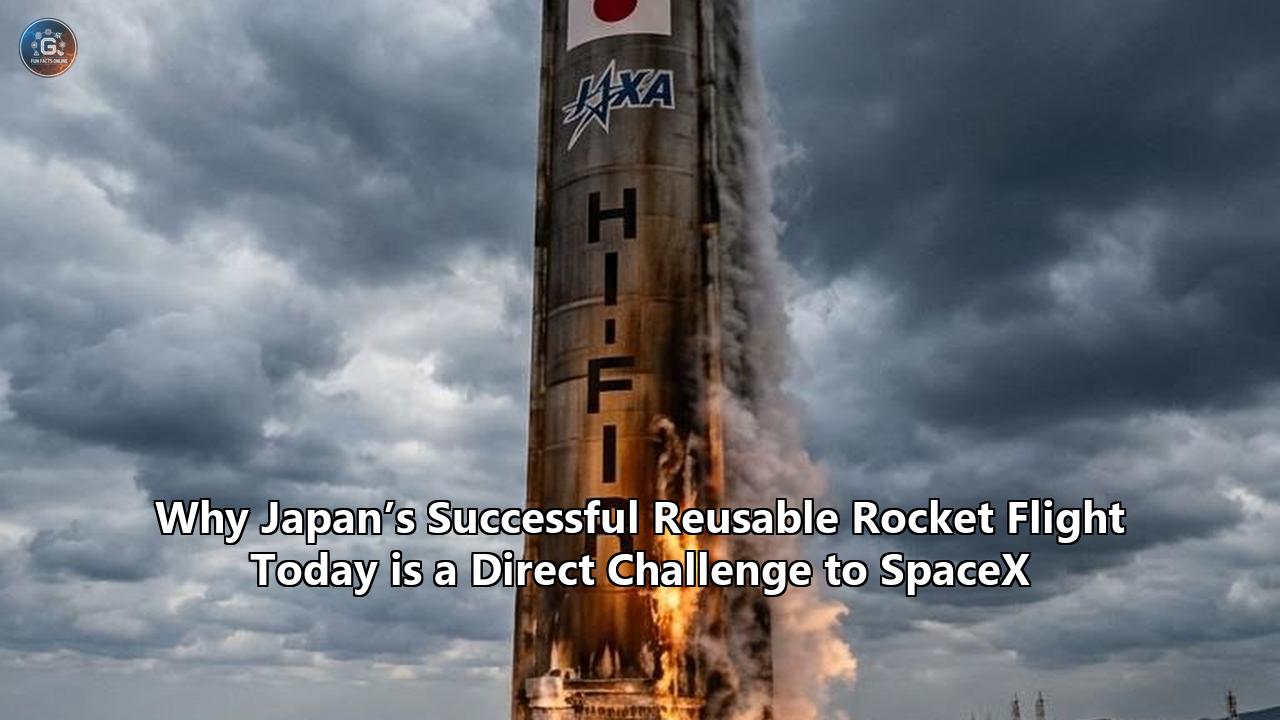
The coastal wind of Akita Prefecture carried more than just the midsummer salt spray on Saturday, July 11, 2026; it carried the roar of a liquid hydrogen engine that could redefine the geopolitical balance of outer space. At the Japan Aerospace Exploration Agency’s (JAXA) Noshiro Testing Center, an experimental, metallic-sheathed prototype named the Reusable Vehicle eXperiment (RV-X) rose vertically from its pad, hovered momentarily in the air, translated horizontally, and then gently touched down on four shock-absorbing landing legs.
The flight was brief—lasting roughly 40 seconds, reaching a peak altitude of 11 meters (36 feet), and shifting 16 meters (52 feet) sideways—but its implications are vast. The successful trial represents Japan's first public demonstration of a vertical takeoff, vertical landing (VTVL) rocket. Under the leadership of Takashi Ito, JAXA’s reusable rocket project manager, the flight validated the sophisticated guidance, navigation, and throttle controls required to return a booster safely to Earth.
“The flight test went well. I feel relieved,” Ito remarked during an online press conference immediately following the event, noting that the agency’s “hardworking” engine had already withstood 165 static combustion tests before this flight.
+-------------------------------------------------------------+
|              JAXA RV-X PROTOTYPE AT A GLANCE                 |
+-------------------------------------------------------------+
| Height: 7.3 meters (23.9 feet)                              |
| Diameter: 1.8 meters (5.9 feet)                             |
| Landing Gear: 4 deployable, shock-absorbing legs            |
| Fuel: Cryogenic Liquid Oxygen & Liquid Hydrogen (LOX-LH2)   |
| Engine: Highly throttleable, re-ignitable 40 kN             |
| Mission Partner: Mitsubishi Heavy Industries (MHI)          |
+-------------------------------------------------------------+
This successful flight of the Japan reusable rocket prototype is not merely an isolated academic achievement. It is a calculated, well-funded challenge to SpaceX’s near-monopoly on reusable space launch systems. For nearly a decade, Elon Musk’s aerospace giant has dictated the economics of low-Earth orbit (LEO) using its fleet of reusable Falcon 9 boosters, leaving traditional space powers reliant on expensive, single-use launch vehicles.
Now, with Japan proving its baseline VTVL capability, the race to dismantle SpaceX’s commercial dominance has entered an intense new phase. This milestone marks a critical turning point that directly threatens SpaceX’s market pricing, reorganizes international alliances, and alters the defense posture of East Asia.
Dismantling the SpaceX Monopoly: The Economic Imperative
To understand why a 40-second hop in northern Japan is a direct threat to SpaceX, one must look at the brutal mathematics of the current commercial launch market. Since SpaceX first successfully landed a Falcon 9 booster in 2015 and commercialized booster reuse in 2017, the company has operated with an unprecedented economic advantage.
The Cost Gap
Independent aerospace analysts estimate that the marginal cost for SpaceX to fly a flight-proven Falcon 9 booster is approximately $15 million. This internal cost includes:
- $7 million for a brand-new, expendable upper stage
- $250,000 for propellant (liquid oxygen and rocket-grade kerosene)
- Approximately $1 million to amortize the manufacturing cost of the recovered booster over its operational lifetime
- Additional outlays for fairing recovery, sea-based drone ship operations, and range fees
Commercially, SpaceX lists a Falcon 9 launch at roughly $74 million. This massive margin allows the company to undercut every expendable rocket in the world while generating the immense cash flow necessary to fund its next-generation Starship program and launch thousands of its own Starlink satellites.
By contrast, traditional space agencies and state-backed corporations have struggled to survive. Japan's current flagship launch vehicle, the H3 rocket, was developed by JAXA and Mitsubishi Heavy Industries (MHI) to replace the reliable but prohibitively expensive H-IIA. While the H3 successfully achieved a target cost of roughly ¥5 billion (approximately $33 million to $35 million) per launch—making it one of the most price-competitive expendable medium-lift rockets in the world—it remains fundamentally limited.
Because the H3 is entirely expendable, every single mission consigns its highly advanced LE-9 main engines to the bottom of the ocean. This economic model is unsustainable in a commercial market where buyers expect the cost-efficiencies of reusable boosters.
Japan's Strategic Path to One-Tenth Cost
The development of the Japan reusable rocket initiative under JAXA's guidance is designed to break this dependency. The RV-X flight is the foundation for an operational, reusable first-stage booster planned for the successor to the H3 rocket, slated for introduction in the early 2030s.
According to Japan’s Basic Space Plan, the government’s ultimate objective is to slash launch costs to one-tenth of the current H3 level by the early 2040s.
- Phase 1 (Early 2030s): Introduce a reusable first stage, aiming to drop the per-launch cost of the H3 successor to approximately ¥2.5 billion (roughly $23 million).
- Phase 2 (Early 2040s): Standardize parts and scale operations to lower the cost to approximately ¥500 million (roughly $4.6 million) per launch.
Estimated Launch Costs (USD)
======================================================
H-IIA (Retired)          | $92 Million (Expendable)
H3 (Current Mainstay)    | $33–$50 Million (Expendable)
Falcon 9 (Sticker Price) | $74 Million (Reusable Booster)
Japan RV-X Successor (2030) | $23 Million (Target Reusable)
Japan RV-X Successor (2040) | $4.6 Million (Target Reusable)
======================================================
If JAXA and MHI achieve these targets, they will do more than just match SpaceX’s pricing. They will offer commercial satellite operators a highly competitive, alternative pathway to space. This is a direct challenge to SpaceX, which has long operated under the assumption that no government-backed program could match its rapid development cycles or cost structures.
Geopolitical Synchronization: The 24-Hour Pivot in East Asia
The timing of Saturday’s RV-X flight cannot be decoupled from the geopolitical events unfolding in neighboring waters. Just 24 hours prior, on Friday, July 10, 2026, Chinese state media announced a massive aerospace milestone: China had successfully completed its first-ever controlled recovery of an orbital-class rocket booster.
The Chinese Academy of Launch Vehicle Technology (CALT) launched its five-meter-diameter Long March 10B rocket from the Hainan commercial launch site. Instead of using deployable landing legs like SpaceX's Falcon 9, the Long March 10B utilized an innovative "net-capture" system mounted on a seaborne barge, using four landing hooks to catch the booster.
This rapid succession of events—China's sea-based recovery on Friday and Japan's land-based VTVL flight on Saturday—signals that the era of American dominance in reusable spaceflight is facing a coordinated, regional challenge from Asia.
           PACIFIC REUSABLE LAUNCH CHRONOLOGY (JULY 2026)

  July 10, 12:15 PM                      July 11, Morning
  [CHINA (Hainan)]                      [JAPAN (Akita)]
  Long March 10B Launch                 RV-X Prototype VTVL
         |                                     |
         +--> Sea-Based Net Recovery           +--> Land-Based Hover & Land
              (First-stage booster)                 (Guidance & control test)
For Tokyo, acquiring a sovereign, commercially viable, and rapidly reusable launch capability is not merely an economic goal; it is a matter of absolute national security. Japan’s space policy is heavily driven by the necessity to monitor military developments in North Korea and counter China’s expanding presence in the East and South China Seas.
To maintain its constellation of intelligence-gathering, remote-sensing, and maritime-surveillance satellites, the Japanese government must have guaranteed access to space. Relying entirely on American commercial providers like SpaceX introduces a strategic vulnerability.
If a geopolitical crisis or supply-chain disruption were to restrict SpaceX’s launch availability, Japan’s defense apparatus could find itself blind. By mastering reusable VTVL technology, Japan ensures it can launch, recover, refurbish, and relaunch its defense assets autonomously, free from foreign corporate dependencies.
The European Lifeline: CALLISTO and the Global Anti-SpaceX Alliance
The successful flight of the RV-X is also reverberating across Europe, where the continent’s premier space agencies are fighting for survival. JAXA is not pursuing this technology in isolation; the RV-X is the direct technological precursor to Callisto (Cooperative Action Leading to Launcher Innovation in Stage Toss-back Operations), a joint demonstrator project co-developed by JAXA, France's National Centre for Space Studies (CNES), and the German Aerospace Center (DLR).
           JAXA (Japan)             CNES (France)             DLR (Germany)
          [Engine & VTVL]          [Launch Site & Ops]     [Aerodynamics & Control]
                 \                        |                        /
                  \                       |                       /
                   v                      v                      v
                +--------------------------------------------------+
                |                 CALLISTO PROJECT                 |
                |   - 13.5m height, 1.1m diameter VTVL             |
                |   - Flight test scheduled: April 2027            |
                |   - Launch base: Kourou, French Guiana           |
                +--------------------------------------------------+
Europe’s flagship rocket, the Ariane 6, made its long-awaited debut in 2024. However, the European Space Agency (ESA) opted to design the Ariane 6 as a fully expendable vehicle, a decision that has drawn intense criticism from industry analysts.
With manufacturing and operations costs for Ariane 6 estimated between €70 million and €90 million per launch—and requiring member states to provide €340 million in annual subsidies just to remain operational—the European space sector is bleeding cash in its struggle to compete with SpaceX.
The Callisto program is Europe’s primary vehicle for catching up, and it relies heavily on Japanese engineering.
- The Division of Labor: JAXA is providing the heart of the Callisto vehicle: a highly throttleable, re-ignitable 40 kN liquid oxygen-liquid hydrogen (LOX-LH2) engine. France and Germany are developing the carbon-composite structural elements, deployable aerodynamic fins, and launch infrastructure.
- The Next Milestone: The flight data gathered during Saturday’s RV-X test in Akita will be fed directly into the Callisto flight computers. Callisto is scheduled to perform its maiden flight test in April 2027 from the Guiana Space Centre in Kourou, French Guiana, where it will attempt to launch to a much higher altitude, perform complex supersonic-to-subsonic aerodynamic maneuvers, and land vertically.
By demonstrating that JAXA’s throttleable engine and landing algorithms work in the real world, the RV-X success provides a vital proof-of-concept for Europe. If Callisto succeeds next year, the technologies gained will be transferred directly to the development of Europe’s next-generation reusable launcher, Ariane Next, and Japan’s H3 successor.
This joint venture establishes a powerful trilateral alliance (Japan, France, and Germany) capable of offering a robust, sovereign alternative to the SpaceX duopoly of Falcon 9 and Starship.
Hydrogen vs. Methane: Japan's Contrarian Engineering Bet
The technological approach of the Japan reusable rocket program reveals a fascinating divergence from the path chosen by SpaceX. To achieve reusability, SpaceX opted for Rocket Propellant 1 (RP-1/kerosene) and liquid oxygen for the Falcon 9, later transitioning to liquid methane and liquid oxygen (methalox) for its massive Starship launch system. Methalox is widely regarded as the ideal fuel for rapid reusability because methane burns clean, leaving virtually no soot or carbon buildup inside the engine, which greatly simplifies the post-flight refurbishment process.
Japan, however, is betting its entire aerospace future on liquid hydrogen (LH2) and liquid oxygen (LOX). This is a contrarian path that presents both extreme engineering difficulties and profound physical advantages.
Fuel Choice Comparison
========================================================================================
Propellant Combo | Key Adopters               | Specific Impulse | Primary Reusability Hurdle
----------------+----------------------------+------------------+-----------------------
RP-1 / LOX       | SpaceX (Falcon 9)          | Moderate (~311s) | Soot buildup, high turbopump stress
LOX / Methane    | SpaceX (Starship)          | High (~380s)     | Medium cryogenic complexity
LOX / Hydrogen   | JAXA (RV-X, H3)            | Very High (~450s)| Leaks, material embrittlement, low density
========================================================================================
The Hydrogen Advantage: Specific Impulse
Liquid hydrogen has the highest energy content per unit of mass of any chemical rocket fuel, producing an exceptional specific impulse (a measure of engine efficiency). This high efficiency is what allows Japanese rockets to lift substantial payloads while remaining relatively compact.
Furthermore, hydrogen burns cleanly, producing only water vapor. This lack of carbon residue eliminates the soot-induced engine wear that plagues kerosene-based engines, theoretically allowing a hydrogen engine to be reused dozens of times with minimal internal cleaning.
The Hydrogen Nightmare: Cryogenic Management
The physical properties of hydrogen make VTVL reusability exceptionally difficult:
- Volumetric Density: Hydrogen is extremely low in density, requiring massive fuel tanks that increase the dry weight of the rocket and create aerodynamic drag during descent.
- Temperature Extremes: Liquid hydrogen must be kept at a frigid -253°C (-423°F), only 20 degrees above absolute zero. This extreme cold causes metal structures to contract and become brittle, making the design of deployable landing legs, steering thrusters, and engine gimbals an engineering gauntlet.
- Throttling Complexity: To land a rocket vertically, the engine must be able to throttle down significantly so the rocket does not accelerate upward as its fuel tanks empty. Throttling a high-energy LOX-LH2 engine without causing combustion instability or flame-out is a notoriously difficult fluid-dynamics problem.
JAXA and MHI’s success in overcoming these hurdles with the RV-X is an incredible engineering triumph. During the Akita test, the RV-X’s engine demonstrated precise throttling, maintaining stable thrust during the transition from a hover to a horizontal glide and down to a soft landing.
The fact that the engine survived its 165th test run and a live VTVL flight without showing signs of degradation proves that Japan has mastered the thermal and structural management of reusable hydrogen systems. If this technology scales up, Japan will possess some of the most thermodynamically efficient and clean-burning reusable rockets in existence, bypassing the soot issues of early-generation SpaceX boosters.
Market Dynamics: Diversification, Commercial Demand, and the ¥1 Trillion Space Fund
The commercial space sector is currently experiencing a historic demand shock. The number of active satellites in orbit has grown exponentially, driven by mega-constellations like Starlink and a surge in sovereign communications, earth-observation, and scientific payloads.
However, satellite operators, international telecommunications firms, and allied governments are becoming increasingly uncomfortable with their absolute reliance on SpaceX.
The Problem with Single-Source Launch Markets
Relying on a single launch provider creates severe market risks:
- Schedule Bottlenecks: A single launchpad anomaly or regulatory grounding of the Falcon 9 fleet could immediately stall the deployment of global satellite networks for months.
- Geopolitical Alignment: Elon Musk’s personal politics, diplomatic maneuvers, and unilateral control over the Starlink network have caused concern in European and Asian capitals. Governments are actively seeking domestic or allied alternatives to ensure their strategic space infrastructure is not subject to the whims of a single American executive.
This is where the Japanese commercial space strategy enters the picture. In 2024, Tokyo launched the Space Strategy Fund, a monumental ¥1 trillion (approximately $6.8 billion), decade-long initiative managed by JAXA on behalf of the Ministry of Economy, Trade and Industry (METI) and other government agencies. The fund represents Japan’s largest-ever dedicated investment in aerospace technology, aiming to double the domestic space market from ¥4 trillion in 2020 to ¥8 trillion ($54 billion) by the early 2030s.
               JAPAN'S SPACE STRATEGY FUND (2024-2034)

        Total Funding: ¥1 Trillion ($6.8 Billion)
        Average Annual Outlay: ¥100 Billion per year (~65% of JAXA's budget)

        Core Objectives:
        1. Double domestic space market to ¥8 Trillion by the early 2030s.
        2. Achieve 30 domestic space launches annually.
        3. Bring over 30 new commercial satellite services online.
        4. Develop and field the H3 reusable rocket successor.
Rather than focusing solely on government operations, the Space Strategy Fund is designed to make JAXA more entrepreneurial and to foster a vibrant private-sector ecosystem. The commercialization of the RV-X’s reusable technology will be shared directly with MHI and Japanese startups, aiming to enable Japan to perform up to 30 orbital launches per year by the early 2030s.
By positioning itself as a reliable, cost-effective, and highly diplomatic space partner, Japan hopes to capture a massive share of the commercial launch market. Satellite operators in Europe, Southeast Asia, and the Americas will soon have the option to bypass SpaceX entirely, launching their payloads on a highly efficient, reusable Japanese vehicle backed by the impeccable quality-assurance standards of JAXA and MHI.
Private Sector Expansion: Beyond JAXA to Corporate Giants
While JAXA and MHI are leading the state-sponsored charge, Japan’s private sector is rapidly mobilizing to support this strategic pivot. In June 2025, Honda R&D Co., a subsidiary of the automotive giant Honda Motor Co., achieved a major milestone by conducting Japan’s first successful flight and landing of a reusable prototype rocket developed entirely by a private entity.
Honda's entry into the space sector is part of a broader corporate trend in Japan, where automotive, heavy industry, and electronics conglomerates are leveraging their manufacturing prowess to enter the aerospace market. By applying lean automotive manufacturing techniques, advanced robotics, and mass-production supply chains to rocket assembly, these companies are directly targeting the production efficiencies that made SpaceX successful.
        JAPAN'S REUSABLE LAUNCH LANDSCAPE

     State-Backed Sector                Private Corporate Sector
     -------------------                ------------------------
     - JAXA (Lead Agency)       - Honda R&D (Automotive)
     - MHI (Heavy Industry)     - Interstellar Technologies (Startup)
     - Core Tech: RV-X, Callisto- Core Tech: Suborbital VTVL,
       LOX-LH2 Propulsion         mass-production structures
This dual-track approach—where JAXA drives state-level, high-energy orbital VTVL technologies while private companies like Honda develop low-cost, mass-produced suborbital and light orbital launchers—creates a highly resilient industrial base.
As the technologies developed for the RV-X are commercialized and shared, a network of specialized suppliers, composite-material manufacturers, and software engineers is emerging across Japan. This ecosystem will drastically reduce the cost of components, accelerate the development of the H3's reusable successor, and ensure that Japan’s space industry can scale up to meet global demand.
Short-Term and Long-Term Consequences: A Chronology of the Space Race
The successful landing of the RV-X in Akita is the first domino to fall in a sequence of events that will systematically reshape the global launch industry over the next two decades.
Short-Term Consequences (1 to 3 Years)
- Data Integration for Callisto (2026): In the immediate aftermath of the Saturday flight, JAXA’s engineering teams will analyze the telemetry, aerodynamic stresses, and thermal profiles of the RV-X’s descent. This data will be integrated into the flight control software of the larger Callisto vehicle currently being assembled by CNES and DLR.
- The Callisto Launch (April 2027): The trilateral partnership will conduct its first major suborbital test of the Callisto demonstrator from Kourou. Callisto will fly a high-altitude trajectory, testing supersonic grid fins and engine re-ignition at extreme speeds before attempting a vertical landing.
- Increased Commercial Backing: The demonstration of real VTVL capability will likely encourage the Japanese government to accelerate disbursements from the ¥1 trillion Space Strategy Fund, funneling more resources into local suppliers and MHI's rocket production lines.
Medium-Term Consequences (3 to 7 Years)
- First Orbital Reusable Flights (circa 2030): Japan plans to debut its first operational, medium-lift reusable rocket. This vehicle will incorporate the RV-X and Callisto technologies to recover its first-stage booster, immediately slashing Japan’s orbital launch costs to roughly half of the current H3 baseline.
- SpaceX Price Adjustments: Facing genuine, lower-cost competition from Japan and a newly resurgent China (which aims to fly its reusable Long March 10B booster repeatedly by the end of 2026), SpaceX may be forced to lower its Falcon 9 launch prices. The era of SpaceX dictating high profit margins on flight-proven boosters will draw to a close.
- A Sovereign European Option: Rather than relying indefinitely on the costly, expendable Ariane 6, the European Space Agency will leverage the Callisto success to fast-track its reusable Themis and Ariane Next programs, restoring Europe’s competitive edge in the commercial market.
Long-Term Consequences (7 to 15 Years)
- The One-Tenth Cost Era (Early 2040s): By standardizing aerospace components, optimizing automated refurbishment processes for hydrogen engines, and scaling launch operations to 30 flights a year, Japan aims to reach its goal of a ¥500 million ($4.6 million) launch cost. This will effectively democratize access to space for secondary countries, small enterprises, and scientific institutions.
- A Mature Hydrogen Supply Chain: Japan’s deep investments in hydrogen-powered rocket technology will converge with its domestic energy transition goals. The country will possess a world-leading, specialized infrastructure for producing, storing, and transferring cryogenic hydrogen, giving it a massive industrial advantage in both the transport and aerospace sectors.
- The Multipolar Space Era: The commercial space market will solidify into a highly competitive, multipolar landscape. No single corporation or nation will control the terms of access to low-Earth orbit. Instead, a balance of power will exist between SpaceX (US), state-backed and private Chinese entities, and the Japanese-European alliance.
What to Watch Next: Upcoming Milestones in the Reusable Space Race
As JAXA celebrates the success of the RV-X, the global aerospace community is already turning its attention to the next major milestones on the horizon.
First, JAXA plans to push the RV-X to its limits at the Noshiro Testing Center. Future test flights will send the prototype to a much higher altitude of approximately 100 meters (328 feet), testing its ability to execute more aggressive hover translations, handle stronger crosswinds, and manage rapid engine throttling during terminal descent.
Second, the progress of China's Long March 10B program will be closely monitored. Following Friday's historic net-based maritime recovery, Chinese engineers are aiming to conduct the rocket’s first-ever booster reflight before the end of the year. If China can successfully refurbish and launch a recovered booster within months, it will prove that its net-capture system is a viable alternative to SpaceX’s landing legs and catch towers.
Finally, the development of the Callisto launch facility in French Guiana is moving into its final integration phase. Over the next year, engineers from JAXA, CNES, and DLR will install the cryogenic liquid hydrogen fueling lines, build the specialized landing pad, and begin integrating the flight-control avionics into the Callisto hull.
The success of the RV-X has proven that Japan’s contrarian bet on high-efficiency, reusable hydrogen propulsion is not just an engineering dream. It is a viable, robust technology that is actively closing the gap with SpaceX, laying the groundwork for a highly competitive, multipolar future in outer space.
Reference:
- https://japantoday.com/category/national/japan-tests-reusable-rocket-prototype-rv-x-to-reduce-costs
- https://www.malaymail.com/news/world/2026/07/11/to-the-moon-maybe-japan-successfully-launches-and-lands-prototype-of-reusable-rocket/227193
- https://www.washingtontimes.com/news/2026/jul/11/japans-space-agency-conducts-successful-test-flight-experimental/
- https://www.wftv.com/unavailable-location/?outputType=amp
- https://en.sedaily.com/international/2026/07/10/japan-tests-reusable-rocket-taking-on-spacex
- https://halifax.citynews.ca/2026/07/10/japans-space-agency-conducts-first-test-flight-for-experimental-reusable-rocket/
- https://www.japantimes.co.jp/news/2024/02/20/japan/science-health/h3-rocket-marketing/
- https://spacedaily.com/g-why-landing-a-rocket-now-costs-less-than-throwing-one-away-and-how-that-single-inversion-is-quietly-gutting-half-the-global-launch-industry/
- https://www.indiatoday.in/world/story/japan-reusable-rocket-test-jaxa-rv-x-completes-first-flight-and-landing-ptag-2945400-2026-07-11
- https://finance.biggo.com/news/6a363c6a-8e42-4652-b417-f1c27283b4f5
- https://en.sedaily.com/international/2026/07/10/japan-tests-reusable-rocket-taking-on-spacex
- https://www.businessinsider.com/watch-china-land-reusable-rocket-long-march-spacex-2026-7
- https://patentpc.com/blog/rocket-launch-costs-2020-2030-how-cheap-is-space-travel-becoming-latest-pricing-data
- https://www.taipeitimes.com/News/world/archives/2026/07/12/2003860628
- https://japan-forward.com/japan-to-develop-reusable-rocket-for-first-launch-in-2030/
- https://www.reddit.com/r/SpaceXLounge/comments/1auvp2r/japan_successfully_launches_nextgen_h3_rocket/
- https://www.japantimes.co.jp/news/2026/07/11/japan/science-health/japan-launches-lands-reusable-rocket/
- https://japan-forward.com/japan-to-develop-reusable-rocket-for-first-launch-in-2030/
- https://payloadspace.com/rocket-development-costs-by-vehicle-payload-research/
- https://www.channelnewsasia.com/east-asia/china-reusable-rocket-space-6246961
- https://www.taipeitimes.com/News/front/archives/2026/07/11/2003860566
- https://www.thehindu.com/sci-tech/china-successfully-tests-sea-based-rocket-booster-recovery-system/article71205427.ece
- https://news.cgtn.com/news/2026-07-10/China-achieves-reusable-rocket-breakthrough-with-Long-March-10B-1OF9e3z0u2Y/p.html
- https://www8.cao.go.jp/space/english/basicplan/2017/basicplan.pdf
- https://en.wikipedia.org/wiki/CALLISTO
- https://www.dlr.de/en/irs/research-transfer/missions-and-projects/callisto
- https://aviationweek.com/aerospace/aircraft-propulsion/tokyo-boldly-pushes-future-aerospace-y1-trillion-fund
- https://ground.news/article/japan-launches-prototype-reusable-rocket-to-compete-with-spacex
- https://discovery.researcher.life/article/callisto-on-the-design-and-development-of-a-reusable-first-stage-demonstrator/7abda870169e3e27b49a48fbcb84c62d