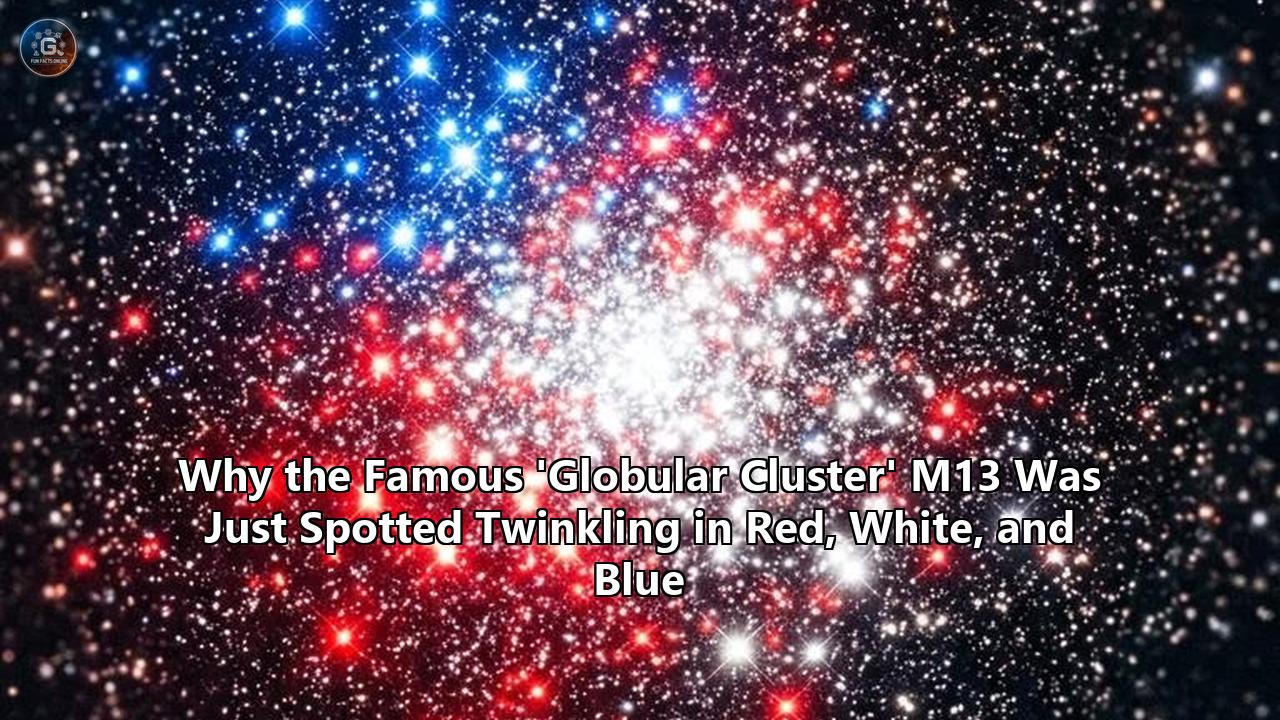
As twilight faded into deep night in early July 2026, observers across the Northern Hemisphere pointed their instruments toward the keystone of the Hercules constellation. What they witnessed was a dazzling, patriotic display: the famous Great Hercules Cluster—systematically cataloged as the M13 globular cluster—was spotted twinkling in vivid, shifting hues of red, white, and blue. Coinciding with the United States' semiquincentennial celebrations, this cosmic light show captured the imagination of amateur astronomers and astrophotographers globally. Equipped with new-generation smart telescopes and highly sensitive CMOS sensors, backyard skywatchers captured real-time, stacked exposures of the cluster's core, revealing a glittering metropolitan sphere of stars shimmering in a patriotic palette.
Yet, behind this beautiful aesthetic spectacle lies a sobering scientific reality. In professional astrophysics, "twinkling"—scientifically termed stellar scintillation—is not a sign of celestial vitality, but an optical obstacle. When a gravitationally bound system of half a million stars like the M13 globular cluster begins to flash and scatter its colors in dramatic, rapid sequences, it highlights a worsening crisis for ground-based astronomy: the rapid degradation of Earth's atmosphere driven by anthropogenic climate change.
The atmospheric turbulence that produces this stunning red, white, and blue scintillation is becoming more frequent and severe. This phenomenon blurs delicate astronomical data, compromises high-resolution imaging, and threatens to degrade the efficacy of multi-billion-dollar ground-based observatories. By examining why the M13 globular cluster was spotted sparkling in these colors, we can understand the physics of stellar populations, the mechanics of atmospheric dispersion, and the urgent solutions researchers are deploying to preserve our view of the cosmos.
The Anatomy of the Sparkle: Why M13 Shines in Red, White, and Blue
To understand why the M13 globular cluster was resolved in these specific colors, we must first look at the demographic makeup of this ancient stellar metropolis. Located approximately 22,200 to 25,000 light-years from Earth, M13 is a spherical swarm of stars spanning roughly 145 to 150 light-years in diameter. It is home to some of the oldest active stars in the universe, with an estimated age of 11.65 billion years.
Because the cluster is so old, its member stars have evolved along distinct astrophysical pathways, creating a highly segregated population of temperatures, masses, and colors. This diversity provides the raw ingredients for its red, white, and blue appearance.
                    STellar Populations within M13

      [ Ancient Red Giants ] ----> High Luminosity, Cool Temp (Red)
                                   e.g., Variable Star V11

      [ Main-Sequence Stars ] ----> Medium Temp, Solar Analogs (White/Yellow)

      [ Blue Stragglers / BHB ] --> Ultra-Hot, Merged/Evolved Stars (Blue)
                                   e.g., Barnard 29
The Red: Ancient Giants on the Brink
The brightest stars visible in M13 to the naked eye or through small telescopes are its red giants. These are aging stars that have exhausted the hydrogen fuel in their cores. Having transitioned off the main sequence, their outer shells have expanded to many times their original diameters and subsequently cooled.
The most prominent example in M13 is V11 (also cataloged as V1554 Hercules), a variable red giant with an apparent visual magnitude of 11.95. These stars radiate primarily in the longer, redder wavelengths of the electromagnetic spectrum. They represent the twilight era of the cluster’s initial generation of stars, serving as glowing red beacons scattered throughout the outer perimeters and dense core.
The White: Solar Analogs and Main-Sequence Standard-Bearers
The vast majority of the stars in the M13 globular cluster are lower-mass main-sequence stars, similar to our Sun. Because they burn their fuel at a conservative rate, they can survive for tens of billions of years.
To the human eye and broadband imaging systems, these mid-temperature stars emit a balanced spectrum of light that appears white or pale yellow. They form the dense, glowing background "snow" of the cluster, packing together so tightly near the core—reaching densities 100 to 500 times greater than our local solar neighborhood—that their individual emissions blend into a brilliant white nucleus.
The Blue: Collision-Born Stragglers and Stellar Castaways
The most intriguing members of the M13 globular cluster are its blue-white stars. Because globular clusters are so old, any original high-mass blue stars should have gone supernova billions of years ago. Yet, M13 contains a distinct population of ultra-hot, luminous blue stars. These are divided into two main categories:
- Blue Stragglers: In the ultra-crowded heart of the cluster, stars are so close together that they occasionally collide and merge. This process combines their masses and replenishes hydrogen fuel in the newly formed star's core. These merger products, called "blue stragglers," appear much younger, hotter, and bluer than their neighboring stars, defying normal stellar evolution.
- Blue Horizontal Branch (BHB) Stars: These are highly evolved, low-metallicity stars that have undergone a helium core flash and are now burning helium in their cores while retaining extremely thin hydrogen envelopes, resulting in high surface temperatures and deep blue-white emissions.
- Stellar Castaways: M13 also hosts anomalies like Barnard 29, an extremely hot, young B2-type blue star. Astronomers believe this star does not natively belong to M13. Instead, it was likely captured by the cluster's gravitational well during one of its periodic orbits through the disk of the Milky Way.
When resolved through a telescope, the spatial distribution of these hot blue stars, moderate white stars, and cool red giants creates a naturally colorful tapestry. However, under normal, pristine atmospheric conditions, these stars shine with a steady, quiet glow.
The fact that observers recently saw this entire collective entity rapidly twinkling and shifting its colors in red, white, and blue signifies that the starlight was passing through a highly disturbed medium: our own atmosphere.
The Challenge: Atmospheric Scintillation and Chromatic Dispersion
To understand why M13 appeared to "twinkle" so dramatically, we must analyze the physics of Earth's atmosphere. This phenomenon is driven by two primary optical challenges: atmospheric refraction and chromatic dispersion.
                            Atmospheric Prism Effect

       Incoming Starlight
       [===============>]
                           \  Earth's Turbulent Atmosphere (Refractive Index η)
                            \
                             \-----> [ Blue Light ] (Bent sharply / Scintillates)
                              \----> [ White Light ] (Central path)
                               \---> [ Red Light ]  (Bent gradually / Scintillates)
Starlight travels unimpeded across vast light-years of space as a straight, coherent wavefront. But the moment those photons hit Earth’s atmosphere, they must pass through a chaotic, fluid medium of air pockets. These pockets, or "turbulent cells," vary continuously in temperature, pressure, and density.
Because the refractive index of air ($\eta$) is directly dependent on its density—which is itself a function of temperature ($T$) and pressure ($P$)—the path of the starlight is constantly bent. This relationship is governed by the Gladstone-Dale relation:
$$\eta - 1 = K \cdot \rho$$
where $K$ is the Gladstone-Dale constant and $\rho$ is the density of the air. As winds and convection currents drag these turbulent cells across the telescope's line of sight, the starlight is refracted rapidly in different directions.
Because stars are so far away, they act as perfect "point sources" of light. Unlike planets, which present small, resolvable disks that average out atmospheric distortions, a point source's entire light beam can be diverted away from or toward an observer's eye or camera sensor in milliseconds. This rapid, random fluctuation in intensity is what we perceive as twinkling.
The Role of Atmospheric Dispersion
The transition from simple twinkling to a multi-colored red, white, and blue display is a direct consequence of atmospheric chromatic dispersion. Just as a glass prism splits white light into a rainbow, Earth's atmosphere acts as a weak prism.
Because the refractive index of air is wavelength-dependent, shorter wavelengths of light (blue and violet) are bent more sharply than longer wavelengths (red). This variation is described by Cauchy's equation for the refractive index of a medium:
$$\eta(\lambda) = A + \frac{B}{\lambda^2} + \frac{C}{\lambda^4} + \cdots$$
where $A$, $B$, and $C$ are dispersion coefficients specific to the gas composition of the atmosphere, and $\lambda$ is the wavelength of the incoming light.
When the M13 globular cluster is observed, its light must pass through this atmospheric prism. When the atmosphere is highly turbulent, the spatial separation between the refracted red and blue light paths of individual stars increases.
As these separated rays pass through rapidly moving thermal cells, they do not arrive at the observer's eye or camera sensor simultaneously. Instead, a cell might momentarily refract only the blue component of a star's light into the optical path, followed milliseconds later by the red component.
This causes the stars to rapidly flash in alternating primary colors. When an entire cluster of half a million stars—each with its own intrinsic red, white, or blue signature—undergoes this intense dispersion and scintillation, the entire object appears to dance as a shimmering, multi-colored tapestry.
What Went Wrong: The Anthropogenic Footprint on the Sky
While atmospheric twinkling has been observed since the dawn of humanity, the intensity and frequency of these colorful distortions are rising. Ground-based astronomers are sounding the alarm: the atmosphere is warming, and this thermal destabilization is degrading our ability to view the cosmos.
A series of climate studies published in journals like Nature Astronomy and Publications of the Astronomical Society of the Pacific (PASP) have detailed how anthropogenic emissions are affecting astronomical observing conditions. Three primary climate-induced factors are driving this increased turbulence:
               Climate-Induced Degradation of Astronomical Seeing

    [ Global Temperature Rise ] ----> Weakens cooling inside telescope domes,
                                      creating "dome seeing" turbulence.

    [ Jet Stream Acceleration ] ----> Increases upper-troposphere wind shear,
                                      causing "wind-driven halos."

    [ Higher Humidity / PWV ]   ----> Absorbs infrared light and increases dew points,
                                      forcing frequent dome closures.
1. The Breakdown of Thermal Dome Control
Professional observatories are designed to operate under strict thermal equilibrium. During the day, the massive rotating domes housing telescopes are sealed and cooled by high-capacity HVAC systems to match the exact temperature predicted for the upcoming sunset.
When the dome opens at dusk, the air inside the dome and the air outside are at the same temperature. This prevents the formation of localized convection currents within the dome itself—an instrumental defect known as "dome seeing".
However, global warming is disrupting this balance. At Cerro Paranal in Chile’s Atacama Desert—home to the European Southern Observatory’s (ESO) Very Large Telescope (VLT)—surface temperatures have risen by 1.5°C over the past few decades, outpacing the global average warming rate.
The active thermal cooling systems of these aging domes were engineered decades ago with a maximum cooling capacity limit (often around 16°C). As daytime temperatures exceed these historic design parameters, the cooling systems can no longer lower the dome’s internal temperature to match the evening air.
When the dome opens, the warmer internal air collides with the cooler night air, creating localized thermal plumes. This micro-turbulence acts like a boiling fluid directly in front of the telescope's primary mirror, causing stars to swell, distort, and twinkle intensely.
2. Jet Stream Accel and the "Wind-Driven Halo"
Anthropogenic warming is altering global weather patterns by changing the temperature gradient between the equator and the poles. This shift is accelerating the subtropical jet streams, leading to increased wind shear in the upper troposphere.
For telescopes, high-altitude wind shear is a major threat. When wind speeds in the upper atmosphere exceed critical thresholds (typically above 30 meters per second), they move turbulent cells across the sky faster than active correction systems can keep up.
This latency lag between atmospheric analysis and physical mirror correction produces an imaging artifact known as a "wind-driven halo". This bright, asymmetrical flare of scattered light smears the starlight, making it impossible to resolve close binary stars, analyze dense stellar cores like that of the M13 globular cluster, or detect faint exoplanets orbiting distant suns.
| Climate Parameter | Historical Baseline (Pre-2000) | Current Trend (Post-2020) | Direct Impact on Astronomy |
|---|---|---|---|
| Local Dome Temp | Steady diurnal cycles, predictable sunset temps | Up to 1.5°C increase at dry-site summits | Creates "dome seeing" convective turbulence |
| Upper Tropospheric Winds | Stable, predictable jet stream patterns | Accelerated wind shear and jet stream shifts | Causes "wind-driven halos" in adaptive optics |
| Precipitable Water Vapor | Extremely dry (< 1mm column water equivalent) | Rising humidity and higher dew points | Absorbs near-infrared; increases condensation risk |
| Atmospheric Attenuation | Minimum scattering of incoming photons | 0.2% photon loss per decade in visible spectrum | Reductions in effective aperture and sensitivity |
3. Precipitable Water Vapor and Photon Deprivation
Global warming increases the rate of evaporation, loading more water vapor into the atmosphere. For infrared telescopes, water vapor is a major obstacle because it absorbs infrared light.
Historically, sites like Mauna Kea in Hawaii or the high peaks of the Andes were chosen because their extreme altitude and dryness left very little water vapor above them—a metric known as Precipitable Water Vapor (PWV).
Recent climatological modeling shows that even these pristine summits are experiencing rising humidity and PWV levels. Dr. Eric Steinbring, an astronomer at Canada's Herzberg Astronomy and Astrophysics Research Center, published a study showing that atmospheric warming has led to a steady increase in atmospheric attenuation.
His team concluded that roughly 0.2 percent fewer visible-light photons make it through Earth's atmosphere per decade. This attenuation acts as a slow, progressive degradation, effectively "chipping away" at a telescope's light-gathering power.
For a 10-meter class telescope, this loss of sensitivity is equivalent to losing several centimeters of primary mirror diameter over time, requiring longer exposure times to capture the same quality of data.
Why M13 is a Crucial Scientific Laboratory Under Threat
The M13 globular cluster is not just a popular target for amateur astrophotographers; it is a vital laboratory for stellar astrophysics. The increasing atmospheric degradation directly threatens several key areas of research:
                    M13 Scientific Research Vectors

    [ Low-Metallicity Stars ] ---> Deciphering the chemical composition of
                                   the early Milky Way (only 4.6% solar iron).

    [ Core Stellar Dynamics ] ---> Studying stellar collisions and mergers
                                   (blue stragglers) in high-density regions.

    [ Astrometric Precision ] ---> Mapping proper motions of stars to trace
                                   dark matter distribution in the galactic halo.
The Search for Early Galactic History
Because M13 formed early in the history of our galaxy, its stars are highly metal-poor, containing only about 4.6% of the iron content of our Sun. By observing the spectra of these ancient stars, astronomers can piece together the chemical evolution of the early Milky Way.
However, obtaining precise spectroscopic data requires stable, focused starlight. If the light from these stars is constantly smeared by atmospheric turbulence, the signal-to-noise ratio drops, forcing researchers to use longer integration times and reducing the efficiency of telescope schedules.
Resolving the Ultra-Dense Core
The heart of the M13 globular cluster is incredibly crowded. In a region of space just 3 light-years across, there are over a hundred stars. For comparison, the nearest star system to our Sun, Alpha Centauri, is over 4 light-years away.
Resolving these individual stars is key to understanding how stellar collisions occur and how blue stragglers are born. When atmospheric seeing worsens, these closely packed stars blur together into a single, unresolved blob of light.
This prevents astronomers from tracking the orbital dynamics, mass transfers, and collision rates inside the cluster's core.
Tracing Dark Matter
Globular clusters like M13 orbit the Milky Way in a vast halo, acting as test masses that help map the galaxy’s gravitational field and dark matter distribution. Tracking the precise proper motions of these clusters requires high astrometric precision.
When starlight twinkles and shifts due to atmospheric turbulence, it introduces measurement errors. This "astrometric jitter" limits our ability to measure the tiny, micro-arcsecond shifts in stellar positions over years, hindering our efforts to map dark matter.
The Solutions: How Astronomers are Fighting Back
Faced with the dual challenges of atmospheric turbulence and a changing climate, the global astronomical community is developing innovative engineering, optical, and structural solutions.
               Astronomical Solutions to Atmospheric Distortion

     [ Active / Deformable Mirrors ] ---> Corrects wavefront errors in real-time
                                          using laser guide stars.

     [ Atmospheric Dispersion Correctors] ---> Realigns separated red, white, and
                                               blue light wavelengths.

     [ High-Res Climate Modeling ]  ---> Informs site selection and design for
                                          next-generation mega-telescopes.

     [ Space-Based Platforms ]      ---> Bypasses Earth's atmosphere entirely
                                          (Hubble, JWST, Nancy Grace Roman).
1. Technical Solutions: Adaptive Optics (AO) and Laser Guide Stars
The primary defense against atmospheric turbulence is Adaptive Optics (AO). This technology works by measuring atmospheric distortion in real-time and adjusting a flexible, deformable mirror to counteract the errors.
                          Adaptive Optics Control Loop

   Distorted wavefront ---> [ Deformable Mirror ] ---> Corrected wavefront ---> Camera
                                    ^
                                    | (Correction signals)
                                    |
[ Wavefront Sensor ] <--- [ Real-time Computer ]- Wavefront Sensing: A sensor analyzes the incoming light from a bright "reference star" (either a natural star near the target or an artificial star created by projecting a sodium laser into the mesosphere, about 90 km up).
- Real-time Processing: A high-speed computer calculates the precise distortions introduced by the atmosphere thousands of times per second.
- Deformable Mirror Correction: The computer sends signals to tiny actuators behind a thin, deformable mirror, reshaping its surface to flatten the distorted wavefront.
This process effectively cancels out the "twinkle," restoring stars to sharp, pinpoint images even during periods of high atmospheric turbulence.
2. Optical Solutions: Atmospheric Dispersion Correctors (ADCs)
To address the colorful "prism effect" of atmospheric dispersion, ground-based telescopes use Atmospheric Dispersion Correctors (ADCs). An ADC consists of two pairs of thin, counter-rotating glass prisms placed in the light path before the camera sensor.
                    Atmospheric Dispersion Corrector (ADC)

     Dispersed Light (Red/Blue split) ---> [ Prism 1 ] ---> [ Prism 2 ] ---> Realigned Light
By rotating these prisms relative to each other, astronomers can introduce an equal and opposite dispersion to the incoming starlight. This realigns the separated red, white, and blue wavelengths, recombining them into a single, sharp image.
This technology is crucial for resolving the dense, multi-colored stellar populations of the M13 globular cluster.
3. Climatological Solutions: Designing Resilient Observatories
For future mega-telescopes like the 39-meter Extremely Large Telescope (ELT) or the Giant Magellan Telescope (GMT), planners are taking climate change into account during the design and site-selection phases.
- High-Resolution Climate Modeling: Astronomers are using next-generation Global Climate Models (GCMs) like NextGEMS and PRIMAVERA to simulate microclimate trends at proposed telescope sites 30 to 50 years into the future.
- Upgraded Thermal Systems: New telescope domes are being designed with advanced aerodynamics and high-capacity, variable-speed cooling systems. These systems can handle higher daytime temperatures and maintain a stable internal environment, minimizing "dome seeing".
- Active Venting: Modern domes incorporate large, controllable wind vents to allow natural air currents to flush out warm air, helping maintain thermal equilibrium with the outside environment.
The Ultimate Escape: Space-Based Astronomy
While advanced ground-based technologies are helpful, the most effective way to escape atmospheric distortion is to bypass Earth's atmosphere entirely. Space-based observatories operate in the pristine vacuum of space, completely free from the effects of scintillation, dispersion, and absorption.
                          Comparing Views of M13

     [ Ground-Based Telescope ]             [ Space-Based Telescope ]
       (With atmospheric distortion)          (Above the atmosphere)

              *   *   *                              *   *   *
            *   *   *   *                          *   *   *   *
           *  (Blurred)  *                        *  (Resolved) *
            *   *   *   *                          *   *   *   *
              *   *   *                              *   *   *
The Legacy of Hubble and JWST
The Hubble Space Telescope has provided some of the most detailed images of the core of the M13 globular cluster. Unimpeded by the atmosphere, Hubble's Advanced Camera for Surveys (ACS) resolved individual stars deep inside the cluster's crowded heart, allowing astronomers to identify blue stragglers and map their spatial distribution.
Similarly, the James Webb Space Telescope (JWST) uses its large, gold-coated primary mirror and infrared-sensitive instruments to peer through cosmic dust, studying the oldest, coldest stars in these ancient clusters with high sensitivity and clarity.
The Next Generation: Nancy Grace Roman
Looking ahead, the upcoming Nancy Grace Roman Space Telescope (scheduled for launch in late 2026 or early 2027) will build on this legacy. Featuring a field of view 100 times larger than that of Hubble, Roman will be able to capture wide-field, high-resolution images of entire globular clusters in a single exposure.
This will allow astronomers to map the outer envelopes and tidal tails of clusters like M13 with unprecedented speed and precision, helping trace their orbits and map the dark matter halo of our galaxy.
Looking Ahead: Preserving Our Window to the Cosmos
The sight of the M13 globular cluster twinkling in red, white, and blue serves as a powerful reminder of our connection to the universe. What began as a beautiful visual display for amateur observers is also an indicator of the changing conditions of Earth's atmosphere.
As global warming continues to affect atmospheric stability, the astronomical community is responding with advanced technology, resilient engineering, and next-generation space missions.
                     A Century of Progress in Resolving M13

    [ 1714 ] - Edmond Halley discovers M13 as a "little patch" of light.

    [ 1779 ] - Individual stars resolved for the first time.

    [ 1974 ] - The symbolic "Arecibo Message" is broadcast toward the cluster.

    [ 1999 ] - Hubble's space-based instruments resolve the ultra-dense core.

    [ 2026 ] - Ground-based astronomers deploy advanced optics to counteract rising
               atmospheric turbulence.
From Edmond Halley's first observation of M13 as a "little patch" in 1714 to today's highly detailed multi-wavelength studies, our ability to resolve the cosmos has progressed alongside our technological capability.
As we work to address climate change on Earth, the efforts to preserve our view of the night sky remind us of our responsibility to protect both our home planet and our window to the stars.
Quick Reference: Observing M13
For those interested in observing the M13 globular cluster, here is a quick guide to locating and viewing this classic deep-sky target:
- Constellation: Hercules
- Coordinates: Right Ascension $16^{\text{h}}\ 41^{\text{m}}\ 41^{\text{s}}$, Declination $+36^{\circ}\ 27'\ 37''$
- Apparent Magnitude: 5.8 (visible to the naked eye under dark, pristine skies)
- Best Observing Window: May through September (culminating near midnight in June and July)
- How to Find It: Locate the "Keystone" asterism in Hercules. M13 is positioned along the western edge, about one-third of the way down from the star Eta ($\eta$) Herculis to Zeta ($\zeta$) Herculis.
- Recommended Equipment:
Binoculars: Reveals a bright, fuzzy, comet-like patch of light.
Small Telescope (4 to 6 inches): Begins to resolve individual stars along the outer perimeters of the cluster.
* Large Telescope (8 inches or larger): Resolves stars across the entire cluster, revealing the dense, glittering core and the famous "propeller" dust lanes.
Reference:
- https://www.space.com/what-to-see-night-sky-july-2026
- https://whenthecurveslineup.com/2026/06/29/2026-july-8-hercules-high-in-the-sky-finding-m13-and-tonights-planets/
- https://esahubble.org/images/potw1011a/
- https://sciencenotes.org/why-do-stars-twinkle-but-planets-do-not/
- https://starshipinsider.com/artikel/nasa-unveils-red-white-and-blue-chandra-images-for-us-250th-anniversary
- https://science.nasa.gov/mission/hubble/science/explore-the-night-sky/hubble-messier-catalog/messier-13/
- https://www.space.com/stargazing/i-resisted-smart-telescopes-for-years-then-one-changed-my-life
- https://www.vedantu.com/physics/why-do-stars-twinkle
- https://www.messier-objects.com/messier-13-hercules-globular-cluster/
- https://www.universetoday.com/articles/climate-change-is-making-the-skies-worse-for-astronomy
- https://uni-koeln.de/en/university/news/news/news-detail/climate-change-impacts-astronomical-observations
- https://physicsworld.com/a/climate-change-threatens-future-astronomical-observations/
- https://www.universetoday.com/articles/climate-change-is-making-the-atmosphere-worse-for-astronomy
- https://science.nasa.gov/asset/hubble/hubble-acswfpc2-image-of-globular-cluster-m13/
- https://en.wikipedia.org/wiki/Messier_13
- https://www.universetoday.com/articles/messier-13
- https://science.nasa.gov/asset/hubble/hubble-acswfpc2-image-of-globular-cluster-m13/
- https://stargazerslounge.com/topic/72238-m13-is-this-normal/
- https://en.wikipedia.org/wiki/Atmospheric_refraction
- https://astronomy.stackexchange.com/questions/23320/what-is-this-rapidly-twinkling-red-blue-and-white-star-i-saw
- https://www.cloudynights.com/forums/topic/764513-about-the-twinkling-of-stars/
- https://pubs.aip.org/aapt/ajp/article-pdf/80/11/980/13062603/980_1_online.pdf
- https://www.forbes.com/sites/brucedorminey/2022/12/25/global-climate-warming-is-even-impacting-astronomy-says-new-study/
- https://www.eso.org/public/blog/climate-change/
- https://www.europlanet.org/europlanet-magazine/issue-4/the-effects-of-climate-change-on-astronomical-observing-facilities/
- https://www.researchgate.net/publication/344272913_The_impact_of_climate_change_on_astronomical_observations
- https://science.nasa.gov/missions/chandra/nasas-chandra-reveals-red-white-blue-universe-for-us-250th/
- https://centaur.reading.ac.uk/106833/9/aa42493-21.pdf
- https://www.sciencedaily.com/releases/2026/07/260702230859.htm
- https://www.youtube.com/watch?v=rHqKaL74GwY
- https://in-the-sky.org/news.php?id=20260602_17_100
- https://www.youtube.com/watch?v=HISG5N04P2A
- https://dyer.vanderbilt.edu/2025/07/29/the-great-cluster-of-hercules/