High above the Pacific Ocean, at an altitude of approximately 39,000 feet, a modified Lockheed L-1011 TriStar aircraft named Stargazer is carrying a payload that could reshape the future of space exploration. Tucked beneath its belly is a Pegasus XL rocket, and cocooned inside its nose cone is LINK, a refrigerator-sized robotic spacecraft built by the Arizona-based startup Katalyst Space Technologies.
At 5:09 a.m. EDT on July 2, 2026, the Stargazer will release the rocket over Kwajalein Atoll in the Marshall Islands. Five seconds later, the solid-propellant booster will ignite, beginning a historic climb into low-Earth orbit. This launch marks the final flight of the Pegasus XL rocket, but more importantly, it represents the start of a daring NASA telescope rescue mission to save the Neil Gehrels Swift Observatory from a fiery death in the Earth's atmosphere.
The $30 million salvage operation is a first-of-its-kind attempt to intercept, grapple, and reboost a science satellite that was never designed to be serviced. Swift, a highly productive observatory launched in 2004, has spent more than two decades detecting gamma-ray bursts—the most violent explosions in the universe. However, a sudden and dramatic escalation in solar activity has caused the telescope's orbit to decay rapidly, dragging it down into the denser layers of Earth's atmosphere.
If LINK cannot reach Swift in time, the observatory will drop below a critical altitude of 185 miles (300 kilometers) by October, passing the point of no return where atmospheric drag will inevitably pull it down to burn up. This is the chronological story of how a quiet orbital decay escalated into a high-stakes rescue mission, and why the future of astrophysics hangs in the balance today.
Phase 1: The Solar Trap (Late 2024 – Early 2025)
The seeds of Swift’s crisis were sown deep within the Sun. In late 2024, Solar Cycle 25—the Sun's 11-year cycle of magnetic activity—escalated far beyond scientists' initial forecasts. This solar maximum brought a barrage of intense solar flares, coronal mass ejections (CMEs), and high-energy radiation that repeatedly slammed into the Earth's magnetic field.
While these solar storms triggered spectacular auroras across the globe, they had a far more insidious effect on spacecraft operating in low-Earth orbit (LEO). As the upper atmosphere absorbed the influx of solar energy, it underwent significant thermal expansion. The thermosphere puffed upward like a heating balloon, dramatically increasing the density of the thin air at altitudes where satellites orbit.
Solar Flare Energy —> Absorbed by Thermosphere —> Atmospheric Expansion —> Increased Orbital Drag —> Rapid Altitude DecayFor Swift, which was originally placed into a stable, circular orbit at an altitude of approximately 370 miles (595 kilometers) in 2004, this atmospheric swelling proved catastrophic. All satellites in LEO experience a minute amount of atmospheric drag that gradually erodes their altitude over decades. Under normal conditions, Swift's altitude would have declined by only a few kilometers per year.
However, by early 2025, NASA orbital mechanics noticed a disturbing spike in the telescope’s rate of descent. The atmospheric density at Swift's operating altitude had multiplied, acting as a subtle but persistent brake. Without any onboard propulsion systems to fight the drag, the 1.4-metric-ton observatory began sinking faster and faster toward Earth.
Phase 2: The Diagnosis and the Dilemma (February 2025)
By February 2025, the situation had escalated from an anomalous trend to an immediate operational emergency. Swift was losing altitude at a rate that shocked mission controllers at NASA’s Goddard Space Flight Center. The telescope had descended well below 250 miles, and its trajectory was pointing toward a destructive atmospheric re-entry as early as mid-2026.
In response, the mission's principal investigator, Brad Cenko, made a painful decision: he suspended Swift's active science operations. To slow the descent, engineers commanded the telescope to execute strategic, passive orientation maneuvers. By pivoting the spacecraft so that its solar panels and main body presented the smallest possible cross-section to the oncoming atmospheric flow, they successfully reduced its drag coefficient. This tactical maneuver managed to buy the telescope valuable time, saving an estimated 25 miles of altitude that would have otherwise been lost to drag.
However, silencing Swift came at a massive scientific cost. True to its name, Swift is designed to pivot within seconds to capture transient astronomical events like gamma-ray bursts, colliding neutron stars, and supernova shockwaves. It is the only off-Earth observatory capable of scanning the sky, detecting a burst, and automatically pointing its three telescopes—the Burst Alert Telescope, the X-ray Telescope, and the Ultraviolet/Optical Telescope—at the source within 20 to 75 seconds.
During its two decades in space, Swift had revolutionized multi-messenger astrophysics, capturing the highest-resolution ultraviolet image of the Andromeda galaxy ever recorded and identifying a gamma-ray burst from a star that exploded 13 billion years ago.
+-------------------------------------------------------------+
|               THE UNIQUE CAPABILITIES OF SWIFT             |
+-------------------------------------------------------------+
| • Ultra-fast pointing: Pivots to targets within 75 seconds  |
| • Multi-wavelength: Ultraviolet, Optical, X-ray, Gamma-ray  |
| • Sentinel role: Works alongside James Webb & Roman         |
| • Track record: 1,400+ gamma-ray bursts detected since 2004 |
+-------------------------------------------------------------+
"Swift plays a notable role in our fleet," said Shawn Domagal-Goldman, NASA's Astrophysics Division director, during a briefing. "This is an observatory with unique capabilities for astrophysics... It is a swift observatory that can quickly pivot across the night sky to find things that go boom in the night."
NASA faced a profound dilemma. The standard operating procedure for an aging LEO satellite would be to let it deorbit naturally. Building a replacement for Swift, however, would cost hundreds of millions of dollars and take close to a decade. With the Nancy Grace Roman Space Telescope scheduled to launch in the near future, astronomers desperately needed Swift to remain operational to act as a cosmic first responder, identifying short-lived targets for Roman and the James Webb Space Telescope to study in deeper detail.
The math was clear: Swift was still highly valuable, but it was sinking. To save it, NASA would have to attempt something that had never been done in the history of American spaceflight.
Phase 3: The $30 Million Gamble (September 2025)
In September 2025, NASA officially committed to an untried path. Rather than abandoning the observatory, the agency awarded a $30 million contract to Katalyst Space Technologies, an aerospace startup based in Flagstaff, Arizona, to execute a high-stakes NASA telescope rescue mission.
The decision was a major departure from traditional space agency procurement. Typically, a mission of this complexity would involve years of design, billions of dollars, and major defense contractors. But time was the one luxury NASA did not have. Katalyst was given less than a year to design, build, test, and prepare a custom robotic servicing vehicle for launch.
Traditional Satellite Servicing             Katalyst Space "LINK" Approach
-------------------------------+-----------------------------------------------
• Decades of planning          |             • 9-month development cycle
• Billions of dollars          |             • $30 million lean contract
• Human astronauts (Shuttle)   |             • Fully autonomous robotic vehicle
• Standardized grapple ports   |             • Custom non-cooperative docking
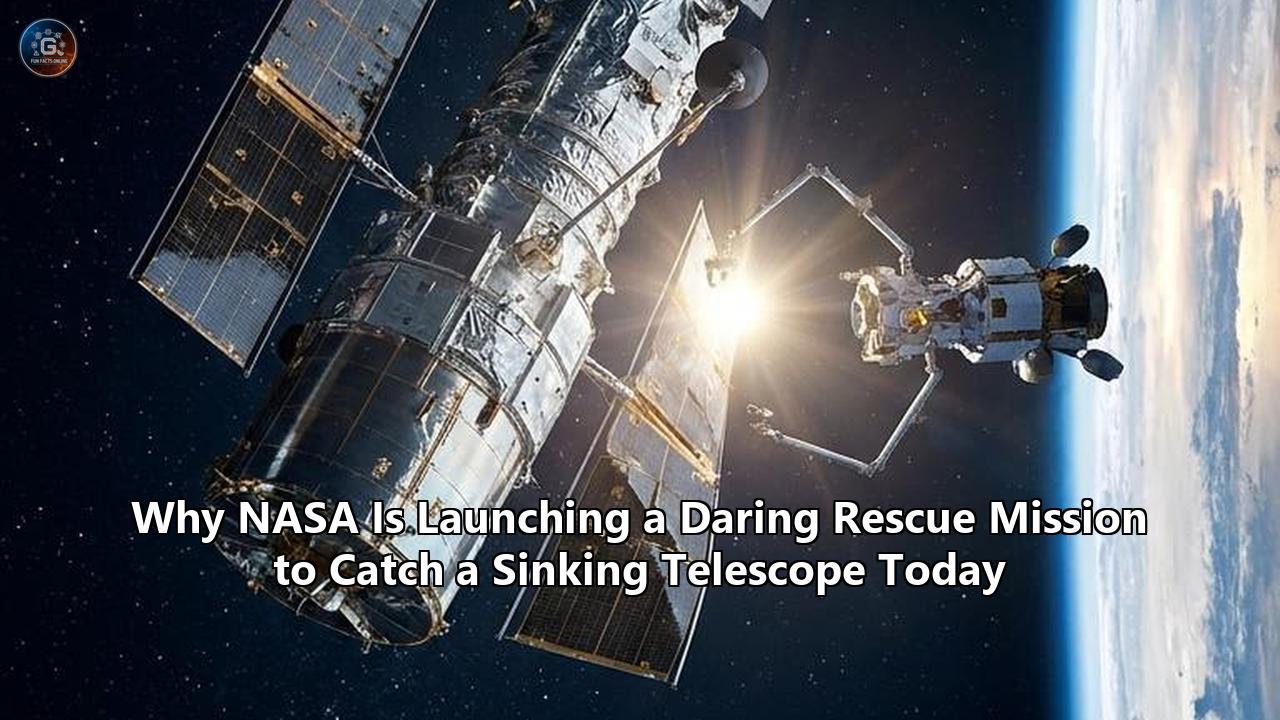
Katalyst’s proposed solution was LINK, a small, highly agile spacecraft equipped with three robotic arms. The spacecraft was designed around a simple, powerful concept: act as an orbital tugboat. LINK would be launched directly into Swift’s orbital plane, rendezvous with the sinking telescope, grab onto its structure, and use its own propulsion system to push both spacecraft into a higher, safer orbit.
"This is the first American space robot to go up and do anything like this," Ghonhee Lee, CEO of Katalyst Space, told reporters. "NASA has all these big senior observatories... all of them can benefit from a service like this. So what we're proving with this mission is this is a new play in the playbook that's available."
For NASA, the $30 million price tag was a bargain. It represented a fraction of the cost of building and launching a new space telescope. More importantly, it offered a testbed for a burgeoning commercial space economy. If Katalyst could successfully execute the NASA telescope rescue mission, it would prove that active satellite servicing, refueling, and life-extension were viable commercial services, paving the way to save other iconic assets—such as the aging Hubble Space Telescope—which is also currently losing altitude due to the same solar storms.
Phase 4: Engineering the Impossible Catch (Late 2025 – Spring 2026)
With the contract signed, the engineering team at Katalyst plunged into a nine-month sprint to turn the LINK concept into reality. They faced two monumental technical challenges: the absolute lack of standard docking equipment on the target, and the tight limits on the rocket that would launch them.
The No-Grapple Problem
When NASA built and launched Swift in the early 2000s, satellite servicing was restricted to massive, crewed Space Shuttle missions. No one designed Swift to be grabbed by a robot. The spacecraft has no docking rings, no magnetic plates, and no standardized grapple fixtures.
To overcome this, Katalyst engineers designed LINK's three robotic arms to be highly adaptable. Measuring just over three feet (one meter) in length, each arm is equipped with two finger-like pinching grippers that resemble the hands of a Lego mini-figure. These grippers are designed to latch onto the structural struts and ring adapters that connect Swift’s main body to its science instrument mounts.
Because the target is "non-cooperative," LINK cannot rely on the telescope to help it dock. Instead, the robot must use an advanced suite of optical cameras, LiDAR sensors, and autonomous proximity operations software to approach Swift with millimeter-level precision. Even a minor navigation error could result in a collision, sending both spacecraft spinning out of control and accelerating their destruction.
       [ LINK Spacecraft ]
         /      |      \
        /       |       \  (3 Robotic Arms, 1-meter reach)
       v        v        v
    [Arm 1]  [Arm 2]  [Arm 3]  <-- Lego-like pinching grippers
       |        |        |
       v        v        v
  [~~~~~~~~~~~~~~~~~~~~~~~~~~~~]
  [  Swift Observatory Struts  ]  <-- Structural non-cooperative grapple points
  [~~~~~~~~~~~~~~~~~~~~~~~~~~~~]
The Lift Limits
Because LINK had to be built quickly and affordably, Katalyst could not use a massive heavy-lift rocket. Instead, the spacecraft had to be lightweight enough to launch on Northrop Grumman's Pegasus XL.
Pegasus is a unique solid-propellant rocket that does not launch from a pad on the ground. Instead, it is carried to high altitude by the Stargazer aircraft and dropped. Once released, its rocket motor ignites, and it carries its payload into orbit.
This air-launch approach is highly flexible, allowing the rocket to be launched from almost anywhere in the world and injected directly into a target satellite's specific orbital plane. However, Pegasus XL has a strict mass limit of about 1,000 pounds (454 kilograms) to LEO.
Katalyst’s engineers had to design LINK to be incredibly compact—roughly the size of a household refrigerator—while still packing in:
- Three robotic arms
- Sophisticated guidance, navigation, and control (GNC) computers
- A high-precision LiDAR imaging system
- A cold-gas reaction control system for delicate docking maneuvers
- A highly efficient ion propulsion system for the slow, steady work of raising the orbit
By the spring of 2026, despite the crushing timeline, the LINK spacecraft had cleared its vibration, thermal vacuum, and software testing phases. The stage was set for the journey to the launch site.
Phase 5: The Final Countdown and the Last Flight of Pegasus (June – July 2026)
In June 2026, the logistical machinery of the mission began to move. Northrop Grumman’s Stargazer aircraft took off from its home base in the United States and flew across the Pacific, landing at Bucholz Army Airfield on Kwajalein Atoll. Kwajalein's proximity to the equator makes it an ideal launch site for accessing low-inclination orbits like the one occupied by Swift.
The mission was originally scheduled to launch on Tuesday, June 30. However, the tropical weather of the Marshall Islands intervened. Persistent cloud cover and high winds over the drop zone forced mission managers to trigger two successive 24-hour weather delays, shifting the launch window first to July 1, and finally to today, Thursday, July 2, at 5:09 a.m. EDT.
The atmosphere at Kwajalein is tense. This launch is not just a high-stakes salvage operation; it is also a farewell. Today's launch is the final scheduled flight of the Pegasus rocket, a pioneering vehicle that first flew in 1990 and ushered in the modern era of air-launched commercial rocketry. Using this historic booster to launch a cutting-edge robotic rescue spacecraft represents a symbolic passing of the torch from the cold-war-era aerospace architecture to the fast-paced, commercial servicing economy of the 21st century.
As the Stargazer climbs to its drop altitude of 39,000 feet today, the telemetry screens at Goddard and Katalyst's mission control are showing green across the board. Swift is currently orbiting at an altitude of approximately 224 miles (360 kilometers). It is sinking rapidly, but it remains above the 185-mile critical threshold where aerodynamic heating and atmospheric density would prevent a safe capture.
The Rendezvous and the Reboost: What Happens Next
Assuming today's launch is successful and LINK is safely deployed into orbit by the Pegasus XL rocket, the truly difficult work begins. The NASA telescope rescue mission is a slow-motion drama that will play out over the next three months.
+--------------------------------------------------------------------------+
|                  MISSION TIMELINE: THE PATH TO SALVATION                 |
+--------------------------------------------------------------------------+
|  July 2, 2026     | Launch of Pegasus XL and LINK from Kwajalein Atoll     |
|  July 3–15, 2026  | LINK checkout, testing, and orbital synchronization    |
|  Mid-July 2026    | Guided approach and close-range flyby of Swift         |
|  Late July 2026   | 2–3 weeks of close-up inspection of Swift's structure  |
|  August 2026      | Robotic capture, latching, and physical locking        |
|  Aug–Sept 2026    | Continuous ion thruster firing to raise orbit          |
|  Late Sept 2026   | Swift reaches 373-mile orbit; science resumes          |
+--------------------------------------------------------------------------+
1. The Orbit Synchronization (July 2 – Mid-July)
Once separated from the rocket's third stage, LINK will deploy its solar arrays and undergo a series of comprehensive system checks. Operators on the ground will spend two to three weeks verifying that its reaction wheels, thrusters, and autonomous navigation sensors are performing exactly as expected. LINK will then fire its thrusters to adjust its orbit, slowly matching Swift's orbital speed and closing the distance between the two spacecraft.
2. The Structural Assessment (Late July)
Before LINK attempts to grab the telescope, it will perform a series of close-range flybys. Because Swift has spent 22 years in the harsh environment of space, engineers must verify that its external components, such as its delicate multi-layer insulation blankets and solar array brackets, are still structurally sound. LINK will spend two to three weeks taking high-resolution imagery of Swift, transmitting the data to Earth where engineers will analyze the visual feeds to select the absolute best grapple points.
3. The Clutches Close (August)
With the target points selected, LINK will begin its final, autonomous approach. Moving at a relative speed of just centimeters per second, the robot will extend its three mechanical arms. Once the grippers are aligned with Swift's structural frame, LINK will execute a coordinated "pinch," locking onto the telescope. This will mark the first time a private, commercial spacecraft has successfully captured an uncrewed U.S. government satellite in orbit.
4. The Slow Rise (August – September)
With the two spacecraft physically joined, LINK will take over attitude control. It will rotate the combined stack and fire its highly efficient ion thrusters. Unlike high-thrust chemical engines, which would place destructive stress on Swift’s delicate instruments, these ion thrusters exert a gentle, continuous force. Over the course of approximately two months, LINK will slowly lift the telescope's altitude from its current 224 miles to a stable, long-term orbit of 373 miles (600 kilometers).
If this timeline holds, Swift's science instruments will be powered back on, and the legendary telescope will be fully back in the business of hunting gamma-ray bursts by late September 2026.
Beyond Swift: A New Era of Orbital Servicing
The implications of today’s launch extend far beyond the survival of a single gamma-ray telescope. The success of this NASA telescope rescue mission could represent a fundamental turning point in how humanity manages its orbital infrastructure.
For decades, the standard lifecycle of an orbital asset has been defined by disposable design. Satellites are launched, run out of maneuvering fuel or suffer minor component failures, and are abandoned to decay and burn up. This practice has not only created a massive orbital debris problem but has also forced governments and commercial operators to spend billions of dollars constantly replacing perfectly good equipment.
If Katalyst successfully saves Swift for just $30 million, it will prove that robotic life extension is highly cost-effective.
The next target is already in sight. The Hubble Space Telescope, a national treasure that has spent 36 years capturing iconic views of the deep universe, is currently suffering from the same solar-induced orbital decay. Hubble cannot be serviced by human astronauts anymore, as the Space Shuttle fleet was retired in 2011. Katalyst CEO Ghonhee Lee has already stated that a larger, next-generation version of their robot, currently in development, could fly a mission to reboost and service Hubble as early as 2028, extending its life by another decade.
+--------------------------------------------------------------------------+
|                     FUTURE ORBITAL SERVICING ROADMAP                     |
+--------------------------------------------------------------------------+
|  2026  |  Swift Boost: First robotic salvage of a LEO telescope          |
|  2027  |  Nexus Mission: US Space Force satellite maneuvering demo       |
|  2028  |  Hubble Reboost: Potential life extension for a national icon   |
|  2030+ |  Commercial Hubs: Orbital refueling, repair, and manufacturing  |
+--------------------------------------------------------------------------+
Furthermore, the technology being demonstrated today has immense national security and commercial applications. The U.S. Space Force has already awarded Katalyst a contract to demonstrate a similar orbital manipulation capability for larger defense satellites using their upcoming Nexus vehicle, scheduled to launch in 2027.
"I envision hundreds of robots in orbit one day," said Lee, "not only fixing and hoisting satellites but also refueling them and building solar farms, data centers, and other platforms."
For today, however, the focus is entirely on a single, aging refrigerator-sized telescope drifting through the silent vacuum of space. As the Stargazer jet reaches its drop point over the pristine waters of Kwajalein Atoll, the global scientific community is watching with bated breath. A classic rocket is about to fly its final mission, and a new generation of robotic lifesavers is about to prove that in the modern space age, no valuable explorer is ever truly beyond rescue.
Reference:
- https://www.pbs.org/newshour/science/nasa-races-to-save-aging-swift-telescope-from-falling-back-to-earth-with-daring-rescue-mission
- https://www.sciencenews.org/article/space-telescope-rescue-mission-nasa-swift
- https://www.space.com/space-exploration/launches-spacecraft/nasa-is-paying-usd30-million-for-a-1st-of-its-kind-rescue-mission-to-the-aging-swift-telescope-before-it-falls-from-space-is-it-worth-it
- https://www.heidiandfrank.com/b/NASA-Is-Trying-to-Rescue-a-Sinking-Space-Telescope-Before-Its-Too-Late/-144687139424339631.html
- https://boingboing.net/2026/06/29/nasas-robot-rescue-of-the-swift-space-telescope-launches-june-30.html
- https://thenextweb.com/news/nasa-swift-telescope-rescue-katalyst
- https://satnews.com/2026/06/29/nasa-and-katalyst-space-technologies-finalize-launch-preparations-for-swift-telescope-orbital-rescue-mission/
- https://www.sciencealert.com/heads-up-nasa-to-launch-daring-telescope-rescue-mission-this-week
- https://www.ndtv.com/science/world-first-space-robot-set-to-rescue-dying-nasa-observatory-11706674