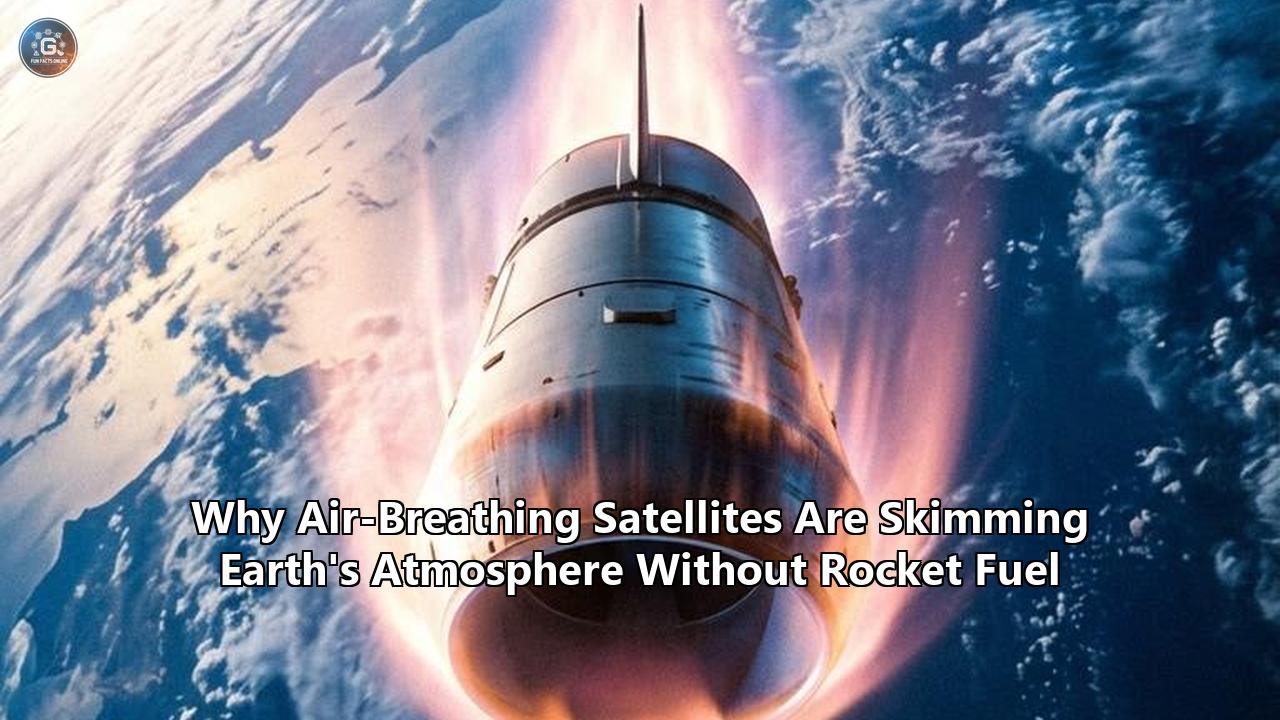
The 160-Kilometer Breakthrough: Continuous Thrust Without Onboard Propellant
During recent upper-atmosphere test flights conducted by the China Academy of Space Technology (CAST), an experimental spacecraft maintained a stable orbit at an altitude of 160 kilometers for over 50 hours. Under normal orbital dynamics, atmospheric drag at this altitude would cause a spacecraft's orbit to decay completely within days, leading to atmospheric re-entry. The test vehicle sustained a constant orbital speed of 7.8 kilometers per second without consuming a single gram of stored liquid propellant.
Instead of carrying heavy tanks of compressed xenon or krypton gas, the satellite scooped sparse atomic oxygen and nitrogen molecules directly from the upper atmosphere, compressed them through an intake duct, ionized them using solar electricity, and expelled them at velocities exceeding 30,000 meters per second.
This flight milestone follows a wave of technological validations across the commercial and public space sectors. Spanish space startup Kreios Space announced a partnership with satellite manufacturer Kongsberg NanoAvionics for an in-orbit VLEO demonstration mission. The spacecraft, designed to fly between 180 km and 200 km, will utilize a 1-kilowatt solar array to power an air-intake propulsion system carrying a 50-to-70-kilogram optical payload. Concurrently, European propulsion specialist TransMIT GmbH successfully passed the European Space Agency (ESA) design review for a cathodeless radio-frequency ion thruster designed specifically to ingest atmospheric gases without suffering internal cathode oxidation.
┌──────────────────────────────────────────────────────────────────────────────────┐
│              AIR-BREATHING ELECTRIC PROPULSION (ABEP) CYCLE                      │
└──────────────────────────────────────────────────────────────────────────────────┘

 Dynamic Pressure (7.8 km/s)
═════════════════════════════►  ┌────────────────┐
  Sparse Air Molecules          │ Passive Air    │  Compression Ratio: 10:1 to 100:1
  (80% Atomic O, 20% N₂)        │ Intake Scoop   │ ═════════════════════════════════►
                                └────────────────┘
                                        │
                                        ▼
                                ┌────────────────┐
  Solar Arrays                  │ Plasma Generator│  High-Voltage Grid Ionization
  (1.0 - 2.5 kW Power) ════════►│ (RF / Inductive)│ ═════════════════════════════════►
                                └────────────────┘
                                        │
                                        ▼
                                ┌────────────────┐
  Ejection Speed:               │ Acceleration   │  Continuous Net Thrust
  30,000 - 45,000 m/s           │ Grids / Nozzle │ ═════════════════════════════════►
                                └────────────────┘  (Offsets 100% of Atmospheric Drag)
By turning the primary obstacle to low-altitude flight—atmospheric drag—into an infinite fuel supply, air-breathing satellites are establishing an operational domain in Very Low Earth Orbit (VLEO), typically defined between 100 km and 300 km above Earth's surface. Eliminating onboard propellant tanks reduces spacecraft launch mass by up to 60%, slashes manufacturing capital expenditure, and allows satellites to remain operational in VLEO for multi-year missions limited only by solar panel degradation.
The Physics of Very Low Earth Orbit: Atmospheric Drag vs. Net Thrust
Operating a satellite below 250 kilometers requires overcoming exponential increases in atmospheric density. At standard LEO altitudes (500 km to 800 km), atmospheric density ranges from $10^{-12} \text{ kg/m}^3$ to $10^{-14} \text{ kg/m}^3$, generating minute drag forces that require only occasional thruster burns to maintain orbit. At VLEO altitudes between 150 km and 200 km, atmospheric density rises sharp to $10^{-9} \text{ kg/m}^3$ to $10^{-11} \text{ kg/m}^3$.
The aerodynamic drag force ($F_d$) acting on a spacecraft is governed by the classic drag equation:
$$F_d = \frac{1}{2} \cdot \rho \cdot v^2 \cdot A \cdot C_d$$
Where:
- $\rho$ is the atmospheric density ($\text{kg/m}^3$)
- $v$ is the orbital velocity relative to the atmosphere ($\sim 7,800 \text{ m/s}$)
- $A$ is the ram-facing cross-sectional area ($\text{m}^2$)
- $C_d$ is the drag coefficient (typically ranging between 2.1 and 3.5 for diffuse gas-surface interactions in rarefied flows)
For a standard 100-kilogram Earth-observation satellite with a 1 square meter cross-sectional area operating at an altitude of 180 km, atmospheric drag exerts a continuous decelerating force of roughly 2.5 to 8.0 millinewtons (mN), depending on solar flux conditions. Left uncompensated, this drag extracts orbital energy at a rate that degrades the satellite's altitude by 10 to 30 kilometers per day, causing catastrophic thermal re-entry within less than a fortnight.
Atmospheric Density vs. Unpowered Orbital Decay Rate

Altitude (km)  | Atmospheric Density (kg/m³) | Continuous Drag Force (mN/m²) | Orbital Lifetime (Unpowered)
───────────────┼─────────────────────────────┼───────────────────────────────┼─────────────────────────────
500 km         | ~ 1.0 × 10⁻¹²               | 0.03 mN                       | 5 to 10 Years
300 km         | ~ 1.5 × 10⁻¹¹               | 0.45 mN                       | 1 to 3 Months
200 km         | ~ 3.2 × 10⁻¹⁰               | 9.73 mN                       | 4 to 8 Days
150 km         | ~ 2.1 × 10⁻⁹                | 63.88 mN                      | 12 to 36 Hours
To maintain a circular orbit at 180 km using traditional electric propulsion systems (such as Hall-effect thrusters firing xenon), a satellite would need to expend approximately 1.5 to 2.2 kilograms of propellant per month. A 200-kilogram satellite carrying 50 kilograms of propellant would deplete its fuel reserves in under two years.
An Air-Breathing Electric Propulsion (ABEP) system resolves this trade-off by capturing incoming gas molecules to produce an equal or greater thrust force ($F_t$):
$$F_t = \dot{m}_{ingested} \cdot \eta_{collection} \cdot v_{exhaust}$$
Where:
- $\dot{m}_{ingested} = \rho \cdot A_{intake} \cdot v$ is the mass flow entering the intake scoop
- $\eta_{collection}$ is the capture efficiency of the intake geometry
- $v_{exhaust}$ is the velocity of the expelled plasma plume ($30,000 - 45,000 \text{ m/s}$)
For an ABEP system to operate successfully, the thrust generated must meet or exceed the total drag force produced by both the satellite body and the air intake collector ($F_t \ge F_{d, total}$). Achieving a positive net thrust ratio ($F_t / F_d > 1.0$) requires an intake compression ratio between 10:1 and 100:1 and an electrical power efficiency capable of ionizing unrefined, mixed atomic species.
Technical Architecture of Air-Breathing Propulsion Systems
Building an engine that ingests vacuum-like upper-atmosphere gases requires a specialized dynamic assembly. Unlike jet engines on aircraft, which rely on mechanical spinning fan blades to compress atmospheric air at lower altitudes, air-breathing satellites operate in hyperthermal, free-molecular flow regimes. At altitudes between 150 km and 250 km, the mean free path of gas molecules ranges from several meters to hundreds of meters, meaning atmospheric particles collide far more frequently with spacecraft surfaces than with each other.
                    CROSS-SECTION OF AN AIR-BREATHING THRUSTER

  Hyperthermal Molecular Inflow (7.8 km/s)
  ──────────────────────────────────────────┐
  ──────────────────────────────────────┐   │
                                        │   │
  ┌─────────────────────────────────────┴───┴──────────────────────────────────────┐
  │ Intake Thermalization Duct (Specular-to-Diffuse Surfaces)                     │
  │                                                                                │
  │   \                                                                       /    │
  │    \  Molecule Trapping Walls                                            /     │
  │     \ (Compression Ratio 10:1 - 100:1)                                  /      │
  │      └──────────────────────────┬───────────────────┬───────────────────┘       │
  │                                 │ Compression Zone  │                           │
  │                                 ▼                   ▼                           │
  │                         ┌───────────────────────────────┐                       │
  │                         │ Electrodeless RF Discharge    │ Induction Coils       │
  │                         │ Chamber (13.56 MHz Field)     │ ▓▓▓▓▓▓▓▓▓▓▓▓▓         │
  │                         │                               │                       │
  │                         │ Gas Mixture: 80% O, 20% N₂    │ [Ionization Zone]     │
  │                         │ Plasma Density: 10¹⁷ m⁻³      │                       │
  │                         └───────────────┬───────────────┘                       │
  │                                         │                                       │
  │                                         ▼                                       │
  │                         ┌───────────────────────────────┐                       │
  │                         │ Acceleration Electrodes /     │                       │
  │                         │ Electrostatic Grids           │                       │
  │                         └───────────────┬───────────────┘                       │
  └─────────────────────────────────────────┼───────────────────────────────────────┘
                                            │
                                            ▼
                              Accelerated Plasma Plume
                              (Exhaust Velocity: 35,000 m/s)
1. The Intake Scoop and Compression Duct
The intake collector must scoop atmospheric molecules arriving at an relative velocity of roughly 7,800 meters per second. Standard intake designs cause incident molecules to bounce off internal walls and escape back into space. Modern ABEP intake scoops utilize parabolic or multi-stage angled surfaces coated with specialized low-accommodation materials.
These surfaces convert the kinetic velocity of incoming hyperthermal particles into thermalized motion, trapping gas particles inside a high-density compression chamber. The intake increases local molecular density from $10^{15} \text{ particles/m}^3$ at ambient VLEO altitudes up to $10^{17} - 10^{18} \text{ particles/m}^3$ at the thruster inlet—a compression ratio exceeding two orders of magnitude.
2. Ionization Engine and Plasma Generator
Traditional electric thrusters rely on high-purity noble gases like xenon or krypton because they possess low ionization energies (12.1 eV for Xe) and high atomic masses (131.29 amu). In contrast, VLEO atmospheric gas consists primarily of:
- Atomic oxygen ($O$, atomic mass 16 amu, ionization energy 13.6 eV) — ~80% by volume at 200 km
- Molecular nitrogen ($N_2$, molecular mass 28 amu, ionization energy 15.6 eV) — ~20% by volume at 200 km
Because atomic oxygen is highly reactive, standard hollow cathodes built from lanthanum hexaboride ($\text{LaB}_6$) or barium oxide ($\text{BaO}$) oxidize and degrade within hours of exposure. To resolve this operational bottleneck, modern designs—such as TransMIT’s cathodeless radio-frequency ion thruster and CAST's high-voltage grid system—use electrodeless plasma generation.
High-frequency radio waves (typically 13.56 MHz) or inductive magnetic coils transfer electrical energy directly into the compressed gas stream, exciting electrons without physical electrode contact. This creates a stable plasma composed of $O^+$ and $N_2^+$ ions.
3. Acceleration Grids and Neutralization
Once ionized, the atmospheric plasma passes through multi-aperture electrostatic grids charged to potential differences between 1,000 volts and 2,500 volts. The electrostatic field accelerates the positive ions out of the exit nozzle, producing a high-velocity plume ($30 \text{ km/s} - 45 \text{ km/s}$). A cathodeless plasma neutralizer injects electrons into the exiting beam to prevent the spacecraft from accumulating a negative electrostatic charge.
Thruster Performance Metrics by Fuel Source

Propellant Source    | Avg Atomic Mass (amu) | Ionization Energy (eV) | Exhaust Velocity (m/s) | Specific Impulse (s) | Engine Lifetime
─────────────────────┼───────────────────────┼────────────────────────┼────────────────────────┼──────────────────────┼───────────────────
Xenon Gas (Stored)   | 131.29 amu            | 12.1 eV                | 30,000 m/s             | ~ 3,060 s            | 10,000 - 15,000 hrs
Krypton Gas (Stored) | 83.80 amu             | 14.0 eV                | 35,000 m/s             | ~ 3,570 s            | 8,000 - 12,000 hrs
Ingested Atmosphere  | ~ 18.4 amu (O / N₂)   | 13.6 - 15.6 eV          | 38,000 - 45,000 m/s    | ~ 3,800 - 4,500 s    | 30,000+ hrs (Est.)
Quantitative Data Comparison Across Orbital Regimes
The trade-off between altitude, spatial imaging resolution, signal latency, payload mass fractions, and propulsion requirements dictates satellite constellation economics. Flying lower drastically improves optical and RF performance, but demands continuous thrust.
Detailed Orbital Dynamics and Hardware Specifications Comparison

Metric / Parameter             | Geostationary (GEO) | Standard LEO       | Low VLEO (Xenon)   | Air-Breathing VLEO
───────────────────────────────┼─────────────────────┼────────────────────┼────────────────────┼─────────────────────
Average Altitude               | 35,786 km           | 550 km             | 180 km             | 180 km
Orbital Velocity               | 3.07 km/s           | 7.61 km/s          | 7.79 km/s          | 7.79 km/s
Atmospheric Density            | 0 kg/m³             | ~ 10⁻¹³ kg/m³      | ~ 5 × 10⁻¹⁰ kg/m³  | ~ 5 × 10⁻¹⁰ kg/m³
Primary Drag Compensation Fuel | None                | None / Minimal Xe  | Stored Xenon/Argon | Ingested Air (O/N₂)
Propellant Mass Fraction       | 40% - 60%           | 10% - 20%          | 35% - 50%          | 0% (Infinite Supply)
Aperture Size for 15-cm GSD    | ~ 160 meters        | 2.44 meters        | 0.80 meters        | 0.80 meters
One-Way Latency (Propagation)  | 119.3 ms            | 1.83 ms            | 0.60 ms            | 0.60 ms
RF Signal Attenuation Factor   | Baseline (0 dB)     | +36.3 dB           | +46.0 dB           | +46.0 dB
Active Mission Lifetime        | 15 - 20 Years       | 5 - 7 Years        | 1.5 - 2.5 Years    | 5 - 8+ Years
De-orbit Time After EOL        | Indefinite (Graveyard)| 5 to 25 Years     | < 7 Days           | < 48 Hours
Optical Physics and Communications Metrics in VLEO
Operating air-breathing satellites at altitudes between 150 km and 200 km provides substantial optical and telecommunications advantages. The physics of wave propagation means that bringing payloads closer to Earth delivers exponential improvements in spatial resolution and signal strength.
                  APERTURE SCALING WITH ORBITAL ALTITUDE
                  (Target: 15-centimeter Ground Sample Distance)

  Alt: 550 km (Standard LEO) ───────────────────────────────────┐
  Diffraction Limit Requires:                                   │
  Aperture Diameter = 2.44 m                                    │  Weight: ~1,200 kg
  Telescope Mass Scale: 100%                                    │  Cost: High
                                                                │
  Alt: 180 km (Air-Breathing VLEO) ──────────────┐              │
  Diffraction Limit Requires:                    │              │
  Aperture Diameter = 0.80 m                     │ Weight: ~180 kg
  Telescope Mass Scale: 15%                      │ Cost: Low
Diffraction-Limited Optical Imaging
The spatial resolution of an orbital Earth-observation telescope is constrained by the diffraction limit of light. Ground Sample Distance (GSD)—the physical distance on the ground represented by a single pixel—is expressed as:
$$GSD = \frac{1.22 \cdot \lambda \cdot h}{D}$$
Where:
- $\lambda$ is the wavelength of light (averaging $550 \text{ nanometers}$ for visible spectrum)
- $h$ is the orbital altitude ($\text{meters}$)
- $D$ is the primary mirror aperture diameter ($\text{meters}$)
To achieve a sub-meter spatial resolution of $15 \text{ centimeters}$ ($0.15 \text{ m}$) from a standard LEO altitude of $550 \text{ kilometers}$, a satellite requires a primary optic diameter:
$$D = \frac{1.22 \cdot (550 \times 10^{-9} \text{ m}) \cdot (550,000 \text{ m})}{0.15 \text{ m}} = 2.46 \text{ meters}$$
A 2.46-meter optical mirror assembly, similar in scale to the Hubble Space Telescope, weighs upwards of 1,200 kilograms and requires a heavy-lift launch vehicle costing tens of millions of dollars.
Lowering the satellite's orbital altitude to $180 \text{ kilometers}$ via air-breathing propulsion alters these scaling equations:
$$D = \frac{1.22 \cdot (550 \times 10^{-9} \text{ m}) \cdot (180,000 \text{ m})}{0.15 \text{ m}} = 0.805 \text{ meters}$$
At 180 km, the required aperture diameter drops from $2.46 \text{ meters}$ to just $0.80 \text{ meters}$. Because primary mirror mass scales roughly with the cube of its diameter ($M \propto D^3$), shrinking the aperture diameter by $67\%$ reduces the optical payload mass from $1,200 \text{ kg}$ down to roughly $130 - 180 \text{ kg}$. This mass reduction enables small, low-cost micro-satellite buses to collect sub-meter intelligence previously restricted to billion-dollar reconnaissance platforms.
Required Aperture Diameter vs. Altitude for Optical Resolutions

Altitude (km) | GSD = 1.0 Meter  | GSD = 0.50 Meter | GSD = 0.15 Meter | Estimated Optical Mass (15cm GSD)
──────────────┼──────────────────┼──────────────────┼──────────────────┼─────────────────────────────────
600 km        | 0.40 m           | 0.81 m           | 2.68 m           | ~ 1,550 kg
500 km        | 0.34 m           | 0.67 m           | 2.24 m           | ~ 980 kg
300 km        | 0.20 m           | 0.40 m           | 1.34 m           | ~ 220 kg
180 km        | 0.12 m           | 0.24 m           | 0.80 m           | ~ 140 kg
150 km        | 0.10 m           | 0.20 m           | 0.67 m           | ~ 85 kg
Telecommunications and Radio Frequency Transmission
RF signal propagation follows the Inverse Square Law, where received power density ($S_{rcv}$) decreases quadratically with distance ($R$):
$$S_{rcv} = \frac{P_{tx} \cdot G_{tx}}{4\pi R^2}$$
Comparing a communications payload operating at $550 \text{ km}$ versus $180 \text{ km}$:
$$\frac{S_{180}}{S_{550}} = \left( \frac{550}{180} \right)^2 = (3.055)^2 \approx 9.33$$
An air-breathing satellite skimming Earth's atmosphere at $180 \text{ km}$ receives an RF signal $9.33 \text{ times}$ stronger ($+9.7 \text{ dB}$) than a spacecraft flying at $550 \text{ km}$ transmitting at identical power levels. Alternatively, the VLEO satellite can achieve equivalent link margins using $89\%$ less electrical transmission power, drastically reducing solar array sizing, battery capacity requirements, and overall thermal dissipation demands.
RF Power Density Scaling and Latency Comparison

Orbital Altitude | Propagation Distance (Zenith) | Free-Space Path Loss (at 12 GHz) | One-Way Latency | Relative Signal Power
─────────────────┼───────────────────────────────┼──────────────────────────────────┼─────────────────┼──────────────────────
35,786 km (GEO)  | 35,786 km                     | 205.1 dB                         | 119.28 ms       | 1x (0 dB)
1,200 km (LEO)   | 1,200 km                      | 155.6 dB                         | 4.00 ms         | 889x (+29.5 dB)
550 km (LEO)     | 550 km                        | 148.8 dB                         | 1.83 ms         | 4,235x (+36.3 dB)
200 km (VLEO)    | 200 km                        | 140.0 dB                         | 0.67 ms         | 31,980x (+45.1 dB)
160 km (VLEO)    | 160 km                        | 138.1 dB                         | 0.53 ms         | 49,970x (+47.0 dB)
One-way speed-of-light signal propagation delay drops from $1.83 \text{ milliseconds}$ at $550 \text{ km}$ down to $0.53 \text{ milliseconds}$ at $160 \text{ km}$. For high-frequency financial trading, real-time tactical military links, and interactive broadband communications, VLEO operations eliminate propagation delay as a system latency bottleneck.
Active Global Demonstrations and Technological Milestones
The development of propellantless VLEO platforms has transitioned from numerical simulations to active hardware testing. Multiple national space agencies and aerospace startups are running competitive flight and laboratory programs.
Active Global Air-Breathing Propulsion Programs

Organization / Company  | Country        | Mission / Project Name | Operational Target Altitude | Core Thruster Architecture
────────────────────────┼────────────────┼────────────────────────┼────────────────────────────┼─────────────────────────────────
CAST                    | China          | VLEO-1 Flight Test     | 160 km                     | High-Voltage Ionization Grid
Kreios Space            | Spain          | Kongsberg VLEO Demo    | 180 km - 200 km            | Inductive ABEP System
ESA / Sitael            | European Union | DISCOVERER / ABEP Demo | 200 km - 250 km            | Dual-Stage Intake Hall Thruster
TransMIT GmbH           | Germany        | Cathodeless ABEP       | 150 km - 200 km            | Cathodeless RF Ion Engine
Bellatrix Aerospace     | India          | Air-Intake Propulsion  | 180 km - 200 km            | Microwave Plasma Thruster
BAE Systems / SOAR      | United Kingdom | SOAR VLEO Payload      | 200 km                     | Material Degradation Test Bus
1. China Academy of Space Technology (CAST)
CAST's 160-kilometer flight test demonstrated continuous thrust generation using dynamic atmospheric ingestion. The engineering team designed a intake scoop that maintains a gas capture efficiency of $58\%$ under hyperthermal flow conditions. The integrated high-voltage ion engine compensated for $100\%$ of atmospheric drag during its 52-hour testing window, verifying that air-breathing systems can maintain stable orbits below 200 km.
2. Kreios Space & Kongsberg NanoAvionics
Spanish propulsion startup Kreios Space signed a launch partnership with Kongsberg NanoAvionics to integrate an ABEP engine into a standardized microsatellite bus. The mission parameters target operational flight between 180 km and 200 km. Powered by a solar array generating over 1,000 watts, the system will balance atmospheric drag while operating an onboard visible and near-infrared (VNIR) optical sensor capable of sub-meter Earth imaging.
Kreios Space / Kongsberg Demonstration Mission Parameters

Parameter                       | Targeted Value
────────────────────────────────┼─────────────────────────────────────────
Target Orbital Altitude         | 180 km to 200 km (VLEO)
Spacecraft Mass Class           | 50 kg - 70 kg Microsatellite
Solar Array Power Generation    | 1,000 Watts (1.0 kW) Peak
Payload Package                 | VNIR Sub-Meter Optical Earth Imager
Primary Mission Objective       | 100% Drag Compensation via Ingested Air
Secondary Mission Objective     | Environmental Mapping & Ionospheric Measurement
3. European Space Agency (ESA) & Sitael
Building on its DISCOVERER project, ESA partnered with Italian propulsion firm Sitael to construct a full-scale vacuum chamber testbed that simulates atmospheric composition and kinetic particle velocities at 200 km. The Sitael dual-stage thruster uses a specialized primary intake to compress incoming flow, followed by a secondary discharge chamber that ionizes atmospheric atomic oxygen and nitrogen. Ground testing confirmed continuous thrust generation of $2.5 \text{ to } 5.0 \text{ mN}$ at power levels between 800 W and 1,500 W.
4. TransMIT GmbH Cathodeless RF System
Germany's TransMIT GmbH completed the formal ESA Design Review for a radio-frequency ion engine that eliminates thermionic cathodes entirely. By using RF electromagnetic fields to ionize incoming gas and an electrodeless plasma accelerator, TransMIT's system prevents cathode degradation caused by atomic oxygen. This design removes the primary mechanical point of failure in air-breathing propulsion systems.
   Traditional Cathode Thruster             TransMIT Cathodeless RF Thruster
┌─────────────────────────────────┐       ┌─────────────────────────────────┐
│ Atmospheric Gas (Oxygen/Nitrogen)│       │ Atmospheric Gas (Oxygen/Nitrogen)│
└────────────────┬────────────────┘       └────────────────┬────────────────┘
                 │                                         │
                 ▼                                         ▼
┌─────────────────────────────────┐       ┌─────────────────────────────────┐
│ Thermionic Hollow Cathode       │       │ Inductive RF Field Generation   │
│ ❌ Atomic Oxygen Poisons Metal  │       │ (13.56 MHz Coil)                │
│ ❌ Rapid Erosion / Short Life   │       │ ✔ No Internal Electrodes        │
└────────────────┬────────────────┘       │ ✔ 100% Oxygen Compatible        │
                 │                        └────────────────┬────────────────┘
                 ▼                                         │
┌─────────────────────────────────┐                        ▼
│ Thruster Failure (< 1,000 hrs)  │       ┌─────────────────────────────────┐
└─────────────────────────────────┘       │ Extended Lifetime (30,000+ hrs) │
                                          └─────────────────────────────────┘
Environmental Engineering: Atomic Oxygen Degradation and Space Debris
While atmospheric gas acts as a free propellant, operating in VLEO presents environmental challenges—principally atomic oxygen (AO) degradation.
1. Atomic Oxygen Erosion and Materials Science
At altitudes between 100 km and 300 km, solar ultraviolet radiation dissociates molecular oxygen ($O_2$) into atomic oxygen ($O$). Because the satellite flies through this gas layer at $7.8 \text{ km/s}$, incoming atomic oxygen atoms collide with spacecraft surfaces at kinetic impact energies of approximately $4.2 \text{ eV}$.
This continuous bombardment causes severe material erosion. Standard satellite polymers like Kapton, Kevlar, and silver-coated thermal blankets oxidize rapidly when exposed to atomic oxygen. Kapton exhibits an erosion yield ($E_y$) of $3.0 \times 10^{-24} \text{ cm}^3\text{/atom}$. At an altitude of 180 km with an atomic oxygen flux of $10^{15} \text{ atoms/cm}^2\text{·s}$, exposed Kapton erodes at a rate of 0.25 millimeters per year, destroying thin structural films and solar array backings.
To operate air-breathing satellites for multi-year missions, engineers utilize resistant materials and protective coatings:
- Fluorinated Ethylene Propylene (FEP) and Teflon-AF, which possess erosion yields under $0.05 \times 10^{-24} \text{ cm}^3\text{/atom}$
- Atomic Layer Deposition (ALD) coatings of silicon dioxide ($\text{SiO}_2$) or titanium dioxide ($\text{TiO}_2$) applied in 100-nanometer protective layers
- Carbon-Carbon Composites and ceramic matrix structures for the intake scoop lip and thruster nozzle
Atomic Oxygen Erosion Rates for Common Spacecraft Materials

Material Grade              | Material Description          | AO Erosion Yield (cm³/atom)   | Operational Survival at 180 km
────────────────────────────┼───────────────────────────────┼───────────────────────────────┼────────────────────────────────
Unprotected Kapton H        | Polyimide Thermal Film        | 3.00 × 10⁻²⁴                  | Fails in < 60 Days
Silver (Bare)               | Thermal Control Mirroring     | 10.50 × 10⁻²⁴                 | Fails in < 14 Days
Aluminum Alloy 6061         | Structural Spacecraft Frame   | ~ 0.00 (Forming Oxide Layer)  | Survives 10+ Years
SiO₂ ALD Coated Kapton      | Atomic Layer Shielded Film    | < 0.01 × 10⁻²⁴                | Survives 7+ Years
Pyrolytic Carbon-Carbon     | High-Temp Ceramic Composite   | 0.12 × 10⁻²⁴                  | Survives 5+ Years
2. Orbital Debris Mitigation and Automatic De-Orbiting
Space debris accumulation in standard LEO orbits (500 km to 1,200 km) threatens long-term orbital sustainability. Collisions in LEO generate fragment clouds that remain in orbit for decades or centuries.
VLEO air-breathing platforms resolve the space debris problem. Because atmospheric drag is high at altitudes below 200 km, any satellite that suffers a catastrophic power loss or engine shutdown de-orbits automatically. Without continuous active thrust from its ABEP engine, an air-breathing satellite loses altitude rapidly and burns up completely in the dense lower atmosphere within 48 to 96 hours. This self-cleansing mechanism eliminates orbital debris risks and guarantees compliance with international space sustainability mandates without requiring reserved de-orbit propellant.
   STANDARD LEO DEBRIS RISK                AIR-BREATHING VLEO SELF-CLEANSING
┌──────────────────────────────┐        ┌──────────────────────────────┐
│ Satellite Failure at 800 km  │        │ Satellite Failure at 180 km  │
└──────────────┬───────────────┘        └──────────────┬───────────────┘
               │                                       │
               ▼                                       ▼
┌──────────────────────────────┐        ┌──────────────────────────────┐
│ Remains in Orbit for 100+ Yrs│        │ Atmospheric Drag Inevitable  │
│ High Collision Risk          │        │ Altitude Loss: 20 km/day     │
└──────────────────────────────┘        └──────────────┬───────────────┘
                                                       │
                                                       ▼
                                        ┌──────────────────────────────┐
                                        │ Complete Thermal Disintegration│
                                        │ Clean Orbit Within 48 Hours  │
                                        └──────────────────────────────┘
Constellation Economics and Financial Projections
Replacing chemical and stored electric propulsion systems with atmospheric intake units fundamentally changes satellite manufacturing and deployment economics.
Cost Structure Comparison: Traditional LEO vs. Air-Breathing VLEO Constellation

Cost Category                   | Traditional LEO Constellation (500 km) | Air-Breathing VLEO Constellation (180 km)
────────────────────────────────┼────────────────────────────────────────┼──────────────────────────────────────────
Satellites Required for Coverage| 100 Spacecraft                         | 140 Spacecraft (Smaller Footprint)
Mass per Satellite              | 450 kg                                 | 110 kg
Primary Mirror Diameter (15cm GSD)| 2.44 Meters                            | 0.80 Meters
Manufacturing Cost per Unit     | $12.5 Million                          | $2.1 Million
Propellant Tank & Gas Load      | $800,000 (Xenon/Tanks)                 | $0 (Air-Breathing)
Launch Cost per Spacecraft      | $4.5 Million ($10,000/kg)              | $1.1 Million ($10,000/kg)
Total Constellation CAPEX       | $1.78 Billion                          | $448 Million
By reducing satellite mass from $450 \text{ kg}$ down to $110 \text{ kg}$—achieved by eliminating heavy xenon tanks and shrinking optical mirror apertures—the launch and manufacturing capital expenditures required to deploy a high-resolution Earth-observation constellation drop by over $74\%$.
    CONSTELLATION CAPEX COMPARISON (TOTAL CAPITAL EXPENDITURE)

  Traditional 500 km LEO Constellation:
  ██████████████████████████████████████████████████ $1,780,000,000

  Air-Breathing 180 km VLEO Constellation:
  █████████████ $448,000,000  (74.8% Cost Savings)
Industry forecasts project that the commercial VLEO market—spanning Earth observation, defense intelligence, and low-latency communications—will expand from $1.8 billion to $22.4 billion by 2035.
VLEO Market Expansion Projections (2024–2035)

Year | Active VLEO Satellites | Earth Observation Sector ($B) | Defense & Comms Sector ($B) | Total VLEO Market Value ($B)
─────┼────────────────────────┼───────────────────────────────┼────────────────────────────┼─────────────────────────────
2024 | 12 Spacecraft          | $0.4 B                        | $1.4 B                     | $1.8 B
2026 | 45 Spacecraft          | $1.1 B                        | $2.8 B                     | $3.9 B
2028 | 180 Spacecraft         | $2.8 B                        | $5.4 B                     | $8.2 B
2030 | 520 Spacecraft         | $5.2 B                        | $9.1 B                     | $14.3 B
2035 | 1,850 Spacecraft       | $8.1 B                        | $14.3 B                    | $22.4 B
Beyond Earth: Mars Atmospheric Skimming Operations
The fluid dynamics that govern air-breathing propulsion systems around Earth apply directly to extraterrestrial planetary exploration. Mars features a thin upper atmosphere composed of $95\%$ carbon dioxide ($CO_2$), $2.6\%$ nitrogen ($N_2$), and $1.9\%$ argon ($Ar$).
                 MARS ATMOSPHERIC INGESTION CYCLE

  Incident CO₂ / N₂ Gas (4.8 km/s)
  ═════════════════════════════════►  ┌────────────────────────┐
  Altitude: 120 km - 140 km           │ High-Compression Scoop │
                                      └───────────┬────────────┘
                                                  │
                                                  ▼
                                      ┌────────────────────────┐
  Solar Electric Power                │ RF Dissociation Chamber│
  (CO₂ ──► C⁺ + O⁺ + O e⁻) ──────────►│ (13.6 eV Ionization)   │
                                      └───────────┬────────────┘
                                                  │
                                                  ▼
                                      ┌────────────────────────┐
  Exhaust Speed: 28,000 m/s           │ Acceleration Electrodes│
  Continuous Drag Compensation        └───────────┬────────────┘
                                                  │
                                                  ▼
                                      High-Velocity Carbon/Oxygen Plume
At altitudes between 120 km and 140 km above the Martian surface, the atmospheric density is comparable to Earth's VLEO regime at 180 km. An air-breathing Martian satellite can scoop ambient carbon dioxide, dissociate the molecule into carbon and oxygen ions via radio-frequency discharges, and accelerate the ionized gas to maintain an orbit below 130 kilometers indefinitely.
Flying at an altitude of 120 km around Mars enables high-resolution surface mapping, ground-penetrating radar analysis for subsurface water ice discovery, and real-time surface rover relay links operating at sub-millisecond propagation latencies—all without transporting thousands of kilograms of electric thruster propellant across deep space.
Future Engineering Milestones and Technical Challenges
As air-breathing propulsion transitions from in-orbit technology demonstrations to operational satellite constellations, several key engineering targets remain the focus of active development:
- Intake Compression Efficiency Above 70%: Advanced surface accommodation coatings utilizing self-assembled monolayers are being developed to reduce diffuse scattering, directing incoming atmospheric gas straight into thruster ionization chambers.
- Solar Panel Power Density Gains: Operating at 160 km requires solar arrays that balance electrical generation with aerodynamic drag. Deployable ultra-thin gallium arsenide (GaAs) solar blankets operating at power-to-area ratios exceeding 400 W/m² are under testing to minimize drag.
- Advanced Cathodeless Plume Neutralization: Maintaining long-term electrical equilibrium on spacecraft bodies without thermionic cathodes requires high-efficiency plasma neutralizers that can process ambient atmospheric ions without degradation.
These ongoing advancements in gas dynamics, plasma physics, and materials engineering are establishing Very Low Earth Orbit as an operational domain. By ingesting the atmosphere to overcome drag, air-breathing satellites eliminate the need for onboard fuel, enabling lower-cost, higher-resolution, and sustainable orbital operations for Earth observation and global communications.
Reference:
- https://www.facebook.com/spacecom/posts/air-breathing-electric-propulsion-could-help-satellites-explore-a-new-frontier-o/1400532161937464/
- https://www.mdpi.com/2226-4310/10/10/899
- https://gizmodo.com/this-satellite-will-literally-breathe-air-to-stay-in-orbit-2000796713
- https://www.transmit.de/presse/presse-2026/473-successful-esa-design-review-marks-key-milestone-for-air-breathing-electric-propulsion-development-at-transmit-iqm
- https://www.space.com/space-exploration/satellites/exploring-very-low-earth-orbit-the-worlds-1st-air-breathing-satellite-thruster-could-soon-get-a-test-run
- https://electricrocket.org/IEPC/w2lke3cb.pdf
- https://www.viridianspace.com/wp-content/uploads/2023/05/IEPC-2022-468_Feldman_BasicAnalysisABEP-1.pdf
- https://www.universetoday.com/articles/this-is-what-an-air-breathing-electric-thrusters-intake-would-look-like
- https://keeptrack.space/x-report/spacex-brief-2026-08-10