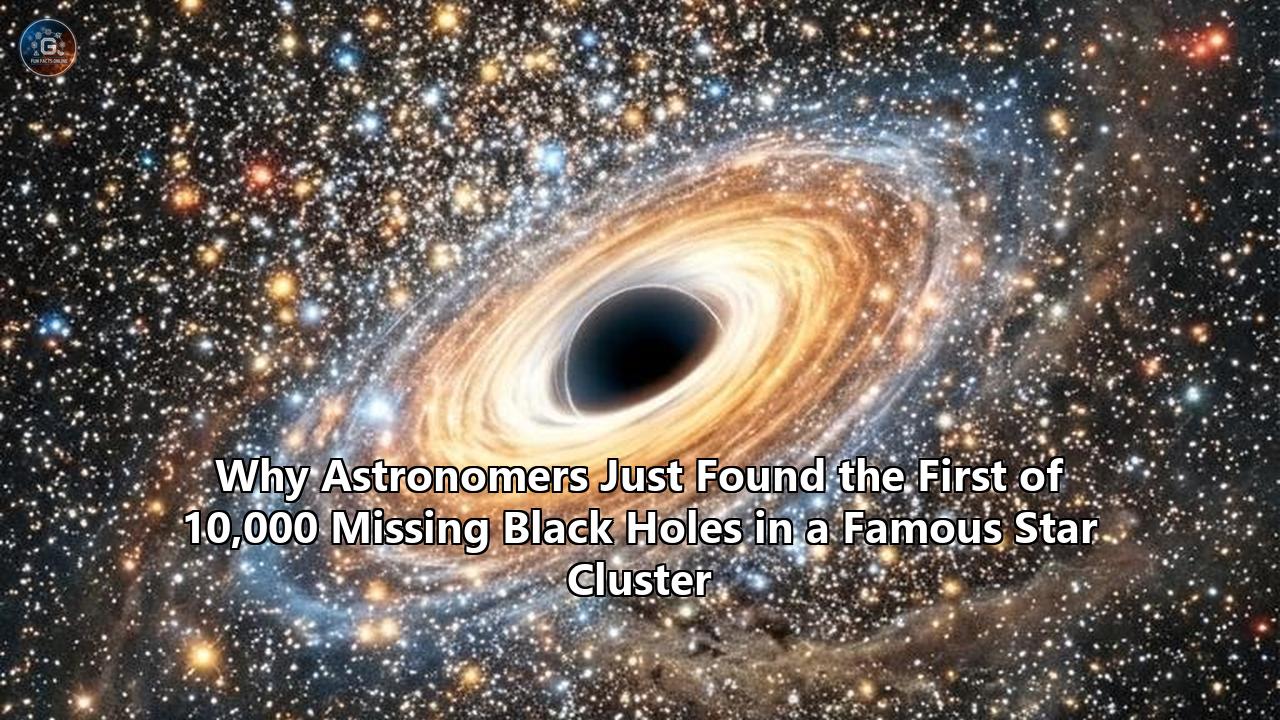
On July 13, 2026, a team of astrophysicists published a paper in The Astrophysical Journal Letters that quietly ended one of the longest-running cold cases in modern observational astronomy.
For decades, mathematical models of stellar evolution have insisted that the Milky Way’s largest globular cluster, Omega Centauri, should be a bustling graveyard of dead stars. According to these simulations, the cluster ought to harbor roughly 10,000 stellar-mass black holes—the ultra-dense, dark remnants left behind when massive stars exhaust their fuel and collapse. Yet, despite decades of scanning the cluster with the world’s most advanced X-ray, radio, and optical telescopes, astronomers had repeatedly come up empty-handed. The black holes were simply missing.
Now, an international collaboration led by Matthew Whitaker of the University of Utah has found the first one.
Using more than 20 years of archival data from the Hubble Space Telescope, supplemented by high-precision near-infrared observations from the James Webb Space Telescope (JWST), the team tracked the microscopic, sub-pixel wobble of a single main-sequence star. Their analysis revealed that the star is locked in a slow, highly eccentric 94-year orbital waltz with an invisible partner weighing 4.46 times the mass of our Sun.
This dark companion, designated oMEGACat BH-2, is the first stellar-mass black hole ever confirmed inside Omega Centauri. Its discovery does more than just validate decades of theoretical physics; it represents the first successful detection of the missing black holes star cluster models have long predicted.
The finding has sent shockwaves through the astrophysical community. It challenges existing assumptions about how black holes form in ancient, metal-poor environments and provides a new blueprint for mapping the dark census of our galaxy. To understand how this breakthrough was achieved—and why it took more than two decades of observation to pull off—we must follow the forensic trail left by a star moving through the crowded heart of a stellar metropolis.
The Forensic Trail: Why the Graveyard Went Silent
To appreciate the scale of this discovery, it is necessary to understand why stellar-mass black holes are so devilishly difficult to find in globular clusters.
A globular cluster is a spherical, tightly packed swarm of up to millions of stars, gravitationally bound and orbiting a galactic core. Because these structures formed early in the universe’s history—often 10 to 12 billion years ago—their most massive stars burned through their nuclear fuel quickly and died long ago. In theory, these dead giants should have collapsed into black holes weighing between 5 and 30 times the mass of our Sun.
Physicists expected these black holes to settle into the dense, chaotic cores of clusters like Omega Centauri. But finding them required them to make their presence known. Historically, astronomers have relied on three primary methods to hunt for black holes:
- X-ray Emission: When a black hole is in a tight binary system with a companion star, its immense gravity can rip gas from the star’s outer layers. As this gas spirals into the black hole, it heats up to millions of degrees, glowing brilliantly in X-rays.
- Radio Emission: The same infalling material can trigger powerful, relativistic jets of plasma that emit synchrotron radiation detectable by radio telescopes.
- Radial Velocity Spectroscopy: By analyzing the starlight of cluster members, astronomers look for the periodic red-shifting and blue-shifting of spectral lines, which reveals a star wobbling toward and away from Earth under the gravitational tug of an unseen companion.
In Omega Centauri, all three methods repeatedly failed.
X-ray and radio surveys of the cluster’s core revealed a desert of activity. The reason is simple: most stellar-mass black holes in globular clusters are "dormant" or "quiet". If they do not have a companion star close enough to feed on, they emit no radiation. They are completely dark.
Traditional Black Hole Detection Methods vs. Dormant Reality

[ Active System ]     Gas Transfer ---> Accretion Disk ---> Emits X-rays/Radio (Easy to Detect)
  Black Hole <========= Companion Star

[ Dormant System ]    Wide Orbit / No Gas Transfer ========> Completely Dark (Invisible to X-ray/Radio)
  Black Hole . . . . . . . . . . . . . . . . . . . . . . . . Companion Star
Radial velocity spectroscopy also hit a brick wall. Omega Centauri is located roughly 18,000 light-years away and contains more than 10 million stars packed into a sphere just 150 light-years across. In the cluster’s crowded center, the light from individual stars blends together.
Attempting to isolate the spectrum of a single, faint star to detect a subtle Doppler shift is like trying to hear a single violin in a crowded stadium during a touchdown roar. The spectral signatures blur, rendering spectroscopic measurements of individual wide binaries nearly impossible.
This observational blind spot left researchers with a troubling paradox. Either their mathematical models of how stars live and die were fundamentally wrong, or thousands of black holes were hiding in plain sight, completely silent.
To break the deadlock, Whitaker’s team had to abandon the hunt for light and instead look for the subtle gravitational fingerprints of dark matter. They turned to a classical, yet immensely challenging technique: astrometry.
The Astrometric Breakthrough: Measuring the Sub-Pixel Waltz
Astrometry is the science of measuring the precise positions and movements of stars on the sky over time. Rather than waiting for a black hole to emit X-rays, astrometry seeks to detect the physical, two-dimensional "wobble" of a visible star as it traces an orbital path around an invisible center of mass.
But executing this in Omega Centauri was an exercise in extreme precision. At a distance of 18,000 light-years, the physical movement of a star orbiting a black hole is microscopically small when projected onto the sky. The angular displacement is measured in milliarcseconds—equivalent to trying to watch a coin shift by its own width from thousands of miles away.
The breakthrough required an unprecedented baseline of observation and a masterfully calibrated catalog.
The foundation of the discovery was built on the oMEGACat project, a massive, high-precision astrometric catalog created by Maximilian Häberle, a postdoctoral fellow at the European Southern Observatory (ESO). During his doctoral research, Häberle undertook the monumental task of analyzing more than 500 archival images of Omega Centauri taken by the Hubble Space Telescope over two decades.
Many of these images had originally been snapped merely to calibrate Hubble's cameras. But because the telescope had pointed at the same patch of sky repeatedly for 20 years, it had unwittingly recorded a continuous, ultra-precise flipbook of the cluster’s stellar motions. Häberle calibrated these images, correcting for the subtle optical distortions of Hubble's instruments, to track the movements of 1.4 million individual stars.
"This discovery highlights the immense legacy value of the Hubble Space Telescope archive," Häberle noted in the wake of the announcement. "It marks the second breakthrough from our oMEGACat astrometric re-analysis, following our confirmation of an intermediate-mass black hole in the cluster's center."
The Astrometric Detective Work (2002–2025)

[Hubble Archive (2002-2023)] -----------------------> [JWST Observations (2024-2025)]
351 high-resolution exposures                         Infrared precision, resolving cluster core
          \                                                       /
           \                                                     /
            v                                                   v
     [oMEGACat Astrometric Catalog] ---> High-precision tracking of Companion Star (0.78 M_sun)
                                    ---> Microscopic 2D orbital wobble detected
                                    ---> Unmasks oMEGACat BH-2 (4.46 M_sun Black Hole)
Sifting through this ocean of data, Whitaker and his colleagues identified a single, unpretentious main-sequence star—a star in the prime of its hydrogen-burning life, weighing roughly 0.78 times the mass of our Sun.
Over a 20-year span covered by 351 Hubble exposures, this star did not travel in a straight line. Instead, it moved along a curved, accelerating arc. To confirm that this curve was indeed a gravitational orbit and not a random perspective effect, the team secured fresh, highly targeted near-infrared observations from the James Webb Space Telescope in 2024 and 2025.
Webb’s state-of-the-art optics resolved the crowded stellar field with incredible clarity, pinning down the star's position with sub-pixel precision.
"The precision of these measurements is incredible, down to a fraction of a pixel on Hubble and Webb's detectors," said lead author Matthew Whitaker. "It would not have been possible to find this black hole without these two space telescopes working in tandem."
When the Hubble and Webb datasets were stitched together, the evidence was undeniable. The star was swinging through a highly elongated, eccentric orbit around a completely dark point in space.
Dissecting the Ghost: The Profile of oMEGACat BH-2
When the researchers analyzed the orbital parameters of the system, they realized they had found something entirely unique. The properties of oMEGACat BH-2 and its companion challenged several established paradigms of binary stellar systems.
The Orbit of a Century
The orbital period of the companion star around oMEGACat BH-2 is estimated to be 94 years. This is the longest orbital period of any black hole binary system discovered to date.
For comparison, most known stellar-mass black hole binaries in our galaxy have orbital periods measured in days or weeks, as they are tight, interacting systems. The widest systems previously confirmed in other star clusters featured orbits of only a few months.
The physical separation between oMEGACat BH-2 and its companion star is immense, averaging roughly 31 Astronomical Units (AU)—about the distance from the Sun to Neptune. Because the orbit is highly eccentric ($e = 0.72$), the star spends most of its time drifting slowly at the far edges of its orbit.
However, during the 23-year window captured by Hubble and Webb, the star was making its "periastron passage"—its closest, fastest approach to the black hole.
"Based on the precise data from Hubble and Webb, we were able to chart the star's path during its closest approach, when it moved the fastest across the sky," Whitaker explained. "This lucky alignment allowed us to measure the strength of the black hole's gravitational pull and calculate its mass with high confidence."
The Highly Eccentric Orbit of oMEGACat BH-2

                    [Slowest Speed]
                        Apastron
                         (Far)
                          / \
                         /   \
                        /     \
                       |       |
                       |       |
                        \     /  <-- Orbit is highly eccentric (e = 0.72)
                         \   /
                          \ /
                        Periastron
                     [Fastest Speed]
                       (Observed)
                           *  <-- oMEGACat BH-2 (4.46 Solar Masses)
Breaking the Neutron Star Limit
To confirm that oMEGACat BH-2 was indeed a black hole and not some other dark stellar remnant, the team had to calculate its mass with rigorous precision.
A previous astronomical survey had spotted the star's anomalous motion and suggested that the dark companion might be a neutron star—the ultra-dense remnant of a supernova that is not quite massive enough to form a black hole.
However, the laws of nuclear physics place a strict upper limit on the mass of a neutron star, known as the Tolman-Oppenheimer-Volkoff (TOV) limit. Under no circumstances can a stable, non-rotating neutron star exceed roughly 2.2 to 2.5 times the mass of our Sun. Beyond this limit, degenerate neutron pressure fails, and the object must collapse into a black hole.
By combining the 23-year baseline of Hubble and Webb data, Whitaker's team constrained the mass of the invisible companion to 4.46 solar masses. This mass comfortably exceeds the TOV limit, ruling out a neutron star or a white dwarf. It has to be a stellar-mass black hole.
| Property | oMEGACat BH-2 | Companion Star |
|---|---|---|
| Mass | $4.46^{+1.22}_{-1.01}\ \text{M}_\odot$ | $\sim 0.78\ \text{M}_\odot$ |
| Nature | Dormant Stellar-Mass Black Hole | Main-Sequence Turnoff Star |
| Orbital Period | $94^{+63}_{-42}\ \text{Years}$ | $94^{+63}_{-42}\ \text{Years}$ |
| Semi-Major Axis | $\sim 31\ \text{AU}$ | $\sim 31\ \text{AU}$ |
| Eccentricity ($e$) | $0.72^{+0.08}_{-0.13}$ | $0.72^{+0.08}_{-0.13}$ |
The Paradox of the Metal-Poor Featherweight
While the confirmation of oMEGACat BH-2 solved the mystery of the missing black holes in this star cluster, it immediately presented theoretical astrophysicists with a new puzzle. Its mass of 4.46 solar masses is surprisingly low—so low, in fact, that it challenges our current models of how stars evolve and die in ancient environments.
To understand why this is a paradox, we must look at the chemical composition of Omega Centauri.
The cluster is notoriously "metal-poor." In astrophysics, any element heavier than hydrogen and helium is referred to as a "metal." Stars that formed early in the history of the universe, like those in Omega Centauri, crystallized out of gas clouds that had not yet been enriched by generations of supernovae. Consequently, they contain very low concentrations of iron, carbon, and oxygen.
Metallicity plays a critical role in how a star dies:
- Metal-Rich Stars (like our Sun): Heavy elements in a star’s outer atmosphere act like physical sails. The intense radiation flowing outward from the star's core pushes against these heavy elements, generating powerful stellar winds. These winds blow massive amounts of gas into space over the star's lifetime. When a metal-rich star finally undergoes a supernova, it has already shed much of its mass, resulting in a relatively lightweight black hole.
- Metal-Poor Stars: Lacking these heavy elements, metal-poor stars have much weaker stellar winds. They retain nearly all of their original mass right up until the moment of their death. When a massive, metal-poor star collapses, almost the entire stellar envelope should fall into the core, theoretically producing a very heavy stellar-mass black hole—typically weighing 15, 20, or even 30 solar masses.
Yet, oMEGACat BH-2 weighs just 4.46 solar masses. It sits squarely in the "mass gap"—an elusive range of masses between the heaviest neutron stars and the lightest black holes, where very few objects have ever been detected.
"Its mass is much lower than would be expected in a metal-poor environment like Omega Centauri," said co-author Anil Seth. "This is surprising and exciting. We now know that a metal-poor star is able to form a lightweight black hole like this, and now we need to figure out how that physics actually works."
The Stellar Collapse Paradox

[Metal-Rich Star] ---> Strong Winds (Sheds Envelope) ---> Lightweight Black Hole (Expected)
[Metal-Poor Star] ---> Weak Winds (Retains Envelope)   ---> Heavy Black Hole (Expected)

[Observed Reality in Omega Centauri]
Metal-Poor Environment ===> oMEGACat BH-2 is only 4.46 Solar Masses (Theorists Puzzled)
The discovery indicates that our understanding of mass loss in early-universe stars is incomplete. It may mean that metal-poor stars undergo far more violent mass-loss episodes during their final stages of life than current computer simulations suggest, or that a significant portion of the star's mass is violently ejected during the supernova itself, rather than collapsing directly into the black hole.
Omega Centauri: The Galactic Forensic Scene
The location of this discovery is as significant as the object itself. Omega Centauri is not an ordinary globular cluster; it is a galactic fossil.
Spanning roughly 150 light-years and containing 10 million stars, Omega Centauri is the most massive globular cluster orbiting the Milky Way. It is so massive and structurally complex that astronomers have long suspected it is actually the bruised, battered core of an ancient dwarf galaxy.
Billions of years ago, this dwarf galaxy ventured too close to the Milky Way. Our galaxy’s immense gravitational tides executed a slow-motion act of cosmic cannibalism, stripping away the dwarf galaxy’s outer stars and gas, leaving only its dense, gravitationally bound nucleus behind.
The Cannibalism of a Dwarf Galaxy

[ Ancient Dwarf Galaxy ]  ===> Gravitational Tides from Milky Way strip outer stars and gas
       O  <-- Dense Core

[ Modern Omega Centauri ] ===> Only the highly dense nucleus survives as a "globular cluster"
       *  <-- Houses Intermediate-Mass Black Hole & ~10,000 Stellar-Mass Black Holes
This galactic origin story was bolstered by a milestone discovery in 2024.
A team also using the oMEGACat dataset confirmed the presence of an intermediate-mass black hole (IMBH) weighing roughly 8,200 solar masses at the exact center of Omega Centauri. Because true globular clusters do not typically harbor central, intermediate-mass black holes, but dwarf galaxies do, this discovery provided clinching evidence of Omega Centauri’s galactic heritage.
However, the confirmation of the central IMBH only deepened the mystery of the missing black holes star cluster simulations predicted should exist. While the 8,200-solar-mass beast ruled the center, the 10,000 stellar-mass black holes born from the cluster's ancient population of massive stars remained completely unaccounted for.
With the discovery of oMEGACat BH-2, scientists finally have physical proof that this small-mass population exists.
Crucially, the unique characteristics of this system suggest that it was not born as a binary. Instead, it was forged in the crowded, high-density stellar mosh pit of the cluster's core.
Dynamic Capture: How to Build a Soft Binary
How does a lightweight, dark black hole end up in a massive 94-year orbit with an ordinary main-sequence star?
If the two objects had been born together as a binary pair from the same collapsing gas cloud billions of years ago, they likely would not have survived the black hole's birth. When a massive star undergoes a supernova, the sudden, asymmetric loss of mass usually ejects the lighter companion, disrupting the binary system and sending both stars hurtling in opposite directions.
Instead, Whitaker’s team argues that oMEGACat BH-2 is a product of dynamical capture.
In the ultra-dense core of Omega Centauri, stars are constantly buzzing past one another at high speeds, like cars in a chaotic multi-lane intersection. When a single stellar-mass black hole drifts through this crowded environment, it occasionally experiences a close gravitational encounter with a binary star system or a pair of single stars.
Through a complex, three-body gravitational dance, the black hole can bleed off kinetic energy, eject one of the stars, and "capture" the other into a wide, eccentric orbit.
Dynamical Capture in a Dense Core

Step 1: Unbound Objects          Step 2: Three-Body Interaction       Step 3: New Binary Formed
  (Black Hole drifts close)        (Energy exchange occurs)             (Widely separated & eccentric)

      ● (Black Hole)                   ●                                      ●========o (Binary)
                                      / \
    o---o (Stellar Pair)             o   o                                    o (Ejected Star)
Such a system is known to astrophysicists as a "soft" binary. Because the orbit is so wide (31 AU), the gravitational bond holding the black hole and the star together is relatively weak compared to the disruptive kinetic energy of other stars passing nearby.
"We calculated that a system like oMEGACat BH-2 will survive for less than a billion years before it is torn apart by encounters with nearby stars," Whitaker said.
In cosmic terms, a billion years is a mere blip—less than 10% of Omega Centauri’s 12-billion-year history. This short lifetime carries profound implications.
If soft binaries like oMEGACat BH-2 are disrupted on timescales of less than a billion years, yet we observe one today, it means these systems are not ancient relic structures. Instead, it suggests that the core of Omega Centauri is a highly dynamic machine, constantly destroying old binary systems and assembling new ones.
The 10,000 stellar-mass black holes in the cluster are not merely sitting quietly in the dark; they are actively engaging in a continuous, multi-billion-year game of musical chairs with the cluster's visible stars.
Gravitational Waves and the Cosmic Mosh Pit
Understanding this dynamic population of stellar-mass black holes is not just a matter of galactic bookkeeping. It is crucial for deciphering one of the most exciting frontiers in modern physics: gravitational wave astronomy.
Since the historic first detection of gravitational waves by the Laser Interferometer Gravitational-Wave Observatory (LIGO) in 2015, physicists have cataloged dozens of mergers between stellar-mass black holes. However, a major question remains: Where and how do these black holes find each other to merge?
There are two primary pathways theorized for creating merging black hole binaries:
- Isolated Binary Evolution: Two massive stars are born together, live their lives, and collapse into black holes without outside interference, eventually spiraling inward due to gravitational wave radiation.
- Dynamical Assembly: Black holes are born individually in dense stellar environments like globular clusters, sink to the center, and dynamically capture companions through the gravitational maneuvers described above. Over time, repeated stellar flybys shrink these orbits until the black holes are close enough to merge.
"Environments like Omega Centauri are the primary places where we think binaries are merging and creating these waves," noted Anil Seth. "Understanding the process of forming black holes and then dynamically forming binaries is vital because it directly affects our ability to interpret and understand gravitational wave events."
By locating and characterizing oMEGACat BH-2, astronomers have acquired their first direct, local laboratory for studying how these dynamical captures occur in real-time. It allows theorists to calibrate their simulations of gravitational wave sources with actual observational data, refining our understanding of how often globular clusters serve as factories for the black hole mergers detected by LIGO, Virgo, and KAGRA.
Opening the Floodgates: What Happens Next?
The discovery of oMEGACat BH-2 is not the final chapter of a story; it is the opening of a floodgate.
Now that astronomers have proven that astrometry can successfully unmask quiet, widely separated black holes in crowded cluster environments, they are already planning to scale up the search. The hunt to locate more of the missing black holes star cluster environments harbor is entering a high-volume phase.
The Limits of the Present
While the Hubble-Webb collaboration succeeded, it required an extraordinary investment of time and luck. It took 23 years of tracking a single star to confirm oMEGACat BH-2, largely because astronomers had to catch the star during its brief, fast passage at periastron.
If the star had been observed during the slow, 70-year portion of its orbit far from the black hole, its motion would have been too subtle to distinguish from a straight line, and the black hole would have remained hidden.
To find the remaining 9,999 black holes in Omega Centauri, astronomers cannot rely on pointing Hubble and Webb at single stars for decades. They need a wider net.
The Hunt for the Remaining 9,999 Black Holes

  [ Current Strategy ]               [ Next-Generation Strategy ]
  Hubble + Webb                      Nancy Grace Roman Space Telescope
  - Narrow field of view             - Massive field of view (100x Hubble)
  - Target-by-target tracking        - Regular, automated cadenced imaging
  - 23 years for 1 discovery         - Simultaneous tracking of millions of stars
Enter the Roman Space Telescope
The true game-changer for this astronomical archaeology will be NASA’s Nancy Grace Roman Space Telescope.
Equipped with a giant 2.4-meter mirror and a field of view 100 times larger than that of Hubble, Roman is designed to capture vast swaths of the sky with the same razor-sharp resolution as its predecessor. Crucially, Roman will conduct regular, high-cadence surveys of the crowded Galactic bulge and nearby star clusters.
"Roman will image the crowded galactic bulge, including the galactic center, very regularly with Hubble-like resolution and with a much wider field of view," Matthew Whitaker said. "We're hoping we'll be able to find black hole binary systems like this one because of the regular cadence of Roman's observations."
With Roman, astronomers will not have to manually piece together archival puzzle pieces over two decades. The telescope's automated surveys will simultaneously track the precise proper motions of millions of stars, flag thousands of orbital anomalies, and map out the dark stellar graveyards of our galaxy's clusters in unprecedented detail.
Beyond Omega Centauri, other massive Milky Way globular clusters—such as 47 Tucanae and M15—are already being targeted for similar astrometric re-analyses. Each cluster represents a unique environment, with its own age, density, and chemical makeup, allowing astronomers to see how different stellar populations influence the creation and survival of black hole binaries.
The Quiet Revolution
For nearly a century, our understanding of the universe has been dominated by the light. We have mapped the cosmos using the photons emitted by burning stars, glowing gas, and high-energy accretion disks. But this focus on light has left us blind to the quiet, dark infrastructure of our galaxy.
The discovery of oMEGACat BH-2 represents a quiet revolution in observational astrophysics.
By showing that we can weigh the dark remnants of the cosmos simply by watching the patient, century-long loops of the stars that orbit them, Whitaker, Häberle, and their colleagues have given us a new pair of eyes. The case of the missing black holes star cluster mystery has officially been cracked, but the work of mapping the silent census of the dark universe has only just begun.
Reference:
- https://science.nasa.gov/missions/hubble/nasas-hubble-discovers-first-of-star-clusters-missing-black-holes/
- https://www.stsci.edu/contents/news-releases/2026/news-2026-017
- https://spacedaily.com/s-astronomers-have-found-the-first-stellar-mass-black-hole-in-omega-centauri-locked-with-a-star-in-a-94-year-orbit-the-longest-period-black-hole-binary-yet-found/
- https://universemagazine.com/en/a-hidden-black-hole-in-the-omega-centauri-cluster-confused-scientists-for-20-years/
- https://www.earth.com/image/missing-black-hole-finally-found-in-omega-centauri/
- https://www.space.com/astronomy/black-holes/the-1st-of-10-000-missing-black-holes-in-the-omega-centauri-star-cluster-has-been-found-by-the-hubble-and-james-webb-space-telescopes
- https://arxiv.org/abs/2606.18350
- https://gizmodo.com/a-missing-black-hole-was-found-hiding-in-a-giant-star-cluster-astronomers-think-there-could-be-thousands-more-2000785795
- https://www.space.com/astronomy/black-holes/the-1st-of-10-000-missing-black-holes-in-the-omega-centauri-star-cluster-has-been-found-by-the-hubble-and-james-webb-space-telescopes
- https://esahubble.org/news/heic2610/
- https://science.nasa.gov/missions/hubble/nasas-hubble-discovers-first-of-star-clusters-missing-black-holes/
- https://spacedaily.com/s-astronomers-have-found-the-first-stellar-mass-black-hole-in-omega-centauri-locked-with-a-star-in-a-94-year-orbit-the-longest-period-black-hole-binary-yet-found/
- https://attheu.utah.edu/facultystaff/missing-link-in-massive-black-hole-formation/
- https://maxhaeberle.github.io/research/
- https://www.telescopeadvisor.com/hubble-omega-centauri-stellar-mass-black-hole-2026/
- https://gizmodo.com/a-missing-black-hole-was-found-hiding-in-a-giant-star-cluster-astronomers-think-there-could-be-thousands-more-2000785795