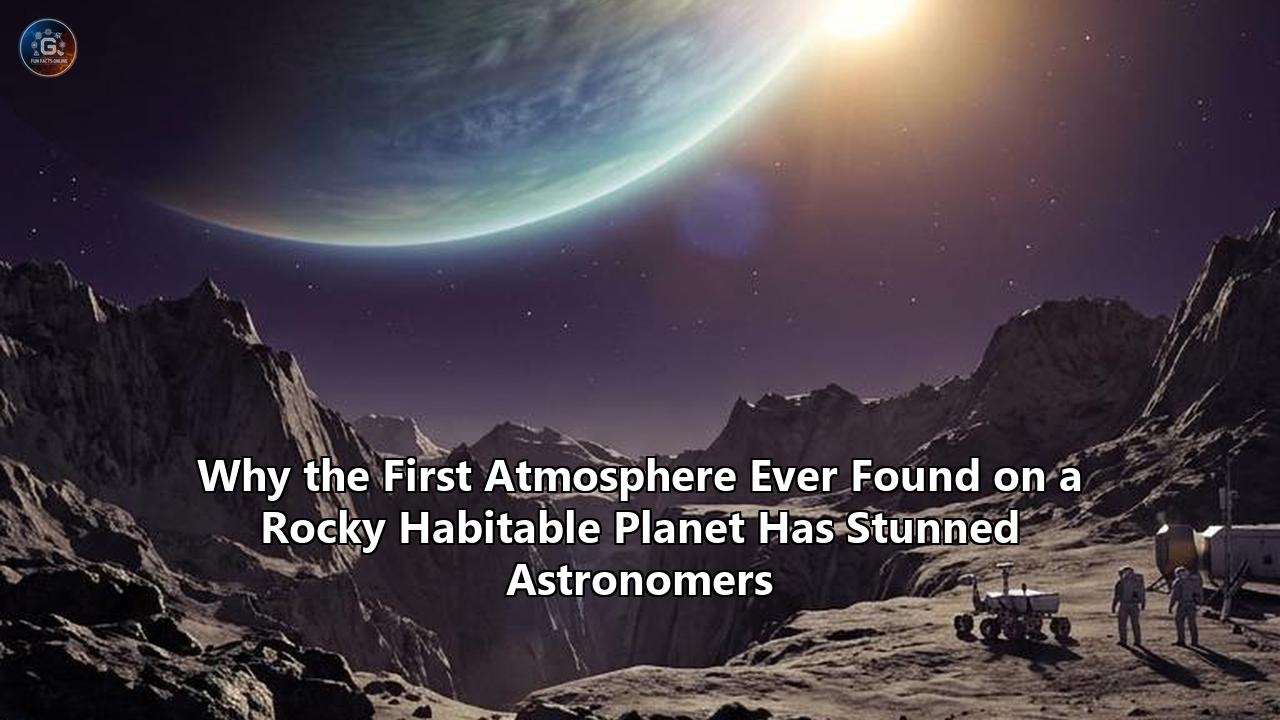
On July 16, 2026, a team of astrophysicists published a landmark study in the journal Science, announcing the first-ever direct detection of an atmosphere on a rocky, temperate planet orbiting within the habitable zone of another star.
The discovery was made not by a multi-billion-dollar space telescope, but from a mountaintop in Chile, using a highly specialized ground-based spectrograph. By observing a rare celestial alignment, researchers captured the unmistakable chemical signature of helium gas streaming away from a nearby "super-Earth" known as LHS 1140 b.
This milestone ends a decades-long search and fundamentally challenges prevailing assumptions about the survival of atmospheres around stars other than our Sun. Until now, every confirmed exoplanet atmosphere belonged to either a bloated, gas-giant planet like Jupiter, or a scorching, highly irradiated world whose surface is a molten ocean of lava.
For the temperate, rocky worlds where life could theoretically take root, astronomers had repeatedly come up empty-handed. The discovery that LHS 1140 b has held onto its gas envelope for billions of years is a profound revelation, providing the strongest evidence yet that habitable environments are not unique to our solar system.
Anatomy of a Super-Earth: Under the Hood of LHS 1140 b
Located approximately 48 light-years away in the southern constellation Cetus, LHS 1140 b has been a prime target for exoplanet researchers since its discovery in 2017.
It is classified as a "super-Earth"—a type of planet with no direct equivalent in our solar system. It is roughly 5.6 times more massive than Earth, yet its radius is only 1.73 times larger. These dimensions yield a density that is lower than that of a pure iron-and-rock planet like Earth, but far too high to represent a gas-rich "mini-Neptune". Instead, LHS 1140 b sits precisely within a fascinating cosmic transition zone, indicating a solid, rocky interior surrounded by a lighter envelope of volatile compounds.
Planetary Profile: LHS 1140 b
===================================================
Distance from Earth:   48 light-years
Mass:                  5.6 x Earth's mass
Radius:                1.73 x Earth's radius
Orbital Period:        24.7 days
Orbital Distance:      9 million miles (0.09 AU)
Stellar Energy:        42% of Earth's solar flux
Host Star Type:        M4.5 Red Dwarf
===================================================
LHS 1140 b completes one orbit around its host star every 24.7 days. While an orbital period of less than a month would place a planet inside the blistering, scorched zone of our own solar system, the rules are entirely different around LHS 1140.
The host star is an M-dwarf, commonly known as a red dwarf. Red dwarfs are significantly smaller, cooler, and dimmer than our G-type Sun; LHS 1140 has only about one-fifth the mass and radius of the Sun. Because the star's energy output is a mere fraction of our Sun's, its "Goldilocks zone"—the orbital band where liquid water can stably exist on a planet's surface—lies much closer in.
At a distance of just 9 million miles from its host star (compared to Earth's 93-million-mile distance from the Sun), LHS 1140 b receives approximately 42 percent of the stellar radiation that Earth does. This places it squarely within the conservative habitable zone of the system.
Without an insulating atmospheric blanket, the planet's equilibrium temperature would hover around a chilly -43 degrees Celsius (-45 degrees Fahrenheit). However, if it possesses a modest greenhouse effect similar to Earth's, its surface could easily host comfortable, liquid-water temperatures. Determining whether such a world has a stable rocky planet atmosphere in this temperate zone has been the holy grail of modern astrobiology.
The M-Dwarf Paradox: The Threat of Stellar Violence
To appreciate why this discovery has stunned the scientific community, one must understand the hostile nature of red dwarf stars.
Red dwarfs are the most common stars in the Milky Way, accounting for roughly 75 percent of the stellar population in our galaxy. If astronomers want to find life elsewhere in the cosmos, red dwarfs represent their statistically best shot.
However, these stars present a profound paradox for habitability. While they are incredibly long-lived—capable of burning steadily for trillions of years—their youth is characterized by extreme violence.
During their first billion years, red dwarfs are highly active, prone to frequent, massive stellar flares that emit torrential blasts of high-energy X-rays and extreme ultraviolet (EUV) radiation. Because habitable-zone planets must orbit incredibly close to these cool stars, they are parked directly in the path of this cosmic radiation.
Consider Proxima Centauri b, the closest known exoplanet to Earth, which orbits a red dwarf just 4.2 light-years away. It is subjected to up to 400 times the X-ray radiation that Earth receives from the Sun. Over billions of years, such intense, high-energy bombardment acts as an atmospheric sandblaster, stripping away volatile gases and leaving behind bare, airless rocks.
Many astronomers feared that all rocky planets orbiting red dwarfs were doomed to this sterile fate. If red dwarf stars inevitably destroy the atmospheres of their planets, then the vast majority of rocky worlds in the galaxy are uninhabitable, dead spheres.
LHS 1140 b, however, breaks this grim rule.
Its parent star, LHS 1140, is an older, exceptionally "quiet" red dwarf. It exhibits very little flare activity and bathes LHS 1140 b in just 10 times the X-ray energy that streams toward Earth—a radiation level that is well within the tolerance limits of basic biology and atmospheric retention.
"Right now on LHS 1140 b, the amount of X-ray flux would not really be threatening to life as we know it at all," explained Collin Cherubim, a NASA Hubble Fellow at the University of Chicago and the lead author of the study, which he began during his doctoral research at Harvard University.
The fact that LHS 1140 b has maintained its gas envelope for more than 3 billion years demonstrates that rocky planets orbiting red dwarfs can, under the right conditions, successfully preserve their skies.
Inside the WINERED Spectrograph: How Ground-Based Tech Sniffed Out Helium
The historic detection of LHS 1140 b's atmosphere did not rely on space-based platforms, but on a unique instrument called the Warm Infrared Echelle (WINERED) Spectrograph, mounted on the 6.5-meter Magellan Clay telescope at the Las Campanas Observatory in Chile.
                                  [Starlight from LHS 1140]
                                             ||
                                             \/
                                    +------------------+
                                    |  LHS 1140 b      | <-- Atmosphere filters starlight
                                    |  (Transiting)    |
                                    +------------------+
                                             ||
                                             \/ [Filtered Light]
                                  [Earth's Atmosphere]
                                             ||
                                             \/
                                  [Magellan Clay 6.5m Telescope]
                                             ||
                                             \/
                                  [WINERED Spectrograph]
                                             ||
                                             \/
                                  [Helium Signal (1083 nm)]
WINERED is a high-resolution, near-infrared spectrograph developed by the Laboratory of Infrared High-resolution spectroscopy (LiH) at Kyoto Sangyo University.
Its design is unique: while its camera is cryogenically cooled to prevent thermal noise, its dispersion optics remain "warm" (non-cooled). Operating in the Y and J bands of the near-infrared spectrum (0.9 to 1.35 micrometers), WINERED is optimized to achieve incredibly high resolving powers (up to R ≈ 70,000) with exceptionally high throughput.
This extreme sensitivity in the short near-infrared wavelengths makes it a formidable tool for exoplanet transmission spectroscopy.
The September 23, 2024 Alignment
To capture the atmospheric signal, Cherubim and his co-author, Shreyas Vissapragada (now a Distinguished Scholar at Carnegie Observatories), targeted a rare, highly fortuitous orbital alignment.
On the night of September 23, 2024, both LHS 1140 b and its closer, sister planet LHS 1140 c were scheduled to transit their host star from Earth's point of view. The exit (egress) of planet c and the entry (ingress) of planet b were separated by a mere 39 minutes. This rapid succession offered a perfect scientific control experiment.
If both transits showed the same spectral anomalies, the signal would likely be a result of stellar activity or instrumental noise. If only the habitable-zone planet showed a signal, it would point directly to a unique planetary atmosphere.
The Mechanics of Transmission Spectroscopy
As a planet transits in front of its host star, it blocks a portion of the star's light, causing a characteristic dip in brightness. If the planet has an atmosphere, that gas envelope acts like a translucent filter.
While the solid body of the planet blocks all light, the thin ring of atmosphere around its edge allows some starlight to pass through.
As this light filters through the gas, different atoms and molecules absorb very specific, highly precise wavelengths of light. When astronomers split this starlight into a rainbow-like spectrum using a spectrograph, these absorbed wavelengths show up as dark gaps, or absorption lines. These lines act as chemical fingerprints.
                 UNFILTERED STARLIGHT            FILTERED THROUGH ATMOSPHERE
              ==========================         ==========================
Wavelengths:  [ Red | Green | Blue | IR ]  --->  [ Red |   X   | Blue |  X   ]
                                                           ^             ^
                                                   Absorbed by      Absorbed by
                                                     Helium          Water Vapor
Targeting the "Helium Leak"
While many searches focus on looking for heavier molecules like water vapor, carbon dioxide, or methane, these gases are typically concentrated in the lower, denser layers of a planet's atmosphere.
At these low altitudes, thick clouds and atmospheric hazes often block the light, making the signals incredibly faint and notoriously difficult to detect, even for giant space observatories like the James Webb Space Telescope (JWST).
To bypass this hurdle, Cherubim’s team decided to search for helium in the planet’s highly expanded upper atmosphere.
Under the influence of high-energy stellar radiation, lightweight helium gas in the upper atmosphere is heated, causing it to inflate and slowly escape into space. Neutral helium in its ground state does not absorb starlight in a way that is easily visible from Earth.
However, when hit by the star's extreme ultraviolet (EUV) light, the helium atoms become "excited" or metastable. In this excited state, they absorb near-infrared starlight at a highly specific wavelength: 1083 nanometers (1.083 micrometers).
During the September 2024 transit, the WINERED spectrograph detected a clear, pronounced dip in starlight at exactly 1083 nanometers as LHS 1140 b crossed the star. The data revealed that excited helium was streaming away from the planet at a speed of several kilometers per second.
Crucially, when LHS 1140 c was observed, no such helium absorption line was detected. This stark contrast confirmed that they were indeed seeing the signature of a genuine rocky planet atmosphere on the outer, habitable-zone world.
The Mystery of the Vanishing Helium: A Variable Atmosphere
While the 2024 detection of escaping helium was a triumphant validation of Cherubim's models, a follow-up observation in 2025 threw a massive curveball at the research team.
When the astronomers pointed the Magellan Clay telescope at LHS 1140 b during another transit a year later, the 1083-nanometer helium absorption line had completely vanished. The signal was gone, leaving no trace of escaping gas.
In astrophysics, a non-detection is often as revealing as a positive detection. The team ruled out instrumental malfunction, leaving only one scientific conclusion: the atmospheric escape of helium on LHS 1140 b is highly variable over time.
"The helium detection in 2024 indicated that the atmosphere is present, whereas the non-detection in 2025 indicates that it is changing," said Vissapragada. "It is a rare privilege to witness the atmosphere of an extrasolar planet change on such short, human timescales!"
                     2024 TRANSIT                            2025 TRANSIT
           ================================        ================================
           High Stellar EUV / Flare Activity       Low Stellar EUV / Calm Phase
                         ||                                      ||
                         \/                                      \/
               Upper Atmosphere Heated                 Upper Atmosphere Cools
                         ||                                      ||
                         \/                                      \/
           Helium Escaping @ 220 tons/sec          Helium Escape Drops / Suppressed
                         ||                                      ||
                         \/                                      \/
               Strong Signal Detected (1083nm)          No Signal Detected (1083nm)
This rapid, dramatic fluctuation is driven by the complex, dynamic relationship between the planet's upper atmosphere and its host star. The mechanism is governed by three primary factors:
- Stellar High-Energy Variability: Even a relatively "quiet" red dwarf like LHS 1140 is subject to magnetic cycles and subtle, unpredictable variations in its X-ray and EUV output. Because these high-energy photons are the exact engine that heats the upper atmosphere and excites the helium atoms, any slight dip in stellar radiation can drastically reduce the volume of escaping, excited helium.
- Magnetic Field Interactions: If LHS 1140 b possesses a planetary magnetic field, it would interact directly with the stellar wind—the stream of charged particles flowing from the red dwarf. These magnetic fields can act as a shield, trapping the escaping gas close to the planet. When the stellar wind strengthens, it can compress this magnetic shield, occasionally "squeezing" the atmospheric tail or sweeping it into a different orbital plane, making it invisible to our line of sight from Earth.
- Hydrodynamic Escape Rates: The researchers estimated that during the 2024 active phase, helium was escaping from LHS 1140 b at an astonishing rate of roughly 220 tons (or hundreds of thousands of kilograms) per second. To put that in perspective, that is roughly the weight of an adult blue whale evaporating into space every single second.
Because LHS 1140 b is massive (5.6 times the mass of Earth), its gravitational pull is strong enough to keep the vast majority of its atmospheric bulk securely bound to the planet.
The escaping helium represents only the topmost, ultra-lightweight layer of the planet's envelope. The lower layers of the atmosphere—containing much heavier, slower-moving molecules like nitrogen, carbon dioxide, and water—remain securely trapped deep within the planet's gravitational well.
What Kind of World Is LHS 1140 b? Eyeball Oceans and Helium Primordial Shrouds
The discovery of a variable, helium-rich upper atmosphere has sparked intense debate among planetary scientists regarding the actual surface conditions of LHS 1140 b.
Its mass and radius measurements suggest two competing geological and environmental models: a "Water World" or a "Helium World".
Hypothesis A: The "Eyeball" Ocean World
One of the most intriguing possibilities is that LHS 1140 b is a massive ocean world, with water making up between 9 and 19 percent of its total mass. By comparison, Earth's oceans account for less than 0.1 percent of its mass.
Because LHS 1140 b orbits very close to its star, the gravitational forces have almost certainly locked the planet into a state of tidal locking. This means its orbital period matches its rotational period; one side of the planet permanently faces the red dwarf star in perpetual daylight, while the other side faces the cold void of space in eternal darkness.
                             TIDALLY LOCKED "EYEBALL" WORLD

                          [Permanent Night]       [Permanent Day]
                           Glaciated/Frozen        Liquid Ocean
                              Ice Sheet              "Iris"
                             +-----------+        +-----------+
                            /  ---------  \      /             \
                           |  ---------**  |    |   ~~~~~~~~    |  <-- Star-facing
                            \  ---------  /      \             /       Liquid Water
                             +-----------+        +-----------+
                                   \____________  ___________/
                                                \/
                                            LHS 1140 b
Under this scenario, the dark hemisphere would be completely glaciated, covered in a massive, miles-thick sheet of water ice.
However, on the day side, the continuous, direct warmth of the red dwarf star would melt a vast, circular region of the ice. This would create a massive, open-liquid ocean centered directly under the star.
From space, such a planet would resemble a giant, frozen eyeball staring fixedly into the cosmos—a white sphere of ice with a dark blue "iris" of liquid water.
The confirmed presence of an atmosphere on LHS 1140 b is crucial for this model. Without atmospheric pressure and greenhouse warming, any liquid water on the day side would instantly evaporate and freeze onto the cold dark side, eventually desiccating the day-side surface.
The atmosphere acts as a vital thermal distributor, circulating heat from the day side to the night side and keeping the planetary climate stable.
Hypothesis B: The Primordial "Helium World"
The second theory, proposed by Cherubim and his PhD advisor Robin Wordsworth, is that LHS 1140 b represents an entirely new, theoretically predicted class of astronomical bodies: a "Helium World".
"This is a newly predicted class of planets that I have argued may not be so exotic, but instead may be a natural step in the evolution of many small planets," Cherubim explained.
                     EVOLUTION OF A HELIUM WORLD

    [Stage 1: Youth]                   [Stage 2: Mature]
    Thick primordial envelope          Lightweight hydrogen stripped;
    of Hydrogen & Helium               Heavy helium left behind
     +---------------+                  +---------------+
    /   H2 + He      \                 /   He-rich      \
   |      (Core)      |   -------->   |     (Core)       |
    \                /                 \                /
     +---------------+                  +---------------+
According to this evolutionary model, many super-Earths form with thick, puffy primordial envelopes composed of hydrogen and helium gas swept up from the early protoplanetary disk.
Over billions of years, the stellar radiation drives a process known as mass fractionation. Because hydrogen is the lightest element in the universe, it is highly susceptible to atmospheric escape. Under stellar heating, hydrogen gas is easily accelerated past the planet’s escape velocity, boiling away into space.
Helium, which is four times heavier than hydrogen, is more difficult to strip away. Over eons, the hydrogen is completely depleted, leaving behind a stable, highly concentrated, helium-dominated upper atmosphere.
This discovery provides a direct window into the deep history of our own solar system. Recent geophysical and planetary science studies suggest that even Earth may have temporarily possessed a thin, primordial hydrogen-helium envelope shortly after its formation.
By studying LHS 1140 b, astronomers can observe a real-time analog of the processes that shaped the early environments of Venus, Earth, and Mars.
Ground-Based Science vs. JWST: A New Astronomical Symbiosis
The detection of LHS 1140 b's atmosphere marks a quiet revolution in the sociology and technology of modern astronomy.
Since its launch, the James Webb Space Telescope has dominated the headlines of exoplanet science. With its massive 6.5-meter gold-coated mirror and ultra-sensitive infrared instruments, JWST was widely expected to be the exclusive tool for atmospheric characterization.
However, JWST has run into significant real-world bottlenecks.
First, telescope time on JWST is one of the most heavily oversubscribed scientific resources in human history. Thousands of astronomers compete for a limited number of observing hours each year, making long-term, repeated monitoring of individual planets incredibly difficult.
Second, detecting the subtle chemical signatures of a rocky planet atmosphere in the dense, low-altitude skies of habitable-zone worlds has pushed JWST to its absolute technical limits.
Clouds and hazes frequently obscure the signals, requiring dozens of transits—representing hundreds of hours of telescope time—to extract a single, statistically significant detection.
By using ground-based facilities like the Magellan Clay telescope equipped with WINERED, astronomers have demonstrated a highly efficient, alternative pathway.
Ground-based telescopes are not restricted by the strict scheduling bottlenecks of a single space telescope. While they must contend with Earth's own atmosphere, high-resolution spectrographs like WINERED can use a technique called cross-correlation to effectively filter out Earth’s atmospheric lines, leaving behind the pure, high-velocity signals of the exoplanet's escaping gas.
This creates a powerful, highly collaborative symbiosis between ground and space:
                            GROUND-SPACE OBSERVATIONAL PIPELINE

    +----------------------------------+          +----------------------------------+
    |      GROUND-BASED TELESCOPES     |          |      SPACE-BASED OBSERVATORIES   |
    |    (Magellan, WINERED, ELT)      |          |          (JWST, Hubble)          |
    +----------------------------------+          +----------------------------------+
    | * High availability of time      |          | * Shielded from Earth's atmosphere|
    | * Targets expanded upper skies   | -------> | * Targets deep, dense lower skies|
    | * Sniffs out escaping Helium     |  [Flag]  | * Detects Water, CO2, Nitrogen   |
    | * Identifies atmospheric retention|          | * Characterizes surface climate  |
    +----------------------------------+          +----------------------------------+
Ground-based telescopes act as highly efficient "scouts."
By searching for escaping helium, ground-based astronomers can quickly determine which rocky planets have successfully retained their gas envelopes and which ones are bare, airless rocks.
Once a planet is flagged as having an atmosphere, the high-precision space assets can be deployed with extreme accuracy. Rather than spending hundreds of hours scanning empty, airless rocks, JWST can focus its precious time on confirmed atmospheric systems like LHS 1140 b, looking for heavier gases in the lower atmosphere.
What Lies Beneath? The Search for Water, Carbon Dioxide, and Nitrogen
Now that the upper helium shroud of LHS 1140 b has been confirmed, the immediate question facing planetary scientists is: What lies beneath it?
Models of atmospheric chemistry suggest that a helium-rich upper atmosphere is highly likely to overlay a dense, secondary atmosphere rich in heavier molecular compounds. Because these heavier molecules are much more difficult to strip away via hydrodynamic escape, they should remain trapped closer to the planet's surface.
                     LHS 1140 b's Highly Layered Atmosphere

            +-------------------------------------------+
            |  ESCAPING UPPER ATMOSPHERE:               | <-- Helium detected
            |  Excited Helium (Highly Variable Tail)    |     by WINERED (2024)
            +-------------------------------------------+
            |  TRANSITION LAYER:                        |
            |  Trace Hydrogen / Photolytic Hazes        |
            +-------------------------------------------+
            |  DENSE LOWER ATMOSPHERE:                  | <-- Under investigation
            |  Nitrogen (N2) / Carbon Dioxide (CO2) /   |     by JWST
            |  Water Vapor (H2O) / Methane (CH4)        |
            +-------------------------------------------+
            |               PLANETARY SURFACE           |
In late 2024, preliminary observations of LHS 1140 b using JWST's Near-Infrared Imager and Slitless Spectrograph (NIRISS) provided tentative, low-significance hints of nitrogen gas (N2) and water vapor (H2O) in its lower atmosphere.
At the time, the data was too noisy to draw definitive conclusions. However, with the Magellan helium discovery validating that LHS 1140 b indeed possesses a robust, long-lived atmosphere, a massive, dedicated observing program is currently underway.
LHS 1140 b is currently a prime target under the Rocky Worlds Director's Discretionary Time (DDT) Program—a joint initiative of the James Webb Space Telescope and the Hubble Space Telescope specifically dedicated to finding and characterizing atmospheres on rocky planets orbiting red dwarf stars.
In mid-2026, JWST completed a series of nine highly detailed, long-exposure transit observations of LHS 1140 b throughout its orbit. Over the next several years, the data collected from these transits will be analyzed to search for the definitive spectral absorption lines of three primary compounds:
- Nitrogen (N2): Nitrogen is a crucial component of any Earth-like atmosphere. Because it is chemically inert, it acts as an excellent buffer gas, regulating atmospheric pressure and preventing oceans from boiling away into space.
- Carbon Dioxide (CO2): Carbon dioxide is a powerful greenhouse gas. Detecting it would confirm that LHS 1140 b has a carbon cycle, which is essential for regulating a planet's long-term climate.
- Water Vapor (H2O): Finding water vapor in the lower atmosphere would be the smoking gun for an active hydrological cycle, confirming that the planet indeed hosts a massive, day-side liquid-water ocean.
If these heavier compounds are verified, LHS 1140 b will immediately vault to the top of the list of the most promising targets in the search for extraterrestrial life, far surpassing the highly contested worlds of the TRAPPIST-1 system.
The Horizon of Astrobiology: What Happens Next?
The confirmation of an atmosphere on LHS 1140 b has fundamentally reshaped the landscape of astrobiology and the long-term roadmap for exoplanet science.
For decades, the search for life beyond Earth was a highly theoretical endeavor. We had a sample size of exactly one: our own solar system. While we had found thousands of exoplanets, we lacked any physical proof that a rocky, temperate world outside our solar system could maintain the atmospheric envelope necessary to sustain liquid water and shield a surface from cosmic radiation.
Now, we know that at least one has.
This discovery has direct, profound implications for the Drake Equation—the mathematical formula used to estimate the number of active, communicative extraterrestrial civilizations in the Milky Way galaxy. One of the most highly debated variables in the equation is $f_e$ (the fraction of suitable planets that actually develop an environment capable of supporting life).
By demonstrating that rocky planets orbiting red dwarfs can successfully preserve their atmospheres for billions of years, this discovery suggests that habitable environments are likely far more common in the universe than previously believed.
Over the next decade, our ability to study these atmospheres will expand exponentially.
In addition to continued observations with JWST, the next generation of ground-based "mega-telescopes" is rapidly nearing completion. The Extremely Large Telescope (ELT) in Chile, with its massive 39-meter primary mirror, is designed to dwarf all existing ground observatories.
Equipped with high-resolution spectrographs, the ELT will be capable of not only detecting the atmospheric composition of super-Earths like LHS 1140 b, but actually searching for "biosignatures"—gaseous anomalies like the simultaneous presence of oxygen and methane that can only be explained by active biological processes.
We are no longer merely cataloging cold, distant coordinate points in the night sky. We are actively peeling back the layers of alien atmospheres, looking at dynamic, changing weather systems on worlds 300 trillion miles away.
LHS 1140 b has proven that the universe does not just contain rocks; it contains skies. And where there are skies, there is the potential for life to look up at them.
Reference:
- https://carnegiescience.edu/detected-rocky-habitable-zone-exoplanet-atmosphere
- https://www.sciencealert.com/for-the-first-time-astronomers-have-detected-an-atmosphere-around-a-rocky-planet-in-the-habitable-zone
- https://carnegiescience.edu/detected-rocky-habitable-zone-exoplanet-atmosphere
- https://www.courthousenews.com/astronomers-reach-a-milestone-in-the-search-for-life/
- https://current.fas.harvard.edu/stories/harvard-scientists-detect-atmosphere-distant-earth-planet
- https://www.sciencenews.org/article/rocky-exoplanet-helium-atmosphere
- https://www.iflscience.com/incredible-atmosphere-detection-in-habitable-zone-rocky-exoplanet-located-just-49-light-years-away-84126
- https://www.404media.co/scientists-discover-planet-has-everything-to-host-earth-like-life-in-breakthrough/
- https://en.wikipedia.org/wiki/LHS_1140_b
- https://arxiv.org/abs/2406.15136
- https://skyandtelescope.org/astronomy-news/first-atmosphere-terrestrial-world/
- https://time.com/article/2026/07/16/earthlike-planet-atmosphere-science-discovery/
- https://www.space.com/astronomy/exoplanets/astronomers-discover-1st-atmosphere-around-a-rocky-earth-like-planet-in-the-habitable-zone
- https://www.reddit.com/r/space/comments/1fbvyii/earthlike_exoplanet_lhs_1140b_may_have_an/
- https://www.404media.co/scientists-discover-planet-has-everything-to-host-earth-like-life-in-breakthrough/
- https://astronomia.udp.cl/en/event/winered-a-near-infrared-high-resolution-spectrograph-in-regular-operation-at-magellan-clay-lco/
- https://wasatchphotonics.com/applications/winered-astronomy-spectrograph/
- http://astro.vaporia.com/start/winered.html
- https://arxiv.org/html/2508.11089v1
- https://www.eurekalert.org/news-releases/1135989
- https://www.discovermagazine.com/rocky-planet-48-light-years-away-may-be-first-in-a-habitable-zone-with-a-confirmed-atmosphere-49391
- https://skyandtelescope.org/astronomy-news/first-atmosphere-terrestrial-world/
- https://www.sciencealert.com/for-the-first-time-astronomers-have-detected-an-atmosphere-around-a-rocky-planet-in-the-habitable-zone
- https://news.ufl.edu/2026/07/exoplanet/