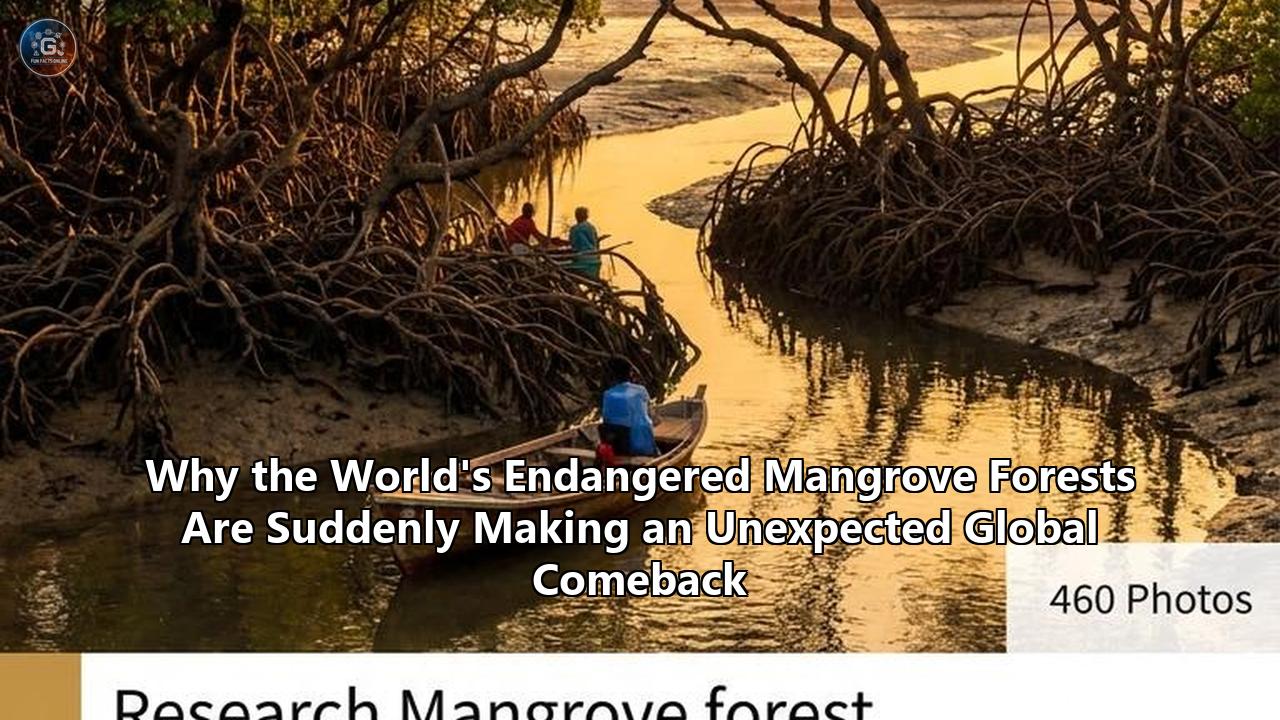
For nearly half a century, the global conservation community operated under a bleak consensus: the world’s mangrove forests—the salt-tolerant, root-woven sentinels guarding tropical coastlines—were on a fast track to extinction. Cleared to make way for commercial shrimp ponds, choked by coastal urbanization, and severed by agricultural expansions, these highly specialized intertidal ecosystems were estimated to be disappearing faster than inland tropical rainforests.
Then came a quiet, monumental shift.
In June 2026, a study published in the journal Science revealed that the multi-decade decline of global mangrove forests has not only ground to a halt but has actively reversed. Analyzing forty years of continuous satellite observations from 1984 to 2023, a research team led by scientists at Tulane University and the University of Cambridge established that global mangrove coverage transitioned from long-term decline to net expansion, with the global rebound beginning around 2010.
The statistics underpinning this coastal renaissance are striking:
- The Era of Loss (1980s–2010): Over these three decades, global mangrove extent contracted from approximately 154,810 square kilometers to 151,928 square kilometers. This represented a net loss of 1.86%, representing nearly 2,900 square kilometers (1,120 square miles) of coastal forest wiped out by human development.
- The Great Rebound (2010–2023): Over the subsequent 13 years, gains outpaced losses. By 2023, global mangrove coverage climbed back to 153,961 square kilometers—reclaiming more than 2,000 square kilometers of lost ground since the 2010 nadir.
- The 40-Year Net Outcome: Over the entire four-decade observation window, the net global decline of mangroves stands at just about 1%—a fraction of the catastrophic losses predicted by historical models.
“After decades of loss, we’re finally seeing a global turning point for mangroves,” stated Dr. Zhen Zhang, a coastal ecologist, postdoctoral scholar at Tulane University, and lead author of the Science study. “This highlights their strong resilience and their potential as a powerful nature-based solution for climate mitigation and coastal protection.”
This unexpected global comeback is not a statistical anomaly or a temporary fluke. Instead, it represents a convergence of slowing deforestation rates, massive international financial alignment, the maturity of scientific mangrove forest restoration techniques, and a surprising, hyper-resilient natural expansion of these forests into newly forming coastal environments.
Reconstruction of the Earth's Coastlines via Remote Sensing
To map forty years of change across highly dynamic, muddy, and often inaccessible tidal zones, researchers had to bypass traditional, ground-based surveys. The cost and safety challenges of manual fieldwork in alligator-dense deltas or deep mangrove swamps historically left massive gaps in global datasets.
The June 2026 study resolved this by combining forty years of NASA and United States Geological Survey (USGS) Landsat observations with ultra-high-resolution PlanetScope satellite imagery from the European Space Agency. Using cloud-computing platforms and machine-learning algorithms, the team trained computers to recognize the unique spectral signatures of mangrove vegetation. Mangroves reflect specific wavelengths of near-infrared and shortwave-infrared light differently than terrestrial forests or open water, allowing researchers to calculate exact canopy density and spatial boundaries over time.
MANGROVE EXTENT TRENDS (1984 - 2023)
==========================================================
1980s Baseline: 154,810 sq km
   \
    \  -1.86% Decline (Deforestation, Shrimp Farming, Urbanization)
     \
2010 Low Point: 151,928 sq km
     /
    /  +2,033 sq km Rebound (Natural Colonization, Restored Hydrology)
   /
2023 Recovery:  153,961 sq km  [Net 40-Year Loss: ~1%]
==========================================================
The satellite data revealed another encouraging structural metric: remaining mangrove forests are growing denser and healthier. Globally, "closed-canopy" mangrove forests—mature stands characterized by continuous, interlocking crowns—expanded steadily over the 40-year period. Because closed-canopy forests feature complex, multi-tiered root systems and high biomass density, they offer vastly superior coastal defense and store significantly more carbon than younger, sparse, or degraded stands.
"What we’re seeing now is a real shift," explained Professor Daniel Friess, Cochran Family Professor of Earth and Environmental Sciences at Tulane University and director of the university's Mangrove Lab. "Mangroves are now showing a net increase globally, and the rate of degradation is slowing."
The Mathematics of Blue Carbon Powerhouses
The global recovery of mangrove forests is particularly valuable for climate mitigation because of the outsized carbon sequestration capacity of intertidal ecosystems, commonly referred to as "blue carbon".
While mangroves represent less than 1% of the world's tropical forest area, they are among the most carbon-dense ecosystems on Earth. Unlike terrestrial trees, which store the majority of their carbon in their living wood and leaves, mangroves store up to 90% of their carbon in the waterlogged, anaerobic (oxygen-depleted) soils beneath them. In these soggy environments, lack of oxygen drastically slows down the decomposition of organic matter, trapping carbon in deep, muddy soils for centuries, if not millennia.
To grasp the sheer scale of this carbon vault, consider the following metrics compiled by the Global Mangrove Alliance (GMA) in their State of the World's Mangroves report:
- Carbon Density: A single hectare of healthy mangrove forest stores an average of 394 metric tons of carbon within its biomass and the top meter of soil.
- The Elephant Equivalence: Assuming an average adult African elephant weighs approximately 6 metric tons, a single hectare of mangroves holds a carbon weight equivalent to 65 elephants.
- Regional Hotspots: In high-density blue carbon hotspots like the Philippines, soil and biomass carbon stocks can soar to over 650 metric tons per hectare—the equivalent of 108 elephants parked on a single soccer-field-sized patch of land.
- Comparison to Rainforests: On a per-hectare basis, healthy mangrove forests can store up to ten times more carbon than mature inland tropical rainforests.
CARBON STORAGE COMPARISON (per hectare)
========================================================================
Mature Terrestrial Rainforest: [██] ~40 metric tons
Mangrove Forest (Global Avg):  [████████████████████] 394 metric tons
Mangrove Forest (Philippines): [███████████████████████████████] 650 metric tons
========================================================================
The climate implications of this dataset are profound. When a mangrove forest is cleared, the soil is exposed to air, prompting rapid aerobic decomposition that releases centuries of accumulated soil carbon back into the atmosphere as carbon dioxide ($CO_2$). Conversely, stopping deforestation avoids these immediate, massive carbon emissions, while allowing forests to regenerate naturally keeps their high-velocity carbon-sequestration engines running.
The Economics of the Comeback: Spatial Models and ROI
Historically, conservation decisions were hampered by a lack of granular economic data. Restoration initiatives often relied on crude global averages, leaving project developers and governments blind to the actual financial commitments required to rebuild coastal habitats.
This data vacuum was filled by a major study published in the journal One Earth, led by resource economists who analyzed financial and operational data from 249 distinct mangrove restoration projects across 25 countries. The study produced the first global, site-specific cost-benefit map for mangrove recovery, revealing that restoring these ecosystems is highly cost-effective.
The True Cost of Restoration
The researchers determined that the median implementation cost for active mangrove forest restoration is $2,099 per hectare ($3,297 per acre). However, because coastal conditions vary wildly, the average implementation cost sits at $9,739 per hectare globally, spanning a broad spectrum from a nominal $9 per hectare to more than $700,000 per hectare in highly complex, heavily degraded environments.
The primary cost drivers identified by the spatial regression models include:
- Geomorphic Setting: Restoring mangroves in protected, low-energy deltas and abandoned aquaculture ponds is significantly cheaper because the natural hydrology is already conducive to plant survival. Conversely, projects on open coasts or eroded shorelines require expensive wave-breaking infrastructure (such as rock barriers or bamboo fences) to prevent young seedlings from being swept away by tides, driving costs up sharply.
- National Economy: Implementation costs scale directly with a country's Gross Domestic Product (GDP) per capita, reflecting localized labor rates. Restoration is exceptionally cost-effective in developing nations such as Myanmar, Liberia, and Cameroon, whereas it is highly expensive in high-income regions like Qatar or the Cayman Islands.
- Project Scale: Larger, newly initiated projects benefit from significant economies of scale, lowering the per-hectare cost.
Achieving Global Targets
The study calculated the total financial requirement to restore 1.1 million hectares of mangroves worldwide—representing all non-urban coastal areas where mangroves have been cleared since 1996.
To restore this entire territory (an area roughly the size of Jamaica) would require an implementation investment of $10.73 billion in 2022 international dollars. If developers must purchase or lease the land rather than working on public or state-owned shorelines, the total cost could scale up to $25.8 billion.
While $10.73 billion sounds like a massive sum, it is highly competitive when measured against alternative climate mitigation strategies:
- Carbon Abatement Cost: Rebuilding these 1.1 million hectares would remove 930 million metric tons (0.93 gigatons) of $CO_2$ from the atmosphere over a 40-year period. This yields an average carbon mitigation cost of just $11.49 per metric ton of $CO_2$—making mangrove restoration one of the cheapest large-scale carbon capture options on Earth.
- The Social Cost of Carbon: At 95% of the potential global restoration sites, the cost to capture carbon via mangroves is less than $50 per ton. This is far below the widely accepted societal damage cost of carbon emissions, meaning nearly all mangrove restoration projects pass a rigorous cost-benefit test on carbon values alone.
| Country | Restoration Potential (Hectares) | Key Geomorphic Advantages | Primary Cost Level |
|---|---|---|---|
| Indonesia | ~204,000 | Expansive river deltas, abandoned aquaculture ponds | Very Low (<$10,000/ha) |
| Brazil | ~110,000 | Intact estuarine systems, massive sediment deposits | Low |
| Mexico | ~75,000 | Protected lagoons, state-backed coastal land buffers | Low to Moderate |
| Myanmar | ~62,000 | Massive river deltas (Irrawaddy), low labor costs | Extremely Low |
| India | ~50,000 | Vast Sundarbans network, mudflat accretion | Low to Moderate |
Beyond carbon, the returns on investment are bolstered by flood protection. Global flood damage avoided by maintaining healthy mangroves is estimated to exceed $65 billion annually. In storm-prone corridors along the Gulf Coast of the United States, the Bahamas, and Cuba, the monetary value of avoided property damage over a 30-year horizon can top $850,000 per hectare of mangrove.
Active Restoration vs. Natural Colonization
One of the most surprising findings of the recent Science study is that human hand-planting did not drive the majority of the global mangrove recovery.
Historically, mangrove forest restoration was synonymous with mass planting campaigns. Governments and non-governmental organizations (NGOs) would mobilize thousands of volunteers to plant millions of red mangrove (Rhizophora mangle) or black mangrove (Avicennia germinans) seedlings along degraded coastlines. Unfortunately, many of these projects suffered from low success rates. Well-meaning groups frequently planted monotypic species in areas with incorrect tidal heights, high wave energy, or unsuitable soil chemistry, resulting in seedling mortality rates exceeding 70% to 80% within the first two years.
The data gathered over the last decade has prompted a paradigm shift toward Ecological Mangrove Restoration (EMR). EMR focuses not on planting trees, but on restoring the natural physical environment. This involves clearing blockages in tidal channels, removing aquaculture dykes, and restoring the natural flow of saltwater and freshwater. Once the correct tidal hydrology is restored, the ocean does the work. Mature mangroves nearby release buoyant seeds (propagules) that float into the restored areas on the tide, naturally seeding themselves in the exact elevation zone and soil conditions where they are most likely to survive.
HUMAN INTERVENTION VS. NATURAL EXPANSION IN MANGROVE REBOUND
========================================================================
Active Human Planting:  [██████████████████] 18% of global increase
Natural Self-Seeding:   [████████████████████████████████████████████] 82%
========================================================================
Source: United Nations Environment Programme / Science (2026)
According to datasets compiled by the United Nations Environment Programme (UNEP) and echoed in the Science study, natural expansion accounted for 82% of the global increase in mangrove forest cover. Active human-led restoration projects, though vital, directly accounted for roughly 18% of the global gains (rising to 25% in South and Southeast Asia, and 33% in Africa).
The satellite imagery confirmed that two-thirds (66.7%) of the global mangrove expansion occurred in completely new coastal marine areas, such as newly formed river deltas and mudflats enriched by terrestrial sediment runoff. The remaining one-third (33.3%) occurred through natural regeneration within previously degraded or cleared forest boundaries.
“The trees’ remarkable ability to quickly colonize land suggests that rather than pursuing active tree-planting projects, conservation funding might be better spent protecting existing forests and the sediment-building dynamics that create mudflats,” noted the authors of the Science study. “Sometimes the most important thing humans can do for restoring nature is get out of the way.”
Winners, Losers, and Climatic Shocks
The global net increase in mangrove forests masks deep regional variations. While some coastlines are experiencing an unprecedented ecological boom, others remain vulnerable to ongoing deforestation and severe climate-induced shocks.
REGIONAL MANGROVE HOTSPOTS & SHIFTS
==============================================================================
[Southeast Asia]   -------> Gained >1,000 sq km since 2010 (Major turnaround)
[Myanmar]          -------> +10% since 2010 (But still down 29% since 1980s)
[US Gulf Coast]    -------> Black mangroves expanding northward (Warming winters)
[West/Cent. Africa] -------> Ongoing net decline (Fuelwood, agricultural clearing)
==============================================================================
Southeast Asia: The Epicenter of the Turnaround
Southeast Asia, which holds roughly one-third of the world’s mangroves, was historically the global epicenter of mangrove destruction. Between 1980 and 2000, hundreds of thousands of hectares of coastal forest in Indonesia, Vietnam, Thailand, and the Philippines were cleared to make way for aquaculture ponds.
However, since 2010, Southeast Asia has gained more than 1,000 square kilometers of mangrove forests. This reversal was largely catalyzed by the catastrophic Indian Ocean Tsunami of December 2004. The disaster served as a stark real-world test: islands and coastal communities protected by dense mangrove buffers suffered significantly less damage and fewer casualties than areas where the forests had been cleared for tourist resorts or fish ponds.
This realization triggered a dramatic shift in public awareness and policy. Countries enacted strict legal protections, banned the clearing of primary mangroves, and launched large-scale coastal rehabilitation programs.
- Indonesia: Holding over 21% of the world's total mangrove area, Indonesia has implemented the most ambitious mangrove rehabilitation program in history, targeting the recovery of 600,000 hectares of degraded coastal wetlands.
- Myanmar: Myanmar has witnessed a 10% net increase in mangrove cover since 2010, though researchers point out that the country remains down 29% compared to its historical 1980s baseline.
The Northward Migration of the US Gulf Coast
On the Gulf Coast of the United States, climate change is driving an unexpected geographical expansion. Historically, the distribution of black mangroves (Avicennia germinans) along the northern Gulf of Mexico was limited by winter freezes. Mangroves are highly sensitive to cold; a single hard freeze can kill mature trees.
However, as global average temperatures rise and winter freezes become less frequent and less severe, black mangroves are migrating northward, colonizing salt marshes in Louisiana, Mississippi, and Alabama.
- The Mississippi River Delta: Mangrove coverage declined slightly in the late 20th century but began a sharp upward trajectory after 2012.
- The Louisiana Coastline: Over the past forty years, Louisiana has recorded a significant net increase in mangrove area. This migration is highly beneficial for the state’s rapidly eroding coast. The dense, interwoven, basket-like root structures of black mangroves are far superior to native salt marsh grasses at trapping sediment and binding soil, which helps delay coastal erosion by minimizing onshore wave impacts.
Regional Vulnerabilities and Compliance Gaps
Despite the global upward trend, several regions are struggling to stem the tide of mangrove deforestation.
- West and Central Africa: Coastal communities in countries like Nigeria, Cameroon, and Gabon continue to clear mangroves at unsustainable rates. Here, the primary drivers are wood extraction for charcoal production and fish-smoking, alongside coastal oil pollution and agricultural clearing.
- The Threat of Climate Extremes: Even in regions with strong net gains, the recovery remains fragile. Extreme weather events can wipe out decades of progress in a matter of hours. For example, in February 2021, a severe winter freeze hit the Texas coast. Despite decades of gradual northward expansion, the freeze caused a catastrophic dieback, wiping out massive swathes of mangroves.
- Relative Sea-Level Rise: In French Guiana, rapid sea-level rise and changes in coastal currents during 2022–2023 caused severe coastal erosion, leading to localized mangrove retreats. If sea levels rise faster than mangroves can accumulate sediment and build elevation, these forests risk being drowned by high tides.
Global Policy and Financial Scaffolding
The sudden stabilization and recovery of global mangroves is backed by a major shift in international environmental policy and green finance. Historically, conservation was funded by modest philanthropic grants or small government budgets, which limited projects to localized, short-term interventions.
Today, mangroves are a core asset in global climate adaptation and carbon market strategies. The primary vehicle driving this global alignment is the Mangrove Breakthrough.
THE MANGROVE BREAKTHROUGH TARGETS (BY 2030)
==============================================================================
* Financial Mobilization:  $4 Billion USD
* Conservation Scope:      15 Million Hectares globally
* Key Pillars:             - Halt all ongoing mangrove losses
                           - Restore 50% of mangroves lost since 1996
                           - Double the area of globally protected mangroves
                           - Establish long-term sustainable financing
==============================================================================
Launched at the UN Climate Change Conference (COP27) as part of the Sharm El-Sheikh Adaptation Agenda, the Mangrove Breakthrough has emerged as the definitive global framework for mangrove conservation.
By early 2026, the initiative achieved several critical structural milestones:
1. Sovereign Endorsements
The Mangrove Breakthrough has secured formal endorsements from over 30 national and subnational governments, including major mangrove-rich nations like Indonesia, Brazil, and Mexico. This has led to the integration of specific, legally binding mangrove conservation and restoration targets directly into these countries' Nationally Determined Contributions (NDCs) under the Paris Agreement.
2. Innovative Financial Instruments
Historically, private investors stayed away from coastal restoration because it lacked clear pathways for financial return. The Mangrove Breakthrough's Finance Taskforce resolved this by structuring investable green assets:
- The Mangrove Catalytic Facility: A blended finance fund that uses philanthropic capital to absorb early-stage risks, paving the way for commercial banks and private equity to invest in coastal restoration.
- Mangrove Transition Bonds: Specialized municipal and sovereign debt instruments where the interest payments are linked to verified ecological metrics, such as sediment accretion, canopy growth, or local fisheries recovery.
- Blue Carbon Credits: With high-integrity carbon credits commanding premium prices, private developers are funding large-scale mangrove forest restoration projects to secure long-term carbon offsets. At an implementation cost of around $11.49 per ton of carbon captured, these projects represent highly attractive opportunities for companies seeking to meet net-zero carbon commitments.
3. Spatial Impact Tracking
In partnership with the open-science platform Restor and the Global Mangrove Watch, the initiative has mapped community-led mangrove projects worldwide. Using 10-meter-resolution satellite mapping (a sixfold improvement over older 25-meter datasets), this platform tracks biodiversity gains, carbon accumulation, water filtration, and exact forest boundaries in real time, ensuring unprecedented transparency and preventing greenwashing in blue carbon markets.
Unresolved Questions and the Path Forward
The recovery of the world’s endangered mangrove forests is a rare conservation success story. However, coastal scientists warn against complacency. While the quantitative data indicates that the global net decline has been halted, the recovery remains fragile and unevenly distributed.
As the international community works toward the 2030 targets established by the Global Mangrove Alliance and the UN Kunming-Montreal Global Biodiversity Framework, several key ecological and operational challenges must be addressed:
The Novel Ecosystem Dilemma
A key scientific concern is that newly colonized or restored mangrove forests are young and lack the structural complexity of mature, centuries-old primary forests. A newly seeded mangrove stand might show up on a satellite map as green canopy, but it does not immediately provide the same level of ecosystem services as an ancient forest.
A mature mangrove forest features a massive, interlocking network of woody prop roots and pneumatophores that shelter nearly 800 billion young fish, prawns, and crabs annually, supporting coastal fisheries that feed millions of people. Young forests, by contrast, have thin roots and sparse canopy, meaning their capacity to support biodiversity and absorb wave energy is only a fraction of their potential. Keeping existing, mature forests protected must remain the top priority.
ECOSYSTEM SERVICE DELIVERY: MATURE VS. YOUNG STANDS
========================================================================
Mature Forest (High Density):  [████████████████████] 100% Services Delivered
Young Regrowth (Low Density):  [████] 20% Services Delivered (Takes 15-30 yrs)
========================================================================
The Sediment-Sea Level Race
The long-term survival of mangroves in the face of accelerating sea-level rise is highly dependent on sediment dynamics. Mangroves can survive rising tides only if they can trap enough riverborne mud and organic debris to build up the soil bed at a rate equal to or faster than the rise in sea level.
However, humans have dammed many of the world's major rivers, trapping sediment behind concrete walls before it can reach the coast. Without a steady supply of upstream sediment, even protected mangroves in river deltas may eventually drown, transforming healthy forests into open water. Future conservation strategies must integrate river basin management with coastal planning to ensure that natural sediment pathways remain intact.
The Human Cost of Conservation
Finally, the long-term viability of the mangrove comeback depends on the inclusion of local coastal communities. Many historical conservation initiatives failed because they excluded the people who lived along the shorelines, cutting off their access to traditional fishing grounds or sources of firewood.
Modern mangrove forest restoration programs are designed around community-led co-management models. By training local fishers and coastal residents to monitor, protect, and restore their local forests, conservation organizations are creating sustainable green economies.
In nations like Indonesia and the Philippines, community-led initiatives are combining mangrove conservation with sustainable ecotourism, managed crab harvesting, and carbon-credit revenue-sharing agreements. When local communities benefit financially from the survival of the trees, they become the most effective guardians against illegal clearing.
Ultimately, the unexpected global comeback of mangrove forests proves that environmental degradation is not an irreversible downward spiral. Armed with rigorous satellite data, cost-effective restoration models, innovative green finance, and a deep respect for the natural resilience of the coast, humanity has successfully turned the tide for one of the planet’s most vital ecosystems. The challenge now is to sustain this momentum, ensuring that these coastal sentinels can continue to protect, store, and thrive for generations to come.
References
- [1] Tulane University / University of Cambridge. (June 2026). "Unexpected expansion and regrowth in Earth's mangrove forests over the past four decades." Science.
- [2] Global Mangrove Alliance. (2024). The State of the World's Mangroves 2024.
- [3] Busch, J., Klinger, D., et al. (July 2025). "Spatially explicit global modeling of mangrove restoration costs and carbon abatement potential." One Earth.
- [4] Global Mangrove Watch (GMW v4.0). (2024). High-Resolution Mapping of Global Coastal Wetlands.
- [5] Mangrove Breakthrough Secretariat. (January 2026). 2025 Impact Report: A Breakthrough Year for Mangroves.
Reference:
- https://www.downtoearth.org.in/wildlife-biodiversity/mangrove-forests-showing-remarkable-recovery-worldwide-study-finds
- https://www.anthropocenemagazine.org/2026/06/mangroves-are-making-a-comeback-its-a-rare-climate-success-story/
- https://www.goodnewsnetwork.org/global-mangrove-loss-slowed-now-reversing-with-more-denser-forests-than-20-years-ago/
- https://www.conservation.cam.ac.uk/news/global-mangrove-forests-recovering-offering-hopeful-sign-climate-and-coastal-resilience
- https://science.nasa.gov/blogs/science-news/2026/06/04/mangrove-forests-rebound/
- https://www.globalseafood.org/advocate/study-after-decades-of-decline-mangrove-forests-are-recovering-worldwide/
- https://gis-zhangzhen.github.io/
- https://news.mongabay.com/2026/06/can-globally-essential-mangroves-bounce-back-from-deforestation-new-study-gives-hope/
- https://www.livescience.com/planet-earth/satellite-images-reveals-mangroves-rebounding-worldwide-but-heres-why-they-could-still-drown
- https://www.muser.press/2026/06/09/climate-science-digest-june-9-2026/
- https://unu.edu/ehs/series/5-things-you-need-know-about-current-state-worlds-mangroves
- https://news.mongabay.com/2026/06/can-globally-essential-mangroves-bounce-back-from-deforestation-new-study-gives-hope/
- https://www.jonahbusch.com/cost-restoring-mangroves
- https://onetreeplanted.org/blogs/stories/the-state-of-the-worlds-mangroves
- https://thelensnola.org/2026/06/15/mangroves-louisiana-coastal-protection-climate-resilience/
- https://news.mongabay.com/short-article/how-much-does-it-cost-to-restore-a-mangrove-forest/
- https://news.tulane.edu/pr/global-mangrove-forests-rebound-offering-hopeful-sign-climate-and-coastal-resilience
- https://www.conservation.org/news/a-climate-ally-needs-support-but-at-what-cost
- https://pipap.sprep.org/content/implementation-costs-restoring-global-mangrove-forests
- https://www.globallandscapesforum.org/publication/the-state-of-the-worlds-mangroves-2024/
- https://www.mangrovebreakthrough.com/
- https://www.anthropocenemagazine.org/2022/07/how-much-is-a-mangrove-forest-worth-in-some-places-850000-per-hectare/
- https://www.researchgate.net/figure/Distribution-and-potential-area-of-mangrove-restoration-opportunity-for-three-scenarios_fig1_366813525
- https://www.drishtiias.com/daily-updates/daily-news-analysis/the-state-of-the-world-s-mangroves-2024
- https://www.mangrovebreakthrough.com/stories/2025-impact-report
- https://iucn.org/story/202211/mangrove-breakthrough-call-action-critical-ecosystem
- https://www.mangrovealliance.org/news/mangrove-breakthrough-unprecedented-4-billion-initiative-launched-to-protect-15-million-ha-by-2030
- https://www.climatechampions.net/news/accelerating-the-mangrove-breakthrough-at-cop29-global-action-and-investments-for-scaling-mangrove-conservation/
- https://blueventures.org/publications/the-state-of-the-worlds-mangroves-2024/
- https://www.mangrovealliance.org/mangrove-forests