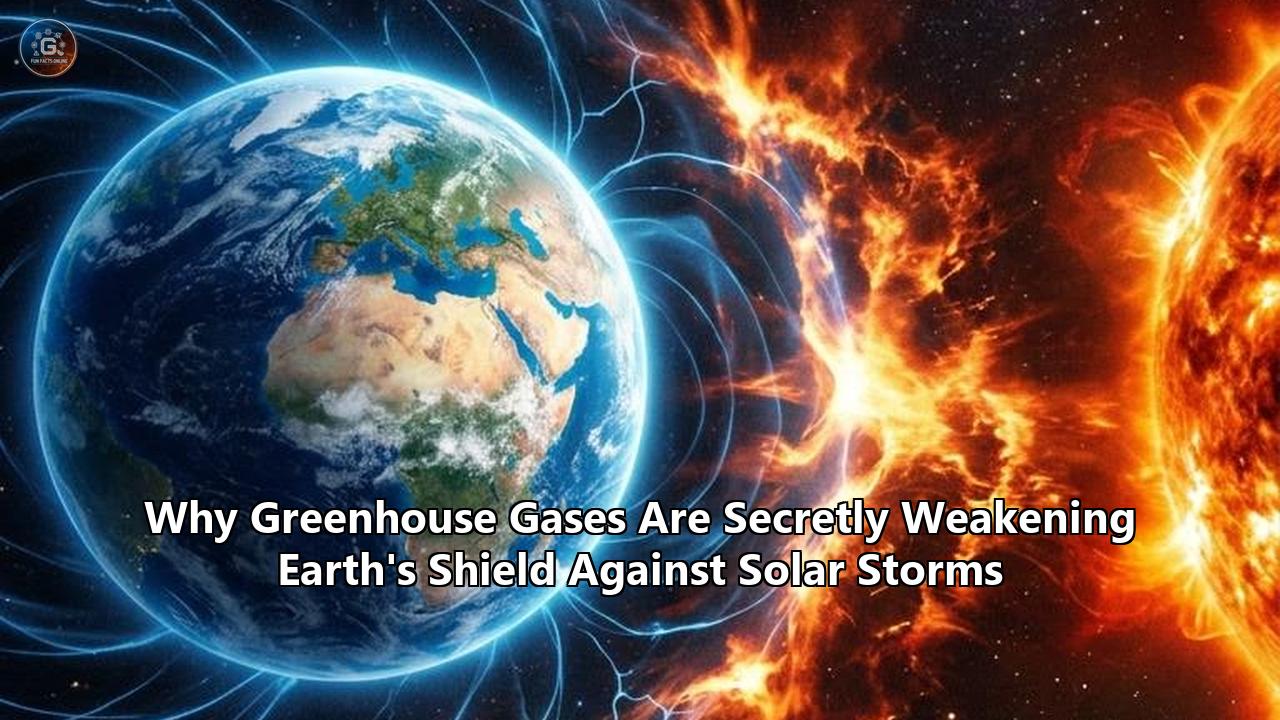
A series of landmark studies published in Nature and Geophysical Research Letters has unveiled a dangerous climate feedback loop operating at the edge of outer space. While accumulating greenhouse gases trap heat in the lower atmosphere, driving surface warming and extreme weather, they exert the exact opposite effect in the upper atmosphere. In the mesosphere and thermosphere—the tenuous atmospheric layers stretching from 50 to 600 kilometers above the surface—increasing carbon dioxide acts as a powerful coolant, forcing the upper sky to cool and contract.
This upper-atmospheric shrinking is altering how Earth responds to incoming space weather. The discovery shatters a decades-old assumption in space physics: the belief that Earth’s geomagnetic shield has a built-in safety limit during severe solar storms. Research led by Dr. Nithin Sivadas of NASA’s Goddard Space Flight Center and Dr. Maria Walach of Lancaster University demonstrates that the geomagnetic response to extreme solar wind does not saturate or level off as previously modeled. Instead, extreme solar eruptions can disturb the upper atmosphere up to twice as severely as legacy models predicted.
Simultaneously, a whole-atmosphere simulation led by Dr. S. Kumar published in Geophysical Research Letters reveals that elevated carbon dioxide fundamentally alters upper-altitude wind systems and ionospheric plasma density. These structural shifts create sharp hemispheric asymmetries and deep ionospheric disturbances during space weather events.
The convergence of these discoveries exposes an urgent challenge. Human activity on the ground is weakening the upper-atmospheric mechanisms that buffer Earth against geomagnetic storms. At a moment when human civilization relies heavily on low-Earth orbit satellites, satellite navigation, subsea telecommunications, and interconnected power grids, the interaction between greenhouse gases solar storms and upper-atmospheric dynamics is emerging as a critical technological vulnerability.
                 UPPER ATMOSPHERE (Thermosphere & Mesosphere)
                 Higher CO₂ Radiates Heat to Vacuum → Atmospheric Shrinkage
                 • Lower baseline air density
                 • Reduced natural plasma buffer at magnetosphere edge
                 • Accelerated magnetic reconnection rates
                                      ▲
                                      │ Energy Influx
                                      ▼
                      EXTREME SOLAR WIND & CMEs
             • Uncapped geomagnetic storm response
             • Sharp ionospheric plasma density gradients
             • Erratic satellite drag spikes & GIC power grid risks
                                      ▲
                                      │ Trapped Heat
                                      ▼
                   LOWER ATMOSPHERE (Troposphere)
                   Higher CO₂ Traps Terrestrial Infrared Radiation
The Physics Paradox: Why CO₂ Warms the Ground but Freezes the Upper Sky
Understanding why greenhouse gases weaken Earth's upper defenses requires examining how carbon dioxide behaves across different atmospheric densities. In the troposphere—the atmospheric layer extending from the surface up to roughly 12 kilometers—air molecules are packed closely together. When a molecule of carbon dioxide absorbs outgoing infrared radiation emitted by Earth's surface, it rapidly collides with surrounding nitrogen and oxygen molecules. These collisions transfer kinetic energy, trapping heat and raising global temperatures near the ground.
In the mesosphere (50 to 85 kilometers) and thermosphere (85 to 600 kilometers), atmospheric density drops by orders of magnitude. The distance between individual gas molecules increases dramatically, changing how energy moves through the medium. When carbon dioxide molecules in the upper atmosphere absorb thermal energy or solar radiation, the probability of them colliding with another molecule before re-emitting that energy is extremely low.
Instead of transferring heat to adjacent air, the carbon dioxide molecule spontaneously re-emits infrared photons at a wavelength of 15 micrometers. Because the air above is so thin, these photons escape directly into the cold vacuum of space without being reabsorbed. Consequently, carbon dioxide transforms into a radiative radiator at high altitudes, venting heat out of the atmosphere.
TROPOSPHERE (Dense Air)
[CO₂ Molecule] ──(Absorbs IR)──> [Collides with N₂/O₂] ──> Heat Trapped

THERMOSPHERE (Ultra-Thin Air)
[CO₂ Molecule] ──(Absorbs Energy)──> [Emits 15µm IR Photon] ──> Escapes to Space (Cooling)
Observational data collected over three decades by NASA satellites—including the AIM (Aeronomy of Ice in the Mesosphere), TIMED (Thermosphere Ionosphere Mesosphere Energetics and Dynamics), and SABER instruments—confirm this mechanism. The summer mesosphere over Earth's polar regions cools by 4 to 5 degrees Fahrenheit (2.2 to 2.8 degrees Celsius) per decade and contracts vertically by 500 to 650 feet per decade.
When gas cools, it compresses. As the mesosphere contracts, the overlying thermosphere sinks into the vacuum left below. Long-term climate modeling conducted by Dr. Ingrid Cnossen at the British Antarctic Survey indicates that thermospheric air density at operational satellite altitudes of 400 kilometers could drop by as much as 30% by 2070 due to rising carbon emissions. This cooling-driven shrinkage alters the natural environmental conditions of near-Earth space.
The Shattered Ceiling: How Greenhouse Gases and Solar Storms Synergize
The cooling of the upper atmosphere alters Earth’s interaction with solar eruptions. Space weather begins at the Sun, where solar flares and coronal mass ejections (CMEs) launch billions of tons of magnetized plasma and high-energy charged particles into interplanetary space. When these solar streams hit Earth, they encounter the magnetosphere—a magnetic bubble generated by the motion of molten iron in Earth’s outer core.
             SOLAR WIND / CORONAL MASS EJECTION
                             │
                             ▼
               DAYSIDE MAGNETOPAUSE BOUNDARY
     (Magnetic Reconnection: Field Lines Snap and Rejoin)
                             │
            ┌────────────────┴────────────────┐
            ▼                                 ▼
NATURAL PLASMA PLUME              DEPLETED PLASMA BUFFER
(Dense cold plasma slows          (Upper-atmosphere cooling
 energy transfer)                  strips plasma buffer)
            │                                 │
            ▼                                 ▼
DAMPENED STORM IMPACT             UNBOUNDED ENERGY INFLUX
• Gradual thermosphere heating    • Uncapped geomagnetic storming
• Stable ionosphere               • Deep ionospheric disturbances
The key gateway through which solar energy enters Earth's space environment is magnetic reconnection. This process occurs when opposing magnetic field lines from the solar wind and Earth's magnetic field snap under immense pressure, release stored kinetic energy, and rejoin. This energy flows directly along field lines into Earth's ionosphere and radiation belts.
The efficiency of magnetic reconnection depends heavily on the density of cold plasma—ionized gas—present at the edge of the magnetosphere. Under normal conditions, neutral atoms and ions slowly leak upward from the thermosphere and ionosphere, forming a protective outer layer known as the plasmaspheric plume. This cold plasma plume acts as a buffer; it dampens the rate of magnetic reconnection, limiting how rapidly solar storm energy can penetrate the system.
As greenhouse gases cool and shrink the upper atmosphere, the upward transport of neutral atmospheric species is suppressed. With less mass leaking into the outer magnetosphere, the density of the protective plasma plume drops. With a thinner plasma buffer, magnetic reconnection during major CMEs occurs faster and with greater efficiency, allowing a higher fraction of solar storm energy to cascade directly into Earth’s near-space environment.
This energy influx encounters a system altered by carbon dioxide emissions. The study led by Dr. Sivadas analyzed high-intensity space weather events to evaluate how Earth reacts under extreme driving conditions. For thirty years, space weather models operated under the "saturation hypothesis"—the assumption that Earth’s magnetosphere reaches an upper ceiling during severe storms, capping the amount of current that can be driven through the ionosphere.
Sivadas and Walach found that this theoretical ceiling does not exist. Under extreme solar wind pressure, the geomagnetic response continues scaling upward, generating ionospheric electric fields and currents up to twice as powerful as previous models estimated.
GEOMAGNETIC RESPONSE TO EXTREME SOLAR WIND

Geomagnetic Disturbances
       ▲
       │                                  /  <-- NEW FINDING (Sivadas et al., 2026):
       │                                 /       Uncapped linear growth up to 2x severity
       │                                /
       │  - - - - - - - - - - - - - - -/ - - - - - - - - - - - - - - - - - -
       │                              /  <-- SATURATION CEILING (Legacy Assumption):
       │                             /       Assumed geomagnetic response flattened out
       │                            /
       │                           /
       └──────────────────────────┴──────────────────────────►
                                                  Solar Wind Driving Force
This interaction between greenhouse gases solar storms and upper-atmosphere fluid dynamics creates unprecedented operational risks. As shown by Kumar et al., doubled atmospheric carbon dioxide alters the global circulation of zonal winds in the mesosphere and thermosphere.
When solar storms hit this altered atmospheric state, the redistribution of thermospheric heat becomes highly asymmetrical. Wind pattern shifts drive extreme density variations across the Northern and Southern Hemispheres, triggering massive localized shifts in ionospheric total electron content (TEC).
Cascading Infrastructure Threats: LEO Collisions and Grid Failures
The physical changes occurring in the thermosphere translate directly into tangible operational hazards for modern satellite constellations and terrestrial utility grids.
                     GREENHOUSE GAS EMISSIONS
                                │
                                ▼
               UPPER ATMOSPHERIC COOLING & SHRINKAGE
                                │
       ┌────────────────────────┴────────────────────────┐
       ▼                                                 ▼
LONG-TERM EFFECT:                                SHORT-TERM SOLAR STORM EFFECT:
Reduced baseline atmospheric drag                Sudden, violent thermal density spikes
       │                                                 │
       ▼                                                 ▼
• Debris remains in orbit for decades            • Severe, unpredictable satellite drag
• Kessler Syndrome risk increases                • Orbit loss & control failure
• Orbital carrying capacity falls 50–66%         • High-voltage transformer overload (GICs)
1. The Low-Earth Orbit Satellite Drag Paradox
The cooling and shrinking of the thermosphere creates two contrasting problems for low-Earth orbit (LEO) operations:
- The Long-Term Accumulation Hazard: Atmospheric drag acts as a natural vacuum cleaner for space junk. Defunct satellites and mission debris gradually lose speed due to friction with air molecules in the thermosphere, eventually falling into the denser lower atmosphere where they burn up safely. Because upper-atmosphere cooling lowers baseline atmospheric density, this natural clearance mechanism is losing efficiency. Research from MIT published in Nature Sustainability by William Parker and Professor Richard Linares reveals that greenhouse gas emissions will extend the lifespan of space debris, reducing the sustainable satellite carrying capacity of popular LEO altitudes (400–600 km) by 50% to 66% by the year 2100.
- The Short-Term Solar Storm Spike: While baseline drag is lower over multi-year timescales, geomagnetic storms cause sudden, severe drag spikes. When extreme solar energy penetrates the thermosphere, the thin gas heats rapidly and expands outward like a heated balloon. Satellites traveling at 17,500 miles per hour suddenly hit localized walls of dense gas.
Because the baseline thermosphere is cooler and structurally altered, these storm-induced density surges are more volatile and difficult to predict. A notable demonstration occurred in February 2022, when SpaceX lost 38 newly launched Starlink satellites in a single event. A relatively modest geomagnetic storm caused upper-atmosphere density to swell by 50% overnight, increasing drag beyond what the satellites' orbit-raising thrusters could overcome.
Under an atmosphere modified by higher greenhouse gas levels, forecasters face greater difficulty predicting atmospheric expansion during solar storms, putting thousands of operational satellites at risk of unexpected re-entry or orbital drift.
SATELLITE CAPACITY IMPACT BY 2100 (MIT MODEL DATA)

Carrying Capacity (% of Historical Baseline)
 100% ───────────────────────────┐
  80%                            │
  60%                            └───► Reduced to 34% - 50% Capacity
  40%                                  due to thermospheric shrinking
  20%                                  and extended debris lifetimes
   0% ─────────────────────────────────────────────────────────────►
      Historical Baseline              Projected Capacity (2100)
2. High-Voltage Power Grid Disruptions
When uncapped geomagnetic storms drive massive electric currents through the ionosphere, they induce electric fields in the Earth's crust. These ground electric fields find paths of least resistance through the grounded neutral connections of high-voltage electrical transformers.
These extra-high-voltage (EHV) transformers are designed to handle alternating current (AC). Geomagnetically Induced Currents (GICs) act as direct current (DC), causing the magnetic cores of transformers to undergo half-cycle saturation. This saturation triggers:
- Severe harmonic distortion across high-voltage transmission lines.
- Rapid internal overheating, melting copper windings and degrading insulating oil.
- Automated trips of high-voltage circuit breakers, triggering widespread voltage instability and potential cascading regional blackouts.
The discovery that geomagnetic storm responses do not saturate implies that severe space weather events—such as a repeat of the 1859 Carrington Event or the 1921 Railroad Storm—will induce ground currents significantly stronger than grid operators previously accounted for in their design standards.
IONOSPHERIC ELECTRIC CURRENT (Enhanced by Solar Storms)
                         │
                         ▼
             INDUCED GROUND ELECTRIC FIELD
                         │
                         ▼
        TRANSFORMER NEUTRAL GROUND CONNECTION
                         │
                         ▼
        DC CURRENT FLOWS INTO AC TRANSFORMER
                         │
                         ▼
CORE SATURATION ──> HARMONIC DISTORTION ──> OVERHEATING ──> GRID COLLAPSE
3. Aviation, Navigation, and Subsea Telecommunications
The heightened ionospheric volatility predicted by Kumar et al. disrupts essential communication networks. Large-scale plasma density gradients distort and refract High-Frequency (HF) radio waves and satellite signals passing through the ionosphere.
+------------------------------------+-----------------------------------------------------------------------------------+
| IMPACT AREA                        | PRIMARY MECHANISM OF DISRUPTIVE VULNERABILITY                                     |
+------------------------------------+-----------------------------------------------------------------------------------+
| Polar Flight Aviation              | Severe HF radio blackout forces commercial polar routes to divert, incurring      |
|                                    | massive fuel costs and route delays.                                              |
+------------------------------------+-----------------------------------------------------------------------------------+
| Precision GNSS / GPS               | Ionospheric scintillation causes loss of signal lock for agricultural, marine,   |
|                                    | autonomous transport, and military operations.                                    |
+------------------------------------+-----------------------------------------------------------------------------------+
| Subsea Fiber-Optic Networks        | High ground-potential differences induce dangerous currents across long-haul      |
|                                    | power feed equipment (PFE) powering underwater signal repeaters.                  |
+------------------------------------+-----------------------------------------------------------------------------------+
Solutions: Engineering Defense Strategies for Space and Infrastructure
Addressing the compounded risks of upper-atmosphere cooling and severe space weather requires a combination of atmospheric modeling, space plasma engineering, orbital management, and terrestrial grid hardening.
                                  INTEGRATED STRATEGIC FRAMEWORK
                                                 │
      ┌────────────────────────┬─────────────────┴────────────────┬────────────────────────┐
      ▼                        ▼                                  ▼                        ▼
MODELING & PREDICTION    SPACE PLASMA DEFENSE            ORBITAL MANAGEMENT        TERRESTRIAL HARDENING
(Whole-Atmosphere        (Project "StormWall"            (5-Year De-orbit Mandates  (Neutral Grounding Resistors
 Physics & WACCM-X)       Plasma Injection)               & Robotic ADR Spacecraft)  & Radiation-Hardened GaN)
1. Climate-Coupled Space Weather Forecasting
Legacy space weather prediction models treated Earth's atmosphere as a static background. Major space weather centers—including NOAA’s Space Weather Prediction Center (SWPC) and the European Space Agency’s Space Safety Programme—are updating their forecasting pipelines to incorporate dynamic, whole-atmosphere models.
Forecasters are implementing tools like the Whole Atmosphere Community Climate Model with eXtension (WACCM-X), developed by the National Center for Atmospheric Research (NCAR). WACCM-X simulates atmospheric physics and chemistry seamlessly from Earth's surface through the thermosphere and ionosphere (up to 700 kilometers).
By continuously integrating real-time carbon dioxide data and stratospheric warming inputs, these climate-coupled models allow operators to forecast how the altered upper atmosphere will respond when struck by solar storms, providing accurate localized drag predictions and ionospheric disturbance warnings.
[Ground-Level CO₂ & Climate Data] ──┐
                                     ├──> [NCAR WACCM-X Model] ──> [Precise Local Drag & TEC Forecasts]
[Real-Time Solar Wind & CME Data] ──┘
2. Active Space Plasma Buffering: Project "StormWall"
To counteract the loss of Earth's natural upper-atmospheric plasma buffer, space plasma dynamicists are evaluating artificial buffering concepts. A leading proposal is Project "StormWall", developed by Dr. Brian Walsh of Boston University alongside Dr. Dan Welling and Dr. Zhenguang Huang of the University of Michigan.
               UPCOMING CORONAL MASS EJECTION (CME)
                                │
                                ▼
         "STORMWALL" SATELLITE DISPENSES PHOTOIONIZING MATERIAL
         (Injects benign material near magnetopause boundary)
                                │
                                ▼
          SOLAR UV RADIATION STRIPS ELECTRONS (Photoionization)
                                │
                                ▼
         ARTIFICIAL COLD PLASMA BUFFER DENSELY POPULATES DRIFT PATHS
                                │
                                ▼
       MAGNETIC RECONNECTION RATE SUPPRESSED (Energy influx dampened)
The StormWall concept involves deploying specialized satellites to release small amounts of photoionizing material—such as harmless, easily ionized gas tracers—at strategic points along the edge of Earth's magnetic field. Solar ultraviolet radiation rapidly knocks electrons off these molecules, converting them into a localized cloud of cold plasma.
This artificial plasma flows along Earth’s natural magnetic field lines to populate the dayside magnetopause. By artificially raising plasma density at the magnetic boundary, StormWall acts as a speed bump for incoming space storms. The increased plasma density suppresses high-efficiency magnetic reconnection, limiting the total amount of energy transferred into Earth’s ionosphere and power networks during severe coronal mass ejections.
3. Space Traffic Management and Active Debris Removal (ADR)
To prevent thermospheric contraction from triggering a runaway Kessler Syndrome—a scenario where colliding orbital debris renders near-Earth space unusable—space agencies and international regulators are tightening orbital compliance rules:
- The 5-Year De-Orbit Rule: Regulatory bodies, including the Federal Communications Commission (FCC) and the European Space Agency (ESA), have shifted from the historical "25-year de-orbit rule" to a strict 5-year post-mission disposal mandate. Satellite operators must reserve sufficient thruster propellant to actively de-orbit spacecraft into the lower atmosphere shortly after their operational lifespan ends, offsetting the reduction in natural drag.
- Commercial Active Debris Removal (ADR): Private aerospace firms are deploying specialized ADR spacecraft designed to rendezvous with, capture, and de-orbit large defunct satellites and rocket bodies. Missions such as Astroscale’s ADRAS-J and ClearSpace-1 use robotic arms, magnetic capture mechanisms, and electrodynamic tethers to manually drag uncooperative debris out of low-Earth orbit, clearing high-density orbital bands.
   HISTORICAL POLICY                        NEW SUSTAINABILITY MANDATE
┌───────────────────────┐                ┌──────────────────────────────┐
│ 25-Year De-orbit Window│               │ 5-Year Strict Disposal Rule  │
│ Dependent on Natural  │  ───────────►  │ Active Propulsion & Active   │
│ Thermospheric Drag    │                │ Debris Removal (ADR) Captures│
└───────────────────────┘                └──────────────────────────────┘
4. Hardening Terrestrial Power Grids
To protect terrestrial energy infrastructure from non-saturating geomagnetic storms, utility companies are deploying protective hardware across vulnerable high-voltage power grids:
+-------------------------------------+-----------------------------------------------------------------------------------+
| PROTECTION TECHNOLOGY               | OPERATIONAL FUNCTION AND INFRASTRUCTURE HARDENING                                 |
+-------------------------------------+-----------------------------------------------------------------------------------+
| Neutral Grounding Resistors (NGRs)  | Solid-state neutral ground resistors installed at transformer stations block      |
|                                     | incoming DC current while preserving safe AC ground paths.                        |
+-------------------------------------+-----------------------------------------------------------------------------------+
| Hall-Effect Sensing Arrays          | Sub-second magnetic sensors monitor transformer cores for early signs of DC       |
|                                     | saturation, triggering automated current diverters before overheating occurs.       |
+-------------------------------------+-----------------------------------------------------------------------------------+
| Hardened Gallium Nitride Avionics   | Low-Earth orbit satellites are retrofitted with GaN power electronics and         |
|                                     | autonomous AI thruster control to survive sudden storm-induced drag spikes.       |
+-------------------------------------+-----------------------------------------------------------------------------------+
What to Watch Next
As scientists work to understand how greenhouse gases impact space weather vulnerabilities, several critical research milestones, observational missions, and policy decisions will shape the field:
                               TIMELINE OF UPCOMING SPACE WEATHER MILESTONES
                                                     │
   ┌──────────────────────────────┬──────────────────┴──────────────┬──────────────────────────────┐
   ▼                              ▼                                 ▼                              ▼
MID-2026                      LATE 2026                         2027                           2028
NASA TRACERS Mission          NOAA SWFO-L1 Launch               UN Space Sustainability        Solar Cycle 25/26
Mapping Polar Cusp            Continuous L1 Solar               Treaty Framework Updates       Transition Drag Data
Reconnection Rates Wind Early Warning For LEO Debris Rules Validation- NASA’s TRACERS Mission Launch: The Tandem Reconnection and Cusp Electrodynamics Reconnaissance Satellites (TRACERS) mission will launch two spacecraft into a sun-synchronous orbit through Earth's polar cusps. TRACERS will gather high-resolution measurements of magnetic reconnection in real time, testing predictions regarding how changing plasma density alters energy transfer during solar storm impacts.
- NOAA’s Space Weather Follow-On L1 (SWFO-L1): Positioned at Lagrange Point 1 (1 million miles sunward of Earth), SWFO-L1 will provide continuous, real-time measurements of solar wind plasma and magnetic fields, providing critical early-warning capability before CMEs reach Earth.
- Updating International Space Sustainability Protocols: The United Nations Committee on the Peaceful Uses of Outer Space (COPUOS) is preparing updated guidelines that incorporate upper-atmosphere climate change into international space traffic management frameworks. These frameworks aim to establish binding global standards for satellite constellation sizes and debris mitigation.
- Long-Term Thermospheric Monitoring: Researchers are watching operational tracking data from commercial constellations to refine long-term models of upper-atmospheric shrinkage. By analyzing thruster usage and orbital decay across thousands of active satellites, atmospheric physicists will gain direct telemetry on how fast the edge of space is contracting.
Understanding the connection between ground-level carbon emissions and upper-atmosphere dynamics highlights a crucial reality: Earth's atmospheric systems are interconnected. Protecting global technological infrastructure requires recognizing that greenhouse gas emissions alter the planet far beyond the surface, reaching all the way to the edge of space.
Reference:
- https://eos.org/editor-highlights/rising-co2-alters-upper-atmosphere-response-to-stratosphere-sudden-warming
- https://scitechdaily.com/earth-may-be-twice-as-vulnerable-to-extreme-solar-storms-as-scientists-thought/
- https://theorkneynews.scot/2025/03/14/climate-change-space-preventing-the-exploitation-of-the-thermosphere/
- https://e360.yale.edu/features/climate-change-upper-atmosphere-cooling
- https://www.theguardian.com/news/2021/jan/05/how-greenhouse-gases-are-actually-cooling-earths-upper-atmosphere
- https://www.space.com/earths-thermosphere-highest-temperature-solar-storms
- https://www.youtube.com/watch?v=QRHqqikdRpM
- https://www.nasa.gov/general/nasa-satellites-see-upper-atmosphere-cooling-and-contracting-due-to-climate-change/
- https://www.technologynetworks.com/applied-sciences/news/earths-atmosphere-is-shrinking-increasing-space-debris-risks-397028
- https://www.nesdis.noaa.gov/our-environment/space-weather/the-effects-of-space-weather-earth
- https://science.nasa.gov/science-research/earth-science/earths-magnetosphere-protecting-our-planet-from-harmful-space-energy/
- https://physicsworld.com/a/can-we-create-a-shield-to-protect-earth-from-solar-storms/
- https://news.mit.edu/2025/study-climate-change-will-reduce-number-satellites-safely-orbit-space-0310