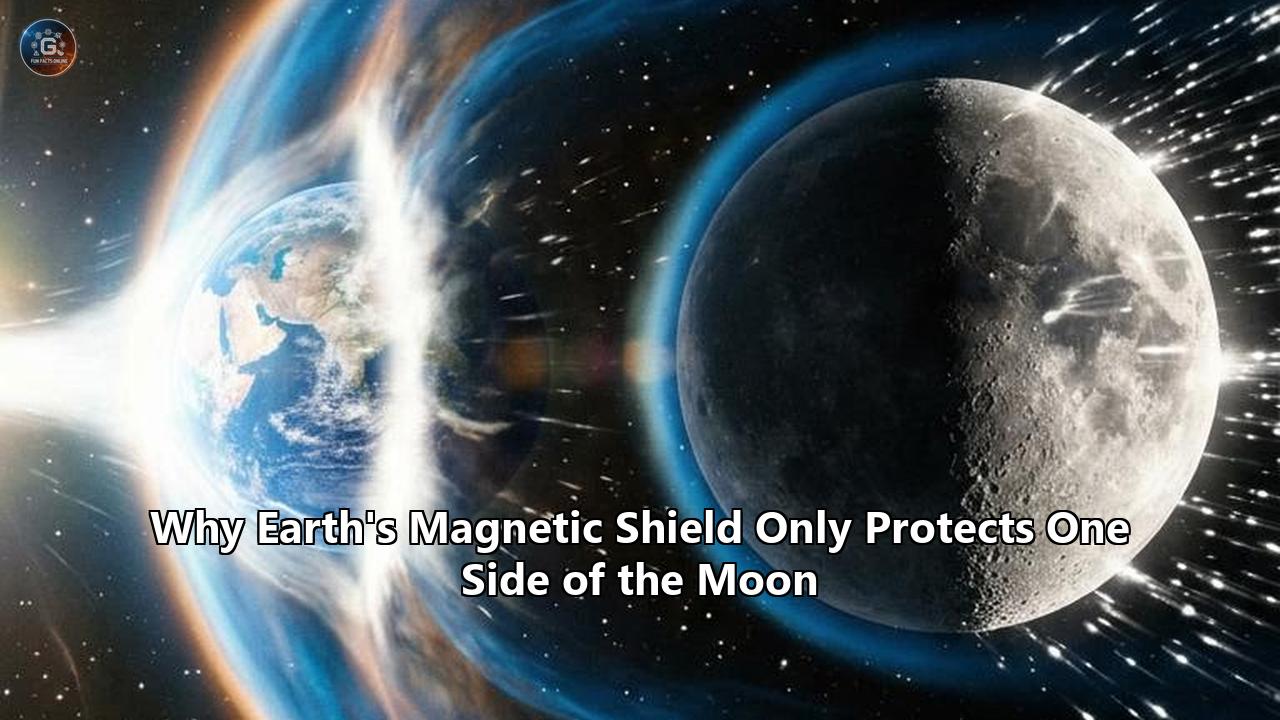
In July 2026, a team of planetary scientists at the Institute of Geology and Geophysics of the Chinese Academy of Sciences published a landmark analysis in Nature Geoscience that solved a long-standing mystery in lunar science. By examining the first-ever soil samples retrieved from the far side of the Moon by the Chang’e-6 mission, researchers proved that Earth’s magnetic field acts as a selective velocity governor for incoming solar wind. While the Earth-facing near side enjoys a moderated stream of solar particles that have been slowed by nearly half, the far side takes the full, unbuffered force of high-speed space weather.
This chemical proof, combined with a March 2026 study in Science Advances revealing a magnetospheric cosmic ray cavity around the Moon’s orbit, dismantles the long-held assumption that space radiation impacts the lunar surface uniformly. Earth’s magnetic envelope does not shield the Moon equally. Instead, it creates a stark environmental divide between the two hemispheres—a structural asymmetry that fundamentally alters our understanding of lunar surface history, volatile distribution, and the safety protocols required for long-term human habitation.
Deceleration at the Boundary: How Earth's Magnetosphere Slows the Solar Wind
The solar wind is a continuous, energetic stream of ionized plasma—primarily protons, alpha particles, and electrons—blasting outward from the Sun's corona at speeds ranging from 400 to 800 kilometers per second. Because the Moon lacks a global intrinsic magnetic field and possesses no meaningful atmosphere, these high-energy particles slam directly into the lunar regolith. Over billions of years, this unrelenting bombardment has reshaped the physical microstructures and chemical composition of the lunar soil.
However, the interaction between Earth’s space weather buffer and the lunar orbit creates a dynamic moon magnetic shield that operates with striking geographical bias.
                                    SOLAR WIND
                                  (400-800 km/s)
                               =========>
                               =========>
                               =========>

                  .---------------------------------------.
                 /         EARTH'S MAGNETOSPHERE          \
                /   .---------------------------------.    \
               |   /          MAGNETOSHEATH           \    |
               |  |    (Solar Wind Slows to ~200 km/s) |   |
               |  |                                    |   |
  [ SUN ] ---->|  |     [ EARTH ]                       |   |=======> MAGNETOTAIL
               |  |                                    |   |         (Plasma Sheet)
               |  |                  [ NEAR SIDE ]     |   |
               |   \                 (Slowed Wind)    /    |
                \   '--------------------------------'    /
                 '---------------------------------------'
                                            |
                                      ((   MOON   ))
                                            |
                                     [ FAR SIDE ]
                                  (Full-Speed Wind)
Earth’s magnetosphere is carved by the solar wind into a teardrop shape. On the sunward side, the field is compressed, but on the night side, it stretches out into a long magnetotail extending hundreds of thousands of kilometers into deep space. As the Moon completes its 27.3-day orbit around Earth, it spends roughly three to five days passing directly through this magnetotail during its full moon phase. During this window, the Moon is enveloped within the magnetotail’s plasma sheet, largely sheltered from direct solar wind protons.
The critical distinction discovered in the Chang'e-6 sample analysis lies in what happens outside this brief full moon window. Surrounding Earth's magnetosphere is the magnetosheath—a turbulent transition region where incoming solar wind is forced to bow, compress, and slow down.
Because the Moon is tidally locked—permanently keeping its near side turned toward Earth and its far side turned toward deep space—the geometric orientation of this particle boundary creates an unequal buffering effect:
- Near-Side Exposure: Solar wind particles traversing the magnetosheath buffer drop from an average velocity of 400 km/s (roughly 250 miles per second) to 200 km/s (125 miles per second) before striking the Earth-facing surface.
- Far-Side Exposure: Facing permanently outward into deep space, the far side receives zero magnetosheath deceleration, absorbing the full, unmitigated kinetic energy of the solar wind.
Calculations led by Chinese Academy of Sciences researchers Zhang Xuhang and He Huaiyu demonstrate that approximately 25% of the total solar wind exposure recorded on the near side was moderated by Earth's magnetosheath buffer. The far side received no such moderation.
Stakeholder Mapping: Who Is Impacted by the Shielding Asymmetry?
The confirmation of this asymmetric shielding ripple effect crosses multiple domains of space science, engineering, and logistics.
+---------------------------------------------------------------------------------+
|                       STAKEHOLDERS IMPACTED BY ASYMMETRY                        |
+------------------------------------+--------------------------------------------+
| Stakeholder Group                  | Primary Impact / Concern                   |
+------------------------------------+--------------------------------------------+
| Crewed Exploration Programs        | Recalibrating long-term radiation exposure |
| (NASA Artemis, CNSA ILRS)          | profiles for near vs. far side habitats.   |
+------------------------------------+--------------------------------------------+
| Lunar Resource Enterprises         | Redesigning extraction technology for      |
| (Helium-3 / Volatile Miners)       | deeper embedded far-side volatiles.        |
+------------------------------------+--------------------------------------------+
| Materials & Hardware Engineers     | Accounting for accelerated degradation     |
| (Lander & Rover Designers)         | rates on far-side solar cells and optics.  |
+------------------------------------+--------------------------------------------+
| Planetary & Heliophysics Scientists| Reconstructing ancient Earth magnetosphere  |
| (Geol/Plasma Researchers)          | signatures using dual-hemisphere samples.  |
+------------------------------------+--------------------------------------------+
Crewed Exploration Programs
Agencies planning permanent surface outposts—including NASA with its Artemis base camp initiatives and the China National Space Administration (CNSA) alongside Roscosmos on the International Lunar Research Station (ILRS)—must adjust their human risk models. Radiation dosage expectations calculated from near-side Apollo data cannot be applied directly to crews operating in far-side basins like the South Pole-Aitken (SPA) region, where particle kinetic energies are systematically higher.
Lunar Resource and Industrial Enterprises
Commercial entities planning to harvest solar-wind-implanted volatiles, such as Helium-3 for fusion energy or hydrogen for off-world propellant synthesis, face contrasting operational landscapes. The depth at which these valuable gases are trapped within regolith grains depends directly on particle impact speed. Far-side harvesting will require deeper thermal or mechanical processing to liberate trapped gases than near-side harvesting.
Hardware and Surface Infrastructure Engineers
Spacecraft designers must account for accelerated material erosion on the far side. Solar panels, optical sensors, thermal blankets, and structural alloys deployed on far-side landers will experience higher sputtering rates and kinetic displacement damage from unbuffered solar protons compared to hardware operating on the near side.
Space Weather Specialists and Heliophysicists
Researchers studying magnetospheric physics now have a massive, multi-billion-year physical record stored directly in lunar rocks. By comparing near-side and far-side soil samples, heliophysicists can read the history of Earth's magnetic dynamo, tracking how our planet's shield grew, shifted, or weakened across geological epochs.
Soil Science Transformed: Isotopic Shifts, Depth Profiles, and Water Chemistry
The evidence that exposed this asymmetric buffering mechanism was found inside 1.935 grams of lunar soil returned by Chang’e-6 from the South Pole-Aitken basin in mid-2024. When scientists analyzed the noble gases trapped within the individual dust grains, the isotopic data revealed a clear physical divergence from near-side samples collected during the Apollo and Chang’e-5 missions.
The Isotopic Fingerprint
Noble gases—helium, neon, argon, krypton, and xenon—are chemically inert. They do not react with surrounding minerals, making them ideal markers for tracking solar wind bombardment over time.
When analyzing neon isotopes in the Chang'e-6 regolith, researchers measured a ratio of Neon-20 to Neon-22 ($^{20}\text{Ne}/^{22}\text{Ne}$) of $11.34 \pm 0.22$. This value was distinctly lower than the ratios recorded across near-side landing sites, which routinely measure above $12.0$.
                                NEON ISOTOPE RATIOS

Near Side (Apollo / Chang'e-5):  |======================| > 12.0
Far Side  (Chang'e-6):          |===================| 11.34 ± 0.22
                                0                    10                  13
This ratio discrepancy occurs because lighter isotopes ($^{20}\text{Ne}$) are preferentially lost or altered when particles strike regolith at maximum kinetic velocity. High-speed solar wind protons punching into far-side dust grains cause severe sputtering—a process where incoming ions knock matrix atoms out of the mineral lattice—selectively eroding the shallowest-trapped lighter isotopes.
Implantation Depths and Microstructure
Because solar wind ions hitting the far side travel at roughly double the speed of those hitting the near side, their kinetic energy ($E_k = \frac{1}{2}mv^2$) is roughly four times greater upon impact.
                          PARTICLE PENETRATION DEPTH

  NEAR SIDE (Slowed: ~200 km/s)          FAR SIDE (Unbuffered: ~400 km/s)
       Solar Wind Particle                    Solar Wind Particle
               |                                      |
               v                                      v
      +-----------------+                    +-----------------+
      |  Shallow Rim    |                    |   Thick Rim     |
      | (~10-20 nm)     |                    |  (~40-80 nm)    |
      +-----------------+                    +-----------------+
      |  Unaltered Core |                    |  Amorphized     |
      |                 |                    |     Lattice     |
+-----------------+ +-----------------+- Near-Side Grains: Slowed particles penetrate only into the outer rims of regolith minerals, creating shallow amorphized (glassy) damage layers extending 10 to 20 nanometers deep.
- Far-Side Grains: Unbuffered particles drive deep into the crystal lattices, destroying crystalline structures down to depths of 40 to 80 nanometers or more.
This means the physical structure of far-side soil is fundamentally more altered by radiation than near-side soil, even when controlling for exposure age and terrain composition.
Dual Paths for Lunar Water Synthesis
The discovery also reshapes our understanding of how water ($H_2O$) and hydroxyl ($OH$) are synthesized on the airless lunar surface.
Solar wind protons striking oxygen-rich silicate minerals (like pyroxene and olivine) break chemical bonds and bind with liberated oxygen to form hydroxyl molecules. However, research led by Dr. Shuai Li at the University of Hawaii revealed that water creation does not stop when the Moon passes inside Earth's magnetotail, where direct solar wind protons are blocked.
+----------------------------------------------------------------------------------+
|                    HEMISPHERIC WATER SYNTHESIS DYNAMICS                          |
+----------------------------------+-----------------------------------------------+
| Region                           | Primary Water / Hydroxyl Generation Mechanism |
+----------------------------------+-----------------------------------------------+
| Near Side (Earth-Facing)         | - Moderated solar wind protons (75% of orbit) |
|                                  | - Earth-derived terrestrial ions (oxygen &    |
|                                  |   hydrogen) via magnetotail plasma sheet |
+----------------------------------+-----------------------------------------------+
| Far Side (Deep-Space Facing)     | - Unbuffered high-speed solar wind protons     |
|                                  | - Zero terrestrial ion enrichment             |
|                                  | - Maximum kinetic sputtering rates            |
+----------------------------------+-----------------------------------------------+
On the near side, Earth's magnetotail acts as a particle bridge. Terrestrial ions—including oxygen and hydrogen escaping from Earth's upper atmosphere—are transported down the magnetotail and deposited directly onto the Earth-facing lunar surface. This terrestrial ion rain enables continuous water synthesis and drives the formation of hematite (an oxidized iron mineral, or "lunar rust") at high near-side latitudes.
On the far side, where the lack of a protective moon magnetic shield allows high-velocity ions to hit the surface directly without magnetosheath filtering, water generation relies entirely on raw interplanetary solar wind protons. The absence of terrestrial ion enrichment on the far side creates a distinct chemical pathway for volatile retention across the two hemispheres.
Short-Term Consequences: Mission Planning, Equipment Lifespans, and Tail Flapping Risk
The immediate fallout from these findings impacts operational space missions scheduled between 2026 and 2030, including NASA's Artemis lander missions, China's Chang'e-7 and Chang'e-8 polar probes, and commercial payloads delivered under NASA's Commercial Lunar Payload Services (CLPS) program.
                      MAGNETOTAIL FLAPPING PHENOMENON

   Normal Solar Wind Angle               Angled Solar Wind Gust

     ====================                  ====================
     ====================                     \ \ \ \ \ \ \ \ \ \
          [ EARTH ]                                [ EARTH ]
       -----------------                        \-----------------
       | Magnetotail   |                         \ Magnetotail   \
       |  Envelops     |                          \  Flaps Away   \
       |   Moon        |                           \               \
       -----------------                            -----------------
          (( MOON ))                                   (( MOON ))
      (Shielded Inside)                            (UNEXPECTEDLY EXPOSED)
The "Tail Flapping" Hazard
While the full moon passage was long considered a brief window of shelter within Earth's magnetotail, data from the UCLA-led THEMIS-ARTEMIS mission proved that this shielding is far less reliable than once assumed.
When solar gusts hit Earth's magnetosphere at an angle, the elongated magnetotail twists and flaps sideways like a windsock in a sudden breeze. During these flapping events, the Moon is abruptly thrown out of the protective plasma sheet and thrust into the magnetosheath—a boundary layer filled with heated, compressed, and turbulent energetic particles.
+---------------------------------------------------------------------------------+
|                      SHORT-TERM OPERATIONAL IMPACTS                             |
+----------------------+----------------------------------------------------------+
| Impact Area          | Operational Adjustment                                   |
+----------------------+----------------------------------------------------------+
| Crew Radiation Safety| Integration of real-time magnetotail position tracking   |
|                      | to warn crews of sudden "tail flapping" exposure events. |
+----------------------+----------------------------------------------------------+
| Hardware Longevity   | Updating sputtering erosion allowances for solar panels  |
|                      | and optical lenses deployed on far-side landers.         |
+----------------------+----------------------------------------------------------+
| Instrument Calibration| Adjusting baseline solar wind particle spectra in        |
|                      | radiation transport models (HZETRN, Geant4).             |
+----------------------+----------------------------------------------------------+
Mission controllers and engineers evaluating the temporary moon magnetic shield during full moon passages must now build real-time tail-flapping warnings into their space weather operations. An astronaut performing an extravehicular activity (EVA) during a full moon could experience sudden spikes in energetic particle fluxes if an interplanetary shock wave causes Earth's magnetotail to shift away from the landing site.
Recalibrating Hardware Lifespans and Solar Arrays
Hardware deployed on the far side must be engineered for harsher physical degradation. Photovoltaic cover glasses, thermal control mirrors, and thin-film coatings operating in far-side basins will experience faster optical darkening and mechanical erosion than identical systems placed on the near side.
Spacecraft engineers are responding by:
- Increasing the thickness of protective quartz covers on far-side solar arrays to prevent micro-pitting caused by high-velocity solar wind ions.
- Re-evaluating thermal insulation blankets, which degrade rapidly under unbuffered particle bombardment.
- Adjusting baseline calibration routines for surface mass spectrometers and radiation dosimeters carried on upcoming CLPS missions.
Long-Term Consequences: Habitability Siting, Mining Logistics, and Paleomagnetic Archaeology
Looking ahead to the era of sustained lunar bases and off-world industrialization (2030–2050), the hemispheric divide created by Earth's magnetosphere will influence where humanity chooses to build, mine, and perform long-term science.
+----------------------------------------------------------------------------------+
|                      LONG-TERM STRATEGIC COMPARISON                              |
+----------------------------------+-----------------------------------------------+
| Factor                           | Hemispheric Comparison                        |
+----------------------------------+-----------------------------------------------+
| Human Habitability Siting        | Near Side Advantage: Moderated particle speeds|
|                                  |, cosmic ray cavity protection,|
|                                  | direct line-of-sight communications.          |
+----------------------------------+-----------------------------------------------+
| Volatile / Helium-3 Extraction   | Far Side Challenge: Deeper implantation depths|
|                                  | require higher heating energy to harvest      |
|                                  | trapped gases.                        |
+----------------------------------+-----------------------------------------------+
| Science & Deep-Space Astronomy   | Far Side Advantage: RF quiet zone ideal for   |
|                                  | radio astronomy, despite harsher space        |
|                                  | weather environment.                          |
+----------------------------------+-----------------------------------------------+
Strategic Base Siting: The Near-Side Habitability Advantage
For permanent surface outposts, establishing habitats where Earth's magnetotail functions as an auxiliary moon magnetic shield offers tangible shielding benefits over the course of an astronaut's operational tour.
                           HABITAT SITING TRADEOFFS

         NEAR-SIDE OUTPOST                      FAR-SIDE OUTPOST
  +--------------------------------+    +--------------------------------+
  | - Solar wind speed halved|  | - Full-speed solar wind |
  | - Cosmic ray cavity protection |    | - Deep kinetic weathering|
  | - Direct Earth communications  |    | - Requires comms relay satellite|
  | - Terrestrial ion deposition   |    | - Pristine radio-quiet zone    |
  +--------------------------------+    +--------------------------------+
While regolith overburden (burying habitats under several meters of lunar dirt) remains mandatory to protect crews from high-energy Galactic Cosmic Rays (GCRs) and catastrophic Solar Particle Events (SPEs), the surface operational environment on the near side is intrinsically less harsh. Crew equipment, surface suits, vehicles, and unburied habitat components on the near side will suffer less kinetic wear and lower total ionizing doses from low-energy solar ions than those placed on the far side.
Furthermore, as demonstrated by the March 2026 Science Advances paper led by astrophysicist Robert Wimmer-Schweingruber, Earth's magnetosphere creates an energetic particle "cavity" that cuts down cosmic ray background radiation along specific arcs of the lunar orbit. Combined with the convenience of direct, line-of-sight radio communication with ground stations on Earth, near-side locations—particularly near-side rim structures around the lunar South Pole like Malapert Mountain—solidify their status as prime real estate for first-generation surface habitats.
The Economics of Lunar Mining
For commercial ventures targeting off-world resource processing, the dual-velocity solar wind environment alters extraction economics.
                        HELIOM-3 / VOLATILE PROCESSING

  NEAR-SIDE REGOLITH                            FAR-SIDE REGOLITH

  [ Surface ]                                   [ Surface ]
  +-----------------------+                     +-----------------------+
  | Shallow Trapped Volatiles | <--- Easy Heat  | Deep Trapped Volatiles| <--- Requires
  | (10-20 nm depth)      |      Release        | (40-80 nm depth)      |      Higher Temp
  +-----------------------+                     +-----------------------+      / Digging
  | Matrix Core           |                     | Matrix Core           |
+-----------------------+ +-----------------------+- Near-Side Harvesting: Because solar wind volatiles ($^3\text{He}$, $H_2$, $Ne$) are lodged in shallow surface layers of regolith dust grains (10–20 nm), releasing these trapped gases through thermal desorption requires relatively moderate processing temperatures.
- Far-Side Harvesting: Because high-energy particles punch much deeper into far-side regolith grains (40–80 nm), liberating trapped gases demands higher thermal energy input or mechanical crushing to break down the amorphized grain matrices.
While the far side may hold higher total cumulative concentrations of certain heavy noble gas isotopes, the energy cost per kilogram of harvested gas will be higher.
Unlocking the Paleomagnetic Tape Recorder
Perhaps the profound long-term scientific outcome of this discovery is the ability to read the deep history of Earth's magnetosphere.
Because the Moon has sat in orbit around Earth for 4.5 billion years, its surface regolith acts as a massive physical archive. By taking deep core samples from both the near side and far side and comparing their noble gas depth profiles layer by layer, geologists can reconstruct the history of Earth's internal core dynamo.
                     PALEOMAGNETIC DRILL CORE RECORD

       Depth in Regolith                       Recorded Epoch

         [ Top Layer ]   -------------------->   Present Day (Modern Magnetosphere)
         [ 1 Meter   ]   -------------------->   1 Billion Years Ago
         [ 2 Meters  ]   -------------------->   2.5 Billion Years Ago
         [ 3 Meters  ]   -------------------->   3.8 Billion Years Ago (Early Dynamo)
This dual-hemisphere comparison will allow scientists to determine precisely:
- When Earth's intrinsic magnetic field first turned on.
- How strongly the magnetosphere deflected space weather during the Sun's violent young phase billions of years ago.
- Whether periodic reversals of Earth's magnetic poles left detectable chemical fingerprints in the near-side lunar regolith.
In essence, deciphering how Earth's ancient geodynamo acted as a proxy moon magnetic shield billions of years ago provides the missing key to understanding how Earth maintained its own atmosphere and oceans—a prerequisite for the emergence of life.
What to Watch Next: Upcoming Milestones and Open Questions
As lunar exploration accelerates over the coming decade, scientists and space agencies are deploying dedicated instruments to map this magnetospheric asymmetry in real time.
+---------------------------------------------------------------------------------+
|                         UPCOMING MISSIONS TO WATCH                              |
+-------------------+-------------------------------------------------------------+
| Target Timeline   | Mission / Event & Key Objective                             |
+-------------------+-------------------------------------------------------------+
| Late 2026 - 2027  | NASA Artemis III & Orbital Science Deployments:             |
|                   | Measuring polar particle velocity distributions in situ.     |
+-------------------+-------------------------------------------------------------+
| 2027 - 2028       | CNSA Chang'e-7 South Pole Lander & Hopper:                  |
|                   | Mapping local magnetic swirls vs magnetotail plasma.        |
+-------------------+-------------------------------------------------------------+
| 2028 - 2030       | Dedicated Magnetotail Constellation Satellites:             |
|                   | Real-time multi-probe tracking of tail flapping boundaries. |
+-------------------+-------------------------------------------------------------+
Key Milestones on the Horizon
- Artemis Surface Science Payloads (Late 2026–2027): Next-generation radiation sensors deployed during crewed lunar landings will measure the kinetic velocity spectrum of incoming protons at high southern latitudes, validating magnetosheath deceleration models on the ground.
- Chang'e-7 and Chang'e-8 Polar Exploration (2027–2028): China's upcoming polar landers carry advanced magnetometers and plasma analyzers to continuously track the composition of terrestrial oxygen and solar wind ions arriving at the lunar surface.
- Dedicated SmallSat Constellations: NASA and ESA are evaluating proposals for dedicated multi-satellite constellations positioned around the Earth-Moon Lagrange points ($L_1$, $L_2$, $L_4$, $L_5$) to continuously monitor real-time magnetotail deformation, offering early warnings for solar gusts and tail flapping events.
Unresolved Scientific Questions
- The Solar Maximum Effect: How does the speed-governing effect of Earth's magnetosheath behave during peak solar activity (Solar Cycle 25/26 transitions)? Do intense coronal mass ejections (CMEs) strip away the magnetosheath buffer, temporarily leaving both sides of the Moon exposed to maximum kinetic bombardment?
- Interaction with Crustal Magnetic Anomalies: The Moon possesses localized crustal magnetic patches (known as "lunar swirls," such as Reiner Gamma). How do these localized, mini-magnetic shields interact with the broader, decelerated particle stream delivered by Earth's magnetotail?
- Refining Volatile Inventories: If far-side solar wind protons punch deeper into regolith grains, does the far side harbor a larger total volume of deeply buried volatile hydrogen than previously estimated from orbital infrared surveys?
The realization that Earth’s magnetosphere shapes the Moon’s two halves in drastically different ways changes lunar science. As human civilization prepares to return to the surface to stay, understanding the reach, dynamic shifts, and limits of Earth's invisible magnetic shadow will be critical to surviving on the lunar frontier.
Reference:
- https://www.earth.com/news/earths-magnetic-shield-slows-the-solar-wind-hitting-the-moon/
- http://www.ecns.cn/m/cns-wire/2026-07-17/detail-ihfhkrtk6177689.shtml
- https://gizmodo.com/astronomers-spot-previously-unknown-space-cavity-thats-quietly-protecting-the-moon-2000737969
- https://physicalsciences.ucla.edu/ucla-research-discovers-that-full-moon-may-not-be-protected-by-earths-magnetic-field-after-all/
- https://www.sci.news/space/moon-water-earth-magnetotail-electrons-12272.html
- https://svs.gsfc.nasa.gov/5644/
- https://www.nasa.gov/solar-system/earth-and-moon-once-shared-a-magnetic-shield-protecting-their-atmospheres/