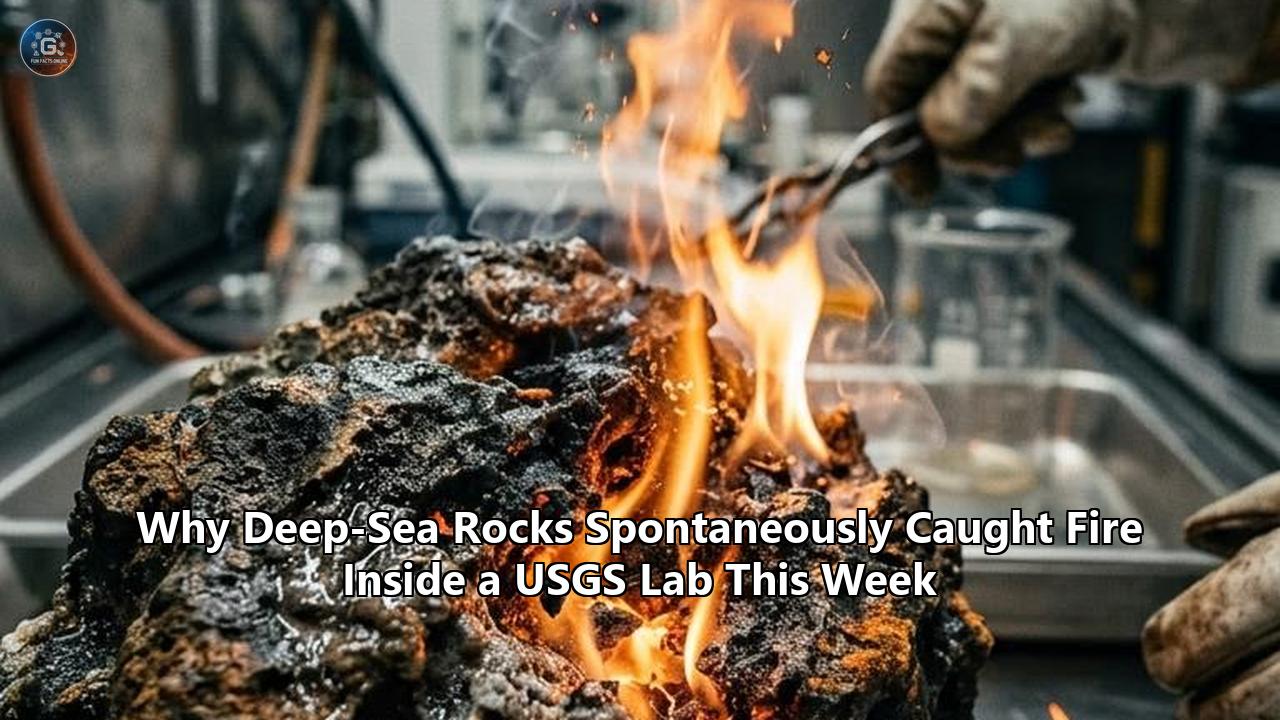
Federal marine geologists studying mineral deposits from the Pacific seafloor encountered an unprecedented laboratory hazard when rock specimens brought up from thousands of meters beneath the surface abruptly began smoking, generated temperatures exceeding 100 degrees Celsius (212 degrees Fahrenheit), and underwent runaway combustion on a preparation bench.
The incident, detailed in a formal investigation published in Scientific Reports and announced by the U.S. Geological Survey (USGS) Pacific Coastal and Marine Science Center, confirms that certain metal-rich formations from deep-ocean hydrothermal fields can turn pyrophoric when introduced to oxygenated laboratory air.
The physical samples—retrieved from the Escanaba Trough along the southern Gorda Ridge, more than 3,000 meters down off the Northern California and Oregon coast—were undergoing routine freeze-drying and mechanical crushing when the exothermic reaction occurred. Rather than behaving like the inert, ancient ores mined on land, the marine rocks acted as high-surface-area chemical fuel.
The sudden flashpoint has triggered immediate safety reviews across federal oceanographic facilities and introduced a major technical hurdle for the deep-sea mining sector, which has spent years planning to hoist millions of tons of massive sulfide ores into open-air transport ships.
ESCANABA TROUGH RUNAWAY OXIDATION SEQUENCE
========================================================================================
[1] 3,200m Abyss      [2] Surface Transit     [3] Lyophilization      [4] Comminution
Anoxic seawater       Decompression; cold-    Pore-ice sublimated;    Mechanical grinding;
Metastable marcasite  chain storage in inert  protective water films  drastic surface area
held at 320 atm.      chambers.               removed.                exposure to air (O₂).
        │                     │                       │                       │
        ▼                     ▼                       ▼                       ▼
   Stable Ore          Latent Chemical        Porous Nanoscale         RUNAWAY EXOTHERMIC
   Precipitate            Instability              Matrix              IGNITION (>100°C)
========================================================================================
2022: The Escanaba Trough Expedition and Deep-Sea Extraction
The genesis of the incident dates to an offshore research cruise conducted in the summer of 2022. Operating within the U.S. Exclusive Economic Zone (EEZ), an interagency research consortium combining the USGS, the Bureau of Ocean Energy Management (BOEM), and the National Oceanic and Atmospheric Administration (NOAA) deployed the Woods Hole Oceanographic Institution’s remotely operated vehicle (ROV) Jason into the Escanaba Trough.
The Escanaba Trough forms the southern axial valley of the Gorda Ridge, a slow-to-intermediate seafloor spreading center flanked by Northern California and southern Oregon.
Geologically, Escanaba differs from bare-rock volcanic rifts like the East Pacific Rise. The trough is choked by up to 500 meters of terrigenous sediment, turbidite blankets funneled offshore from the ancestral Columbia and Klamath river systems during Pleistocene glacial melt pulses.
Beneath this sediment blanket, basaltic magma sills inject intense volcanic heat into pore fluids. Hydrothermal fluids superheated beyond 300 degrees Celsius dissolve transition metals from the volcanic basement and upward-percolating sediments. When these acidic, metal-charged plumes breach the seafloor and contact cold, alkaline seawater, minerals drop out of solution, building massive hydrothermal mounds, sulfide chimneys, and broad replacement crusts rich in copper, zinc, iron, lead, silver, and gold.
ROV Jason conducted targeted sampling operations across four distinct hydrothermal zones in the trough. Robotic mechanical arms used hydraulic claws and chisel samplers to collect 57 individual rock samples directly from hydrothermal structures.
The specimens were loaded into insulated bio-boxes and elevator pallets on the seafloor, insulated against physical destruction during the three-kilometer ascent through the water column, and transferred to shipboard cold-storage lockers at 4 degrees Celsius.
At depth, the rocks had rested in perpetual darkness, under hydrostatic pressures exceeding 32 megapascals (over 300 atmospheres), bathed in bottom waters nearly depleted of free oxidants.
At the time of recovery, the scientific team treated the cargo as conventional seafloor massive sulfide (SMS) material. Geologists assumed the samples would behave according to established mineralogical handling procedures practiced for decades on land-based volcanogenic massive sulfides (VMS). That operational assumption would soon break down.
The Transfer to Santa Cruz: Laboratory Ingestion and Preparation
Upon arriving dockside, the 57 samples were cataloged and transported to the USGS Pacific Coastal and Marine Science Center laboratories in Santa Cruz, California. The objective was rigorous geochemical and mineralogical characterization, led by USGS research oceanographer Dr. Amy Gartman and physical scientist Jaycee Favela.
The primary analytical suite called for:
- Bulk chemical quantification via inductively coupled plasma optical emission spectrometry (ICP-OES)
- Inductively coupled plasma mass spectrometry (ICP-MS)
- Powder X-ray diffraction (XRD) for crystal lattice determination
- Scanning electron microscopy to resolve microstructural mineral boundaries
Standard geochemical sample preparation protocols require the complete removal of moisture prior to pulverization. Residual seawater leaves crystallized salt (halite) inside pore cavities, which skews analytical mass fractions and corrodes high-temperature analytical instruments.
To eliminate water without subjecting heat-sensitive hydrothermal phases to oven degradation, laboratory technicians deployed lyophilization, or freeze-drying.
The rocks were flash-frozen and placed into vacuum chambers where internal ice sublimated directly from solid to gas, leaving behind entirely desiccated, pristine mineral frameworks.
The lyophilization step inadvertently primed the samples for chemical destabilization. In their natural marine state, seafloor sulfides retain thin boundary layers of interstitial water that suppress immediate atmospheric gas absorption. The freeze-drying process stripped those protective moisture barriers away, opening microscopic pore networks directly to ambient room air.
PROGRESSION OF MATERIAL DESTABILIZATION
┌──────────────────────────────────────────────────────────────────┐
│  SUB-SEAFLOOR (3,200m depth)                                    │
│  Pyrrhotite (Fe₁₋ₓS) + marcasite (FeS₂) precipitation           │
│  Hydraulic pressure: >320 atm; Ambient fluids: reducing         │
├──────────────────────────────────────────────────────────────────┤
│  POST-CRUISE DESICCATION (USGS Lab)                              │
│  Vacuum freeze-drying removes interstitial pore fluids          │
│  Nanoscale crystallites lose protective water barrier            │
├──────────────────────────────────────────────────────────────────┤
│  MECHANICAL ACTIVATION (Milling)                                 │
│  Aggressive crushing generates fresh, unpassivated fracture faces│
│  High surface-area-to-volume ratio exposed directly to O₂        │
├──────────────────────────────────────────────────────────────────┤
│  AUTOCATALYTIC THERMAL RUNAWAY                                   │
│  Exothermic oxidation: FeS₂ + O₂ ➔ Fe-sulfates/oxides + SO₂      │
│  Core temperature surpasses 100°C; sample chars and oxidizes     │
└──────────────────────────────────────────────────────────────────┘
The Flashpoint: Mechanochemical Comminution and Spontaneous Ignition
The turning point occurred during mechanical processing inside the Santa Cruz prep facility. To prepare the freeze-dried samples for XRD and chemical digestion, researchers had to crush the rock fragments into fine, uniform powders—typically finer than 75 microns.
Technicians placed fragments of the Escanaba Trough rocks into mechanical mills and mortars. As mechanical energy sheared the dense metallic fragments, researchers observed physical and thermal anomalies.
Two of the processed samples began to warm rapidly. Within moments of crushing, heat output accelerated without the application of an external heat source. A pungent, suffocating odor of sulfur dioxide gas ($\text{SO}_2$) discharged from the containers, forcing personnel to secure safety equipment and move the reacting material into exhaust fume hoods.
Temperatures inside the powdered rock masses shot past 100 degrees Celsius (212 degrees Fahrenheit). The powdered samples glowed with internal self-heating, scorching containment vessels and producing visible wisps of dense smoke.
The reaction continued until the original dark, metallic sulfide powders had burned through their reactive potential, leaving behind brittle, crumbly aggregates of reddish-brown iron oxides, hematite, and hydrated iron sulfate crusts. The original mineral structures were entirely incinerated and chemically destroyed.
The event marked the first documented case where oceanographic core and rock samples underwent spontaneous, open-air laboratory combustion purely from the mechanical acts of retrieval, drying, and crushing.
The team realized they were not merely dealing with an anomalous laboratory mishap; they were witnessing an undocumented, exothermic hazard inherent to deep-sea mineral extraction.
Had this occurred on an industrial scale—such as within the crushing hopper or cargo bay of a commercial ocean mining vessel—the rapid-onset deep sea rocks fire would have destroyed mechanical processing lines and posed an immediate life-safety risk to shipboard personnel.
The Forensic Investigation: Dissecting the Mechanism
The USGS team halted comminution procedures across the Escanaba sample suite to launch a systematic geochemical forensics campaign. They needed to identify the exact chemical and mineralogical trigger separating the two combusting samples from the 55 companion samples that remained thermally stable under identical laboratory conditions.
THERMAL EVOLUTION COMPARISON: ESCANABA TROUGH SAMPLES
Temp (°C)
  120 ┼─────────────────────────────────────────────▲ (Combusting Samples: >100°C)
      │                                            / \
  100 ┼───────────────────────────────────────────/───\── Thermal Runaway
      │                                          /     \
   80 ┼─────────────────────────────────────────/       \ Rapid Oxidation Phase
      │                                        /         \
   60 ┼───────────────────────────────────────/           \
      │                                      /             ▼ (Oxidized Residuums)
   40 ┼─────────────────────────────────────/
      │  (Non-Combusting Background Samples)
   20 ┼──────────────────────────────────────────────────────── Stable Plateau
      └──────┬─────────────┬─────────────┬─────────────┬─────────────►
          0 min         5 min        10 min        15 min        20 min
Eliminating the Hydrocarbon Hypothesis
The primary suspect was petroleum contamination. The Escanaba Trough contains hydrothermal petroleum systems. When basaltic intrusions bake the thick blanket of river-derived organic muds, high-temperature thermal cracking generates crude oil, asphalt, and asphaltic bitumen that actively migrate through porous hydrothermal edifices.
On land, hydrocarbon-saturated coal or oil-shale beds frequently undergo spontaneous heating when exposed to air.
USGS geochemists performed organic extraction assays, gas chromatography, and mass spectrometry on the burned samples and their unburned twins. The results surprised the team:
- The combusting samples contained negligible concentrations of hydrothermally derived petroleum.
- Several non-combusting samples retrieved from neighboring mounds exhibited heavier petroleum coatings yet failed to display any thermal reactivity.
- Hydrocarbons were officially ruled out as the driver of the ignition.
Crystallography and Nanoscale Mineral Architecture
The research team turned to advanced solid-state characterization tools, deploying:
- High-resolution scanning electron microscopy (SEM)
- Scanning transmission electron microscopy (STEM)
- Selected area electron diffraction (SAED)
- Quantitative X-ray powder diffraction (XRD)
The scans revealed a structural difference between the stable and unstable rocks.
The samples that ignited did not consist of standard, coarse-grained iron pyrite ($\text{FeS}_2$). Instead, they were dominated by a mineralogical replacement feature: primary bladed crystals of pyrrhotite ($\text{Fe}_{1-x}\text{S}$) that had been pseudomorphed by secondary marcasite ($\text{FeS}_2$), an orthorhombic polymorph of iron disulfide.
MINERALOGICAL METAMORPHOSIS IN ESCANABA DEPOSITS
┌─────────────────────────────────┐       ┌─────────────────────────────────┐
│     PRIMARY HYDROTHERMAL        │       │      SECONDARY RETROGRADE       │
│         PRECIPITATE             │       │          ALTERATION             │
├─────────────────────────────────┤       ├─────────────────────────────────┤
│ Mineral: Hexagonal Pyrrhotite   │  ──►  │ Mineral: Nanocrystalline        │
│          (Fe₁₋ₓS)               │Seafloor Marcasite (FeS₂)                │
│ Morphology: Coarse, euhedral    │Cooling│ Morphology: Pseudomorphic       │
│             blades              │       │             aggregates          │
│ Grain Size: 10–100 μm           │       │ Grain Size: Sub-micron domains  │
│ Surface Area: Low to moderate   │       │ Surface Area: Extremely high    │
└─────────────────────────────────┘       └─────────────────────────────────┘
Pyrrhotite is a high-temperature, sulfur-deficient iron mineral that forms inside the central conduits of hydrothermal chimneys. As chimney venting wanes, ambient ocean water penetrates the structure. The cooling fluids become slightly more acidic and oxidized, destabilizing the pyrrhotite.
Rather than dissolving entirely, the iron atoms undergo internal structural reorganization: sulfur atoms from circulating seawater integrate into the lattice, converting the pyrrhotite into secondary marcasite while retaining the external bladed shape of the original mineral. This preservation of shape without preserving crystal structure is known as pseudomorphism.
Under STEM magnification, these pseudomorphs revealed a dangerous microstructure. They were not solid crystals. They were vast networks of disordered, porous, nanocrystalline marcasite clusters.
Each individual crystallite measured merely tens to hundreds of nanometers across. Because of this sub-microscopic grain size, the specific surface area of the mineral was several orders of magnitude higher than that of normal hydrothermal ore minerals.
Trillions of active, unpassivated sulfur and iron bonding sites were packed into every cubic millimeter of the rock, waiting for a compatible oxidant.
CRYSTAL TEXTURE COMPARISON: STABLE VS. COMBUSTING PHASES
┌──────────────────────────────────────┬──────────────────────────────────────┐
│ TERRESTRIAL / COARSE PYRITE (FeS₂)   │ ESCANABA NANOCRYSTALLINE MARCASITE   │
├──────────────────────────────────────┼──────────────────────────────────────┤
│ • Dense, interlocking cubic crystals │ • Porous, spongy orthorhombic blades │
│ • Specific surface area: <0.1 m²/g   │ • Specific surface area: >15–30 m²/g │
│ • Thick passivation boundary         │ • Hyper-reactive unpassivated bonds  │
│ • Low kinetic oxidation rate         │ • Ultra-rapid kinetic oxidation rate │
│ • Thermally stable in dry air        │ • Pyrophoric runaway potential       │
└──────────────────────────────────────┴──────────────────────────────────────┘
The Thermodynamics of the Ignition
Once the physical structure was clear, the USGS team modeled the thermodynamics of the reaction using thermogravimetric analysis (TGA) coupled with differential scanning calorimetry (DSC).
The oxidation of iron disulfide by atmospheric oxygen is an exothermic reaction. The primary pathways for dry, high-temperature oxidation proceed via the following stoichiometric transformations:
$$2\text{FeS}_2 + 7\text{O}_2 \rightarrow 2\text{FeSO}_4 + 2\text{SO}_2 \quad (\Delta H^\circ \approx -1,400\text{ kJ/mol})$$
$$4\text{FeS}_2 + 11\text{O}_2 \rightarrow 2\text{Fe}_2\text{O}_3 + 8\text{SO}_2 \quad (\Delta H^\circ \approx -3,300\text{ kJ/mol})$$
Every single mole of marcasite transformed into iron oxide releases immense thermal energy. Under normal circumstances on Earth’s surface, this reaction happens gradually over years or centuries.
Rain and airborne moisture react with exposed rocks, washing away weathered ions and dissipating heat into the ambient atmosphere through natural convective airflow.
In the Santa Cruz laboratory, however, three operational factors converged to turn an ordinary chemical transformation into a runaway deep sea rocks fire:
- Moisture Removal: Lyophilization stripped the pore system of all liquid water. Water has a high specific heat capacity ($4.184\text{ J/g}^\circ\text{C}$); without it, there was no internal thermal sink to absorb liberated calories.
- Mechanochemical Activation: The physical grinding did not just reduce particle size; it delivered external mechanical energy that sheared the mineral along weak cleavage planes, exposing fresh, unoxidized Fe(II) and S(-I) atomic sites directly to the air. The friction generated local micro-temperatures that pushed the mineral over its low activation energy barrier ($E_a$).
- The Autocatalytic Feedback Loop: Marcasite is structurally metastable relative to pyrite. As the first micro-crystallites reacted with atmospheric oxygen, the heat they generated could not escape the surrounding powder matrix. The local temperature climbed. According to the Arrhenius relationship, chemical reaction rates increase exponentially with temperature:
$$k = A e^{-\frac{E_a}{RT}}$$
As temperature jumped from 22 degrees Celsius to 40, then 60, and beyond 100 degrees Celsius, the rate of oxidation multiplied with each increment. Oxygen rushed into the interstitial voids between crushed grains, fueling an autocatalytic feedback loop that terminated only when the reactive sulfur inventory was entirely consumed.
The rocks did not require an open pilot flame; they generated the entire thermal excursion internally.
Why Terrestrial Ores Behave Differently
A fundamental question confronting geologists following the event was why land-based mining operations have handled millions of tons of iron sulfide rocks for centuries without encountering spontaneous explosions in hand.
The answer lies in geologic deep time.
The copper, zinc, and iron ores mined on land—such as the massive volcanogenic massive sulfide (VMS) deposits of the Iberian Pyrite Belt in Spain and Portugal, the Kidd Creek deposit in Canada, or the massive copper mines of Cyprus—were formed on ancient seafloors hundreds of millions of years ago.
Over geological epochs, those deposits were buried under thousands of meters of sedimentary overburden, compressed by tectonic collisions, and subjected to metamorphic heating and recrystallization.
Metamorphism acts as a natural furnace that drives minerals toward their lowest, most stable thermodynamic equilibrium states. Coarse-grained, well-ordered pyrite crystals grow at the expense of fragile, metastable phases like marcasite or pyrrhotite.
The nanoscale pores are crushed shut, crystalline lattices heal their internal defects, and the specific surface area shrinks to fractions of a square meter per gram.
Furthermore, terrestrial ores that sit near the surface have spent thousands of years interacting with oxygenated groundwater, developing thick, passivated oxide coatings that blunt rapid reactions.
GEOLOGIC TIME AND STABILITY DIVERGENCE
┌──────────────────────────────────────┬──────────────────────────────────────┐
│ TERRESTRIAL VMS DEPOSITS             │ MODERN SEAFLOOR MASSIVE SULFIDES     │
│ (e.g., Iberian Pyrite, Kidd Creek)   │ (e.g., Escanaba, Mid-Atlantic Ridge) │
├──────────────────────────────────────┼──────────────────────────────────────┤
│ Age: 300 to 2,700 million years      │ Age: Decades to a few thousand years │
│ History: Deep burial, high-grade     │ History: Pristine hydrothermal       │
│ metamorphism, recrystallization      │ precipitation; no metamorphic healing│
│ Mineralogy: Coarse, euhedral, stable │ Mineralogy: Metastable, rapid-growth │
│ pyrite, dense chalcopyrite           │ phases (marcasite, wurtzite, Fe₁₋ₓS) │
│ Internal Surface Area: Low           │ Internal Surface Area: Nanoscale     │
│ Atmospheric Behavior: Slowly oxidizes│ Atmospheric Behavior: Pyrophoric,    │
│ to acid mine drainage over months    │ can combust spontaneously in hours   │
└──────────────────────────────────────┴──────────────────────────────────────┘
Modern seafloor massive sulfides are infant minerals. The deposits at the Escanaba Trough and other mid-ocean ridge centers are only decades, centuries, or a few thousand years old.
They have never experienced tectonic burial or metamorphic maturation. They cooled rapidly in cold bottom waters, locking in high-energy, metastable mineral structures that are chemically incompatible with the oxygen-rich surface world.
When raised to the surface, these modern deep-sea minerals encounter an environment fundamentally alien to the one in which they formed: a 300-fold reduction in ambient pressure, a temperature swing of tens of degrees, and, crucially, an atmosphere containing 21 percent molecular oxygen.
Timeline of the Escanaba Escalation
CHRONOLOGY OF DISCOVERY AND ESCALATION
========================================================================================
SUMMER 2022
USGS, NOAA, and BOEM launch an interagency expedition to the Escanaba Trough aboard
oceanographic vessels. ROV Jason extracts 57 hydrothermal massive sulfide rocks from
3,200m depth under cold-chain, anoxic conditions.
----------------------------------------------------------------------------------------
FALL 2022
Samples arrive at USGS Pacific Coastal and Marine Science Center in Santa Cruz.
Specimens undergo standard vacuum freeze-drying to remove pore fluids prior to chemical
and mineralogical analysis.
----------------------------------------------------------------------------------------
LATE 2022 (The Ignition)
During mechanical crushing inside an open-air laboratory, two distinct metal-sulfide
samples spontaneously self-heat. Temperatures exceed 100°C; the samples emit thick
sulfur dioxide smoke and oxidize completely to iron sulfates and hematite.
----------------------------------------------------------------------------------------
2023 – MID 2026
Forensic investigations eliminate organic hydrocarbons as the cause. High-resolution
electron microscopy (SEM/STEM) identifies the fuel: nanocrystalline marcasite replacing
bladed pyrrhotite with astronomical specific surface area.
----------------------------------------------------------------------------------------
AUTUMN 2026
Scientific Reports publishes the peer-reviewed findings. The USGS issues a formal safety
and regulatory advisory regarding the chemical reactivity and self-heating hazards of
seafloor massive sulfides.
========================================================================================
Maritime Shipping Hazards and the Supply Chain Threat
The documentation of spontaneous combustion in hydrothermal samples moves the discussion of deep-sea mining from environmental and economic projections into the realm of basic maritime safety and vessel survivability.
The international shipping of bulk solid cargoes is strictly governed by the International Maritime Solid Bulk Cargoes (IMSBC) Code, overseen by the International Maritime Organization (IMO).
Under the IMSBC framework, mineral ores are classified according to their physical risks:
- Group A consists of cargoes that may liquefy if shipped with moisture content above their transportable moisture limit (TML), causing sudden loss of vessel stability and capsize.
- Group B consists of cargoes that possess chemical hazards, such as self-heating, toxic gas emissions, or oxygen depletion.
Historically, the commercial ocean mining conversation around seafloor massive sulfides focused almost exclusively on Group A hazards: dewatering the ore slurry brought up from the seafloor so that the rock pile does not slosh like liquid inside the hold.
The USGS laboratory incident forces an abrupt re-evaluation of Group B chemical hazards. If commercial operators dredge, dewater, and crush seafloor massive sulfides at sea, dry processing exposes massive tonnages of nanocrystalline marcasite to atmospheric oxygen inside confined ship holds.
MARITIME BULK HOLD RISK SCENARIOS FOR DEEP-SEA ORES
┌──────────────────────────────────────┬──────────────────────────────────────┐
│ CONVENTIONAL LIQUEFACTION (Group A)  │ PYROPHORIC COMBUSTION (Group B)      │
├──────────────────────────────────────┼──────────────────────────────────────┤
│ Trigger: High residual pore moisture │ Trigger: Excessive drying + crushing │
│ Mechanism: Cargo slurry sloshes,     │ Mechanism: Oxygenation of marcasite  │
│ destabilizing vessel center of mass  │ causes thermal runaway (>100°C–300°C)│
│ Consequence: Rapid structural roll,  │ Consequence: Cargo hold inferno, toxic│
│ dynamic capsizing of bulk carrier    │ SO₂ release, hull thermal stress     │
│ Mitigation: Intensive dewatering,    │ Mitigation: Inert gas blanketing,    │
│ maintaining moisture below TML       │ moisture retention, oxygen starvation│
└──────────────────────────────────────┴──────────────────────────────────────┘
The physical conditions inside a dry bulk cargo hold create an ideal environment for thermal runaway:
- Thermal Insulation: A bulk cargo hold containing 20,000 to 50,000 deadweight tons of crushed mineral ore possesses immense thermal inertia. Minerals like marcasite and iron oxides are poor thermal conductors. While heat escapes readily from a 50-gram laboratory dish, heat generated inside a 10-meter-deep industrial ore pile cannot escape via surface convection.
- Air Voids and Chimney Effects: In a loose pile of crushed ore, void spaces permit continuous air infiltration. As internal oxidation warms the core of the pile, a thermal chimney develops: rising hot air draws fresh oxygen from the hold's perimeter into the reacting interior, feeding the fire indefinitely.
- Toxic Gas Generation: The reaction generates copious amounts of sulfur dioxide ($\text{SO}_2$) gas. In high concentrations, $\text{SO}_2$ reacts with atmospheric moisture to form airborne sulfurous and sulfuric acid mists, which degrade electrical insulation, corrode structural marine steel, and incapacitate crew members entering cargo spaces or machinery rooms.
THE BULK HOLD THERMAL FEEDBACK LOOP
         ┌────────────────────────────────────────────────────────┐
         ▼                                                        │
┌──────────────────┐     ┌──────────────────┐     ┌───────────────┴──┐
│ Air Infiltration │ ──► │ Surface Reaction │ ──► │ Heat Accumulation │
│ Oxygen enters    │     │ Marcasite oxidizes│    │ Ore pile insulates│
│ loose ore matrix │     │ exothermically   │     │ core; temp rises  │
└──────────────────┘     └──────────────────┘     └───────────────┬──┘
                                                          │
         ┌────────────────────────────────────────────────────────┘
         ▼
┌──────────────────┐     ┌──────────────────┐     ┌──────────────────┐
│ Kinetic Speedup  │ ──► │ Thermal Chimney  │ ──► │ CATASTROPHIC     │
│ Arrhenius jump in│     │ Rising heat draws│     │ CARGO HOLD       │
│ oxidation rate   │     │ fresh O₂ inward  │     │ COMBUSTION       │
└──────────────────┘     └──────────────────┘     └──────────────────┘
The mining sector has observed catastrophic analogues before. Direct reduced iron (DRI)—pure iron pellets produced through industrial reduction—is notorious in commercial shipping for spontaneous ignition when exposed to moisture and oxygen, leading to multiple catastrophic total vessel losses.
Shipping regulations had never considered that raw, untreated rocks hoisted directly from the deep ocean floor could present an identical pyrophoric risk. A severe deep sea rocks fire occurring aboard an industrial mining barge or a trans-oceanic bulk carrier in open water would create an emergency with few safe fire-suppression options.
Standard marine firefighting protocols that use water would fail catastrophically: applying small or moderate amounts of water to a runaway metal sulfide fire can generate hydrogen gas via hydrolysis, accelerating the blaze and causing primary deck explosions.
Regulatory Repercussions at the International Seabed Authority
The revelation that seafloor hydrothermal minerals can act as spontaneous chemical hazards arrives at an intensely politicized juncture for the ocean floor.
The International Seabed Authority (ISA), the autonomous body established under the United Nations Convention on the Law of the Sea (UNCLOS), has been operating in Kingston, Jamaica, to negotiate an industrial "Exploitation Code."
This set of binding global regulations would allow state-sponsored mining contractors to transition from marine mineral exploration to active commercial extraction in international waters.
While polymetallic nodules on the abyssal plains of the Clarion-Clipperton Zone (CCZ) have dominated media headlines, hydrothermal seafloor massive sulfides represent the second major frontier of deep-sea exploitation.
The ISA has already approved multiple commercial exploration contracts for seafloor massive sulfides along the Northern Mid-Atlantic Ridge, the Southwest Indian Ridge, and the Central Indian Ridge to state-backed entities from:
- China (China Ocean Mineral Resources Research and Development Association)
- Russia (Ministry of Natural Resources and Environment)
- India
- France
- Germany
- South Korea
ISA MASSIVE SULFIDE CONTRACTS & OCEANIC SETTINGS
┌───────────────────────┬──────────────────────┬──────────────────────────────┐
│ CONTRACT HOLDER       │ TARGET GEOGRAPHIC    │ GEOLOGICAL HOST              │
│                       │ LOCATION             │ ENVIRONMENT                  │
├───────────────────────┼──────────────────────┼──────────────────────────────┤
│ COMRA (China)         │ Southwest Indian     │ Ultra-slow spreading ridge;  │
│                       │ Ridge                │ deep serpentinized faults    │
├───────────────────────┼──────────────────────┼──────────────────────────────┤
│ Min. Natural Res.     │ Northern Mid-        │ Slow spreading ridge; basalt │
│ (Russia)              │ Atlantic Ridge       │ and ultramafic hosted vents  │
├───────────────────────┼──────────────────────┼──────────────────────────────┤
│ BGR (Germany)         │ Central & Southeast  │ Intermediate/slow ridge;     │
│                       │ Indian Ridge         │ highly localized SMS mounds  │
├───────────────────────┼──────────────────────┼──────────────────────────────┤
│ Govt. of India        │ Central Indian       │ Hydrothermal fields along    │
│                       │ Ridge                │ intermediate spreading axes  │
└───────────────────────┴──────────────────────┴──────────────────────────────┘
The technical assumption driving these contract applications has been that mining sulfide deposits on the ocean floor requires adapting open-pit and underground terrestrial mining tools to subsea operations: cutting and grinding mounds with heavy tracked crawlers, slurrying the aggregate to a production support vessel, dewatering the solids, and transporting them in standard bulk ore carriers to shore-side smelting plants.
The USGS findings demonstrate that deep-sea sulfide rocks do not behave like their terrestrial namesakes.
The publication has given delegations calling for a precautionary pause or a formal moratorium on seabed mining fresh, empirical leverage.
Environmental opposition historically rested on ecological concerns: the destruction of endemic vent fauna, noise pollution, and massive particulate sediment plumes smothering the water column. The USGS discovery introduces an operational issue: industrial processing feasibility and occupational safety.
Delegates scrutinizing the draft Exploitation Code must now grapple with how to regulate materials that may ignite upon surface exposure.
If processing these rocks requires continuous inert-gas atmospheres (such as nitrogen or argon blanketing), constant subsea storage, or wet milling under deoxygenated seawater, the capital expenditure ($CAPEX$) and operating expenditure ($OPEX$) calculations of deep-sea mining models will escalate sharply.
A mining consortium cannot simply shovel wet marcasite-rich rocks onto a conveyer belt without risking the ignition of transport equipment or the catastrophic loss of a bulk cargo carrier.
Laboratory Handling Protocols: The New Operating Reality
Inside institutional and academic laboratories, the Santa Cruz incident has ended the practice of treating deep-ocean mineral rocks as chemically benign hand samples.
The USGS is implementing updated handling guidelines for marine mineral archives across its national network, with partner organizations like the Woods Hole Oceanographic Institution, the Scripps Institution of Oceanography, and European marine institutes following suit.
UPDATED PROTOCOLS FOR HYDROTHERMAL SULFIDE HANDLING
┌──────────────────────────────────────┬──────────────────────────────────────┐
│ HISTORICAL WORKFLOW                  │ NEW POST-ESCANABA WORKFLOW           │
├──────────────────────────────────────┼──────────────────────────────────────┤
│ 1. Sub-bottom core extraction        │ 1. Sub-bottom core extraction        │
│ 2. Uncontrolled surface transit      │ 2. Nitrogen-purged storage bins      │
│ 3. Open-air visual inspection        │ 3. Hypoxic glovebox preparation      │
│ 4. Unrestricted freeze-drying        │ 4. Controlled desiccation in Ar/N₂   │
│ 5. Open mechanical mortar milling    │ 5. Cryogenic or wet anoxic milling   │
│ 6. Standard open-shelf curation      │ 6. Sealed, anoxic vacuum ampoules    │
└──────────────────────────────────────┴──────────────────────────────────────┘
The revised laboratory safety protocols require:
- Pre-Screening Mineralogical Phase Ratios: Technicians must screen intact rock chips via micro-X-ray fluorescence ($\mu$-XRF) or optical petrography to quantify the presence of secondary marcasite, pyrrhotite, and other reactive metal sulfides before undertaking large-scale sample drying.
- Elimination of Open-Air Lyophilization for Reactive Suites: Samples rich in iron disulfides must no longer be freeze-dried and then left exposed to room air on open benches. If drying is required for isotopic or chemical assay, the samples must be purged with high-purity nitrogen or argon gas throughout desiccation and subsequent storage.
- Wet and Anoxic Comminution: The practice of dry pulverization using planetary ball mills or open mortar-and-pestle grinders has been suspended for modern seafloor sulfide rocks. Grinding must be conducted under liquid nitrogen (cryogenic milling) or in a deoxygenated aqueous slurry to quench mechanical friction and starve the mineral faces of free oxidants.
- Environmental Gas Scrubbing and Thermal Containment: Fume hoods utilized for processing subsea geological samples must be equipped with active sulfur dioxide scrubbing systems, and mechanical crushers must be seated on heat-dissipating, blast-resistant containment trays to prevent fire propagation to surrounding facilities.
Outstanding Questions and Next Research Frontiers
The incident at Santa Cruz has revealed a blind spot in marine geosciences: the kinetic instability of modern subsea mineral deposits when removed from their native environments. The USGS team has underscored that not every hydrothermal rock is guaranteed to ignite.
The 55 Escanaba samples that remained stable prove that combustion requires a precise mineralogical alignment: high proportions of nanocrystalline marcasite, extreme surface area, the absence of protective hydration films, and mechanical energy inputs.
PYROPHORIC SUSCEPTIBILITY INDEX FOR SEAFLOOR HYDROTHERMAL SITES
Hydrothermal Site        Host Geology            Combustion Propensity
───────────────────────────────────────────────────────────────────────
Escanaba Trough          Sediment-covered ridge  CRITICAL (High Marcasite)
Guaymas Basin            Sediment-covered rift   ELEVATED (High Secondary FeS)
Middle Valley            Sedimented basin        ELEVATED (Porous Sulfides)
TAG Hydrothermal Field   Bare-rock basalt        MODERATE (Pyrite Dominant)
Endeavour Segment        Bare-rock rift valley   MODERATE (Variable Fe-S)
Rainbow Vent Field       Ultramafic basement     LOW (Cu-Ni-Co Dominant)
───────────────────────────────────────────────────────────────────────
The critical scientific challenge is mapping where this pyrophoric hazard exists across the ocean floor. Marine geochemists are now focusing on comparative studies between sedimented spreading systems and bare-rock ridges.
In sedimented basins like the Escanaba Trough, the Middle Valley along the Juan de Fuca Ridge, and the Guaymas Basin in the Gulf of California, hydrothermal fluids are buffered by thick layers of organic silt, creating chemistry rich in dissolved iron and sulfur that promotes the precipitation of fragile, low-temperature marcasite.
In contrast, bare-rock basaltic systems like the Trans-Atlantic Geotraverse (TAG) active mound on the Mid-Atlantic Ridge deposit higher proportions of crystalline, high-temperature pyrite and chalcopyrite, which may possess lower surface-area-to-volume ratios and greater mechanical stability.
Whether bare-rock massive sulfides are truly immune to this self-heating behavior remains unproven. The USGS research team is coordinating with academic institutions to systematically test historical core repositories, using thermogravimetric analysis to establish the exact critical threshold of marcasite concentration required to trigger self-heating.
What began as an ordinary day of sample preparation at a federal research desk has exposed an overlooked physical reality: the minerals of the deep abyss are products of extreme, anoxic conditions.
When torn from those depths and introduced to the mechanical stresses of the surface world, their chemistry does not quietly adapt. As industrial ambitions push deeper into the ocean, the spontaneous ignition of these rocks serves as a stark reminder that the materials of the abyss obey the rules of their native world—and when exposed to ours, they can push back with explosive, thermal force.
Reference:
- https://www.sciencealert.com/scientists-collected-deep-sea-rocks-they-spontaneously-caught-fire-in-the-lab
- https://www.usgs.gov/programs/cmhrp/news/deep-sea-sulfide-minerals-can-spontaneously-heat-and-combust-when-exposed-air
- https://www.usgs.gov/publications/spontaneous-combustion-metal-sulfide-minerals-and-implications-seafloor-massive
- https://www.usgs.gov/programs/cmhrp/news/deep-sea-sulfide-minerals-can-spontaneously-heat-and-combust-when-exposed-air
- https://news.ssbcrack.com/researchers-warn-of-spontaneous-combustion-risks-in-deep-sea-mineral-mining/
- https://www.researchgate.net/publication/414900114_Spontaneous_combustion_of_metal_sulfide_minerals_and_implications_for_seafloor_massive_sulfide_mining
- https://www.usgs.gov/science/science-explorer/ocean/marine-minerals-and-offshore-energy
- https://www.facebook.com/MechanicalEngineersRocks/videos/scientists-have-made-a-surprising-discovery-showing-that-some-rocks-on-the-deep-/2757998361230391/
- https://wearethefrontier.org/world/us/2026/10/11/seafloor-rock-samples-spontaneously-combusted
- https://www.reddit.com/r/askscience/comments/tvxu4/how_can_rocks_burst_into_flames/
- https://www.usgs.gov/publications/baked-shale-and-slag-formed-burning-coal-beds
- https://pubs.usgs.gov/newpubs
- https://news.ua.edu/2026/06/ua-study-reveals-ancient-ocean-life-collapse-triggered-wildfire/
- https://wisevoter.com/world/us/2026/10/07/seafloor-rocks-combust-lab-testing
- https://www.noc.ac.uk/n/Isobel%20Yeo