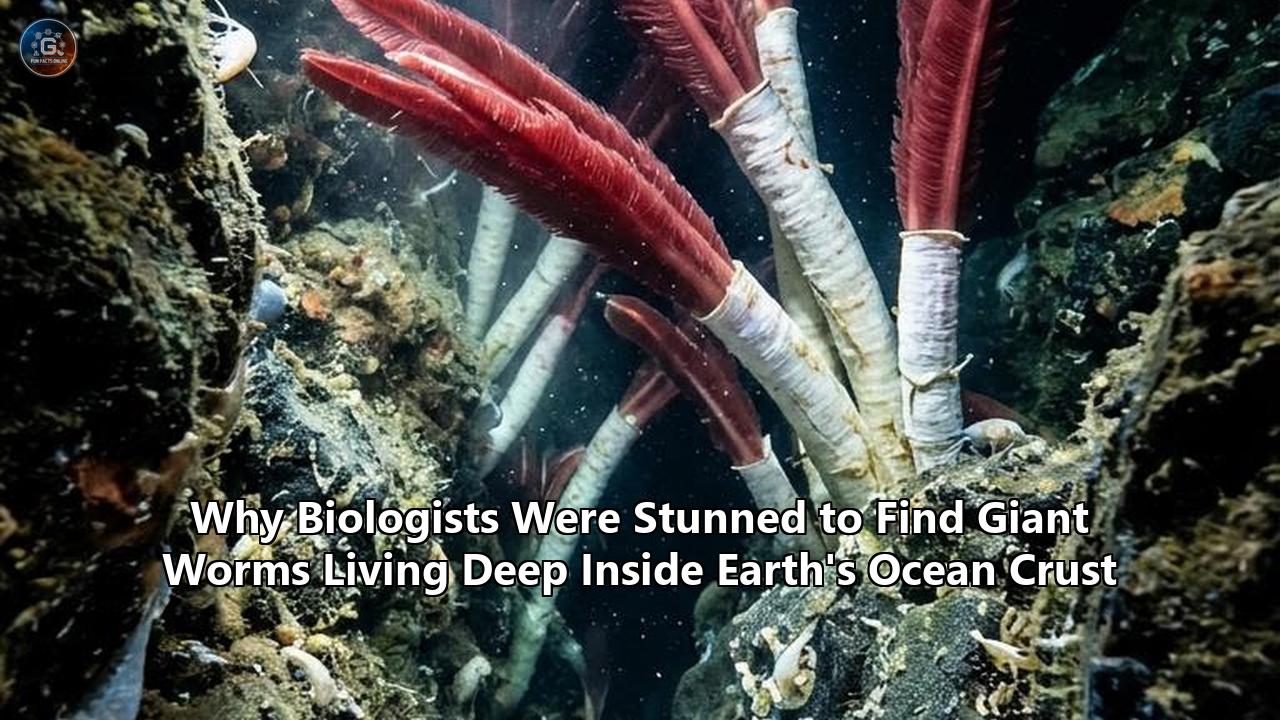
At a depth of 2,515 meters along the East Pacific Rise, an international research team directed a robotic arm to wedge a metal pry bar beneath a slab of solidified undersea lava, levering the volcanic shelf upward. As the rock broke free, the high-definition cameras of the remotely operated vehicle (ROV) SuBastian illuminated an environment that marine biology had long assumed could not exist: beneath the ocean floor, inside the dark, water-filled cavities of the Earth’s upper basaltic crust, lived thriving colonies of mature tubeworms.
The expedition, conducted aboard the Schmidt Ocean Institute’s research vessel Falkor (too) and led by marine biologists Dr. Monika Bright of the University of Vienna and Dr. Sabine Gollner of the Royal Netherlands Institute for Sea Research (NIOZ), uncovered an entire animal biome flourishing inside the subseafloor. In formal findings published in Nature Communications, the research consortium revealed that the upper oceanic crust at hydrothermal vents is not merely a realm of single-celled microbes, but a dynamic, three-dimensional ecosystem supporting complex macrofauna.
Among the animals pulled from these subterranean lava pockets were Riftia pachyptila—the iconic giant hydrothermal vent tubeworm—and its relative Oasisia alvinae, alongside predatory polychaete worms, limpets, and marine snails. Some of the specimens extracted from the subterranean rock measured up to 50 centimeters in length. Several female tubeworms contained ripe eggs, demonstrating that these creatures are not accidental washaways trapped in subterranean dead ends, but sexually mature organisms actively reproducing beneath the seabed.
The identification of viable communities of giant worms ocean crust habitats has upended fundamental assumptions about the spatial limits of animal life on Earth. For more than four decades following the 1977 discovery of hydrothermal vents along the Galápagos Rift, biological oceanography operated under a two-dimensional paradigm: bacteria and archaea inhabited the subterranean bedrock, while animal life was strictly confined to the benthic surface where fluids vent into the open sea.
That conceptual boundary has collapsed. The realization that macrofaunal ecosystems extend into the rocky subseafloor forces an immediate re-evaluation of global marine biomass, reshapes ecological models of how organisms colonize isolated habitats, and sets off urgent legal debates over deep-sea mining proposals that risk crushing biological communities humanity did not know existed.
The Physical Architecture of the Subsurface Underworld
To understand how complex metazoans can survive buried within volcanic rock, one must examine the specific volcanic and hydrogeological forces that shape the East Pacific Rise. The study site, situated at 9° 50′ North along a fast-spreading mid-ocean ridge, is marked by rapid tectonic expansion and violent episodic eruptions. Magma chambers located approximately 1.5 to 2 kilometers beneath the seafloor continuously supply basaltic melt to the crust.
When lava erupts onto the seabed at these depths, it encounters bottom water chilled to approximately 1.8°C and subjected to hydrostatic pressures exceeding 250 atmospheres. The lava freezes almost instantly along its outer boundaries, creating inflated lobes and massive sheet flows. As an eruption wanes, molten lava beneath the chilled upper crust drains out toward lower topographical depressions or collapses back into magma conduits.
This drainage cycle leaves behind extensive hollow architectures known as lobate lava shelves, supported by vertical lava pillars. Over time, successive volcanic flows stack atop one another like multi-story structures. These subseafloor cavities range from tight fracture networks just millimeters across to fluid-filled voids measuring several meters wide and dozens of centimeters high, situated just beneath the uppermost 10 to 20 centimeters of basalt crust.
       [ Cold Ambient Ocean Water (~2°C) ]
                       │
       ┌───────────────▼───────────────┐
       │   Lobate Lava Crust (Basalt)   │  <-- Benthic Communities
       └───────┬───────────────┬───────┘      (Surface Vents)
               │               │
  ┌────────────▼───────────────▼────────────┐
  │      Subseafloor Crustal Cavities       │  <-- Newly Discovered Habitat
  │   - Fluid Temperature: 18°C – 25°C      │      (Riftia pachyptila,
  │   - Hydrothermal Fluid / Seawater Mix   │       Oasisia alvinae, Snails)
  └────────────────────┬────────────────────┘
                       │
        [ Deep Magmatic Heat & Fluids ]
          (H2S, CH4, Metals at ~400°C)
The physical environment within these cavities differs radically from the freezing, stagnant conditions of the abyssal plain. Rather than being dry or stagnant, these pockets are continuously washed by diffuse hydrothermal fluids. Deep within the crust, seawater that has permeated through recharge zones contacts hot basalt adjacent to magma chambers, stripping minerals, metals, and reduced sulfur species from the rock while superheating to temperatures up to 400°C.
Buoyant and chemically altered, this fluid rises rapidly toward the seabed. Before discharging into the open water column as black smokers, a substantial fraction of this thermal flow mixes with entrained, cold, oxygenated ocean water inside the shallow subsurface fractures.
During the Falkor (too) expedition, temperature probes placed directly into the newly opened cavities registered fluid temperatures between 18°C and 25°C. This creates a subterranean thermal refuge. The cavities are protected from the extreme, protein-denaturing heat of primary hydrothermal chimneys, yet elevated well above the metabolic paralysis of the deep abyssal cold.
Chemical assays of the cavity fluids confirmed high concentrations of dissolved hydrogen sulfide ($H_2S$), elevated carbon dioxide, and depleted dissolved oxygen—a precise chemical signature that mirrors the diffuse flow zones found at the surface of hydrothermal vents, but contained entirely within subterranean stone vaults.
The Physiology of Chemosynthetic Symbiosis in Complete Darkness
The survival of Riftia pachyptila inside the oceanic crust is an evolutionary paradox made possible by mutualistic symbiosis. As adults, these worms possess neither a mouth, a gut, nor an anus. They cannot ingest organic particles, graze on biofilms, or filter food from the surrounding water.
Instead, their entire physical mass—which can grow to more than 2 meters in length and 4 centimeters in diameter on the seafloor surface—is nourished internally by billions of chemolithoautotrophic bacteria belonging to the species Candidatus Endoriftia persephone. These endosymbionts are packed within a highly vascularized internal organ called the trophosome, which accounts for much of the animal’s body weight.
The discovery of mature giant worms ocean crust biomes challenged decades of assumptions regarding the energetic constraints on metazoan physiology. To sustain its bacterial partners, an adult tubeworm must perform a physiological balancing act: it must simultaneously acquire reduced sulfur compounds to serve as an electron donor, and oxygen to act as an electron acceptor.
In a standard seafloor vent environment, the worm achieves this by extending its bright red, vascularized branchial plume directly into the turbulent mixing zone where sulfide-rich vent water collides with oxygen-rich bottom currents. Specialized, multi-subunit extracellular hemoglobins bind both $H_2S$ and $O_2$ simultaneously at distinct sites with high affinity, transporting both compounds through a closed circulatory system to the trophosome without poisoning the animal’s cellular respiration.
$$\text{HS}^- + 2\text{O}_2 \xrightarrow{\text{Endosymbiont Oxidation}} \text{SO}_4^{2-} + \text{H}^+ + \text{Chemical Energy (ATP / NAD(P)H)}$$
$$\text{CO}_2 + \text{Chemical Energy} \xrightarrow{\text{Calvin Cycle}} \text{Organic Carbon (Sugars, Amino Acids)}$$
Inside the subseafloor cavities, this physiological exchange occurs without direct access to the open ocean's water column. The cavity networks must maintain precise hydraulic circulation to prevent suffocation. If the subterranean fluid were purely anoxic hydrothermal discharge, the tubeworms would asphyxiate due to lack of oxygen. Conversely, if the cavities were dominated entirely by descending seawater, the symbiotic bacteria would starve from a lack of hydrogen sulfide.
The presence of reproducing populations indicates that the ocean crust operates as an active, subterranean mixing chamber. Fractures in the basalt allow cold, oxygen-saturated abyssal water to be continuously sucked downward into the shallow crust, while ascending hydrothermal plumes pump hydrogen sulfide upward from below. The resulting fluid within the cavities provides a continuous, highly stable metabolic bath.
Moreover, the physical morphology of the animals recovered from inside the crust revealed subtle adaptations to their subterranean constraints. While seafloor-dwelling Riftia typically construct rigid, vertical tubes composed of chitin and protein complexes that project upward into the water column, the specimens excavated from beneath the lobate lava were oriented horizontally or tortuously bent along the contours of the rock cavities.
Specimens of Oasisia alvinae, a smaller relative, were observed hanging upside down, their white tubes anchored directly to the ceilings of the basalt voids and entwined around basaltic "drips" that formed when molten lava drained from the chamber millions of years ago.
Polychaete worms of the genus Paralvinella, along with mobile limpets and peltospirid snails, were observed crawling over thick, white microbial mats that lined the floors and walls of the cavities, demonstrating that the tubeworms form the structural foundation of a multi-tiered trophic web embedded inside the oceanic plate.
Overturning the Two-Dimensional Model: The Subterranean Larval Conduit
The most far-reaching biological consequence of the Falkor (too) expedition is its solution to an ecological mystery that has puzzled deep-sea oceanographers since hydrothermal vents were first identified: the problem of rapid colonization.
Hydrothermal vent fields are dynamic and geologically transient. Submarine volcanic eruptions periodically pave over active vent fields with fresh lava flows, wiping out every living creature on the seafloor. Alternatively, tectonic shifts routinely clog hydrothermal plumbing, causing vents to shut down entirely and starving the chemosynthetic communities that depend on them.
Yet, when new hydrothermal vents split open on the ocean floor—sometimes kilometers away from any established community—macrofaunal species appear with remarkable speed. Within months of a volcanic eruption, tiny juvenile tubeworms can be observed affixing themselves to raw basalt; within two to three years, dense thickets of mature Riftia dominate the new vent field.
For decades, larval ecology held that this colonization occurred almost exclusively through the pelagic water column. The hypothesis posited that adult worms released hundreds of thousands of gametes into the bottom currents. The resulting trochophore-like larvae were assumed to rise into the water column, drifting across tens or hundreds of kilometers of barren abyss before sensing the chemical plumes of a new hydrothermal vent and descending back to the seafloor to settle.
However, empirical evidence for this pelagic model was thin. Despite hundreds of research cruises pulling plankton nets and deploying larval traps directly above active vent fields, finding Riftia larvae in the open water column was exceptionally rare. The mathematical density of drifting larvae could not account for the rapid, overwhelming colonization observed on newly cleared volcanic surfaces.
The discovery published by Bright and her colleagues provides the missing mechanism: the larvae are traveling through the ocean crust itself.
  Traditional Model: Pelagic Dispersal
  [ Planktonic Larvae Drift Through Open Water Column (Unobserved/Rare) ]
  ─────────────────────── Ocean Floor ─────────────────────────
  [ Hydrothermal Vent A ]                        [ Hydrothermal Vent B ]

  =============================================================

  Modern Model: Subcrustal Hydraulic Dispersal
  ─────────────────────── Ocean Floor ─────────────────────────
  [ Surface Vent A ]                              [ Surface Vent B ]
          │                                               ▲
          ▼ Recharge Entrainment                          │ Discharge Venting
  ┌───────────────────────────────────────────────────────────────┐
  │         Subseafloor Crustal Hydraulic Fracture Network        │
  │   - Larvae pulled into crust through recharge zones           │
  │   - Dispersal via warm subsurface fluid channels              │
  │   - Permanent colonization of subcrustal cavities             │
  │   - Emergence at adjacent vent fields                         │
  └───────────────────────────────────────────────────────────────┘
The oceanic crust around hydrothermal ridges is intensely fractured, cracked by thermal contraction as hot basalt contacts cold water, and shattered by tectonic faulting. As cold bottom water is drawn into the crust across broad recharge areas to replenish the hydrothermal convection cell, it pulls down gametes and microscopic larvae spawned by surface animals.
Once inside the shallow crust, these microscopic organisms are transported horizontally through the maze of subterranean fissures and lava shelves by subsurface fluid currents.
This realization shifts how scientists conceptualize benthic-subsurface coupling. Rather than the seafloor acting as an ecological floor, it operates as a permeable membrane:
- Recharge Entrainment: Free-swimming larvae and microbial symbionts spawned at surface vents are drawn downward through cracks in the basalt by descending water currents.
- Subsurface Colonization: Larvae that encounter warm, diffuse fluids and stable rock surfaces inside subterranean cavities anchor themselves to the ceiling or floor, growing into sexually mature subseafloor adults.
- Discharge Dispersal: Other larvae are swept along active hydrothermal conduits, carried horizontally beneath the solid crust, and pushed out through newly opening vent fissures to rapidly seed virgin seafloor fields.
- Underground Seed Banking: When surface communities are destroyed by volcanic lava flows, scraping, or top-down predation, the subseafloor populations survive insulated beneath solid rock, providing an immediate biological reservoir that repopulates the surface once conditions stabilize.
Who Is Affected: Academic Disciplines and Geopolitical Stakeholders
The emergence of a three-dimensional animal biosphere in the oceanic basement ripples through multiple scientific and industrial domains. Its reverberations are felt from theoretical biology to international maritime law.
1. Deep-Sea Ecologists and Evolutionary Biologists
For marine ecologists, previous spatial models calculating species density, biomass, and diversity must be revised. Hydrothermal vent communities have historically been cataloged through surface-area projections: researchers photograph a vent field via submersibles, count visible tubeworm plumes per square meter, and derive population estimates.
These estimates are systematically incomplete. If an equivalent or greater biomass of metazoans lives distributed within the upper five to ten meters of the basaltic basement, global estimates of chemosynthetic animal biomass are substantially underestimated.
Evolutionary biologists must also grapple with the subseafloor as an evolutionary nursery. The protected, thermally regulated cavities within the basalt may represent ancestral refugia where early chemosynthetic animals survived ocean-surface extinction events, such as asteroid impacts or global ocean anoxic episodes.
2. Biogeochemists and Marine Geologists
The geochemical balance of the global ocean relies on calculations of hydrothermal fluxes—the rates at which heat, carbon, sulfur, iron, manganese, and methane are exchanged between the Earth's mantle, crust, and the hydrosphere. Chemical oceanographers have treated the subseafloor primarily as an abiotic, water-rock reactor altered only by the metabolic kinetics of single-celled archaea and bacteria.
The presence of macroscopic animals alters this calculus. Tubeworms and polychaetes are biological pumps: they irrigate their surroundings, concentrate trace metals within their tissues, alter local pH and redox potentials through intense sulfide uptake, and produce massive quantities of organic matter that fuel heterotrophic microbial consumption inside the crust. Geochemical models of subseafloor fluid modification must now integrate metazoan bio-irrigation and metabolic sinks.
3. The Deep-Sea Mining Sector and Maritime Regulators
The most immediate and contentious conflict generated by this discovery occurs within the halls of the International Seabed Authority (ISA) in Kingston, Jamaica. The ISA is tasked under the United Nations Convention on the Law of the Sea (UNCLOS) with organizing and controlling mineral-related activities in the international seabed Area for the "benefit of mankind as a whole," while simultaneously ensuring the effective protection of the marine environment from harmful effects.
Commercial entities and state-backed contractors are targeting seafloor massive sulfide (SMS) deposits for industrial exploitation. SMS deposits form along mid-ocean ridges where hydrothermal vents precipitate concentrated ores of copper, gold, zinc, silver, and cobalt. Mining consortia have spent years preparing environmental impact assessments (EIAs) predicated on the assumption that stripping the top layers of basalt would only destroy the immediate benthic surface communities.
The discovery of the giant worms ocean crust ecosystem invalidates the baseline ecological science underpinning these environmental assessments. Establishing that the presence of giant worms ocean crust populations represents an interconnected, continuous ecosystem rather than isolated pockets means any mechanical disruption to the seabed will cause far wider ecological destruction than previously admitted.
The Mining Conflict: Invalidating Environmental Impact Baselines
The engineering architecture designed to harvest seafloor massive sulfides involves enormous, tracked robotic crawlers weighing several hundred tons. These machines, such as the seafloor bulk cutters and collecting machines tested in recent years, operate by deploying massive rotary cutter-heads to grind, crush, and pulverize the volcanic crust to depths of three to ten meters.
       DEEP-SEA MINING CUTTER-HEAD IMPACT

       Seafloor Bulk Cutter (Heavy Tracked Machine)
       ====================[ CUTTER-HEAD ]====================
       ▼▼▼▼▼▼▼▼▼▼▼▼▼▼▼▼▼▼▼▼▼▼▼▼▼▼▼▼▼▼▼▼▼▼▼▼▼▼▼▼▼▼▼▼▼▼▼▼▼▼▼▼▼▼▼
       ─────────────────── Seafloor Surface ─────────────────
       ░░░░░░░░░░░░░░░░░░░░░░░░░░░░░░░░░░░░░░░░░░░░░░░░░░░░░░
       ░░  Subsurface Cavities Destroyed by Mechanical Grinding ░░
       ░░  - Total habitat collapse                            ░░
       ░░  - Crushing of Riftia & Oasisia populations          ░░
       ░░  - Subterranean plumbing choked by toxic silt        ░░
       ░░  - Hydraulic conduits severed                        ░░
       ░░░░░░░░░░░░░░░░░░░░░░░░░░░░░░░░░░░░░░░░░░░░░░░░░░░░░░
       ──────────────── Upper Oceanic Crust ─────────────────
Industry environmental impact assessments have operated on a foundational premise: that while the surface vent chimneys would be destroyed, the physical damage would be localized to the two-dimensional benthic layer. Proponents of SMS extraction have argued that because hydrothermal vents are adapted to natural volcanic disturbances, their ecosystems would quickly recolonize from surrounding areas once operations ceased.
The empirical data from the Falkor (too) expedition disproves this argument.
First, mechanical pulverization of the upper five meters of volcanic crust does not simply scrape away surface fauna—it obliterates the entire subterranean architectural nursery that makes surface recolonization possible. By crushing the porous lobate shelves, crushing machines would permanently collapse the subseafloor voids and fracture networks.
Second, mining operations generate suffocating sediment plumes. While pelagic plumes drifting in the water column have received widespread regulatory attention, the subseafloor consequences have been entirely ignored. Heavy, mineralized drill tailings and sediment fines pumped onto the seabed will infiltrate the recharge zones of the hydrothermal circulation system.
As seawater is drawn into the crust, these toxic, heavy-metal-laden particles will be pulled into the subterranean fracture networks, choking the fluid conduits and suffocating the filter-feeding and branchial apparatuses of subseafloor animals.
The realization that mining operations would obliterate entire networks of giant worms ocean crust systems has prompted intense scrutiny at the International Seabed Authority. Under UNCLOS Article 145, the ISA is legally mandated to adopt rules, regulations, and procedures to prevent:
"...pollution and other hazards to the marine environment... interference with the ecological balance of the marine environment... and the protection and conservation of the natural resources of the Area and the prevention of damage to the flora and fauna of the marine environment."
Legal challenges are emerging from member nations and non-governmental coalitions who argue that no commercial mining contract for hydrothermal sulfides can be lawfully approved because the regulatory baseline—the measurement of existing biodiversity and ecological functioning—was scientifically flawed.
Until the vertical depth, spatial distribution, and taxonomic richness of the subseafloor animal biome are quantified, approving the mechanical demolition of the oceanic crust violates the precautionary principle codified in international environmental law.
Astrobiological Implications: Rewriting the Habitable Zone
Beyond the jurisdictional waters of the Earth, the presence of macroscopic metazoan life thriving inside subterranean rock matrices alters our understanding of extraterrestrial habitability.
For decades, astrobiology has viewed hydrothermal vent analogues as prime candidates for the emergence of life on ocean worlds such as Jupiter’s moon Europa and Saturn’s moon Enceladus. Data from NASA’s Galileo, Cassini, and James Webb Space Telescope missions have confirmed that these icy moons harbor liquid water oceans beneath outer ice shells, possessing rocky silicate cores, hydrothermal activity, and abundant chemical energy sources including molecular hydrogen ($H_2$) and methane ($CH_4$).
                PLANETARY OCEAN CROSS-SECTION
                (Europa / Enceladus Analogue)

   ┌────────────────────────────────────────────────────────┐
   │             Outer Ice Shell (10 - 30 km)               │
   └──────────────────────────┬─────────────────────────────┘
                              │
   ┌──────────────────────────▼─────────────────────────────┐
   │             Subsurface Global Liquid Ocean             │
   │               - Cold, Chemically Saturated             │
   └──────────────────────────┬─────────────────────────────┘
                              │
   ===========================▼==============================
   ░░░░░░░░░░░░░░░ Silicate / Basaltic Seafloor ░░░░░░░░░░░░░
   ┌────────────────────────────────────────────────────────┐
   │      Subcrustal Fracture Networks & Cavities           │
   │  - Hydrothermal fluid / Ocean water mixing             │
   │  - Chemolithoautotrophic metabolic drivers             │
   │  - Complex multi-cellular organisms shielded           │
   │    from ocean-wide circulation and surface radiation   │
   └────────────────────────────────────────────────────────┘
However, classical astrobiological theory has long drawn a sharp distinction between the potential for single-celled extremophiles and the evolutionary plausibility of complex, macroscopic animal life. The traditional consensus asserted that while chemosynthetic bacteria might inhabit the pore spaces of Europa's rocky mantle, macroscopic metazoans would be strictly unviable due to the extreme metabolic constraints, the absence of sunlight-driven primary production, and the harsh physical conditions of enclosed subterranean environments.
The discovery that Earth supports dense communities of complex, sexually reproducing animals encased within subterranean basalt directly refutes this constraint.
It demonstrates that metazoan biology requires neither sunlight nor direct exposure to an open ocean to achieve high biomass and complex multi-tiered ecological structures. An animal ecosystem can sustain itself entirely inside the fracture networks of a planet’s upper crust, provided that two conditions are met:
- Active convective circulation of chemically reduced fluids driven by internal planetary heat.
- An entrainment mechanism that delivers an oxidant-bearing liquid phase through connected pore spaces or cavities.
This shifts the targets for future astrobiological exploration missions. Life detection protocols designed for Europa or Enceladus have largely been configured to sample ice plumes or skim the upper interfaces of the sub-ice oceans.
The East Pacific Rise findings demonstrate that the primary locus of complex biological organization may not be located in the open ocean waters, nor even strictly on the exposed surface of the ocean floor, but deep within the fractured rock basement beneath it.
The Technical Execution: How the Subseafloor Was Unlocked
The technological barrier that kept this biome hidden for nearly fifty years highlights the physical difficulty of observing deep-ocean substrates.
Historically, scientific exploration of hydrothermal vents has relied on human-occupied submersibles (such as WHOI's Alvin) or work-class remotely operated vehicles configured for observational imaging, fluid sampling, and selective biological plucking. Submersible operations are constrained by strict protocols designed to prevent damage to expensive subsea assets and avoid disturbing fragile biological features. Scientists intentionally avoided crushing or dismantling the basalt floor.
The 2023 expedition aboard RV Falkor (too) adopted an interventionist experimental approach. Equipped with ROV SuBastian—a 4,500-meter-rated robotic system possessing two heavy-duty hydraulic manipulator arms with millimeter-scale force feedback—the team engineered a mechanical pry bar and chisel assembly.
The scientific strategy was executed systematically across distinct dive stations:
- Site Selection: Operations focused on the "Fava Flow Suburbs" and the "Tica Vent" fields along the East Pacific Rise. These sites are characterized by young basaltic terrains where fast sheet flows had created extensive lobate formations.
- Mechanical Excavation: Using SuBastian’s hydraulic manipulator arm, pilots wedged the custom chisel into natural contraction fractures along the edges of lobate lava shelves. By applying upward hydraulic torque, they systematically cleaved and lifted square-meter slabs of solid basalt between 10 and 20 centimeters thick.
- Real-time Environmental Monitoring: Immediately upon lifting a slab, temperature probes and micro-chemical sensors were inserted into the opened cavity to measure volatile gases and thermal profiles before ambient abyssal water could dilute the pristine subterranean fluids.
- In-Situ Biological Recovery: A specialized suction sampler equipped with partitioned, thermally insulated carousels was deployed to capture free-swimming polychaetes and snails without subjecting them to thermal shock during ascent. Larger tubeworms anchored to the underside of the ceilings were recovered by completely flipping the lava slabs upside down and bringing the intact rock frameworks to the surface in sealed bio-boxes.
- Subsurface Staining and Settlement Experiments: To verify the active transit of larvae, the team anchored specialized "mesh box staining gadgets" over cleared cracks in the ocean floor, applying harmless biological stains to identify whether animals settling inside the fissures originated from the downwelling seawater or emerged upward from the underlying crust.
  CHRONOLOGY: FROM ANOMALY TO CONFIRMED BIOME

  1977           Galápagos Rift Discovery
                 Hydrothermal vents and giant tubeworms discovered;
                 paradigm established that macrofauna are strictly benthic.

  1990s - 2010s  The "Missing Larvae" Conundrum
                 Decades of net trawls fail to identify sufficient Riftia
                 larvae in the pelagic water column to explain rapid colonization.

  Summer 2023    The "VentUnderworld" Expedition
                 RV Falkor (too) and ROV SuBastian deploy chisels at 9° 50' N
                 on the East Pacific Rise, physically flipping lobate lava shelves.
                 Mature Riftia, Oasisia, and polychaetes discovered inside.

  October 2024   Formal Peer-Reviewed Publication
                 Bright et al. publish in Nature Communications, establishing
                 the crustal subseafloor as an active macrofaunal biome.

  Present - 2027 Regulatory & Conservation Re-evaluation
                 The International Seabed Authority faces legal challenges over
                 SMS mining codes; marine scientists lobby for 3D volumetric MPAs.
The success of these operations demonstrated that the lack of prior evidence for subseafloor animals was not due to their biological absence, but to an observational bias: marine science had spent half a century treating the seabed as an impenetrable floor rather than a hollow ceiling.
Comparative Ecology: Known Vent Taxa Recovered Sub-Crust
The macrofaunal inventory recovered from within the shallow crust reveals that subterranean cavities are populated not by bizarre, evolutionary divergence, but by specialized members of the known hydrothermal vent community. The table below categorizes the dominant macrofaunal taxa identified within the subseafloor voids during the Nature Communications study:
| Taxonomic Class / Species | Morphological / Ecological Guild | Subsurface Orientation & Position | Observed Physiological State | Significance to Biome Model |
|---|---|---|---|---|
| ---Riftia pachyptila--- (Siboglinidae) | Sessile, gutless tubeworm; endosymbiotic sulfur oxidizer. | Anchored to cavity floor and lateral walls; bent along contours of voids; up to 50 cm. | Mature females containing ripe oocytes; active vascular blood flow. | Confirms permanent, reproducing macrofaunal residency inside crustal rocks. |
| ---Oasisia alvinae--- (Siboglinidae) | Small, slender tubeworm; endosymbiotic sulfur oxidizer. | Hanging upside down from cavity ceilings; wrapped around descending lava drips. | Dense, living colonies; tubes cemented to overhead basaltic roof. | Demonstrates exploitation of overhead micro-conduits and descending warm fluids. |
| ---Paralvinella spp. (Alvinellidae) | Highly mobile, thermophilic polychaete (bristle worm). | Free-crawling over white microbial mats lining cavity floors and walls. | Active locomotion, feeding on subterranean filamentous bacterial mats. | Confirms a functioning trophic web with grazing detritivores inside the crust. |
| ---Bathymodiolus thermophilus--- (Mytilidae) | Chemosynthetic deep-sea vent mussel. | Wedged within vertical cracks and cave entryways leading into voids. | Filtering diffuse vent fluids; symbiotic bacteria in gills. | Demonstrates transition from open benthic margins into subterranean entryways. |
| Peltospirid & Lepetodrilid Gastropods | Mobile benthic snails and limpets. | Grazing on the upper ceilings and rocky floors of subseafloor voids. | Intact shells, active muscular feet, scraping epilithic biofilms. | Proves that mobile grazers exploit the subterranean biosphere for nutrient foraging. |
| Polynoidae (Scale worms) | Predatory polychaetes. | Interspersed among tubeworm tube clumps inside the cavities. | Healthy, predatory adults actively hunting within the dark chambers. | Demonstrates top-down predatory regulation operating within subcrustal spaces. |
The composition of this community shows that the subseafloor cavity network is not an isolated evolutionary branch, but an extension of the vent ecosystem itself. The same foundational mutualisms that drive primary productivity on the surface of the oceanic plate are fully functional within its interior.
Short-Term and Long-Term Consequences
The scientific confirmation of an animal ecosystem embedded in the upper oceanic crust sets off immediate practical repercussions and initiates long-range scientific and environmental shifts.
       CONSEQUENCES ROADMAP

       SHORT-TERM IMPACTS (1 - 3 Years)
       ┌────────────────────────────────────────────────────────┐
       │ • Invalidation of standard Deep-Sea Mining EIAs        │
       │ • Regulatory battles at International Seabed Authority │
       │ • Development of non-destructive crustal imaging tools │
       │ • Re-calculation of local biogeochemical models        │
       └──────────────────────────┬─────────────────────────────┘
                                  │
                                  ▼
       LONG-TERM IMPACTS (5 - 15+ Years)
       ┌────────────────────────────────────────────────────────┐
       │ • Establishment of 3D Volumetric Marine Protected Areas│
       │ • Identification of subcrustal animal biomes globally  │
       │ • Re-evaluation of metazoan survival during mass       │
       │   extinction events                                    │
       │ • Re-engineering of astrobiological life-detection     │
       │   payloads for icy ocean worlds                        │
       └────────────────────────────────────────────────────────┘
Short-Term Consequences: Regulatory and Technical Realignments
In the near term, the most severe disruption is legal and administrative. Environmental assessment protocols formulated by the International Seabed Authority and national regulatory agencies are fundamentally disrupted. Mining consortiums that have invested hundreds of millions of dollars in exploration licenses and mining machine development face regulatory friction.
Independent scientific review boards now possess peer-reviewed proof that scraping the seafloor causes structural damage to a living subterranean habitat. A growing bloc of ISA member states—including France, Germany, Chile, Costa Rica, and numerous Pacific Island nations—have leveraged these findings to reinforce their calls for a precautionary pause or moratorium on seabed exploitation.
Scientifically, oceanographic research methods are undergoing an immediate change. Trawling plankton nets to capture larvae or using passive visual surveys to quantify vent biodiversity is no longer sufficient.
Research institutions are engineering new tools to probe the subseafloor without destroying it. High-resolution acoustic tomography, sub-bottom micro-profilers, and micro-endoscopic cameras designed to slip into narrow basaltic cracks without prying open slabs are in active development.
Long-Term Consequences: A Volumetric Biosphere and Planetary Habitability
Over the coming decades, this discovery will redefine marine conservation biology from a two-dimensional framework into a three-dimensional volumetric discipline. The ratification of the United Nations High Seas Treaty (the Agreement on Marine Biodiversity of Areas Beyond National Jurisdiction, or BBNJ Treaty) provides a mechanism to establish Marine Protected Areas (MPAs) in international waters.
Conservation treaties must now draft legal definitions that protect ecological strata extending beneath the seafloor surface. Protecting a hydrothermal vent can no longer be achieved by drawing a polygon on a bathymetric map; it requires designating volumetric protective envelopes that safeguard the subsurface hydraulic recharge zones extending kilometers horizontally and hundreds of meters vertically into the volcanic crust.
Geochemically, global carbon cycle calculations must incorporate animal-mediated metabolism within the crust. If metazoan communities are common throughout young, porous oceanic crust along the 65,000 kilometers of mid-ocean ridges circling the globe, their collective respiration, carbon fixation, and sulfide oxidation represent an unaccounted-for variable in Earth's geochemical ledger.
In astrobiology, the conceptual boundary between planetary surfaces and habitable subsurface volumes has dissolved. The search for life across the solar system is shifting its focus deeper into planetary geology. If macroscopic animals can flourish encased in volcanic rock at the bottom of Earth's oceans, the potential for complex biological systems to inhabit the subterranean interiors of Mars, Europa, Titan, and Enceladus expands from science fiction into an empirical priority.
Unresolved Frontiers and Future Milestones
Despite the clarity of the evidence published by Bright, Gollner, and their co-authors, the initial discovery opens several unanswered scientific questions that will drive deep-sea oceanographic research over the next decade.
       KEY SCIENTIFIC QUESTIONS AHEAD

       [ VERTICAL DEPTH ]   ---> How deep does macrofaunal life extend?
                                 Are animals limited to 1 meter, or do they
                                 penetrate 10-50 meters into sheet flows?

       [ GLOBAL PREVALENCE ] ---> Does this occur at slow-spreading ridges
                                 (Mid-Atlantic, SW Indian) where ultramafic
                                 serpentinization replaces basaltic volcanism?

       [ TROPHIC COMPLEXITY ] -> Does the subcrust host dedicated predators?
                                 Are there subterranean fish, octopuses, or
                                 specialized parasites adapted exclusively to
                                 underground life?
The primary unresolved question is the vertical depth of the animal subseafloor biosphere. The Falkor (too)* expedition accessed cavities situated within the upper tens of centimeters to a meter of the volcanic crust, where lobate shelves could be physically pried open by an ROV manipulator.
Whether macrofauna can penetrate five, ten, or fifty meters into the fractured, porous basalt remains completely unknown. Porosity logs from scientific ocean drilling programs indicate that fluid-filled fracture networks persist through hundreds of meters of Layer 2A basalt in young oceanic crust. If fluid temperatures remain below the upper thermal limit for metazoan life (approximately 50°C to 55°C for specialized hydrothermal polychaetes) and oxygenated mixing continues, animals could theoretically inhabit depths far beneath the reach of current sampling tools.
A second critical question concerns global geological diversity. The East Pacific Rise is an ultra-fast to fast-spreading ridge characterized by sheet lavas and shallow magma chambers.
Scientists have yet to determine whether similar subterranean animal communities exist along slow-spreading ridges, such as the Mid-Atlantic Ridge or the Southwest Indian Ridge. In these slow-spreading environments, volcanic sheet flows are rare; instead, the geology is dominated by massive tectonic faulting, core complexes, and mantle peridotite exposed to seawater, which drives an entirely different chemical process known as serpentinization.
Whether the fracture systems of serpentinized ultramafic systems like the Lost City hydrothermal field host subterranean macrofauna remains entirely untested.
Upcoming oceanographic missions are already being mobilized to address these blind spots. International drilling initiatives and autonomous sub-bottom exploratory programs are slated to deploy deep-crustal fluid observatories and long-term subseafloor colonization incubators over the next three to five years.
What is already settled, however, is that humanity's view of the deep ocean was incomplete. The solid rock of the ocean floor is not a biological floor; it is a roof over a complex animal underworld. As industrial interests move closer to exploiting the minerals of the deep seabed, the discovery of this hidden ecosystem serves as an urgent reminder of how little is known about the planet's geology, and how rapidly irreversible damage can be inflicted upon habitats that science is only beginning to see.
Reference:
- https://lifesciences.univie.ac.at/news-events/newsordner/einzelansicht/news/ecology-animal-life-discovered-below-the-seafloor/
- https://schmidtocean.org/newsletter05-progress-report/
- https://www.mpi-bremen.de/en/Secret-life-underground-Animal-life-beneath-the-seafloor.html
- https://www.researchgate.net/publication/384937953_Animal_life_in_the_shallow_subseafloor_crust_at_deep-sea_hydrothermal_vents
- https://oceanographicmagazine.com/news/subseafloor-exploration-finds-life-exists-in-incredible-places/
- https://www.earth.com/animals/giant-marine-worms-found-living-under-the-ocean-floor/
- https://www.facebook.com/ABCNews/videos/giant-tubeworms-part-of-thriving-ecosystem-found-under-the-seafloor-in-the-pacif/1735551397206708/
- https://schmidtocean.org/cruise-log-post/giant-worms-on-a-very-special-volcano/
- https://www.sci.news/biology/hydrothermal-vent-animals-13345.html
- https://www.researchgate.net/publication/384937953_Animal_life_in_the_shallow_subseafloor_crust_at_deep-sea_hydrothermal_vents
- https://www.futura-sciences.com/en/giant-worms-discovered-under-the-ocean-scientists-cant-believe-it_24327/
- https://www.instagram.com/reel/DBWk-LaM72O/
- https://schmidtocean.org/cruise/underworld-of-hydrothermal-vents/
- https://astrobiology.com/2024/10/16/animal-life-discovered-below-the-seafloor-at-hydrothermal-vents/