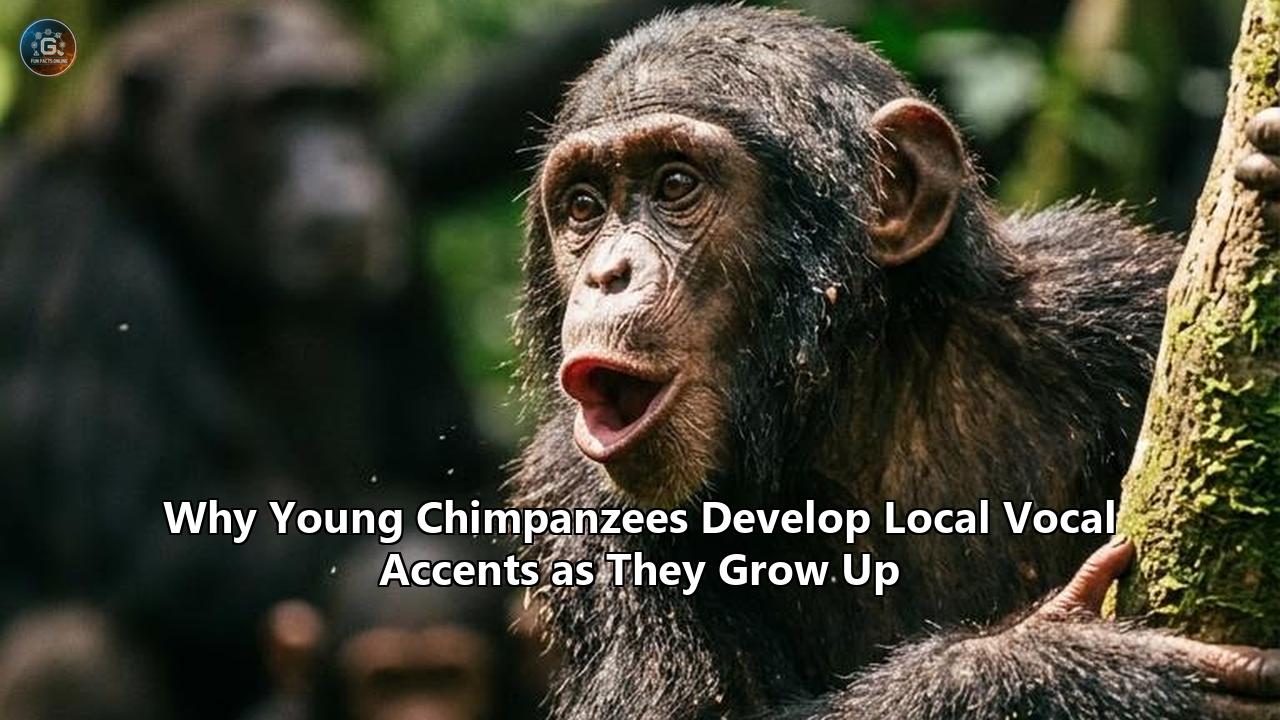
A bioacoustic investigation published in PLOS ONE has demonstrated that young chimpanzees (Pan troglodytes) systematically acquire population-specific vocal accents as they grow, upending decades of primatological theory that treated great ape calls as hardwired genetic reflexes.
The study, led by Kassandra Giragosian of Queen Mary University of London alongside collaborators at the University of Portsmouth, analyzed 11,225 individual vocalizations recorded across two geographically separated eastern chimpanzee (Pan troglodytes schweinfurthii) populations: the wild communities of Gombe National Park in Tanzania and the semi-wild sanctuary groups of the Chimfunshi Wildlife Orphanage in Zambia.
By tracking acoustic metrics across infants and juveniles, the research team found that while infant chimpanzees exhibit only faint regional acoustic variations, juveniles produce calls with sharp, statistically distinct community signatures.
The acoustic divergence intensified dramatically across developmental stages. When analyzing grunts—short-range vocalizations used in foraging and social greetings—classification algorithms successfully assigned infant calls to their home site with 76.1% accuracy. For juvenile grunts, that classification precision surged to 91.9%.
Whimpers, which serve as distress vocalizations directed at caregivers, displayed no statistically significant site-specific distinction in infancy (classifying at a baseline 76.6%), yet developed distinct geographic signatures in juveniles, leaping to an 84.9% classification success rate. Laughter, an essential social lubricant during peer play, sharpened from 93% accuracy in infancy to 96.7% in juvenile subjects.
DEVELOPMENTAL ACCENT CONVERGENCE: CLASSIFICATION ACCURACY BY CALL TYPE
=============================================================================
Call Type        Infant Stage Accuracy (%)       Juvenile Stage Accuracy (%)
-----------------------------------------------------------------------------
Grunts                     76.1%                           91.9%
Whimpers                   76.6% (non-significant)         84.9%
Laughs                     93.0%                           96.7%
=============================================================================
Data source: Giragosian, Davila-Ross, & Taylor (PLOS ONE, 2026)
“Understanding how communication develops during early life is fundamental to understanding animal behaviour,” Giragosian stated upon the release of the findings. “Our findings show that chimpanzee vocalisations are not simply fixed from birth but continue to develop as young animals interact with their social and ecological environments.”
The implications of this discovery ripple across evolutionary anthropology, cognitive biology, bioacoustics, and primate conservation. The study establishes that the building blocks of human dialect formation—the gradual acoustic accommodation to a peer group over developmental time—predate the emergence of the genus Homo, rooted deep within the hominid lineage.
Bioacoustic Mechanics: How Chimpanzee Dialects Crystallize
To map the emergence of these regional accents, the researchers tracked a multidimensional matrix of acoustic variables. These included fundamental frequency ($F_0$), pitch contours, frequency modulation rates, duration, temporal spacing of discrete call units, and formant dispersion, which reflects the physical filtering of the supralaryngeal vocal tract.
In early infancy, great ape vocal anatomy is mechanically constrained. The infant larynx sits relatively high in the neck, and neural control over the intrinsic laryngeal muscles is immature. Infant whimpers across both Gombe and Chimfunshi share acoustic profiles characterized by high fundamental frequencies, simple downward pitch glides, and unmodulated harmonic stacks. These early cries function as raw, survival-critical distress signals engineered to trigger immediate maternal retrieval. Because natural selection heavily penalizes ambiguity in life-or-death maternal signaling, infant whimpers remain biologically canalized across populations.
ACOUSTIC TRAJECTORY FROM INFANCY TO JUVENILE MATURITY
+-------------------------------------------------------------------------+
| INFANT STAGE (Ages 0-3)                                                 |
| - High, uniform fundamental frequency (F0)                              |
| - Tight maternal proximity; limited broader social exposure             |
| - Distress calls (whimpers) acoustically undifferentiated across sites  |
| - Play laughs show early micro-variations                               |
+-------------------------------------------------------------------------+
                                    │
                                    ▼ (Social weaning, peer playgroups,
                                       acoustic accommodation)
+-------------------------------------------------------------------------+
| JUVENILE STAGE (Ages 4-8)                                               |
| - Laryngeal descent & refined motor control of vocal tract              |
| - Broadened interaction with peer cohorts and adult hierarchy           |
| - Whimpers diverge into distinct population-specific acoustic profiles  |
| - Grunts and laughs crystallize into sharp community dialects           |
+-------------------------------------------------------------------------+
As chimpanzees transition from infancy (ages 0–3) into the juvenile stage (ages 4–8), their social world expands while their vocal anatomy undergoes structural changes. The juvenile phase coincides with nutritional and social weaning. Young chimpanzees spend less time in direct physical contact with their mothers and begin spending hours in peer playgroups, traveling with mixed-age parties and navigating the broader social hierarchy.
During this window, chimpanzee vocal communication undergoes extensive acoustic accommodation. Juveniles adjust their respiratory support, laryngeal positioning, and lip posture to match the subtle acoustic norms of their community. In grunts, this manifests as community-wide adjustments in duration, dominant frequency peaks, and inter-grunt intervals. In play laughter, juveniles modulate the ratio of voiced to unvoiced exhalations and the temporal patterning of staccato chuckles, matching the acoustic cadence of their regular play partners.
The finding that whimpers become dialectally differentiated in juvenile life is especially telling. Once a juvenile is no longer solely reliant on immediate maternal rescue, whimpering expands its contextual utility to include negotiations with peers, appeals to older siblings, and appeasement behaviors toward dominant adults. As the social context of the call broadens, social learning and local conformity exert greater influence over its acoustic structure, pulling the call away from its innate baseline and toward the local community norm.
Stakeholder Impact: Disciplines and Practices Facing Direct Revision
┌─────────────────────────────────────────────────────────────────────────┐
│                    STAKEHOLDER IMPACT MATRIX                           │
├──────────────────────────┬──────────────────────────────────────────────┤
│ Stakeholder Sector       │ Primary Operational / Theoretical Impact    │
├──────────────────────────┼──────────────────────────────────────────────┤
│ Evolutionary             │ Replaces the "gestural-first" exclusive      │
│ Anthropologists          │ model; integrates vocal plasticity into the  │
│                          │ early hominid communicative toolkit.         │
├──────────────────────────┼──────────────────────────────────────────────┤
│ Field Primatologists &   │ Requires longitudinal, age-stratified vocal  │
│ Bioacousticians          │ baselines rather than static species-level   │
│                          │ acoustic catalogs.                           │
├──────────────────────────┼──────────────────────────────────────────────┤
│ Sanctuary Managers &     │ Demands acoustic compatibility protocols for │
│ Reintroduction Teams     │ translocating and socially integrating       │
│                          │ orphaned or displaced primates.              │
├──────────────────────────┼──────────────────────────────────────────────┤
│ Wildlife Conservation    │ Expands conservation frameworks to recognize │
│ Policymakers             │ distinct vocal traditions as culturally      │
│                          │ irreplaceable population units.              │
└──────────────────────────┴──────────────────────────────────────────────┘
Evolutionary Anthropologists and Linguists
For more than half a century, dominant theories of language evolution have posited an evolutionary discontinuity between non-human primate vocalizations and human speech. Prominent frameworks advanced throughout the late 20th century argued that non-human primate vocal production was involuntary, emotionally reactive, and genetically fixed, contrasting with human speech, which relies on learned, culturally transmitted symbolic codes. Consequently, many theorists concluded that human language must have evolved almost exclusively through a gestural bridge, with manual signing preceding vocal language because ape gestures demonstrated intentionality and flexibility that calls allegedly lacked.
The demonstration of ontogenetic dialect acquisition in young chimpanzees directly challenges this dichotomy. By showing that great apes modify their acoustic outputs across development through social exposure, the study supplies the evolutionary substrate for vocal plasticity in the last common ancestor of humans and chimpanzees six to eight million years ago. Linguists investigating the origins of phonology must now account for the reality that social shaping of the vocal tract is not a Homo sapiens novelty, but a deeply conserved hominid trait.
Field Primatologists and Acoustic Ecologists
Field researchers across long-term research stations—including the Taï Chimpanzee Project in Côte d'Ivoire, the Budongo Conservation Field Station and Kibale Chimpanzee Project in Uganda, and the Gombe Stream Research Center in Tanzania—must recalibrate their ethological recording protocols. Historically, bioacoustic profiles collected at a single field site were frequently generalized to describe the entire species, or differences between sites were attributed entirely to subspecific genetic divergence (Pan troglodytes verus versus P. t. schweinfurthii).
Primatologists must now treat bioacoustic datasets as dynamic, culturally influenced records. Acoustic monitoring studies must stratify vocal data by age cohort, kinship line, and social network position. Ethologists can no longer treat adult vocalizations as static endpoints; they must document the social learning trajectories that produce those endpoints over years of juvenile development.
Wildlife Sanctuary Managers and Rehabilitation Biologists
For rescue and rehabilitation centers such as Chimfunshi in Zambia, the Jane Goodall Institute’s Tchimpounga Sanctuary in the Republic of the Congo, and the Ape Action Africa sanctuary in Cameroon, this research carries direct operational relevance. Sanctuaries routinely integrate confiscated, orphaned infants into established social groups.
If young chimpanzees rely on an open developmental window to calibrate their vocal output to the local group accent, orphans reared in social isolation or alongside human handlers may develop atypical acoustic signatures. Reintroducing these individuals into established chimpanzee troops could produce communicative friction, as resident adults and juveniles may misinterpret the uncalibrated acoustic nuances of an outsider's grunts or whimpers. Sanctuary protocols may need to incorporate targeted acoustic enrichment, exposing orphaned infants to playback recordings of their future group's dialect to facilitate social integration.
What Changes: Dismantling the Innate Call Paradigm
The central theoretical shift forced by this discovery is the abandonment of the binary classification separating "vocal learners" from "vocal non-learners."
The Traditional Dichotomy
In classical bioacoustics, vocal learning was treated as a rare evolutionary gift granted to songbirds, parrots, hummingbirds, cetaceans, bats, elephants, and humans, while non-human primates were relegated to the category of vocal non-learners. That consensus rested on early isolation and cross-fostering experiments on macaque monkeys (Macaca mulatta) and squirrel monkeys (Saimiri sciureus) conducted in the 1970s and 1980s, which demonstrated that infant monkeys raised in acoustic isolation or cross-fostered by other species still produced species-typical calls.
THE EVOLVING SPECTRUM OF VOCAL MODIFICATION CAPACITIES
───────────────────────────────────────────────────────────────────────────
TRADITIONAL BINARY MODEL:
[ Rigid Innate Vocalizers ] ──X── NO CONTINUUM ──X── [ Open Vocal Learners ]
(All Non-Human Primates)                               (Humans, Songbirds, Cetaceans)

CONTEMPORARY CONTINUUM MODEL:
├────────────────────────┼────────────────────────┼───────────────────────┤
Auditory Contextual      Acoustic Accommodation   Vocal Production
Learning                 & Dialect Ontogeny       Learning
(All Anthropoid Primates) (Chimpanzees, Marmosets) (Humans, Cetaceans, Songbirds)
───────────────────────────────────────────────────────────────────────────
That rigid taxonomy obscured subtler, highly sophisticated forms of vocal plasticity. Primatologists gradually uncovered evidence of vocal modification in adult apes, such as the 2015 study by Watson and colleagues demonstrating that captive adult chimpanzees relocated from Beekse Bergen in the Netherlands to Edinburgh Zoo gradually modified their "apple" food grunts over three years to match the acoustic pitch of the resident Scottish group. Yet critics routinely dismissed adult convergence as an artifact of captivity or an exceptional, narrow response to novel food rewards.
The Developmental Reinterpretation
The PLOS ONE findings reframe the issue from rare adult accommodation to a fundamental developmental process. By tracking calls from wild and semi-wild infants to juveniles across thousands of acoustic samples, the researchers established that the entire vocal repertoire is plastic during ontogeny.
Non-human primates do not lack vocal flexibility; rather, their vocal plasticity operates under different regulatory mechanisms than human speech. While a human child learns entirely new arbitrary phonemes and lexical items, a young chimpanzee begins with an innate skeletal repertoire of call types—grunts, whimpers, screams, barks, pant-hoots, and laughs—and uses developmental social feedback to sculpt the acoustic contours, durations, and temporal rhythms of those calls into a localized dialect.
This positions great ape communication on a continuous spectrum of vocal learning:
- Usage Learning: Developing the ability to apply innate calls to appropriate social contexts based on environmental experience.
- Acoustic Accommodation (Dialect Ontogeny): Modifying the fine acoustic structure (pitch, timbre, cadence) of existing repertoire calls to conform with the local peer group.
- De Novo Production Learning: Generating entirely novel acoustic signals through direct imitation (as seen in human speech and oscine birdsong).
By demonstrating that young chimpanzees actively inhabit the second category across multiple call classes, the study confirms that social learning plays an indispensable role in shaping great ape vocal structure.
The Social and Ecological Drivers of Vocal Differentiation
Why do juvenile chimpanzees conform to local accents? The development of localized vocal signatures is driven by two reinforcing pressures: social accommodation dynamics and ecological soundscape filtering.
                  ┌─────────────────────────────────────────┐
                  │ DIVERGENT PRESSURES SHAPING CALL ACCENTS │
                  └────────────────────┬────────────────────┘
                                       │
            ┌──────────────────────────┴──────────────────────────┐
            ▼                                                     ▼
┌───────────────────────────────────────┐ ┌───────────────────────────────────────┐
│     SOCIAL SELECTION PRESSURES        │ │    ACOUSTIC HABITAT FILTERING         │
├───────────────────────────────────────┤ ├───────────────────────────────────────┤
│ • In-group identity marking           │ │ • Sound propagation physics           │
│ • Social bonding & peer affiliation   │ │ • Canopy density vs. woodland scrub   │
│ • Reduction of playgroup aggression   │ │ • Ambient biophonic background noise  │
│ • Fluency in community hierarchy      │ │ • Atmospheric attenuation & wind      │
└───────────────────────────────────────┘ └───────────────────────────────────────┘
Social Mechanics: In-Group Affiliation and Peer Play
Chimpanzees live in complex fission-fusion societies where community members split into small parties that change composition throughout the day. Navigating these fluid dynamics requires sophisticated social monitoring. Within these communities, juveniles must establish social bonds outside their maternal matrilines to secure future political alliances, hunting partnerships, and grooming networks.
In mammalian social groups, vocal convergence serves as an acoustic badge of group identity. By adopting the precise acoustic cadence of their local cohort, juvenile chimpanzees signal in-group membership, reduce social tension, and build affiliation.
During high-energy juvenile play sessions, which feature rough-and-tumble wrestling and chasing, a miscommunicated signal can cause play to escalate into genuine aggression. Conforming to the community's specific acoustic laugh template provides an unambiguous, mutually intelligible signal that intentions remain non-aggressive. Similarly, matching the local acoustic profile of food grunts ensures smooth coordination at feeding patches, reassuring dominant individuals that a juvenile’s approach is benign and cooperative.
       CHIMPANZEE ONTOGENETIC VOCAL DEVELOPMENT PATHWAY

  +-----------------------------------------------------------+
  |                   EARLY INFANCY (Ages 0-2)                |
  |  - Maternal acoustic bubble; tight spatial proximity      |
  |  - Universal distress cries (whimpers) maximize survival   |
  +-----------------------------+-----------------------------+
                                │
                                ▼
  +-----------------------------------------------------------+
  |                   LATE INFANCY (Ages 2-4)                 |
  |  - Initial forays into social playgroups                  |
  |  - Emergence of micro-dialects in play laughter           |
  |  - Exposure to diverse adult grunt acoustics              |
  +-----------------------------+-----------------------------+
                                │
                                ▼
  +-----------------------------------------------------------+
  |                   JUVENILE STAGE (Ages 4-8)               |
  |  - Nutritional weaning; broad social mobility             |
  |  - Peer-group vocal convergence & auditory accommodation  |
  |  - Crystallization of community-specific grunt/whimper    |
  |    accents (>85-92% site discrimination)                  |
  +-----------------------------+-----------------------------+
                                │
                                ▼
  +-----------------------------------------------------------+
  |                 ADOLESCENCE & ADULTHOOD (Ages 9+)         |
  |  - Long-range territorial calls (pant-hoots) integrate   |
  |    community signatures                                   |
  |  - Female immigrants face acoustic accommodation into     |
  |    unfamiliar host communities                            |
  +-----------------------------------------------------------+
Ecological Filtering: The Acoustic Adaptation Hypothesis
Alongside social dynamics, environmental physics exerts constant selective pressure on vocal transmission. The acoustic adaptation hypothesis posits that animal signals are tuned by natural selection to maximize transmission fidelity and minimize degradation within the caller's specific physical habitat.
The two populations examined in the PLOS ONE study occupy distinct ecological landscapes:
- Gombe National Park (Tanzania): A rugged Rift Valley environment composed of steep valleys, open miombo woodlands, dry deciduous forest patches, and steep rocky ridges overlooking Lake Tanganyika. Sound traveling through Gombe must contend with dramatic thermal updrafts, wind shear across ridges, and variable canopy cover.
- Chimfunshi Wildlife Orphanage (Zambia): Situated on the Zambian plateau, characterized by dense, flat Miombo forest enclosures, taller continuous tree canopies, and distinct humidity levels that alter the attenuation of higher-frequency sounds.
=============================================================================
ENVIRONMENTAL FILTERING PROFILES
=============================================================================
Parameter               Gombe National Park        Chimfunshi Wildlife Reserve
-----------------------------------------------------------------------------
Topography              Steep Rift Valley ridges   Flat plateau terrain
Vegetation Structure    Fragmented woodland scrub  Continuous Miombo forest
Canopy Attenuation      Low-to-moderate            High, stratified foliage
Acoustic Obstacles      Wind shear, thermal drafts Dense trunk/leaf reverberation
Signal Optimization     Broad frequency excursions Modulated resonant formants
=============================================================================
As juvenile chimpanzees venture farther from their mothers, calling over longer distances through their home terrain, calls that penetrate the local foliage and topography are received and responded to more effectively. This environmental feedback creates a subtle acoustic filter: juveniles gradually drop vocal parameter variations that attenuate poorly in their specific forest type, reinforcing dialectal divergence between populations inhabiting different ecosystems.
Short-Term Consequences: Field Methodologies and Captive Husbandry
The publication of this data triggers immediate adjustments across primatological field research, bioacoustic database management, and captive ape welfare.
                       SHORT-TERM SECTOR IMPACTS

  ┌───────────────────────────────────────────────────────────────────────┐
  │ 1. PASSIVE ACOUSTIC MONITORING (PAM) PLATFORMS                        │
  │    • Algorithm retraining: Machine-learning models must incorporate   │
  │      age-stratified acoustic parameters to avoid misclassifying wild  │
  │      juvenile vocalizations.                                          │
  │    • Dialect-aware tracking: Algorithms can now utilize community     │
  │      accents to map group movements and inter-community border        │
  │      encounters automatically.                                        │
  └───────────────────────────────────┬───────────────────────────────────┘
                                      │
  ┌───────────────────────────────────┴───────────────────────────────────┐
  │ 2. REHABILITATION & RESCUE ENCLOSURE PROTOCOLS                        │
  │    • Dialect auditing: Assessing the vocal compatibility of rescued   │
  │      infants prior to introducing them to established social groups.  │
  │    • Bioacoustic social pairing: Structuring peer cohorts to avoid    │
  │      social isolation caused by communicative mismatch.               │
  └───────────────────────────────────┬───────────────────────────────────┘
                                      │
  ┌───────────────────────────────────┴───────────────────────────────────┐
  │ 3. PRIMATE REPERTOIRE CATALOGING REVISIONS                            │
  │    • Rejection of universal species-level acoustic templates.         │
  │    • Multi-site developmental recording standards deployed across     │
  │      pan-African field stations.                                      │
  └───────────────────────────────────────────────────────────────────────┘
1. Recalibration of Machine-Learning Bioacoustic Algorithms
Automated Passive Acoustic Monitoring (PAM) has become a primary non-invasive tool for tracking wild ape populations across Central and West Africa. Sensor grids deployed in remote rainforests record terabytes of audio to detect presence, territorial movements, and poaching activity.
Previously, audio-recognition models (such as convolutional neural networks trained to identify chimpanzee vocalizations) were trained on generalized acoustic templates derived from pooled datasets.
These algorithms frequently misclassify or fail to detect calls produced by juveniles because their acoustic values diverge from adult reference libraries. Data science teams working with conservation organizations must now retrain classification pipelines using age-stratified, population-specific training sets.
Simultaneously, dialect differences provide a new monitoring capability: conservationists can use accent profiles to distinguish between neighboring territorial communities via remote acoustic sensors, mapping boundary disputes and home range shifts without requiring direct visual habituation.
2. Welfare and Social Integration Protocols in Sanctuaries
Accredited sanctuaries housing rescued chimpanzees must incorporate bioacoustic audits into their management strategies.
When young chimpanzees are rescued from the illegal pet or bushmeat trades, they often arrive having spent critical developmental windows isolated from conspecific vocal feedback. Integrating these infants into peer playgroups requires monitoring their acoustic adjustment.
Sanctuary staff can utilize bioacoustic tracking software on handheld devices to evaluate whether a new arrival is adjusting its grunt and whimper acoustics to the resident group's dialect, using acoustic convergence as an objective biomarker of social integration and psychological recovery.
Long-Term Consequences: Hominid Evolution, Neuroscience, and Conservation
Looking beyond immediate research applications, the discovery that juvenile chimpanzees develop vocal dialects alters fundamental evolutionary models, opens new lines of neurobiological inquiry, and reshapes international wildlife policy.
=============================================================================
LONG-TERM SYSTEMIC SHIFTS
=============================================================================
Domain                  Historical Consensus       Emerging Framework
-----------------------------------------------------------------------------
Evolutionary            Language arose exclusively Chimpanzee vocal communication
Anthropology            via manual gestures; calls incorporates developmental
                        were rigid reflexes.       plasticity; voice and gesture
                                                   co-evolved.
-----------------------------------------------------------------------------
Primate                 Ape brains lack direct     Broader subcortical-cortical
Neurobiology            cortical-laryngeal motor   plasticity networks enable
                        control networks.          fine acoustic modulation.
-----------------------------------------------------------------------------
International           Conservation protects      Conservation frameworks
Conservation Policy     only genetic taxa and      must protect intangible
                        physical habitats.         cultural diversity & dialects.
=============================================================================
1. Rewriting the Evolutionary Timeline of Speech Precursors
For decades, researchers placed the emergence of vocal learning late in the hominin lineage, associating it with the evolution of the FOXP2 gene, modern hyoid bone morphology, and the expansion of the thoracic spinal cord in Neanderthals and Homo sapiens.
The realization that chimpanzee vocal communication is open to developmental social modulation demonstrates that the cognitive and physiological capacity for dialect formation was present in the common ancestor of humans and chimpanzees prior to their evolutionary split.
CHRONOLOGICAL TIMELINE OF HOMINID VOCAL EVOLUTION THEORIES
───────────────────────────────────────────────────────────────────────────
TRADITIONAL ANTHROPOLOGICAL TIMELINE:
6-8 Ma                      2 Ma                     300 ka
Ancestor (Homo/Pan)         Homo erectus             Homo sapiens
│                           │                        │
├─ Rigid, innate calls ─────┴─ Gestural proto-lang ──┴─ Sudden emergence of
                                                        learned vocal speech

REVISED HOMINID VOCAL PLASTICITY TIMELINE:
6-8 Ma                      2 Ma                     300 ka
Ancestor (Homo/Pan)         Homo erectus             Homo sapiens
│                           │                        │
├─ Multimodal communication ┴─ Expanded vocal-tract ─┴─ Full syntactic
   incorporating dialect       plasticity & complex     phonology & speech
   ontogeny & call plasticity  syllabic structures
───────────────────────────────────────────────────────────────────────────
This structural reality invalidates unimodal "gesture-first" models of human language evolution. Instead, it strengthens the multimodal origin hypothesis: our early hominin ancestors possessed a flexible communicative system combining intentional manual gestures with socially shaped, dialectally variable vocalizations. Human speech did not emerge from an acoustic vacuum; it built upon a foundation of developmental vocal plasticity already present in ancestral apes.
2. Neurobiological Implications for Great Ape Vocal Tract Control
Dialect development requires a functional auditory-vocal feedback loop. An animal must hear the vocalizations of its companions, store an acoustic template in memory, compare its own vocal output against that template, and adjust its motor commands to minimize the acoustic difference.
THE GREAT APE AUDITORY-VOCAL FEEDBACK LOOP
┌─────────────────────────────────────────────────────────────────────────┐
│ 1. Auditory Perception: Juvenile hears community grunt/laugh template   │
└────────────────────────────────────┬────────────────────────────────────┘
                                     │
                                     ▼
┌─────────────────────────────────────────────────────────────────────────┐
│ 2. Cognitive Comparison: Auditory cortex compares sensory input against │
│    internal memory representations of local peer norms                  │
└────────────────────────────────────┬────────────────────────────────────┘
                                     │
                                     ▼
┌─────────────────────────────────────────────────────────────────────────┐
│ 3. Motor Execution: Cortical and subcortical pathways issue refined     │
│    commands to laryngeal and supralaryngeal articulators                │
└────────────────────────────────────┬────────────────────────────────────┘
                                     │
                                     ▼
┌─────────────────────────────────────────────────────────────────────────┐
│ 4. Auditory Self-Monitoring: Acoustic output is monitored in real-time, │
│    calibrating future motor commands over years of juvenile development │
└─────────────────────────────────────────────────────────────────────────┘
Historically, neuroanatomists asserted that non-human primates lacked direct connections between the primary motor cortex and the laryngeal motoneurons in the brainstem (the nucleus ambiguus), a pathway considered exclusive to humans.
The demonstration of widespread, multi-call dialect ontogeny in young chimpanzees forces neuroscientists to look more closely at the great ape brain.
While non-human primates may lack the dense, direct cortico-motoneuronal connections that enable human speech articulation, they possess robust indirect networks operating through the supplementary motor area, the anterior cingulate cortex, and the basal ganglia. These subcortical-cortical loops provide sufficient motor flexibility over the vocal tract and respiratory muscles to allow gradual acoustic convergence over developmental time.
3. Cultural Conservation: Protecting Intangible Primate Heritage
In international conservation policy, endangered species are historically managed as genetic units. Protection plans focus on preserving evolutionary significant units (ESUs), maintaining demographic numbers, and safeguarding geographic habitats.
The confirmation of population-level vocal dialects adds weight to an emerging conservation paradigm: the protection of animal culture. Under frameworks spearheaded by the Convention on the Conservation of Migratory Species of Wild Animals (CMS) and the International Union for Conservation of Nature (IUCN), culturally transmitted behaviors—such as nut-cracking tool use, termite-fishing techniques, and now localized vocal communication dialects—must be formally recognized as part of a population's conservation value.
                   CULTURAL DIVERSITY AS A CONSERVATION ASSET

     +──────────────────────────────────────────────────────────────+
     |                 CHIMPANZEE CONSERVATION FOCUS                |
     +──────────────────────────────┬───────────────────────────────+
                                    │
           ┌────────────────────────┴────────────────────────┐
           ▼                                                 ▼
┌────────────────────────────────────┐    ┌────────────────────────────────────┐
│      MATERIAL CULTURE PROTOCOLS    │    │      NON-MATERIAL HERITAGE         │
├────────────────────────────────────┤    ├────────────────────────────────────┤
│ • Stone hammer / anvil nut-use     │    │ • Population vocal accents         │
│ • Termite & ant dipping probes     │    │ • Community-specific pant-hoots    │
│ • Leaf sponge manufacture          │    │ • Social grooming dialects         │
└────────────────────────────────────┘    └────────────────────────────────────┘
If a fragmented, isolated chimpanzee community disappears, the loss extends beyond genetic diversity to include the extinction of a unique vocal tradition and dialect that took generations of social transmission to develop. Preserving wildlife requires safeguarding the social networks through which behavioral traditions are passed from one generation to the next.
Comparative Bioacoustics: Chimpanzees in the Broader Animal Landscape
To contextualize the scale of chimpanzee vocal plasticity, it is instructive to compare their developmental trajectory with other taxonomic groups known for vocal modification.
TAXONOMIC COMPARISON OF VOCAL ONTOGENY AND DIALECT FORMATION
=============================================================================
Taxon         Primary Mechanism         Sensitive Window   Dialect Extent
-----------------------------------------------------------------------------
Chimpanzees   Ontogenetic convergence   Infancy to         Repertoire-wide
              & social accommodation    Juvenile (0-8 yrs) acoustic accents

Humans        Imitative production &    Infancy to         Novel phonology &
              lexical acquisition       Adolescence        infinite syntax

Songbirds     Sensorimotor imitative    Fledgling to       Discrete syllables,
(Oscines)     learning from tutors      Sub-adult          syntax variations

Cetaceans     Direct vocal imitation    Lifelong           Signature whistles,
(Orcas, etc.) & group convergence                          pod-specific codas

Marmosets     Parental contingent       Infancy            Acoustic maturation
(Callitrichids) vocal feedback                             from cries to phee-calls
=============================================================================
Unlike oscine songbirds, which pass through a narrow critical period during which they must hear a male tutor's song or risk permanent communicative incompetence, young chimpanzees develop their accents in a fluid, multi-peer social environment. Their vocal development resembles the acoustic maturation seen in common marmosets (Callithrix jacchus), where infants rely on vocal feedback from parents to transition from infant cry strings to mature "phee" calls, though chimpanzees apply this plasticity across a much broader social matrix.
Furthermore, while cetaceans such as killer whales (Orcinus orca) develop distinct pod-level dialects through lifelong acoustic mimicry, chimpanzee accents emerge from the fine-tuning of existing evolutionary calls within complex land-based ecosystems. This places great ape vocal ontogeny in a unique evolutionary space: anchored by innate communicative templates, yet sculpted by social learning and environmental physics into distinctive cultural signatures.
Upcoming Research Milestones and Open Questions
The discovery of ontogenetic dialect development raises targeted empirical questions that will define the next decade of primatological and bioacoustic research.
                        FUTURE RESEARCH ROADMAP

  ┌───────────────────────────────────────────────────────────────────────┐
  │ 1. ADOLESCENT FEMALE IMMIGRATION STUDIES                              │
  │    Track dispersing sub-adult females via synchronized acoustic tags │
  │    to determine if they adopt the accent of their new host community. │
  └───────────────────────────────────┬───────────────────────────────────┘
                                      │
  ┌───────────────────────────────────┴───────────────────────────────────┐
  │ 2. LONGITUDINAL HIGH-DENSITY ACOUSTIC ARRAYS                          │
  │    Deploy multi-microphone spatial arrays across primary research     │
  │    sites (Taï, Kibale, Bossou) to map real-time peer mimicry.         │
  └───────────────────────────────────┬───────────────────────────────────┘
                                      │
  ┌───────────────────────────────────┴───────────────────────────────────┐
  │ 3. GENOME-WIDE ASSOCIATION & ACOUSTIC COGNITION                       │
  │    Cross-reference population genetic sequencing with bioacoustic     │
  │    libraries to isolate non-genetic variance conclusively.            │
  └───────────────────────────────────────────────────────────────────────┘
The Dispersal Question: Do Immigrant Females Code-Switch?
In chimpanzee societies, males remain in their natal communities for life (patrilocality), while adolescent females (ages 10–13) disperse to join neighboring, often hostile communities to avoid inbreeding.
This life-history pattern creates a critical research frontier: When an adolescent female leaves her natal community and integrates into a new group, what happens to her vocal accent?
Does she retain the accent of her birth community, serving as a permanent acoustic record of her origins? Or does she undergo a second phase of vocal accommodation, actively modifying her grunts, whimpers, and pant-hoots to match the dialect of her adoptive community to reduce aggression from resident females?
Longitudinal acoustic tracking of dispersing females across adjacent study communities in places like the Taï National Park or Kibale Forest will provide definitive answers regarding the limits of adult vocal plasticity.
THE DISPERSAL CODE-SWITCHING HYPOTHESIS
+───────────────────────────────────+       +───────────────────────────────────+
| NATAL COMMUNITY A                 |       | HOST COMMUNITY B                  |
| - High-pitch grunt dialect        |       | - Low-pitch, elongated grunt      |
| - Rapid chuckle laughter cadence  |       | - Staccato laughter cadence       |
+─────────────────┬─────────────────+       +─────────────────▲─────────────────+
                  │                                           │
                  │ Adolescent female disperses at age 11     │
                  └───────────────────────────────────────────┘
                                           │
                                           ▼
                  +───────────────────────────────────────────+
                  | CORE QUESTION FOR FUTURE MONITORING:      |
                  | Does the immigrant female retain Accent A |
                  | or acoustically accommodate to Accent B   |
                  | to secure social acceptance?              |
                  +───────────────────────────────────────────+
High-Density Acoustic Array Deployments
Advances in solar-powered bioacoustic hardware and automated signal isolation will allow researchers to deploy high-density, multi-microphone arrays across contiguous territories. These arrays will record continuous audio across multiple social parties simultaneously, mapping how subtle acoustic variations ripple through social networks in real time.
Researchers will be able to test whether an influential individual—such as a high-ranking alpha male or a socially central matriarch—acts as an acoustic trendsetter, driving dialectal shifts across the wider community.
Neurofunctional Imaging of Great Ape Vocal Processing
Advances in non-invasive neuroimaging and awake fMRI training with captive great apes will allow researchers to measure neural activation in young chimpanzees listening to natal versus non-natal dialects.
Identifying whether non-natal accents elicit heightened amygdala responses (signaling wariness toward an outsider) or specialized temporal lobe processing will illuminate the neural mechanisms through which great apes perceive, process, and maintain community identity through voice.
Technical Summary: Key Study Parameters
=============================================================================
METHODOLOGICAL AND STATISTICAL SUMMARY
Giragosian, Davila-Ross, & Taylor (PLOS ONE, 2026)
=============================================================================
Study Locations:             1. Gombe National Park (Tanzania) - Wild
                             2. Chimfunshi Wildlife Reserve (Zambia) - Sanctuary
Target Species:              Pan troglodytes schweinfurthii (Eastern Chimpanzee)
Total Subjects:              N = 31 (21 infants, 10 juveniles)
Total Vocalizations Analyzed: N = 11,225
  - Laughter:                N = 4,733
  - Grunts:                  N = 3,694
  - Whimpers:                N = 2,798
Analytical Method:           Permuted Discriminant Function Analysis (pDFA)
Key Acoustic Metrics:        Fundamental frequency (F0), duration, formant
                             dispersion, temporal inter-call intervals,
                             pitch trajectory modulation.
Primary Statistical Finding: pDFA cross-site discrimination accuracy increased
                             significantly from infant to juvenile cohorts
                             across all call types, establishing ontogenetic
                             vocal divergence.
=============================================================================
The realization that young chimpanzees do not simply inherit their vocal communication systems, but actively develop localized accents through years of social interaction and ecological exposure, removes one of the final conceptual barriers between human and non-human primate communication.
Human speech development—beginning with universal infant cries, progressing through babbling, and culminating in community-specific regional accents—rests upon an evolutionary architecture shared with our closest living relatives. Dialect acquisition is not an exclusively human achievement, but an ancient primate heritage written into the developing voices of young apes navigating their social worlds.
Reference:
- https://journals.plos.org/plosone/article?id=10.1371/journal.pone.0355313
- https://www.discovermagazine.com/young-chimpanzees-develop-distinct-vocal-accents-that-become-stronger-with-age-49637
- https://timesofindia.indiatimes.com/etimes/animals/new-study-reveals-chimpanzees-can-develop-distinct-accents-and-their-voices-become-more-recognisable-as-they-grow/amp_articleshow/133761293.cms
- https://studyfinds.com/chimpanzees-regional-accents/
- https://www.orissapost.com/chimpanzees-may-have-dialects-study-reveals-new-details/
- https://www.eurekalert.org/news-releases/1142600
- https://timesofindia.indiatimes.com/education/news/do-you-understand-the-chimpanzee-accent-study-finds-chimps-can-have-accents-too-and-their-voices-change-with-age/articleshow/133758286.cms