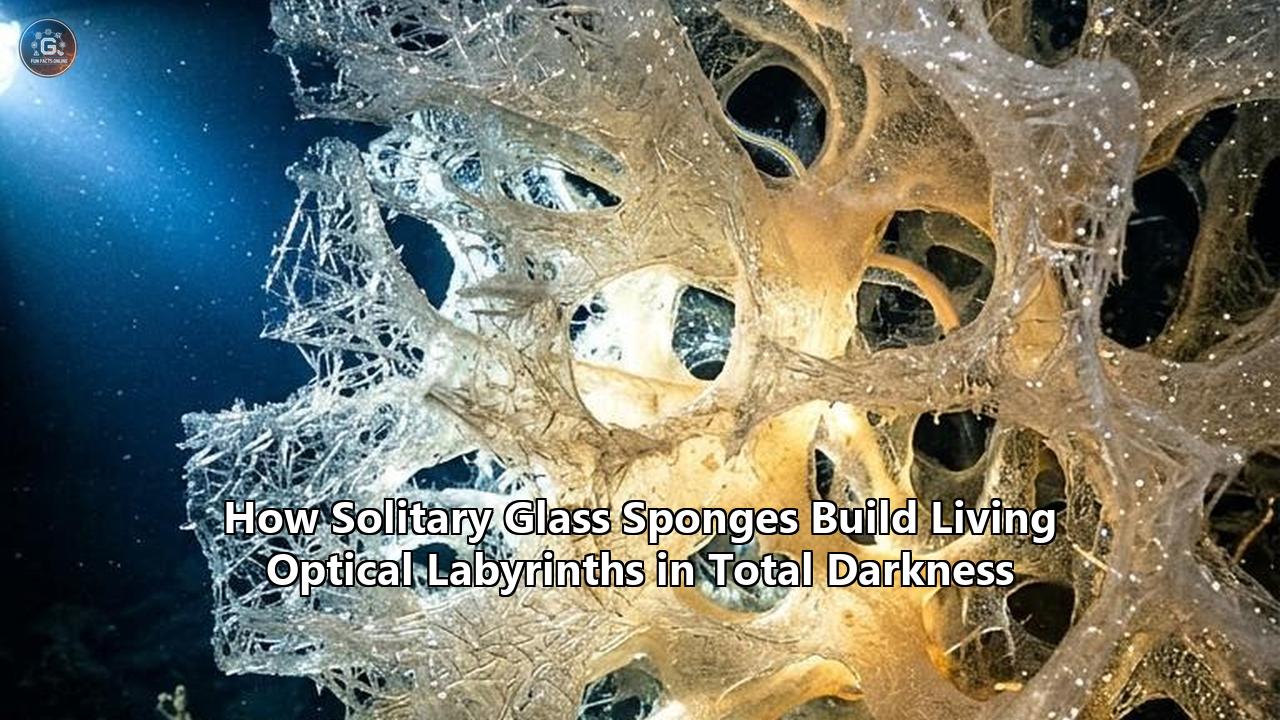
Deep beneath the photic zone, where ambient sunlight completely terminates and hydrostatic pressures exceed hundreds of atmospheres, an unexpected structural marvel flourishes across the abyssal seafloor. Recent high-resolution biophotonic analyses, nanoscale modulus mapping, and petascale hydrodynamic simulations have unraveled the mechanisms through which solitary hexactinellid organisms construct and operate intricate, living optical labyrinths. Operating in complete darkness, these marine invertebrates synthesize elaborate skeletal architectures out of amorphous hydrated silica, transforming raw dissolved minerals from near-freezing seawater into structural frameworks that simultaneously behave as advanced fiber-optic networks, fluid-dynamic vortex generators, and load-bearing micro-architectures.
                 =================================================
                 HEXACTINELLID BIOSILICA WAVEGUIDE ARCHITECTURE
                 =================================================

   Incoming Deep-Sea      +-------------------------------------------+
   Bioluminescence / ---> | Outer Annular & Tuberculate Siliceous Rim |
   Ambient Light          +-------------------------------------------+
                                                │
                                                ▼
                          +-------------------------------------------+
                          | Alternating Concentric Nanoscale Shells   |
                          | (Organic Interlayers: Modulus ~0.7 GPa)   |
                          +-------------------------------------------+
                                                │
                                                ▼
                          +-------------------------------------------+
                          | Low-Refractive-Index Cladding Layer       |
                          | (Silicatein-Templated Amorphous SiO2)     |
                          +-------------------------------------------+
                                                │
                                                ▼
                          +===========================================+
                          | High-Refractive-Index Axial Glass Core    |
                          | (Pure Vitreous Silica, n ≈ 1.46)          |
                          | Total Internal Reflection & Light Routing |
                          +===========================================+
                                                │
                                                ▼
                          +-------------------------------------------+
                          | Recirculating Atrium & Benthic Cavity     |
                          | (Symbiont Microhabitats & Sensory Routing)|
                          +-------------------------------------------+
The discovery that solitary glass sponges like Euplectella aspergillum (commonly known as the Venus' flower basket) and giant anchor-spicule bearers like Monorhaphis chuni and Hyalonema sieboldi assemble fiber-optic systems superior in fracture resistance to human-manufactured telecommunication cables has set off ripples across materials science, marine ecology, and structural engineering. By resolving the long-standing mystery of how biological systems achieve low-temperature synthesis of optical waveguides while manipulating benthic fluid dynamics, researchers have presented a biological blueprint that challenges conventional manufacturing paradigms.
The Cold Synthesis of Biosilica Labyrinths
Industrial fiber optics demand extreme thermal environments. Modern manufacturing relies on vapor deposition and draw towers operating at temperatures exceeding 1,500°C to produce silica glass cores and cladding layers. This high-temperature regime ensures optical clarity, but it leaves synthetic fibers inherently brittle, vulnerable to micro-crack propagation, and incapable of incorporating organic dopants that could enhance mechanical toughness or alter internal light path dynamics.
┌──────────────────────────────────┬──────────────────────────────────┐
│  SYNTHETIC FIBER OPTIC CABLES    │   HEXACTINELLID BIOSILICA FIBERS │
├──────────────────────────────────┼──────────────────────────────────┤
│ • High-temp thermal draw         │ • Ambient-temp biomineralization │
│   (>1,500°C)                     │   (2°C–4°C)                      │
│ • Homogeneous vitreous silica    │ • Hierarchical concentric layers │
│ • Prone to micro-fracture        │ • Compliant organic interlayers  │
│   and brittle failure            │   arresting crack propagation    │
│ • Uniform refractive profile     │ • Paraxial index gradient with   │
│ • Energy-intensive production    │   Bragg reflection capabilities  │
│                                  │ • Zero thermal residual stress   │
└──────────────────────────────────┴──────────────────────────────────┘
Solitary hexactinellids bypass these thermal demands entirely. Living in abyssal temperatures between 2°C and 4°C, they precipitate amorphous, hydrated silica ($\text{SiO}_2 \cdot n\text{H}_2\text{O}$) directly from silicic acid present in seawater at concentrations of only a few parts per million.
The primary architect of this process is an axial protein filament dominated by silicatein, a specialized catalytic enzyme embedded within the core of every structural spicule. Silicatein accelerates the polycondensation of silicon alkoxides and silicic acid, organizing the mineral phase into uniform nanospheres around an organic scaffold.
The structural outcome is a multi-scale composite. In Euplectella aspergillum and Monorhaphis chuni, individual spicules are built as concentric cylinders.
A central core of pure silica (roughly 2 micrometers in diameter) surrounds the proteinaceous axial thread. Encasing this core are dozens of coaxial cylindrical lamellae, each separated by an ultra-thin organic interlayer measuring between 5 and 35 nanometers in thickness.
Nanomechanical testing using atomic force microscopy and reverse finite element analysis reveals that while the inorganic biosilica layers possess an elastic modulus of approximately 37 GPa, the compliant proteinaceous interlayers register a modulus of only 0.7 GPa.
This alternating stiff-and-compliant architecture acts as a mechanical shock absorber. When an external shear force or impact initiates a fracture in an outer silica sleeve, the crack does not propagate straight through the glass rod. Instead, the organic boundary layer deflects the crack tip, dissipating strain energy along the cylinder's circumference and arresting structural failure.
Crack Initiation ───► [ Glass Layer (E ≈ 37 GPa) ]
                             │
                             ▼ (Crack hits organic boundary)
                      [ Organic Interlayer (E ≈ 0.7 GPa) ] ──► Crack Deflected & Arrested
                             │
                      [ Protected Inner Glass Core ] ───────► Optical Continuity Maintained
Waveguides in the Deep: The Physics of Living Glass
The optical properties emerging from this hierarchical layering are functionally sophisticated. Interferometric refractive-index profiling shows that hexactinellid spicules possess a sharply defined paraxial refractive gradient. The core maintains a high refractive index ($n \approx 1.46$) comparable to high-purity synthetic silica, while the surrounding concentric cylinders exhibit systematically lower refractive indices due to the higher concentration of integrated organic matrices and specific ionic dopants, such as sodium.
This spatial modulation of permittivity mimics synthetic step-index and graded-index multimode optical fibers. Light introduced into the spicule undergoes total internal reflection along the core, while the layered cladding acts as a one-dimensional photonic crystal capable of inducing Bragg reflections across visible, near-infrared, and ultraviolet spectra.
Experimental propagation of ultra-short laser pulses ($T_0 < 40\text{ fs}$) through spicules of Hyalonema sieboldi and Pheronema species has demonstrated that waveguide dispersion within the multilayered cladding effectively counteracts material dispersion, significantly suppressing chromatic dispersion over extended distances.
        Light Input (Bioluminescent Pulse)
                       │
                       ▼
    =======================================  <--- Low n Cladding
    ~~~~~~~~~~~~~~~~~~~~~~~~~~~~~~~~~~~~~~~  <--- High n Pure Core (n ≈ 1.46)
    =======================================  <--- Low n Cladding
                       │
                       ▼
         Total Internal Reflection Path
Additionally, terminal anchor spicules often terminate in bulbous, lens-like structures or anchor crowns equipped with outward-curving barbs. These morphological variations act as microlenses, broadening the numerical aperture of the fiber and allowing it to harvest divergent light from broad angles across the benthic boundary layer.
The spicules are not simple passive rods; they operate as an interconnected optical matrix. Stauractine (cross-shaped) and hexactine (six-pointed) spicules fuse at structural intersections through secondary silica deposition, creating an optical network throughout the animal's cylindrical body cage.
The Ecological Paradox: Why Channel Photons in the Midnight Zone?
The presence of high-performance optical waveguides in an ecosystem completely removed from solar irradiation presents an evolutionary puzzle.
At depths of 500 to 5,000 meters, the only existing illumination originates from bioluminescent organisms: dinoflagellates, copepods, cnidarians, and benthic bacterial colonies. Biologists and biophysicists have formulated three primary hypotheses to explain the selective advantages of this living optical labyrinth:
1. The Bioluminescent Collection and Distribution Model
The sponge's outer spicule framework captures fleeting bioluminescent flashes produced in the surrounding water column. The light is funneled through the spicule network directly into the central body cavity (the atrium).
This faint, diffused illumination creates a localized glow that attracts phototactic micro-crustaceans and larvae toward the sponge's filtration surfaces, ensuring a steady stream of metabolic fuel.
Abyssal Deep (Total Darkness)
   │
   ├─► Flash of Bioluminescent Microplankton
   │      │
   │      ▼
   │   [ Sponge Anchor Spicule / Microlens ]
   │      │ (Light trapped via Total Internal Reflection)
   │      ▼
   │   [ Internal Skeletal Waveguide Lattice ]
   │      │
   │      ▼
   └─► [ Internal Atrium Illuminated with Soft Glow ]
          │
          ▼
       Attracts Pelagic Micro-organisms & Hosts Endosymbiotic Shrimp
2. Endosymbiotic Signaling and Habitat Conditioning
Many solitary hexactinellids host specialized endosymbionts. Euplectella aspergillum, for instance, famously encloses a breeding pair of spongicolid shrimp (such as Spongicola venustus) within its internal cavity. The shrimp enter as microscopic juveniles, feed on trapped planktonic matter, and grow too large to escape through the mesh-like sieve plate that caps the cylinder, spending their adult lives within the sponge.
Internal light transmission through the biosilica cage provides visual orientation for the crustacean inhabitants, facilitating symbiotic cleaning behavior and reproductive cycles.
3. Non-Neural Cellular Coordination
Sponges lack a central nervous system, neurons, and conventional synapses. Yet, they exhibit whole-body coordinated responses, such as arrest of water filtration when exposed to noxious sediment plumes.
Recent photobiological investigations suggest that silica spicules may channel biophotonic pulses to trigger light-sensitive cryptochrome and flavin proteins distributed throughout the sponge's syncytial tissue (the continuous, multinucleated cytoplasm that characterizes hexactinellid bodies). In this framework, the optical labyrinth functions as a primitive optical nervous system, transmitting signals across the organism faster than chemical diffusion would permit.
Fluid Mechanics Meets Photonic Architecture
The biological success of glass sponges rests on the convergence of optical physics and fluid mechanics. A structural frame that optimizes light capture must also survive the physical stresses exerted by abyssal currents and manage fluid transport for respiration and suspension feeding.
                 =================================================
                 COUPLED HYDRODYNAMIC & OPTICAL INTEGRATION
                 =================================================

                     Benthic Ocean Current (High Shear Stress)
                                     │   │   │
                                     ▼   ▼   ▼
                     ┌──────────────────────────────────┐
                     │ External Helical Ridges & Lattice│
                     │ • Disrupts Von Kármán Vortices   │
                     │ • Reduces Downstream Drag Stress │
                     └──────────────────────────────────┘
                                     │
                     ┌───────────────┴──────────────────┐
                     │                                  │
                     ▼                                  ▼
      +-----------------------------+    +-----------------------------+
      |  HYDRODYNAMIC CONVERGENCE   |    |    OPTICAL WAVEGUIDING      |
      | • Creates Low-Velocity      |    | • Directs Bioluminescent    |
      |   Internal Recirculation    |    |   Photons via Biosilica     |
      | • Enhances Nutrient Dwell   |    | • Concentrates Light at the |
      |   Time for Filtration       |    |   Internal Atrium Core      |
      +-----------------------------+    +-----------------------------+
                     │                                  │
                     └───────────────┬──────────────────┘
                                     │
                                     ▼
                     [ Maximum Metabolic Efficiency &
                       Structural Mechanical Resilience ]
Supercomputing simulations using Lattice Boltzmann methods—resolving fluid-structure interactions across billions of grid points—have demonstrated that the cylindrical lattice of Euplectella aspergillum fundamentally alters benthic fluid flow.
The alternating checkerboard pattern of square openings, reinforced by diagonal braces and external helical ridges, creates a hydrodynamic shielding effect.
Current Flow ──► [ Outer Rigid Lattice + Helical Ribs ]
                        │
                        ├─► Suppresses shedding turbulence (Minimizes Drag)
                        │
                        └─► Generates slow internal recirculation vortex
                                │
                                ▼
Spongocoel Cavity: Slower Flow = Extended Feeding Time- Vortex Suppression: As ambient ocean currents strike the sponge's exterior, the porous lattice and helical ridges disrupt the shed vortex streets that would otherwise induce severe lateral vibrations and structural fatigue.
- Internal Recirculation: Water entering the body cavity (the spongocoel) through the lateral pores is organized into a slow, symmetrical internal vortex. This recirculation reduces internal shear stress, preventing damage to the delicate flagellated chambers while extending the residence time of suspended organic particles, thereby maximizing nutrient absorption.
- Mechanical Load Redistribution: The square grid combined with diagonal braces forms an optimal structural geometry that maximizes buckling resistance under compressive loads while utilizing minimal mineral mass.
The dual-purpose nature of the spicule grid allows it to act as both a low-loss optical fiber array and a structurally sound fluid damper.
Impact Analysis: Who Is Affected and What Changes
The scientific unraveling of hexactinellid biosilica systems triggers immediate consequences across several disciplines, challenging established engineering methodologies and forcing revisions in deep-sea conservation frameworks.
                     AREAS IMPACTED BY GLASS SPONGE DISCOVERIES
                                         │
        ┌────────────────────────────────┼────────────────────────────────┐
        │                                │                                │
        ▼                                ▼                                ▼
+───────────────────+          +───────────────────+          +───────────────────+
|    MATERIALS &    |          |  CIVIL & MARINE   |          |  OCEAN DYNAMICS & |
|  PHOTONICS SECTOR |          |    ENGINEERING    |          |    CONSERVATION   |
+───────────────────+          +───────────────────+          +───────────────────+
| • Low-temp fiber  |          | • Buckling-proof  |          | • Vulnerable      |
|   synthesis       |          |   lattice designs |            Marine Ecosystem  |
| • Bio-compatible  |          | • Hydrodynamic    |            designations      |
|   micro-optics    |            drag mitigation   |          | • Mining buffer   |
| • Fracture-proof  |          | • Vortex-damping  |            zone policies     |
|   waveguides      |            architecture      |          | • Silica cycle    |
+───────────────────+          +───────────────────+            reassessments     |
                                                              +───────────────────+
1. Photonics and Optical Telecommunications
Modern optical fiber production is energy-intensive and produces brittle waveguides that require heavy polymer jacketing to endure physical bending.
The ability of hexactinellid sponges to produce optical-grade glass at low ambient temperatures using proteinaceous catalysts points toward a clean, low-energy bio-manufacturing route for optical fibers.
Furthermore, because these biological fibers incorporate organic interlayers, they can bend at tight radii without catastrophic failure, opening new avenues for flexible endoscopy, in-vivo biomedical sensing, and bio-integrated optoelectronics.
2. Structural and Civil Engineering
The diagonal-braced square lattice of Euplectella has demonstrated superior resistance to elastic buckling compared to traditional engineering lattice designs.
Architects and aerospace engineers are applying these principles to create lightweight structural columns, deep-sea exploration hulls, and wind-resistant high-rise towers.
Mimicking the sponge's helical ridges allows civil engineers to design underwater oil and gas conduits, offshore wind-turbine pilings, and bridge supports that naturally suppress current-induced vortex vibrations, reducing mechanical wear and structural failure.
Conventional Cylinder in Flow          Hexactinellid-Inspired Cylinder
─────────────────────────────          ───────────────────────────────
Flow ──► ( ( ( O ) ) )                 Flow ──► ≡≡≡ [ (O) ] ≡≡≡
Violent alternating vortex shedding    Smooth streamlines, suppressed drag,
High mechanical fatigue                Internal flow recirculation
3. Benthic Ecology and Ocean Policy
The structural vulnerability of these slow-growing organisms has reshaped marine conservation priorities. Hexactinellids can live for hundreds to thousands of years, building ancient deep-sea reefs and individual glass spicule stalks up to 3 meters in length.
Because their optical and filtration systems rely on clear, unpolluted water, deep-sea resource extraction poses a significant threat to their survival.
Sediment plumes generated by planned seabed polymetallic nodule mining and deep bottom-trawling operations risk clogging the porous lattices, extinguishing light transmission, and suffocating the syncytial tissue.
Systematic Evaluation: Short-Term and Long-Term Consequences
┌───────────────────────────────┬───────────────────────────────┐
│ SHORT-TERM CONSEQUENCES       │ LONG-TERM CONSEQUENCES        │
├───────────────────────────────┼───────────────────────────────┤
│ • Enzymatic biosilica trials  │ • Transition to green,        │
│   in laboratory conditions    │   low-temperature photonics   │
│ • Hydrodynamic retrofitting   │ • Bio-compatible, flexible    │
│   for marine pilings          │   neural/medical implants     │
│ • Redefinition of deep-sea    │ • Structural lattices for     │
│   Vulnerable Marine Ecosystem │   aerospace/deep-ocean hulls  │
│   (VME) protection boundaries │ • Binding international laws  │
│ • Deployment of sensitive     │   regulating benthic mining   │
│   in-situ optical cameras     │   and preserving glass reefs  │
└───────────────────────────────┴───────────────────────────────┘
Short-Term Consequences (1–3 Years)
- Bench-scale enzymatic glass manufacturing: Materials laboratories are synthesizing recombinant silicatein enzymes to produce microscale biosilica coatings and optical films at room temperature, eliminating the energy footprint of high-heat glass processing.
- Immediate structural retrofits: Marine architecture firms are adopting hexactinellid lattice geometry to build stronger offshore infrastructure capable of withstanding turbulent tidal currents without requiring solid, heavy breakwaters.
- Marine Protected Area expansions: Oceanographic mapping expeditions are using the presence of solitary and colonial glass sponges as an indicator to declare newly surveyed abyssal zones as Vulnerable Marine Ecosystems (VMEs), triggering immediate fishing and trawling restrictions.
Long-Term Consequences (5–15 Years)
- Transformation of telecommunications and medical diagnostics: Industrial adoption of laminated organic-inorganic glass manufacturing will enable ultra-durable, crack-resistant fiber networks and flexible, bio-resorbable optical conduits that can be safely routed through human blood vessels and brain tissues for optogenetic therapy.
- Next-generation biomimetic aerospace architecture: Spacecraft fuselages and deep-sea exploration vessels built using sponge-inspired hierarchical lattices will achieve higher strength-to-weight ratios, offering superior damage tolerance and resistance to external hydrostatic or aerodynamic pressures.
- International seabed environmental legislation: Verified data documenting the delicate photonic and hydrodynamic interdependence of abyssal benthic systems will alter international negotiations within the International Seabed Authority (ISA). Mining contractors will face stricter requirements to maintain wide buffer zones around hexactinellid aggregations, establishing enforceable global preservation standards.
Technical Comparison of Solitary Hexactinellid Spicule Systems
Hexactinellid species display distinct spicular adaptations that fulfill their structural and optical functions:
| Species | Primary Spicule Type | Geometric Dimensions | Core Refractive Index ($n$) | Primary Biomechanical / Optical Function |
|---|---|---|---|---|
| ---Euplectella aspergillum--- | Anchoring basalia & fused lattice stauractines | Length: 5–15 cm Diameter: 40–70 $\mu\text{m}$ | $1.458 - 1.462$ | Step-index multi-mode waveguiding; high-buckling structural cage with fluid vortex optimization. |
| ---Monorhaphis chuni--- | Giant monolithic basal spicule | Length: up to 300 cm Diameter: 5–10 mm | $1.455 - 1.460$ | Benthic floor anchoring; laminated crack deflection; high-capacity low-dispersion optical conduit. |
| ---Hyalonema sieboldi--- | Twisted basal spicule bundle | Length: 10–30 cm Diameter: 50–120 $\mu\text{m}$ | $1.456 - 1.461$ | Bragg-grating reflection; chromatic dispersion suppression; flexible stalk anchorage in soft sediment. |
| ---Sericolophus hawaiicus--- | Elongated root tuft spicules | Length: 10–20 cm Diameter: 30–60 $\mu\text{m}$ | $1.457 - 1.463$ | Supercontinuum light generation; distributed bioluminescent collection; shear-stress mitigation. |
What to Watch Next
As deep-sea exploration and high-precision biophotonics progress, several crucial milestones will determine how effectively biological glass systems are translated into practical technologies:
                                  MILESTONE ROADMAP
                                          │
       ┌──────────────────────────────────┼──────────────────────────────────┐
       │                                  │                                  │
       ▼                                  ▼                                  ▼
[ Phase 1: In-Situ Capture ]   [ Phase 2: Bio-Catalytic ]   [ Phase 3: Abyssal Protections ]
• Sub-millimeter ROV cameras     Scaling                  • Formal ISA mining moratoriums
  detecting living optical     • Commercializing low-temp   surrounding glass sponge
pulses at abyssal depths. enzymatic glass draws. benthic fields.- Direct in-situ optical detection: Deep-sea ROV expeditions equipped with ultra-low-noise electron-multiplying charge-coupled device (EMCCD) sensors aim to capture real-time light transmission through living glass sponges directly on the ocean floor. Confirming active photon routing in an undisturbed abyssal setting will resolve whether light signaling is an active biological function or a structural byproduct of mineral formation.
- Laboratory synthesis of commercial-length biosilica fibers: Research groups are scaling up recombinant silicatein bioreactors to produce continuous, flexible silica fibers at ambient temperatures. Successfully matching the transmission losses of industrial fiber ($<0.2\text{ dB/km}$) while retaining biological fracture toughness will mark a significant shift in optical cable manufacturing.
- Resolving the hexactinellid signal transduction pathway: Molecular biologists are working to sequence the photoprotein and cryptochrome receptors within sponge syncytia. Identifying how non-neural organisms process optical data could alter our understanding of early sensory evolution in multicellular life.
- Seabed policy decisions: The International Seabed Authority's forthcoming regulatory framework for commercial seabed harvesting will serve as a test for deep-sea conservation. The enforcement of binding ecological buffer zones around vulnerable hexactinellid grounds will dictate the preservation of these complex, living optical labyrinths for centuries to come.
Reference:
- https://pubmed.ncbi.nlm.nih.gov/19198784/
- https://impact.ornl.gov/en/publications/lessons-for-new-classes-of-inorganicorganic-composites-from-the-s/
- https://cordis.europa.eu/article/id/430564-is-a-deep-sea-sponge-inspiring-the-design-of-future-mechanical-structures
- https://aizenberglab.seas.harvard.edu/sites/g/files/omnuum6296/files/2003_Nature_0.pdf
- https://cordis.europa.eu/article/id/430564-is-a-deep-sea-sponge-inspiring-the-design-of-future-mechanical-structures
- https://www.pnas.org/doi/10.1073/pnas.1415502112
- https://www.photonics.com/Articles/Optical-Fibers-Found-in-Deep-Sea-Sponges/a16846
- https://pubs.rsc.org/en/content/articlepdf/2013/ra/c3ra40574e
- https://ir.arcnl.nl/pub/567/00409publishedVersion.pdf
- https://oneworldoneocean.com/blog/stem-sea-sponge-fiber-optics/
- https://pmc.ncbi.nlm.nih.gov/articles/PMC373466/
- https://www.frontiersin.org/journals/marine-science/articles/10.3389/fmars.2018.00123/full
- https://www.mpikg.mpg.de/5407160/125_201401
- https://creation.com/en/articles/fantastic-fibre-optics-sponges-super-spicules
- https://www.researchgate.net/publication/231110979_Optical_fibres_based_on_natural_biological_minerals_-_Sea_sponge_spicules
- https://www.digitalatlasofancientlife.org/learn/porifera/hexactinellida/
- https://laughingsquid.com/how-sponges-use-light-to-think/
- https://schmidtocean.org/cruise-log-post/glass-sponges-the-living-ornaments-of-the-deep-sea/
- https://australian.museum/learn/animals/sea-stars/sponges/invertebrates-collection-deepsea-glass-sponge/
- https://crev.info/2021/08/glass-sponges-lessons-from-the-deep/
- https://scitechdaily.com/remarkable-structures-of-deep-sea-venus-flower-sponges-useful-for-design-of-ships-planes-and-skyscrapers/
- https://pubmed.ncbi.nlm.nih.gov/34290424/
- https://wyss.harvard.edu/news/glass-sponges-hold-internal-secrets-to-structural-strength/
- https://pmc.ncbi.nlm.nih.gov/articles/PMC8190087/
- https://www.labmanager.com/glass-sponges-have-properties-for-the-design-of-ships-planes-and-skyscrapers-26354
- https://reefbites.com/2024/09/13/secrets-of-the-sponges/
- https://pubmed.ncbi.nlm.nih.gov/34749755/
- https://pubs.acs.org/doi/10.1021/acsaom.5c00572