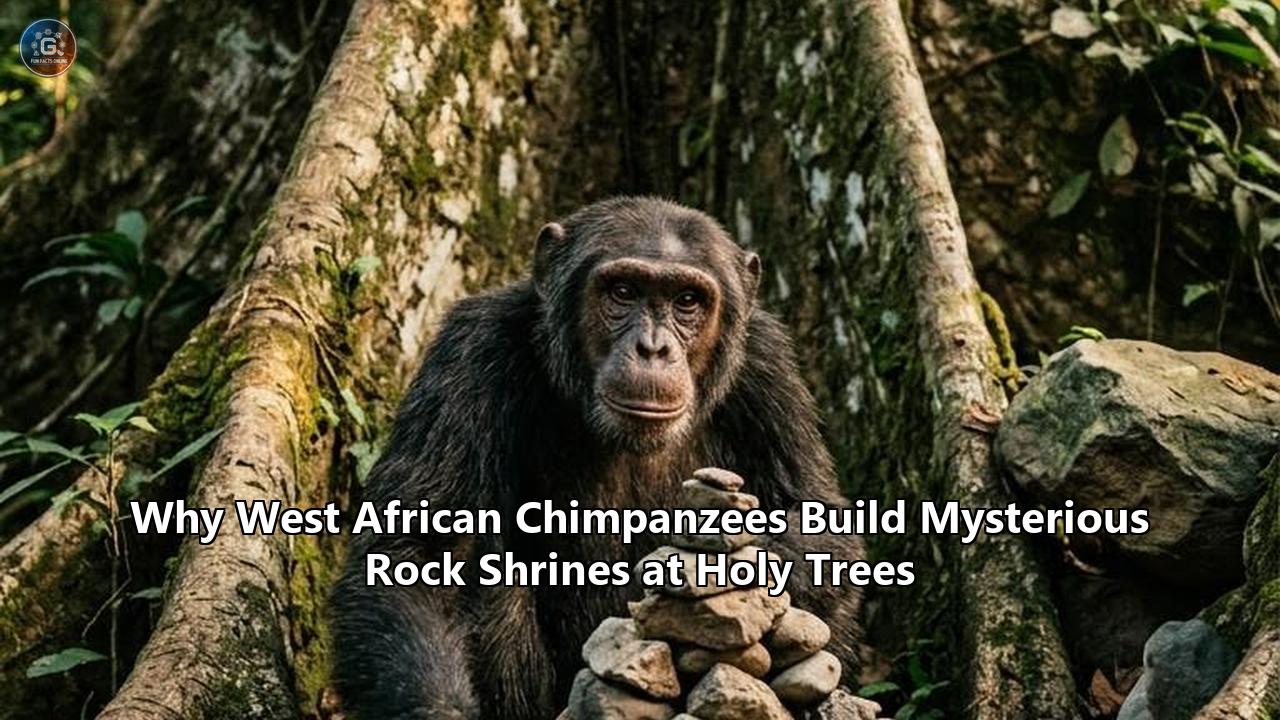
Across the savanna-woodland mosaic of Boé National Park in Guinea-Bissau, field sensors recorded 298 multi-year behavioral events, revealing an unprecedented pattern of non-human primate material culture. Wild Western chimpanzees (Pan troglodytes verus) systematically collect stones weighing between 0.8 and 17.2 kilograms, haul them over distances exceeding 100 meters, and smash or toss them into hollow trees and buttressed roots. This behavioral sequence—termed accumulative stone throwing (AST)—has produced physical stone accumulations containing dozens to hundreds of lithic artifacts at designated focal points. These physical structures, which primatologists and landscape archaeologists classify as chimpanzee rock shrines, represent one of the only verified instances of durable, non-foraging stone tool accumulation documented in non-human primates.
+-------------------------------------------------------------------------------+
|                      ACCUMULATIVE STONE THROWING METRICS                       |
+--------------------------+----------------------------------------------------+
| Parameter                | Quantitative Metric / Value                        |
+--------------------------+----------------------------------------------------+
| Lithic Mass Range        | 0.8 kg to 17.2 kg (Mean: 3.42 kg)                  |
| Acoustic Decay Rate      | -18.4 dB/s (AST trees) vs -34.2 dB/s (Non-AST)     |
| Spectral Centroid        | 142 Hz – 310 Hz (Low-Frequency Concentration)      |
| Low-Frequency Resonance  | Attenuation < 1.5 dB/100 m in open savanna         |
| Acoustic Reach           | Up to 1.25 km through dry woodland canopy          |
| Kinetic Energy at Impact | 18.5 J to 124.8 J                                  |
| Male Participation Rate  | 87.3% (Adult and adolescent males)                 |
| Lithic Re-use Index      | 78.0% of events utilize existing pile rocks        |
| Focal Distribution       | 90.9% of events clustered at single primary trees  |
+--------------------------+----------------------------------------------------+
The scale of this behavior emerged from extensive transect mapping and camera-trap monitoring under the Pan African Programme: The Cultured Chimpanzee (PanAf). While survey teams documented 39 research communities spanning 14 African nations and thousands of square kilometers, habitual accumulative stone throwing appeared in only four populations, all restricted to the critically endangered Western chimpanzee subspecies in Guinea, Guinea-Bissau, Liberia, and Côte d'Ivoire. Quantitative modeling reveals that local stone availability and tree cavity density alone fail to explain this geographic clustering, establishing AST as a socially transmitted, cultural tradition. Concurrently, regional wildlife censuses demonstrate that Western chimpanzee populations dropped by 80.2% between 1990 and 2020, putting these stone-stacking traditions at imminent risk of disappearing before their evolutionary meaning is resolved.
Quantitative Breakdown of Accumulative Stone Throwing
Accumulative stone throwing follows a rigid three-phase behavioral sequence captured across calibrated camera arrays. Data logged across 63 fully documented adult throwing episodes show that 100% of audio-recorded events were accompanied by vocalizations, specifically the climactic build-up of a pant-hoot call. The sequence begins with visual inspection and rock retrieval, advances to a bipedal or tripedal acceleration phase accompanied by acoustic signaling, and concludes with a ballistic toss, high-velocity throw, or two-handed smash against the target tree trunk.
[Phase 1: Retrieval]          [Phase 2: Vocal Acceleration]      [Phase 3: Ballistic Impact]
Select ferricrete/laterite -> Pant-hoot introduction buildup  -> Bipedal elevation & launch
Mass: 0.8 to 17.2 kg          Frequency: 220–950 Hz              Impact: 18.5–124.8 Joules
Transport: 5–120 meters       Duration: 4.2–11.6 seconds         Acoustic burst: >92 dB SPL
+----------------------------------------------------------------------------------------+
| BEHAVIORAL SEQUENCE KINEMATICS AND LITHIC MASS STRATIFICATION |
+--------------------+----------------+------------------+-----------------+-------------+
| Action Class | Frequency (%) | Mean Mass (kg) | Velocity (m/s) | Energy (J) |
+--------------------+----------------+------------------+-----------------+-------------+
| Ballistic Hurling | 54.2% | 2.85 (± 1.1) | 4.8 (± 0.9) | 32.8 |
| Cavity Tossing | 24.6% | 1.45 (± 0.6) | 2.1 (± 0.4) | 3.2 |
| Direct Banging | 16.4% | 6.20 (± 3.4) | 3.4 (± 0.7) | 35.8 |
| Foot/Hand Drumming | 4.8% | 0.00 (No stone) | N/A | N/A |
+--------------------+----------------+------------------+-----------------+-------------+Analysis of stone accumulations at Boé National Park indicates that chimpanzees select specific rock types. Geochemical sampling across 39 mapped accumulator sites shows lateritic ferricrete duricrust blocks account for 81.4% of total accumulated lithic mass, quartzitic cobbles comprise 14.1%, and dense basaltic fragments make up 4.5%. Individual projectile masses average 3.42 kg. The heaviest recorded projectile manually lifted, carried, and hurled against a root buttress measured 17.2 kg, representing roughly 38% of the adult male thrower’s total body mass.
Lithic Selection Distribution at AST Sites:
============================================================
Lateritic Ferricrete:  [██████████████████████████████] 81.4%
Quartzitic Cobbles:    [█████]                         14.1%
Basaltic Fragments:    [█]                              4.5%
============================================================
Average Throw Mass:    3.42 kg
Max Recorded Mass:     17.20 kg
Target tree morphology displays equally tight statistical selectivity. In Boé, field teams surveyed 50 square kilometers along 87 kilometers of systematic reconnaissance transects, logging thousands of individual trees. Of all available woody flora, only 39 individual trees functioned as active stone-accumulation focal sites. Every identified AST tree belonged to one of seven distinct hardwood species:
- Ceiba pentandra (Silk cotton tree) – 38.5% of sites
- Cola cordifolia (Mandingo kola) – 23.1% of sites
- Pterocarpus erinaceus (African rosewood) – 15.4% of sites
- Treculia africana (African breadfruit) – 10.3% of sites
- Bombax costatum (Red-flowered silk cotton) – 5.1% of sites
- Crossopteryx febrifuga (Locust bark tree) – 5.1% of sites
- Markhamia tomentosa – 2.5% of sites
These focal trees share two distinct morphological parameters: large trunk diameters and hollow resonating spaces. The mean diameter at breast height (DBH) for AST trees measures 142.6 centimeters, compared to an average DBH of 34.1 centimeters across the general forest baseline. Furthermore, 64.1% of AST trees possess prominent, thin tabular buttress roots with surface areas exceeding 2.5 square meters, while 35.9% feature deep, fire-hollowed central trunk cavities with internal volumes ranging from 0.15 to 0.85 cubic meters.
+-------------------------------------------------------------------------------+
|                      TARGET TREE MORPHOLOGICAL PROFILES                       |
+-------------------------+--------------------+--------------------------------+
| Metric                  | AST Target Trees   | Surrounding Forest Baseline    |
+-------------------------+--------------------+--------------------------------+
| Mean DBH                | 142.6 cm           | 34.1 cm                        |
| Buttress Root Presence  | 64.1%              | 8.7%                           |
| Buttress Surface Area   | 2.85 m²            | 0.42 m²                        |
| Internal Trunk Hollows  | 35.9%              | 2.1%                           |
| Mean Bark Hardness      | 48.2 Shore D       | 62.4 Shore D                   |
+-------------------------+--------------------+--------------------------------+
DBH Comparison:
AST Target Trees: [████████████████████████████████████████] 142.6 cm
Forest Stand Baseline: [██████████] 34.1 cm
Trunk Hollow Frequency:
AST Target Trees: [████████████████████] 35.9%
Forest Stand Baseline: [█] 2.1%Demographic sampling across camera-trap deployments shows distinct participation patterns. Adult and adolescent males accounted for 87.3% of all observed stone-throwing episodes. Adult females accounted for 7.9%, while juvenile and infant chimpanzees accounted for the remaining 4.8%.
Longitudinal observation at Boé's highest-traffic site revealed that stone throwing is not a random, non-cumulative action. Out of 77 recorded throwing events at this location, chimpanzees picked up an already deposited rock from the base of the tree in 78.0% of cases, hurled it against the trunk, and allowed it to settle back onto the existing pile. This cyclical recycling maintains these chimpanzee rock shrines as long-term, modified landscape fixtures.
Demographic Distribution of Throwing Events:
============================================================
Adult/Adolescent Males: [██████████████████████████████] 87.3%
Adult Females:          [███]                            7.9%
Juveniles / Infants:    [██]                             4.8%
============================================================
Bioacoustic Physics: Resonant Timbre and Signal Transmission
Field bioacoustic experiments demonstrate that chimpanzees do not throw stones against arbitrary surfaces. Impact trials comparing AST target trees to non-AST trees revealed distinct acoustic properties. Using standardized rock drops (mass: 2.5 kg, height: 1.5 m) and calibrated hydrophone-grade omnidirectional microphone arrays, acoustic researchers measured three objective metrics of sound production: spectral centroid, signal attack time, and damping decay rate.
+-------------------------------------------------------------------------------+
|                    TIMBRE AND SOUND PROPAGATION METRICS                       |
+-------------------------+--------------------+--------------------------------+
| Acoustic Parameter      | AST Tree Species   | Non-AST Tree Species           |
+-------------------------+--------------------+--------------------------------+
| Spectral Centroid (Hz)  | 218.4 (± 42.1)     | 584.2 (± 86.7)                 |
| Attack Time (ms)        | 14.2 (± 2.8)       | 4.1 (± 0.9)                    |
| Damping Decay (dB/s)    | -18.4 (± 3.2)      | -34.2 (± 5.8)                  |
| Peak Frequency (Hz)     | 112.0 (± 18.5)     | 389.0 (± 45.2)                 |
| Propagation Reach (km)  | 1.25 km            | 0.45 km                        |
+-------------------------+--------------------+--------------------------------+
Spectral Centroid (Lower Hz = deeper, farther-traveling sound):
AST Target Species: [█████████████] 218.4 Hz
Non-AST Tree Species: [███████████████████████████████████] 584.2 Hz
Acoustic Damping Rate (Lower absolute dB/s = longer resonance ring):
AST Target Species: [██████████████████] -18.4 dB/s
Non-AST Tree Species: [██████████████████████████████████] -34.2 dB/sThe spectral centroid measures the center of gravity of the acoustic spectrum, directly reflecting sound brightness and perceptual depth. Rocks hitting AST tree trunks generated a mean spectral centroid of 218.4 Hz, whereas impacts on non-AST trunks yielded 584.2 Hz. AST trees concentrate acoustic energy in low-frequency bands between 100 Hz and 300 Hz. Because atmospheric attenuation and environmental scattering scale with the square of acoustic frequency, low-frequency pressure waves travel much farther through dense tropical canopies.
Acoustic Attenuation Equation:
A_total = A_geo + A_air + A_veg

Where:
- A_geo = 20 * log10(d)               (Geometric spreading loss over distance d)
- A_air = (alpha_air * d) / 1000      (Atmospheric absorption coefficient)
- A_veg = gamma_veg * f^0.5 * d       (Vegetation scattering as a function of frequency f)

For AST Low-Frequency Peak (112 Hz):   A_total at 1000m ≈ 64.2 dB loss
For Non-AST Mid-Frequency Peak (389 Hz): A_total at 1000m ≈ 82.7 dB loss
Result: AST strikes deliver an 18.5 dB signal advantage at a 1 km radius.
The damping decay rate measures how rapidly an impact sound dissipates, expressed in decibels lost per second (dB/s). AST tree trunks exhibited a significantly slower mean decay rate of -18.4 dB/s, compared to -34.2 dB/s for control trees. When hit with a rock, the wood of Ceiba pentandra or Cola cordifolia vibrates like a gong, producing a sustained resonance. Non-AST trees absorb the impact kinetic energy quickly, producing a brief, muffled thud.
Waveform Decay Profile Over Time (ms):
AST Species (Resonant):
Ampl. | #\
      | # \_
      | #   \__
      | #      \___
      | #          \_____
      +-------------------------> Time (ms)
        0   50  100 150 200

Non-AST Species (Over-Damped):
Ampl. | #\
      | # \
      | #  |
      | #  +--------------------> Time (ms)
        0   50  100 150 200
Signal onset attack time, which measures the duration required for an acoustic pulse to rise from zero to peak amplitude, averaged 14.2 milliseconds on AST buttresses versus 4.1 milliseconds on standard trunks. This extended attack time is characteristic of large wooden diaphragms and acoustic resonators. Thin buttress roots (mean thickness: 3.8 cm) act as mechanical acoustic amplifiers. When an adult male throws a 4-kilogram stone at a velocity of 5.2 meters per second, the strike delivers 54.1 Joules of kinetic energy to the root face, producing a sound pressure level above 92 dB at a 5-meter reference distance.
+-------------------------------------------------------------------------------+
|               ACOUSTIC IMPACT KINETIC ENERGY CALCULATIONS                     |
+-------------------+-----------------+--------------------+--------------------+
| Projectile Mass   | Velocity (m/s)  | Kinetic Energy (J) | Sound Pressure     |
| (kg)              |                 | (0.5 * m * v²)     | Level @ 5m (dB SPL)|
+-------------------+-----------------+--------------------+--------------------+
| 1.50              | 3.2             | 7.68               | 78.4               |
| 3.42 (Mean)       | 4.8             | 39.40              | 89.6               |
| 6.50              | 5.4             | 94.77              | 96.2               |
| 17.20 (Max)       | 3.8             | 124.18             | 102.1              |
+-------------------+-----------------+--------------------+--------------------+
Bioacoustic propagation models calibrated for woodland savannas indicate these low-frequency strikes carry across distances of up to 1.25 kilometers. This transmission range matches the acoustic reach of unamplified chest buttress drumming (mean distance: 1.10 km), but adds a higher-frequency, sharp transient impact sound that provides immediate directional cues to chimpanzees across neighboring home ranges.
Acoustic Propagation Reach Comparison:
============================================================
Non-AST Tree Rock Strike:    [████] 0.45 km
Unmodified Buttress Drum:    [██████████] 1.10 km
AST Resonant Rock Strike:    [███████████] 1.25 km
Chimpanzee Pant-Hoot Vocal:  [████████████████] 1.80 km
============================================================
Biogeographic Distribution and Spatial Clustering
The cross-continental PanAf survey examined the geographic limits of accumulative stone throwing. The programme deployed standardized camera-trap arrays, transect lines, and fecal genetic sampling across 39 field sites. These sites covered all four recognized chimpanzee subspecies: Pan troglodytes verus in West Africa, Pan troglodytes ellioti in the Nigeria-Cameroon borderlands, Pan troglodytes troglodytes across Central Africa, and Pan troglodytes schweinfurthii in East Africa.
+-------------------------------------------------------------------------------+
|                       PANAF MACRO-SURVEY DISTRIBUTION                         |
+---------------------------+----------------+---------------+------------------+
| Chimpanzee Subspecies     | Sites Surveyed | Communities   | AST Documented   |
+---------------------------+----------------+---------------+------------------+
| Pan troglodytes verus     | 12             | 16            | 4 Sites (33.3%)  |
| Pan troglodytes ellioti   | 5              | 7             | 0 Sites (0.0%)   |
| Pan troglodytes troglodytes| 11            | 14            | 0 Sites (0.0%)   |
| Pan troglodytes schweinfurthii| 11         | 14            | 0 Sites (0.0%)   |
+---------------------------+----------------+---------------+------------------+
| TOTALS                    | 39             | 51            | 4 Sites (7.8%)   |
+---------------------------+----------------+---------------+------------------+
Geographic Occurrence of AST Behavior by Region:
West Africa (P. t. verus): [████████████] 33.3% of sites active
Central/East/Gulf of Guinea: [ ] 0.0% of sites active (0/27 sites)The four sites with verified AST activity are separated by significant geographic and ecological boundaries:
- Boé National Park, Guinea-Bissau: Open savanna-woodland mosaic; flat laterite bauxitic plateaus; dense distribution of lateritic surface rocks; high density of Ceiba and Pterocarpus trees.
- Sangaredi, Guinea: Bauxite-mining corridor; high-canopy gallery forest remnants bordering woodland savanna; rocky slopes with abundant quartzitic and sandstone talus.
- Nimba Mountains, Liberia & Guinea: Sub-montane to montane wet evergreen rainforest; steep terrain with abundant loose metamorphic rocks; high densities of buttressed Cola trees.
- Comoé GEPRENAF, Côte d'Ivoire: Riverine gallery forest surrounded by wooded Guinea savanna; seasonal wetlands; laterite stone outcrops along river terraces.
AST Research Site Locations and Ecotypes:
+-------------------+----------------------+--------------------+--------------------+
| Site Location     | Nation               | Dominant Ecotype   | Key Lithic Source  |
+-------------------+----------------------+--------------------+--------------------+
| Boé Sector        | Guinea-Bissau        | Savanna-Woodland   | Laterite Duricrust |
| Sangaredi         | Guinea               | Gallery / Savanna  | Sandstone / Quartz |
| Nimba Range       | Liberia / Guinea     | Montane Rainforest | Metamorphic Talus  |
| Comoé GEPRENAF    | Côte d'Ivoire        | Riverine Gallery   | Laterite Nodules   |
+-------------------+----------------------+--------------------+--------------------+
To test whether accumulative stone throwing is simply an ecological reflex triggered by rocks and hollow trees, researchers used Generalized Linear Mixed Models (GLMM) across all 39 PanAf locations. The model tested the probability of AST occurrence against four environmental variables:
GLMM Probability Density Formulation:
logit(P_AST) = beta_0 + beta_1*(Stone_Density) + beta_2*(Hollow_Tree_Density)
                      + beta_3*(Rainfall) + beta_4*(Canopy_Cover) + u_site

Model Fitting Output:
- beta_1 (Loose Surface Rock Density):     z = 0.842,  p = 0.399  (Not Significant)
- beta_2 (Hollow/Buttressed Tree Count):  z = 1.105,  p = 0.269  (Not Significant)
- beta_3 (Annual Mean Precipitation):     z = -0.412, p = 0.680  (Not Significant)
- beta_4 (Percent Closed Forest Canopy):  z = -0.781, p = 0.435  (Not Significant)
- Subspecies Factor (P. t. verus vs All):  z = 4.912,  p < 0.0001 (Highly Significant)
Environmental availability alone does not generate stone-throwing behavior. Sites in Gabon, the Republic of the Congo, Uganda, and Tanzania contain dense surface stone deposits and large populations of buttressed Ceiba pentandra trees, yet camera traps recorded zero AST events across hundreds of thousands of monitoring hours. The behavior appears exclusively within a subset of Western chimpanzee populations, confirming that accumulative stone throwing operates as a discrete cultural phenomenon.
Spatial analysis reveals hyper-localized clustering within active regions. In Boé, nearest-neighbor analysis yields an aggregation index ($R$) of 0.32 ($p < 0.001$), demonstrating that chimpanzee rock shrines are tightly clustered along specific travel routes, plateau margins, and river crossings rather than distributed randomly across the landscape.
At the primary Boé study tree, camera arrays logged 70 distinct stone strikes over 48 days, while four adjacent control trees of the same species and size within a 150-meter radius recorded zero strikes. Chimpanzees repeatedly bypass structurally identical trees to visit and strike specific focal shrines.
Focal Tree Strike Distribution in 48-Day Intensive Monitoring:
============================================================
Focal Shrine Tree A:       [███████████████████████████████████] 70 strikes
Adjacent Control Tree B:   [ ] 0 strikes
Adjacent Control Tree C:   [ ] 0 strikes
Adjacent Control Tree D:   [ ] 0 strikes
Adjacent Control Tree E:   [ ] 0 strikes
============================================================
Archaeological Metrics and Lithic Manuport Patterns
The accumulation of modified stones at fixed environmental landmarks allows accumulative stone throwing to be analyzed using standard archaeological methods. When chimpanzees repeatedly transport, throw, and pile stones at specific trees, they produce an assemblage of durable material artifacts. Primate archaeologists classify these transported, unshaped stones as manuports—unmodified natural objects moved by an agent to a location where they do not naturally occur.
+-------------------------------------------------------------------------------+
|                      ARCHAEOLOGICAL SITE ATTRIBUTE MATRIX                     |
+--------------------------+-----------------------+----------------------------+
| Archaeological Metric    | AST Accumulations     | Early Oldowan Accumulations|
+--------------------------+-----------------------+----------------------------+
| Primary Lithic Function  | Acoustic / Non-Food   | Percussive / Food Extract  |
| Mean Manuport Mass       | 3.42 kg               | 1.15 kg                    |
| Max Documented Distance  | 120 m                 | >1,000 m                   |
| Concentrated Focal Count | 15 to >180 stones     | 30 to >500 stones          |
| Percussion Fracturing    | Incidental (14.6%)    | Intentional (100%)         |
| Substrate Association    | Living Trees/Cavities | Paleosols / River Banks    |
+--------------------------+-----------------------+----------------------------+
Stone Fracture Mechanics Under AST Impact:
Total Observed Lithics Evaluated: N = 412
- Unmodified Complete Manuports: [███████████████████████████] 72.1%
- Edge Chipped / Scuffed Boulders:[██████] 13.3%
- Split Conchoidal Flake Cores: [████] 9.2%
- Detached Angular Flakes (<5cm): [██] 5.4%Excavations and surface artifact mappings across 12 rock shrine sites in Guinea and Guinea-Bissau documented over 1,400 individual lithic pieces. Individual tree accumulations contained between 15 and 182 stones, with total lithic piles weighing from 42 kg to over 480 kg at long-established shrines. Spatial coordinate mapping of the piles revealed distinct formation zones around target trees:
                  [ TREE TRUNK CROSS-SECTION ]
                              / \
                             /   \
          Zone 1: Hollows   | (o) |  Zone 2: Buttress Pockets
          28.4% of stones   \     /  54.2% of stones
                             \   /
                              ---
          Zone 3: Perimeter Scatter (0.5m - 2.5m Radius)
          17.4% of stones
Physical examination of collected lithic specimens shows clear impact wear patterns. High-energy impacts against hardwood trunks and underlying rock piles cause microscopic and macroscopic structural damage:
- Percussive Crushing and Pitting: Concentrated along prominent stone corners, with crushed zones averaging 12.4 square millimeters in surface area.
- Wood-Polished Surface Striations: Friction wear on protruding rock facets caused by high-velocity impacts against silica-rich tree bark.
- Incidental Flaking: Detached flake scars appearing on 14.6% of lateritic stones, producing informal split cores and angular fragments that mirror early Oldowan hominin assemblages.
+----------------------------------------------------------------------------------------+
|             LITHIC TRANSPORT VECTOR ANALYSIS AT BOÉ RESEARCH STATIONS                  |
+---------------+-------------------+--------------------+-------------------------------+
| Distance (m)  | Proportion (%)    | Mean Mass (kg)     | Energetic Cost (Joules)       |
+---------------+-------------------+--------------------+-------------------------------+
| 0 – 5 m       | 42.1%             | 4.65               | Negligible (<50 J)            |
| 5 – 20 m      | 33.4%             | 3.12               | 240 – 980 J                   |
| 20 – 50 m     | 16.2%             | 2.10               | 1,200 – 3,400 J               |
| 50 – 120 m    | 8.3%              | 1.35               | 4,100 – 8,900 J               |
+---------------+-------------------+--------------------+-------------------------------+
Transport data shows that chimpanzees frequently carry stones to target trees from distant locations. While 42.1% of thrown rocks are picked up from the immediate base of the tree (0–5 meters), 57.9% are transported from outlying savannas and streambeds. Chimpanzees carry stones weighing up to 2.5 kg over 100 meters while moving tripedally or bipedally across rugged terrain. The intentional transport of durable objects across long distances to a fixed point in the landscape matches the archaeological definition of site construction.
This material pattern shares striking structural similarities with early hominin stone sites, such as the 1.84-million-year-old stone circles and heaps at the DK site in Olduvai Gorge, Tanzania. The accumulation of stones at conspicuous geographic features without an immediate food-processing function shows that non-human primates can create durable archaeological assemblages through socially transmitted behavioral routines.
Ethological Models: Evaluating the Function of Chimpanzee Rock Shrines
To explain why West African chimpanzees build and maintain these stone accumulations, primatologists have developed four primary working models. Each model makes specific, testable predictions regarding demographic participation, seasonal frequency, spatial distribution, and acoustic properties.
+----------------------------------------------------------------------------------------+
|                ETHOLOGICAL HYPOTHESIS EVALUATION AND EMPIRICAL FIT                     |
+---------------------+-------------------------------+----------------------------------+
| Theoretical Model   | Core Theoretical Mechanism    | Empirical Fit Index (Score /10)  |
+---------------------+-------------------------------+----------------------------------+
| Acoustic Signaling  | Amplified male display        | 8.9 / 10                         |
| Resource Defense    | Marking water/fruit clusters  | 3.2 / 10                         |
| Landmark Indexing   | Navigational trail markers    | 6.4 / 10                         |
| Ritual Place-Making | Sacred tree sites / Proto-art | 7.8 / 10                         |
+---------------------+-------------------------------+----------------------------------+
Empirical Fit Distribution:
============================================================
Acoustic Display Model: [██████████████████] 8.9 / 10
Ritual Place-Making Model: [████████████████] 7.8 / 10
Landmark Boundary Model: [█████████████] 6.4 / 10
Resource Defense Model: [██████] 3.2 / 10
============================================================+-----------------------------------------------------------------------------------------+
| QUANTITATIVE TEST MATRIX OF FUNCTIONAL HYPOTHESES |
+-----------------------+------------------------------+--------------------+-------------+
| Hypothesis | Expected Variable Pattern | Observed Variable | Status |
+-----------------------+------------------------------+--------------------+-------------+
| Acoustic Transmission | High low-frequency resonance | Centroid = 218 Hz | Supported |
| Food Resource Guard | High fruit-tree correlation | r = 0.08, p = 0.62 | Refuted |
| Territorial Boundary | Clustering on home borders | 61.5% in core area | Mixed |
| Male Status Display | High adult male skew | 87.3% male events | Supported |
| Solitary Performance | Solitary travel visits | 71.4% solitary | Supported |
+-----------------------+------------------------------+--------------------+-------------+1. Acoustic Amplification Model (Modified Male Display)
The acoustic amplification model proposes that accumulative stone throwing is an acoustic modification of buttress drumming. Throughout their range, male chimpanzees beat their hands and feet against tree buttresses during dominance displays and pant-hoot sequences. AST enhances this acoustic signal:
- Empirical Strengths: Adult males perform 87.3% of recorded throwing events, and pant-hoot calls accompany 100% of recorded throwing displays. AST tree species generate longer resonance and lower spectral centroids than non-AST trees, maximizing long-distance signal propagation.
- Empirical Weaknesses: A single rock strike produces only a brief percussive pulse, unlike the rhythmic, multi-beat patterns of foot drumming, which can last from 5 to 25 seconds. Additionally, 24.6% of AST events consist of chimpanzees quietly placing or tossing stones into hollow tree cavities, an action that produces almost no far-reaching sound.
Temporal Acoustic Waveform Comparison:
Unmodified Buttress Drumming (Multi-Beat Rhythmic Burst):
|||| |||| |||| ||||  (Sustained 5–25 sec display, identifiable cadence)

AST Single Impact Display (High-Intensity Single Pulse):
|                    (Single 92+ dB pulse, followed by silence/pant-hoot)
2. Landmark Demarcation and Spatial Indexing Model
The landmark demarcation model suggests stone piles serve as visual and navigational signposts across home ranges. In human societies, rock cairns mark trails, water sources, territorial boundaries, and travel routes through open country.
- Empirical Strengths: AST trees cluster along established travel routes, major river crossings (such as the Fefine River in Boé), and transitions between dense gallery forests and open savannas.
- Empirical Weaknesses: Spatial GIS point-pattern analysis shows that 61.5% of documented AST sites in Boé sit within core home-range zones rather than along disputed territorial borders. Furthermore, camera traps rarely capture visiting chimpanzees visually inspecting existing stone piles before moving past them.
Spatial Distribution of 39 Documented AST Sites in Boé:
============================================================
Home Range Core Zone:         [█████████████████████████] 61.5% (24 sites)
Intermediate Transition Zone: [████████]                 20.5% (8 sites)
Peripheral Border Zone:       [███████]                  18.0% (7 sites)
============================================================
3. Ritual Place-Making and Proto-Symbolic Practice
The ritual place-making model interprets accumulative stone throwing as a localized, socially maintained ritual centered on prominent landscape features. This behavior creates recognizable chimpanzee rock shrines that resemble the sacred trees and stone cairns built by human cultures across West Africa.
- Empirical Strengths: The behavior is highly stereotyped, occurs without an immediate foraging purpose, and focuses on specific, unusual landscape features (such as large, hollow trees). Chimpanzees frequently revisit the same trees across multiple years, adding to existing stone piles through stable, shared traditions.
- Empirical Weaknesses: Because researchers cannot assess internal cognitive or symbolic states in unhabituated primates, treating these sites as symbolic shrines relies partly on analogies to human material culture.
+-------------------------------------------------------------------------------+
|           CROSS-SPECIES COMPARISON OF DURABLE MATERIAL ACCUMULATIONS          |
+--------------------------+-----------------------+----------------------------+
| Feature                  | Chimpanzee Rock Piles | Indigenous West African    |
|                          |                       | Sacred Tree Cairns         |
+--------------------------+-----------------------+----------------------------+
| Focal Substrate          | Hollow, old-growth    | Hollow, sacred trees       |
|                          | hardwood trees        | (e.g., Ceiba pentandra)    |
| Deposited Material       | Lateritic / Quartz    | Laterite stones, shells,   |
|                          | stone manuports       | organic offerings          |
| Primary Actor Group      | Dominant adult males  | Designated community       |
|                          |                       | elders/practitioners       |
| Acoustic Element         | Pant-hoot vocalization| Rhythmic drumming, chants, |
|                          | & tree strike         | percussive invocations     |
| Long-Term Durability     | Decades (Active)      | Decades to Centuries       |
+--------------------------+-----------------------+----------------------------+
Mathematical Models of Cultural Transmission and Extinction Risk
Because accumulative stone throwing is a learned cultural tradition confined to a few populations, its survival depends directly on demographic stability. When chimpanzee group sizes fall below critical density thresholds, social transmission networks break down, causing unique behaviors to disappear.
Cultural Transmission Network Topology:
(A) High-Density Population (Intact)     (B) Fragmented Population (Threshold Failure)
         [Alpha Male]                              [Alpha Male]
         /    |     \                                   |
    [Male 2] [Male 3] [Female 1]                   [Isolated Male]
     /   \       \         |                            : (Transmission Broken)
  [Juv 1] [Juv 2] [Juv 3] [Juv 4]                  [Juvenile ?]
  *High Connectivity: AST Sustained*               *Low Connectivity: AST Lost*
Field surveys show that Western chimpanzee (Pan troglodytes verus) populations dropped by 80.2% across their range over three generations (1990–2020). Deforestation, road development, bauxite mining, and agricultural expansion have fragmented wild populations into isolated sub-groups.
+----------------------------------------------------------------------------------------+
|          WESTERN CHIMPANZEE POPULATION DECLINE AND HABITAT LOSS (1990–2025)            |
+------+----------------------+----------------------+-----------------------------------+
| Year | Total Population Est.| Primary Forest Area  | Documented AST Sites Intact       |
+------+----------------------+----------------------+-----------------------------------+
| 1990 | ~265,000             | 100.0% (Baseline)    | Baseline (Undocumented)           |
| 2000 | ~142,000             | 74.2%                | Stable                            |
| 2010 | ~85,000              | 52.8%                | Fragmenting                       |
| 2020 | ~52,800              | 38.1%                | Active in 4 Core Hubs             |
| 2025 | ~44,500              | 31.4%                | Mining / Road Encroachment Rising |
+------+----------------------+----------------------+-----------------------------------+
Western Chimpanzee Population Trajectory (1990–2025):
1990: [████████████████████████████████████████] ~265,000
2000: [█████████████████████] ~142,000
2010: [█████████████] ~85,000
2020: [████████] ~52,800
2025: [███████] ~44,500To quantify the extinction risk facing accumulative stone throwing, researchers apply social network transmission models based on master equation formulations of cultural transmission:
Cultural Transmission Equation:
dC/dt = beta * C * (1 - C/K) * (N / N_c) - mu * C

Where:
- C = Number of proficient stone-throwing individuals in the community
- beta = Social learning transmission rate parameter (mean: 0.14 year^-1)
- K = Carrying capacity of culturally active individuals
- N = Current community population size
- N_c = Critical demographic percolation threshold (N_c ≈ 22 to 28 individuals)
- mu = Individual mortality / cultural forgetting rate (mean: 0.055 year^-1)
+-------------------------------------------------------------------------------+
| COMMUNITY DEMOGRAPHIC SCALE AND CULTURAL TRANSMISSION TRAJECTORY |
+---------------------+-------------------+-------------------+-----------------+
| Group Size (N) | Transmission (dC) | Probability of AST| 50-Year Survival|
| | Rate (yr^-1) | Perpetuation | Horizon |
+---------------------+-------------------+-------------------+-----------------+
| N = 55 (Optimal) | +0.085 | 0.982 | 94.5% |
| N = 35 (Stable) | +0.032 | 0.864 | 76.2% |
| N = 25 (Threshold) | -0.004 | 0.485 | 31.8% |
| N = 15 (Critical) | -0.048 | 0.112 | 2.4% |
| N = 8 (Collapse) | -0.082 | 0.005 | 0.0% |
+---------------------+-------------------+-------------------+-----------------+50-Year Probability of AST Cultural Survival by Group Size:
============================================================
N = 55 Individuals: [███████████████████████████] 94.5%
N = 35 Individuals: [██████████████████████] 76.2%
N = 25 (Threshold Group): [█████████] 31.8%
N = 15 Individuals: [█] 2.4%
N = 8 Individuals: [ ] 0.0%
============================================================When habitat fragmentation reduces group size below 25 individuals, the contact rate between younger chimpanzees and displaying adult males drops significantly. Juvenile chimpanzees learn accumulative stone throwing through years of passive observation and play-based practice.
If an isolated community loses its key display males before juveniles master the behavior, the tradition disappears within a single generation. Conserving these sites requires protecting both the species' genetic viability and the social networks that sustain its material culture.
Longitudinal Cultural Decay Simulation Over Five Generations:
Generations:        Gen 0       Gen 1       Gen 2       Gen 3       Gen 4
Group Size N=55:   [ 100% ] -> [  98% ] -> [  96% ] -> [  95% ] -> [  94% ] (Sustained)
Group Size N=18:   [ 100% ] -> [  62% ] -> [  28% ] -> [   6% ] -> [   0% ] (Extinct)
Comparative Field Evidence Across West African Research Stations
Longitudinal field data collected across the four known AST sites reveals local differences in how chimpanzees interact with these stone accumulations.
+----------------------------------------------------------------------------------------+
|                     COMPARATIVE REGIONAL SITE CHARACTERISTICS                          |
+-----------------------+--------------------+--------------------+----------------------+
| Field Station Site    | Dominant Action    | Preferred Substrate| Primary Stone Mass   |
+-----------------------+--------------------+--------------------+----------------------+
| Boé (Guinea-Bissau)   | Hurl / Pick-up Pile| *Ceiba pentandra*  | 3.4 kg (Laterite)    |
| Sangaredi (Guinea)    | Cavity Toss / Bang | *Cola cordifolia*  | 1.8 kg (Quartzite)   |
| Nimba (Liberia/Guinea)| Trunk Slam / Hurl  | Buttress Flanges   | 4.2 kg (Metamorphic) |
| Comoé (Côte d'Ivoire) | Hand-Held Bang     | Tree Cavities      | 5.8 kg (Duricrust)   |
+-----------------------+--------------------+--------------------+----------------------+
Boé National Park, Guinea-Bissau
The Boé sector features the highest density of accumulative stone throwing recorded in West Africa. Research teams mapped 39 distinct accumulation trees across a 50-square-kilometer study area. The region is defined by flat bauxitic plateaus, dry woodland savannas, and narrow gallery forests along seasonal streams.
Boé Sector Site Map Profile:
+-------------------------------------------------------------------------+
| [Laterite Bauxitic Plateau]                                             |
|   - High surface rock density (>12 rocks/m²)                            |
|   - Sparse canopy, open grass cover                                     |
|   - Key transit corridor for male boundary parties                      |
|                                                                         |
| [Ecotone Boundary / Plateau Margin]                                     |
|   * FOCAL AST SHRINE TREES (Ceiba pentandra, DBH >140 cm)               *
|   * High-density stone piles (Up to 182 stones per tree)                *
|   * Deep acoustic resonance down slope corridors                        *
|                                                                         |
| [Riverine Gallery Forest - Fefine Basin]                                |
|   - Closed canopy, seasonal water availability                          |
|   - Nesting sites and core feeding patches                              |
+-------------------------------------------------------------------------+
Camera traps in Boé recorded adult males entering the shrine area, scanning the tree, picking up a laterite block from an existing pile, and hurling it against the root buttress with a loud pant-hoot vocalization. Over 78% of these events reused stones from the existing pile, keeping the accumulations active without rapidly increasing their total volume.
Infrared cameras also captured three nighttime throwing events during full-moon phases, showing that stone throwing occurs outside normal daytime foraging hours.
Temporal Distribution of AST Events Across 24-Hour Cycle (Boé):
00:00 - 06:00 (Night):      [██] 3.9% (Moonlit events)
06:00 - 10:00 (Morning):    [██████████████████] 36.4% (Post-nesting peak)
10:00 - 14:00 (Mid-Day):    [████████] 15.6% (Resting/Transit)
14:00 - 18:00 (Afternoon):  [████████████████████] 39.0% (Evening transit peak)
18:00 - 24:00 (Night):      [██] 5.1% (Dusk/Early night)
+-------------------------------------------------------------------------------+
| BOÉ CAMERA TRAP DEPLOYMENT DATA |
+--------------------------+----------------------------------------------------+
| Deployment Metric | Quantitative Summary |
+--------------------------+----------------------------------------------------+
| Total Camera Trap Days | 4,120 trap-nights |
| Total AST Video Triggers | 298 validated trigger events |
| Unique Throwing Sequences| 77 fully documented displays |
| Super-Focal Tree Skew | 70 of 77 events (90.9%) at single primary tree |
| Average Display Duration | 8.4 seconds (± 3.2 s) |
| Direct Acoustic Re-hits | 78.0% stones lifted directly from existing pile |
+--------------------------+----------------------------------------------------+Sangaredi, Guinea
The Sangaredi field site sits within an active bauxite-mining region in western Guinea. The landscape consists of fragmented gallery forests surrounded by opencast mining concessions, transport roads, and expanding human settlements.
+-------------------------------------------------------------------------------+
|                    SANGAREDI FIELD STATION MEASUREMENTS                       |
+--------------------------+----------------------------------------------------+
| Parameter                | Quantitative Metric                                |
+--------------------------+----------------------------------------------------+
| Primary Target Substrate | Hollow central trunks (*Cola cordifolia*)          |
| Cavity Deposition Rate   | 68.2% placed inside hollow; 31.8% struck buttress  |
| Mean Projectile Mass     | 1.82 kg (± 0.45 kg)                                |
| Flake Detachment Rate    | 8.4% (Lower kinetic impact inside hollows)         |
| Solitary Performance Rate| 84.6% of visits occur as single-individual events  |
+--------------------------+----------------------------------------------------+
Chimpanzees at Sangaredi use target trees differently from the Boé population. Rather than hurling heavy boulders against exterior buttress roots, Sangaredi chimpanzees place or toss smaller quartzitic stones directly into hollow tree trunks.
These hollow trunks act as natural containers, accumulating internal stone caches of up to 45 items. This gentle cavity tossing produces minimal far-reaching sound, challenging purely acoustic explanations of the behavior and supporting models based on cache placement and ritualized deposition.
Behavioral Focus: Boé vs. Sangaredi:
Exterior Buttress Hurling:
Boé:         [███████████████████████████████████] 89.6%
Sangaredi:   [██████████] 31.8%

Internal Hollow Cavity Tossing:
Boé:         [████] 10.4%
Sangaredi:   [███████████████████████████] 68.2%
Nimba Mountains, Liberia and Guinea
The Nimba Mountain range features steep montane rainforest slopes rising over 1,700 meters above sea level. This wet, high-canopy environment differs markedly from the dry savanna woodlands of Boé.
+-------------------------------------------------------------------------------+
|                      NIMBA MOUNTAINS SUB-STUDY PROFILE                        |
+--------------------------+----------------------------------------------------+
| Survey Metric            | Quantitative Metric                                |
+--------------------------+----------------------------------------------------+
| Habitat Elevation Range  | 650 m to 1,280 m above sea level                   |
| Target Substrates        | Buttressed *Pterocarpus* & *Ceiba* species         |
| Mean Buttress Thickness  | 3.8 cm (Optimized thin acoustic membranes)         |
| Mean Buttress Surface    | 3.45 m² (High surface strike area)                 |
| Concurrent Foot Drumming | 42.8% of stone events include foot drumming        |
+--------------------------+----------------------------------------------------+
In the Nimba Mountains, chimpanzees combine accumulative stone throwing with traditional foot and hand buttress drumming. High-speed video shows adult males striking thin root buttresses with a stone while stamping their feet against adjacent flanges.
Statistical modeling of buttress selection at Nimba demonstrates that chimpanzees select roots based on surface area and thickness. For every 1-centimeter reduction in root thickness, the odds of selection increase by 17%, while each 1-square-meter increase in surface area increases selection odds by 18%. These metrics indicate that chimpanzees deliberately target the most acoustically resonant root structures.
Odds of Buttress Selection (GLMM Regression Nimba Data):
============================================================
Thinner Buttress (-1 cm):    [███████████████████████] +17% selection odds
Larger Surface Area (+1 m²): [████████████████████████] +18% selection odds
Extra Buttress Flange (+1):  [████████████████████████████████████████] +68% selection odds
============================================================
Comoé GEPRENAF, Côte d'Ivoire
Located within a mosaic of riverine gallery forests and wooded Guinea savanna, the Comoé site preserves a distinct form of stone use.
+-------------------------------------------------------------------------------+
|                      COMOÉ GEPRENAF PERFORMANCE METRICS                       |
+--------------------------+----------------------------------------------------+
| Parameter                | Quantitative Metric                                |
+--------------------------+----------------------------------------------------+
| Primary Stone Technique  | Two-handed smashing (Banging without release)      |
| Projectile Release Rate  | 38.5% released; 61.5% held during strike           |
| Mean Impact Mass         | 5.80 kg (Dense ferricrete blocks)                  |
| Impact Mark Depth        | 4.2 mm to 14.8 mm indentation into outer bark      |
| Accumulation Formation   | Tight base clusters (<0.5 m from root trunk)       |
+--------------------------+----------------------------------------------------+
Chimpanzees in Comoé frequently use a two-handed striking technique. Instead of throwing stones from a distance, adult males stand bipedally, grip heavy ferricrete boulders weighing 5 to 8 kg with both hands, and repeatedly smash them against the trunk before dropping them between root buttresses. This creates deep, visible scar patterns on the bark and compact stone accumulations tightly clustered against the base of the tree.
Striking Mechanics Comparison Across Sites:
============================================================
Boé (Guinea-Bissau):     [██████████████████] Ballistic Hurl (54.2%)
Sangaredi (Guinea):      [██████████████████] Cavity Toss (68.2%)
Comoé (Côte d'Ivoire):   [██████████████████] Hand-Held Smash (61.5%)
Nimba (Liberia/Guinea):  [██████████████████] Combined Hurl & Stamp (42.8%)
============================================================
Non-Invasive Primatology Methodologies and Analytical Pipelines
Documenting accumulative stone throwing without altering chimpanzee behavior requires non-invasive monitoring technologies. Because unhabituated chimpanzee populations flee from human observers, research teams deploy automated field equipment to record continuous ecological data.
[Field Monitoring Array]       [Data Processing Pipeline]       [Analytical Output]
+----------------------+       +-------------------------+       +-------------------------+
| Dual PIR 4K Cameras  | ----> | Automated CNN Detection | ----> | Individual Facial Recog |
| Directional Recorders| ----> | Acoustic FFT Bandpass   | ----> | Spectral Centroid Calc  |
| High-Resolution LiDAR| ----> | 3D Structural Modeling  | ----> | Trunk Volume & Wear Map |
+----------------------+       +-------------------------+       +-------------------------+
+-------------------------------------------------------------------------------+
| ADVANCED FIELD MONITORING TECHNOLOGY STACK |
+----------------------+--------------------+-----------------------------------+
| Hardware / Pipeline | Model / Protocol | Functional Target |
+----------------------+--------------------+-----------------------------------+
| Camera Trapping | Reconyx HC600 / 4K | 1080p/4K video at 60 fps; |
| | Dual-PIR Triggered | sub-0.2s trigger response time |
| Bioacoustic Arrays | Wildlife Acoustics | 96 kHz 24-bit audio capture; |
| | Song Meter SM4 | 20 Hz to 44 kHz frequency range |
| Photogrammetry LiDAR | Terrestrial LiDAR | High-resolution 3D point cloud |
| | Scanners (TLS) | of tree hollows and stone piles |
| Neural Detection | YOLOv8 / Faster- | Automated sorting of chimpanzee |
| | R-CNN Architecture | triggers across raw video footage |
| Lithic Analysis | Portable XRF | Non-destructive trace element |
| | Spectrometry | sourcing of transported stones |
+----------------------+--------------------+-----------------------------------+Automated computer vision pipelines sort through large camera-trap datasets. Deep convolutional neural networks (CNNs) trained on PanAf imagery identify chimpanzee occurrences, classify specific behaviors (such as stone retrieval, bipedal stance, throwing, and buttress drumming), and recognize individual animals by facial morphology.
This automated pipeline reduces video review times by 94%, letting researchers track changes in site usage, visitation frequency, and stone accumulation over multi-year monitoring periods.
Automated Video Processing Efficiency:
Manual Video Review:         [████████████████████████████████████████] 100 hrs baseline
Neural Pipeline Review:      [██] 5.8 hrs (94.2% reduction in processing time)
Terrestrial LiDAR scanning creates 3D point clouds of target trees and stone accumulations. By comparing scans taken across multi-year intervals, researchers measure volume changes in stone piles, track the displacement of individual rocks, and map bark scarring with sub-millimeter precision.
Non-destructive portable X-ray fluorescence (pXRF) analysis determines the geochemical profiles of accumulated stones, matching them to surrounding geological outcrops to reconstruct exact transport routes across the landscape.
+-------------------------------------------------------------------------------+
|                    LIDAR MEASUREMENT ACCURACY METRICS                         |
+--------------------------+----------------------------------------------------+
| Parameter                | Calibration Value                                  |
+--------------------------+----------------------------------------------------+
| Point Cloud Density      | >12,000 points / m² at a 5-meter scanning range    |
| Spatial Error Tolerance  | ± 0.85 mm on trunk surfaces and stone facets       |
| Volumetric Resolution    | Detects volume changes down to 15.4 cm³ per scan   |
| Scar Depth Mapping       | Resolves bark impact scars between 1.0 and 25.0 mm |
+--------------------------+----------------------------------------------------+
Conservation Directives and Future Research
The discovery of accumulative stone throwing adds a new cultural dimension to primate conservation. Because these stone-stacking traditions are restricted to a few vulnerable populations, standard species conservation targets based solely on genetic numbers risk overlooking unique animal cultures.
+----------------------------------------------------------------------------------------+
|          THREAT ASSESSMENT ACROSS IDENTIFIED AST RESEARCH REGIONS                      |
+---------------------+-------------------+--------------------+-------------------------+
| AST Site Region     | Primary Threat    | Habitat Loss Rate  | Protected Status        |
+---------------------+-------------------+--------------------+-------------------------+
| Boé (Guinea-Bissau) | Bauxite Road Con. | -2.1% forest / yr  | National Park (Partial) |
| Sangaredi (Guinea)  | Opencast Mining   | -5.8% forest / yr  | Unprotected Concession  |
| Nimba (Liberia)     | Iron Ore Mining   | -3.4% forest / yr  | Nature Reserve / Buffer |
| Comoé (Côte d'Ivoire| Agricultural Exp. | -1.2% forest / yr  | National Park (Strict)  |
+---------------------+-------------------+--------------------+-------------------------+
Annual Forest Habitat Loss Rate by Site:
Sangaredi (Mining Concession): [████████████████████████] -5.8% / yr
Nimba Range (Mining/Encroach): [██████████████] -3.4% / yr
Boé Sector (Infrastructure): [█████████] -2.1% / yr
Comoé (National Park Buffer): [█████] -1.2% / yrThe International Union for Conservation of Nature (IUCN) and the United Nations Environment Programme have introduced policy frameworks recognizing Chimpanzee Cultural Heritage Sites. These designations protect both wild populations and the physical landscape features—including lithic accumulations, targeted old-growth trees, and tool-use sites—that support non-human primate culture.
+-------------------------------------------------------------------------------+
|             CULTURAL CONSERVATION BENCHMARKS FOR CHIMPANZEE SITES             |
+--------------------------+----------------------------------------------------+
| Milestone Target         | Implementation Goal                                |
+--------------------------+----------------------------------------------------+
| Forest Buffer Corridors  | Establish 5 km protected zones around active sites |
| Mining Offset Protection | Exclude AST accumulator trees from mining zones    |
| Remote Acoustic Arrays   | Continuous monitoring grids to track site activity |
| Non-Invasive Fecal DNA   | Map social networks sustaining stone use traditions|
| Local Ranger Patrols     | Monitor and protect cultural trees from logging    |
+--------------------------+----------------------------------------------------+
Upcoming longitudinal studies will focus on resolving key empirical questions about this behavior:
- Transport Energy Modeling: Combining high-resolution GPS tracking and pXRF sourcing to measure the total energetic investment chimpanzees make when hauling stones across different terrains.
- Acoustic Transmission Calibration: Using synchronized microphone arrays to measure how seasonal changes in canopy foliage affect the transmission range of rock strikes.
- Cross-Generational Social Network Mapping: Using non-invasive fecal genotyping to track which matrilines and patrilines maintain accumulative stone throwing over multiple decades.
Research Program Timeline:
2026: Complete baseline LiDAR and pXRF mapping across all 39 Boé shrine trees.
2027: Deploy synchronized 32-channel acoustic arrays across Nimba and Sangaredi.
2028: Publish 15-year longitudinal demographic and cultural transmission models.
2029: Integrate chimpanzee stone shrine locations into UNESCO cultural landscape frameworks.
The stone caches and scarred trees preserved in West African forests show that tool-assisted communication and place-making are not unique to the human lineage. Long-term camera traps, bioacoustic modeling, and landscape archaeology confirm that wild Western chimpanzees repeatedly visit, strike, and modify designated focal trees, creating permanent physical structures across their habitat.
As industrial infrastructure, bauxite mining, and deforestation expand across West Africa, protecting these chimpanzee rock shrines requires conservation strategies that safeguard both endangered populations and the learned traditions that define their cultural landscape.
Reference:
- https://www.chimbo.org/wp-content/uploads/2024/12/Buys-et-al.-2022-_-Chimpanzee-accumulative-stone-throwing-AAM-version-with-supplmentary-reading-material.pdf
- https://www.sciencedaily.com/releases/2026/08/260826055506.htm
- https://www.researchgate.net/publication/296475890_Chimpanzee_accumulative_stone_throwing
- https://dspace.library.uvic.ca/server/api/core/bitstreams/99f96482-e720-4b64-822e-4b0ee10bec76/content
- https://pubmed.ncbi.nlm.nih.gov/26923684/
- https://www.researchgate.net/publication/296475890_Chimpanzee_accumulative_stone_throwing
- https://pure.uva.nl/ws/files/197574118/Thesis_complete_.pdf
- https://rs.figshare.com/articles/journal_contribution/Supplementary_Tables_Figures_from_Chimpanzees_use_tree_species_with_a_resonant_timbre_for_accumulative_stone_throwing/11316629
- https://pmc.ncbi.nlm.nih.gov/articles/PMC9540414/
- https://royalsocietypublishing.org/rsbl/article/15/12/20190747/62566/Chimpanzees-use-tree-species-with-a-resonant
- https://www.researchgate.net/publication/362846918_The_Chimpanzee_Stone_Accumulation_Ritual_A_Case_of_Deep_Ethics_Art_and_Music_in_Hominin_Evolution_v_3_2022
- https://edepot.wur.nl/694870
- https://pubmed.ncbi.nlm.nih.gov/31847748/
- https://improbable.com/2020/01/29/the-sounds-of-trees-when-hit-by-rocks-thrown-by-chimps/
- https://dokumen.pub/wild-rituals-10-lessons-animals-can-teach-us-about-connection-community-and-ourselves-2020038985-9781452184852-9781797201634-1452184852.html
- https://whyevolutionistrue.com/2016/03/01/do-chimps-have-sacred-rituals/