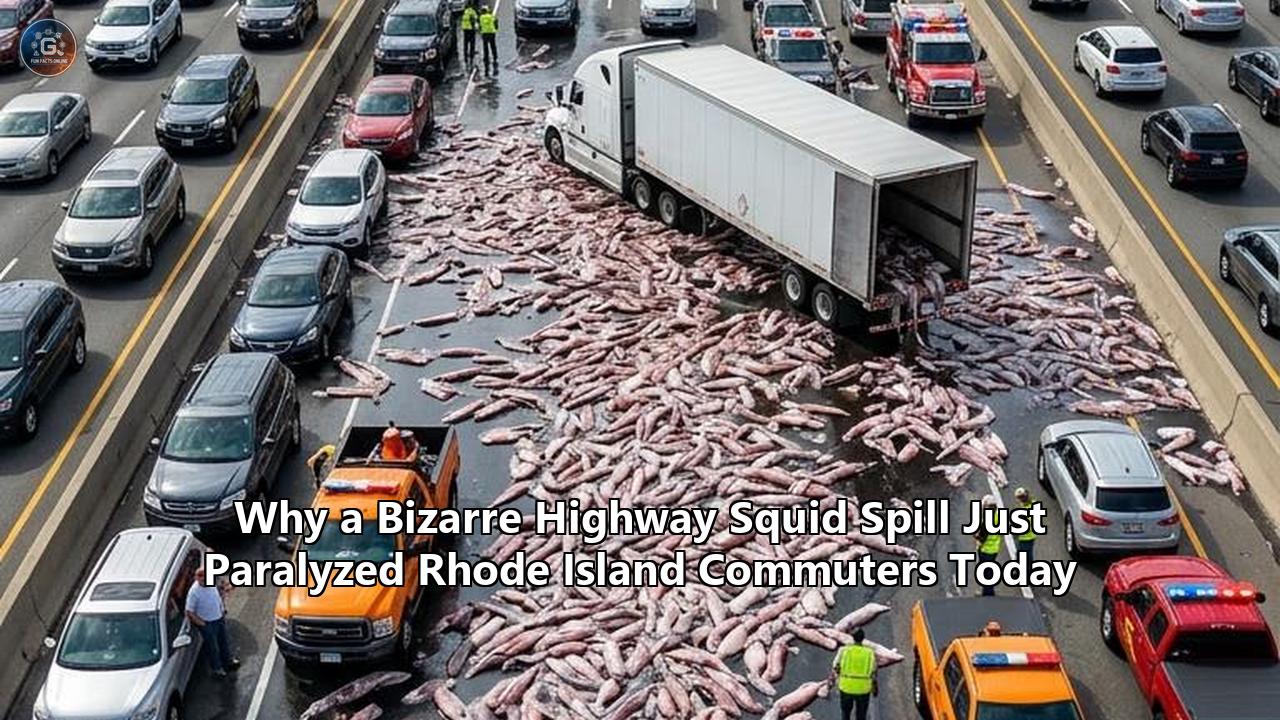
Tens of thousands of pounds of fresh cephalopods covered a major coastal highway in Narragansett, Rhode Island, after a fully loaded commercial tractor-trailer overturned at a critical intersection, triggering an eight-hour traffic paralysis, a complex environmental cleanup, and immediate demands for infrastructure reform.
The rollover occurred at the intersection of Point Judith Road (Route 108) and Galilee Escape Road, the primary conduit linking mainland transportation networks to the Port of Galilee and the Block Island Ferry terminal. The commercial semi-trailer was carrying more than 20 tons—approximately 40,000 pounds—of locally harvested longfin inshore squid (Doryteuthis pealeii) bound for regional processing plants when the trailer separated from its hitch and rolled onto its side.
Within minutes of the 9:27 a.m. incident, the roadway was blanketed in a slick, viscous layer of crushed ice, marine protein, and thousands of sea creatures. Under a direct summer sun that pushed midday asphalt temperatures past 95 degrees Fahrenheit, the biological material rapidly degraded, releasing an intense odor across Washington County while creating an extreme skid hazard that made the asphalt impassable for motor vehicles.
+-----------------------------------------------------------------------------------------+
|                              INCIDENT SNAPSHOT: POINT JUDITH                            |
+-----------------------------------------------------------------------------------------+
| Location:           Intersection of Route 108 (Point Judith Rd) & Galilee Escape Rd     |
| Time of Incident:   9:27 AM                                                             |
| Cargo Volume:       20+ Tons (40,000+ lbs) of bulk iced squid                           |
| Roadway Clearance:  5:15 PM (Extended 8-hour total closure)                             |
| Primary Impact:     Galilee Port access severed, Block Island Ferry traffic halted      |
| Response Agencies:  Narragansett Police, Narragansett Fire, RIDOT, RI State Police, DPW |
| Primary Hazard:     Severe loss of pavement friction, organic runoff, volatile odor     |
+-----------------------------------------------------------------------------------------+
Emergency responders, municipal public works crews, the Rhode Island Department of Transportation (RIDOT), and environmental teams spent nearly eight hours containing the site, operating heavy machinery to scrape the biomass off the road surface, and scrubbing the road with specialized surfactants before reopening the corridor at 5:15 p.m.. While no injuries were reported, the crash stranded thousands of motorists, blocked ferry passengers, stalled commercial fishing freight, and exposed critical vulnerabilities in the transportation infrastructure supporting one of the most lucrative seafood ports in the United States.
The event quickly captured national attention as the Rhode Island squid spill, highlighting how a single vehicle mechanical failure or cargo imbalance can sever a regional economic lifeline. Beyond the bizarre nature of the accident, transportation safety analysts, logistics directors, and municipal leaders are treating the disruption as a serious case study in freight stability, coastal road design, and municipal readiness for non-petroleum organic hazardous spills.
The Immediate Crisis: Anatomy of the Intersection Bottleneck
The incident unfolded on a Sunday morning during peak summer transit hours, when traffic heading toward Point Judith is at its weekly maximum. The tractor-trailer, departing the commercial docks of Galilee, attempted to negotiate the right-hand transition from Galilee Escape Road onto Route 108 North. As the vehicle executed the turn, the trailer experienced a dynamic shift in its center of gravity, causing the rear box to twist, tear away from the fifth-wheel kingpin assembly, and slam onto the asphalt on its port side.
The impact split the refrigerated container's roof and side panels, discharging 20 tons of iced squid across three lanes of travel.
                                  [ROUTE 108 NORTH]
                                          ▲
                                          │ (Traffic Gridlock)
                                          │
                                 ┌────────┴────────┐
                                 │   DEBRIS ZONE   │
                                 │  20 Tons Squid  │
                                 │  & Crushed Ice  │
   [GALILEE ESCAPE RD] ─────────►│  [ROLLOVER]     │
   (Port Logistics Traffic)      └────────┬────────┘
                                          │
                                          │ (Access Blocked)
                                          ▼
                               [PORT OF GALILEE / FERRY]
"Our units arrived on scene within four minutes of the initial 911 dispatch to find the intersection completely impassable," said Capt. Ryan Prest of the Narragansett Police Department. "The trailer had suffered catastrophic structural failure upon impact with the pavement. We had tens of thousands of pounds of marine cargo spread across several hundred feet of roadway, completely blocking the only high-capacity route into and out of the Port of Galilee."
The geographic configuration of Point Judith created an instant operational crisis. Galilee sits at the southern tip of Narragansett, buffered by Point Judith Pond to the west and the Atlantic Ocean to the south. All vehicular traffic—including heavy commercial freight haulers, municipal buses, local service vehicles, and thousands of tourists traveling to the Block Island Ferry—must move through a narrow highway neck controlled by Route 108.
When the trailer overturned, that neck was completely pinched off:
- Ferry Disruptions: Thousands of passengers scheduled for mid-morning and early afternoon sailings on the Block Island Hi-Speed and traditional ferries were trapped in stationary queues stretching several miles north onto Route 1. Vehicles attempting to catch reserved vehicle ferries could not reach the loading gates.
- Commercial Seafood Stoppage: Galilee is the second-largest commercial fishing port in New England by value and volume, serving as the commercial hub for the East Coast squid fleet. Dozens of refrigerated trucks carrying time-sensitive catch to distribution hubs in Boston, New York City, and Philadelphia were stranded inside the port facility, unable to depart.
- Emergency Service Isolation: The rollover blocked the primary mutual-aid and emergency evacuation route for the coastal village of Galilee, forcing local emergency medical services (EMS) and fire units to establish temporary standby staging areas on either side of the spill zone.
"The scene started to smell bad as the squid sat out in the sun for a few hours," Capt. Prest observed during the recovery operation. "Heavy equipment, municipal front-end loaders, and dump trucks had to be brought in because standard road-clearing equipment simply cannot push or vacuum that volume of dense biological matter off hot asphalt".
What Went Wrong: The Physics and Logistics of Bulk Seafood Transport
While local residents dubbed the event the "Squidpocalypse," commercial motor vehicle enforcement investigators and freight engineers immediately turned their attention to the mechanical, physical, and operational factors that caused the rollover. Transporting freshly harvested marine species presents severe logistical challenges rarely encountered in dry freight or standard refrigerated logistics.
+-----------------------------------------------------------------------------------------+
|                  TECHNICAL FACTORS IN BULK SEAFOOD ROLLOVERS                            |
+-----------------------------------------------------------------------------------------+
| Dynamic Free-Surface Effect: Unfrozen catch packed in slush/ice behaves like a semi-    |
|                              liquid, sloshing laterally during directional changes.     |
|                                                                                         |
| Center-of-Gravity Elevation: High-stacked insulated tote bins elevate the mass center,  |
|                              reducing the rollover threshold during low-speed turns.    |
|                                                                                         |
| Kingpin Dynamic Shear:       Torsional stress from shifting biological cargo exceeds    |
|                              standard fifth-wheel locking pin tolerances on tight radii.|
|                                                                                         |
| Temperature Sensitivity:     Strict dockside-to-packer cold chain rules demand rapid    |
|                              loading, increasing the risk of uneven weight distribution.|
+-----------------------------------------------------------------------------------------+
The Fluid Dynamics of Iced Seafood Cargo
Bulk squid is typically loaded directly from fishing vessel holds into industrial plastic fish totes or large insulated bulk containers, packed with slurry or crushed fresh ice to maintain flesh integrity and food safety standards. Unlike frozen boxed goods, which can be strapped securely onto wooden pallets and locked against trailer walls, bulk iced seafood exhibits dynamic fluid behavior:
- Lateral Surge (The Free-Surface Effect): When a tractor-trailer enters a curve, the water-ice-squid mixture inside unrestrained or partially filled bulk totes shifts outward toward the curve's exterior. This movement creates a sudden, uneven lateral weight transfer, shifting hundreds of foot-pounds of torque to the trailer's suspension system in milliseconds.
- Elevated Center of Mass: Fresh squid totes are stacked two to three layers high inside standard 53-foot refrigerated trailers. Because the cargo cannot be rigidly bound like solid manufactured goods, the effective center of gravity rises dynamically as the trailer rolls into a turn.
- Torsional Stress on the Fifth-Wheel Coupling: As the tractor pulls through an intersection and turns its steer axle, the trailer resists the rotational force. If the cargo shifts abruptly, the torsional load on the fifth-wheel kingpin mechanism spikes dramatically. Investigators noted that during this incident, the trailer detached directly at the coupling interface before rolling.
Commercial vehicle inspectors cited the driver for failure to secure a load properly under state transportation codes. However, logistics specialists point out that bulk seafood transport operates within a regulatory gray zone where standard cargo securement protocols designed for rigid palletized freight fail to address the semi-fluid mechanics of fresh catch.
       CARGO STABILITY DYNAMICS: DRY FREIGHT VS. BULK ICED SEAFOOD

   DRY PALLETIZED FREIGHT                    BULK ICED SEAFOOD TOTE SYSTEM
┌─────────────────────────────┐             ┌─────────────────────────────┐
│ [Rigid Box]   [Rigid Box]   │             │ ~ ~ ~ (Ice/Water Slurry) ~  │
│ [Solid Mass]  [Solid Mass]  │             │ [Squid Mass]   [Squid Mass] │
│ ── Strapped & Blocked ──    │             │ ── Free-Floating Liquid ──  │
│                             │             │                             │
│ ▲ Center of Gravity (Fixed) │             │ ▲ Center of Gravity (Shifts)│
└─────────────────────────────┘             └─────────────────────────────┘
  Static Load: Predictable                    Dynamic Load: High Rollover Risk
  Roll Threshold: ~0.45g                      Roll Threshold: <0.28g in turns
The Cold Chain Race Against the Clock
The pressure on seafood haulers leaving Point Judith is intense. Squid is an exceptionally delicate seafood commodity; once landed, enzymatic breakdown and bacterial proliferation occur rapidly unless temperatures are kept strictly between 32 and 34 degrees Fahrenheit.
Rhode Island landings of longfin squid are designated for premium restaurant and export markets, where dock-to-processing speed dictates market value. Processing plants located across the Northeast—in New Bedford, Boston, and northern New Jersey—operate on strict processing windows. Drivers often face tight schedules to navigate coastal arterial roads, connect to Interstate 95, and deliver their loads before thermal degradation begins. This commercial pressure can lead to hurried loading procedures at the dock, creating situations where weight distribution across trailer axles is unevenly balanced.
The Biological Hazard: Why Seafood Spills Defeat Standard Road Clearing
Municipal and state emergency response teams routinely handle highway accidents involving overturned trucks, crushed vehicles, and fuel spills. However, the Rhode Island squid spill presented a combination of physical, chemical, and biological hazards that standard municipal cleanup kits could not resolve.
+-----------------------------------------------------------------------------------------+
|               THE FOUR-STAGE HAZARD PROFILE OF A BULK CEPHALOPOD SPILL                 |
+-----------------------------------------------------------------------------------------+
|                                                                                         |
|  [STAGE 1: MECHANICAL SLIP] ──► Extreme friction drop (Mu < 0.15) via mucus & lipids    |
|             │                                                                           |
|  [STAGE 2: THERMAL DECAY]   ──► Rapid release of volatile amines (TMA, Cadaverine)      |
|             │                                                                           |
|  [STAGE 3: TOXIC RUNOFF]    ──► High Biochemical Oxygen Demand (BOD) threatens estuaries|
|             │                                                                           |
|  [STAGE 4: SURFACE BONDING] ──► Lipids bake into asphalt pores, requiring deep degreaser|
|                                                                                         |
+-----------------------------------------------------------------------------------------+
1. The Pavement Friction Coefficient Collapse
Squid bodies are coated in a thick layer of natural glycoproteins and mucus designed to minimize aquatic drag. When crushed under the weight of an overturning 80,000-pound commercial vehicle and blended with melting crushed ice, these glycoproteins create an oily emulsion on asphalt.
Under standard dry conditions, modern asphalt pavements provide a coefficient of friction ($\mu$) between 0.70 and 0.85. Wet pavement typically drops to 0.40–0.60. Engineering evaluations of organic marine protein slicks indicate that a coating of squid tissue and biological fluids reduces surface friction below 0.15—a value lower than wet vehicular ice.
Tires moving over this emulsion experience complete hydroplaning at speeds as low as 10 miles per hour. Standard rubber push plows and broom sweepers cannot scrape this viscous layer away; they merely smear the organic lipids deeper into the porous asphalt aggregate.
PAVEMENT FRICTION COEFFICIENTS (μ) BY SURFACE CONDITION
+---------------------------------------------+-------------------+
| Surface Type                                | Friction Value (μ)|
+---------------------------------------------+-------------------+
| Dry Clean Asphalt Aggregate                 | 0.75 - 0.85       |
| Wet Asphalt (Standard Rainwater)            | 0.50 - 0.65       |
| Packed Snow                                 | 0.20 - 0.30       |
| Black Ice                                   | 0.15 - 0.20       |
| Crushed Marine Cephalopod / Lipid Emulsion  | 0.08 - 0.14       |
+---------------------------------------------+-------------------+
2. High-Temperature Volatile Decomposition
Squid muscle tissue contains high concentrations of trimethylamine oxide (TMAO), an organic compound that marine organisms use to maintain osmotic balance in saltwater environments. Upon death and exposure to air, bacterial enzymes immediately convert TMAO into trimethylamine (TMA), the chemical responsible for the pungent, ammonia-like odor of rotting fish.
"Squid has a very distinctive, sharp odor to it under normal fishing conditions," explained Richard Stevens, a veteran commercial fisherman and Narragansett resident. "I use squid for bait every week, so I'm used to it. But when you take 40,000 pounds of it, crush it flat, and let it bake under the August sun on black asphalt that's hitting 100 degrees, the smell becomes overwhelming within an hour. It gets into the air conditioning systems of every car for miles".
As midday ambient temperatures hovered above 80 degrees Fahrenheit, the decomposition process accelerated. The release of volatile organic amines, paired with putrescine and cadaverine (toxic diamines produced by the breakdown of amino acids in decaying animal tissue), created an air-quality hazard for cleanup crews, who had to work in respirators and heavy rubber protective suits.
                BIOCHEMICAL CONVERSION PROCESS UNDER SUMMER HEAT

  [Fresh Squid Muscle] ──────► Rich in Trimethylamine Oxide (TMAO)
           │
           ▼ (Bacterial & Enzymatic Action at 80°F+ Ambient Temp)
  [Volatile Breakdown] ──────► Trimethylamine (TMA) + Dimethylamine (DMA)
           │
           ▼ (Secondary Protein Breakdown)
  [Putrefactive Diamines] ───► Putrescine (1,4-diaminobutane) + Cadaverine (1,5-pentanediamine)
           │
           ▼
  [Atmospheric Plume]  ──────► Pervasive volatile organic odor covering a 3-mile radius
3. The Threat to Coastal Estuaries and Shellfish Beds
Point Judith Road runs parallel to sensitive coastal wetlands, salt marshes, and tidal drainage basins that feed directly into Point Judith Pond—one of Rhode Island’s prime oyster farming and recreational shellfishing habitats.
Decaying marine biomass possesses an exceptionally high Biochemical Oxygen Demand (BOD). If tens of thousands of pounds of liquefied squid protein and melting ice wash directly into municipal storm drains, the organic matter feeds explosive bacterial growth in receiving waters. This process strips dissolved oxygen from the water column, creating localized hypoxic "dead zones" capable of suffocating juvenile fish, crabs, and seeded shellfish beds.
Responders could not simply wash the road down with high-pressure fire hoses into roadside catch basins. Doing so would have triggered an environmental contamination incident in violation of state water quality standards. Every gallon of wash water had to be managed, diverted, or treated.
Infrastructure Bottlenecks: Rhode Island's Calamari Economy vs. Coastal Geometry
To understand why this single accident crippled traffic across southern Rhode Island, one must examine the state's commercial fishing profile and coastal infrastructure.
In 2014, Rhode Island officially named calamari the state appetizer, celebrating an industry that dominates East Coast commercial landings. Point Judith lands millions of pounds of squid annually, ranking as one of the most productive commercial squid ports on the Atlantic seaboard.
+-----------------------------------------------------------------------------------------+
|                  RHODE ISLAND COMMERCIAL SQUID SECTOR AT A GLANCE                       |
+-----------------------------------------------------------------------------------------+
| Primary Species:            Longfin Inshore Squid (*Doryteuthis pealeii*)               |
| East Coast Landing Share:   Over 54% of all East Coast longfin squid landed in RI       |
| Primary Port:               Port of Galilee (Point Judith), Narragansett, RI            |
| Annual Economic Value:      $25M - $35M direct ex-vessel value ($100M+ regional impact)|
| Peak Harvest Season:        May through October (Overlaps directly with tourism season) |
| Transport Reliance:         100% truck freight via Route 108 / Galilee Escape Road      |
+-----------------------------------------------------------------------------------------+
The Port of Galilee generates substantial economic value for the state, but it operates on a century-old infrastructure footprint. When Galilee was established as a major fishing port in the early 20th century, modern multi-axle 80,000-pound refrigerated semi-trailers did not exist. The port's access roads were designed for small flatbeds and local utility trucks.
Today, Galilee accommodates three major competing economic interests, all relying on a single two-lane corridor:
                  THE POINT JUDITH TRAFFIC CONFLICT

                  ┌──────────────────────────────┐
                  │      ROUTE 108 ARTERY        │
                  │   Single Roadway Corridor    │
                  └──────────────┬───────────────┘
                                 │
         ┌───────────────────────┼───────────────────────┐
         ▼                       ▼                       ▼
┌─────────────────┐    ┌──────────────────┐    ┌───────────────────┐
│ COMMERCIAL PORT │    │  TOURIST TRANSIT │    │ COASTAL BEACHES   │
│ 50+ Heavy Fish  │    │  Block Island    │    │ Thousands of      │
│ Freight Semis   │    │  Ferry Terminals │    │ Day-Trippers &    │
│ Daily           │    │  (1M+ Pax/Year)  │    │ Beachgoers        │
└─────────────────┘ └──────────────────┘ └───────────────────┘- Industrial Marine Freight: Heavy semi-trucks transporting squid, lobster, scallops, and groundfish north toward processing and air-freight facilities.
- Mass Ferry Transit: The Block Island Ferry, which transports over one million passengers and hundreds of thousands of vehicles across Block Island Sound each year.
- Recreational Tourism: Roger Wheeler State Beach, Salty Brine State Beach, and dozens of waterfront restaurants that draw tens of thousands of day-trippers every weekend from Providence, Boston, and Connecticut.
Because there is no secondary rail or direct highway link to Galilee, industrial fish-hauling operations share the exact same turning lanes, stoplights, and pedestrian crossings as beachgoers and ferry commuters. The intersection of Point Judith Road and Galilee Escape Road is the physical nexus where these two worlds collide. When the trailer flipped, it severed the sole commercial access point for the entire complex.
The Eight-Hour Recovery Operation: How Responders Tackled the Spill
Clearing 40,000 pounds of slick, decomposing marine life from a major highway intersection required a coordinated effort involving local emergency services, state environmental officials, and municipal public works crews. The operation proceeded in four distinct tactical phases:
+-----------------------------------------------------------------------------------------+
|                          FOUR-PHASE INCIDENT RECOVERY TIMELINE                          |
+-----------------------------------------------------------------------------------------+
|                                                                                         |
|  [09:27 - 10:30]  PHASE 1: CONTAINMENT & TRIAGE                                         |
|                   - Perimeter established; traffic diverted onto secondary local roads  |
|                   - Catch basins sealed with magnetic polyurethane drain bladders       |
|                   - EMS staging established on northern and southern perimeters         |
|                                                                                         |
|  [10:30 - 13:45]  PHASE 2: MECHANICAL BULK HARVESTING                                   |
|                   - Front-end loaders and skid-steers scrape 20 tons of biomass        |
|                   - Heavy dump trucks load biological waste for specialized disposal    |
|                   - Extrication and uprighting of the damaged commercial trailer        |
|                                                                                         |
|  [13:45 - 15:30]  PHASE 3: VACUUM REMEDIATION & LIPID STRIPPING                        |
|                   - Industrial vacuum trucks extract semi-solid slurry from gutters     |
|                   - Application of biodegradable non-ionic degreasing surfactants       |
|                   - High-pressure rotary scrubbers strip proteins from asphalt pores    |
|                                                                                         |
|  [15:30 - 17:15]  PHASE 4: FRICTION TESTING & CORRIDOR REOPENING                        |
|                   - High-volume fresh water washdown with recovery vacuuming            |
|                   - Pavement skid resistance testing by RIDOT highway engineers         |
|                   - Roadway officially declared safe and reopened at 5:15 PM            |
|                                                                                         |
+-----------------------------------------------------------------------------------------+
Phase 1: Containment and Environmental Defense
The first priority for Narragansett Fire Department incident commanders was securing the drainage perimeter. Crews deployed polyurethane magnetic drain seals and absorbent sediment booms around all municipal stormwater inlets along Route 108. This action prevented thousands of gallons of melting ice, blood, and cephalopod fluids from entering the subterranean stormwater network and draining into Point Judith Pond.
Simultaneously, Narragansett Police coordinated emergency traffic turnarounds. Vehicles trapped on Galilee Escape Road were reversed one by one under police escort, while ferry officials were contacted to slow down vessel boarding and alert arriving passengers of the shutdown.
Phase 2: Mechanical Extraction
Once the perimeter was secured, standard road-clearing sweepers were deemed ineffective. The town deployed heavy municipal front-end loaders with rubber-tipped cutting edges and compact skid-steer loaders normally reserved for winter snow removal and earthmoving.
Working alongside private commercial towing contractors, operators carefully scooped massive piles of squid and crushed ice from the asphalt into high-sided steel dump trucks. The ruined cargo—valued at tens of thousands of dollars—was hauled to a specialized organic waste processing and rendering facility.
       TACTICAL SITE CLEARANCE CONFIGURATION AT POINT JUDITH ROAD

               [Drain Seal Boom]                   [Drain Seal Boom]
             ┌───────────────────┐               ┌───────────────────┐
             │ █ Catch Basin █   │               │ █ Catch Basin █   │
             └─────────┬─────────┘               └─────────┬─────────┘
                       │                                   │
  ═════════════════════╪═══════════════════════════════════╪═════════════════════
     TRAFFIC DIVERTED  │                                   │  TRAFFIC DIVERTED
  ─────────────────────┴───────────────────────────────────┴─────────────────────
         [Skid Steer] ──► [40,000 lbs Biomass Pile] ◄── [Front Loader]
                                 │
                                 ▼
                    [High-Sided Dump Truck Transport]
  ───────────────────────────────────────────────────────────────────────────────
  ═══════════════════════════════════════════════════════════════════════════════
Heavy-duty commercial rotator tow trucks then attached rigging lines to the overturned trailer, uprighting the crushed reefer box and clearing the roadway center so workers could access the remaining cargo beneath the chassis.
Phase 3: Lipid Degreasing and Surface Scrubbing
With the bulk biomass removed, the road remained coated in a translucent layer of squid mucus and animal fat that posed a severe slip-and-slide hazard. Fire crews, working with RIDOT highway maintenance personnel, applied industrial-grade, biodegradable, non-toxic citrus-based degreasers and marine-safe surfactant foams.
Crews used high-pressure hot-water wash systems mounted on commercial cleaning trucks, combined with street sweepers equipped with wire-bristle scrubbing discs, to agitate the surfactant and lift the biological fats out of the microscopic grooves of the asphalt. Vacuum trucks followed immediately behind, recovering the emulsified wastewater to prevent environmental contamination.
Phase 4: Pavement Friction Verification and Clearance
Before clearing the intersection for public travel, RIDOT safety personnel conducted decelerometer skid testing to verify that the pavement's coefficient of friction had returned to state-mandated safety levels. At 5:15 p.m., after nearly eight hours of intensive labor in high-heat conditions, the intersection was fully reopened to vehicular traffic.
The Solutions: How Regulators, Engineers, and Fleets Are Modernizing
The disruption caused by the Rhode Island squid spill has spurred state agencies, municipal governments, and the commercial fishing industry to develop concrete solutions. Preventing future incidents requires a multi-faceted approach addressing vehicle safety standards, bio-spill emergency management protocols, and roadway design.
+-----------------------------------------------------------------------------------------+
|                  COMPREHENSIVE PROBLEM-SOLUTION ACTION MATRIX                           |
+-----------------------------------------------------------------------------------------+
| CHALLENGE IDENTIFIED         │ INTERVENTION / SOLUTION           │ LEAD ENTITY         |
+------------------------------+-----------------------------------+---------------------+
| Dynamic cargo slosh & load   │ Mandate internal baffled totes;   │ FMCSA, RI State     |
| instability in bulk reefers  │ load-securement telemetry checks  │ Police Commercial   |
|                              │                                   │ Enforcement Unit    |
+------------------------------+-----------------------------------+---------------------+
| Lack of protocol for non-    │ Create State Bio-Spill Protocol   │ RIDOT, RIDEM,       |
| petroleum organic hazmat     │ with pre-positioned degreasers    │ Narragansett Fire   |
| road emergencies             │ and fast-deploy drain seals       │ Department          |
+------------------------------+-----------------------------------+---------------------+
| Tight intersection geometry  │ Redesign turning radius, bank-    │ RIDOT Engineering   |
| causing high-torque rollover │ angle adjustments, high-friction  │ Division            |
| on heavy commercial turns    │ aggregate pavement surface        │                     |
+------------------------------+-----------------------------------+---------------------+
| Complete isolation of Port   │ Develop secondary emergency-only  │ Town of Narragansett│
| of Galilee during corridor   │ egress lane connecting Galilee to │ Planning Board,     |
| closures                     │ Route 1 bypass corridors          │ RIDOT               |
+------------------------------+-----------------------------------+---------------------+
1. Modernizing Cargo Securement for Semi-Fluid Seafood Freight
The Rhode Island State Police Commercial Enforcement Unit, in consultation with the Federal Motor Carrier Safety Administration (FMCSA), is reviewing bulk seafood transport regulations. Traditional freight enforcement focuses heavily on flatbed strapping and rigid pallet blocking. However, transporting bulk iced seafood requires specialized standards:
         ENGINEERED REEFING TRAILER: BAFFLED BULK TANK CONVERSION

┌────────────────────────────────────────────────────────────────────────┐
│ [Refrigeration Unit]                                                   │
│   ┌──────────────┐  ┌──────────────┐  ┌──────────────┐  ┌────────────┐ │
│   │ Baffled Bulk │  │ Baffled Bulk │  │ Baffled Bulk │  │ Dynamic    │ │
│   │ Tote Unit A  │  │ Tote Unit B  │  │ Tote Unit C  │  │ Weight     │ │
│   │ (Anti-Surge) │  │ (Anti-Surge) │  │ (Anti-Surge) │  │ Sensor     │ │
│   └──────────────┘  └──────────────┘  └──────────────┘  └────────────┘ │
│   ════════════════ Floor Anchor Track System ═══════════════════════   │
└───────────────────────────────────┬────────────────────────────────────┘
                                    │
                                    ▼
       - Prevents lateral fluid surge during tight intersection turns
- Locks payload to chassis centerline, suppressing roll moment- Mandatory Baffled Bulk Containers: Fleet operators are evaluating heavy-duty insulated transport totes equipped with internal perforated baffles. These baffles suppress the lateral sloshing of ice and seafood slurries during turns, reducing the dynamic rollover forces transmitted to the trailer frame by up to 65%.
- Integrated Floor-Tracking Tie-Downs: Rather than relying on simple friction between plastic tote bottoms and trailer floors, new fleet guidelines recommend retrofitting reefer trailers with recessed aircraft-style floor-tracking systems. Totes are mechanically locked to the trailer floor, preventing cargo clusters from sliding outward during sharp turns.
- Onboard Dynamic Axle Sensors: Modern reefer units are increasingly equipped with real-time telematics that monitor individual axle load distributions. If a dockside loading crew stacks cargo too heavily toward one side, dashboard sensors alert the driver before the vehicle leaves the port facility.
2. Establishing Dedicated Bio-Spill Emergency Protocols
The Narragansett incident exposed a gap in municipal emergency response: while fire departments have well-drilled hazardous material (HAZMAT) protocols for diesel fuel, acid, and chemical spills, they often lack pre-established protocols for large-scale organic agricultural and seafood spills.
       NEW RHODE ISLAND PROTOCOL FOR HIGH-VOLUME ORGANIC SPILLS

                 [INCIDENT REPORTED: ORGANIC/BIO SPILL]
                                   │
                                   ▼
              [STEP 1: IMMEDIATE STORM DRAIN ISOLATION]
         Deploy pre-cached magnetic bladders & sediment booms
                                   │
                                   ▼
              [STEP 2: RAPID SKID MECHANICAL HARVEST]
         Mobilize front loaders; divert waste to commercial rendering
                                   │
                                   ▼
              [STEP 3: BIO-SURFACTANT ENZYMATIC APPLICATION]
         Apply non-toxic lipid-emulsifying foam to strip fish oils
                                   │
                                   ▼
              [STEP 4: VACUUM-RECOVERY PRESSURE WASH]
         Wash down aggregate with continuous industrial suction recovery
                                   │
                                   ▼
              [STEP 5: DIGITAL FRICTION VERIFICATION]
         RIDOT decelerometer testing before reopening lane access
The Rhode Island Department of Environmental Management (RIDEM) and RIDOT are assembling a dedicated Statewide Agricultural and Marine Bio-Spill Protocol:
- Pre-Positioned Environmental Defense Kits: Galilee, New Bedford, and other major coastal fishing hubs will maintain dedicated spill-response trailers stocked with magnetic catch-basin covers, non-toxic lipid-emulsifying surfactants, and high-capacity portable pumps.
- Rapid-Response Vacuum Contracts: Municipalities will establish emergency on-call agreements with commercial industrial-vacuum providers to ensure specialized suction trucks arrive at coastal road incidents within 30 minutes, cutting clearance times down from eight hours to under two.
- Odor-Neutralizing Bio-Enzymes: Emergency inventories will include sprayable, eco-friendly enzymatic odor neutralizers that instantly bind to volatile amines, suppressing decomposition smells and improving working conditions for response crews.
3. Roadway Geometry and Intersection Engineering Interventions
RIDOT highway engineers are conducting a safety review of the intersection of Point Judith Road and Galilee Escape Road to address the physical roadway geometry that contributed to the rollover.
           INTERSECTION REDESIGN: ROUTE 108 & GALILEE ESCAPE ROAD

  OLD CONFIGURATION                       PROPOSED HIGH-FRICTION REDESIGN
  -----------------                       -------------------------------
  - Tight 90° turn radius                 - Expanded 120-foot turn radius
  - Flat cross-slope (0% superelevation)  - 3% positive bank angle (superelevation)
  - Standard smooth asphalt               - High-Friction Surface Treatment (HFST)
  - Low lateral roll tolerance (<0.30g)   - High dynamic roll tolerance (>0.55g)

            │                                       │
            ▼                                       ▼
  ┌───────────────────┐                   ┌───────────────────┐
  │ █ HIGH ROLL RISK  │                   │ █ SAFE FREIGHT    │
  │   OVERTURNS       │                   │   TRANSITION      │
  └───────────────────┘                   └───────────────────┘
Expanding the Curve Turning Radius
The current intersection configuration features a tight turn designed for passenger sedans. RIDOT is drafting plans to widen the turning throat of the right-turn lane from Galilee Escape Road onto Route 108 North, expanding the radius from 45 feet to over 120 feet. This expansion will allow commercial semi-trucks to complete the turn at a much gentler angle, reducing the lateral centrifugal acceleration on trailers by more than 40%.
Applying High-Friction Surface Treatment (HFST)
RIDOT plans to install High-Friction Surface Treatment (HFST) across the intersection approaches. HFST involves applying calcined bauxite aggregate bound with thermosetting polymer resin to the asphalt surface.
This treatment dramatically enhances pavement grip, maintaining a high coefficient of friction even when surfaces become wet or contaminated with organic films:
FRICTION RETENTION UNDER HEAVY ORGANIC CONTAMINATION
+------------------------------------+--------------------+--------------------+
| Pavement Surface Type              | Clean Grip (μ)     | Organic Slick (μ)  |
+------------------------------------+--------------------+--------------------+
| Standard Hot-Mix Asphalt (HMA)     | 0.78               | 0.11               |
| Stone Matrix Asphalt (SMA)         | 0.82               | 0.18               |
| Calcined Bauxite HFST Coating      | 0.96               | 0.58               |
+------------------------------------+--------------------+--------------------+
Modifying Superelevation (Roadway Banking)
The existing intersection cross-slope is largely flat, which forces commercial vehicle suspensions to absorb all lateral turning forces. By re-profiling the roadbed with a positive 2.5% to 3.0% inward superelevation (banking angle), gravitational forces will naturally pull heavy cargo toward the center of the vehicle rather than pushing it outward against the trailer walls.
                  CROSS-SECTION: ROADWAY SUPERELEVATION EFFECT

        FLAT INTERSECTION (EXISTING)           BANKED INTERSECTION (PROPOSED)

        Centrifugal Force                      Centrifugal Force
               ◄───                                   ◄───
         ┌─────────────┐                        ┌─────────────┐
         │             │                        │   Cargo     │
         │   Cargo     │                        │  Inward     │
         │   Slosh     │                        │  Offset     │
         │    ───►     │                        │   ───►      │
         └─────────────┘                        └─────────────┘
       ───────────────────                   ─────── / 3.0% Slope / ─────
       Lateral rollover risk: HIGH           Lateral rollover risk: LOW
4. Long-Term Infrastructure Redundancy for Point Judith
The near-total isolation of the Port of Galilee during the cleanup has revived discussions regarding long-term infrastructure redundancy for Washington County's coastal peninsula.
+-----------------------------------------------------------------------------------------+
|                  POINT JUDITH INFRASTRUCTURE REDUNDANCY PROPOSALS                       |
+-----------------------------------------------------------------------------------------+
|                                                                                         |
|  [PROJECT A: GALILEE ESCAPE EXTENSION]                                                  |
|  - Description: Extend Sand Hill Cove Road westward with a controlled, gated access     |
|    link to Route 1.                                                                     |
|  - Primary Benefit: Provides emergency egress and commercial detour routing if Route 108|
|    is blocked.                                                                          |
|                                                                                         |
|  [PROJECT B: OFF-PEAK COMMERCIAL FREIGHT CORRIDORS]                                     |
|  - Description: Restrict 5-axle commercial seafood haulers to designated night and early|
|    morning travel windows (10:00 PM - 7:00 AM) during summer weekends.                  |
|  - Primary Benefit: Separates heavy industrial freight from high-density passenger and  |
|    ferry traffic.                                                                       |
|                                                                                         |
|  [PROJECT C: DOCKSIDE PRE-PROCESSING & COLD LOGISTICS HUB]                              |
|  - Description: Build dockside blast-freezing and containerized packing infrastructure  |
|    directly inside the Port of Galilee.                                                 |
|  - Primary Benefit: Converts shifting bulk iced-tote shipments into stable, blast-frozen|
|    boxed pallets prior to highway transport.                                            |
|                                                                                         |
+-----------------------------------------------------------------------------------------+
Town planners and state transportation officials are exploring whether an existing secondary utility right-of-way connecting Sand Hill Cove Road to regional bypass corridors can be paved and maintained as an emergency-only egress lane. In the event of future rollovers, chemical spills, or severe coastal flooding, this secondary lane could be opened by local police within minutes, ensuring that emergency vehicles and passenger transit are never completely cut off from the mainland.
The Broader Context: Commercial Seafood vs. Coastal Tourism
The highway closure highlighted a broader structural reality facing coastal communities across the United States: the coexistence of working industrial waterfronts and recreational tourism economies within confined geographic footprints.
                    COASTAL PENINSULA COMPETING DEMANDS

             ┌──────────────────────────────────────────────┐
             │         NARRAGANSETT / POINT JUDITH          │
             │           Single Roadway Arterial            │
             └──────────────────────┬───────────────────────┘
                                    │
                  ┌─────────────────┴─────────────────┐
                  ▼                                   ▼
       [INDUSTRIAL HARBOR]                   [TOURISM DESTINATION]
       - 50M+ lbs annual seafood landings    - 1M+ ferry passengers annually
       - 80,000-lb heavy commercial haulers  - 20,000+ daily beach day-trippers
       - Strict time-sensitive cold chain    - Pedestrian-dense beach corridors
       - 24/7 harvest operations             - Peak traffic on sunny weekends
The Port of Galilee generates more than $100 million in annual regional economic activity through its commercial fishing fleet, seafood wholesalers, vessel repair facilities, and cold-storage operations. Simultaneously, Washington County's tourism industry generates hundreds of millions of dollars in hospitality revenue, ferry ticketing, retail sales, and beach recreation.
Both industries depend entirely on the same asphalt. When a commercial hauler experiences a mechanical failure or loses its load, the economic fallout cascades through both sectors simultaneously:
- Wholesale seafood distributors lose valuable product and risk missing scheduled delivery windows to national restaurant and retail supply chains.
- Tourism businesses suffer immediate financial losses when thousands of visitors are stuck in gridlock, cancel hotel and ferry reservations, or avoid commercial coastal corridors altogether.
"The incident on Point Judith Road was messy, strange, and made for wild headlines across the country, but those of us who live and work here understand it as a serious wake-up call," said local business operator and seafood advocate Maria Valenti. "Our working waterfront and our visitor economy cannot remain at war over a single two-lane road. We need modern logistics, upgraded turning infrastructure, and smarter transportation planning so that 40,000 pounds of squid doesn't bring the entire southern half of the state to an absolute halt."
What to Watch Next
As municipal, state, and commercial entities process the lessons of the August incident, several key developments will determine how southern New England updates its coastal freight and emergency systems:
+-----------------------------------------------------------------------------------------+
|                                 UPCOMING KEY MILESTONES                                 |
+-----------------------------------------------------------------------------------------+
|                                                                                         |
|  [OCTOBER 2026]  State Police Commercial Enforcement Safety Review                     |
|                  Release of the final mechanical failure and cargo distribution report  |
|                  on the Narragansett rollover.                                          |
|                                                                                         |
|  [NOVEMBER 2026] RIDOT Route 108 Corridor Engineering Assessment                        |
|                  Presentation of geometric redesign options and high-friction surfacing |
|                  proposals for the Point Judith Road / Galilee Escape Road nexus.       |
|                                                                                         |
|  [JANUARY 2027]  General Assembly Legislative Session                                   |
|                  Introduction of state legislation establishing standardized organic    |
|                  bio-spill cleanup funding and marine cargo transport rules.            |
|                                                                                         |
|  [SPRING 2027]   Galilee Emergency Egress Route Planning                                |
|                  Municipal town council hearings on secondary emergency egress lanes    |
|                  and coastal freight scheduling ahead of the 2027 summer tourist season.|
|                                                                                         |
+-----------------------------------------------------------------------------------------+- State Police Commercial Enforcement Final Report: The Commercial Enforcement Unit's final investigation will detail the precise mechanics of the fifth-wheel separation, axle load distribution, and turning speed. Its findings could drive changes to how commercial seafood carriers secure bulk iced totes across New England.
- RIDOT Capital Redesign Filings: Highway engineers are expected to submit preliminary design proposals for the Route 108 and Galilee Escape Road intersection, incorporating expanded turning geometry and High-Friction Surface Treatments.
- Legislative Action on Bio-Spill Protocols: State lawmakers representing coastal districts are preparing legislation to establish dedicated state emergency funding and standardized response protocols for non-petroleum organic spills, ensuring towns receive immediate state resources and specialized equipment when biological road disasters strike.
- Galilee Port Modernization Grants: Federal and state port infrastructure grants will be evaluated to determine if dockside flash-freezing and advanced containerized loading facilities can be expanded directly in Galilee, shifting freight stability from loose, sloshing bulk ice totes to secure, low-profile palletized cargo.
The sudden paralysis of Rhode Island’s coastal artery demonstrated that modern supply chains and transit systems are only as resilient as their most vulnerable intersections. By addressing the engineering, regulatory, and emergency challenges behind the headline, transportation leaders and industry stakeholders are working to ensure that a localized freight failure never again strands an entire coastal community.
Reference:
- https://www.facebook.com/StateofRhodeIsland/videos/heres-a-drone-view-showing-the-massive-cleanup-in-narragansett-after-thousands-o/2262787651176149/
- https://www.theguardian.com/us-news/2026/aug/19/squid-spill-rhode-island-highway
- https://www.youtube.com/shorts/RF-KJxiOUQc
- https://www.wpxi.com/unavailable-location/
- https://www.independent.co.uk/news/rhode-island-police-state-police-phoenix-b3036005.html
- https://www.facebook.com/NBCNews/videos/thousands-of-pounds-of-squid-spilled-on-rhode-island-rode/1646269553586151/
- https://www.king5.com/article/news/nation-world/rhode-island-squid-spill/507-255a0db4-1234-4324-868a-5d31550b44f3
- https://www.sfgate.com/news/article/truckload-of-squid-spills-into-the-street-in-22395514.php