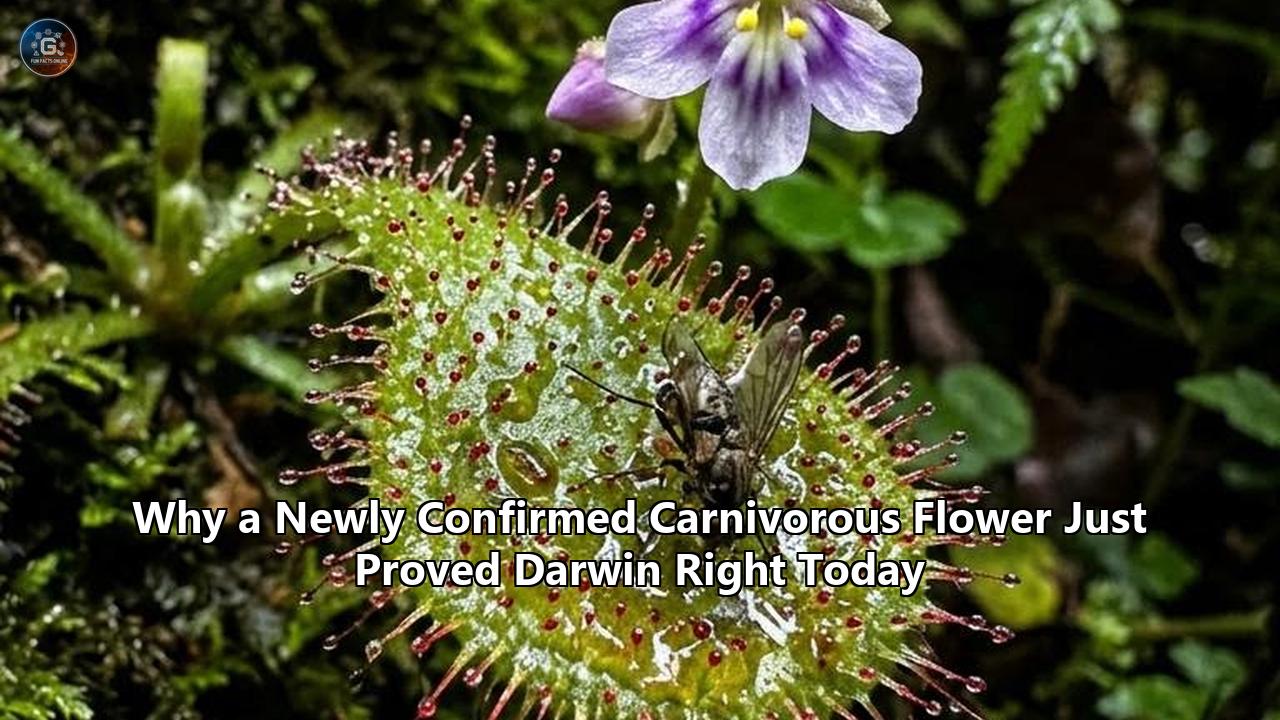
In a botanical milestone published on August 4, 2026, in Nature Communications, an international research consortium confirmed that Saxifraga candelabrum—a delicate, rock-dwelling alpine wildflower native to the high-altitude cliffs of southwestern China—is a fully functional, predatory plant. The confirmation conclusively validates an evolutionary prediction made 151 years ago by Charles Darwin in his 1875 treatise Insectivorous Plants, resolving a question that had lingered untested in botany for more than a century and a half.
The joint investigation, led by Dr. Xin-Jian Zhang and Professor Hang Sun of the Kunming Institute of Botany at the Chinese Academy of Sciences, alongside Professor Douglas Soltis of the Florida Museum of Natural History at the University of Florida, established that S. candelabrum does not merely trap insects by accident. Instead, the species actively lures tiny flies, captures them on glandular hairs covering its flowering stalks, digests their soft tissues with secreted enzymes, and incorporates the derived nitrogen directly into its reproductive structures and leaves.
┌─────────────────────────────────────────────────────────────────────────┐
│                      THE BOTANICAL TRIAGE MATRIX                        │
├───────────────────────┬───────────────────────┬─────────────────────────┤
│  Defensive Trichomes  │    Protocarnivory     │     True Carnivory      │
├───────────────────────┼───────────────────────┼─────────────────────────┤
│ • Sticky physical     │ • Traps insects       │ • Actively lures prey   │
│   barrier             │ • No endogenous       │ • Endogenous digestive  │
│ • Herbivore deter-    │   enzymes             │   enzymes               │
│   rence only          │ • Scavengers or rot   │ • Direct cellular       │
│ • No nutrient         │   mediate breakdown   │   nutrient absorption   │
│   absorption          │ • Variable nutrient   │ • Measured fitness &    │
│                       │   uptake              │   growth gain           │
└───────────────────────┴───────────────────────┴─────────────────────────┘
"To have the opportunity to confirm a prediction of Darwin is both humbling and exciting," Soltis said following the study’s release. "Darwin suspected that sticky hairs on these mountain plants were doing far more than just defending the foliage, but the analytical tools of the 19th century could not settle the debate. Today, we have the molecular, isotopic, and genomic tools to prove he was right all along".
This carnivorous flower discovery marks the first documented case of true carnivory within the family Saxifragaceae and the wider order Saxifragales, adding a distinct independent evolutionary origin of plant predation to the tree of life. More fundamentally, it exposes an enduring conceptual error in natural history: the assumption that plant carnivory is an exotic exception restricted to waterlogged bogs, rather than a cryptic survival strategy hidden throughout the global flora.
The Ecological Paradox of Predatory Blossoms
The scientific challenge exposed by Saxifraga candelabrum is rooted in an old evolutionary paradox known as the pollinator-prey conflict. For decades, evolutionary biologists maintained that placing lethal insect traps directly adjacent to nectar-rich, open blossoms was an evolutionary dead end.
If a plant relies on insects for cross-pollination to achieve genetic diversity and produce viable seeds, turning its flowering stem (scape) into a deadly adhesive field risks killing its own reproductive vectors.
                     POLLINATOR-PREY SPATIAL DILEMMA

   CLASSICAL CANONICAL CARNIVORE           CRYPTIC CARNIVOROUS FLOWER
         (e.g., Drosera)                    (Saxifraga candelabrum)

         [ Elevated Flower ]                    (  Open Flower  )
                 │                                      │
                 │ (20–40 cm gap)             [Sticky Glandular Hairs]
                 │                           (Prey trapped at stem level)
                 │                                      │
      [ Ground-Level Traps ]                    [ Basal Rosette ]
      (Prey digested at base)                 (Roots in bare limestone)
To prevent this fatal interference, canonical carnivorous plants—such as sundews (Drosera), pitcher plants (Sarracenia and Nepenthes), and the Venus flytrap (Dionaea muscipula)—spatially separate their hunting organs from their reproductive structures. They either raise their flowers on long stalks tens of centimeters above their basal traps or alter the seasonal timing between blooming and pitcher development.
Because Saxifraga candelabrum concentrates its glistening, glue-tipped trichomes exclusively along its inflorescence branches and flower stalks, standard ecological theory assumed the secretions served solely as a physical deterrent against crawling nectar thieves, such as ants or aphids. This assumption created a collective blindspot across systematic botany.
Field botanists frequently observed hundreds of dead insects encrusting the stems of alpine plants without considering that the plant was feeding on them. The scientific literature routinely categorized such species as "protocarnivorous" or passively sticky, dismissing the possibility of metabolic uptake because it clashed with established models of pollinator safety.
┌─────────────────────────────────────────────────────────────────────────┐
│                    THE BOTANICAL CHALLENGE AT A GLANCE                  │
├───────────────────────┬─────────────────────────────────────────────────┤
│ The Blindspot         │ Traps on floral stems were assumed to be        │
│                       │ strictly defensive to protect pollinators.      │
├───────────────────────┼─────────────────────────────────────────────────┤
│ The Missing Link      │ Inability to distinguish defensive adhesion     │
│                       │ from metabolic assimilation in the field.       │
├───────────────────────┼─────────────────────────────────────────────────┤
│ The Ecological Risk   │ Underestimating nutrient pathways in fragile    │
│                       │ alpine biomes facing climate destabilization.   │
├───────────────────────┼─────────────────────────────────────────────────┤
│ The Modern Solution   │ Coupling isotopic $^{15}\text{N}$ labeling with │
│                       │ fluorogenic enzyme assays and de novo genomics. │
└───────────────────────┴─────────────────────────────────────────────────┘
The 151-Year Impasse: Where Classical Botany Stalled
To understand why this confirmation took more than a century and a half, one must examine the experimental dead end encountered by Charles Darwin at his Down House estate in Kent during the early 1870s.
In his 1875 volume Insectivorous Plants, Darwin dedicated substantial portions of his text to testing species beyond known groups like Drosera and Utricularia. He closely examined European saxifrages, including Saxifraga rotundifolia and Saxifraga umbrosa, observing that their glandular trichomes exhibited structural similarities to the tentacles of sundews.
                     DARWIN'S 1875 EXPERIMENTAL CEILING

  [ Observation ]  ──>  Dense, glandular hairs catch small flying insects.
                             │
  [ Experiment ]   ──>  Placed roast meat, egg albumin, and live midges.
                             │
  [ Obstacle ]     ──>  No gross mechanical leaf movement detected;
                        optical microscopes could not measure chemical uptake.
                             │
  [ Deadlock ]     ──>  Hypothesis shelved as "unproven / inconclusive"
                        for 151 years.
Darwin placed raw meat particles, hard-boiled egg whites, and dead flies onto the sticky hairs of live Saxifraga specimens. He looked for two specific markers of carnivory:
- Mechanical movement: Rapid leaf curling or tentacle bending toward the prey.
- Obvious secretion surges: A visible bath of digestive acid dissolving the albumen within hours.
While the hairs on Saxifraga remained adhesive, they did not fold over like sundew tentacles. The microscopes and reagents of the Victorian era could not detect sub-micromolar concentrations of proteolytic enzymes, nor could they trace the movement of organic nitrogen atoms through plant cell walls. Darwin was forced to categorize his findings on Saxifraga as inconclusive, stating that while the plants clearly captured insects in large numbers, he could not establish that the captured animals served as a nutritional resource.
                    CHRONOLOGY OF BOTANICAL CARNIVORY

  1875        1960              2021              2026
   │           │                 │                 │
 Darwin      Croizat           Lin et al.        Zhang et al.
 publishes   proposes          confirm           confirms
 "Insecti-   monophyly         carnivory         Saxifraga
 vorous      (later            in Triantha       candelabrum
 Plants"     disproved)        occidentalis      in Nat. Commun.
Following Darwin’s death, botany entered a period of rigid classification. Plant carnivory was treated as a rare morphological extreme. A species had to possess intricate, highly modified organ structures—such as the snap-traps of Aldrovanda, the suction bladders of Utricularia, or the slippery pitchers of Heliamphora—to be considered for rigorous nutritional study.
Plants that utilized simple glandular hairs without obvious movement were relegated to footnotes as passive traps. For decades, field surveys cataloged hundreds of species across families like Saxifragaceae, Caryophyllaceae, and Stylidiaceae as merely "sticky," halting targeted investigations into their digestive biochemistry.
Inside the Discovery: How Saxifraga candelabrum Solved the Predatory Riddle
The resolution to this long-standing mystery began at elevations above 2,500 meters (8,200 feet) in the Hengduan Mountains of Yunnan and Sichuan provinces. This rugged region at the southeastern edge of the Qinghai-Tibet Plateau is an evolutionary hotspot, characterized by jagged limestone gorges, high ultraviolet exposure, and thin, alkaline soils that retain almost no accessible nitrates or phosphates.
                      HENGDUAN MOUNTAIN HABITAT PROFILE

  Elevation:         2,500 m to 3,300 m (8,200 to 10,800 ft)
  Substrate:         Bare vertical limestone rock crevices
  Microclimate:      Intense UV-B, high diurnal thermal swings, dry winds
  Nutrient Status:   Extremely low bioavailable nitrogen (N) and phosphorus (P)
  Dominant Prey:     Chironomidae (nonbiting midges), Sciaridae (dark-winged fungus gnats)
In this environment, Saxifraga candelabrum anchors its roots into narrow stone fractures where organic soil is absent. When the research team conducted comprehensive field surveys across alpine populations near Shangri-La, they documented a consistent ecological pattern: mature S. candelabrum individuals were coated in decaying insects, carrying an average of 71 trapped carcasses per plant.
Prey Retention Survey across 45 Specimens (1888–2026):
[██████████████████████████████████████████░░] 95.6% (43/45 plants with insect prey)
Average prey load per mature flowering plant: 71 insects (predominantly midges)
To eliminate the possibility that this insect retention was a modern aberration caused by shifting localized bug densities, the team surveyed 45 historical herbarium specimens collected between 1888 and 2016. A striking 43 of those 45 specimens (95.6%) retained insect carcasses glued to their glandular trichomes. The behavior was not incidental; it was an evolutionary constant spanning centuries.
┌─────────────────────────────────────────────────────────────────────────┐
│              THE FOUR TESTS OF TRUE BOTANICAL CARNIVORY                 │
├──────────────────────┬────────────────────────┬─────────────────────────┤
│ Criterion            │ Experimental Method    │ Saxifraga candelabrum   │
│                      │                        │ Result                  │
├──────────────────────┼────────────────────────┼─────────────────────────┤
│ 1. Active Attraction │ Olfactory vs Visual    │ Emits specific floral   │
│                      │ exclusion chambers     │ volatiles targeting     │
│                      │                        │ Chironomidae midges     │
├──────────────────────┼────────────────────────┼─────────────────────────┤
│ 2. Mechanical        │ Field census and       │ Multicellular glandular │
│    Capture           │ physical adhesive      │ hairs hold small insects│
│                      │ shearing trials        │ with high retention     │
├──────────────────────┼────────────────────────┼─────────────────────────┤
│ 3. Chemical          │ Fluorogenic substrate  │ Strong, endogenous      │
│    Digestion         │ assays (ELF-97) for    │ phosphatase & acid      │
│                      │ phosphatase/protease   │ protease secretion      │
├──────────────────────┼────────────────────────┼─────────────────────────┤
│ 4. Nutrient          │ Stable isotope tracing │ Significant $^{15}\text │
│    Assimilation      │ with $^{15}\text{N}$-  │ {N}$ accumulation in    │
│                      │ labeled Drosophila     │ fruits, leaves, stems   │
└──────────────────────┴────────────────────────┴─────────────────────────┘
To formally establish carnivory, a plant must satisfy four sequential criteria: attraction, capture, digestion, and assimilation. The researchers systematically tested S. candelabrum against each requirement.
1. Active and Selective Prey Attraction
The researchers set up enclosed field chambers using either glass barriers (which blocked volatile odors while maintaining visual cues) or opaque mesh screens (which allowed scent diffusion while blocking optical signals). The experiments revealed that S. candelabrum emits a specific profile of volatile organic compounds (VOCs) that attracts nonbiting midges (Chironomidae) and fungus gnats (Sciaridae) directly toward the stem surface.
Critically, the plant displayed an ecological filter. While small, weak-flying midges were drawn to the sticky flowering scapes, larger, high-efficiency pollinators—such as hoverflies (Syrphidae) and native bees (Anthophila)—were attracted strictly to the open petals and easily avoided or broke free from the glandular hairs. The plant had solved the pollinator-prey conflict through size-selective mechanical tuning of its mucilage.
                      SIZE-SELECTIVE TRAPPING DYNAMICS

       Small Midges (Chironomidae)           Large Pollinators (Syrphid Flies/Bees)
       Low kinetic momentum                  High kinetic momentum
       Weak cuticular pull                   Strong flight musculature
                 │                                      │
                 ▼                                      ▼
       [ Trapped permanently ]               [ Unhindered flower visit ]
       [ Digested for Nitrogen ]             [ Cross-pollination achieved ]
2. Physical Retention Mechanisms
The glandular trichomes of S. candelabrum are multicellular, biseriate structures topped with an active secretory head cell cluster. These glands produce an adhesive resin rich in polysaccharides and phenolic compounds, capable of withstanding the dry winds and rapid evaporation typical of high altitudes.
Kinematic tracking demonstrated that when a midge makes contact with two or more hair heads, the adhesive force exceeds the maximum flight force of the insect, permanently pinning it against the stem surface within seconds.
3. Endogenous Enzymatic Digestion
To confirm whether the plant digests its prey internally or relies on surface microbes to decay the carcasses, the team deployed fluorogenic enzyme assays. Using fluorescently labeled substrate probes (ELF-97 phosphatase substrate), the scientists recorded immediate phosphatase activity localized directly around the glandular hair heads within hours of prey capture.
The enzyme signal was absent in non-stimulated trichomes and activated upon chemical contact with insect cuticle components (chitin and ammonium salts). This proved that S. candelabrum produces its own digestive enzymes, fulfilling the third key criterion of carnivory.
ENZYMATIC DIGESTION PATHWAY:
Insect Cuticle Contact ──> Glandular Hair Stimulation ──> Phosphatase & Protease Secretion ──> Soft Tissue Liquefaction
4. Isotopic Verification of Nutrient Absorption
The definitive proof came through stable isotope ratio mass spectrometry (IRMS). The researchers reared fruit flies (Drosophila melanogaster) on an artificial growth medium heavily enriched with the stable isotope nitrogen-15 ($^{15}\text{N}$). They manually applied ten $^{15}\text{N}$-labeled flies to the glandular hairs of wild S. candelabrum plants, while running identical parallel applications on known carnivorous sundews (Drosera peltata) and non-carnivorous control alpine plants (Gentiana and Potentilla).
      STABLE ISOTOPE ($^{15}\text{N}$) ABSORPTION PROFILE (14-Day Post-Feeding)

  Atom % $^{15}\text{N}$ Excess
    ▲
0.8 │                                  ██████ (Flowers & Fruits)
0.6 │                            ██████ (Upper Stem Leaves)
0.4 │                      ██████ (Basal Rosette Leaves)
0.2 │
0.0 └───┬────────────────────────┬────────────────────────┬───────────────►
      Non-Carnivorous Control   Surrounding Soil Core    S. candelabrum
           (Potentilla)             (Zero Leaching)          Tissues
After a two-week feeding period, the research team harvested and dissected the plants, using mass spectrometry to track the movement of the heavy nitrogen:
- Surrounding soil cores: Showed negligible $^{15}\text{N}$ signal, demonstrating that nutrients had not washed off into the ground to be absorbed by roots.
- Non-carnivorous controls: Exhibited zero significant $^{15}\text{N}$ uptake into internal vascular bundles.
- ---Saxifraga candelabrum---: Displayed substantial, system-wide $^{15}\text{N}$ enrichment.
The highest concentration of prey-derived nitrogen was found inside the developing floral organs and fruits, followed by the upper stem leaves, and finally the basal rosette. The plant was actively extracting nitrogen from its insect victims and funneling it directly into seed development and leaf maintenance.
Genomic Blueprint: How Evolution Rewires Defensive Plants for Carnivory
Beyond physiological confirmation, the international research team assembled and annotated a chromosome-level genome of Saxifraga candelabrum, unlocking the genetic history that enabled this carnivorous flower discovery.
The genomic data revealed that plant carnivory does not require the invention of brand-new, unique genes from scratch. Instead, evolution acts as an opportunist, co-opting ancient plant defense and stress-signaling systems and converting them into predatory tools.
┌─────────────────────────────────────────────────────────────────────────┐
│              GENOMIC CO-OPTION & ADAPTIVE REPURPOSING                   │
├─────────────────────────┬─────────────────────────┬─────────────────────┤
│ Ancestral Defense Gene  │ Original Function in    │ Repurposed Role in  │
│ Family                  │ Typical Plants          │ S. candelabrum      │
├─────────────────────────┼─────────────────────────┼─────────────────────┤
│ Class I/III Acid        │ Defense against fungal  │ Prey tissue protein │
│ Endochitinases          │ pathogens; cell wall    │ degradation and     │
│                         │ lysis                   │ exoskeleton opening │
├─────────────────────────┼─────────────────────────┼─────────────────────┤
│ S-like Acid Ribbon      │ Systemic phosphate      │ Direct release of   │
│ Nucleases / Phosphatases│ scavenging under starva-│ inorganic phosphate │
│                         │ tion; programmed death  │ from insect nucleic │
│                         │                         │ acids and ATP       │
├─────────────────────────┼─────────────────────────┼─────────────────────┤
│ PTR / NRT1 Peptide and  │ Root nitrate absorption │ Trans-cuticular     │
│ Nitrate Transporters    │ from soil aqueous pores │ amino acid uptake   │
│                         │                         │ in glandular hairs  │
├─────────────────────────┼─────────────────────────┼─────────────────────┤
│ Jasmonic Acid (JA)      │ Wounding and chewing-   │ Prey detection,     │
│ Signaling Cascade       │ insect defense response │ enzyme synthesis    │
│                         │                         │ activation trigger  │
└─────────────────────────┴─────────────────────────┴─────────────────────┘
When a standard non-carnivorous plant is attacked by caterpillars, it activates the jasmonic acid (JA) biochemical cascade, prompting its leaves to produce bitter defense compounds and protease inhibitors to deter feeding. In Saxifraga candelabrum, the comparative transcriptome showed that the identical JA signaling network is triggered when an insect struggles against the sticky hair.
However, rather than producing deterrent toxins, the downstream genetic targets have been rewired to trigger the immediate exocytosis of hydrolytic enzymes from the glandular hair tips.
ANCESTRAL PATHWAY:
Insect Mechanical Trauma ──> JA Signaling Burst ──> Toxic Secondary Metabolites (Defense)

CARNIVOROUS PATHWAY:
Insect Hair Deflection   ──> JA Signaling Burst ──> Exocytosis of Proteases (Predation)
Phylogenomic analysis demonstrated that S. candelabrum belongs to the order Saxifragales, placing it hundreds of millions of years of evolutionary divergence away from classical carnivorous orders like Caryophyllales (Drosera, Nepenthes, Dionaea), Lamiales (Pinguicula, Genlisea, Utricularia), and Ericales (Sarracenia, Roridula).
                                 ANGIOSPERM PHYLOGENY

  Order Alismatales    ────────► Triantha occidentalis (False Asphodel)
  Order Saxifragales   ────────► Saxifraga candelabrum  ◄── [2026 Confirmation]
  Order Caryophyllales ────────► Drosera, Nepenthes, Dionaea
  Order Ericales       ────────► Sarracenia, Roridula
  Order Lamiales       ────────► Pinguicula, Utricularia, Philcoxia
This discovery establishes that true botanical carnivory has evolved at least 11 to 12 times independently across the history of angiosperms. This widespread evolutionary convergence underscores a key biological principle: when flowering plants encounter severe, mineral-poor habitats, natural selection consistently repurposes glandular hair defense systems into meat-eating digestive machinery.
Why the Carnivorous Flower Discovery Matters for Conservation and Alpine Ecology
The scientific realization that Saxifraga candelabrum is a confirmed carnivore reshapes our understanding of high-altitude nutrient cycling and ecosystem dynamics. Historically, alpine biogeochemistry treated rock faces and vertical cliff ecosystems as closed, low-productivity systems where primary producers relied exclusively on mineral weathering and atmospheric dust deposition for their trace nutrients.
                     ALPINE CLIFF NUTRIENT RE-ROUTING

       [ Valley Floor / Scree Basin ]
                    │
                    ▼ (Insect mass emergence: Chironomidae)
       [ Updraft Wind Currents ]
                    │
                    ▼
       [ Vertical Limestone Cliffs ]
                    │
                    ▼
       [ Saxifraga candelabrum ] ───► Traps & Metabolizes Insects
                    │
                    ▼
       [ Nitrogen & Phosphorus Infusion ] ───► Seed Production & Soil Formation
By tapping into windblown insect populations, S. candelabrum functions as a nutrient bridge, extracting nitrogen, phosphorus, and potassium from midges that hatch in lower-altitude valley wetlands and carrying those elements into sheer cliff microhabitats. This active nutrient pipeline fuels localized biological productivity, supporting tiny mosses, lichens, and microbial colonies that establish themselves around the decaying rosettes of the saxifrage cushions.
However, the confirmation of carnivory in these alpine plants arrives alongside mounting environmental pressures. The Qinghai-Tibet Plateau and the Hengduan Mountains are warming at more than twice the global average rate, triggering structural changes across these fragile biomes:
- Hydrological Disruption: Glacial retreat and erratic meltwater patterns alter the localized moisture levels of alpine rock crevices, shortening the flowering and sticky-trap seasons of S. candelabrum.
- Pollinator and Prey Desynchronization: Shifts in temperature disrupt the seasonal emergence of Chironomidae midges, threatening to disconnect the plant's hunting cycle from its period of seed production.
- Vegetation Encroachment: Lower-elevation generalist subalpine shrubs are migrating upslope, competing for rock crevices and shading out low-growing, high-light specialist herbs.
┌─────────────────────────────────────────────────────────────────────────┐
│                    ALPINE CLIMATE THREAT MATRIX                         │
├─────────────────────────┬─────────────────────────┬─────────────────────┤
│ Stress Factor           │ Immediate Ecological    │ Impact on Cryptic   │
│                         │ Mechanism               │ Carnivores          │
├─────────────────────────┼─────────────────────────┼─────────────────────┤
│ Accelerated Alpine      │ Early snowmelt; upward  │ Trapping period     │
│ Warming                 │ migration of shrubs     │ compressed; habitat │
│                         │                         │ loss                │
├─────────────────────────┼─────────────────────────┼─────────────────────┤
│ Phenological Decoupling │ Midges emerge prior to  │ Failure of nitrogen │
│                         │ floral scape extension  │ translocation into  │
│                         │                         │ seed development    │
├─────────────────────────┼─────────────────────────┼─────────────────────┤
│ Nitrogen Deposition     │ Atmospheric industrial  │ Evolutionary trade- │
│                         │ emissions fertilize     │ off inverted; trap  │
│                         │ alpine screes           │ maintenance costs   │
│                         │                         │ exceed root gain    │
└─────────────────────────┴─────────────────────────┴─────────────────────┘
Because traditional conservation monitoring frameworks classify species based on standard photosynthetic and root-absorption models, cryptic carnivorous plants have been systematically overlooked in biodiversity impact assessments. If an ecological assessment ignores the fact that a species relies on aerial insect prey for more than 50% of its nitrogen budget, conservation plans cannot accurately forecast how habitat disruption will affect the plant's long-term survival.
The Global Response: What Botanists, Institutions, and Taxonomists Are Doing
The confirmation of Saxifraga candelabrum has spurred international action across academic institutions, botanical gardens, and conservation bodies. Rather than treating this finding as an isolated curiosity, scientists are rolling out standardized research programs to uncover and protect other potential predatory plants hiding in plain sight.
                     FOUR-PHASE GLOBAL SCIENTIFIC ACTION PLAN

 ┌────────────────────────────────────────────────────────────────────────┐
 │ 1. Systematic Isotope Screening ($^{15}\text{N}$ & $^{33}\text{P}$)    │
 │    Screening sticky-stemmed genera (Silene, Stylidium, Geranium)       │
 ├────────────────────────────────────────────────────────────────────────┤
 │ 2. Herbarium Archival Re-Audits                                        │
 │    Micro-sampling 100,000+ historical vouchers for trapped prey        │
 ├────────────────────────────────────────────────────────────────────────┤
 │ 3. Deployment of Portable Fluorometric Field Assays                    │
 │    Real-time enzymatic testing of secretory trichomes on remote cliffs │
 ├────────────────────────────────────────────────────────────────────────┤
 │ 4. Overhaul of IUCN Red List Assessment Protocols                      │
 │    Integrating predatory dependence into alpine conservation models    │
 └────────────────────────────────────────────────────────────────────────┘
1. High-Throughput Isotopic Field Protocols
Researchers at the Kunming Institute of Botany, in collaboration with the International Carnivorous Plant Society and the Royal Botanic Gardens, Kew, are establishing standardized screening workflows for ambiguous sticky plants. Instead of waiting decades for opportunistic investigations, botanical field researchers are deploying portable isotope-enrichment kits.
These field protocols allow field teams to test wild populations of glandular plants across the Andes, the European Alps, and the North American Rockies using localized $^{15}\text{N}$ micro-dosing and portable infrared spectrometry, delivering absorption data in weeks rather than years.
FIELD PROTOCOL WORKFLOW:
Identify Glandular Wildflower ──> Apply $^{15}\text{N}$ Micro-Dose ──> 14-Day Incubation ──> IRMS Isotope Verification
2. Systematic Audits of Global Herbarium Archives
Herbaria worldwide contain hundreds of millions of dried, pressed plant specimens, many collected in the 18th and 19th centuries. Inspired by the successful confirmation of insect-prey continuity on 130-year-old S. candelabrum sheets, a multi-institution consortium has initiated the Cryptic Carnivore Archival Scan.
Herbarium Scan Target Genera:
• Saxifraga (450+ species)    • Silene (900+ species)
• Stylidium (300+ species)    • Passiflora (550+ species)
• Primula (500+ species)      • Plumbago (20+ species)
Trained botanists and computer-vision algorithms are scanning high-resolution digitizations of sticky genera—such as Silene (catchflies), Stylidium (triggerplants), Passiflora, Primula, and Plumbago—to catalog insect carcass distributions and identify high-priority candidate species for living tissue enzymatic assays.
3. Re-evaluating Global Biodiversity and Red List Criteria
Conservation biologists are actively petitioning the International Union for Conservation of Nature (IUCN) to update its assessment criteria for alpine and lithophytic plant communities.
Led by teams at the Florida Museum of Natural History, experts are drafting guidelines that require ecological risk models to evaluate the status of insect food sources when assessing the vulnerability of high-altitude rock-face endemics.
REVISED IUCN THREAT EVALUATION FRAMEWORK:
Root Soil Chemistry ──► [ Atmospheric Nutrient Influx ] ◄── Local Insect Phenology
                                  │
                                  ▼
               True Vulnerability Score for Cryptic Carnivores
If an alpine plant derives vital reproductive nutrients from insect predation, protections must extend beyond the plant's physical rock face to include the nearby wetlands and screes that produce its prey.
How Saxifraga Compares to Other Cryptic Carnivores
The validation of Saxifraga candelabrum is part of a growing shift in modern botany. Over the past two decades, several seemingly common wildflowers have been unmasked as active carnivores once advanced analytical tools were applied to their sticky traps.
┌─────────────────────────────────────────────────────────────────────────┐
│           COMPARATIVE MATRIX OF CRYPTIC CARNIVOROUS TAXA                │
├───────────────────┬───────────────────┬────────────────┬────────────────┤
│ Species           │ Family / Order    │ Trap Location  │ Unique         │
│                   │                   │ & Mechanism    │ Adaptation     │
├───────────────────┼───────────────────┼────────────────┼────────────────┤
│ Saxifraga         │ Saxifragaceae /   │ Flowering      │ High-altitude  │
│ candelabrum       │ Saxifragales      │ stems; biseri- │ cliff litho-   │
│ [Confirmed 2026]  │                   │ ate glandular  │ phyte; targets │
│                   │                   │ hairs          │ midges         │
├───────────────────┼───────────────────┼────────────────┼────────────────┤
│ Triantha          │ Tofieldiaceae /   │ Sticky hairs   │ Only mono-     │
│ occidentalis      │ Alismatales       │ exclusively on │ cot with sticky│
│ [Confirmed 2021]  │                   │ floral scape   │ trap; 64% leaf │
│                   │                   │                │ N from prey    │
├───────────────────┼───────────────────┼────────────────┼────────────────┤
│ Philcoxia         │ Plantaginaceae /  │ Underground    │ Traps nema-    │
│ minensis          │ Lamiales          │ subterranean   │ todes in deep  │
│ [Confirmed 2012]  │                   │ adhesive leaves│ quartz sand    │
├───────────────────┼───────────────────┼────────────────┼────────────────┤
│ Triphyophyllum    │ Dioncophyllaceae /│ Ephemeral      │ Switches car-  │
│ peltatum          │ Caryophyllales    │ glandular      │ nivory on only │
│ [Confirmed 1999]  │                   │ liana leaves   │ before liana   │
│                   │                   │                │ phase          │
└───────────────────┴───────────────────┴────────────────┴────────────────┘
The 2021 confirmation of Triantha occidentalis (false asphodel) in the bogs of western North America showed that an abundant monocot growing near major urban centers like Vancouver and Seattle had been eating meat for millennia without detection. Triantha traps small gnats on its flowering stems while sparing pollinating bees and butterflies, obtaining up to 64% of its nitrogen from insect prey.
Similarly, Philcoxia minensis, discovered in the harsh white sand dunes of central Brazil, hides its microscopic, glue-coated leaves beneath the soil surface to trap and digest subterranean nematodes.
These discoveries demonstrate that Saxifraga candelabrum is not an isolated botanical anomaly. Instead, it is part of an overlooked ecological guild: predatory plants that abandoned the complex trap designs of canonical carnivores in favor of flexible, low-cost glandular hairs.
Expanding Frontiers: The Unresolved Questions of Plant Carnivory
While the confirmation of Saxifraga candelabrum closes a 151-year-old scientific mystery, it opens extensive new questions for botanical research. Chief among them is the status of the two European species that first caught Charles Darwin’s attention in 1875: Saxifraga rotundifolia and Saxifraga umbrosa.
                     THE UNTESTED SAXIFRAGA HORIZON

            Genus Saxifraga (~450 recognized species globally)
            │
            ├── Saxifraga candelabrum  ───► [CONFIRMED CARNIVORE (2026)]
            │
            ├── Saxifraga rotundifolia ───► [Darwin's 1875 Subject: Untested]
            │
            ├── Saxifraga umbrosa      ───► [Darwin's 1875 Subject: Untested]
            │
            └── 400+ Other Glandular Alpine Species ───► [Pending Screening]
Neither S. rotundifolia nor S. umbrosa has undergone modern isotopic $^{15}\text{N}$ labeling under rigorous laboratory conditions. The genus Saxifraga contains roughly 450 species, many of which bear glandular hairs and inhabit nutrient-poor arctic-alpine habitats across Europe, Asia, and the Americas.
Botanists now face the possibility that carnivory is not an isolated trait found in a single Chinese species, but a widespread evolutionary strategy distributed throughout multiple clades of the family Saxifragaceae.
┌─────────────────────────────────────────────────────────────────────────┐
│                     UPCOMING BOTANICAL MILESTONES                       │
├─────────────────────────┬─────────────────────────┬─────────────────────┤
│ Research Milestone      │ Lead Consortium / Org   │ Expected Timeline   │
├─────────────────────────┼─────────────────────────┼─────────────────────┤
│ European Saxifraga      │ Alpine Flora Isotope    │ 2026–2027           │
│ Re-Testing Program      │ Consortium (Univ. of    │                     │
│                         │ Florida / CAS / Kew)    │                     │
├─────────────────────────┼─────────────────────────┼─────────────────────┤
│ Global Herbaria AI      │ Global Biodiversity     │ 2026–2028           │
│ Trichome Scanning       │ Information Facility    │                     │
│                         │ (GBIF) / CAS            │                     │
├─────────────────────────┼─────────────────────────┼─────────────────────┤
│ Comprehensive Multi-    │ International Alliance  │ 2027–2028           │
│ Omics of Saxifragales   │ for Plant Functional    │                     │
│ Digestion               │ Genomics                │                     │
└─────────────────────────┴─────────────────────────┴─────────────────────┘
Scientific teams are also investigating the biochemical evolution of plant mucilage and digestive enzymes. Comparing the high-resolution genome of S. candelabrum with those of Drosera, Cephalotus, and Nepenthes will enable researchers to identify the shared genomic pathways that allow divergent plant families to build functional digestive systems from unrelated starting points.
Understanding how plants optimize adhesive secretions under severe high-altitude environmental stress could also yield bio-inspired adhesives capable of performing across wide temperature swings and extreme UV conditions.
Reframing the Plant Kingdom’s Boundary Between Defense and Predation
The validation of Saxifraga candelabrum in Nature Communications marks a major moment for evolutionary biology. By confirming that an alpine wildflower uses its floral scapes to lure, capture, digest, and absorb insect prey, modern science has validated Charles Darwin’s 1875 intuition and resolved the long-standing pollinator-prey paradox.
                     REVISED PLANT NUTRITION SPECTRUM

 [ Pure Autotrophy ] ──► [ Defensive Glands ] ──► [ Opportunistic Carnivory ] ──► [ Obligate Carnivory ]
    (Grass / Trees)         (Tomato / Tobacco)         (Saxifraga / Triantha)        (Dionaea / Nepenthes)
This discovery shows that botanical carnivory is not a binary switch restricted to specialized bog plants, but a dynamic evolutionary continuum. Glandular hairs that evolve to defend delicate tissues against grazing insects can, under the right environmental pressures, cross the threshold into active predation.
As field researchers and molecular biologists apply stable isotope tracking and genomic tools to unexplored flora worldwide, the botanical map is shifting. The flora of the world's highest cliffs and remote valleys holds quiet predators that have been thriving in plain sight for centuries, quietly waiting for scientific tools to finally catch up with Darwin's foresight.
Reference:
- https://www.the-independent.com/asia/china/china-daily/carnivorous-plants-darwin-species-nature-b3036992.html
- https://finance.biggo.com/news/abd345ed-69af-4985-b143-9446e8898740
- https://casrai.org/news/saxifraga-candelabrum-carnivorous-plant-darwin-confirmed
- https://www.thebrighterside.news/post/150-year-old-darwin-mystery-solved-by-a-carnivorous-alpine-flower/
- https://www.smithsonianmag.com/smart-news/charles-darwin-theorized-that-these-plants-were-carnivorous-150-years-ago-a-new-study-proves-him-right-180989265/
- https://www.smithsonianmag.com/smart-news/charles-darwin-theorized-that-these-plants-were-carnivorous-150-years-ago-a-new-study-proves-him-right-180989265/
- https://global.chinadaily.com.cn/a/202608/18/WS6a83bd14a3106bc57421c0e0.html
- https://www.independent.co.uk/asia/china/china-daily/carnivorous-plants-darwin-species-nature-b3036992.html
- https://www.gktoday.in/scientists-validate-darwins-theory-in-saxifraga-candelabrum/
- https://www.livescience.com/planet-earth/plants/darwins-hypothesis-provided-an-important-inspiration-scientists-bolster-150-year-old-darwinian-theory-with-a-carnivorous-plant-in-china
- https://www.pnas.org/doi/10.1073/pnas.2022724118
- https://www.pnas.org/doi/abs/10.1073/pnas.2022724118
- https://www.facebook.com/smithsonianmagazine/posts/more-than-150-years-ago-the-famed-naturalist-charles-darwin-hypothesized-that-tw/1420357953289724/
- https://en.wikipedia.org/wiki/Carnivorous_plant
- https://www.asiaresearchnews.com/content/carnivorous-plants-confirm-150-year-old-darwin-prediction
- https://gizmodo.com/darwin-made-a-bold-claim-about-these-plants-in-1875-he-was-right-2000794205
- https://www.kq2.com/cnn/cnn-other/2026/08/04/scientists-identify-an-insect-eating-plant-proving-charles-darwin-right-after-150-years/
- https://www.natureasia.com/en/info/press-releases/detail/9405
- http://global.chinadaily.com.cn/a/202608/13/WS6a7dc5aba31073853ec5330b_2.html
- https://botany.ubc.ca/highlights/first-new-carnivorous-plant-identified-in-20-years/
- https://www.earth.com/plants/a-hairy-leafed-saxifraga-joins-the-list-of-known-carnivorous-plants/
- https://www.facebook.com/livescience/posts/researchers-have-confirmed-that-a-plant-native-to-alpine-regions-in-southwest-ch/1410733174250052/
- https://www.facebook.com/californiacarnivores/videos/the-bleeding-bell-flower-nescodon-mauritianus-is-not-a-carnivorous-plant-but-its/1279042368621047/
- https://news.wisc.edu/new-carnivorous-plant-must-balance-trapping-prey-and-being-pollinated/
- https://www.sciencenews.org/article/wildflower-carnivore-plant-sticky-hair-insect-trap
- https://nauka.offnews.bg/zhivotat/darvin-se-okaza-prav-tova-mesoiadno-rastenie-ulavia-komari-203497.html