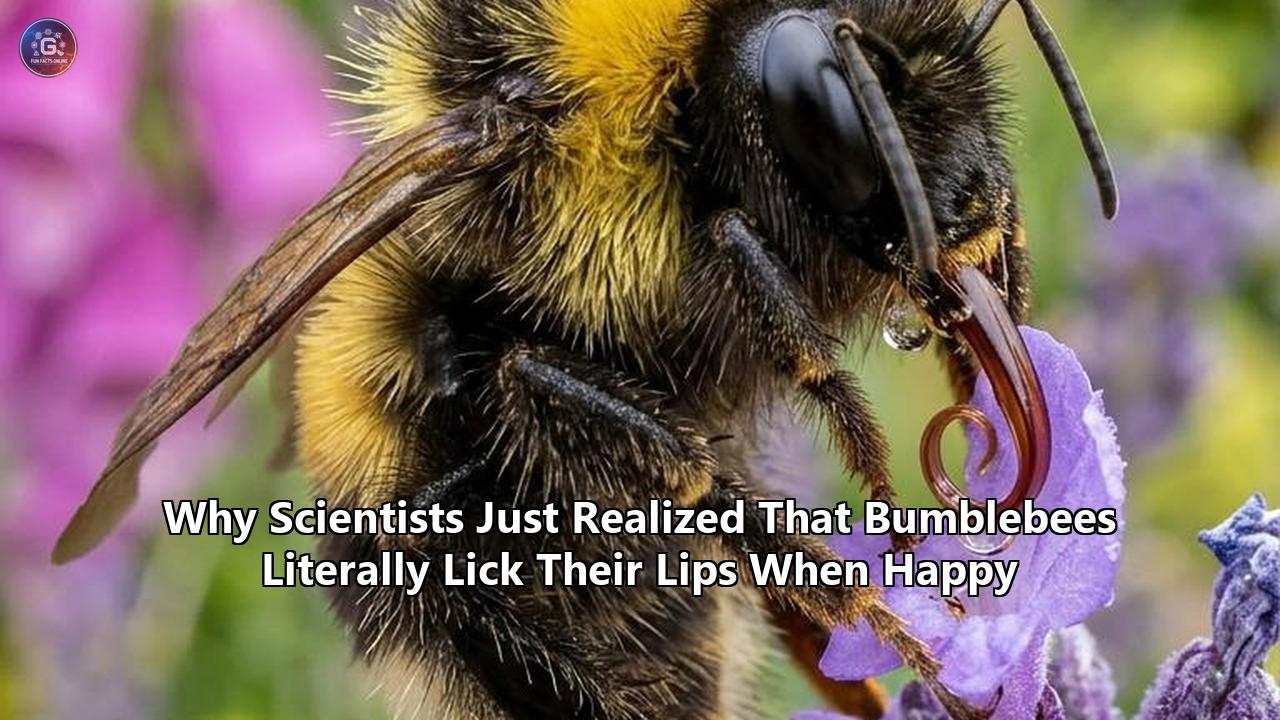
Inside a temperature-controlled laboratory at Southern Medical University in Guangzhou, China, a single buff-tailed bumblebee (Bombus terrestris) sat inside a tiny, transparent acrylic tube. Suspended directly in front of her was a glass micropipette tip containing a single, microscopic droplet of clear liquid: a 60 percent sucrose solution, the chemical equivalent of high-grade floral nectar.
The bee reached forward, extended her long, dark, hairy tongue-like mouthpart—known as a glossa—and drank. The sugary fluid vanished in less than a second.
Then, the researchers removed the pipette. The food was gone. There was no chemical residue left in the air, no sticky trace on the acrylic glass, and no physical incentive for the insect to keep working her mouth.
Yet, as a high-speed camera captured the scene at 500 frames per second, the bumblebee did something that stunned the scientists watching the playback. Long after the meal had ended, she continued to rhythmically extend and retract her glossa into the open, empty air. She thrust her tongue out, curled it slightly, drew it back, and repeated the motion over and over again, tasting nothing but empty space.
To the human eye, the movement was instantly recognizable. It was the physical manifestation of a satisfying sigh, the insect equivalent of a dog licking its chops after a bowl of wet food, or a human newborn smacking its lips after tasting a drop of honey.
This remarkable study, published in the Proceedings of the National Academy of Sciences (PNAS), represents a profound shift in our understanding of invertebrate minds. For the first time, scientists have documented that insects possess discrete, observable facial and mouth expressions that do not merely serve a mechanical purpose, but instead broadcast their internal subjective state. They are, in a very literal, biological sense, licking their lips when they are happy.
Conversely, when the same bumblebees were presented with drops of bitter quinine or salty water, they did not merely reject the food. They shook their heads violently from side to side and scrubbed their mouthparts with their front legs in a display of pure, physical revulsion.
These findings suggest that even a brain smaller than a grain of sand—containing roughly one million neurons compared to a human's 86 billion—is capable of experiencing the world not just as a series of mechanical inputs, but as a spectrum of pleasure and disgust.
To understand how a team of researchers managed to prove that a bumblebee is capable of subjective enjoyment, one has to follow a trail of evidence that winds through the history of behaviorism, the chemistry of the mammalian brain, and a series of delicate laboratory tests that pushed the boundaries of what we believe about animal consciousness.
The Ghost in the Six-Legged Machine
For more than a century, the dominant view in biology treated insects as little more than highly sophisticated, six-legged micro-robots.
This perspective was anchored in the early 20th-century work of German-American physiologist Jacques Loeb, who argued that animal behavior could be entirely explained through "forced movements" or tropisms—automatic, involuntary physical alignments to external stimuli, much like a plant growing toward the sun. Later, B.F. Skinner’s school of radical behaviorism cemented this mechanical view. In the behaviorist framework, an insect does not "want" sugar because it tastes good, nor does it "dislike" poison because it tastes bad. It is simply a stimulus-response machine. Sweetness triggers a hardwired motor reflex that opens the mouth; bitterness triggers an automatic reflex that closes it.
"There's always been a tension between thinking of insects as animals or some sort of mini robots," says Dr. Andrew Barron, a neuroethologist at Macquarie University in Sydney and a co-author of the study. For the vast majority of scientific history, the mini-robot view held the upper hand. It was a comfortable, convenient shield. If insects are merely biological automata running deterministic code, then humanity is spared the ethical complications of how we treat them in agriculture, research, and the environment.
         THE TRADITIONAL TROPISM MODEL (JACQUES LOEB)
   [Stimulus: Sucrose] ---> [Sensory Receptor] ---> [Reflexive Motor Program]
                                                      (No Internal State)

         THE NEW AFFECTIVE EVALUATION MODEL (PENG ET AL.)
   [Stimulus: Sucrose] ---> [Sensory Receptor] ---> [AFFECTIVE EVALUATION] ---> [Orofacial Expression]
                                                      (Subjective Value)          (Post-Consumption Licking)
In recent decades, however, this shield has begun to crack. Researchers have demonstrated that honeybees can comprehend the abstract concept of zero, learn to solve complex puzzles by observing their peers, use tools, recognize individual human faces, and even experience pessimistic cognitive biases after being shaken, simulating a predator attack.
"Many people are comfortable saying that insects can sense, learn, and make decisions," says Dr. Fei Peng, a lead author of the study and a specialist in bee cognition at Southern Medical University. "But they are much less comfortable saying that they may evaluate things as pleasant or unpleasant. Our findings push on that intuition."
Understanding this aspect of bumblebee behavior required looking past the binary of whether an insect approaches or retreats from a substance. It required looking at how they behave after they have already made their choice. This is where the concept of "orofacial expressions"—the movements of the mouth and face—becomes crucial.
In mammals, these expressions have long been the gold standard for studying the internal states of non-verbal subjects. When a human baby is given sugar water, they smile and make rhythmic tongue protrusions. Give them something bitter, and they gape their mouth, shake their head, and wipe their lips. These exact same expressions are found in chimpanzees, orangutans, monkeys, and even rats.
Because these reactions are identical across wildly different mammalian species, neuroscientists agree they are evolutionary indicators of a shared internal state: the sensory experience of pleasure (liking) or disgust (disliking).
But insects do not have the complex arrangement of facial muscles that mammals use to grin, grimace, or wince. To find out if they possessed an equivalent emotional vocabulary, Peng, Solvi, Barron, and their colleagues had to look closely at the only highly mobile, expressive apparatus an insect has on its face: its mouthparts.
Decoding the Orofacial Code
The team assembled 18 different colonies of the common European buff-tailed bumblebee, Bombus terrestris, housing them in specialized climate-controlled flight arenas.
To observe the fine-grained physical movements of the bees' mouthparts, the researchers constructed a high-resolution, macro-videography rig. Individual bees were carefully introduced into a miniature, transparent acrylic chamber. Beneath them was an ultra-high-definition camera operating at 500 frames per second, focused upward to capture the underside of the bee's head in extreme detail.
The researchers prepared five distinct liquid solutions designed to test the boundaries of the bees' sensory and emotional responses:
- A highly rewarding 60 percent sucrose solution (sweet)
- A moderately rewarding 20 percent sucrose solution (sweet)
- Plain, distilled water (neutral)
- A 5 percent sodium chloride solution (salty)
- A 1 millimolar quinine solution (bitter)
One by one, the bees were offered a single droplet of these solutions via a glass pipette. The resulting high-speed footage, analyzed frame-by-frame, revealed two distinct, highly stereotyped suites of behaviors.
                     BUMBLEBEE OROFACIAL RESPONSE SPECTRUM

     [ 60% Sucrose Drop ]                 [ 5% Salt / Quinine Drop ]
              │                                        │
              ▼                                        ▼
    Appetitive Evaluation                     Aversive Evaluation
   (Subjective "Liking")                    (Subjective "Disliking")
              │                                        │
    ┌─────────┴─────────┐                    ┌─────────┴─────────┐
    ▼                   ▼                    ▼                   ▼
Post-Consumption    Glossal Lapping      Head Shaking        Mouth Wiping
Glossa Protrusion   (Extended Air-      (Vigorous Lateral    (Front Leg
(Lip-Smacking)       Savoring)           Shrugging)          Scrubbing)
When a bumblebee tasted the sweet 60 percent sucrose, she drank it down eagerly. But the truly telling moment came after consumption was complete.
Once the droplet was fully ingested and the pipette was retracted, the bee didn't simply return to a resting state or attempt to walk away. Instead, she repeatedly pushed her long, tongue-like glossa out into the open air and pulled it back in, a behavior the researchers designated as post-consumption glossa protrusion.
This "lip-smacking" behavior occurred significantly more often after the highly concentrated 60 percent sugar solution than after the weaker 20 percent solution, and it was entirely absent when the bees were given plain water.
But what happened when they tasted the salty or bitter drops was even more dramatic.
Almost immediately upon making contact with the 5 percent salt or 1 millimolar quinine, the bees recoiled. They began to shake their heads violently from side to side in a rapid, vibrating motion.
At the same time, they lifted their front legs and began to vigorously scrub and wipe their mouths and antennae, as if desperately trying to scrape away the offending chemical residue. They backed away from the droplet, refusing to make further contact.
"If a rat gets a salty taste it doesn't like, it wipes its mouthparts, wipes its whiskers, wipes its tongue," Dr. Barron notes, drawing a direct parallel between the rodents and the insects. "And we see something very similar in a bee."
However, the researchers knew that simply observing these movements was not enough to claim that the bees were experiencing subjective states of liking or disliking. The scientific community is notoriously, and rightfully, skeptical of anthropomorphism.
A critic could easily argue that the post-consumption tongue movements were merely a mechanical cleaning mechanism to clear residual, sticky sugar from the mouthparts, or a sensory reaction to the high viscosity of the heavy syrup. To rule this out, the team performed a clever control experiment: they created a non-nutritive, highly viscous liquid using methylcellulose, a chemical agent that thickens water to match the exact density of 60 percent sugar syrup without adding any sweet taste or nutritional reward.
When the bees drank this thick, sticky, but flavorless fluid, they did not exhibit the post-consumption glossa protrusions. The "lip-licking" was not a mechanical response to viscosity; it was a specific reaction to the sweetness of the reward.
Yet, the biggest hurdle still remained. How could the scientists prove that these behaviors were not just highly complex, pre-programmed, automated reflexes? How could they prove that the bee was actually evaluating the taste based on its subjective value?
The Thirst Test: Shattering the Reflex Myth
The defining characteristic of a reflex is its rigidity.
If you tap a human just below the kneecap, the leg kicks out. It does not matter if the human is tired, hungry, angry, or ecstatic; the patellar reflex is a hardwired loop that operates independently of the brain's emotional centers. If the bumblebee’s lip-licking and head-shaking were merely chemical-reflex loops, they should be triggered every single time those specific molecules made contact with the taste receptors on the bee’s mouth.
To shatter this reflex hypothesis, the Guangzhou and Sydney teams designed a test that altered the bees' internal physiological state.
They took a group of bumblebees and briefly placed them in a warm chamber kept at 104 degrees Fahrenheit (40 degrees Celsius). The temperature was safe enough not to harm the insects, but warm enough to rapidly dehydrate them.
Now, the bees were no longer just foraging; they were desperately thirsty.
The researchers then presented these dehydrated bees with the same 5 percent sodium chloride (salty) solution that the hydrated bees had previously rejected with violent head-shaking and mouth-wiping.
The result was a total reversal of bumblebee behavior.
Instead of backing away in disgust, the dehydrated bees drank the salty water eagerly. And once they had finished drinking, they did not shake their heads or wipe their mouths. Instead, they repeatedly extended and retracted their glossas in the air, performing the exact same "lip-licking" display they normally reserved for the richest sugar water.
                       THE DEHYDRATION FLIP

   [ Hydrated Bee ]  + [ 5% Salt Drop ] ===> Refusal, Head Shaking, Mouth Wiping
                                               (Evaluated as Unpleasant/Aversive)

   [ Dehydrated Bee ] + [ 5% Salt Drop ] ===> Eager Drinking, Glossa Protrusions
                                               (Evaluated as Pleasant/Rewarding)
"If you give me an electrolyte drink right now, I may find the taste quite nasty," Dr. Barron explained. "But after finishing a long-distance run, I would think, 'This is really the best.' An internal state is changing the evaluation of things."
This state-dependent shift proved that the glossa movements were not fixed, hardwired responses to specific chemical molecules. The salty water was not inherently "bad" to the bee, nor was the sugar water inherently "good." The value of the substance was determined by what the insect's body needed at that exact moment.
The "lip-licking" did not represent the detection of sugar; it represented the detection of utility and satisfaction. The bumblebee was evaluating her food subjectively, assigning a positive or negative value to the experience based on her internal state.
To confirm this at the deepest possible level, the researchers decided to step inside the bee's brain. They wanted to see if they could manipulate these expressions of pleasure and disgust by turning the chemical knobs of the insect's nervous system.
Kent Berridge’s Legacy and the Dual Engines of Desire
To understand the neurological implications of the bumblebee study, one must look back at a groundbreaking distinction made in mammalian neuroscience in the late 1980s and 1990s by Dr. Kent Berridge and his colleagues at the University of Michigan.
Until Berridge's work, scientists believed that "wanting" something and "liking" something were the exact same thing, governed by the same chemical pathway in the brain: dopamine. It was assumed that dopamine was the "pleasure molecule," and that the surge of dopamine when eating chocolate, taking a drug, or winning a game was the physical experience of joy.
Berridge proved this was completely wrong. Through a series of elegant experiments on rats, he demonstrated that wanting (motivation, craving, and the drive to seek out a reward) is neurally and chemically separate from liking (the actual hedonic impact, or pleasure, experienced when the reward is consumed).
                   MAMMALIAN REWARD BIFURCATION (KENT BERRIDGE)

                      ┌───────────────────────────────┐
                      │         BRAIN REWARD          │
                      └───────────────┬───────────────┘
                                      │
                     ┌────────────────┴────────────────┐
                     ▼                                 ▼
               [ WANTING ]                        [ LIKING ]
         (Incentive Salience)                  (Hedonic Impact)
                     │                                 │
         Driven by: Dopamine                 Driven by: Endocannabinoids
                     │                                  & Opioids
                     ▼                                 ▼
         Promotes: Seeking, Craving,         Promotes: Savoring, Tongue
                   and Work                            Protrusions, Lip Licking
Berridge's team destroyed the dopamine-producing pathways in rats' brains. The resulting rats were completely devoid of motivation. They would not walk across a cage to feed themselves, and they would starve to death if food was placed even a few inches away. Their "wanting" system was dead.
But when the researchers placed a drop of sugar water directly into the mouths of these dopamine-deprived rats via a tiny tube, a surprising thing happened: the rats smiled. They made the exact same rhythmic, positive tongue-protrusion movements as normal rats. They still liked the sugar, even though they had lost the ability to want it.
Conversely, when researchers boosted the rats' dopamine levels, they ran around frantically seeking food, eating vast quantities of it. But when their facial expressions were analyzed, they weren't showing any increased signs of "liking" the taste. They were highly motivated, but they were not experiencing any extra pleasure.
So, what does govern "liking" in mammals?
Berridge and other researchers discovered that hedonic impact is regulated by tiny, highly localized networks in the brain called "hedonic hotspots," situated within structures like the nucleus accumbens and ventral pallidum. These hotspots are not triggered by dopamine, but rather by endogenous opioids and endocannabinoids (such as anandamide). When anandamide is injected into these hotspots, the animal's physical "liking" reactions to sweetness are doubled, even if their drive to seek out the food remains unchanged.
This distinction is not merely an academic curiosity; it is central to understanding human disorders like addiction, where a person can intensely "want" (crave) a drug due to a sensitized dopamine system, while no longer "liking" (enjoying) it.
Until the Southern Medical University study, this sophisticated dual-engine reward system was believed to be a unique feature of the complex mammalian brain. Insects were assumed to operate on a far simpler, single-track system: sensory input triggers dopamine, which triggers action.
The research team set out to test if the bumblebee's tiny brain was secretly running the same dual-engine architecture as our own.
The Chemistry of Pleasure vs. The Chemistry of Pursuit
To dissect the neurochemistry of the bumblebee's mind, the researchers used precise pharmacological interventions to artificially turn up either the "wanting" or the "liking" dial in their subjects.
First, they focused on dopamine (along with octopamine, the insect equivalent of noradrenaline), the neurotransmitter known to drive reward-seeking and feeding motivation in flies and honeybees.
They topically treated a group of bumblebees with dopamine and then measured their responsiveness to sugar water.
The dopamine treatment worked exactly as expected on the bees' motivational state: it made them incredibly eager. They exhibited a massive spike in sugar responsiveness, seeking out the pipette with intense focus and showing a high willingness to drink even dilute, low-reward sugar solutions.
But when the researchers looked at the high-speed footage of the bees' post-consumption expressions, they saw something fascinating.
Despite their frantic desire to get the food, the dopamine-treated bees did not show any increase in post-consumption glossa protrusions. They wanted the food more, but once they got it, they didn't seem to enjoy it any more than a normal bee. Their "wanting" had been dialed up to ten, but their "liking" remained at baseline.
                  PHARMACOLOGICAL MANIPULATION IN BUMBLEBEES

   [ Dopamine / Octopamine Boost ]
        │
        ├─► [Wanting] Sugar Responsiveness / Seeking: MASSIVE INCREASE (▲▲▲)
        └─► [Liking] Post-Consumption Glossa Protrusions: NO CHANGE (═)

   [ Anandamide (Endocannabinoid) Boost ]
        │
        ├─► [Wanting] Motivation to Seek / Forage: DECREASE (▼)
        └─► [Liking] Post-Consumption Glossa Protrusions: MASSIVE INCREASE (▲▲▲)
Next, the researchers targeted the endocannabinoid system.
For a long time, it was thought that insects lacked endocannabinoids entirely because they seemed to lack the specific receptors found in mammals. However, recent research has revealed that honeybees and bumblebees do indeed synthesize an endocannabinoid called anandamide from dietary precursors, and that it plays an active, functional role in their nervous systems.
The team treated another group of bees with anandamide.
The effect was the exact opposite of dopamine. Under the influence of the endocannabinoid, the bees' motivation to seek out sugar actually decreased—they were slower to approach the pipettes and showed less interest in searching for food.
But when they did finally take a sip of the sugar water, their post-consumption behavior exploded.
The anandamide-treated bees displayed a massive, significant increase in post-consumption glossa protrusions, licking their lips repeatedly and savoring the sweet taste long after the drop was gone. The endocannabinoid had amplified the sensory pleasure of the reward, even as it dampened their drive to go out and get it.
"This is the first case where wanting and liking have been distinguished and revealed in an invertebrate," says Jonathan Birch, a professor at the London School of Economics who specializes in animal sentience.
The implications of this neurochemical double-act are staggering. It means that the separation of desire and pleasure is not a mammalian invention. It is an ancient, deeply rooted organizational principle of animal brains.
A bumblebee does not simply forage because it is driven by a series of blind, chemical commands to collect calories. It possesses a dedicated internal neurochemical architecture designed to let it experience the qualitative goodness of its life. It is driven by the anticipation of pleasure, and rewarded by the feeling of satisfaction.
The Evolutionary Economics of Feeling Good
This realization raises a fundamental evolutionary question: Why?
Why would natural selection bother to write the capacity for "pleasure" and "disgust" into a brain that could easily fit on the tip of a pencil? Why would an insect need to have an inner life, rather than just running a highly optimized set of robotic behavioral rules?
The answer lies in a concept that evolutionary biologists call "computational efficiency."
Consider what it would take to build a completely robotic bumblebee that could navigate the real world using only hardwired reflexes.
A bee in the wild is constantly bombarded by a chaotic, ever-shifting landscape of multivariate decisions. It must evaluate thousands of different flower species, each with unique scents, colors, shapes, nectar concentrations, and structural complexities. It must balance this against its own internal energetic levels, the nutritional needs of the colony’s larvae, the ambient temperature, the risk of predators (like crab spiders waiting on petals), and the presence of competitor species.
If the bee’s brain relied entirely on pre-programmed reflex loops, it would need a distinct, hardwired rule for every single possible combination of these variables:
- Rule 4,501: If temperature is 22°C, sugar concentration is 15%, and a shadow passes, freeze.
- Rule 12,904: If thirsty, sodium levels are low, and water contains 5% salt, drink for exactly 1.2 seconds.
To house such an astronomical catalog of deterministic rules, the insect's brain would have to be massive, consuming far too much energy and weight for a flying animal.
               THE COMPUTATIONAL EFFICIENCY OF EMOTION

   Deterministic Robotic Path (Brute-Force Rules):
   [10,000+ Inputs] ──► [Massive Hardwired Lookup Table] ──► [10,000+ Specific Outputs]
                          (Requires a huge, heavy brain)

   Affective Evaluation Path (Common Currency):
   [10,000+ Inputs] ──► [CENTRAL AFFECTIVE ENGINE] ──► [Motor Output Choice]
                         - Pleasant (Do More)
                         - Unpleasant (Do Less)
                          (Requires < 1 milligram of brain tissue)
Affective evaluation—the ability to feel things as "good" or "bad"—is a masterfully elegant shortcut. It compresses thousands of complex, real-time inputs into a single, universal, scalar currency: affective value.
Instead of a million hardwired rules, the bee's brain has a simple, centralized evaluation engine.
If an action leads to a state that is beneficial to the bee’s current biological survival, the central engine registers a surge of "pleasantness" (via the endocannabinoid pathway), which reinforces that behavior and tells the bee to keep doing it. If an action leads to something harmful, the engine registers "unpleasantness," signaling the bee to stop, retreat, and try something else.
By using emotions as a common currency for decision-making, a tiny brain can remain incredibly flexible, creative, and adaptive. It can learn from novel experiences, adapt to unpredictable environments, and make complex trade-offs without needing a massive neurological footprint.
The lip-licking of the bumblebee is not an ornamental luxury; it is the outward exhaust of a highly efficient, biological computer that uses subjective feelings to navigate a dangerous, beautiful world.
A New Ethic for the Micro-World
The revelation of an inner emotional life in bees is more than a fascinating scientific discovery; it is a direct challenge to how we interact with the natural world.
For decades, we have treated insects as disposable, feelingless pests or minor ecosystem cogs. We crop-dust fields with powerful neurotoxic pesticides, trap and study them in invasive laboratory experiments with little to no welfare oversight, and manage commercial hives as industrial units, assuming that because they are small, they cannot suffer.
"If bumblebees evaluate experiences as pleasant or unpleasant, the scientific and moral frameworks governing how humans interact with insects may need significant revision," notes a recent editorial in Open Magazine.
Consider the impact of modern pesticides like neonicotinoids or sulfoxaflor.
These chemicals are designed to target the nervous systems of insects, often leaving them alive but cognitively impaired, disoriented, or unable to forage effectively. Historically, pesticide safety has been measured in terms of lethality: if a chemical does not outright kill a bee, it is often deemed relatively safe.
But if bees have a complex brain reward system governed by dopamine and endocannabinoids, what do these neurotoxins do to their capacity for pleasure and evaluation?
A bee that has lost its ability to evaluate its world, or one that is trapped in a chronic state of chemical dysphoria, is a bee that cannot effectively navigate its environment. By ignoring the internal states of insects, we may be causing a scale of suffering that is difficult to comprehend, while simultaneously destroying the very pollinators that sustain our global food systems.
                 UPSTREAM ETHICAL AND POLICY REASSESSMENTS

   Traditional Framework:                   Sentience-Based Framework:
   ┌───────────────────────────┐            ┌───────────────────────────┐
   │  Insects as Reflex Automata │            │ Insects as Sentient Agents │
   └─────────────┬─────────────┘            └─────────────┬─────────────┘
                 │                                        │
   * Lethal dose (LD50) is the               * Non-lethal cognitive and hedonic
     only major safety metric.                 disruption must be measured.
   * No legal welfare protections            * Legal inclusion in animal welfare
     in laboratory research.                   and sentience legislation.
   * Industrial farming treats               * Commercial hive management must
     colony as purely mechanical.              incorporate behavioral enrichment.
The UK's Animal Welfare (Sentience) Act, which was updated to legally recognize the sentience of decapod crustaceans (like lobsters and crabs) and cephalopods (like octopuses), currently does not extend its protections to insects.
The SMU study, however, has provided some of the most robust behavioral and chemical evidence of invertebrate sentience ever documented. It bridges the gap between the complex neural networks of mammals and the micro-brains of insects, showing that the core emotional toolkit of the animal kingdom was drafted hundreds of millions of years ago, long before our evolutionary paths diverged.
"It's experiencing its world, and it's not a robotic entity running on a program," says Dr. Barron. Once we accept that a bumblebee can literally "like" its food, the intellectual barrier to admitting they can also experience fear, anxiety, and pain begins to crumble.
Beyond the Horizon of the Tiny Mind
The discovery of the bumblebee’s lip-licking behavior opens up a vast, unexplored landscape of scientific inquiry.
Researchers are already looking at how this new behavioral marker can be used to unlock other mysteries of the invertebrate mind. By observing the frequency and intensity of post-consumption glossa protrusions, scientists can now quantitatively measure an insect's "satisfaction" across various environments.
- Can we use this marker to design better, more attractive floral corridors for wild pollinators?
- Can we measure how chronic stress, such as hive overcrowding or pesticide exposure, alters a bee’s hedonic baseline?
- Can we identify the precise location of the insect "hedonic hotspot" within the mushroom bodies of the bee brain?
                     FUTURE FRONTIERS IN INSECT COGNITION

   [ Neural Mapping ] ─────────► Track the direct pathway between the glossa
                                 and the mushroom bodies of the bee brain.

   [ Pesticide Screening ] ────► Use lip-licking frequency as a non-lethal,
                                 affective assay for neurotoxic damage.

   [ Emotional Contagion ] ───► Test if a bee displaying positive licking
                                 can spread a "happy" state to her hive mates.
Furthermore, the study of bumblebee behavior is now intersecting with the field of comparative psychology in ways that would have been unthinkable a generation ago.
If the basic structure of emotions is shared between a human and a bee, then emotion is not a late-stage byproduct of human intelligence. It is a fundamental property of life itself, a primal biological tool developed by nature to help sentient organisms choose the light over the dark, the sweet over the bitter, and life over death.
The next time you walk through a garden and see a fat, fuzzy bumblebee resting on a clover blossom, take a moment to watch her closely.
If she has just finished sipping a rich vein of sweet nectar from the heart of the flower, you might see her sit back, lift her head slightly, and stretch her long tongue out into the warm summer breeze. She isn't cleaning herself, and she isn't acting out a mindless reflex.
She is savoring the moment. In her own tiny, brilliant way, she is happy.
Key Takeaways of the Southern Medical University & Macquarie University Study
| Metric / Discovery | Detail | Significance |
|---|---|---|
| Species Studied | Bombus terrestris (18 colonies) | Establishes a highly replicable, widely available model for invertebrate emotion. |
| Positive Behavioral Marker | Post-consumption glossa protrusion ("Lip-licking") | The first documented behavioral indicator of positive evaluation (liking) in an insect. |
| Negative Behavioral Markers | Head-shaking and mouth-wiping | Functional equivalents to mammalian expressions of disgust and aversive evaluation. |
| Reflex-Shattering Experiment | Dehydrated bees enjoying salty water, then licking their lips | Proves the reactions are state-dependent and represent subjective valuation, not automated chemical reflexes. |
| Neurological Separation | Dopamine triggers "wanting" (craving); Anandamide triggers "liking" (pleasure) | Matches the exact dual-engine reward architecture discovered in mammals by Dr. Kent Berridge. |
Reference:
- https://www.smithsonianmag.com/smart-news/bumblebees-seem-to-lick-their-lips-after-sweet-treats-and-shake-their-heads-at-bad-tastes-hinting-at-the-insects-inner-lives-180989098/
- https://www.pnas.org/doi/10.1073/pnas.2529114123
- https://www.theguardian.com/environment/2026/jul/07/bees-emotion-like-behaviour-liking-disliking-inner-lives
- https://www.thecooldown.com/green-tech/bees-mouthpart-movements-study-china/
- https://coherenceism.org/news/article/the-bee-that-felt
- https://scienmag.com/research-uncovers-the-secret-inner-world-of-bees/
- https://www.theanimalreader.com/2026/07/09/bumblebees-experience-positive-and-negative-feelings-new-study/
- https://www.earth.com/news/bumblebees-may-actually-enjoy-the-taste-of-their-food/
- https://www.columbiagorgenews.com/news/national/bumblebees-show-emotions-through-facial-expressions-just-like-mammals/article_79563cbd-29df-5126-934d-d7bef06f1588.html
- https://openthemagazine.com/world/bumblebees-have-feelings-too-what-else-have-we-got-wrong-about-insects
- https://www.reddit.com/r/InterstellarKinetics/comments/1uq3xp3/study_scientists_caught_bumblebees_licking_their/
- https://www.scimex.org/newsfeed/study-reveals-the-inner-life-of-bees
- https://www.psychologytoday.com/us/blog/animal-emotions/201611/happy-bees-bumblebees-show-dopamine-based-positive-emotions
- https://biz.chosun.com/en/en-science/2026/07/08/7GZPANMG3FB6BLN3P2BHGRKXNE/
- https://www.pnas.org/doi/10.1073/pnas.2529114123
- https://pmc.ncbi.nlm.nih.gov/articles/PMC2813042/
- https://sites.lsa.umich.edu/berridge-lab/wp-content/uploads/sites/743/2019/10/Berridge-Liking-wanting-food-rewards-Physiol-Behav-2009.pdf
- https://biz.chosun.com/en/en-science/2026/07/08/7GZPANMG3FB6BLN3P2BHGRKXNE/
- https://sites.lsa.umich.edu/berridge-lab/wp-content/uploads/sites/743/2021/07/2020-Warlow-Baumgartner-et-al-Sensitization-transition-to-addiction-Cambridge-Handbk-Addictions.pdf
- https://pmc.ncbi.nlm.nih.gov/articles/PMC2756052/
- https://www.cambridge.org/core/books/abs/cambridge-handbook-of-substance-and-behavioral-addictions/sensitization-of-incentive-salience-and-the-transition-to-addiction/E904DBA2BA0DE15831A17D6A11F928F7
- https://ground.news/article/bees-reveal-emotion-like-reactions-from-lip-licking-to-head-shaking-in-new-videos_80c80d
- https://www.smithsonianmag.com/smart-news/bumblebees-seem-to-lick-their-lips-after-sweet-treats-and-shake-their-heads-at-bad-tastes-hinting-at-the-insects-inner-lives-180989098/
- https://www.reddit.com/r/science/comments/1ureasr/bumblebees_orofacial_reactions_to_tastes_provide/
- https://www.researchgate.net/publication/320399068_Nutritional_Physiology_and_Ecology_of_Honey_Bees
- https://portal.smu.edu.cn/bsbiien/info/1046/1551.htm