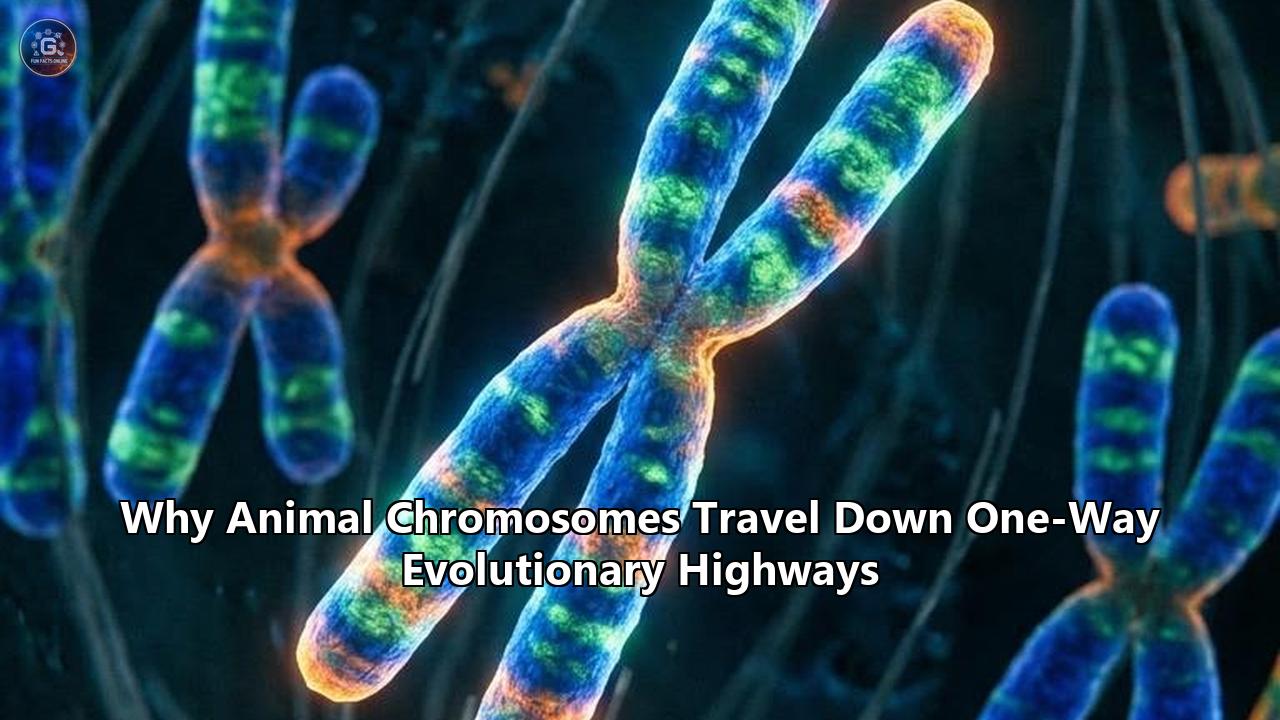
A massive comparative analysis of 5,821 chromosome-scale genomes across 4,454 animal species and 19 phyla has revealed that the physical architecture of animal genomes does not evolve through unrestricted, random shuffling. Instead, animal genomes traverse a restricted network of irreversible "evolutionary highways".
The study, led by researchers at the University of Vienna and published in Science Advances, introduces a computational and mathematical framework known as "evolutionary genome topology". By projecting the chromosomal arrangements of thousands of species across 600 million years of evolutionary history onto a shared coordinate map, the researchers discovered that structural genome reorganization is fundamentally directional. Once chromosomes undergo a specific process called "fusion-with-mixing" (FWM)—wherein separate chromosomes fuse and their constituent genes intermingle through subsequent inversions and intra-chromosomal translocations—the process becomes statistically and biologically impossible to reverse.
"For the first time, we can see thousands of genomes on a single map and trace the unique paths along which animals' DNA evolved," explained lead author Darrin Schultz, who conducted the research at the University of Vienna and is now an assistant professor at Lehigh University. "Viewing the map as a whole gives us a picture of the patterns by which animal genomes have changed over time."
The discovery directly challenges long-held assumptions in evolutionary genomics that have historically modeled genome rearrangement as a largely stochastic, unconstrained process. It also introduces a powerful alternative to sequence-based phylogenetic reconstruction, offering a structural metric to resolve some of the deepest and most contentious branches on the animal tree of life.
                         [ PRECAMBRIAN ANCESTOR ]
                       29 Ancestral Linkage Groups
                                    │
            ┌───────────────────────┴───────────────────────┐
            ▼                                               ▼
   [ ALGEBRAIC HIGHWAY ]                         [ DISSOCIATIVE DETOUR ]
  (Consolidation & Mixing)                     (Non-Algebraic Scattering)
            │                                               │
  • Intrachromosomal shuffling                   • Centric & holocentric fission
  • Irreversible gene entanglement               • High chromosomal dispersion
  • Retained macrosynteny blocks                 • Complete syntenic erasure
            │                                               │
            ▼                                               ▼
  Stable Bilaterians & Cnidarians                Coleoid Cephalopods,
 (Sponges, Corals, Amphioxus, Humans)          Glass Sponges, Annelids
Synteny Topologies vs. Sequence Phylogenetics
For decades, resolving deep animal relationships has relied almost exclusively on sequence-based molecular phylogenetics. This traditional paradigm aligns orthologous nucleotide or amino acid sequences across species to estimate evolutionary trees based on statistical models of sequence substitution.
While sequence phylogenetics has transformed systematic biology, it faces severe mathematical and biological limitations when peering back more than half a billion years into the Precambrian explosion:
- Signal Saturation: Over hundreds of millions of years, multiple mutations hit the same nucleotide or amino acid sites, eroding the phylogenetic signal.
- Long-Branch Attraction (LBA): Fast-evolving lineages accumulate substitutions rapidly, causing analytical software to incorrectly group them together regardless of true relationship.
- Model Misspecification: Assumptions regarding base composition homogeneity and substitution matrices often break down across deeply divergent phyla.
- Incomplete Lineage Sorting (ILS): Rapid ancestral radiations cause gene trees to systematically conflict with species trees.
The topological approach developed by Oleg Simakov, Darrin Schultz, and Daniel Rokhsar bypasses sequence alignment altogether. Instead of comparing individual letter substitutions, it evaluates the presence, absence, and structural mixing of 29 Ancestral Linkage Groups (ALGs)—the foundational chromosomal units that were already present in the single-celled ancestors of all animals over 600 million years ago.
| Analytical Dimension | Sequence-Based Phylogenomics | Evolutionary Genome Topology |
|---|---|---|
| Primary Data Source | Nucleotide or amino acid alignments | Chromosome-level gene linkages (Macrosynteny) |
| Evolutionary Horizon | Highly sensitive to mutation saturation beyond 300–500 Mya | Tracks structural retention across >600–800 Mya |
| Reversibility Assumption | Reversible (Markovian substitution models) | Irreversible (Fusion-with-mixing acts as a ratchet) |
| Vulnerability to Artifacts | Highly susceptible to Long-Branch Attraction | Immune to substitution rate variation |
| Assembly Requirement | Short-read drafts or transcriptomes sufficient | Requires high-fidelity chromosome-scale assemblies |
| Biological Output | Gene trees and branch lengths in substitutions/site | Manifold coordinate maps of structural genome state space |
The methodological shift highlights a sharp operational tradeoff. Sequence-based phylogenomics can be executed using fragmented, low-coverage draft genomes or transcriptomes. Topological mapping requires chromosome-scale assemblies where scaffold lengths match actual biological chromosomes. Until recently, generating chromosome-scale assemblies for non-model organisms was cost-prohibitive. The global expansion of long-read sequencing technologies—such as Pacific Biosciences high-fidelity (HiFi) circular consensus sequencing and Oxford Nanopore ultra-long reads—coupled with high-throughput chromosome conformation capture (Hi-C) has finally generated the critical mass of assemblies required to map animal genome architecture at scale.
The Mechanical Trap: Why Fusion-with-Mixing Cannot Run in Reverse
The core mechanism dictating why animal chromosomes move down one-way streets is the distinction between simple chromosome fusions and fusion-with-mixing.
When two distinct chromosomes—originating from separate ancestral linkage groups, say ALG $A$ and ALG $B$—fuse end-to-end (such as through a Robertsonian translocation or a telomere-to-telomere ligation), they initially form a dicentric or newly stabilized monocentric hybrid chromosome where the genes belonging to ALG $A$ remain segregated on one arm and the genes of ALG $B$ remain on the other. At this early stage, an event known as centric fission could theoretically split the chromosome back along the ancestral junction, cleanly restoring the original two chromosomes.
STAGE 1: Robertsonian / End-to-End Fusion (Reversible)
[ A1 - A2 - A3 - A4 - A5 ] ─── [ B1 - B2 - B3 - B4 - B5 ]
                              │
                              ▼
[ A1 - A2 - A3 - A4 - A5 ─── B1 - B2 - B3 - B4 - B5 ]
(Clean boundary remains: Fission can still cleanly restore A and B)

STAGE 2: Intrachromosomal Rearrangements (Inversions & Transpositions)
                              │
                              ▼
[ A1 - B3 - A4 - B1 - A2 ─── B5 - A5 - B2 - A3 - B4 ]
(The "Mixing" Phase: Boundaries are completely erased)

STAGE 3: Random Chromosome Fission (Irreversible Shattering)
                              │
               ┌──────────────┴──────────────┐
               ▼                             ▼
   [ A1 - B3 - A4 - B1 - A2 ]    [ B5 - A5 - B2 - A3 - B4 ]
          (Fragment X)                  (Fragment Y)
However, as evolutionary time elapses, this clean boundary is systematically erased. Intrachromosomal inversions, transpositions, and localized rearrangements continually shuffle gene order along the length of the fused chromosome. Over millions of years, loci from ALG $A$ and ALG $B$ become thoroughly interspersed.
If a subsequent chromosomal fission event occurs within this mixed chromosome, the double-strand break and subsequent centromeric stabilization will not occur along the original boundary. Instead, the fission cuts through an intermingled array of genes, generating two daughter chromosomes that each carry an inseparable mosaic of both ALG $A$ and ALG $B$ fragments. For these shattered pieces to ever reconstitute the original ancestral linkage groups $A$ and $B$, thousands of independent genomic rearrangements would have to execute in precise reverse order—a statistical impossibility in eukaryotic biology.
MATHEMATICAL FORMULATION OF FUSION-WITH-MIXING

Let an ancestral chromosome state be defined as an ordered set of genes:
  C_A = {g_1, g_2, ..., g_n} ⊂ ALG_A
  C_B = {g'_1, g'_2, ..., g'_m} ⊂ ALG_B

1. Simple Fusion:
  C_F0 = C_A ⌢ C_B = {g_1, ..., g_n, g'_1, ..., g'_m}
  P(Reversal | Fission at junction) ≈ 1

2. Mixing Operation through k Inversions (I):
  C_Fk = (I_k ∘ I_{k-1} ∘ ... ∘ I_1)(C_F0)
  Entropy H(Gene Order) approaches maximum mixing:
  P(g_i is adjacent to g_j | g_i ∈ ALG_A, g_j ∈ ALG_B) > 0

3. Subsequent Fission at arbitrary site s:
  C_Fk ──> C_D1 = {c_1, ..., c_s},  C_D2 = {c_{s+1}, ..., c_{n+m}}
  Where C_D1 ∩ ALG_A ≠ ∅ AND C_D1 ∩ ALG_B ≠ ∅

The probability of restoring ancestral states:
  P(Restoration) = ∏_{i=1}^{k} P(I_i^{-1}) × P(Breakpoint = Junction) ≈ 0
This unidirectional ratchet means that whenever an animal lineage undergoes fusion-with-mixing, it permanently leaves behind its ancestral genomic coordinates. The new structural arrangement becomes the immutable baseline upon which all subsequent mutations, duplications, and rearrangements must build. In the broader landscape of animal chromosome evolution, this irreversibility creates phylogenetic markers that cannot be wiped clean by subsequent homoplasy or convergent sequence substitutions.
Competing Evolutionary Trajectories: Algebraic Consolidation vs. Dissociative Chaos
The global topological map reveals that animal lineages navigate animal chromosome evolution along two sharply contrasting structural paths, branching away from a common baseline of extreme karyotypic stasis.
                                  [ PRE-METAZOAN KARYOTYPE ]
                                    (29 Ancestral Elements)
                                               │
               ┌───────────────────────────────┼───────────────────────────────┐
               ▼                               ▼                               ▼
    [ KARYOTYPIC STASIS ]            [ CONSOLIDATION MODE ]          [ DISSOCIATION MODE ]
 • ~20–30 Chromosomes             • Low chromosome numbers (N=3–12)• High or fractured counts
 • Preserved macrosynteny         • Extensive fusion-with-mixing   • Centric fissions & scattering
 • Corals, Sponges, Scallops,     • Algebraic combinations         • Non-algebraic architecture
   Amphioxus                      • Nematodes, Fruit Flies,        • Coleoid Cephalopods,
                                    Certain Mammals                  Glass Sponges, Earthworms
1. The Anchor of Karyotypic Stasis
The baseline state across the Metazoa is not rapid upheaval, but astonishing architectural preservation. The analysis reveals that the last common ancestor of all animals possessed 29 ancestral linkage groups. Hundreds of modern organisms across wildly divergent ecological niches—including stony corals (Acropora millepora), sea anemones (Nematostella vectensis), Pacific oysters (Crassostrea gigas), yesso scallops (Patinopecten yessoensis), and the lancelet (Branchiostoma floridae)—still maintain their genomes across approximately 20 to 30 chromosomes that map one-to-one with these Precambrian linkage groups.
Despite hundreds of millions of years of divergence and extensive sequence mutation, the macroscopic gene content of their chromosomes has remained virtually unmixed.
2. The Algebraic Consolidation Highway
In lineages following the consolidation trajectory, chromosomes undergo repeated rounds of fusion-with-mixing without extensive chromosome fission. The rate of chromosome fusion drastically outpaces the rate of translocation or structural fission.
The archetypal example of this mode is found in the phylum Nematoda (such as Caenorhabditis elegans), as well as within Drosophila and certain mammalian lineages. Nematodes are notorious for exceptionally high rates of nucleotide sequence substitution, which historically led geneticists to hypothesize that their genomes were thoroughly scrambled.
However, topological mapping reveals that all six chromosomes of C. elegans represent algebraic combinations of the 29 ancestral linkage groups. They condensed their genome down to a few large chromosomes via ordered fusions, yet the ancient modules remain fully identifiable within those compound units.
3. The Non-Algebraic Dissociation Detour
In sharp contrast to algebraic consolidation, certain animal lineages veer off the standard evolutionary highway into a regime of structural dissociation. In these clades, chromosomes undergo rampant, widespread fissions and translocations that scatter ancestral linkage groups into small, disjointed fragments across dozens or hundreds of newly formed chromosomes.
CONSOLIDATION vs. DISSOCIATION ARCHITECTURE

Consolidation (Algebraic):
Ancestral ALGs (1, 2, 3, 4) ──> Chromosome 1: [ALG 1 + ALG 2 (Mixed)]
                            ──> Chromosome 2: [ALG 3 + ALG 4 (Mixed)]
* Result: Low chromosome count, high internal synteny retention.

Dissociation (Non-Algebraic):
Ancestral ALGs (1, 2, 3, 4) ──> Shattered into micro-fragments
                            ──> Dispersed across 40–90 distinct chromosomes
* Result: Syntenic signatures erased; irreducible algebraic state.
Lineages that have taken this dissociative detour include:
- Coleoid Cephalopods (Octopuses, Squids, Cuttlefishes): While the ancestral nautilus preserves ancient macrosynteny, the modern octopus and squid lineages experienced catastrophic chromosomal fission and reorganization, dispersing ancestral modules across 30 to 46 chromosomes.
- Clitellate Annelids (Earthworms and Leeches): Exhibiting massive dissociation, breaking ancestral bilaterian linkage groups into hundreds of scattered sub-elements.
- Hexactinellid Sponges (Glass Sponges): Unlike demosponges, which maintain the ancestral metazoan karyotype, glass sponges underwent intense chromosomal fragmentation.
- Culicine Mosquitoes: Displaying extreme intrachromosomal and interchromosomal scrambles compared to ancestral insect linkage groups (Muller elements).
These dissociative events represent irreversible non-algebraic transformations. Once a genome undergoes whole-scale structural dissociation, it occupies a completely separate, isolated domain of genome architecture space from which it can never return to the ancestral configuration.
Case Study: Resolving the Deepest Branch in the Animal Kingdom
The practical power of viewing chromosomes as one-way highways is best illustrated by the debate surrounding the root of the animal tree of life: Are comb jellies (Ctenophora) or sponges (Porifera) the sister group to all other living animals?
For nearly two decades, phylogenomic studies based on sequence alignments produced contradictory results. Depending on whether researchers used site-heterogeneous amino acid models, Dayhoff recoding, specific outgroups, or trimmed alignments, the phylogenetic tree flipped between "ctenophore-sister" and "sponge-sister," fueling endless methodological disputes.
                     [ HYPOTHESIS A: Sponge-Sister ]
                                (Historical)
                     Non-Animals (Choanoflagellates)
                           │
                           ├── Sponges (Porifera)
                           └── Bilateria + Cnidaria + Ctenophora

                     [ HYPOTHESIS B: Ctenophore-Sister ]
                         (Confirmed by Macrosynteny)
                     Non-Animals (Choanoflagellates, Ichthyosporeans)
                           │
                           ├── Ctenophores (Comb Jellies)
                           │     └─ Shares ancestral, unfused ALGs with unicellular outgroups
                           │
                           └── Sponges + Cnidarians + Bilaterians + Placozoans
                                 └─ United by 7 derived, irreversible Chromosome Fusions
The chromosome topology approach broke the deadlock by analyzing the presence of derived fusion-with-mixing events:
- Unicellular Outgroup Baseline: Researchers assembled chromosome-scale genomes for the closest living single-celled relatives of animals—the choanoflagellate Salpingoeca rosetta, the filasterean amoeba Capsaspora owczarzaki, and the ichthyosporean Sphaeroforma arctica. These single-celled eukaryotes preserve ancestral linkage groups that existed before the emergence of multicellularity.
- Ctenophores Retain Ancient Syntenies: The chromosome architecture of ctenophores (Mnemiopsis leidyi and Pleurobrachia bachei) shares the exact, unfused ancestral linkage arrangements seen in the single-celled outgroups.
- The Shared Irreversible Signature: In contrast, sponges, placozoans, cnidarians (jellyfish, corals), and bilaterians (invertebrates and vertebrates) share seven distinct, complex chromosome fusions with subsequent gene mixing.
Because fusion-with-mixing cannot be undone, these seven chromosomal fusions represent shared derived characters (synapomorphies) that occurred once in the common ancestor of sponges, cnidarians, and bilaterians—after that lineage had already split from the lineage leading to modern ctenophores.
To argue that sponges are the sister group would require ctenophores to independently split all seven fused chromosomes back into their exact ancestral, pre-metazoan configurations—a scenario that defies the laws of genomic probability. Chromosomal topology thus provided unambiguous structural proof that ctenophores are the sister group to all other living animals.
The Highway Network Across Major Phyla
By projecting 5,821 chromosome-scale genomes onto this multidimensional topological space, the research team mapped the specific structural paths traversed by every major animal phylum.
600 Mya (Precambrian)             450 Mya (Paleozoic)                Present Day
  Ancestral Linkage Groups ────────┬── Spiralia ────────────────────── Scallops (Stasis)
           (ALGs 1–29)             │                                 └ Cephalopods (Dissociation)
                                   ├── Ecdysozoa ───────────────────── Insects (Muller Elements)
                                   │                                 └ Nematodes (Consolidation)
                                   ├── Cnidaria / Porifera ────────── Corals & Sponges (Stasis)
                                   └── Deuterostomia ──────────────── Amphioxus (Stasis)
                                                                     └ Vertebrates (2R Duplication)
                                                                        ├ Birds (Microchromosomes)
                                                                        └ Mammals (Rearranged)
1. Invertebrate Deuterostomes and the Chordate Transition
The cephalochordate amphioxus (Branchiostoma) represents one of the most structurally conserved genomes in the animal kingdom. Amphioxus carries 19 chromosomes that map directly to the ancestral metazoan linkage groups with virtually zero interchromosomal mixing.
This stability served as the critical baseline that enabled researchers to decode the origins of vertebrate chromosomes.
2. The Vertebrate 2R Whole-Genome Duplication
Vertebrate evolution was initiated by two rounds (2R) of whole-genome duplication in the ancestral chordate lineage, quadrupling the ancestral genetic repertoire. Following these duplications, vertebrates did not maintain four identical copies of every chromosome; instead, their genomes underwent a defined series of rediploidizations and chromosome fusions.
- Avian Genomes (Birds): Birds maintained an ancient vertebrate karyotype structure, locking their chromosomes into a distinct configuration of large macrochromosomes and numerous, GC-rich microchromosomes that have remained virtually unchanged since the divergence of non-avian theropod dinosaurs.
- Mammalian Genomes: Mammals abandoned this stasis, experiencing accelerated rates of intrachromosomal inversions and interchromosomal translocations, yielding modern human, rodent, and artiodactyl karyotypes that represent highly rearranged mosaics of the duplicated vertebrate linkage groups.
3. Arthropods and the Robustness of Muller Elements
In insects, chromosome evolution is governed by conserved chromosomal units known as Muller elements (labeled A through F in Drosophila). While gene order within each Muller element is scrambled across species via continuous inversions, the overarching gene content of each element rarely leaks onto other chromosomes.
Topological mapping demonstrates that Muller elements are direct descendants of specific ancestral bilaterian linkage groups, showing that insects have traveled along an algebraic consolidation path that preserves structural integrity over 400 million years.
THE INSECT STRUCTURAL MATRIX: MULLER ELEMENTS
  Ancestral ALG Module X ──────> Muller Element A ───[Intense Inversions]───> Drosophila Chromosome XL
  Ancestral ALG Module Y ──────> Muller Element B ───[Intense Inversions]───> Drosophila Chromosome 2L
  Ancestral ALG Module Z ──────> Muller Element C ───[Intense Inversions]───> Drosophila Chromosome 2R
  (Cross-element gene exchanges are strongly suppressed by meiotic selection)
Competing Sequencing Approaches: From Fragmented Contigs to 3D Topologies
The realization that animal genomes operate along topological highways is inextricably linked to a technological transition in how genomic data is generated and assembled. Understanding the strengths and weaknesses of these sequencing platforms explains why this structural map took decades to uncover.
ERA 1: Short-Read Sequencing (Illumina, Sanger)
[ Contig 1 ]  [ Contig 2 ]  [ Contig 3 ]  [ Contig 4 ]  [ Contig 5 ]  (Scattered Scaffolds)
* Problem: Genes are identified, but chromosomal linkage and macrosynteny are invisible.

ERA 2: Long-Read Sequencing + Hi-C Scaffolding (PacBio HiFi, Oxford Nanopore, Omni-C)
[═══════════════════════════════ CHROMOSOME SCALE ═══════════════════════════════]
* Resolution: Complete physical linkage from telomere to telomere reveals macrosynteny highways.
1. Short-Read Drafts vs. Chromosome-Level Assemblies
Prior to 2020, over 90% of all published animal genomes in public repositories (such as NCBI GenBank) were fragmented draft assemblies consisting of tens of thousands of disconnected contigs. While draft assemblies are sufficient for cataloging protein-coding gene repertoires, they are blind to chromosome topology. If two genes from distinct ancestral linkage groups reside on the same chromosome due to an ancient fusion, a fragmented assembly will place them on separate small scaffolds, completely hiding the structural event.
2. PacBio HiFi vs. Oxford Nanopore Ultra-Long
The breakthrough behind the 5,821-genome analysis stems from long-read sequencing technologies:
- PacBio HiFi (Circular Consensus Sequencing): Yields reads between 15 to 25 kilobases with >99.9% base accuracy. This allows bioinformatic assemblers to resolve complex repetitive elements, transposable element insertions, and segmental duplications that previously caused assemblies to break.
- Oxford Nanopore (ONT) Ultra-Long Reads: Capable of generating continuous reads spanning hundreds of kilobases up to several megabases. ONT excels at traversing heterochromatic regions and resolving complex structural breakpoints, though it historically required higher error-correction overhead.
3. Chromosome Conformation Capture (Hi-C)
To bridge the gap between long contigs and physical, biological chromosomes, researchers rely on proximity-ligation technologies (Hi-C and Omni-C). By crosslinking chromatin within intact cell nuclei, digesting DNA with restriction enzymes, and ligating adjacent fragments, Hi-C captures the three-dimensional contact frequency between all loci in the genome.
Because DNA sequences on the same chromosome interact far more frequently with each other than with sequences on different chromosomes, Hi-C contact maps allow algorithms to scaffold millions of base pairs into complete, telomere-to-telomere chromosomes.
COMPARATIVE TECHNICAL PROFILES OF GENOMIC TECHNOLOGIES

Short-Read NGS (Illumina):
  - Read Length: 150–300 bp
  - Accuracy: >99.9%
  - Assembly Metric (N50): Kilobase to low megabase scale
  - Synteny Resolution: Local micro-synteny only; blind to macro-chromosomal fusions.

Long-Read HiFi + Hi-C:
  - Read Length: 15,000–25,000 bp (HiFi) + 3D Proximity Maps
  - Accuracy: >99.99% (Q40+)
  - Assembly Metric (N50): Chromosome-arm to whole-chromosome scale (>50 Mb)
  - Synteny Resolution: Full macrosynteny and topological manifold reconstruction.
3D Genome Architecture: The Selective Barriers Preserving Synteny
If chromosomes are constantly subject to double-strand DNA breaks and cellular stress, what biological forces keep these 29 ancestral linkage groups intact across 600 million years in some lineages, while allowing rapid fusion in others? The answers lie at the intersection of evolutionary constraints, gene regulation, and meiotic mechanics.
       [ TOPOLOGICALLY ASSOCIATING DOMAIN (TAD) & REGULON ARCHITECTURE ]
  ┌────────────────────────────────────────────────────────────────────────┐
  │                                                                        │
  │     Promoter       Enhancer 1             Enhancer 2         Gene B    │
  │        │               │                      │                │       │
  │   [ Gene A ] ──── [ regulatory ] ───────── [ regulatory ] ─── [ Dev ]  │
  │        ▲               ▲                      ▲                ▲       │
  │        └───────────────┴──────────┬───────────┴────────────────┘       │
  │                                   │                                    │
  │                     Insulator Protein Complex (CTCF)                   │
  └────────────────────────────────────────────────────────────────────────┘
  * Physical disruption (translocation break) inside a TAD leads to:
    - Enhancer hijacking (aberrant gene activation)
    - Loss of developmental signaling (embryonic lethality)
1. Topologically Associating Domains (TADs) and Enhancer Compatibility
In the three-dimensional nucleus, DNA is folded into Topologically Associating Domains (TADs)—discrete spatial neighborhoods where genes and their distant cis-regulatory enhancers are physically sequestered. Enhancers within a TAD coordinate the spatiotemporal expression of critical developmental genes (such as Hox, Pax, Sox, and Fox transcription factors).
If a chromosomal translocation or fission event occurs within a TAD, it disrupts enhancer-promoter loops or causes "enhancer hijacking," where a gene is exposed to ectopic regulatory signals, frequently resulting in embryonic lethality. Consequently, large genomic regulatory blocks (GRBs) act as selective anchors, preventing chromosomal breakpoints from slicing through coordinated gene networks.
2. Meiotic Recombination Constraints and Centromere Dynamics
In sexually reproducing animals, homologous chromosomes must pair, synapse, and undergo crossing over during meiosis I. Structural heterozygosity—such as carrying one fused chromosome and two unfused ancestral homologs—often creates complex trivalent configurations during metaphase I.
These configurations can lead to improper spindle attachment, nondisjunction, and aneuploid gametes. Unless a chromosome fusion rapidly fixes within a small, inbred population or provides a significant selective advantage, purifying selection eliminates structural rearrangements, enforcing long-term karyotypic stasis.
3. Holocentricity vs. Monocentricity
The difference between lineages on the stability highway versus those experiencing dissociative scattering often hinges on centromere structure:
- Monocentric Chromosomes: Most animals have a single, localized centromere per chromosome. If a monocentric chromosome experiences a double-strand break, the acentric fragment (lacking a centromere) cannot attach to the spindle apparatus and is lost during cell division. This enforces strong negative selection against chromosome fission.
- Holocentric Chromosomes: In lineages like nematodes (Caenorhabditis) and true bugs (Hemiptera), the centromeric kinetochore proteins assemble along the entire length of the chromosome. If a holocentric chromosome breaks, both fragments retain kinetochore activity and can successfully segregate during meiosis. This drastically lowers the selective barrier to chromosome fusions and fissions, allowing holocentric clades to explore unique trajectories on the topological map.
Applied Genomics: Biodiversity Conservation and Evolutionary Forecasting
The topological framework goes beyond clarifying ancient history; it provides concrete applications for modern conservation genomics and computational evolutionary modeling.
TRADITIONAL CONSERVATION METRICS          TOPOLOGICAL GENOMIC METRICS
┌─────────────────────────────────┐      ┌─────────────────────────────────┐
│ • Allele Frequencies            │  VS  │ • Structural Uniqueness         │
│ • Heterozygosity (H_o, H_e)     │      │ • Topological Manifold Position │
│ • Nucleotide Diversity (π)      │      │ • Irreversible Synteny State    │
│ • Population Bottlenecks        │      │ • Genome Reorganization Limit   │
└─────────────────────────────────┘      └─────────────────────────────────┘
Focus: Short-term demographic health     Focus: Preservation of deep evolutionary legacy
1. Updating EDGE Metrics for Genomic Architectural Uniqueness
Current biodiversity conservation frameworks often rely on EDGE (Evolutionary Distinct and Globally Endangered) scores to prioritize species that represent unique, irreplaceable branches on the phylogenetic tree.
Topological mapping provides a structural genomic metric for EDGE scoring. Species that occupy isolated, extreme outlier regions on the genome architecture map—such as highly divergent deep-sea glass sponges, unique cephalopods, or relict lineages like the tuatara—contain structural genomic organizations found nowhere else on Earth. If these species go extinct, their irreplaceable chromosomal states are permanently lost from the planet's evolutionary catalog.
2. Simulating Future Evolutionary Trajectories
Because animal chromosome evolution functions as a set of irreversible, directional pathways, the mathematical manifolds developed by the University of Vienna team enable researchers to run forward simulations. By calculating the transition probabilities between current chromosomal states and potential future fusions or translocations, computational biologists can model where genomes can and cannot evolve next.
Lineages that have already progressed far down the consolidation highway have effectively exhausted their structural degrees of freedom, locking their regulatory machinery into rigid chromosomal blocks. In contrast, lineages retaining unfused ancestral linkage groups preserve higher combinatorial flexibility for future evolutionary trajectories.
The Horizon of Chromosome Biology
The mapping of animal chromosome evolution across 5,821 genomes establishes that chromosomal architecture is not a passive, neutral backdrop to point mutations, but an active, irreversible historical record. The transition from sequence-only phylogenetics to structural genome topology marks a major turning point in our ability to reconstruct the tree of life, resolve ancient evolutionary radiations, and understand the physical rules governing eukaryotic genomes.
                     [ UPCOMING MACROGENOMIC MILESTONES ]
                                      │
  ┌───────────────────────────────────┼───────────────────────────────────┐
  ▼                                   ▼                                   ▼
[ Earth BioGenome Project ]     [ Pangenome Chromosome Graphs ]     [ Functional Mechanics ]
Target: Telomere-to-telomere    Target: Mapping structural          Target: Decoupling TAD
assemblies for all 1.8 million  variation within species to catch   disruption from fitness costs
described eukaryotic species    the birth of new "Highways"         via CRISPR architectural editing
Several key questions and technical milestones will shape the next decade of research:
- Completion of the Earth BioGenome Project: As global initiatives like the Darwin Tree of Life and Earth BioGenome Project work toward generating chromosome-level assemblies for hundreds of thousands of species, the topological coordinate map will increase in resolution, illuminating the transition zones where rare fusions occurred.
- Intraspecific Chromosome Graph Pangenomics: Moving from single reference genomes per species to population-level pangenomes will reveal the earliest stages of chromosomal consolidation, showing how fusion-with-mixing transitions from a low-frequency structural variant in a population to an irreversible, fixed feature of an entire clade.
- Functional Validation of Syntenic Constraints: Combining chromosome topology maps with high-throughput CRISPR structural rearrangements will allow researchers to systematically test why specific gene linkages resist fission, directly measuring the fitness costs of breaking ancient syntenic bonds.
By charting the one-way highways of the genome, comparative genomics has revealed that life does not merely drift through an infinite sea of structural possibilities. Instead, animal chromosomes carry an indelible record of where they have traveled—a physical architecture sculpted by half a billion years of history, marching along evolutionary paths that can never turn back.
Reference:
- https://www.researchgate.net/publication/412828534_Topological_mixing_and_irreversibility_in_animal_chromosome_evolution
- https://www.miragenews.com/largest-ever-animal-genomes-comparison-unveiled-1730616/
- https://www.sciencedaily.com/releases/2026/08/260824065514.htm
- https://www.univie.ac.at/en/news/detail/roadmap-of-animal-biodiversity-largest-ever-comparison-of-chromosome-scale-genomes
- https://www.biorxiv.org/content/10.1101/2024.07.29.605683v1.full
- https://escholarship.org/uc/item/4d85n8nt
- https://ideas.repec.org/a/nat/nature/v618y2023i7963d10.1038_s41586-023-05936-6.html
- https://pmc.ncbi.nlm.nih.gov/articles/PMC8809688/
- https://qb3.berkeley.edu/news/reconstructing-the-chromosomes-of-the-earliest-animals-on-earth/
- https://bioengineer.org/largest-ever-chromosome-scale-genome-comparison-maps-animal-biodiversity/
- https://www.darwintreeoflife.org/
- https://www.researchgate.net/publication/358308733_Deeply_conserved_synteny_and_the_evolution_of_metazoan_chromosomes
- https://www.vienna.at/viennese-researchers-discover-evolutionary-highways-in-animal-genomes/10406276
- https://ucrisportal.univie.ac.at/en/publications/topological-mixing-and-irreversibility-in-animal-chromosome-evolu/
- https://www.zsl.org/what-we-do/projects/darwin-tree-life-project