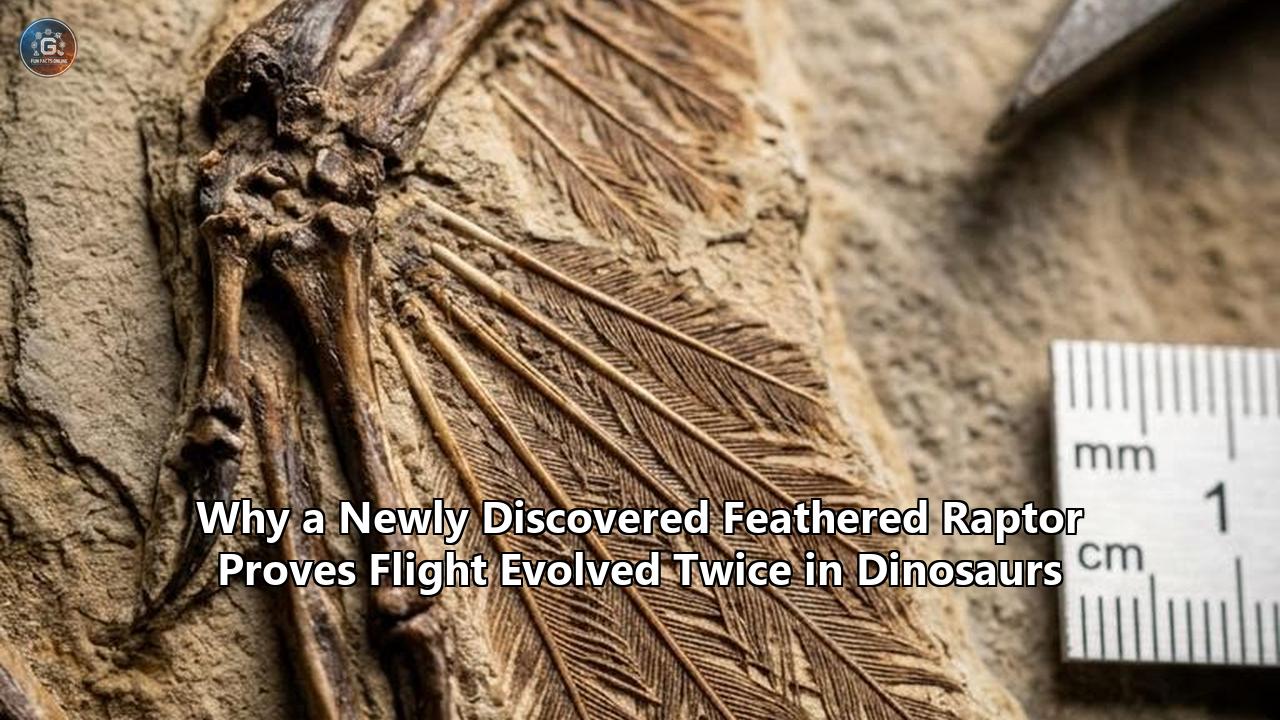
An exquisitely preserved, four-winged predator unearthed from the Early Cretaceous rocks of northeastern China has delivered definitive physical evidence that powered aerial locomotion arose independently in non-avian dinosaurs, dispelling the long-held assumption that the mechanics of flight were invented only once along the direct lineage leading to birds.
The newly described species, Norellraptor barsboldi, published in Nature Communications by an international team of paleontologists led by Xuri Wang of the Chinese Academy of Geological Sciences and Andrea Cau of the OPHIS Paleontological Museum, establishes that microraptorine dromaeosaurids constructed their own aerodynamic flight apparatus from scratch. While these agile predators developed wings, enlarged sternal plates, and asymmetrical flight feathers that closely resemble those of early avialans, a comprehensive anatomical and osteohistological analysis shows they assembled these adaptations through a developmental and chronological sequence fundamentally distinct from true birds.
The finding resolves decades of intense debate surrounding the origins of vertebrate flight. Rather than representing a direct branch of proto-birds or degenerate descendants of an ancestral flyer, microraptorines engineered a parallel solution to aerodynamic lift. The discovery marks a decisive turning point in the study of dinosaur flight evolution, proving that the Mesozoic sky was colonized not along a solitary evolutionary highway, but through repeated, convergent experiments across distinct theropod lineages.
                     ┌─── Scansoriopterygidae (Yi qi, Ambopteryx)
                     │     └── Membranous aerodynamic surfaces
                     │
── Paravian Stem ────┼─── Avialae (Archaeopteryx, Confuciusornis, Modern Birds)
                     │     └── Independent Origin I: Bipedal, two-winged flapping flight
                     │
                     └─── Dromaeosauridae (Microraptorinae: Norellraptor, Microraptor)
                           └── Independent Origin II: Four-winged aerial apparatus
The Lamadong Specimen: Anatomy of a Cretaceous Hunter
The fossil at the center of the discovery—designated holotype 130108-MHGU-F4281 and housed at the Museum of Hebei GEO University—was recovered from the laminated lacustrine siltstones of the Jiufotang Formation near Lamadong town in Jianchang County, Liaoning Province. Radiometric dating places the fossiliferous horizon between 120 and 124 million years old, a window corresponding to the Barremian-Aptian transition of the Early Cretaceous. During this interval, explosive volcanic activity across eastern Asia repeatedly smothered flourishing temperate ecosystems in fine ash, creating the exceptional taphonomic conditions of the Jehol Biota.
The specimen is a nearly complete, articulated skeleton measuring precisely 57 centimeters from the premaxilla to the tip of the caudal series. Preserved in two dimensions on a split slab, it exhibits anatomical details including carbonized feather halos, claws, and articulated gastralia. Morphological measurements indicate a living mass of roughly one kilogram, approximately the weight and dimensions of a modern common raven or American crow.
The genus name Norellraptor honors the late American Museum of Natural History paleontologist Mark Allen Norell, while the species epithet barsboldi commemorates the veteran Mongolian researcher Rinchen Barsbold. Both scientists spent decades laying the morphological groundwork for paravian theropod classification.
+--------------------------------------------------------------------------+
|                  NORELLRAPTOR BARSBOLDI: SPECIMEN METRICS                |
+--------------------------+-----------------------------------------------+
| Catalog Number           | 130108-MHGU-F4281                             |
| Total Skeletal Length    | 57 cm (22.4 inches)                           |
| Estimated Adult Mass     | ~0.95–1.05 kg                                 |
| Locality / Formation     | Lamadong, Jianchang, Liaoning / Jiufotang Fm  |
| Chronostratigraphic Age  | Early Cretaceous (~120–124 Ma)                |
| Histological Age         | >= 3 years (subadult/adult threshold)         |
| Overlapping Flight Syn.  | 57 of 194 anatomical traits (29.4%) with Aves |
+--------------------------+-----------------------------------------------+
The physical layout of the fossil reveals an animal built for predatory agility. Its skull houses recurved, ziphodont dentition featuring fine serrations along the distal margins, matched with enlarged orbital cavities indicative of keen binocular vision. Its feet retain the hyperextensible, trenchant second pedal digit—the classic dromaeosaurid "killing claw"—alongside a gracile metatarsus.
The animal's integument provides critical details. Clear carbonaceous impressions demonstrate that pennaceous, veined flight feathers erupted not only along the posterior margins of the ulna and manual digits, but also sprouted as long, distinct airfoils along the distal half of the tibia and metatarsus. Combined with a fan of stabilizing remiges anchored along the stiffened distal vertebrae of the tail, Norellraptor operated as a four-winged biplane system.
To resolve whether the diminutive size and specialized proportions represented a juvenile condition or a mature animal, the researchers subjected the cortical bone of the left radius to petrographic thin-sectioning. The bone microstructure exhibited dense secondary remodeling, a well-formed external cortex, and at least three distinct lines of arrested growth (LAGs).
"The radius cross-sections verify that this individual was at least three years of age when it died," explains Andrea Cau. "It was not a juvenile still developing basic limb dimensions. It was an anatomically mature subadult that had crossed the developmental threshold into skeletal stability, giving us confidence that the wing proportions and muscular insertion scars we observe reflect its functional adult lifestyle".
Mapping 194 Anatomical Adaptations
Determining whether shared traits between two organisms stem from common descent (homology) or separate evolutionary responses to identical environmental demands (homoplasy) requires tracing character polarity through deep time. To unravel this, the research team scored Norellraptor across a phylogenetic data matrix comprising 194 discrete morphological changes specifically tied to aerial locomotion, aerodynamic control, and skeletal lightweighting across Coelurosauria.
The resulting statistical mapping yielded a clear metric: of the 194 anatomical innovations traced across the microraptorine radiation, roughly 30 percent (57 traits) are identical to those documented along the avian stem line that produced Archaeopteryx, Jeholornis, and modern Neornithes.
The remaining 70 percent of their architectural features diverged sharply. The critical signal emerged not merely from the list of physical traits, but from the strict chronological sequence in which each lineage acquired them.
=============================================================================
         COMPARATIVE TRAIT ASSEMBLY: NON-AVIAN RAPTORS VS. BIRDS
=============================================================================

Trait Category        Microraptorine Sequence        Avialan (Avian) Sequence
-----------------------------------------------------------------------------
Manual Digits         Phalanges shortened early      Phalanges remain elongated
                      in evolutionary sequence;      until late-stage wrist
                      manus remains unfused.         fusion (carpometacarpus).

Wrist Mechanics       Limited lateral carpal         Early evolution of the
                      flexion; semilunate carpal     semilunate carpal permitting
                      maintains raptorial grip.      tight transverse wing folding.

Pectoral Girdle       Sternal plates fuse late;      Coracoid struts and furcula
                      reliance on elongated          develop early; triosseal
                      scapular blade attachments.    canal evolves for upstroke.

Pelvic Elements       Pubis retroverted without      Pubis fully retroverted early;
                      fusion; ischia develop         ischium modifies to lighten
                      distal processes for drag.     pelvis for bipedal takeoff.

Aerodynamic Surfaces  Quadruple airfoils (forelimb   Bipedal reliance; rear limbs
                      and hindlimb pennaceous        divested of flight feathers
                      flight feathers).              to optimize launch kinetics.
=============================================================================
In the lineage leading directly to true birds, skeletal alterations to the shoulder girdle and wrist occurred first. Avialans developed a mobile, crescent-shaped semilunate carpal early in their history, an innovation that allowed the hand to fold laterally against the forearm to protect long primary feathers while on the ground. Only later did birds reduce the relative length of their fingers and consolidate the bones of the hand into a fused carpometacarpus.
Norellraptor and its microraptorine kin inverted this sequence. In these dromaeosaurids, the manual phalanges shortened drastically at the very base of the clade—a modification likely intended to maintain the mechanical stiffness required to support feather quills without snapping under aerodynamic shear. Yet their wrists remained flexible in a predatory, grasping plane, lacking the specialized folding hinge that characterizes avian carpal architecture.Differences extend into the thoracic cavity. While birds stabilized their flight stroke through an early-evolving, strut-like coracoid anchored to a deeply keeled, single-piece ossified sternum, Norellraptor utilized paired sternal plates that fused much later in the evolutionary timeline. The micro-raptors anchored their flight muscles across a broadened anterior thoracic cage supported by expanded rib-sternum lateral connections. These mechanical workarounds provided structural rigidity during flapping cycles while preserving an intact, predatory chest cavity.
"When you observe identical structures appearing in differing chronological orders across two lineages, common ancestry of that specific trait is mathematically rejected," Cau noted. "Birds and microraptorines were building two different mechanical airframes using the same ancestral theropod parts bin. They ended up at a similar aerodynamic destination, but they traveled along completely separate evolutionary roads".
Lineage Divergence Point
       │
       ├─► Avialan Route:      Shoulder Mobility ──► Carpal Hinge ──► Phalangeal Reduction
       │
       └─► Microraptor Route:  Phalangeal Reduction ──► Thoracic Bracing ──► Late Sternum Fusion
Dismantling the Single-Origin Consensus
For more than a century, vertebrate paleontology operated under the core assumption that the origin of avian flight was a singular macroevolutionary event. The discovery of Archaeopteryx lithographica in 1861 within the Solnhofen limestones of Germany cemented the idea of a tidy, direct lineage running from small, ground-dwelling coelurosaurian dinosaurs straight into the air. When John Ostrom documented the profound skeletal similarities between Deinonychus and Archaeopteryx during the late 1960s and 1970s, he proved beyond reasonable doubt that birds were living dinosaurs.
Yet Ostrom’s insight fostered an unintentional dogmatism: the premise that flight-related adaptations were too anatomically complex to have arisen more than once among theropods. Under this orthodox model, any non-avian dinosaur displaying aerodynamic feathers, elongated forelimbs, or a retroverted pubis was interpreted either as a direct ancestor of birds or as a secondarily flightless descendant that had abandoned the skies, analogous to the modern ostrich or emu.
The unearthing of Microraptor zhaoianus and Microraptor gui from Liaoning in the early 2000s complicated this neat narrative. The presence of extensive primary flight feathers on their metatarsals rattled avian specialists.
A camp of researchers argued that these four-winged raptors represented an evolutionary relic—a living realization of the hypothetical "Tetrapteryx" stage proposed by American naturalist William Beebe in 1915. In their view, four-winged gliding was the ancestral condition for all of Paraves, an ancient shared foundation that birds refined into two-winged flapping while dromaeosaurids eventually discarded it entirely.
Orthodox Single-Origin Hypothesis (Rejected by Norellraptor Data):
Paravian Ancestor (Flight Evolved Once) ──► Shared Tetrapteryx Stage ──┬──► Avialae (Retained flight)
                                                                      │
                                                                      └──► Dromaeosauridae (Lost/degenerated)

Convergent Dual-Origin Reality (Supported by Norellraptor Data):
Non-flying Paravian Ancestor (Feathered) ──┬──► Avialae (Flight Origin 1: Modern avian architecture)
                                          │
                                          └──► Microraptorinae (Flight Origin 2: Four-winged raptor framework)
The anatomical sequence documented in Norellraptor barsboldi renders that single-origin hypothesis untenable. If Microraptor and Norellraptor were secondarily flightless descendants of an ancestral flying paravian, their lineage should show degeneration or direct inheritance of early avian wrist and shoulder structures.
Instead, the baseline members of Microraptorinae lack aerodynamic traits entirely, while derived members progressively accumulate novel, specialized adaptations that bear no ancestral trace of avian carpal hinges or strut-like coracoids.
The character analysis proves that basal microraptorines were strictly cursorial. The clade moved toward aerodynamic capability incrementally, evolving forearm length, quill knobs, and asymmetrical vanes independently over an estimated 15-million-year period following their split from the troodontid-avian node.
The implications cascade through our understanding of dinosaur flight evolution, showing that the physical capacity to harvest aerodynamic lift was an accessible evolutionary threshold that multiple paravian lines crossed independently.
Biomechanical Realities: Four Wings Against Gravity
To establish that Norellraptor was truly airborne and not merely an ornate glider, the authors executed detailed biomechanical reconstructions calculating the animal's wing area, aspect ratio, wing loading, and center of mass. The presence of asymmetrical feathers is a critical physical proxy.
In modern birds, symmetrical pennaceous feathers are restricted to display plumage or birds that have lost the power of flight; aerodynamically functional flight remiges require an asymmetrical vane layout to prevent twisting under fluid pressure and to act as individualized aero-valves during downstroke and upstroke cycles. The primary feathers on the forelimbs of Norellraptor display an asymmetry ratio of 3.2 to 1, falling comfortably within the functional range of extant, flapping birds.
=============================================================================
         AERODYNAMIC PROFILE: NORELLRAPTOR VS. EXTANT ANALOGUES
=============================================================================

Taxon                     Wingspan   Body Mass   Wing Loading   Aspect Ratio
-----------------------------------------------------------------------------
Norellraptor barsboldi     0.78 m     1.02 kg     0.41 g/cm²     5.8 (Medium)
Corvus brachyrhynchos      0.90 m     0.45 kg     0.32 g/cm²     6.1 (Active flier)
Microraptor gui            0.82 m     1.00 kg     0.44 g/cm²     5.4 (Glider/Flapper)
Falco sparverius           0.55 m     0.12 kg     0.28 g/cm²     6.8 (High lift)
=============================================================================
The reconstructed wing loading of Norellraptor—the ratio of total body mass to lifting surface area—averages 0.41 grams per square centimeter. In living birds, any value below 1.0 gram per square centimeter permits steady, powered flight, while values under 0.5 grams per square centimeter enable burst takeoff from level ground without relying on elevation or high headwinds.
The animal's hindlimb wings, while useless for modern avian-style terrestrial running, provided an auxiliary lifting surface that lowered its stall speed and allowed for tight cornering through dense understory growth.
Independent experts have largely corroborated these biomechanical parameters while noting the distinct physical constraints under which Norellraptor operated.
"Microraptors were operating under a completely different flight envelope than early avialans like Archaeopteryx or Confuciusornis," says Michael Pittman, a vertebrate paleontologist at the Chinese University of Hong Kong who has studied the aerodynamics of feathered theropods. "The inclusion of large metatarsal feathers changes how the animal stabilizes pitch and yaw. While a modern bird relies primarily on its tail fan (uropatygium) and pectoral stroke for trim, Norellraptor could modulate its aerodynamic balance by splaying and angling its hindlimbs".
AERODYNAMIC LIFT SURFACES: NORELLRAPTOR BARSBOLDI

           [ Forelimb Primary Wing ] ─── Flapping Lift Generation
                     │
         [ Hindlimb Auxiliary Wing ] ─── Pitch Stability & Stall Reduction
                     │
           [ Tail Feathers Fan ]     ─── Yaw Control & Directional Trim
Pittman's aerodynamic models suggest that Norellraptor generated powered propulsion via high-frequency, shallow-amplitude wing strokes rather than the deep, vertical flapping excursion utilized by ducks or pigeons.
Because microraptorines lacked the advanced triosseal canal—the pulley-like skeletal conduit in modern birds that allows the supracoracoideus muscle to elevate the wing from below—their upstroke relied on dorsal shoulder musculature, specifically the deltoideus complex. This limited the maximum power of their upward recovery stroke.
To compensate, the animal’s low wing loading and secondary hindlimb lift allowed it to maintain altitude and execute rapid gliding bounds interspersed with bursts of active flapping.
Expert Reactions and Scientific Friction
The formal description of Norellraptor has energized the international paleontological community, highlighting points of consensus while bringing lingering taxonomic disputes to the surface.
Rui Pei, a paleontologist at the Institute of Vertebrate Paleontology and Paleoanthropology (CAS) who was not involved in the original study, affirmed the significance of the paper's phylogenetic rigor.
"The anatomical sequence presented in this study provides solid support for the dual-origin model," Pei says. "For years, the field was divided into those who viewed microraptors as aerial dead-ends and those who tried to shoehorn them into the direct bird lineage. The realization that they developed flight along a completely separate vector from stem-avialans resolves long-standing incongruities in the fossil record. It demonstrates that microraptors acquired traits convergent with the early evolutionary stages of true birds, albeit through a distinct evolutionary pathway, supporting the hypothesis that flapping flight evolved independently in non-avialan dinosaurs and birds".
=============================================================================
                  EXPERT CONSENSUS & COMPETING PERSPECTIVES
=============================================================================

Scientist             Institution               Core Scientific Assessment
-----------------------------------------------------------------------------
Andrea Cau            OPHIS Museum              Disproves single-origin dogma;
(Lead Author)                                   identifies a non-overlapping
                                                sequence of flight assembly.

Rui Pei               Chinese Academy           Confirms convergent pathway;
(Independent)         of Sciences               endorses distinct mechanical
                                                solutions to flapping thresholds.

Scott Hartman         Univ. of Wisconsin-       Validates aerial capacity but
(Independent)         Madison                   cautions against assuming long-
                                                range endurance over burst flight.

Hans Larsson          McGill University         Highlights explosive Late Jurassic
(Independent)                                   radiation of experimental wing
                                                morphologies across Paraves.
=============================================================================
Yet some researchers urge caution regarding how far the term "powered flight" is stretched. Scott Hartman, a vertebrate paleontologist and functional morphologist at the University of Wisconsin-Madison, emphasizes the distinction between brief aerodynamic maneuvers and sustained, long-distance aerial locomotion.
"There is no doubt that Norellraptor had crossed an aerodynamic threshold," Hartman notes. "Its wing loading calculations and feather asymmetry confirm that it was doing real work in the air. But we must avoid picturing this animal flying across miles of open ocean like an albatross. The absence of a vaulted acrocoracoid process and the configuration of its scapulocoracoid joint mean that its metabolic and muscular expenditure during sustained flapping would have been punishingly high. It was likely a supreme arboreal and ambush specialist—bursting from branches, engaging in short powered pursuit flights, and banking between trees with unmatched agility".
Other paleontologists point out the complex phylogenetic placement of related ambiguous taxa. Hans Larsson of McGill University notes that acknowledging multiple origins of flight requires rethinking several problematic forms across the Late Jurassic and Early Cretaceous.
"Once you accept that flight evolved twice within Paraves, you must reckon with the fact that it might have evolved three or four times," Larsson says. "Where do the scansoriopterygids like Yi qi fit, with their membranous, bat-like skin wings? What do we do with Rahonavis from Madagascar, which has clear quill knobs on its ulna but sits uncomfortably close to large, ground-dwelling unenlagiines? Norellraptor clarifies the microraptor story, but it also demonstrates that dinosaur flight evolution was a chaotic, wide-ranging phenomenon across the Mesozoic".
Mesozoic Aerial Locomotion Clades:
• Avialans (e.g., Archaeopteryx): Two-winged pennaceous flapping fliers
• Microraptorines (e.g., Norellraptor): Four-winged pennaceous burst fliers / gliders
• Scansoriopterygids (e.g., Yi qi, Ambopteryx): Membranous bat-winged tree-dwellers
Ecology of the Jehol Forest Canopy
The emergence of independent flight capabilities in microraptorines cannot be understood in isolation from the lush, highly competitive environment in which Norellraptor lived. The Early Cretaceous Jiufotang Formation represents a inland ecosystem defined by expansive freshwater lakes, active volcanic arcs, and temperate forests dominated by conifers, ginkgoes, cycads, and seed ferns.
This multi-tiered arboreal habitat was densely populated. Competition for prey and living space was fierce. In the understory and soil, ancestral mammals such as Eomaia, Sinodelphys, and Repenomamus scurried through the leaf litter.
In the canopy, an array of early enantiornithine birds—the dominant group of toothed, clawed avian fliers of the Cretaceous—flourished, while an assortment of pterosaurs occupied the skies above open lakes.
       Cretaceous Jiufotang Forest: Spatial and Aerial Stratification

High Open Sky    │  Pterosaurs (e.g., Liaoningopterus, Chaoyangopterus)
                 │
Upper Canopy     │  True Birds / Enantiornithes (e.g., Eoenantiornis, Bohaiornis)
                 │
Mid Canopy       │  Microraptorines (Norellraptor, Microraptor) ◄── [Agile Ambush]
                 │
Understory/Floor │  Mammalia (Eomaia), Lizards, Non-flying Theropods (Sinornithosaurus)
For a 57-centimeter predator like Norellraptor, the capacity to launch into the air was an effective ecological strategy. The animal was not competing directly with soaring pterosaurs or highly maneuverable stem birds for open aerial space.
Instead, it operated within the vertical complexity of the forest. Its gut contents and dental morphology suggest a generalist carnivorous diet centered on small mammals, squamate lizards, amphibians, and nestling birds.
Access to an independent aerial pathway offered three distinct ecological dividends:
- Energy-Efficient Movement Through Dense Forest: Moving between widely spaced trees by climbing down to the ground and running across the predator-strewn forest floor carried an enormous metabolic cost and severe predation risk from larger theropods like compsognathids and tyrannosauroids. Parachuting and flapping between canopies eliminated these hazards.
- Three-Dimensional Ambush Dynamics: The combination of asymmetrical wings and a rudder-like feathered tail allowed Norellraptor to stoop upon arboreal prey from above, utilizing high lift to brake sharply before impact.
- Wing-Assisted Incline Running (WAIR): Before fully crossing the threshold into level-ground takeoff, the early proto-wings of microraptorines likely provided downward aerodynamic force, pressing the animal’s feet against steep tree trunks to permit vertical running up bark surfaces to escape danger.
In this light, convergent evolution of flight was an expected biological response to the opportunities of the Cretaceous canopy. Just as modern flying squirrels, sugar gliders, and colugos developed similar gliding membranes along distinct mammalian lineages to exploit forest structures, microraptorines and avialans independently leveraged their ancestral plumage to conquer the vertical dimensions of the ancient world.
Anatomy Under Parallel Selective Pressures
The evolutionary mechanisms that allow unrelated lineages to arrive at identical mechanical structures—known to evolutionary biologists as convergent evolution or homoplasy—depend heavily on the architectural baseline inherited from their shared ancestor.
Neither Norellraptor nor early birds invented feathers to fly. Paleontological discoveries over the past three decades have conclusively shown that filamentous proto-feathers, and later complex pennaceous quills, evolved in basal coelurosaurs for thermoregulation, brood brooding, and visual mating displays long before aerodynamic forces came into play.
                           ANCESTRAL COELUROSAURIAN
                       [Pennaceous Feathers + Bipedalism]
                                       │
                     ┌─────────────────┴─────────────────┐
                     ▼                                   ▼
          AVIALAN TRAJECTORY                 MICRORAPTORINE TRAJECTORY
  • Forelimb specialization only      • Quadruple-wing configuration
  • Carpal hinge evolution            • Phalangeal shortening
  • Fusion: Carpometacarpus           • Sternal plate expansion
  • Strut-like single coracoid        • Deltoideus-driven upstroke
  • Supracoracoideus triosseal pulley • Tail-and-leg pitch stabilization
When changing environmental pressures favored aerial locomotion, both lineages were drawing from the same underlying developmental toolkit. Both groups possessed hollow, thin-walled pneumatic bones that drastically reduced skeletal mass without sacrificing tensile strength.
Both possessed an expanded, ossified furcula (wishbone) capable of acting as an elastic spring during physical exertion. Both possessed interlocking barbs and barbules on their pennaceous feathers, providing an airtight aerodynamic plane.
Yet the divergence in how these elements were assembled reveals the presence of distinct mechanical constraints:
1. Wing Topology and Muscular Anchorage
Birds achieved flapping power by modifying their ventral musculature. They evolved a deep, keel-like carina on their ossified sternum to anchor the massive pectoralis major muscle (for the power stroke) and rerouted the supracoracoideus via the triosseal canal to pull the humerus upward from below.
Norellraptor solved this challenge by distributing the mechanical loads across its lateral rib cage. Its sternum formed broad, flattened plates lacking a deep keel. The force required for its downstroke was anchored across enlarged, forward-curving coracoids and heavily reinforced sternal ribs, while its upstroke relied entirely on enlarged dorsal shoulder muscles anchored to an elongate, strap-like scapular blade.2. Digital Consolidation vs. Functional Claws
In early birds, the grasping function of the hand was rapidly subordinated to the mechanical needs of the wing. The fingers became streamlined, the third digit was reduced to a slender splint, and manual mobility was constrained to the lateral flapping plane.
Norellraptor retained long, viciously curved manual unguals on all three digits, alongside an unfused manus. To ensure that flight feathers could withstand aerodynamic loads without peeling away from flexible finger joints, the microraptorines shortened the intermediate phalanges while expanding the base of the metacarpals, maintaining predatory utility without compromising wing rigidity.Bird Wing Hand (Avialan):
[Carpometacarpus] ──► Fused, rigid block; fingers reduced to structural struts; minimal predatory grip.
Norellraptor Hand (Microraptorine):
[Unfused Manus] ──► Shortened intermediate phalanges; mobile joints; predatory raptorial claws retained.3. Bipedal Takeoff vs. Four-Winged Gliding Aerodynamics
Modern birds are bipedal launch specialists; their powerful hindlimbs provide greater than 80 percent of the kinetic energy required to propel them into the air, after which the forelimbs assume the aerodynamic work.
In Norellraptor, the hindlimbs were heavily feathered all the way to the digits, severely restricting their effectiveness as fast-running terrestrial struts. Launching into the air likely occurred through drop-launches from elevated perches or via steep, wing-assisted leaps rather than a prolonged horizontal runway sprint. Once airborne, these feathered legs transformed into variable-camber lift generators, an aerodynamic design not seen in any bird alive today.
Technical Analysis of the Jiufotang Formation Stratigraphy
The recovery of Norellraptor barsboldi expands our understanding of the biostratigraphic distribution of flight adaptations within the Mesozoic rocks of northeastern China. The volcanic-sedimentary deposits of the Jehol Group are subdivided into two major sequential units: the older Yixian Formation (spanning roughly 125 to 129 million years ago) and the overlying Jiufotang Formation (spanning roughly 120 to 124 million years ago).
=============================================================================
             CHRONOSTRATIGRAPHIC SUCCESSION OF THE JEHOL BIOTA
=============================================================================

Stratigraphic Unit     Age Range       Key Aerodynamic Taxa Recovered
-----------------------------------------------------------------------------
Jiufotang Formation    120–124 Ma      Norellraptor barsboldi (Four-winged dromaeosaur)
(Upper Jehol)                          Microraptor gui (Derived four-winged raptor)
                                       Jeholornis prima (Long-tailed early avialan)
                                       Confuciusornis sanctus (Short-tailed pygostylian)
-----------------------------------------------------------------------------
Yixian Formation       125–129 Ma      Sinornithosaurus millenii (Basal dromaeosaur)
(Lower Jehol)                          Caudipteryx zoui (Oviraptorosaur, display plumage)
                                       Liaoningosaurus paradoxus (Armored ankylosaur)
                                       Archaeopterygidae indeterminate (Stem birds)
=============================================================================
The temporal distribution of these fossil horizons shows that microraptorines were diversifying and refining their four-winged architecture in the Jiufotang Formation alongside fully flight-capable, pygostyle-bearing avialans like Confuciusornis. This co-occurrence conclusively proves that microraptors were not primitive precursors that gave rise to birds, nor were they outcompeted when true birds appeared.
They represented a successful, stable ecological radiation of non-avian carnivores that occupied specialized aerial niches alongside true avians for tens of millions of years.
Sedimentological analysis of the Lamadong fossil site indicates that Norellraptor died during an episode of ash fallout. The presence of unbroken skeletal elements, unscattered manual claws, and the preservation of delicate, semi-transparent feather sheaths confirm minimal post-mortem transport.
The animal suffocated or was stunned by volcanic gas, dropped into an anoxic, calm lacustrine environment, and was rapidly interred beneath a layer of silica-rich tuffaceous mud. This micro-environment prevented scavengers, bottom-dwelling burrowers, or water currents from disturbing the body, preserving soft-tissue anatomy that would have been destroyed in open sandstone or floodplain environments.
Future Frontiers: Imaging and Excavation Horizons
The identification of Norellraptor barsboldi provides new insights while opening fundamental lines of inquiry for field researchers and evolutionary biologists. Paleontologists are preparing new field seasons focused on the lower horizons of the Yixian Formation, seeking older, transitional microraptorian specimens from the Hauterivian stage to pinpoint the initial emergence of this parallel lineage.
                     IMMEDIATE RESEARCH INITIATIVES
                                   │
      ┌────────────────────────────┼────────────────────────────┐
      ▼                            ▼                            ▼
[Synchrotron micro-CT]    [Laser-Stimulated Fluo.]     [Deep Yixian Fieldwork]
Map 3D internal bone      Illuminate soft-tissue       Isolate earliest basal
architecture & hollow     patagia, muscles, and        transitional microraptorines
vascular networks.        feather follicle roots.      from Hauterivian strata.
Advanced analytical techniques will soon reveal details from the holotype. The specimen is scheduled for synchrotron radiation micro-computed tomography (SR-μCT) at the Shanghai Synchrotron Radiation Facility. This non-destructive, sub-micron imaging will map the internal pneumatic chambers within the vertebrae and limb bones, establishing whether Norellraptor possessed an avian-style respiratory system featuring unidirectional airflow and extensive air sac integration into its skeletal frame.
Laser-Stimulated Fluorescence (LSF)—a technique utilizing high-powered ultraviolet lasers to excite faint fluorescence in minerals and preserved organics—is also being applied to the fossil's wing surfaces. Preliminary trials on other Liaoning theropods have exposed previously invisible details, including propatagium soft-tissue flight membranes across the front of the elbow, muscle margins, and feather quill attachment sites.
Applying LSF to Norellraptor will allow biomechanical engineers to reconstruct the exact aerodynamic camber of its wings, testing whether skin flaps bridged the gap between its feathered legs and its tail to form an integrated aerodynamic lift surface.
Broader systematic questions remain unanswered. If microraptorines independently engineered a functional flight apparatus, where does that leave other enigmatic clades?
Unenlagiines, anchiornithines, and troodontids all show sporadic, mosaic accumulations of flight-related anatomy. Paleontologists must now evaluate whether flight emerged not merely twice, but repeatedly across Paraves, with multiple lineages evolving wings only to hit physical limits or succumb to extinction.
The discovery of Norellraptor barsboldi shows that flight was not a unique evolutionary milestone achieved by a single lineage. It was an ecological solution that life stumbled upon, engineered, and deployed multiple times across the ancient world.
As excavations across northeastern China continue to pull new specimens from the ash, the Mesozoic sky is emerging as a crowded theater of aerodynamic experimentation, where birds were simply the only flying dinosaurs fortunate enough to survive into the modern day.
Reference:
- https://www.sci.news/paleontology/norellraptor-barsboldi-15101.html
- http://www.dinochecker.com/dinosaurs/NORELLRAPTOR
- https://www.sci.news/paleontology/norellraptor-barsboldi-15101.html
- https://www.zmescience.com/science/news-science/fuur-winged-dinosaur-flight-evolution/
- https://www.researchgate.net/publication/10939061_Four-winged_dinosaurs_from_China
- https://www.smithsonianmag.com/smart-news/remarkable-fossil-of-a-feathered-winged-dinosaur-further-hints-that-flight-evolved-multiple-times-among-the-terrible-lizards-180989612/
- https://drooid.social/post/726971/new-microraptor-species-shows-30-flight-evolution-overlap/full-breakdown
- https://www.zmescience.com/science/news-science/fuur-winged-dinosaur-flight-evolution/
- https://www.eurekalert.org/news-releases/699985
- https://www.facebook.com/61586307447148/posts/-did-dinosaurs-evolve-flight-more-than-oncea-remarkable-new-feathered-dinosaur-f/122150283471210248/
- https://thespotnews.net/en/a-four-winged-dinosaur-fossil-from-china-shows-flight-evolved-at-least-twice-norellraptor-was-not-a-close-relative-of-birds-but-tried-flying-on-its-own/
- https://www.facebook.com/alexander.w.baldwin/posts/paleontologists-in-china-have-discovered-a-new-species-of-dinosaur-a-feathered-r/1640856341413365/
- https://www.livescience.com/animals/dinosaurs/remarkably-preserved-feathered-dinosaur-discovered-in-china-reveals-new-secrets-of-flying-predator-evolution
- https://impactful.ninja/how-tiny-chinese-raptor-may-prove-flight-evolved-twice/
- https://ground.news/article/newly-identified-norellraptor-could-reshape-what-we-know-about-feathered-dinosaur-flight-evolution_d63848
- https://www.natureasia.com/en/info/press-releases/detail/9449
- https://www.researchgate.net/figure/Microraptor-fossil-specimens-used-as-the-basis-for-model-making-Primary-sources-a_fig2_256764342
- https://www.earth.com/animals/feathered-dinosaurs-were-flying-before-birds/
- https://www.sciencealert.com/discovery-of-exquisite-feathered-dinosaur-in-china-could-rewrite-the-evolution-of-flight