STOCKHOLM — The Royal Swedish Academy of Sciences awarded the 2026 Nobel Prize in Physics to Francis Halzen, professor of physics at the University of Wisconsin–Madison, honoring his decisive contributions to the IceCube Neutrino Observatory and the discovery of high-energy neutrinos originating in the distant cosmos.
The prize, announced Tuesday morning in Stockholm, carries a purse of 12 million Swedish kronor and recognizes an achievement that spent decades hovering on the knife-edge between audacity and technical heresy. Rather than constructing a conventional telescope out of mirrors or launching a detector into orbit, Halzen turned a cubic kilometer of ancient glacial ice beneath the South Pole into an instrument capable of catching the universe's most elusive subatomic messengers.
"This is a celebration of a very unusual project," Halzen said following the announcement, reflecting on an enterprise that began with pencil sketches in the late 1980s and culminated in an unearthly detector buried 2.5 kilometers deep in the polar cap.
Mark Pearce, Chair of the Nobel Committee for Physics, underscored the sheer scope of the endeavor during the presentation in Stockholm: "Francis Halzen has led an international team of researchers and engineers who have provided us with a fantastic instrument. His tenacity and scientific vision has paved the way for a new kind of astronomy".
Mainstream coverage inevitably frames the achievement in standard astrophysical terms: ghost particles, distant blazars, and cosmic rays. But the operational reality behind the award is a masterclass in extreme experimental engineering, bureaucratic endurance, and thermodynamic problem-solving.
Before a single cosmic neutrino could be identified, Halzen and his collaborators had to outmaneuver deep-ocean rivals, decode the glaciological quirks of 60,000-year-old ice age dust layers, develop custom radiation-hardened electronics capable of freezing inside solid glaciers, and melt 86 shafts through the Antarctic plateau with five megawatts of boiling water.
The Ocean Graveyard and the Polar Gambit
The theoretical necessity for a cubic-kilometer detector had been understood since the early 1970s. Cosmic rays—ultra-energetic protons and atomic nuclei—had been bombarding Earth's upper atmosphere for eons, some packing millions of times more energy than anything CERN’s Large Hadron Collider could generate. Yet because these charged particles are bent and scrambled by interstellar magnetic fields, tracing their arrival back to their source is impossible. They arrive from everywhere and nowhere.
Neutrinos offered the clean alternative. Born in the same violent cosmic accelerators that fling protons across space, these neutral particles carry no charge and have virtually no mass. They travel across billions of light-years in straight lines, unaffected by magnetic fields and unobstructed by dense gas clouds.
The fundamental problem was catching them. A high-energy neutrino can pass through light-years of lead without touching an atom. To intercept even a tiny fraction of the cosmic flux, physicists calculated that an optical detector needed to monitor a gigaton of transparent matter.
Building a container of that size on Earth was financially and structurally impossible. The medium had to be provided by nature.
Through the late 1970s and 1980s, the international particle physics community assumed the detector would be built underwater. The leading effort was the Deep Underwater Muon and Neutrino Detection (DUMAND) project off Keahole Point in Hawaii. The plan called for anchoring strings of photomultiplier tubes to the ocean floor at depths of 4,000 meters.
The early history of neutrino detection south pole efforts began not on the polar plateau, but in the wreckage of those ocean tests. Ocean water proved brutal. Saltwater corroded steel cables and pressured housings. Deep undersea currents swayed vertical sensor strings, throwing spatial calibration into chaos. Worse, the ocean was luminescent: colonies of bioluminescent organisms flashed sporadically near the detectors, while the natural radioactive decay of Potassium-40 ($^{40}\text{K}$) dissolved in sea salt produced a relentless, noisy background of Cherenkov photons that blinded sensitive instrumentation.
In late 1993, when DUMAND attempted to deploy its first operational string, an electrical short circuit severed communication to shore. The project lost momentum, funding dried up, and oceanic high-energy neutrino astronomy stalled.
Halzen, a theoretical particle physicist who had earned his reputation working on the phenomenology of quarks and leptons, took a different approach. Learning of early Soviet ideas exploring radio detection in Antarctic ice at Vostok Station, Halzen reasoned that polar ice could serve as an optical Cherenkov medium.
Polar ice had no radioactive potassium. It had no bioluminescent fish. It did not drift or slosh with tides. Once frozen inside the ice cap, sensors would be locked in place forever, stabilized within a pristine, sterile solid.
When Halzen pitched the concept of drilling miles into the South Pole ice sheet to the National Science Foundation (NSF) and the broader physics community, the reception was cold. Antarctic drilling was viewed by particle physicists as logistically absurd and fiscally reckless. Halzen was stepping outside the conventional boundaries of collider physics to run heavy industrial equipment at the geographic bottom of the planet.
The Bubble Calamity: How Glaciology Nearly Derailed AMANDA
To prove that clear ice could work, an international team established the Antarctic Muon and Neutrino Detector Array (AMANDA) in the early 1990s. In the 1993–1994 austral summer, using a rudimentary hot-water rig, the crew melted four boreholes to depths between 800 and 1,000 meters and lowered strings of photomultiplier tubes.
The initial results nearly killed the concept.
When physicists pulsed calibration lasers through the ice, the light did not travel in crisp, straight lines. It scattered wildly into diffuse, milky halos. The ice at 800 meters was thick with microscopic air bubbles—gaseous pockets trapped tens of thousands of years earlier when snow compacted into firn. Instead of illuminating a single photomultiplier tube, a Cherenkov photon bounced between bubbles hundreds of times before hitting a sensor. Directionality was lost. Without directional reconstruction, distinguishing an upward-traveling astrophysical neutrino from a deluge of downward-falling atmospheric muons was impossible.
Critics within the physics community seized on the AMANDA data as proof that Halzen’s ice concept was dead on arrival. Halzen and his glaciologist collaborators, however, looked deeper into the phase diagram of water.
Glaciological physics predicted that under sufficient hydrostatic pressure, air bubbles cannot remain in a gaseous state. At depths below approximately 1,400 meters, the crushing weight of the ice cap—exceeding 140 atmospheres—forces gaseous nitrogen and oxygen molecules directly into the ice's crystalline lattice, transforming the mixture into solid clathrate hydrates. In this clathrate phase, the refractive index of the gas matches the surrounding ice. The bubbles vanish completely.
In 1995 and 1996, the AMANDA team drilled deeper, pushing boreholes to 2,000 meters. When the sensors turned on below 1,500 meters, the data revealed an astonishing transformation: the scattering length climbed precipitously, and the absorption length extended beyond 200 meters.
The deep polar plateau was not milky ice; it was the clearest natural solid on planet Earth. A flash of blue light could glide through hundreds of meters of deep Antarctic ice with minimal distortion. AMANDA had shown that high-energy neutrino physics in solid ice was scientifically sound, clearing the path for the National Science Board to approve the construction of IceCube in 2001.
Five Megawatts at -40°C: The Engineering of Deep Boreholes
Moving from AMANDA’s proof-of-concept to IceCube required an unprecedented engineering escalation. AMANDA monitored a fraction of an ice volume; IceCube demanded a full cubic kilometer. That meant melting 86 individual boreholes, each 60 centimeters wide and 2,500 meters deep, in a precise hexagonal array spaced 125 meters apart.
The industrial reality of neutrino detection south pole construction required brute-force thermal engineering.
The system built to accomplish this was the Enhanced Hot Water Drill (EHWD), designed by the University of Wisconsin Physical Sciences Laboratory. The EHWD was effectively a mobile, 5-megawatt thermal plant erected atop one of the coldest, highest, and most remote plateaus in the world.
The operation was governed by severe logistical physics:
- The Rodriguez Well: Nothing at the South Pole is liquid. To feed the high-pressure boilers, drillers had to pump thermal energy into the subsurface snowpack to create a vast, underground pool of meltwater known as a "Rod well".
- The Firn Drill Phase: The top 50 meters of the Antarctic sheet consists of uncompacted firn—a porous, granular snowpack. Blasting high-pressure water into this layer caused the liquid to drain away into the surrounding porous snow like a sieve. The team had to build a specialized firn drill featuring a heated copper cone that melted its way through the porous crust without circulating open water, sealing the casing before the main drill could take over.
- The Main Hot-Water Blast: Once past the firn, the primary drill delivered 200 gallons of water per minute at pressures up to 1,000 pounds per square inch. The water was heated by a bank of commercial diesel heaters to 88°C—just below the boiling point of water at the South Pole's 2,835-meter pressure altitude.
- The Fuel Burn: Drilling a single hole consumed roughly 4,800 gallons of specialized low-temperature aviation fuel (JP-8), brought to the Pole gallon-by-gallon inside the bellies of ski-equipped LC-130 Hercules aircraft.
The logistical crisis peaked during the first construction season (2004–2005). The drilling system suffered continuous sensor malfunctions, high-pressure hose couplings froze, and the extreme cold crippled hydraulic lines. When the short summer season closed in mid-February, the crew had completed just one hole.
With 85 holes left to drill and the South Pole open for flight operations only three and a half months a year, the project faced a multi-decade timeline that would have guaranteed cancellation.
Halzen and the engineering team initiated an aggressive operational overhaul during the 2005 off-season. They added closed-loop computer controls, insulated critical water conduits, deployed dual drill towers to allow continuous operation, and engineered sonic caliper tools to monitor the exact diameter of the hole as the drill head descended.
By the 2009–2010 season, the operation was executing like an industrial factory. The team was completing a 2.5-kilometer deep hole every 48 hours.
The drillers faced a strict deadline: the freeze-back clock.
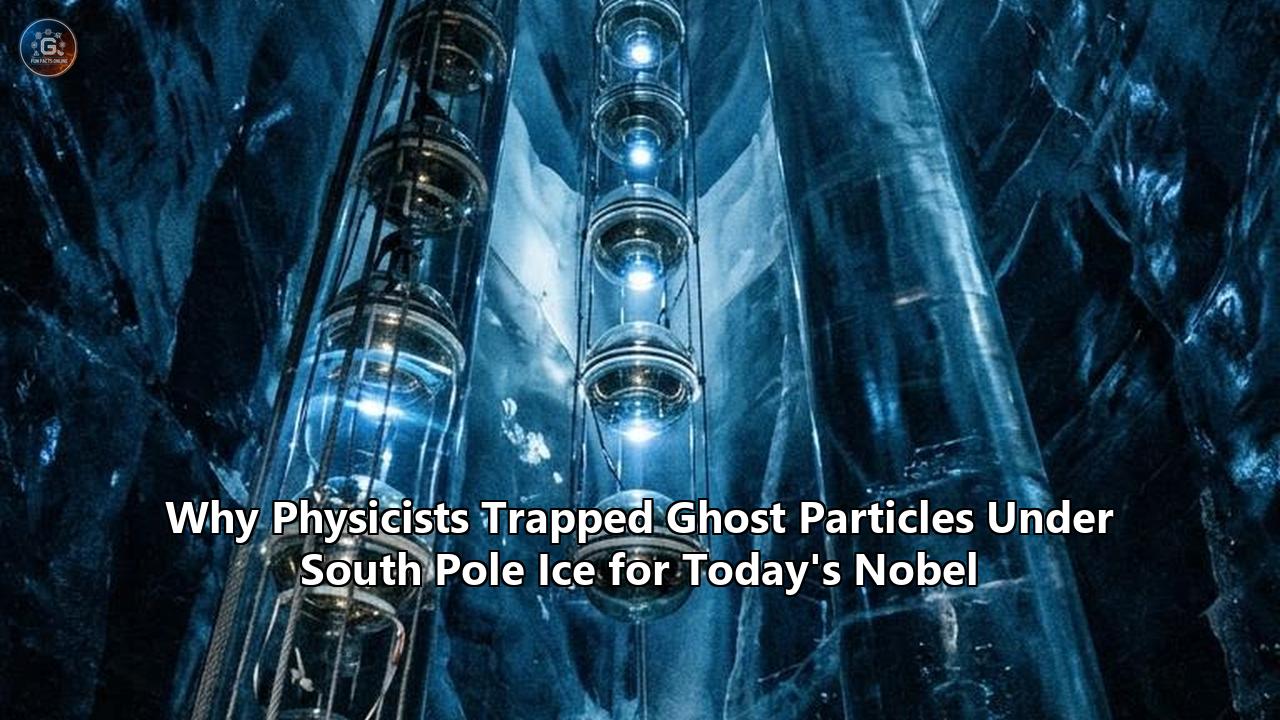
Once the drill head reached 2,500 meters and was winched back to the surface, the column of liquid water had only hours before the surrounding -50°C ice initiated rapid freeze-back. Technicians had a window of roughly 24 to 36 hours to spool out 2.5 kilometers of armored cable, manually attaching 60 basketball-sized optical sensors at 17-meter increments as the line was dropped into the abyss.
If a cable snagged or a winch locked up midway through deployment, the hole would freeze shut around the half-deployed string. The entire string—worth millions of dollars—would be crushed and lost, leaving a permanent obstruction in the array grid. In total, across 86 boreholes drilled through 2010, the deployment crews never lost a single string.
Silicon Inside the Pressure Spheres: The DOM Architecture
Drilling through the ice sheet was only half the technical challenge. The signals generated within the ice had to reach computers at the surface intact.
In AMANDA, the photomultiplier tubes had transmitted analog signals up standard copper cables. Over two kilometers of electrical wiring, the fast electronic pulses generated by single Cherenkov photons smeared out, losing their crisp nanosecond timing. Analog signals were useless for reconstructive physics at the cubic-kilometer scale.
The obvious modern fix was fiber optics, but polar glaciology made fiber impractical. When 2.5 kilometers of liquid water refreezes inside a borehole, it freezes from the outside edges inward, generating extreme, non-uniform hydrostatic pressures that exceed 400 atmospheres. These lateral shear stresses sheared and snapped early fiber cables during test deployments.
To bypass the problem, an engineering team led by Lawrence Berkeley National Laboratory developed the Digital Optical Module (DOM).
                ICE SURFACE (AMUNDSEN-SCOTT STATION)
                                 │
             ┌───────────────────┴───────────────────┐
             │   IceCube Laboratory (Data Center)    │
             │   - Master Clock Sync (2 ns accuracy) │
             │   - Real-time Trigger & Filtering     │
             └───────────────────┬───────────────────┘
                                 │  Armored Copper Cables
     0 m ────────────────────────┼────────────────────────
         Firm Layer (Snowpack)   │
    50 m ────────────────────────┼────────────────────────
                                 │
                                 │  86 Boreholes
                                 │  Spaced 125m apart
                                 │
  1450 m ────────────────────────┼────────────────────────
         CLEAR ICE CAP           │  Top of Instrument Array
                                 │
                                 │  Each string contains:
                                 │  60 Digital Optical Modules
                                 │  (DOMs) spaced 17m apart
                                 │
                                 ▼
                    ┌─────────────────────────┐
                    │    BOROSILICATE GLASS   │
                    │      PRESSURE SPHERE    │
                    │                         │
                    │   ┌─────────────────┐   │
                    │   │  Photomultiplier│   │
                    │   │   Tube (10-in)  │   │
                    │   └────────┬────────┘   │
                    │            ▼            │
                    │   ┌─────────────────┐   │
                    │   │   ATWD / fADC   │   │
                    │   │ Digitizer Board │   │
                    │   └────────┬────────┘   │
                    │            ▼            │
                    │   ┌─────────────────┐   │
                    │   │ Twisted Pair Tx │   │
                    └───┴────────┬────────┴───┘
                                 │  Digital data sent up
  2450 m ────────────────────────┴────────────────────────
         BEDROCK (2800m total depth)
The DOM was not just an optical sensor; it was an autonomous, low-power minicomputer hermetically sealed inside a 0.5-inch-thick borosilicate glass sphere capable of withstanding 10,000 psi.
Each DOM houses a downward-facing 10-inch Hamamatsu photomultiplier tube, a high-voltage generation base, a delay line, and an advanced digitization system centered on a custom chip called the Analog Transient Waveform Digitizer (ATWD).
When a photon strikes the photocathode of a DOM, the resulting electronic pulse is captured directly on the board and digitized at 300 million samples per second across three overlapping gain channels. The waveforms are converted into pure digital bits within the glass sphere before being sent up rugged, twisted-pair copper wire. Copper was heavy, but it was physically forgiving; it could stretch and deform as the ice shifted without breaking electrical continuity.
Digitizing deep inside the ice introduced an acute operational constraint: timing synchronization.
To trace a relativistic particle’s direction to within a fraction of a degree, every single one of the 5,160 DOMs distributed throughout the cubic kilometer had to agree on time to within less than 3 nanoseconds.
The engineering team devised a calibration protocol called Reciprocal Active Pulsing (RAP). Several times every second, surface servers fire an ultra-precise electrical ping down the copper cable to each individual DOM. The DOM digitizes the incoming ping and instantly returns an identical pulse back up the cable.
By comparing the departure and arrival times, the central data acquisition system measures the round-trip signal travel time through each cable—accounting for temperature shifts in the ice that alter electrical resistance—and synchronizes the entire multi-kilometer array's distributed clocks to under two nanoseconds.
Reading the Shadows of the Ice Age
Even with synchronized DOMs and bubble-free clathrate ice, the detector confronted another major physical obstacle: the glacial stratigraphy of Antarctica itself.
The Antarctic ice sheet is an active geological archive. Over millennia, changes in Earth's atmospheric climate deposited distinct horizontal strata of mineral dust, sea salt, and volcanic ash blown south during prehistoric eruptions.
Around 65,000 years ago, during the depths of the Last Glacial Maximum, the Southern Hemisphere experienced intense aridity, blanketing the Antarctic ice cap in heavy layers of windblown continental dust.
Inside IceCube’s instrumented volume, this historic dust storm manifested as a dense, 100-meter-thick band between 2,000 and 2,100 meters below the surface. In this band, optical scattering surged. Photons emitted inside the dust layer were delayed and deflected by microscopic silicate particles, blurring the directional reconstruction of particle paths.
Instead of treating the dust as an intractable defect, IceCube researchers mapped every vertical millimeter of it.
Every DOM was built with a ring of ultra-bright ultraviolet LEDs called "flashers." Physicists pulsed these flashers systematically across all 86 strings, measuring the time-of-flight of photons traveling from string to string across the grid. They supplemented these measurements with high-resolution laser dust loggers lowered down boreholes during the initial melting.
Through these scans, the team assembled a comprehensive, three-dimensional optical profile of the South Pole glacier. The model accounted for depth-dependent dust concentrations, the orientation of asymmetric ice crystals flowing toward the Weddell Sea, and the optical distortion created by the refrozen "hole ice" immediately surrounding each DOM string.
Overcoming these optical anomalies allowed neutrino detection south pole operations to resolve the trajectory of incoming particles with sub-degree angular precision, turning an inhomogeneous ice sheet into an analytical lens.
The Kinematics: Tracks, Cascades, and Pointing
When a cosmic neutrino arrives at the South Pole, it passes through the bulk of the planet without impedance. But occasionally, an ultra-high-energy neutrino collides head-on with an atomic nucleus inside a water molecule—either a hydrogen or oxygen atom locked in the ice matrix.
The collision is mediated by the weak nuclear force via two distinct kinematic channels:
1. Charged-Current (CC) Muon Neutrino Interactions (Tracks)
When a muon neutrino ($\nu_\mu$) strikes a nucleon, it exchanges a charged $W^\pm$ boson, converting into a high-energy muon:
$$\nu_\mu + N \rightarrow \mu^- + X$$
Because the incoming neutrino carries hundreds of teraelectronvolts (TeV) or petaelectronvolts (PeV) of energy, the resulting muon is hurled forward at virtually the same angle as the parent neutrino.
The muon travels faster than the phase velocity of light in ice ($c/n$, where $n \approx 1.31$). As it barrels through the glacier, it creates an optical shockwave analogous to a sonic boom: a conical sheath of faint blue Cherenkov light emitted at an angle of roughly 41 degrees.
These high-energy muons can travel several kilometers through the ice sheet, illuminating a sequence of DOMs in a razor-straight path. By analyzing the nanosecond arrival times of photons across adjacent strings, IceCube algorithms reconstruct the muon’s flight path to within less than 0.5 degrees.
These track events serve as the observatory’s directional crosshairs, pointing directly back to the active galactic nuclei or supermassive black holes that produced them.
2. Neutral-Current or Electron/Tau Neutrino Interactions (Cascades)
When an electron neutrino ($\nu_e$) collides with a nucleus, it produces an electron that promptly dumps its energy into a compact electromagnetic shower:
$$\nu_e + N \rightarrow e^- + X$$
Similarly, neutral-current interactions from all neutrino flavors exchange a neutral $Z^0$ boson, transferring a fraction of the neutrino’s energy to the nucleus and creating a localized hadronic particle shower:
$$\nu_x + N \rightarrow \nu_x + X$$
These showers deposit their energy in a spherical zone spanning only a few meters. To the surrounding DOMs, the event looks like an expanding blue flashbulb.
While directional pointing from spherical cascades is more difficult to reconstruct (typically 10 to 15 degrees), cascades provide IceCube with its most pristine calorimetric data. Because the entire energy of the primary interaction is deposited within the instrumented volume, physicists can determine the neutrino’s initial kinetic energy with high accuracy.
| Interaction Channel | Neutrino Flavor | Event Topology in Ice | Primary Physics Utility |
|---|---|---|---|
| Charged-Current ($\nu_\mu$) | Muon ($\nu_\mu$) | Long straight track (km scale) | Point-source astronomical pointing ($<0.5^\circ$) |
| Charged-Current ($\nu_e$) | Electron ($\nu_e$) | Compact spherical shower | Total energy calorimetry (precise energy reconstruction) |
| Charged-Current ($\nu_\tau$) | Tau ($\nu_\tau$) | "Double bang" (two connected cascades) | Flavor oscillation & extreme energy validation |
| Neutral-Current (All) | All flavors ($\nu_e, \nu_\mu, \nu_\tau$) | Localized hadronic shower | Measuring the diffuse cosmic neutrino flux |
The Breakthrough: From Bert and Ernie to NGC 1068
For years after AMANDA’s completion, skeptics argued that IceCube would discover nothing more than atmospheric noise. Every second, atmospheric cosmic-ray showers generate a constant shower of mundane down-going muons and neutrinos that flood the detector.
The breakthrough came in April 2012, shortly after the full 86-string IceCube array began operating.
Data filters flagged two unpredicted, gigantic spherical cascades lighting up hundreds of optical modules. The events carried deposited energies of 1.04 PeV and 1.14 PeV—over a million times more energetic than the neutrinos emitted by the Sun or human nuclear reactors.
The team nicknamed the events "Bert" and "Ernie". Months later, an even more violent event, dubbed "Big Bird," arrived with an energy of 2 PeV.
Calculations confirmed that these neutrinos could not have been produced by cosmic rays colliding with Earth’s atmosphere; atmospheric physics could not generate that energy profile. They were the first high-energy neutrinos detected that originated beyond our solar system, proving that the cosmos harbored natural particle accelerators operating at extreme energy limits.
What followed was the realization of multi-messenger astrophysics:
- The Blazar TXS 0506+056 (September 2017): IceCube detected a 290-TeV muon neutrino, cataloged as event IC170922A. Within 43 seconds, automated alerts dispatched the coordinates to ground and space telescopes worldwide. NASA’s Fermi Gamma-ray Space Telescope and the MAGIC Cherenkov telescopes in the Canary Islands swiveled to the exact patch of sky and caught the blazar TXS 0506+056 in a state of high gamma-ray flaring, confirming that supermassive black holes driving relativistic jets fire cosmic neutrinos across cosmological distances.
- Active Galaxy NGC 1068 (November 2022): IceCube pinpointed a steady-state flux of 79 neutrinos tracing back to Messier 77 (NGC 1068), an active galaxy in the constellation Cetus. Photons from the inner core of NGC 1068 are entirely blocked by a dense torus of interstellar dust and gas, but the neutrinos sliced through the dust unhindered, giving physicists their first direct view of a galactic core powered by an accreting supermassive black hole.
- The Milky Way Plane (June 2023): Applying machine learning algorithms to a decade of cascade data, the collaboration stripped away atmospheric backgrounds to produce the first high-energy neutrino image of the Milky Way’s plane, proving that our home galaxy actively accelerates high-energy cosmic rays.
The Scientific Geopolitics and the Road to Gen2
The decision by the Nobel Committee to award the prize solely to Francis Halzen mirrors the historical recognition of large-scale infrastructure architects like Ernest Lawrence (the cyclotron) and Carlo Rubbia (CERN’s antiproton accumulator). While the scientific papers that confirmed cosmic neutrinos bear the signatures of hundreds of international collaborators, Halzen was the strategist who carried the concept across forty years of institutional inertia and technical doubt.
The landscape of neutrino astrophysics is shifting rapidly. The South Pole is no longer the sole outpost pursuing cosmic messengers.
In Lake Baikal, Russia operates the Baikal-GVD detector, using freshwater ice to build a competitive array. In the deep Mediterranean Sea, European consortia are constructing KM3NeT, deploying multi-PMT optical modules to achieve high angular resolution in the Northern Hemisphere sky. Meanwhile, Chinese astrophysicists are developing the Tropical Deep-sea Neutrino Telescope (TRIDENT) and the NEON array in the South China Sea.
Yet the South Pole remains the center of gravity for the discipline. The next phase of neutrino detection south pole science, known as IceCube-Gen2, expands this perimeter.
                     ICECUBE-GEN2 EXPANSION

                     500 km² Shallow Radio Array
          (Detects Askaryan Radio Pulses up to EeV scale)
       ┌──────────────────────────────────────────────────┐
       │                                                  │
       │           8 km³ Optical Array (120 strings)      │
       │         ┌───────────────────────────────┐        │
       │         │                               │        │
       │         │       Original IceCube        │        │
       │         │            (1 km³)            │        │
       │         │       86 Strings (2010)       │        │
       │         │                               │        │
       │         └───────────────────────────────┘        │
       │                                                  │
       └──────────────────────────────────────────────────┘
The Gen2 facility will encompass three major expansions:
- An 8-Cubic-Kilometer Optical Array: Gen2 will deploy approximately 120 new sensor strings spaced 240 meters apart, increasing the instrumented optical volume eightfold to collect tenfold more high-energy cosmic neutrinos every year.
- A 500-Square-Kilometer Radio Array: Beyond 10 PeV, neutrino interactions generate intense, coherent radio pulses via the Askaryan effect—the accumulation of a negative charge excess in the shower cascade. Radio waves travel kilometers through cold Antarctic ice with negligible attenuation. By deploying hundreds of autonomous radio antennas across a 500-square-kilometer swath of the surface, Gen2 aims to detect ultra-high-energy neutrinos up to the exaelectronvolt ($10^{18}$ eV) scale.
- The IceCube Upgrade: Currently in deployment, this project adds seven closely spaced strings to the inner core of the array, outfitted with multi-PMT modules (mDOMs) and wavelength-shifting optical sensors to measure neutrino oscillations, constrain the neutrino mass ordering, and calibrate the South Pole ice sheet's optical model with sub-percent accuracy.
The Nobel Prize awarded in Stockholm validates a forty-year campaign that once seemed impossible. By transforming an Antarctic glacier into a deep-ice optical instrument, the physicists at the South Pole did not just confirm the existence of elusive subatomic particles—they built a permanent observatory capable of peering straight into the engines of the violent universe.
Reference:
- https://www.nobelprize.org/prizes/physics/
- https://www.siliconrepublic.com/innovation/icecube-neutrino-observatory-wins-nobel-prize-physics-awards-recognition
- https://www.theguardian.com/science/2026/oct/06/nobel-prize-in-physics-francis-halzen-south-pole-neutrinos-icecube-detector
- https://icecube.wisc.edu/science/icecube/
- https://www.kva.se/en/news/the-nobel-prize-in-physics-2026/
- https://icecube.wisc.edu/news/detector/2014/12/drilling-icecube-story-of-innovation-expertise-and-strong-will/
- https://icedrill.org/library/icecube-enhanced-hot-water-drill-functional-description
- https://arxiv.org/pdf/2607.25535
- https://www.nobelprize.org/prizes/physics/2026/press-release/
- https://www.space.com/science/particle-physics/hunting-cosmic-ghosts-why-neutrino-detection-won-the-nobel-prize-in-physics
- https://www.symmetrymagazine.org/breaking/2011/03/08/astronomy-on-ice-icecube-from-start-to-finish?language_content_entity=und
- https://www.thedailystar.net/news/crime-justice/news/public-outrage-mounts-over-ramisa-murder-4181751
- https://www.youtube.com/watch?v=ENNIgli_k8o
- https://www.reddit.com/r/MachinePorn/comments/41a8v3/the_hotwater_fern_drill_used_for_construction_of/
- https://arxiv.org/html/2609.26436v1
- https://www.researchgate.net/figure/MASTER-light-curve-of-the-TXS-0506-056-blazar-for-the-16-yr-Archive-light-curve-of-the_fig2_342206272
- https://www.nobelprize.org/prizes/physics/2026/summary/
- https://www.thedailystar.net/news/bangladesh/news/power-cuts-leave-200-hilsa-fishing-trawlers-stranded-lack-ice-4245916