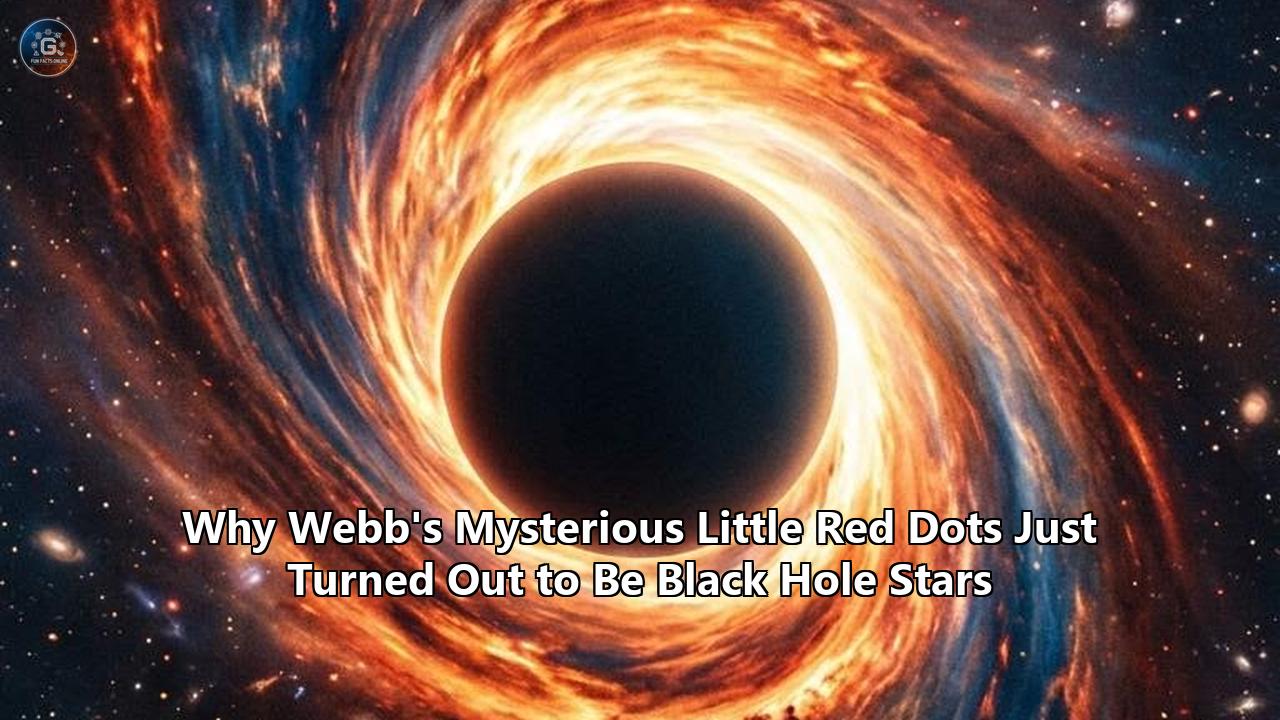
Astronomers analyzing the deepest spectroscopic surveys from NASA’s James Webb Space Telescope have unlocked the physical nature of one of the early cosmos’s most baffling phenomena. A flurry of observational results—culminating in ultra-deep, gravitationally lensed spectroscopy of the distant object GLIMPSE-17775 and extreme high-redshift systems like MoM-BH\-1—has confirmed that the mysterious high-redshift objects known as "Little Red Dots" are black hole stars.
These colossal structures, theoretically conceived decades ago as "quasi-stars," represent an exotic, short-lived evolutionary phase in which a rapidly feeding supermassive black hole seed is completely enshrouded within an enormous, optically thick envelope of pristine gas.
The confirmation resolves a high-stakes crisis in observational astrophysics. Since the telescope began science operations, the discovery of hundreds of compact, intensely red sources glowing between 600 million and 1.5 billion years after the Big Bang threatened to upend established models of galaxy assembly and black hole growth. Initial interpretations suggested these objects were either impossibly dense stellar systems or hosted supermassive black holes so disproportionately massive that they violated standard cosmology.
With the latest spectroscopic datasets confirming the presence of gas-enshrouded central black holes, the mystery of the Webb telescope little red dots has transitioned from a theoretical crisis into a verified observational window into the birth of supermassive black holes.
+-----------------------------------------------------------------------------+
|                      ANATOMY OF A "BLACK HOLE STAR"                         |
|                                                                             |
|   [ Radiation-Supported Envelope ]  <--- Diameter: >10-100 AU (Solar System)|
|   |  - Optically thick, partially ionized gas (T_eff ~ 5,000-7,000 K)       |
|   |  - Creates stellar-like Balmer breaks and optical [Fe II] forest        |
|   |  - Traps X-rays; drives electron-scattering line broadening             |
|   |                                                                         |
|   |    [ Super-Eddington Accretion Zone ]                                   |
|   |    |  - Trapped radiation funnels mass directly inward                  |
|   |    |                                                                    |
|   |    |      ( ( (  CENTRAL SEED BLACK HOLE  ) ) )                         |
|   |    |             Mass: 10^4 to 10^6 M_sun                               |
|   |    |             Rapid growth via direct collapse / runaway collisions  |
|   +----+--------------------------------------------------------------------+
The Crisis at Cosmic Dawn: How Little Red Dots Challenged Astrophysics
The problem began almost immediately after the observatory released its first deep-field images. Survey programs including CEERS (Cosmic Evolution Early Release Science), JADES (JWST Advanced Deep Extragalactic Survey), UNCOVER, and the RUBIES spectroscopic survey began cataloging hundreds of faint, point-like objects characterized by flat or blue ultraviolet continua paired with steep, red optical slopes.
These objects, quickly cataloged across the astronomical literature as Little Red Dots (LRDs), accounted for roughly 1% of all detected galaxies at redshifts $z \sim 4\text{--}9$. Despite their abundance, their physical properties refused to conform to any single category of known celestial bodies:
- Extreme Spatial Compactness: The vast majority of LRDs appeared unresolved or barely resolved in NIRCam imaging, corresponding to physical radii smaller than 50 to 100 parsecs. For comparison, typical galaxies at comparable redshifts span several hundred to thousands of parsecs.
- Distinctive "V-Shaped" Spectral Energy Distributions (SEDs): Photometry and prism spectroscopy revealed a faint blue slope in the rest-frame ultraviolet coupled with a steep red continuum in the rest-frame optical, separated by a sharp inflection point.
- High-Velocity Broad Balmer Lines: High-resolution NIRSpec gratings revealed broad emission lines of hydrogen—most notably $\text{H}\alpha$ and $\text{H}\beta$—with full widths at half maximum (FWHM) exceeding $1,000\text{ to }4,000\text{ km/s}$, indicative of rapid gas velocities typically seen only near gravitational singularities.
- X-Ray and Radio Silence: Despite displaying optical emission lines characteristic of active galactic nuclei (AGN), sensitive stacking of data from NASA's Chandra X-ray Observatory and the Atacama Large Millimeter/submillimeter Array (ALMA) revealed an unexpected absence of corresponding X-ray or radio flux.
        Relative Flux (F_lambda)
           ^
           |         Rest-Frame Optical (Steep Red Slope)
           |                \
           |                 \      [Inflection / Balmer Break ~3646 Å]
           |                  \    /
           |                   \  /
           |                    \/
           |                    /\
           |                   /  \
           |  Rest-Frame UV   /    \
           |  (Faint Blue)   /      \
           +----------------------------------------> Wavelength (lambda)
                    THE CHARACTERISTIC "V-SHAPED" LRD SPECTRUM
When astrophysicists applied standard analytical models to these observations, both prevailing hypotheses ran into physical impasses.
If the light from the Webb telescope little red dots was produced purely by stars, the implied stellar masses ($10^9\text{ to }10^{11}\ M_\odot$) packed into a radius under 100 parsecs required stellar densities exceeding $10^5\text{ to }10^9\ M_\odot/\text{pc}^3$. Such concentrations exceed the core densities of the densest Milky Way globular clusters by several orders of magnitude. At those densities, stellar collision timescales drop below 100,000 years, triggering runaway dynamical instability.
Conversely, if the broad emission lines were treated as the classical Keplerian signatures of supermassive black holes feeding at standard sub-Eddington rates, the standard virial mass formulas yielded black hole masses ranging from $10^7\text{ to }10^9\ M_\odot$.
In local galaxies like the Milky Way, a central supermassive black hole accounts for roughly 0.1% of its host galaxy's total stellar mass. In the LRD population, this ratio soared to an unfeasible 10% to 30%, and in several extreme objects, the black hole appeared to outweigh the total stellar content of its entire host galaxy.
Diagnosing the Breakdown: The Theoretical and Observational Deadlock
The apparent presence of massive black holes just a few hundred million years after the Big Bang exposed fundamental limitations in standard cosmological timelines.
Under the standard model of cosmic structure formation ($\Lambda\text{CDM}$ cosmology), the first stars (Population III) formed in small dark matter minihalos around redshift $z \sim 20\text{--}30$. When these metal-free stars died, their core collapses produced "light" black hole seeds of approximately $10\text{ to }100\ M_\odot$.
Growing a 100-solar-mass seed into a billion-solar-mass black hole by redshift $z = 7$ (roughly 750 million years after the Big Bang) requires continuous, uninterrupted accretion at the theoretical maximum known as the Eddington limit:
$$\dot{M}_{\text{Edd}} = \frac{4\pi G M_{\bullet} m_{\text{p}}}{\eta \sigma_{\text{T}} c}$$
Where:
- $G$ is the gravitational constant,
- $M_{\bullet}$ is the black hole mass,
- $m_{\text{p}}$ is the proton mass,
- $\eta$ is the radiative efficiency (typically $\sim 0.1$),
- $\sigma_{\text{T}}$ is the Thomson scattering cross-section,
- $c$ is the speed of light.
Because outward radiation pressure halts the infall of matter once luminosity matches the Eddington limit ($L_{\text{Edd}} = \eta \dot{M}_{\text{Edd}} c^2$), the black hole's mass increases exponentially with an e-folding timescale (the Salpeter time) of roughly 45 million years:
$$M(t) = M_0 \exp\left( \frac{1 - \eta}{\eta} \frac{t}{t_{\text{Salpeter}}} \right)$$
To reach $10^9\ M_\odot$ within 700 million years, a light seed must feed at or above 100% duty cycle without pause, never encountering supernova feedback, gas depletion, or dynamical ejection. Standard astrophysics offered no viable mechanism to maintain such extreme conditions across hundreds of separate objects simultaneously.
Time Post-Big Bang:   0 Myr       ~200 Myr                 ~700 Myr (Cosmic Dawn)
                       |             |                            |
LIGHT SEED PATHWAY:    |--- [Pop III Star] -> [10-100 M_sun Seed] - - - > [Stalled at ~10^5 M_sun]
(Fails standard limit) |                                          (Insufficient growth time)
                       |
HEAVY SEED PATHWAY:    |--- [Gas Cloud] ---> [QUASI-STAR / LRD] ---> [10^6 - 10^9 M_sun SMBH]
(Black Hole Star)      |                     (Rapid Enshrouded Growth)   (Observed by JWST)
Adding to the confusion was the complete absence of high-energy X-ray signatures. In conventional active galaxies, the inner accretion disk heats to millions of Kelvin, generating powerful coronal X-ray emissions that easily penetrate galactic dust.
Yet when observers pointed Chandra at verified LRD coordinates, the targets remained undetected, exhibiting an X-ray-to-optical luminosity ratio hundreds of times lower than standard quasars.
Furthermore, the rest-frame optical continuum displayed what appeared to be a prominent "Balmer break"—a characteristic sharp drop in flux shortward of $3646\text{ \AA}$ normally caused by hydrogen absorption in the atmospheres of intermediate-age stars ($A$- and $B$-type stars). This spectral contradiction polarized the astronomical community:
+-----------------------------------------------------------------------------+
|               THE DUALITY PARADOX IN EARLY LRD OBSERVATIONS                 |
+-----------------------------------------------------------------------------+
|  Stellar Scenario                           |  Standard AGN Scenario        |
|  - Matches: Balmer absorption jump          |  - Matches: Broad Balmer      |
|  - Fails: Implies impossible central        |    emission lines (>2,000km/s)|
|    stellar densities (>10^8 M_sun/pc^3)     |  - Fails: Total absence of    |
|  - Fails: Cannot explain high velocities    |    X-ray emission; creates    |
|    in broad emission lines without gravity  |    overmassive black hole     |
|    of a black hole                          |    mass anomalies             |
+-----------------------------------------------------------------------------+
Astrophysicists were caught in an analytical paradox where neither classical galactic evolution nor textbook active galactic nucleus models could account for the properties of the Webb telescope little red dots.
The Breakthrough: Identifying the "Black Hole Star" Mechanism
The impasse began to dissolve when teams combined deep-exposure spectroscopic campaigns with gravitational lensing. A critical turning point occurred with the detailed analysis of GLIMPSE-17775, a little red dot positioned behind the massive galaxy cluster Abell S1063 at redshift $z = 3.5$.
The gravitational field of Abell S1063 acted as a natural cosmic lens, magnifying the background object and boosting a 20-hour NIRSpec integration into the observational equivalent of an 80-hour exposure.
Led by Vasily Kokorev of the University of Texas at Austin, the resulting spectrum yielded more than 40 distinct emission and absorption features, providing an unprecedented chemical and physical breakdown of an LRD’s internal environment.
Relative Flux
  ^
  |                     [H-alpha line with exponential scattering wings]
  |                                   /\
  |                                  /  \
  |   [Iron Forest: ~16 Fe II lines] /    \      [Helium Fluorescence]
  |          ||||||||||||           /      \               ||
  |          ||||||||||||          /        \              ||
  +-------------------------------------------------------------------> Wavelength
       KEY SPECTROSCOPIC SMOKING GUNS DETECTED IN GLIMPSE-17775
The data gathered from GLIMPSE-17775, combined with findings from high-redshift targets such as MoM-BH\-1 reported by Rohan Naidu (University of Hawaiʻi) and "The Cliff" analyzed by Anna de Graaff (Max Planck Institute for Astronomy), revealed four interconnected physical processes that define the black hole star phenomenon:
1. Electron Scattering Overturns Mass Estimates
For decades, astronomers estimated black hole masses by measuring the Doppler broadening of hydrogen emission lines, assuming that line width ($\Delta v$) is driven entirely by orbital velocity in the gravitational potential well of the black hole:
$$M_{\bullet} = f \frac{R_{\text{BLR}} (\Delta v)^2}{G}$$
Where $R_{\text{BLR}}$ is the radius of the broad-line region and $f$ is a geometric virial factor.
In GLIMPSE-17775 and related LRDs, researchers discovered that the broad wings of the $\text{H}\alpha$ and $\text{H}\beta$ emission lines do not match the standard Gaussian or Lorentzian velocity profiles produced by rotation. Instead, they display clean exponential wings.
This profile is the unambiguous signature of electron scattering (Thomson scattering) occurring as photons pass through a dense, warm ($T_{\text{e}} \approx 7,000\text{ K}$), partially ionized gas cloud with electron densities of $n_{\text{H}} \approx 10^9\text{ to }10^{10}\text{ cm}^{-3}$.
Because thermal electrons scatter and broaden the hydrogen photons, the observed line widths reflect optical depth and gas density rather than raw gravitational velocity.
Recalculating the central black hole masses using electron-scattering corrections immediately lowered the inferred masses by a factor of 10 to 100. The black holes inside these systems were not impossible monsters of $10^9\ M_\odot$, but seeds ranging from $10^4\text{ to }10^6\ M_\odot$—perfectly aligned with cosmological predictions.
LINE PROFILE COMPARISON:
Orbital Broadening (Standard AGN):   Electron Scattering (Black Hole Star):
         ^                                    ^
        / \   (Gaussian/Lorentzian)          / \   (Sharp core, exponential
       /   \                                /   \   sloping wings driven by
     _/     \_                            _/     \_ optical depth)
2. Dense Gas Cocoons and the Iron Forest
The deep spectrum of GLIMPSE-17775 identified an "iron forest" composed of 16 individual optical $[\text{Fe II}]$ emission lines, paired with helium absorption and fluorescence.
These lines can only form in a dense, warm, radiation-dominated layer of gas. The gas cocoon absorbs the extreme-ultraviolet and X-ray radiation pouring from the central accretion zone and reprocesses it into rest-frame optical and infrared wavelengths.
This provides a direct physical explanation for the missing X-rays: the gas envelope is Compton-thick ($N_{\text{H}} > 10^{24}\text{ cm}^{-2}$), trapping high-energy photons before they can escape into intergalactic space.
3. The Pseudo-Photosphere and the Balmer Break
In a black hole star (quasi-star), the accretion luminosity generated at the center is so immense that radiation pressure expands the outer gaseous envelope into a giant pseudo-photosphere spanning hundreds to thousands of astronomical units (AU)—larger than the entire solar system.
Theoretical simulations published by Andrew Santarelli and collaborators at Yale University using the MESA-QUEST modeling framework demonstrate that the outer boundary of this envelope cools to an effective temperature between $4,500\text{ K and }7,000\text{ K}$.
At these temperatures, the envelope behaves like the atmosphere of a cool, giant star, producing strong hydrogen Balmer absorption without requiring an underlying population of evolved stars. The characteristic "Balmer break" that previously confused galactic evolutionary models is generated directly by the dense, warm envelope of the black hole star itself.
+-----------------------------------------------------------------------------+
|            CORE CHARACTERISTICS OF THE CONFIRMED BLACK HOLE STAR            |
+-----------------------------------------------------------------------------+
|  Central Engine         | Black hole seed (10^4 - 10^6 M_sun)               |
|  Accretion Mode         | Super-Eddington interior / Enshrouded growth      |
|  Envelope Size          | 10 to 1,000 AU (Radiation-pressure supported)     |
|  Photospheric Temp      | T_eff ~ 4,500 - 7,000 K                           |
|  Gas Density (Envelope) | n_H ~ 10^9 - 10^10 cm^-3                          |
|  X-Ray Penetration      | Suppressed (<0.1% escape via Compton trapping)    |
|  Spectral Identifiers   | Exponential Balmer wings, [Fe II] forest,         |
|                         | pseudo-Balmer break, rest-frame red excess        |
+-----------------------------------------------------------------------------+
The Birth of Heavy Seeds: Direct Collapse and Stellar Runaways
Confirming that Little Red Dots are black hole stars provides the missing link in understanding how supermassive black holes formed in the early universe.
Astrophysicists have long debated two primary pathways for generating black hole seeds: "light seeds" from Population III stellar deaths, and "heavy seeds" ($10^4\text{ to }10^6\ M_\odot$) formed through direct collapse or runaway collisions. The black hole star nature of the Webb telescope little red dots confirms that the universe relied heavily on the heavy-seed channel.
                       PRIMORDIAL GAS HALO (z > 10)
                                    |
            +-----------------------+-----------------------+
            |                                               |
     [Pathway A: DCBH]                             [Pathway B: Runaway Dynamics]
  Pristine, Lyman-Werner                        Dense proto-galaxy core
  radiation suppresses H2                      (rho_star > 10^5 M_sun/pc^3)
            |                                               |
  No fragmentation; direct                       Rapid mass segregation &
  infall of ~10^5 M_sun gas                     stellar collisions (<1 Myr)
            |                                               |
            +-----------------------+-----------------------+
                                    |
                         [ BLACK HOLE STAR ]
             Central core collapses into seed black hole;
           Envelope remains inflated by trapped radiation
                                    |
             (Super-Eddington accretion for 10-30 Myr)
                                    |
                         [ NAKED QUASAR / SMBH ]
            Gas envelope consumed or blown away via feedback
Pathway A: Direct Collapse Black Holes (DCBH)
In pristine primordial halos irradiated by intense Lyman-Werner ultraviolet flux from nearby star-forming galaxies, molecular hydrogen ($\text{H}_2$) formation is suppressed. Without $\text{H}_2$ cooling, the gas cannot fragment into small stellar cores.
Instead, the entire cloud of $10^5\text{ to }10^6\ M_\odot$ undergoes isothermal collapse at $\sim 10,000\text{ K}$. The core collapses into an initial seed, while the outer infalling layers form an envelope that traps outgoing radiation, producing a classic quasi-star.
Pathway B: Runaway Stellar Dynamics
In hyper-dense early star clusters, theoretical modeling led by Fabio Pacucci and Lars Hernquist (Harvard-Smithsonian Center for Astrophysics) demonstrates that dynamical friction drives massive stars into the cluster center in less than 100,000 years.
Runaway physical collisions merge these stars into a single Very Massive Star ($M \sim 10^4\text{ to }5\times 10^4\ M_\odot$).
Due to general relativistic instabilities, the core of this monster star collapses directly into a black hole seed while still swaddled in the star’s outer convective layers, establishing a black hole star state.
In both pathways, the outer gas cocoon enables the internal black hole to feed at super-Eddington rates. Because the envelope absorbs the radiation and re-emits it across a massive surface area, the internal accretion flow is not halted by radiation feedback. The black hole can gain mass orders of magnitude faster than a standard exposed quasar.
=================================================================================
                 GROWTH RATE AND TIMELINE COMPARISONS
=================================================================================
Parameter               Standard Quasar (Sub-Eddington)   Black Hole Star (LRD Phase)
---------------------------------------------------------------------------------
Accretion Rate (M_dot)  <= 1.0 x M_dot_Edd                5 to 50 x M_dot_Edd
Growth Factor per 10Myr ~1.25x                             ~10x to 100x
Radiative Appearance    UV-bright, X-ray loud             Red optical, X-ray silent
Lifetime of Phase       ~10^7 - 10^8 years                ~10^7 - 3 x 10^7 years
Comoving Density (z~5)  ~10^-7 to 10^-8 Mpc^-3            ~10^-5 Mpc^-3
=================================================================================
This short lifetime explains another critical observation: why the Webb telescope little red dots appear in huge numbers at $z \sim 5\text{--}8$ but almost completely disappear below $z \sim 3\text{--}4$.
A black hole star is an inherently transient object with an active lifespan of roughly 10 to 30 million years. Once the black hole devours roughly 10% to 50% of the surrounding gas envelope, radiation-driven winds and thermal feedback blow away the remaining shell.
The object sheds its crimson cocoon, transforming into a standard, exposed, X-ray-bright active galactic nucleus—the progenitors of the mature supermassive black holes found at the centers of modern galaxies today.
Action Plan: How Global Observatories and Theorists Are Mobilizing
The confirmation of the black hole star model has triggered an international mobilization across observational astronomy, space agency missions, and theoretical physics. Research teams worldwide are deploying new observation protocols and multi-wavelength campaigns to systematize the study of LRDs.
                  GLOBAL RESEARCH STRATEGY FOR BLACK HOLE STARS
                                        |
        +-------------------------------+-------------------------------+
        |                               |                               |
[Targeted JWST Spectroscopy]    [Multi-Wavelength Stacking]    [Numerical Simulation Suites]
- High-res grating (G395H)      - Ultra-deep Chandra/XMM       - MESA-QUEST radiation codes
- Lensed field expansions       - ALMA dust mass probes        - 3D GR-RMHD cosmological runs
- NIRCam morphological stacks   - Roman wide-field censuses    - Synthetic spectral libraries
1. High-Resolution Spectroscopic Follow-Ups
Observing programs in JWST Cycles 3, 4, and beyond are shifting focus from broadband photometric surveys to targeted high-resolution grating spectroscopy ($R \sim 2700$ with NIRSpec G395H and G235H).
Teams are specifically targeting the line shapes of $\text{H}\alpha$, $\text{H}\beta$, $\text{Pa}\alpha$, and the optical $[\text{Fe II}]$ complex across hundreds of candidates to measure electron scattering depths and systematically separate cocoon kinematics from host-galaxy rotation.
Simultaneously, morphological stacking techniques—such as the recent work by Xuheng Ding (Wuhan University) and Lilan Yang (Hunan Normal University) stacking 217 LRD images across multiple infrared bands—are successfully separating the central point-source black hole star from the faint, compact host galaxies surrounding them.
2. Multi-Wavelength Observational Campaigns
Because individual LRDs fall below the single-exposure detection thresholds of current high-energy telescopes, consortia are coordinating deep stacking campaigns:
- ALMA Millimeter Probes: Mapping the cold dust and molecular gas reservoirs around LRDs to measure gas replenishment rates and verify that the red slopes are caused by dense gas envelopes rather than standard interstellar dust extinction.
- Ultra-Deep X-Ray Stacking: Stacking hundreds of hours of archival and new Chandra and XMM-Newton observations to detect the highly attenuated, hard X-ray leakage ($>10\text{ keV}$) that can pierce Compton-thick gas envelopes.
- Subaru Hyper Suprime-Cam and Roman Surveys: Leveraging wide-field ground and space telescopes to identify the brightest, rarest LRD candidates across thousands of square degrees to serve as prime targets for deep spectroscopic dissection.
3. Advanced Computational Modeling
Theoretical groups are updating stellar evolution and hydrodynamic simulation codes:
- MESA-QUEST Integration: Incorporating general-relativistic radiation hydrodynamics (GR-RMHD) into the Modules for Experiments in Stellar Astrophysics (MESA) code to simulate the complete lifespan of quasi-stars, tracking how internal convection and radiation-driven mass loss govern black hole growth.
- Cosmological Hydro-Simulations: Incorporating black hole star formation sub-grid models into massive cosmological simulations (such as IllustrisTNG, FIRE, and EAGLE successors) to verify whether this rapid growth channel accurately reproduces the black hole mass functions observed across cosmic time.
Future Milestones: What to Watch Next
As astrophysics absorbs the realization that early cosmic history was populated by black hole stars, several major observational and theoretical milestones will define the coming years:
+-----------------------------------------------------------------------------+
|                          DECISION TIMELINE & ROADMAP                        |
+-----------------------------------------------------------------------------+
|  Milestone              | Target Facility   | Primary Objective             |
+-------------------------+-------------------+-------------------------------+
|  Cycle 4-5 LRD Spectra  | JWST NIRSpec      | Measure electron-scattering   |
|                         |                   | profiles across 500+ LRDs     |
|  Obscured X-Ray Census  | Athena / Lynx     | Detect hard X-ray cores       |
|                         | Concept Missions  | through Compton-thick shells  |
|  Wide-Area Statistics   | Roman Space       | Map LRD cosmic spatial        |
|                         | Telescope         | distribution and clustering   |
|  Gravitational Waves    | LISA (ESA/NASA)   | Detect mergers of heavy seeds |
|                         |                   | produced by quasi-star cores  |
+-------------------------+-------------------+-------------------------------+
Key Questions Demanding Immediate Resolution:
- The Host Galaxy Connection: What is the exact relationship between the black hole star and its surrounding proto-galaxy? High-resolution coronagraphy and lensing reconstruction will determine whether the host galaxy’s star formation is triggered or suppressed by the extreme energy output of the central quasi-star.
- The Direct Detection of the Cocoon Blow-Out: Can astronomers catch an LRD in the exact act of shedding its envelope? Identifying transition objects—where the dense gas cocoon is being cleared by radiation-driven superwinds—will provide empirical bounds on the duration of the quasi-star phase.
- Gravitational Wave Signatures: When the central black holes within black hole stars merge during early protogalactic collisions, they generate low-frequency gravitational waves. The Laser Interferometer Space Antenna (LISA), slated for launch in the 2030s, will directly detect the inspiral and coalescence of these $10^4\text{ to }10^6\ M_\odot$ heavy seeds, providing a non-electromagnetic verification of the black hole star lifecycle.
The solution to the Little Red Dot enigma demonstrates that the early universe was not breaking the laws of physics—it was operating in an extreme, high-density regime that had remained unobserved until now. By unmasking these crimson dots as black hole stars, astronomers have resolved a major cosmological tension and uncovered the engine that built the modern universe's supermassive black holes.
Reference:
- https://www.universetoday.com/articles/the-jwst-little-red-dots-could-be-black-hole-stars
- https://www.space.com/astronomy/black-holes/james-webb-space-telescope-finds-evidence-the-mysterious-little-red-dots-are-black-hole-stars
- https://futurism.com/space/astronomers-discover-black-hole-star
- https://aasnova.org/2026/03/25/starring-in-the-early-universe-black-hole-stars-and-little-red-dots/
- https://en.wikipedia.org/wiki/Quasi-star
- https://science.nasa.gov/missions/webb/nasa-webb-finds-strongest-evidence-yet-for-black-hole-stars/
- https://en.wikipedia.org/wiki/Little_Red_Dots
- https://www.youtube.com/watch?v=Ezi9VvVOIcw
- https://cerncourier.com/the-mystery-of-the-little-red-dots/
- https://www.facebook.com/wired/posts/an-object-observed-by-the-james-webb-space-telescope-lends-credence-to-a-strange/1430774102251511/
- https://www.mpg.de/25316826/black-hole-stars
- https://www.aanda.org/articles/aa/full_html/2024/11/aa48857-23/aa48857-23.html
- https://www.aanda.org/articles/aa/abs/2026/03/aa57537-25/aa57537-25.html
- https://www.aanda.org/articles/aa/full_html/2026/03/aa57537-25/aa57537-25.html
- https://teams.issibern.ch/littlereddots/
- https://medium.com/technicity/how-jwsts-latest-discovery-of-little-red-dots-could-rewrite-cosmic-history-f3619c3a2664
- https://astrobites.org/2024/11/23/little-red-dots-agn-or-not/
- https://arxiv.org/html/2505.12719v1
- https://www.frontiersin.org/journals/astronomy-and-space-sciences/articles/10.3389/fspas.2026.1779045/full
- https://arxiv.org/abs/2509.02664
- https://www.researchgate.net/scientific-contributions/Andrew-D-Santarelli-2271862016
- https://science.nasa.gov/missions/webb/nasa-webb-finds-strongest-evidence-yet-for-black-hole-stars/
- https://skyandtelescope.org/astronomy-news/little-red-dot-is-a-cocooned-black-hole/
- https://aasnova.org/2026/03/25/starring-in-the-early-universe-black-hole-stars-and-little-red-dots/
- https://www.universetoday.com/articles/the-little-red-dots-that-turned-out-to-be-black-holes-in-disguise
- https://science.slashdot.org/story/25/08/02/0516214/early-universes-little-red-dots-may-be-black-hole-stars
- https://arxiv.org/html/2510.17952
- https://www.iflscience.com/jwst-image-trick-finally-reveals-compact-galaxies-around-mysterious-little-red-dots-84457