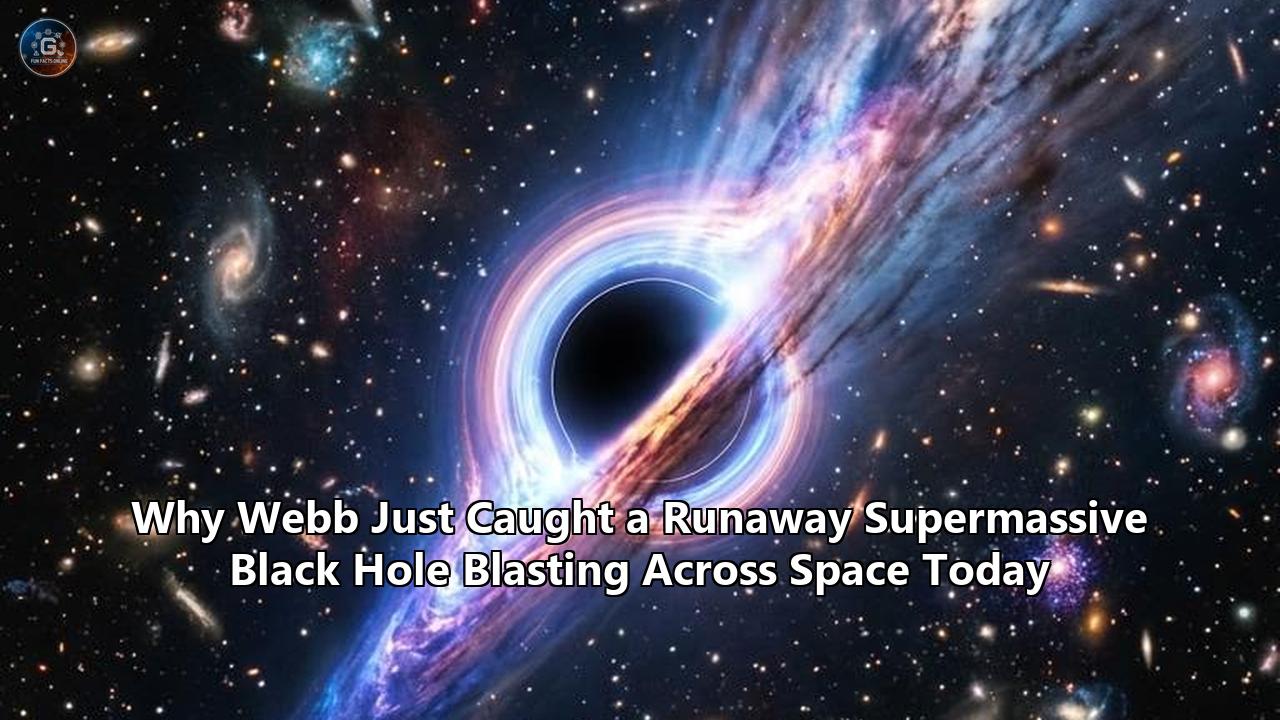
The James Webb Space Telescope (JWST) has delivered empirical confirmation of a cosmic phenomenon long confined to theoretical physics: a supermassive black hole physically ejected from its home galaxy and hurtling through deep space.
Spectroscopic data collected by JWST’s Near-Infrared Spectrograph (NIRSpec) Integral Field Unit (IFU) has confirmed that candidate object RBH-1 is an active runaway supermassive black hole cutting through the circumgalactic medium at roughly 954 kilometers per second—over 2.1 million miles per hour. Rocketing outward from a merging galactic system at redshift $z = 0.964$ (a cosmic epoch approximately 7.5 billion years in the past), the black hole has traveled more than 230,000 light-years from its host galactic nucleus.
Behind this gravitational juggernaut lies a narrow, highly collimated contrail of compressed gas and newborn stars spanning more than 200,000 light-years—a structure double the diameter of the Milky Way. At its leading edge, JWST isolated the unmistakable kinematic and ionization signatures of a Mach 4 to 6 supersonic bow shock. The discovery confirms that when galaxies collide, their central black holes do not merely merge in silence; under specific gravitational dynamics, the resulting monster can be cast into intergalactic space, reshaping every environment it touches.
[ Merging Host Galaxies ] -------- 230,000 light-years --------> [ Supersonic Bow Shock ]
  (Cosmic Owl System, z=0.964)   \                                \
                                  \-- [ 200,000 ly Contrail ] ----> [ Runaway SMBH: ~10^7 M☉ ]
                                      (~10^8 M☉ in Newborn Stars)     (Velocity: ~954 km/s)
The Detection: Kinematics of a Supersonic Bow Shock
The structure was originally flagged in deep optical imagery from the Hubble Space Telescope by a research team led by Pieter van Dokkum of Yale University. At the time, the Hubble data presented an astronomical anomaly: a razor-thin, linear streak pointing away from an irregular pair of merging galaxies informally dubbed the "Cosmic Owl". While the initial data hinted at an ejected black hole, alternative interpretations quickly emerged. Independent researchers proposed that the streak might instead be an edge-on, bulgeless disk galaxy, a tidal tail generated purely by gravitational stripping, or a bipolar astrophysical jet originating from an active galactic nucleus (AGN).
Resolving that ambiguity required the spatial resolution and infrared spectroscopy of JWST. Leveraging the NIRSpec IFU, van Dokkum and his collaborators mapped the spatial and velocity distribution of the ionized gas at the tip of the streak with unprecedented spectral accuracy.
JWST NIRSpec IFU Kinematic Profile at Wake Tip:
+-------------------------------------------------------------------------+
| Spatial Resolution: ~0.1 arcseconds (~1 kpc at z = 0.964)               |
| Radial Velocity Discontinuity: Δv ≈ 600 km/s                            |
| Transverse Gas Deflection: Hundreds of km/s perpendicular to apex       |
| Diagnostic Line Ratios: High [O III] λ5007 / Hβ & [N II] / Hα           |
| Mechanical Shock Velocity: 954 ± 50 km/s (Supersonic Mach ~4–6)         |
+-------------------------------------------------------------------------+
The infrared spectroscopy revealed a violent kinematic discontinuity at the apex of the streak. The radial velocity of the gas shifts by roughly 600 kilometers per second across a spatial scale of just 0.1 arcseconds (equivalent to less than 1 kiloparsec at that redshift). Furthermore, the gas is being driven laterally outward from the tip, matching the hydrodynamic profiles generated by three-dimensional shock models of an ultra-dense, non-luminous mass puncturing a gaseous medium.
Emission-line diagnostics eliminated the remaining counter-theories:
- Rejection of the Edge-On Galaxy Model: Edge-on disks exhibit smooth, symmetric, and monotonic rotation curves that plateau according to standard Tully-Fisher dynamics; RBH-1 displays an abrupt, asymmetric kinematic jump incompatible with stable disk rotation.
- Rejection of the Relativistic Jet Model: Astrophysical jets experience continuous deceleration and dissipate their energy via terminal radio lobes (hotspots), exhibiting line ratios dominated by non-thermal synchrotron processes and high magnetic field confinement; RBH-1 shows shock-ionized gas cooling directly into active star-forming complexes behind a compact gravitational core.
- Confirmation of Bow Shock Hydrodynamics: Ratios of $[\text{O III}]\,\lambda5007/\text{H}\beta$ and $[\text{N II}]/\text{H}\alpha$ across the apex align precisely with radiative shock models where gas with a density of $n_{\text{H}} \sim 0.1\text{--}1\text{ cm}^{-3}$ is abruptly compressed, heated to temperatures exceeding $10^5\text{ K}$, and subsequently cools, initiating gravitational fragmentation.
The observational profile establishes that an invisible compact mass of approximately 10 to 20 million solar masses ($M_\odot$) is currently transiting the circumgalactic medium, plowing through ambient gas and leaving a stellar nursery in its wake.
Ejection Dynamics: The Physics of Gravitational Recoil
A black hole possessing the mass of tens of millions of suns cannot be dislodged by conventional astrophysical interactions. Its ejection requires mechanical energy on a scale that only general relativistic gravitational interactions can liberate. Astrophysicists attribute the trajectory of RBH-1 to one of two high-energy phenomena: anisotropic gravitational-wave recoil during a supermassive black hole coalescence, or a three-body chaotic slingshot encounter.
EJECTION SCENARIO A: Anisotropic Gravitational-Wave Recoil
  Galaxy Merger ──> SMBH Binary Hardening ──> Asymmetric GW Emission ──> Linear Momentum Kick
  (Spins misaligned, unequal masses)          (Net flux in one direction) (v_kick up to ~4,000 km/s)

EJECTION SCENARIO B: Three-Body Slingshot
  Galaxy 1 + Galaxy 2 (Stable Binary) + Galaxy 3 Merger ──> Hierarchical Triplet Interaction
  (Chaotic three-body orbit) ──> Lightest SMBH Ejected at Super-Escape Velocity
1. Anisotropic Gravitational-Wave Recoil
When two galaxies merge, their central supermassive black holes sink to the center of the newly formed gravitational potential via dynamical friction with surrounding stars and gas. As the binary separation shrinks to milliparsec scales, orbital decay becomes dominated by the emission of gravitational radiation.
If the merging black holes possess unequal masses or, more critically, misaligned spin vectors, the gravitational radiation is emitted anisotropically. General relativity dictates that gravitational waves carry linear momentum away from the binary system. Due to the asymmetry of the wavefield:
$$P_{\text{net}} = \int \frac{dE_{\text{GW}}}{dt} \frac{\hat{n}}{c} \, dt \neq 0$$
To conserve total momentum, the newly merged single black hole must receive an equal and opposite physical "kick" (gravitational recoil).
Numerical relativity simulations demonstrate that while mass asymmetry alone typically yields recoil velocities of 100 to 300 km/s, the "superkick" and "hangup-kick" configurations—involving black holes with high dimensionless spin parameters ($a/M \sim 0.9$) oriented within the orbital plane—can generate kicks exceeding 3,000 to 4,000 km/s. RBH-1’s observed velocity of ~954 km/s falls comfortably within the theoretical distribution for gravitational-wave recoil resulting from a gas-poor ("dry") or partially aligned merger.
2. Three-Body Chaotic Slingshots
The alternative mechanism involves a sequential hierarchical merger. If a third galaxy interacts with the host system before the original central supermassive black hole binary has had sufficient time to coalesce (a long-standing theoretical bottleneck known as the "final parsec problem"), a three-body system forms.
Three-body gravitational interactions are inherently chaotic and unstable. The system rapidly exchanges orbital energy until the lightest of the three bodies is accelerated past the system’s escape velocity and ejected from the nucleus, while the remaining binary recoils in the opposite direction.
In the case of RBH-1, structural morphology supports both hypotheses, though the absence of a visible secondary counter-tail strongly favors an asymmetric merger recoil event.
The Starburst Contrail: Star Formation in Unbound Space
The most visually striking consequence of this runaway supermassive black hole is the 200,000-light-year trail of stellar clusters it leaves behind. Unlike standard star formation, which takes place inside the bound dark matter halos and deep potential wells of galactic disks, the stars in this trail are forming directly in the circumgalactic medium.
Shock-Induced Wake Star Formation Sequence:
[ Runaway SMBH Moves at Mach 5 ]
              │
              ▼
[ Gas Overcompression (Isothermal Shock) ]
  • Compression factor: ρ_shock / ρ_0 ≈ M^2
  • Shock heating to T > 10^5 K followed by radiative cooling
              │
              ▼
[ Jeans Instability Triggered ]
  • Jeans Mass: M_J ∝ T^(3/2) / ρ^(1/2) drops drastically
  • Gas fragments into self-gravitating molecular cores
              │
              ▼
[ Starburst Contrail Assembly ]
  • ~10^8 Solar Masses of newborn O/B type stars
  • Age gradient along wake: Oldest stars near host, youngest at the apex
As the black hole tears through the circumgalactic medium at supersonic speeds, it does not swallow the bulk of the gas. Because its velocity far exceeds the sound speed of the medium ($c_s \sim 100\text{--}200\text{ km/s}$), classical Bondi-Hoyle-Littleton accretion is suppressed. The accretion radius scales inversely with the square of the velocity:
$$R_{\text{acc}} = \frac{2 G M_{\text{BH}}}{v^2 + c_s^2}$$
Instead of accreting, the massive object acts as an astrophysical snowplow. It drives a shock front that compresses the diffuse circumgalactic gas. Under isothermal shock conditions, the post-shock density $\rho_{\text{post}}$ increases relative to the ambient density $\rho_0$ by a factor roughly proportional to the square of the Mach number:
$$\frac{\rho_{\text{post}}}{\rho_0} \approx \mathcal{M}^2 \approx \left(\frac{954\text{ km/s}}{150\text{ km/s}}\right)^2 \approx 40$$
This compression drives the gas past the critical threshold for gravitational instability. The local Jeans mass—the minimum mass required for a gas cloud to collapse under its own gravity—drops sharply:
$$M_J \propto \frac{T^{3/2}}{\rho^{1/2}}$$
As the shock-heated gas radiates thermal energy away via atomic cooling lines, the compressed gas fragments into molecular clouds. These clouds then collapse to form massive, young stellar associations. The total stellar mass synthesized along this trail is calculated to be roughly $10^8 M_\odot$.
JWST observations confirm a clear stellar age gradient across the trail: the stellar populations nearest the host galaxy formed first (tens of millions of years ago), while the youngest, hottest star clusters (dominated by massive O- and B-type stars) reside immediately behind the advancing bow shock. This represents an entirely new mode of star formation, completely decoupled from any galactic disk or dark matter scaffolding.
Immediate Impacts Across Observational and Theoretical Astrophysics
The confirmation of RBH-1 triggers an immediate reassessment across several core fields of astrophysics.
+------------------------------------------------------------------------------------------------+
| IMMEDIATE FIELD IMPACTS                                                                        |
+------------------------------------+-----------------------------------------------------------+
| Theoretical Domain                 | Primary Disruption / New Requirement                      |
+------------------------------------+-----------------------------------------------------------+
| SMBH Retention Models              | Downward revision of black hole occupancy in dwarf/mid    |
|                                    | mass galaxies; un-seeded galaxies are more common.        |
+------------------------------------+-----------------------------------------------------------+
| Co-Evolution & Scaling Laws        | Decoupling of M-sigma relation; host galaxies can evolve |
|                                    | without central AGN feedback loops.                       |
+------------------------------------+-----------------------------------------------------------+
| Hydrodynamic Simulations           | Cosmological simulations (TNG, EAGLE, FIRE) must implement|
|                                    | high-velocity recoil dynamics and wake star formation.    |
+------------------------------------+-----------------------------------------------------------+
| High-Energy Astrophysics           | New search strategies for hyper-compact stellar clusters  |
|                                    | and off-nuclear X-ray sources.                            |
+------------------------------------+-----------------------------------------------------------+
1. Revision of SMBH Halo Retention Fractions
For decades, cosmological models have assumed that nearly every intermediate and massive galaxy hosts a supermassive black hole at its core. However, the retention of a central black hole depends directly on the escape velocity ($v_{\text{esc}}$) of the host galaxy’s gravitational potential:
$$v_{\text{esc}} = \sqrt{\frac{2 G M_{\text{halo}}}{R_{\text{vir}}}}$$
In massive elliptical galaxies, $v_{\text{esc}}$ can exceed 1,500 km/s, making total ejection rare. But in dwarf, irregular, and intermediate-mass galaxies, the escape velocity typically ranges between 300 and 800 km/s.
Because RBH-1 demonstrates that gravitational-wave recoils can easily deliver velocities of ~954 km/s, theoretical models must now account for a substantial population of low- to intermediate-mass galaxies that have lost their central black holes entirely.
2. Disruption of Galaxy-SMBH Scaling Laws
Modern astrophysics relies heavily on the $M_{\text{BH}} - \sigma$ relation—an empirical correlation between the mass of a supermassive black hole ($M_{\text{BH}}$) and the velocity dispersion ($\sigma$) of its host galaxy's stellar bulge. This relation is considered foundational evidence for "co-evolution," wherein central active galactic nuclei regulate star formation via energy and momentum feedback.
The physical ejection of a central black hole breaks this regulatory loop permanently:
- The Bereft Host Galaxy: Without a central black hole, the host galaxy loses its primary mechanism for AGN feedback. It can no longer inject thermal energy into its interstellar medium to suppress cooling flows. Consequently, the galaxy may experience uncontrolled starburst episodes until its cold gas reservoir is exhausted by stellar winds and supernova feedback alone.
- Core Scouring: The three-body interactions or binary hardening phases preceding an ejection dynamically scatter stars out of the galactic nucleus, producing a flattened, low-density stellar core—a distinct morphological signature observable across intermediate-redshift surveys.
The Host Galaxy Left Behind: An Anatomical Case Study
The system from which RBH-1 escaped offers a unique laboratory for studying the immediate structural fallout of a supermassive black hole ejection.
                         [ HOST GALAXY NUCLEUS ]
                                    │
       ┌────────────────────────────┴────────────────────────────┐
       ▼                                                         ▼
[ Dynamical Fallout ]                                     [ Gas & Thermal Fallout ]
• Stellar core scouring (diffuse center)                   • Cessation of central AGN feedback
• Nuclear star cluster destruction                        • Gas settles into central cooling pools
• Asymmetric kinematic distortion                         • Starburst phase without quenching mechanism
At $z = 0.964$, the host system appears as an active, highly disturbed merger remnant. JWST NIRCam and NIRSpec observations reveal critical details about the current state of this host:
Absence of an Active Galactic Nucleus
High-resolution mid-infrared and near-infrared spectra show that the central core of the primary host galaxy is completely devoid of standard AGN excitation signatures. There is no broad-line region (BLR) emission, nor is there an unresolved high-temperature point source indicative of an active accretion disk. The galaxy’s center is kinematically quiet compared to standard post-merger systems of comparable mass.
Core Relaxation and Kinematic Distortion
The ejection of tens of millions of solar masses from a compact central potential perturbs the orbits of nuclear stars. Without the dominant central gravitational well, stellar orbits undergo collisionless phase mixing, causing the dense central cusp to expand into a core of uniform, lower stellar density. JWST surface brightness profiles confirm a deficit of central starlight relative to a standard Sérsic profile ($n \sim 4$), matching theoretical predictions for an emptied nucleus.
Unregulated Central Star Formation
Unchecked by AGN radiation pressure or jet heating, molecular gas within the host galaxy has begun collapsing into compact, dust-enshrouded starburst regions. The total star formation rate in the host is elevated relative to quiescent galaxies of identical stellar mass ($M_ \approx 4 \times 10^{10} M_\odot$), providing observational evidence that removing the central engine fundamentally alters the host galaxy's evolutionary pathway.
The Circumgalactic Medium: Chemical Enrichment and Wake Hydrodynamics
The circumgalactic medium (CGM)—the vast reservoir of diffuse gas extending from a galaxy's visible edge to its virial radius—is fundamentally altered by the transit of an ejected black hole.
                   [ WAKE HYDRODYNAMIC STRUCTURE ]

                  Direction of Motion (954 km/s) ───►

        \               Shocked Shell               /
         \   [ High-Temperature Ionized Gas ]      /
          \   (T > 10^5 K, [O III] / Hβ Peak)     /
           \                                     /
            \       +--------------------+      /
─────────────\──────|   RBH-1 (SMBH)     |─────/─────────────
 Ambient CGM  \     |  M ~ 10-20x10^6 M☉ |    /   Ambient CGM
 n_H ~ 0.1 cm^-3    +--------------------+        n_H ~ 0.1 cm^-3
              /                               \
             /     Cooling & Compression Zone  \
            /    [ Gas Cools via Metal Lines ]  \
           /     (Jeans Instability Triggered)   \
          /                                       \
         /     Contrail: Starburst Complexes       \
        /      100 Million Solar Masses of Stars    \
1. In Situ Intergalactic Nucleosynthesis
Under standard cosmological paradigms, heavy elements (metals such as carbon, oxygen, magnesium, and iron) are synthesized in stars residing inside galaxies and later distributed into the CGM via galactic superwinds, supernova feedback, and tidal stripping.
RBH-1 upends this local distribution model. By triggering the formation of over 100 million solar masses of stars in situ within the circumgalactic environment, the runaway supermassive black hole has established an isolated stellar nursery far beyond the host galaxy's galactic disk. Over the next several hundred million years:
- Massive O and B stars along the trail will undergo core-collapse supernovae, directly seeding the pristine halo gas with alpha elements.
- Intermediate-mass stars will transition through the asymptotic giant branch (AGB) phase, enriching the circumgalactic medium with carbon and nitrogen.
- This direct injection of metals alters the cooling curve of the halo gas, accelerating future cooling flows and fundamentally modifying the local baryon cycle.
2. Turbulence Injection and Thermal Stratification
A 10-million-solar-mass gravitational source traversing 230,000 light-years deposits an enormous amount of kinetic energy into its host halo. The drag force (dynamical friction) exerted by the surrounding gas on the black hole transfers momentum into large-scale turbulent cascades:
$$\frac{dE}{dx} = 4\pi G^2 M_{\text{BH}}^2 \rho \frac{\ln \Lambda}{v^2}$$
Where $\ln \Lambda$ is the Coulomb logarithm of the interaction.
This energy deposition inflates a hot, turbulent cylinder through the circumgalactic medium. Over cosmic time, this turbulent wake disrupts the smooth accretion of intergalactic filaments onto the host galaxy, redistributing thermal pressure and altering the accretion physics governing the halo.
The Wandering Population: Implications for Dark Matter and Intergalactic Space
The confirmation of RBH-1 proves that supermassive black holes can be permanently dislodged from their galaxies. This raises a major question for modern cosmology: How many detached supermassive black holes are quietly wandering through intergalactic space?
ESTIMATED FRACTION OF EJECTED SMBHs BY HOST HALO MASS
+-----------------------+---------------------+-------------------------------+
| Host Galaxy Type      | Halo Mass (M☉)      | Theoretical Escape Fraction   |
+-----------------------+---------------------+-------------------------------+
| Dwarf Galaxies        | 10^9 – 10^11        | 50% – 85%                     |
| Intermediate Spiral   | 10^11 – 10^12       | 15% – 35%                     |
| Giant Elliptical      | 10^12 – 10^14       | < 5%                          |
+-----------------------+---------------------+-------------------------------+
*Escape fraction represents the percentage of major merger events yielding recoil kicks v_kick > v_esc.
Numerical models of hierarchical cosmic structure formation suggest that during the era of peak galaxy mergers—between redshifts $z = 1$ and $z = 3$—tens of thousands of major galactic mergers took place per cubic megaparsec.
If even a fraction of these mergers occurred with asymmetric spin orientations, a substantial population of unbound black holes must populate the modern universe.
                [ The Wandering SMBH Inventory ]
                                │
        ┌───────────────────────┴───────────────────────┐
        ▼                                               ▼
[ Hyper-Compact Stellar Systems ]              [ Naked Intergalactic Black Holes ]
• Carries bound core: r_b ~ G M / v^2          • Completely stripped of stars
• Radius: ~0.1 to 10 parsecs                   • Invisible except during rare CGM transit
• Appears as an ultra-compact "star"           • Undetectable by current wide surveys
• Contains ~1,000 to 100,000 stars             • Detected solely via gravitational lensing
Hyper-Compact Stellar Systems (HCSSs)
An ejected black hole does not always escape completely naked. Any star orbiting the original central black hole with an orbital velocity greater than the kick velocity ($v_{\text{orb}} > v_{\text{kick}}$) remains gravitationally bound to the black hole during the ejection.
The radius of this bound stellar cluster, known as a Hyper-Compact Stellar System (HCSS), is dictated by:
$$r_{\text{bound}} \approx \frac{G M_{\text{BH}}}{v_{\text{kick}}^2}$$
For an object of $M_{\text{BH}} \sim 10^7 M_\odot$ kicked at $v_{\text{kick}} \sim 1,000\text{ km/s}$, the bound radius is roughly:
$$r_{\text{bound}} \approx \frac{(6.674 \times 10^{-11})(2 \times 10^{37})}{(10^6)^2} \approx 1.3 \times 10^{15}\text{ m} \approx 0.04\text{ parsecs}$$
This cluster contains thousands of tightly bound stars packed into a region mere fractions of a light-year across. From Earth, an HCSS is virtually indistinguishable from an ordinary point-like star, possessing an internal velocity dispersion of hundreds of kilometers per second. RBH-1 likely harbors an HCSS at its immediate center, serving as a gravitationally anchored payload moving at the tip of the shock front.
Connection to Gravitational Wave Astronomy and LISA
The confirmation of RBH-1 provides crucial observational calibration for gravitational wave physics, linking electromagnetic telescope discoveries directly with next-generation gravitational wave observatories.
[ Supermassive Binary Coalescence ]
              │
              ├───► Gravitational Waves (mHz regime) ───► LISA / Pulsar Timing Arrays
              │
              └───► Anisotropic Recoil Kick ───────────► JWST / Roman / Optical Imaging
The primary instruments operating in or entering this domain include:
+---------------------------------------------------------------------------------------------------+
| GRAVITATIONAL WAVE DETECTORS & SMBH MERGERS                                                        |
+-------------------+-----------------------------+-------------------------------------------------+
| Observatory       | Frequency Band              | Target SMBH Mass Range                          |
+-------------------+-----------------------------+-------------------------------------------------+
| LISA (ESA/NASA)   | 0.1 mHz – 1 Hz              | 10^4 M☉ – 10^7 M☉ (Direct detection of mergers) |
+-------------------+-----------------------------+-------------------------------------------------+
| NANOGrav / EPTA   | 1 nHz – 100 nHz             | 10^8 M☉ – 10^10 M☉ (Stochastic background)      |
+-------------------+-----------------------------+-------------------------------------------------+
| Einstein Tel. / CE| 1 Hz – 10 kHz               | Intermediate mass black hole mergers            |
+-------------------+-----------------------------+-------------------------------------------------+
Calibrating Recoil Predictions for the Laser Interferometer Space Antenna (LISA)
Scheduled for launch in the mid-2030s, the Laser Interferometer Space Antenna (LISA) is designed specifically to detect the gravitational wave signatures of merging supermassive black holes in the $10^4$ to $10^7 M_\odot$ mass regime—the exact mass category of RBH-1.
One of LISA’s primary objectives is to measure the spin parameters and mass ratios of merging black holes to determine how cosmic structures grew over cosmic time.
Until now, the distribution of black hole spin alignments in the early universe has been constrained only by theoretical modeling:
- Wet Mergers (Gas-Rich): Large gas reservoirs are thought to exert torque on black hole binaries, aligning their spins parallel to the orbital angular momentum vector prior to coalescence. Aligned spins yield small gravitational recoil kicks ($v_{\text{kick}} < 200\text{ km/s}$), allowing the merged black hole to remain inside its host galaxy.
- Dry Mergers (Gas-Poor): In the absence of substantial circumbinary gas disks, black hole spins remain randomly oriented. Coalescence under these conditions generates asymmetric gravitational radiation, triggering the "superkick" regime ($v_{\text{kick}} > 1,000\text{ km/s}$) that launched RBH-1.
By measuring the physical properties of RBH-1, researchers now have empirical proof that severe, misaligned recoil configurations occur in the universe, validating numerical relativity waveform models that predict high-velocity ejections.
SPIN CONFIGURATION VS. MERGER KICK MAGNITUDE
  Aligned Spins (Gas-Rich / "Wet" Merger):
    [ ↑ Spin ]  +  [ ↑ Spin ]  ──► Symmetrical GWs ──► Low Kick (v < 200 km/s) ──► SMBH Retained

  Misaligned Spins (Gas-Poor / "Dry" Merger):
    [ ↗ Spin ]  +  [ ↙ Spin ]  ──► Asymmetric GWs ──► Superkick (v > 1000 km/s) ──► SMBH Ejected
Short-Term Operational Adjustments in Astronomy
The confirmation of a runaway supermassive black hole has triggered immediate shifts in operational astronomy, prompting targeted follow-up campaigns and archival re-analyses across multiple flagship observatories.
                        [ IMMEDIATE OBSERVATIONAL CAMPAIGN ]
                                         │
        ┌────────────────────────────────┼────────────────────────────────┐
        ▼                                ▼                                ▼
[ High-Energy X-Ray ]           [ Radio Interferometry ]         [ Archival Deep Re-Mining ]
  Chandra / XMM-Newton            ALMA / VLA / NOEMA               HST / JWST / DESI Archives
  Target: Diffuse shock-heated    Target: CO molecular gas         Target: Linear emission features,
  plasma & bound accretion disk   cooling & synchrotron shocks     unexplained stellar wakes
1. High-Energy Follow-Up with Chandra and XMM-Newton
Targeted deep-exposure pointing proposals are underway with the Chandra X-ray Observatory and ESA’s XMM-Newton. Observational goals include:
- Detecting the diffuse thermal bremsstrahlung emission produced by the hot gas surrounding the Mach ~5 bow shock.
- Searching for faint, point-source X-ray emission at the apex, which would signal low-level accretion onto the black hole from its tightly bound HCSS stellar companions.
2. Radio Interferometry of the Cold Molecular Reservoir
Proposals across the Atacama Large Millimeter/submillimeter Array (ALMA) and the Very Large Array (VLA) aim to trace cold molecular gas dynamics along the contrail:
- Carbon Monoxide (CO) Transitions: Mapping $\text{CO}(J=1\to0)$ and $\text{CO}(J=3\to2)$ lines will quantify the mass of cold molecular gas directly collapsing into stars along the wake.
- Synchrotron Emission: High-frequency radio mapping can detect relativistic electrons accelerated by the shock front, measuring the strength of the circumgalactic magnetic field compressed ahead of the black hole.
3. Re-Mining Archival Deep-Field Surveys
Astronomers are reassessing decades of archival imaging from the Hubble Space Telescope, the Dark Energy Survey (DES), the Subaru Hyper Suprime-Cam survey, and early JWST cycles.
Linear, asymmetric features previously dismissed as cosmic ray artifacts, background edge-on galaxies, or anomalous diffraction spikes are being re-screened using machine learning algorithms trained on RBH-1’s specific morphological and chromatic profiles.
Long-Term Consequences for Next-Generation Observatories
Looking further ahead, the confirmation of RBH-1 directly impacts observational pipelines and mission science cases for facilities entering service over the next decade.
+---------------------------------------------------------------------------------------------------+
| NEXT-GENERATION OBSERVATORIES & RUNAWAY SMBH DISCOVERY POTENTIAL                                  |
+--------------------+-----------------------------+------------------------------------------------+
| Facility           | Operational Capability      | Primary Scientific Impact on Runaway SMBHs     |
+--------------------+-----------------------------+------------------------------------------------+
| Nancy Grace Roman  | Wide-Field Infrared Imaging | Statistical census of linear starburst wakes   |
| Space Telescope    | (100x Hubble field of view) | across billions of light-years of space.       |
+--------------------+-----------------------------+------------------------------------------------+
| Vera C. Rubin Obs. | 10-Year Legacy Survey of    | Detecting anomalous astrometric motions and    |
| (LSST)             | Space and Time (LSST)       | high-velocity hyper-compact stellar systems.   |
+--------------------+-----------------------------+------------------------------------------------+
| Euclid Space       | Wide-Angle Optical/Near-IR  | Identifying CGM filaments and detached wakes   |
| Telescope (ESA)    | All-Sky Survey              | in thousands of intermediate-redshift clusters.|
+--------------------+-----------------------------+------------------------------------------------+
| Extremely Large    | 30–39m Ground-Based AO      | Direct diffraction-limited spatial resolution  |
| Telescopes (ELTs)  | Imaging and Spectroscopy    | of bound HCSS cores around runaway black holes.|
+--------------------+-----------------------------+------------------------------------------------+
The Nancy Grace Roman Space Telescope
Scheduled for launch in 2027, the Nancy Grace Roman Space Telescope will provide an imaging field of view 100 times larger than that of Hubble at comparable resolution.
Because RBH-1 was discovered largely by chance in a relatively narrow field of view, detecting such structures has historically been constrained by limited sky coverage. Roman's High-Latitude Wide-Area Survey will systematically survey thousands of square degrees, allowing astronomers to transition from studying single isolated anomalies to conducting statistical population analyses of runaway supermassive black holes.
Hubble vs. Roman Field-of-View Comparison for Wake Detection:
┌────────────────────────────────────────────────────────┐
│ Roman Wide Field Instrument (WFI)                      │
│ [ 0.281 deg² per pointing ]                            │
│                                                        │
│   ┌────────┐                                           │
│   │ Hubble │ (0.003 deg²)                              │
│   │ WFC3   │                                           │
│   └────────┘                                           │
│   "Finds 1 candidate by luck" ──► "Finds dozens        │
│                                    systematically"     │
└────────────────────────────────────────────────────────┘
The Vera C. Rubin Observatory
The Legacy Survey of Space and Time (LSST), conducted at the Vera C. Rubin Observatory in Chile, will image the entire southern sky every few nights across a 10-year baseline.
Rubin’s deep optical stack will detect low-surface-brightness stellar wakes and identify candidate HCSSs moving across the foreground or halo regions of local galaxies via precision astrometry and anomalous proper motions.
Extremely Large Telescopes (ELT, TMT, GMT)
The upcoming class of ground-based 30-meter-class telescopes—including the European Southern Observatory’s Extremely Large Telescope (ELT), the Thirty Meter Telescope (TMT), and the Giant Magellan Telescope (GMT)—will feature adaptive optics systems capable of resolving down to milliarcsecond scales.
These facilities will be able to:
- Spatially resolve the bound stellar cluster (HCSS) surrounding the black hole's event horizon.
- Measure the internal velocity dispersion of the stars orbiting the runaway black hole to compute its gravitational mass dynamically via the virial theorem, bypassing the need for indirect scaling relations.
- Dissect the shock-induced star-forming clumps at scales of tens of parsecs, resolving individual star clusters forming directly in the circumgalactic medium.
Detailed Comparative Analysis: Competing Models vs. Observational Realities
To understand why the JWST NIRSpec IFU confirmation of RBH-1 is so definitive, it is useful to directly contrast the observed data against the physical predictions of competing astrophysical models.
+--------------------------------------------------------------------------------------------------+
| MODEL COMPARISON TABLE: RBH-1 OBSERVATIONAL METRICS VS. COMPETING HYPOTHESES                      |
+-----------------------+---------------------+---------------------+------------------------------+
| Observational Metric  | Runaway SMBH Model  | Edge-On Disk Galaxy | Relativistic AGN Jet         |
+-----------------------+---------------------+---------------------+------------------------------+
| Kinematic Jump at Tip | Sharp step change   | Continuous, smooth  | Decelerating deceleration,   |
|                       | (Δv ≈ 600 km/s)     | rotation curve      | turbulent terminal hotspot   |
+-----------------------+---------------------+---------------------+------------------------------+
| Ionization Mechanism  | Radiative bow shock | Photoionization     | Synchrotron radiation +      |
|                       | ([O III]/Hβ > 3)    | from H II regions   | non-thermal ionization       |
+-----------------------+---------------------+---------------------+------------------------------+
| Morphology of Tip     | Hyper-compact, apex | Bulge/halo stellar  | Diffuse radio lobe           |
|                       | with trailing wings | light distribution  | / expanded plasma cocoon     |
+-----------------------+---------------------+---------------------+------------------------------+
| Star Formation Mode   | Shock-induced in-   | In situ along disk  | Positive feedback inside host|
|                       | situ CGM starburst  | plane               | ISM, none in distant CGM     |
+-----------------------+---------------------+---------------------+------------------------------+
| Velocity Field        | Strong transverse   | Coplanar orbital    | Strictly longitudinal        |
| Geometry              | lateral expulsion   | tangential motion   | outward propagation          |
+-----------------------+---------------------+---------------------+------------------------------+
Every observational metric gathered by JWST aligns exclusively with the runaway supermassive black hole model:
- The Velocity Discontinuity: A clean 600 km/s step across less than a kiloparsec cannot be produced by the gravitational potential of an edge-on galaxy lacking a massive bulge; such a system would self-disrupt under those shear velocities.
- Ionization Diagnostics: The line ratios indicate shock ionization driven by a supersonic physical object, incompatible with normal H II star-forming regions.
- Lateral Gas Deflection: The gas is being pushed outward* from the axis of motion, matching the exact physical behavior of fluid dynamics around a supersonic blunt body.
Theoretical Framework: The Mathematical Mechanics of Wake Star Formation
To appreciate the thermodynamic journey of the gas trailing RBH-1, consider the fundamental equations governing the wake's collapse.
[ Ambient Circumgalactic Gas ] (T ~ 10^6 K, n_0 ~ 0.05 cm^-3)
               │
               ▼  <── Supersonic Bullet Transit (v_BH ≈ 954 km/s)
[ Rankine-Hugoniot Shock Conditions Applied ]
  • T_shock = (3 / 16) * (μ m_p / k_B) * v_BH^2  ──►  T_shock > 10^7 K (initially)
  • Post-shock gas rapidly cools radiatively via Lambda(T)
               │
               ▼  <── Isothermal Cooling Phase (T drops to ~10^4 K, then ~10^2 K)
[ Extreme Compression ]
  • Effective Density: ρ_c = ρ_0 * (v_BH / c_s)^2
  • Local density spikes by a factor of 40 to 100
               │
               ▼  <── Jeans Mass Threshold Crossed
[ Gravitational Collapse ]
  • Jeans Length: λ_J = sqrt(π * c_s^2 / (G * ρ_c)) shrinks to parsec scales
• Star Formation Contrail Assembled (~10^8 M☉ in stellar mass)- Shock Heating: When the black hole strikes the circumgalactic gas at velocity $v_{\text{BH}}$, the immediate post-shock temperature $T_{\text{shock}}$ is determined by the Rankine-Hugoniot relations:
$$T_{\text{shock}} = \frac{3}{16} \frac{\mu m_p}{k_B} v_{\text{BH}}^2$$
For $v_{\text{BH}} = 954\text{ km/s}$, this produces a high-temperature plasma shell ahead of the black hole.
- Radiative Cooling: The gas cools rapidly through line emission (primarily fine-structure lines of metals and hydrogen recombination). The cooling timescale $\tau_{\text{cool}}$ must be shorter than the dynamical expansion timescale $\tau_{\text{dyn}}$ for star formation to occur:
$$\tau_{\text{cool}} = \frac{3 k_B T}{2 n \Lambda(T)} < \tau_{\text{dyn}} \approx \frac{R_{\text{shock}}}{v_{\text{BH}}}$$
Because the circumgalactic medium around merging galaxies at $z \sim 1$ is enriched with metals from earlier merger-driven outflows, the cooling function $\Lambda(T)$ is efficient, allowing the compressed gas to rapidly cool to $10^4\text{ K}$ and lower.
- Fragmentation and Star Formation: Once cooled, the overdense gas becomes unstable to gravitational collapse. The critical Jeans length $\lambda_J$ shrinks:
$$\lambda_J = \sqrt{\frac{\pi c_s^2}{G \rho_{\text{shock}}}}$$
Because $\rho_{\text{shock}}$ is enhanced by a factor of $\mathcal{M}^2$, $\lambda_J$ drops by a factor of $\mathcal{M} \approx 5\text{--}6$, fragmenting the 200,000-light-year cylinder into hundreds of individual, self-gravitating star clusters.
Future Milestones and Open Questions
While JWST has confirmed the runaway nature of RBH-1, several fundamental questions remain regarding the life cycle and fate of this runaway supermassive black hole:
+---------------------------------------------------------------------------------------------------+
| ROADMAP OF UPCOMING SCIENTIFIC MILESTONES FOR RBH-1                                               |
+-------------------+----------------------------+--------------------------------------------------+
| Milestone Target  | Facility / Campaign        | Key Physics Being Tested                         |
+-------------------+----------------------------+--------------------------------------------------+
| Direct HCSS       | JWST NIRCam High-Contrast  | Resolving the bound stellar cluster to           |
| Detection         | Sub-Pixel Imaging          | determine the black hole's precise point-mass.   |
+-------------------+----------------------------+--------------------------------------------------+
| High-Res X-ray    | AXIS (Proposed) /          | Measuring shock-heated gas temperatures and      |
| Profile           | Chandra Ultra-Deep         | checking for ultra-low accretion signatures.     |
+-------------------+----------------------------+--------------------------------------------------+
| Recoil Counterpart| Keck AO / JWST NIRSpec     | Locating the counter-recoiling companion or      |
| Identification    | Host Core Deconstruction   | measuring the precise stellar core displacement. |
+-------------------+----------------------------+--------------------------------------------------+
| Wake Stellar Mass | Roman Space Telescope WFI  | Constructing a full initial mass function (IMF)  |
| Function          | Deep Multi-Band Mapping    | for stars formed in intergalactic space.         |
+-------------------+----------------------------+--------------------------------------------------+
1. Will the Wake Form an Isolated Dwarf Galaxy?
As the runaway supermassive black hole continues its journey away from the host system, the 200,000-light-year-long stellar contrail will age. Without a surrounding dark matter halo to bind it, the fate of this stellar structure is uncertain:
- The stars may slowly diffuse into the intergalactic medium, contributing to the diffuse intra-cluster light (ICL).
- Portions of the trail may remain bound by their own self-gravity, eventually settling into a string of ultra-compact dwarf galaxies (UCDs) or globular cluster systems orbiting in the intergalactic void.
2. Resolving the Event Horizon Vicinity
Although JWST has resolved the supersonic bow shock, the black hole itself remains unresolved as a point mass at the apex. Future observations utilizing high-contrast coronagraphic imaging with JWST and the next generation of ground-based Extremely Large Telescopes will focus on isolating the light from the bound Hyper-Compact Stellar System. Measuring the stellar spectrum of this compact cluster will allow astronomers to determine the black hole's mass with pinpoint accuracy, free from circumgalactic gas contamination.
3. Locating the Counter-Kicking Core
Newtonian momentum conservation dictates that if a single black hole is kicked in one direction via a three-body encounter, the remaining binary or host core must recoil in the opposite direction.
If RBH-1 was ejected via a three-body slingshot, an equal and opposite kinematic signature should exist within or near the Cosmic Owl host system. High-precision stellar radial velocity surveys of the host galaxy's nucleus will test whether a secondary supermassive black hole binary is currently oscillating within the host's gravitational potential.
                         [ BILATERAL MOMENTUM CONSERVATION ]
                                          │
                  ┌───────────────────────┴───────────────────────┐
                  ▼                                               ▼
      [ Runaway SMBH (RBH-1) ]                       [ Recoiling Binary / Host Core ]
      • Mass: ~1-2 x 10^7 M☉                         • Mass: ~3-5 x 10^7 M☉
      • Velocity: ~954 km/s                          • Velocity: ~200-400 km/s (Opposite Vector)
      • Leaves starburst contrail                    • Oscillates inside host galaxy potential
Summary Analysis: A Paradigm Shift in Cosmic Evolution
The confirmation of RBH-1 by the James Webb Space Telescope shifts the study of runaway supermassive black holes from theoretical modeling to direct empirical analysis.
The data confirms that the coalescence of galaxies is not always a stabilizing process that concentrates mass into a single central nucleus. Under violent relativistic recoils or chaotic multi-body interactions, central engines can be completely detached from their galactic homes, transforming them into high-speed projectiles that traverse circumgalactic space.
┌─────────────────────────────────────────────────────────────────────────────────────────────────┐
│ CORE TAKEAWAYS FROM THE WEBB OBSERVATIONS OF RBH-1                                              │
├─────────────────────────────────────────────────────────────────────────────────────────────────┤
│ 1. Direct Physical Proof: Confirmed existence of an ejected supermassive black hole             │
│    traveling at ~954 km/s at redshift z = 0.964.                                                │
│                                                                                                 │
│ 2. Novel Star Formation Mode: Compression of circumgalactic gas generates a 200,000-light-year  │
│    contrail containing ~100 million solar masses of newborn stars in intergalactic space.       │
│                                                                                                 │
│ 3. Gravitational Wave Recoil Validation: Validates general relativistic "superkick"             │
│    predictions, providing observational calibration for the upcoming LISA mission.              │
│                                                                                                 │
│ 4. Halo Evolution Impact: Demonstrates that intermediate and dwarf galaxies can lose their      │
│    central engines entirely, breaking standard co-evolution and M-sigma assumptions.           │
│                                                                                                 │
│ 5. Future Population Searches: Establishes observational templates for wide-field surveys with   │
│    the Nancy Grace Roman Space Telescope, Euclid, and the Vera C. Rubin Observatory.            │
└─────────────────────────────────────────────────────────────────────────────────────────────────┘
As the James Webb Space Telescope continues to probe the deep universe and next-generation observatories prepare to scan the sky, RBH-1 stands as empirical proof of the violent mechanics governing cosmic evolution: a supermassive black hole cast out from its host galaxy, leaving a brilliant trail of newborn stars across the void of space.
Reference:
- https://www.space.com/astronomy/black-holes/james-webb-space-telescope-confirms-1st-runaway-supermassive-black-hole-rocketing-through-cosmic-owl-galaxies-at-2-2-million-mph-it-boggles-the-mind
- https://www.sciencealert.com/jwst-confirms-first-runaway-supermassive-black-hole-tearing-through-space
- https://www.youtube.com/watch?v=oNCRQVC8Xtc
- https://astrobites.org/2026/01/20/runaway-smbh/
- https://www.livescience.com/space/black-holes/james-webb-telescope-confirms-a-supermassive-black-hole-running-away-from-its-host-galaxy-at-2-million-mph-researchers-say
- https://arxiv.org/abs/2512.04166
- https://www.reddit.com/r/spaceporn/comments/1ppwdeg/james_webb_space_telescope_confirms_1st_runaway/
- https://www.iac.es/en/outreach/news/mystery-runaway-supermassive-black-hole-solved