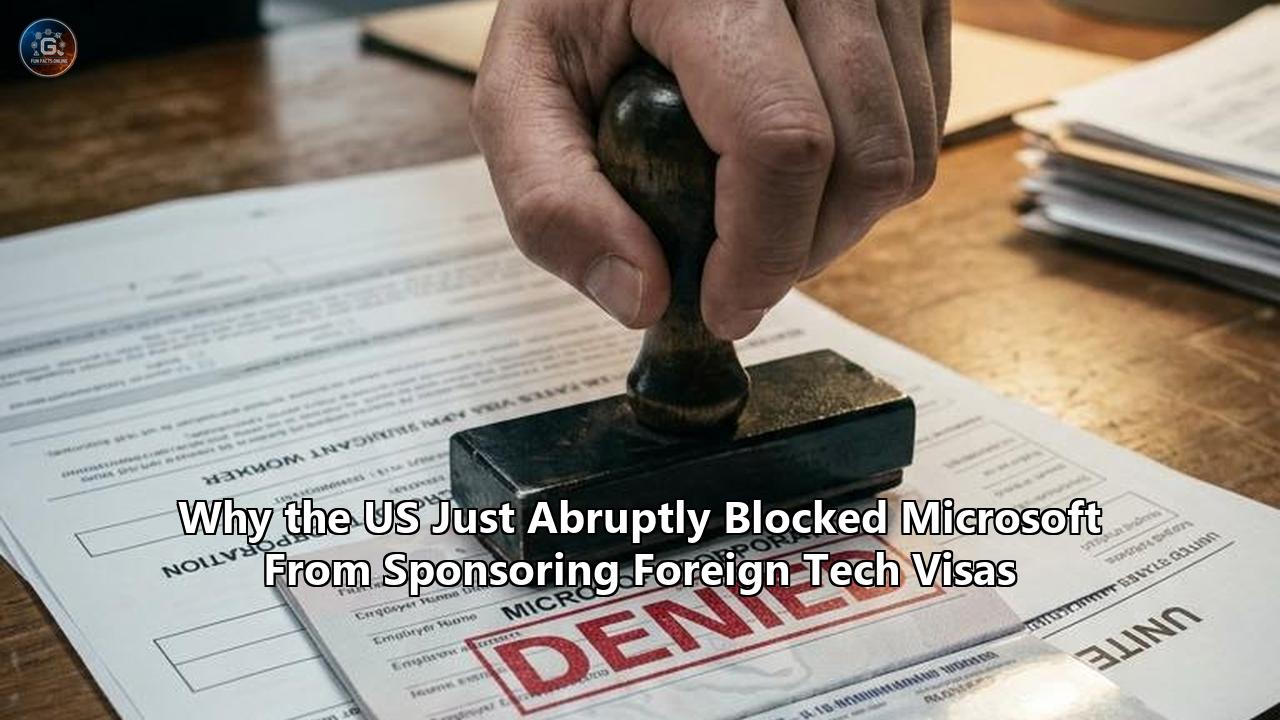
The United States government has abruptly suspended Microsoft from the federal program that allows American employers to sponsor foreign technology workers for permanent residency, launching a direct enforcement offensive against one of the world’s most valuable technology corporations.
Announced by Vice President JD Vance and Labor Secretary Keith Sonderling during a joint White House press briefing, the decision bars Microsoft from filing new applications under the Permanent Labor Certification (PERM) program and freezes all of the company’s pending green-card applications indefinitely. The Department of Labor simultaneously hit seven other major technology and outsourcing firms—including software giant Adobe and information technology services providers Cognizant, Infosys, Tata Consultancy Services, Wipro, HCLTech, and Capgemini—with identical suspensions.
The administration accused Microsoft of systematically manipulating the skilled-worker immigration system, alleging that the company laid off thousands of American engineers while turning to foreign labor on temporary work visas to depress wages.
“There has been no company in the United States, unfortunately, that has abused the system more than Microsoft,” Vance said. “Our message to Microsoft is: You’re a great American company, but you’ve got to hire great American workers. You cannot lay off American workers and then replace them with foreign indentured servants.”
The administration alleged that Microsoft laid off approximately 6,000 domestic workers over the preceding year while simultaneously benefiting from roughly 6,300 H-1B visas and nearly 3,000 permanent green-card certifications. “If you do the math,” Vance asserted, “for every worker that Microsoft laid off, they replaced that worker with one and a half foreign indentured servants”.
The confrontation produced immediate political theater in Washington. Merely hours after Vance stood at the White House podium lambasting Microsoft’s labor practices, President Donald Trump presented Microsoft Chief Executive Officer Satya Nadella—an Indian-born immigrant who arrived in the United States as a graduate student before ascending to lead the tech empire—with the National Medal of Technology and Innovation at a White House science summit.
The sudden enforcement blitz has sent shockwaves through Silicon Valley and the greater Seattle technology corridor. By severing the bridge between temporary H-1B specialty occupation visas and lawful permanent residence, the federal government has effectively locked Microsoft out of its primary talent-retention pipeline, leaving thousands of foreign-born engineers, data scientists, and systems architects facing a ticking legal clock on their status in the United States.
                     +----------------------------------------+
                     |    U.S. Department of Labor (DOL)      |
                     |  Issues Sudden Freeze Under 20 CFR     |
                     |             § 656.31(b)                |
                     +-------------------+--------------------+
                                         |
               +-------------------------+-------------------------+
               |                                                   |
               v                                                   v
+-------------------------------+               +----------------------------------+
|      Microsoft & Adobe        |               |   Global IT Services Providers   |
|   Direct Product Builders     |               | (Cognizant, Infosys, TCS, Wipro, |
| High Median Comp ($170k+)     |               |         HCLTech, Capgemini)      |
+---------------+---------------+               +------------------+---------------+
                |                                                  |
                +-------------------------+------------------------+
                                          v
                      +---------------------------------------+
                      |       PERM Labor Pipeline Frozen      |
                      |   • ETA-9089 applications halted      |
                      |   • Prevailing wage tests voided      |
                      |   • 180-day investigatory clock begins|
                      +-------------------+-------------------+
                                          |
                                          v
                      +---------------------------------------+
                      |        Downstream Impact Points       |
                      |  • AC21 6-year H-1B extensions blocked|
                      |  • Green card priority dates trapped  |
                      |  • R&D work pushed to foreign GCCs    |
                      +---------------------------------------+
The Legal Mechanism: How Freezing PERM Triggers De Facto H-1B Restrictions
To understand why the administration’s action strikes directly at Microsoft’s operations, one must look past standard visa filings to the procedural mechanics of corporate immigration law.
The suspension does not immediately revoke valid, existing H-1B status, nor does it bar Microsoft from filing lottery petitions for temporary visas through U.S. Citizenship and Immigration Services (USCIS). Instead, the Department of Labor invoked 20 C.F.R. § 656.31(b)—a regulatory provision permitting the agency to suspend processing of all Permanent Labor Certification (PERM) applications if an employer is under investigation for suspected fraud, labor displacement, or willful misrepresentation.
               CONVENTIONAL TECH CAREER PIPELINE

   F-1 Student Visa / OPT
            │
            ▼
   H-1B Lottery Selection (Cap: 65,000 + 20,000 Advanced Degree)
            │
            ▼
   H-1B Initial Term (Years 1-3)
            │
            ▼
   H-1B First Extension (Years 4-6 Statutory Limit)
            │
  ┌─────────┴─────────────────────────────────────────┐
  │   CRITICAL JUNCTURE: DOL PERM LABOR CERTIFICATION  │
  │   • Mandatory labor market test for US workers    │
  │   • Form ETA 9089 approval                        │
  └─────────┬─────────────────────────────────────────┘
            │ ◄─── [TRUMP-VANCE PERM FREEZE HALTS THIS STEP]
            ▼
   USCIS Form I-140 Immigrant Petition
            │
            ▼
   AC21 Statutory Extension (Permits H-1B renewals past Year 6)
            │
            ▼
   Form I-485 Adjustment of Status (Permanent Resident / Green Card)
The PERM program, managed by the Labor Department's Employment and Training Administration, requires companies seeking to sponsor foreign workers for employment-based immigrant visas (predominantly EB-2 and EB-3 categories) to prove that there are no qualified, willing, and able American workers available to fill the open position. Employers must run formal recruitment campaigns, place advertisements with state workforce agencies, publish notices in regional newspapers of general circulation, and offer salaries that meet or exceed prevailing wage minimums determined by the federal government. Once the Labor Department certifies that the recruitment failed to yield qualified domestic applicants, the company submits Form ETA 9089, clearing the foreign national to file an I-140 Immigrant Petition for Alien Worker with USCIS.
The critical intersection between PERM and temporary visas is governed by the American Competitiveness in the Twenty-First Century Act of 2000 (AC21). By law, an H-1B specialty occupation visa carries a strict statutory ceiling of six years. Foreign tech workers can break through that six-year ceiling only if their employer has filed a PERM labor certification or an I-140 petition on their behalf at least 365 days before the six-year mark, or if their I-140 petition has been formally approved but cannot be fully acted upon due to statutory per-country visa backlogs.
By freezing all new and pending PERM filings, the federal government cut the retaining cable holding senior technical staff inside the United States. Foreign software engineers reaching their fourth or fifth year on an H-1B visa at Microsoft cannot start the labor certification process required to remain in the country. For engineers with applications caught mid-process inside the Department of Labor, the clock continues to run. If their six-year statutory limit arrives before the suspension is lifted and their certification cleared, they must either leave the country, transfer to an overseas corporate office, or find an employer whose labor pipeline remains open.
Immigration attorneys point out that the administrative freeze creates de facto Microsoft H-1B visa restrictions without the administration having to navigate lengthy administrative rulemaking or alter congressional statutes governing the initial H-1B cap.
The freeze exploits the Labor Department's regulatory framework regarding reductions in force. Under 20 C.F.R. § 656.17(k), if an employer has laid off workers in the same or related occupation within the six months preceding the filing of a PERM application in the intended area of employment, the employer must document that it notified and considered all potentially qualified laid-off U.S. workers for the opening before seeking foreign certification. By linking recent corporate layoffs to tens of thousands of active foreign filings, the administration found an administrative lever to halt company filings across the board.
The Administration’s Charge: Allegations of Structural Replacement
Standing alongside Vance at the White House press conference was Labor Secretary Keith Sonderling and Department of Labor Inspector General Anthony D’Esposito, whose office has opened multiple criminal and civil inquiries into corporate compliance across tech hiring. Sonderling said the enforcement dragnet followed an extensive inter-agency review that uncovered what he characterized as systemic evasions of American labor protections.
“We will not accept any new or process any pending permanent labor certification applications involving these companies,” Sonderling told reporters. “Since 2009, just these companies alone have requested almost 3 million foreign workers. They’ve received over 230,000 H-1B visa approvals and over 100,000 permanent labor certifications”.
Sonderling added that the Labor Department’s investigatory task forces had identified roughly $22 billion worth of fraudulent transactions, shell-filings, and program abuses across the commercial landscape, though he did not break down what portion of that total directly applied to Microsoft.
               THE ADMINISTRATION'S REPLACEMENT CLAIM

   Microsoft Domestic Actions (Prior Year):
   [████████████████████] ~6,000 American Worker Layoffs

   Microsoft Foreign Labor Filings (Prior Year):
   [█████████████████████] ~6,300 H-1B Visa Petitions
   [██████████] ~3,000 PERM Labor Applications

   Administration Contention:
   "1.5 foreign indentured servants hired for every domestic worker cut"
   ---------------------------------------------------------------------

                 MICROSOFT'S ACTUAL WORKFORCE DATA

   Total Filings: ~6,000 H-1B Applications
   ├── [████████████████] 80% Renewals & Status Extensions of Existing Staff
   └── [████] 20% New Hires (Already residing in US / OPT Graduates)

   Total Impact: New foreign arrivals represented ~1% of US workforce.
   Wage Profile: $147,000 – $182,000+ base median (excluding stock/bonus).
Vance zeroed in on recruitment tactics, accusing major companies of turning the PERM labor market test into an administrative fiction. Under federal rules, an employer must advertise a position before filing for a green card to confirm no qualified American is available. Vance alleged that corporate recruiters intentionally construct recruitment notices designed to attract zero domestic applicants.
“Here’s the basic game that American corporations and foreign corporations will play,” Vance told reporters. “They will say, maybe they’ll put an advertisement in a small-town newspaper. They’ll go out there and say that we have advertised for a position with our company and nobody is responding to it, and they will use that lack of response to then go and replace American workers with what is effectively foreign indentured servants”.
Vance argued that tying a worker’s legal status in the country to a single corporate sponsor creates an imbalanced workplace dynamic. “When someone comes in, they are completely subordinate to that company,” Vance said. “If they lose that job, they have to leave the country. That gives the employer complete leverage over the foreign national while shutting the door on American graduates and veteran engineers who demand competitive market wages”.
Inspector General Anthony D’Esposito warned that the agency’s scrutiny would not stop with regulatory pauses. “Subpoenas have been served, investigations are under way, and nobody will be getting a free pass because their name is carved into an expensive building,” D’Esposito stated.
The political architecture of the move reflects the influence of White House Deputy Chief of Staff Stephen Miller, who stood in the briefing room as Vance and Sonderling laid out the enforcement actions. For years, nationalist economic strategists have argued that tech companies have distorted high-skilled immigration to create a captive, compliant labor force, challenging long-standing Silicon Valley arguments that the nation suffers from a chronic shortage of domestic engineering talent.
Microsoft Strikes Back: Internal Data and the Arithmetic of High Wages
Microsoft pushed back against the administration's claims, publishing a line-by-line defense of its hiring record, wage practices, and workforce composition.
“We believe in the strength and talent of the American workforce,” the company said in an official statement. “That is why the vast majority of Microsoft employees in the United States are Americans. We look forward to providing the Administration with additional information”.
The company dismantled the administration’s claim that it laid off 6,000 domestic employees only to backfill those positions with foreign arrivals:
- The 80% Extension Reality: Of the approximately 6,000 H-1B petitions Microsoft submitted during the last fiscal year, 80 percent were not new hires. Instead, they were standard applications to extend the three-year status or update the corporate titles of software professionals already employed by Microsoft within the United States.
- The 1% Scope of New Hires: The remaining 20 percent of petitions filed for new personnel were for individuals already legally present within the United States—overwhelmingly international graduates of American research universities working under Optional Practical Training (OPT)—who applied for open positions. Microsoft noted that new visa beneficiaries represent barely 1 percent of its total domestic workforce.
- No Inflow of New Arrivals: The company said none of its new H-1B petitions were used to bring outside cohorts of low-cost workers directly from foreign countries to replace domestic employees who had been let go during corporate reorganizations.
Publicly available Department of Labor filings challenge the assertion that Microsoft pays foreign staff below-market rates. The Labor Department's disclosure records reveal that software engineering salaries sponsored by Microsoft consistently rank among the highest across the tech sector. Base salaries for Microsoft H-1B software developers typically range from $147,000 to $182,000 annually, with total compensation—including performance equity and cash bonuses—frequently pushing annual remuneration between $200,000 and $450,000 depending on seniority, specialty, and geographical location.
“Microsoft only files H-1B petitions for those who meet the rigorous standards of this visa category,” the company's statement continued. “We pay our employees some of the highest compensation in the tech sector, and our wages are among the highest of all H-1B filings. We pay our H-1B employees the same as any other employees doing comparable work”.
Inside Microsoft’s Redmond headquarters, the administrative freeze produced an immediate internal crisis. Corporate vice presidents and engineering leads were flooded with inquiries from managers whose teams rely on senior foreign staff. In internal communications and closed Slack channels, foreign employees voiced panic over expiring six-year clocks, stalled green-card queues, and travel risks.
The suspension creates sharp operational vulnerabilities in mission-critical infrastructure. Engineers working on Microsoft Azure’s cloud virtualization layers, cybersecurity incident response units, and OpenAI model deployment pipelines include substantial contingents of foreign-born PhDs and software engineers on long-term visas. A sustained freeze on their legal status threatens to destabilize projects central to the company’s enterprise contracts and national security partnerships.
The Two-Tiered Shock: Product Tech Giants vs. IT Outsourcing Firms
One of the most consequential aspects of the Labor Department's enforcement action is its deliberate conflation of two completely different operating models: proprietary software product developers and third-party IT consulting contractors.
By packaging Microsoft and Adobe in the same enforcement action as Cognizant, Infosys, Tata Consultancy Services (TCS), Wipro, HCLTech, and Capgemini, the administration deployed a single regulatory weapon against two distinct business models.
┌──────────────────────────────────────┬──────────────────────────────────────┐
│ DIRECT PRODUCT DEVELOPERS            │ IT STAFF AUGMENTATION / OUTSOURCING  │
│ (Microsoft, Adobe)                   │ (TCS, Infosys, Wipro, Cognizant)     │
├──────────────────────────────────────┼──────────────────────────────────────┤
│ Core Business:                       │ Core Business:                       │
│ Proprietary software, cloud infra-   │ Third-party IT support, systems      │
│ structure (Azure), AI foundation     │ integration, corporate staff         │
│ models, enterprise operating systems.│ augmentation, back-office migration. │
├──────────────────────────────────────┼──────────────────────────────────────┤
│ Compensation Strategy:               │ Compensation Strategy:               │
│ High-tier base ($150k-$250k+) plus   │ Lower-tier, entry-level prevailing   │
│ lucrative equity grants; competes for│ wage structures ($75k-$110k),        │
│ top global elite research talent.    │ focused on billing margins.          │
├──────────────────────────────────────┼──────────────────────────────────────┤
│ PERM Use Profile:                    │ PERM Use Profile:                    │
│ Retention tool: sponsored to keep    │ Historic volume users, though        │
│ vital core engineers permanently     │ rapidly pivoting away from PERM in   │
│ within the domestic enterprise.      │ favor of offshore delivery centers.  │
├──────────────────────────────────────┼──────────────────────────────────────┤
│ Operational Exposure:                │ Operational Exposure:                │
│ Severe: Senior staff leave, R&D lines│ Adaptable: Accelerates migration of  │
│ stall, core IP innovation disrupted. │ contracts directly to Indian GCCs.   │
└──────────────────────────────────────┴──────────────────────────────────────┘
The differences between these two groups run deep:
Product Giants: High-Comp R&D and Intellectual Property
Microsoft and Adobe hire foreign nationals primarily as core full-time personnel. Sponsoring an employee for an H-1B visa and moving them through the multi-year PERM green-card pathway is expensive; corporate legal fees, filing costs, prevailing wage audits, and recruitment campaigns easily surpass $15,000 to $25,000 per individual case. These tech companies absorb those costs to secure specialized personnel who design core algorithmic architectures, build proprietary software, and optimize global data center networks. For these firms, foreign labor is not a cost-cutting tactic; it is an international search for specialized technical talent.
The Outsourcing Matrix: Labor Arbitrage and Staff Augmentation
In contrast, global IT consulting firms historically operated on labor arbitrage. Known throughout the tech industry by the historical acronym "WITCH" (Wipro, Infosys, Tata, Cognizant, HCL), these providers routinely used the H-1B program to import junior and mid-level programmers on client-site contracts to manage back-office software maintenance, database configurations, and legacy enterprise migrations.
While reforms enacted during the late 2010s reduced their domination of the annual H-1B lottery, these companies historically accounted for a large share of all temporary visas issued in the United States. In recent years, companies like TCS have responded to regulatory scrutiny by scaling back green-card filings. In response to the Labor Department's announcement, TCS noted that its business model has shifted toward local domestic hiring, with its total U.S. PERM filings dropping into the single digits annually.
By grouping Microsoft with offshore outsourcing vendors, the administration applied a blunt narrative: that any company employing thousands of foreign-born tech workers is running a low-cost replacement scheme.
Industry observers note that this approach reshapes the political landscape. For decades, enterprise tech leaders could distance themselves from criticisms of visa mill abuses by pointing to their high salary disclosures and direct-employment models. Now, the administration's enforcement actions show that high wages and corporate stature offer no immunity from regulatory crackdowns.
          HISTORIC H-1B LOTTERY VOLUMES: SHIFT OVER TIME

   2015 Peak Outsourcing Era:
   Outsourcing Contractors (TCS, Infosys, Cognizant, Wipro)
   [████████████████████████████████████████████] ~60-70% of Cap
   Direct Tech Product Firms (Microsoft, Google, Apple)
   [█████████████] ~20-25% of Cap

   2025-2026 Shift Under Scrutiny:
   Outsourcing Contractors (Pivoting offshore to GCCs)
   [████████████████] ~25-30% of Cap
   Direct Tech Product Firms (Aggressive domestic OPT recruitment)
   [█████████████████████████████] ~50-55% of Cap
The Wider Offensive: $100K Fees, OPT Levies, and University Probes
The sudden PERM suspension of Microsoft and its peer firms is not an isolated regulatory incident. It represents one prong of an aggressive, coordinated executive campaign aimed at raising the cost of foreign skilled labor across the entire domestic economy.
Over the weeks leading up to the announcement, the White House and its cabinet agencies deployed administrative rules designed to curb foreign high-skilled employment at multiple entry points:
                     THE SKILLED TALENT CHOKEPOINTS

    ACADEMIA                   GRADUATION                ENTERPRISE
+---------------+          +---------------+          +---------------+
| International |          |   Optional    |          |   Corporate   |
|   Students    |  ====>   |   Practical   |  ====>   |  Sponsorship  |
|  (F-1 / J-1)  |          | Training (OPT)|          | (H-1B / PERM) |
+-------+-------+          +-------+-------+          +-------+-------+
        |                          |                          |
        v                          v                          v
  [PROBE LEVIED]            [COST ESCALATION]          [PIPELINE FROZEN]
  DOL Inspector General     DHS proposed rule          DOL suspends PERM
  opens probes into         mandates $70,000           under 20 CFR § 656.31(b);
  9 top universities        fee on universities        DHS proposes $103,000
  (Harvard, MIT, etc.)      per OPT student            employer petition fees
  for J-1 program fraud.    work authorization.        on foreign hiring.
The $103,000 H-1B Petition Surcharge
In August, the Department of Homeland Security introduced a proposed regulation that would impose an administrative filing fee of roughly $103,000 on employers seeking each new H-1B worker. The administration framed this measure as a fee to discourage companies from looking overseas when filling domestic positions.
The move followed a previous attempt to implement a $100,000 filing penalty, which was struck down in June by a federal district judge who ruled that the executive branch had exceeded its statutory authority by imposing what amounted to an unauthorized tax. Undeterred, the administration revised its regulatory justification and reissued the rule, setting up a legal battle over the limits of executive power.
The $70,000 OPT University Surcharge
Just 24 hours before moving against Microsoft, the Department of Homeland Security introduced a rule targeting the Optional Practical Training (OPT) program. Under standard OPT rules, foreign graduates with science, technology, engineering, and mathematics (STEM) degrees from American universities can work in the United States for up to three years post-graduation. The administration’s proposal requires American colleges and universities to pay an annual fee of $70,000 for every international student they enroll in the OPT program.
By shifting this financial burden directly onto university balance sheets, the administration aims to curb international enrollment in STEM degree tracks, reducing the domestic pipeline of foreign graduates entering corporate employment.
Criminal Inquiries into Elite Higher Education
Simultaneously, Vance and Inspector General D’Esposito announced federal fraud investigations into nine major American research institutions over their use of the J-1 exchange visitor program. The target list reads like a roster of the nation’s top academic institutions: Harvard, Yale, Stanford, Brown, Caltech, the Massachusetts Institute of Technology (MIT), the University of Pittsburgh, the University of California, Davis, and Arizona State University.
Vance alleged that these universities were using J-1 visas to bring in low-cost foreign graduate researchers and post-doctoral scholars to handle research workloads, suppressing wages for domestic academics and American doctoral candidates.
Taken together, these initiatives represent an attempt to reshape corporate hiring. By raising fees on OPT students, opening fraud inquiries into the universities that train them, slapping large fees onto initial H-1B petitions, and freezing the PERM process required for permanent residency, the administration has constructed a regulatory squeeze across every tier of high-skilled immigration.
The Legal Battleground: Executive Overreach and Administrative Law
The Department of Labor's sudden freeze of Microsoft's labor certifications has set off alarm bells across administrative and corporate law practices. Legal scholars argue that the government's use of 20 C.F.R. § 656.31(b) stretches the executive branch's regulatory authority past legal boundaries.
               THE ADMINISTRATIVE PROCEDURE ACT (APA) HURDLE

┌──────────────────────────────────┐      ┌──────────────────────────────────┐
│   DEPARTMENT OF LABOR CLAIM      │      │     EMPLOYER LEGAL CHALLENGE     │
├──────────────────────────────────┤      ├──────────────────────────────────┤
│ Authority under 20 CFR § 656.31: │      │ 1. Arbitrary & Capricious:       │
│ Agency can pause PERM processing │      │ Blanket enterprise-wide freeze   │
│ for up to 180 days during an     │      │ issued without individual        │
│ active investigation into fraud  │      │ specific findings of fraud.      │
│ or willful misrepresentation.    │      │                                  │
│                                  │      │ 2. Procedural Due Process:       │
│ Goal: Prevent bad-faith labor    │      │ Halting approved, paid-for,      │
│ applications from passing while  │      │ pending applications without an  │
│ broad inquiries continue.        │      │ evidentiary hearing or notice.   │
│                                  │      │                                  │
│ Scope: Discretionary authority   │      │ 3. Ultra Vires Overreach:        │
│ over labor certification rules.  │      │ Converting narrow fraud powers   │
│                                  │      │ into broad economic bans.        │
└──────────────────────────────────┘      └──────────────────────────────────┘
The core legal question centers on the scope of 20 C.F.R. § 656.31(b). Historically, this provision was drafted to give the Labor Department a way to pause specific, individual PERM filings where investigators had direct evidence of forged credentials, fraudulent job offers, or shell companies created solely to sell green-card sponsorships.
The regulation states that the certifying officer may suspend processing of applications for up to 180 days if the agency learns that an employer is under investigation by the Department of Labor or another federal authority for fraud or willful misrepresentation. If criminal or civil judicial proceedings are formally initiated, the suspension can be extended until those matters are fully resolved.
The administration is using this regulatory mechanism to impose enterprise-wide freezes on entire corporations. Under its reading of the rule, an open investigation into a handful of positions or a single department gives the agency authority to halt all filings across a 220,000-person global corporation.
Legal challenges to the move are expected to focus on several key vulnerabilities:
1. Arbitrary and Capricious Agency Action
Under Section 706 of the Administrative Procedure Act (APA), federal courts must invalidate agency actions found to be "arbitrary, capricious, an abuse of discretion, or otherwise not in accordance with law." Corporate litigants are likely to argue that freezing thousands of applications—many for specialized positions unrelated to any recent workforce reductions—without showing individualized fraud violates basic APA principles.
2. Violation of Procedural Due Process
The Fifth Amendment protects corporate entities and lawful residents from the arbitrary deprivation of property and statutory entitlements without due process of law. Employers pay significant non-refundable fees, conduct expensive recruitment processes according to federal mandates, and make binding contractual commitments based on published agency timelines. Freezing those petitions through a press-conference announcement without advance administrative notice, formal charges, or an opportunity to respond raises constitutional concerns.
3. Regulatory Misuse and the Major Questions Doctrine
The Supreme Court has increasingly applied the major questions doctrine to rein in executive agencies that claim sweeping economic authorities without clear, explicit authorization from Congress.
Litigants will argue that Congress never gave the Department of Labor the power to cut an entire Fortune 50 company out of the immigration system through administrative guidance. If the administration uses a narrow fraud rule to reshape national technology hiring, federal courts may see it as an unauthorized expansion of agency authority.
Industry coalitions—including TechNet, the U.S. Chamber of Commerce, and BSA | The Software Alliance—are already meeting with outside counsel to prepare emergency motions for temporary restraining orders (TROs) and preliminary injunctions in federal court. If a federal judge steps in to block the suspension, the White House could see its high-profile tech enforcement initiative paused on administrative grounds.
Corporate Realignment: Offshoring, GCCs, and the Canadian Valve
If the administration’s strategy is designed to force tech giants into hiring American engineers, corporate executives and economic analysts warn that it may backfire. Rather than replacing foreign-born software engineers with domestic personnel, tech companies are well-positioned to shift high-paying development roles outside the United States entirely.
               PROJECTED CORPORATE WORKFORCE REALIGNMENT

                  ┌─────────────────────────────────┐
                  │    DOMESTIC PERM/H-1B BAN       │
                  │   Blocks Talent in Redmond, WA  │
                  └────────────────┬────────────────┘
                                   │
         ┌─────────────────────────┴─────────────────────────┐
         │                                                   │
         ▼                                                   ▼
┌─────────────────────────────────┐       ┌─────────────────────────────────┐
│     THE VANCOUVER VALVE         │       │  GLOBAL CAPABILITY CENTERS(GCC) │
│ • 140 miles north of Redmond    │       │ • Bangalore, Hyderabad, Pune    │
│ • No per-country nationality cap│       │ • Direct offshore R&D hubs      │
│ • Canadian Global Skills Visa   │       │ • Zero U.S. payroll tax base    │
│   issued in 14 to 30 days       │       │ • Zero U.S. jurisdictional reach│
│ • Full cross-border integration │       │ • Retains core IP development   │
└─────────────────────────────────┘       └─────────────────────────────────┘
The technology sector of 2026 is fundamentally different from the sector of the late 1990s. Today, cloud networks, automated code deployment pipelines, and collaboration platforms allow tech companies to distribute software engineering teams across global offices with minimal productivity loss.
Tech companies have two established pathways to adapt to prolonged restrictions:
1. The Canadian Safety Valve
For Microsoft, the simplest hedge against American immigration restrictions sits 140 miles north of its headquarters. The Microsoft Canada Development Centre (MCDC) in Vancouver, British Columbia, was built partly to absorb international engineers who were shut out of the American immigration system.
Canada’s immigration policy features a Global Skills Strategy that processes work permits for high-skilled technical personnel in two to four weeks, with no per-country nationality quotas and direct paths to permanent residency within two years.
If an engineering team in Redmond faces the expiration of its workers' six-year H-1B limits due to the PERM freeze, Microsoft can relocate those engineers to its Vancouver campus. The company retains the intellectual capital, the employees keep their careers, and the U.S. economy loses the payroll taxes, consumer spending, and secondary job creation those workers provide.
2. The Acceleration of Global Capability Centers (GCCs)
Over the past five years, enterprise software companies have shifted away from third-party IT contractors in favor of building their own offshore corporate hubs, known as Global Capability Centers (GCCs). Tech giants operate massive research campuses in Bangalore, Hyderabad, and Pune that are direct corporate subsidiaries—not third-party vendors.
If the federal government imposes $100,000 application surcharges and blocks green-card sponsorships, enterprise finance chiefs will likely shift new headcount to overseas GCCs.
Once a software engineering role is moved to Hyderabad or Dublin, it rarely returns to the United States. Rather than boosting domestic hiring, an extended freeze could accelerate the export of high-paying software jobs.
       TOTAL COMPENSATION FLOW: DOMESTIC VS. OFFSHORE EXPORT

   U.S. Domestic Hire (Senior Staff Engineer, Redmond):
   ┌────────────────────────────────────────────────────────┐
   │ Total Cost: $280,000 - $350,000 / year                  │
   │ Includes: Federal taxes, state payroll, benefits, space│
   └────────────────────────────────────────────────────────┘
                              VS.
   Offshore GCC Hire (Senior Staff Engineer, Bangalore/Vancouver):
   ┌─────────────────────────────┐
   │ Total Cost: $75,000-$130,000│
   │ Zero U.S. payroll tax base  │
   └─────────────────────────────┘

   Net Effect: Corporate reaction to visa freezes often results in
   permanent offshore capital reallocation, not domestic backfilling.
The artificial intelligence sector faces unique risks from these disruptions. Modern AI research relies heavily on an international bench of mathematical modelers, distributed systems engineers, and chip-architecture software developers. Leading industry studies show that more than half of the top-tier AI researchers working in American laboratories and corporate institutions are foreign nationals.
If tech companies cannot offer a clear pathway to permanent residency, the world’s top scientific talent will increasingly seek opportunities in European, Asian, or Canadian research hubs, challenging American leadership in foundational technologies.
The Human Dimension: The Backlog Trap and Life in Limbo
Behind the macroeconomic debates, corporate balance sheets, and White House podiums lies a human toll that touches thousands of high-skilled immigrant families.
The United States employment-based immigration system has long been strained by a statutory per-country ceiling. Under immigration laws dating back to 1965 and 1990, no single country of birth can receive more than 7 percent of the total employment-based green cards issued in any fiscal year. Because India supplies a large share of the world's computer science and engineering professionals, Indian nationals face a severe backlog.
           THE DECADES-LONG BACKLOG TRAP (EB-2/EB-3 INDIA)

  [========================================================================>]
  Projected wait time for newly sponsored Indian engineer: 80 - 150 years

  Years 1 - 6:       H-1B Visa Initial Term & Extensions.
  Year 5:            DOL PERM Application & I-140 Filed. ◄── [FROZEN]
  Years 6 - 25+:     Rolling AC21 3-Year Extensions (Dependent on PERM/I-140).
  Year 21 of Child:  "Aging Out" - Dependent children lose H-4 visa status,
                     face deportation or conversion to F-1 international status.
According to data compiled by the Congressional Research Service (CRS) and the Cato Institute, an Indian national entering the EB-2 or EB-3 green-card queue today faces a projected wait that can stretch across decades, with some projections reaching over a century without congressional reform. To manage this delay, workers rely on AC21 provisions to extend their H-1B visas in three-year increments indefinitely while they wait for their priority dates to become current.
The prerequisite for that long-term legal bridge is an approved PERM labor certification and an approved I-140 immigrant petition.
When the Department of Labor froze Microsoft's PERM pipeline, it broke that bridge for thousands of employees:
- The Career Lock-In: A worker whose PERM is paused cannot easily change jobs or accept a promotion without risking their place in the queue. They are locked into their current job description, unable to move up or switch teams.
- The "Aging Out" Nightmare: Immigrant tech workers raising families in the United States face the constant worry that their children will "age out". Children living in the country on dependent H-4 visas lose their legal status the day they turn 21. If the parent has not reached the final step of permanent residency, the child loses legal status and must either secure an international student visa or self-deport from the only country they have ever known. Freezing the PERM pipeline accelerates this risk for thousands of immigrant families.
- The International Travel Trap: Because H-1B visa holders must get their passports stamped at overseas consulates to re-enter the country after traveling abroad, the threat of administrative holds keeps many workers from leaving the United States. Many workers are forced to miss funerals, family weddings, and reunions with aging parents abroad out of fear that they will be denied re-entry into the United States.
For these workers, being publicly characterized as "foreign indentured servants" by the Vice President of the United States added emotional insult to legal uncertainty. Many have lived in the country for more than a decade, paying federal, state, and local taxes, buying homes in suburban school districts, and building lives in local communities. The administrative freeze has left their futures hanging in the balance.
Washington's Shifting Realpolitik: Nadella, Vance, and the Midterm Clock
The political crosscurrents behind the Microsoft suspension were made vivid by the split-screen optics of October 8, 2026.
At 10:00 AM, Vice President JD Vance stood in the White House James S. Brady Press Briefing Room, flanked by Cabinet officials and enforcement heads, accusing Microsoft of running an unlawful replacement scheme that harms domestic tech workers.
By 2:30 PM, Microsoft CEO Satya Nadella was seated inside the East Room of the White House, where President Donald Trump draped the National Medal of Technology and Innovation around his neck.
                               OCTOBER 8, 2026
                      THE WHITE HOUSE SPLIT-SCREEN

           10:00 AM                                   2:30 PM
     PRESS BRIEFING ROOM                         THE EAST ROOM
┌──────────────────────────────┐          ┌──────────────────────────────┐
│ Vice President JD Vance      │          │ President Donald Trump       │
│ launches an enforcement      │          │ awards Microsoft CEO         │
│ offensive against Microsoft. │          │ Satya Nadella the National   │
│                              │          │ Medal of Technology.         │
│ • PERM program frozen        │          │                              │
│ • Accused of labor abuse     │          │ • Honored for tech leadership│
│ • Vance: "Replace American   │          │ • Joined by Elon Musk and    │
│   workers with foreign       │          │   other global innovators    │
│   indentured servants"       │          │ • Celebrated as an engine of │
│                              │          │   American economic power    │
└──────────────────────────────┘          └──────────────────────────────┘
The split-screen dynamic reflects competing political priorities within the administration. The White House wants to celebrate American leadership in cutting-edge computing, but it is also under political pressure to deliver on economic promises made to domestic voters.
With the 2026 midterm elections approaching, the administration faces growing pressure over economic conditions, corporate layoffs, and tech-sector contraction. Over 130,000 tech employees lost their jobs across the sector over the preceding nine months, according to industry tracker Layoffs.fyi. For voters frustrated by corporate restructuring and selective hiring, the administration's focus on high-skilled visa programs offers a visible target.
Vance has positioned himself as an economic populist who argues that corporate America has decoupled its interests from the domestic working class. By targeting Microsoft—a corporate icon with a $3 trillion market footprint—the administration sends a political signal that even the most powerful technology companies are subject to its policies.
When pressed by reporters on the contradiction between honoring Nadella and penalizing his company on the same day, Vance made no apologies.
“We’re going to continue to support Microsoft and have a great relationship with Microsoft, but we’re also going to deny them the ability to apply for these permanent residencies until they show that they are going to get serious about putting American workers first,” Vance said. “It’s one thing if you want to bring in a person like Elon Musk or Lisa Su—obviously, if that person wants to come in and build something great in the United States of America, we support that. But you cannot run broad labor replacement programs at the expense of American workers”.
The rhetoric points to a policy that evaluates immigration based on individual economic status: high-profile tech founders and executives are celebrated, while the broader ranks of software engineers, systems developers, and computational scientists face strict enforcement measures.
What to Watch: The Unfolding Escalation
As the tech sector and legal community digest the sudden ban, the fight between the federal government and corporate America will play out across multiple fronts over the coming months:
               UPCOMING MILESTONES & BATTLEGROUNDS

       OCTOBER 2026                       NOVEMBER 2026                       DECEMBER 2026+
+--------------------------+       +--------------------------+       +--------------------------+
|  Written DOL Notices     | ====> |   Federal Injunctions    | ====> |  The 180-Day Deadline   |
|  DOL issues formal       |       |   Industry groups (Tech- |       |  DOL must either file    |
|  specifications outlining|       |   Net, Chamber) file APA |       |  formal administrative   |
|  scope of PERM freezes.  |       |   challenges in District |       |  charges or lift the     |
|                          |       |   Courts; TROs sought.   |       |  preliminary suspension. |
+--------------------------+       +--------------------------+       +--------------------------+
1. The Written DOL Specifications
The first formal test will come when the Department of Labor issues its detailed administrative notices to Microsoft, Adobe, and the six named IT service providers.
Attorneys will review these notices to see whether the government tries to justify an enterprise-wide freeze or narrows the scope of the suspension to specific business units, geographic divisions, or job titles that conducted layoffs over the past six months.
If the written notices try to impose a sweeping, company-wide ban without citing specific, evidence-backed violations, the government will be in a weaker position when defending the action in federal court.
2. Emergency Injunction Filings in Federal District Court
A corporate legal challenge will likely land in federal court shortly. Corporate legal teams are weighing whether Microsoft will file its own lawsuit or coordinate through industry associations like the U.S. Chamber of Commerce or TechNet.
Attorneys will file motions for emergency temporary restraining orders (TROs) to lift the PERM freeze while litigation plays out, arguing that the disruption to business operations and talent retention causes irreparable harm.
The outcome will turn on whether federal judges see the administration's use of 20 C.F.R. § 656.31(b) as an authorized exercise of enforcement discretion or an unconstitutional end-run around the Administrative Procedure Act.
3. Corporate Mobility and Headcount Reallocations
Inside Microsoft, Human Resources and global mobility teams are already reviewing talent rosters to identify employees nearing their critical six-year H-1B limits.
The industry will be watching to see if Microsoft accelerates relocations to its Vancouver campus, shifts open enterprise software requisitions to development hubs in Ireland and India, or institutes emergency cross-border remote work arrangements.
If hiring requisitions begin migrating out of the country in large numbers, the administration's crackdown could end up shifting high-paying software jobs overseas.
4. The 180-Day Regulatory Clock
Under 20 C.F.R. § 656.31(b), the Department of Labor’s initial administrative suspension cannot exceed 180 days unless formal civil or criminal proceedings are filed in court.
That puts the administration on a six-month clock. By the end of that period, federal investigators must either present formal findings of fraud and initiate legal proceedings or allow the suspension to expire.
Whether the Labor Department has gathered evidence of widespread immigration fraud at Microsoft—or deployed the suspension as a temporary political and regulatory pressure tactic—will become clear as that deadline approaches.
For now, the suspension stands as a dramatic escalation in the battle between Washington and Silicon Valley. By moving against the immigration pipelines that sustain American tech companies, the federal government has opened a conflict that will test executive power, reshape corporate workforce strategies, and affect the lives of thousands of skilled immigrant workers.
Reference:
- https://www.foxbusiness.com/politics/vance-suspends-microsoft-others-from-foreign-workers-applying-green-cards-accuses-company-visa-abuse
- https://www.reddit.com/r/immigration/comments/1x0t1lz/us_suspends_visa_program_for_tech_firms_including/
- https://wolfsdorf.com/dol-announces-perm-suspensions-for-microsoft-adobe-and-major-it-firms/
- https://thenextweb.com/news/microsoft-perm-green-card-suspension-vance
- https://www.youtube.com/watch?v=EqSglhYKmN4
- https://www.geekwire.com/2026/microsoft-responds-to-trump-administration-accusation-that-it-abuses-foreign-worker-programs/
- https://www.briefs.co/news/labor-department-moves-to-suspend-microsoft-and-adobe-from-g/
- https://www.businessinsider.com/smart-people-perm-program-suspended-microsoft-adobe-indian-tech-h1b-2026-10
- https://www.forbes.com/sites/stuartanderson/2026/10/09/jd-vance-attacks-companies-and-immigration/
- https://www.ft.com/content/5cfecbba-69ed-42d0-98fd-3ae019144692?syn-25a6b1a6=1
- https://www.aljazeera.com/economy/2026/10/8/us-suspends-microsoft-and-adobe-from-visa-programme-amid-fraud-claims
- https://time.com/article/2026/10/09/us-immigration-visa-fraud-green-card-h1b-j1-microsoft-adobe/
- https://www.youtube.com/watch?v=OamYHQC8fcQ
- https://mynorthwest.com/local/vance-microsoft-h-1b-visa-workers/4284374
- https://qz.com/microsoft-suspended-green-card-program-h1b-visa-100826
- https://www.reddit.com/r/amazonemployees/comments/1x0u31m/microsoft_is_being_suspended_from_program_to/