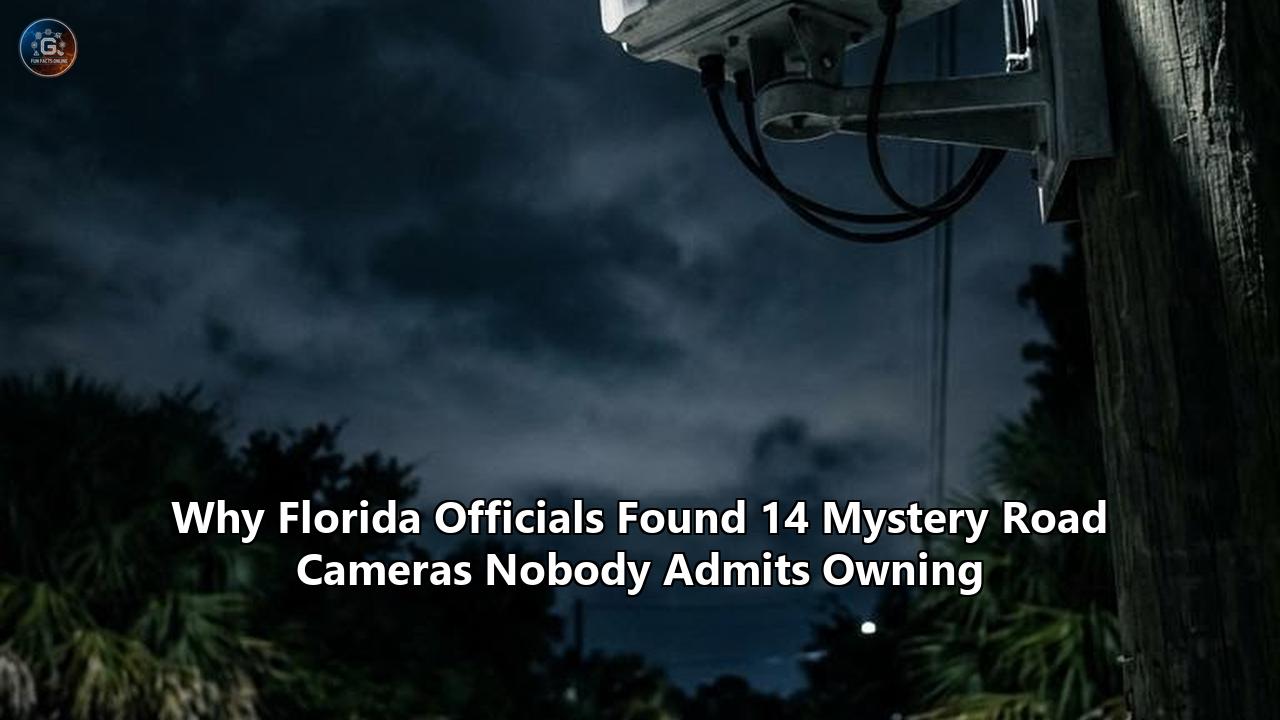
On a stretch of asphalt cutting through St. Lucie County on Florida’s Atlantic coast, a routine municipal audit meant to dismantle a surveillance system instead exposed a phantom network.
County public works crews, dispatched in mid-September 2026 to execute a board directive to strip all automated license plate readers (ALPR) from county rights-of-way, carried a master inventory list detailing 52 authorized camera locations. Every unit on that list was manufactured by Atlanta-based surveillance contractor Flock Safety, installed under municipal contracts, and tracked in county planning records.
When the field technicians completed their physical sweep, the equipment count did not stop at 52. Mounted high on wooden utility poles, streetlights, and standalone steel masts across the county were 14 additional ALPR units monitoring major traffic arteries. None of these 14 devices had ever been reviewed, permitted, or approved by the St. Lucie County Planning and Development Department.
When county administrators circulated the GPS coordinates and pole identification numbers to local police departments, the mystery deepened. The St. Lucie County Sheriff’s Office acknowledged that three of the unauthorized devices belonged to its fleet, though agency officials offered no public explanation for why the hardware had bypassed county permitting. The region’s other two municipal agencies—the Port St. Lucie Police Department and the Fort Pierce Police Department—inspected the remaining 11 installations and formally denied ownership.
Flock Safety, the tech company whose proprietary software and Falcon camera enclosures operate the network, maintains that it works closely with law enforcement and that permitting rules vary by jurisdiction. Yet nobody in county government, from the board of commissioners to the public works division, could identify who commissioned the hardware, who authorized the pole attachments, or who was actively siphoning the real-time location data of thousands of drivers moving along Florida’s Treasure Coast.
Faced with an active, unaccountable surveillance grid operating directly over public streets, county administrators ordered immediate physical countermeasures. Technicians scaled the poles to wrap the optical lenses in heavy black plastic bags, securing them with zip ties, and slapped neon-red warning notices across the metal housings. The placards gave the anonymous owners a strict 30-day ultimatum to dismantle the equipment before county crews returned with bucket trucks and sawzalls to cut the hardware from the infrastructure.
The discovery of these 14 mystery road cameras has peeled back the veneer of modern roadside surveillance, laying bare a fragmented ecosystem of private vendors, regulatory loopholes, conflicting police jurisdictions, and broken infrastructure oversight that extends far beyond a single coastal Florida county.
                       +---------------------------------------+
                       |      St. Lucie County Discovery       |
                       |       66 Total Cameras Located        |
                       +-------------------+-------------------+
                                           |
                 +-------------------------+-------------------------+
                 |                                                   |
                 v                                                   v
      +--------------------+                              +--------------------+
      | 52 Permitted Units |                              |  14 Mystery Road   |
      |   (County Fleet)   |                              |      Cameras       |
      +--------------------+                              +----------+---------+
                                                                     |
                                           +-------------------------+-------------------------+
                                           |                                                   |
                                           v                                                   v
                                +--------------------+                              +--------------------+
                                |  3 Claimed Units   |                              |  11 Unclaimed      |
                                | (Sheriff's Office) |                              |  Phantom Cameras   |
                                +--------------------+                              +----------+---------+
                                                                                               |
                                                                                    +----------+----------+
                                                                                    | Bagged in plastic   |
                                                                                    | 30-day red notices  |
                                                                                    | Facing removal      |
                                                                                    +---------------------+
The Catalyzing Crisis: FDOT Memorandum 26-01
The sweep that exposed the mystery cameras was not triggered by routine maintenance. It was the direct fallout of a high-stakes confrontation between Florida state officials and the rapid, unchecked expansion of private camera networks.
On August 31, 2026, the Florida Department of Transportation (FDOT) issued a directive that reverberated across every municipal precinct in the state: Engineering and Operations Memorandum No. 26-01. Signed by FDOT Chief Operating Officer and Assistant Secretary Will Watts, the order revoked all existing permits for automated license plate readers operating within the rights-of-way of the State Highway System.
                                  FDOT MEMORANDUM NO. 26-01
                             CRACKDOWN TIMELINE & JURISDICTION

   Aug 31, 2026: Memo Issued                   Sep 30, 2026: Removal Deadline
   --------------------------------------------------------------------------------->
   * Revokes all active ALPR permits           * Police must clear state highway rights-of-way
   * Freezes new highway applications          * FDOT crews authorized to seize hardware
   * Cites surveillance risks & misuse         * Triggers local county & municipal audits
Watts cited an “exponential increase in deployments along our roadways, coupled with concerning reports of misuse, data privacy concerns and surveillance schemes,” declaring that state intervention was necessary to “preserve Floridians’ sovereignty and quality of life.” The memo established a hard 30-day deadline—September 30, 2026—for local law enforcement agencies to pull their hardware off state roads or face forfeiture, with state contractors authorized to forcibly remove non-compliant hardware.
The executive push had clear political momentum. Governor Ron DeSantis stepped out in front of the directive, publicly framing ALPR networks as an intrusive overreach that had escaped democratic oversight. During an August press conference, DeSantis pushed past standard conservative tough-on-crime talking points to attack the core business model of dragnet vehicle tracking:
"If you want to get in your car and you want to go down to Buc-ee's in St. Augustine, it's really none of the government's damn business if you're doing that, right? These cameras that are out there now—who's to say they're only doing the license plate? Now, they say that. I think it's capturing people in their cars. I don't want to be in a situation where these tech companies know everything about you and where you're going."
The state-level intervention forced immediate administrative friction. Under Florida Statute 316.0777, FDOT exercises statutory authority over physical equipment inside state highway boundaries. However, that authority ends at the county line or city street curb.
Fearing that law enforcement would simply evade the state directive by migrating cameras from state routes (such as US-1 or State Road A1A) onto secondary residential roads, county commissions began taking matters into their own hands.
On September 1, 2026, the St. Lucie County Board of County Commissioners convened an emergency debate. Commissioner James Clasby argued that half-measures would leave residents vulnerable to privatized surveillance webs over which local leaders held no structural leverage. The commission voted 3-2 to terminate its municipal contract with Flock Safety and ban all ALPR devices from county-controlled easements and rights-of-way.
When the county’s code enforcement and public works personnel were sent into the field to map the removal process, they quickly realized that state highway corridors were not the only places where administrative boundaries had collapsed. The local right-of-way itself had been co-opted.
Anatomy of the Hardware: The Self-Contained Surveillance Node
To grasp why 14 automated cameras could sit in plain view along public roads without official records, one must examine the specific physical engineering of modern ALPR systems. Unlike older municipal traffic cameras—which required massive infrastructure investments, trenching for underground fiber-optic cabling, dedicated AC power tie-ins, and high-visibility industrial mounting gantries—modern license plate readers operate as decoupled, low-profile tactical endpoints.
       +-------------------------------------------------------+
       |             TYPICAL FLOCK FALCON ALPR NODE            |
       +-------------------------------------------------------+
                                  |
                                  +--> [Solar Array]: 30W-60W panel; zero utility grid reliance
                                  |
                                  +--> [Optical Enclosure]: Compact black housing, weatherized
                                  |      |
                                  |      +--> [Dual-Lens Array]: Day sensor + IR illuminator
                                  |      |
                                  |      +--> [Edge Processing Chip]: Runs OCR & Vehicle
                                  |             Fingerprint ML models locally
                                  |
                                  +--> [Cellular Modems]: Multi-carrier eSIM (LTE-M / 4G)
                                  |      bypasses municipal IT switches and networks
                                  |
                                  +--> [Power Core]: Internal LiFePO4 battery pack (continuous)
                                  |
                                  +--> [Mounting Rig]: Stainless steel banding straps secured
                                         directly to wooden/composite utility distribution poles
The hardware identified across St. Lucie County consists primarily of Flock Falcon cameras. These devices are lightweight, weighing under 10 pounds, and are built to run independently of municipal electrical and data grids.
Power Independence and Rapid Deployment
Each Falcon unit utilizes a 30-watt to 60-watt solar panel paired with an internal Lithium Iron Phosphate ($\text{LiFePO}_4$) battery buffer. This hardware delivers sustained power draw even through several consecutive days of overcast conditions. Because the devices draw no power from local utility drops, they eliminate the need for electrical service permits, meter installations, or certified electrician inspections.
A field installer needs only a 14-foot A-frame ladder, an impact driver, and stainless-steel strapping to cinch the camera to an existing roadside structure in less than twenty minutes.
Edge AI and the Vehicle Fingerprint Engine
The cameras do not transmit an uninterrupted, raw video stream to the cloud—a constraint that preserves cellular bandwidth and lowers power consumption. Instead, the unit’s internal logic board features low-power edge compute processors running specialized neural network computer vision models:
- Dual-Lens Optical Array: The unit couples a high-resolution visible-spectrum sensor with an active Infrared (IR) illuminator and sensor. This setup cuts through headlight glare, darkness, and severe weather conditions to capture retroreflective license plate film.
- Optical Character Recognition (OCR): When a vehicle enters the field of view, the system triggers, captures a high-speed still frame, runs local OCR to extract alpha-numeric plate sequences, and stamps the record with millisecond-accurate GPS and UTC time codes.
- Flock's "Vehicle Fingerprint" Classification: The system goes beyond basic license plate reading. The edge software extracts physical vehicle attributes, classifying:
Color, make, model, and body style.
Structural alterations (aftermarket rims, roof racks, front-end bull bars, tinted windshields).
Unique damage profiles (dents, missing hubcaps, cracked bumpers).
Identifying markings (bumper stickers, window decals, custom lettering).
[Passing Vehicle]
       │
       ▼
[Falcon Optical Unit] ──> [Edge Processor]
                               │
            ┌──────────────────┴──────────────────┐
            ▼                                     ▼
     [OCR Engine]                     [Fingerprint Engine]
     - Plate: 7-character string       - Make: Honda
     - Jurisdiction: Florida           - Model: Civic
     - Confidence: 98.4%               - Color: Silver
                                       - Mod: Roof rack, rear dent
            │                                     │
            └──────────────────┬──────────────────┘
                               ▼
               [Encrypted JSON + Snapshot Payload]
                               │
                               ▼ (Over-the-Air Cellular)
                 [Amazon Web Services (AWS) GovCloud]
                               │
                               ▼
           [FlockOS Federated Query & Hotlist Pipeline]
Cellular Telemetry and IT Isolation
The Falcon units process imagery locally and instantly convert it into an encrypted telemetry payload containing the vehicle metadata, plate string, and a compressed image snapshot. The device then fires this bundle over commercial cellular infrastructure via integrated multi-carrier eSIM chips (hopping dynamically across AT&T, Verizon, and T-Mobile towers).
Because the devices transmit directly to Amazon Web Services (AWS) GovCloud environments using private APNs (Access Point Names) with end-to-end TLS encryption, they never touch local government IT networks.
A municipal IT director, county network administrator, or local civil engineer can monitor county fiber lines and network gateways indefinitely and never see a single data packet originating from these devices.
By operating entirely off-grid and transmitting out-of-band over commercial cellular spectrum, these camera nodes exist as physical and digital ghosts within the communities they monitor.
The Four Hypotheses: How Ghost Hardware Takes Root
The sudden discovery of 14 unpermitted, unrecorded cameras—11 of which remain wholly unclaimed after days of public scrutiny—raises an obvious question: How does high-end surveillance hardware get mounted to roadside poles without a paper trail?
Interviews with infrastructure engineers, former law enforcement investigators, municipal planners, and utility access specialists point to four distinct structural vectors that explain how the mystery road cameras took root.
+---------------------------------------------------------------------------------------------------+
|                            THE FOUR SOURCES OF UNPERMITTED ROAD CAMERAS                           |
+---------------------+---------------------+-----------------------+-------------------------------+
| 1. Private / HOA    | 2. Covert Federal   | 3. Vendor Permitting  | 4. Cross-Jurisdictional       |
|    Encroachment     |    Task Forces      |    Drift              |    Leapfrogging               |
+---------------------+---------------------+-----------------------+-------------------------------+
| Subdivisions & HOAs | Federal agencies    | Tech firm deploys on  | Outside police agencies       |
| purchase cameras;   | (DEA, HSI, FBI)     | utility poles without | track suspects beyond their   |
| contractors place   | mount tactical      | waiting for municipal | home borders without filing   |
| them on public-     | devices for inter-  | reviews or formal     | interlocal right-of-way       |
| right-of-way poles. | diction operations. | right-of-way permits. | permits with the county.      |
+---------------------+---------------------+-----------------------+-------------------------------+
1. The Commercial and HOA Encroachment Loophole
The most technically and legally probable origin for the 11 unclaimed cameras stems from Flock Safety’s bifurcated sales architecture. Unlike traditional defense contractors who deal exclusively with state and local governments, Flock sells identical Falcon hardware to private entities: Homeowners Associations (HOAs), commercial strip malls, automotive dealerships, business improvement districts, and apartment complexes.
Under Flock’s operating structure, a private entity pays an annual subscription fee—typically ranging between $2,500 and $3,500 per camera per year—for the hardware, software, and cellular uplink. Private clients are provided access to the same FlockOS platform, with one critical feature: the option to "opt-in" and federate their cameras with local law enforcement.
When an HOA board votes to install ALPR units at the entrance of a subdivision, the board rarely possesses land-surveying expertise. Private installation contractors hired by the vendor or HOA routinely seek the best optical line-of-sight to capture passing cars.
In suburban layouts, the boundary between an HOA's private common element and the county's public right-of-way is often an invisible line running parallel to the roadway ditch.
Installers frequently strap cameras onto the nearest wooden utility pole without verifying whether that pole sits on private subdivision land or within the public county easement.
If an HOA-funded camera is strapped to an FP&L (Florida Power & Light) pole in the county right-of-way, pointing down a public county thoroughfare, it constitutes an unauthorized, unpermitted public surveillance installation.
If the HOA’s contract allows local police to mirror that data feed through a mutual-sharing agreement, the police can query and access traffic data on county roads without the county commission ever having issued an infrastructure permit or budgeted a dime.
2. Multi-Jurisdictional Leapfrogging
St. Lucie County is bordered by Indian River County to the north, Martin County to the south, and Okeechobee County to the west. Criminal investigations rarely respect county lines, and modern policing networks are heavily incentivized to set up "digital nets" at key transit chokepoints along inter-county transit arteries.
Regional drug task forces, auto-theft strike teams, and neighboring municipal police forces frequently purchase ALPR equipment under their own independent operating budgets. If an agency in a neighboring county wants to track target vehicles moving toward high-speed corridors like Interstate 95 or Florida's Turnpike, its field units face substantial administrative friction when attempting to negotiate interlocal right-of-way agreements with adjacent counties.
In multiple instances across the United States, investigating agencies have bypassed regional administrative channels entirely: they contract directly with a vendor to deploy cameras at specific road junctions outside their home jurisdiction, relying on field technicians to attach the equipment to utility infrastructure without notifying local county engineering boards.
The St. Lucie County Sheriff’s Office acknowledged ownership of three unpermitted cameras discovered during the sweep, proving that local police agencies were indeed maintaining hardware outside the bounds of county planning records.
Whether the remaining 11 belong to external municipal departments or specialized joint task forces operating under off-the-record understandings remains an active, unresolved line of inquiry.
3. Clandestine Federal Surveillance Deployments
Federal law enforcement agencies—specifically the Drug Enforcement Administration (DEA), Homeland Security Investigations (HSI), and the Federal Bureau of Investigation (FBI)—have long deployed tactical ALPR systems along major drug and human trafficking corridors. South Florida, and the Interstate 95 spine running through St. Lucie County, represents one of the most active narcotics transshipment routes on the eastern seaboard.
Federal agencies frequently deploy automated surveillance nodes along state and local highways to support active, sealed investigations. These operations often rely on Title III court orders, federal grand jury subpoenas, or administrative task-force authorities that bypass local municipal permitting processes.
Federal agencies rarely mount their own hardware using badged personnel; instead, they purchase turnkey services through commercial surveillance vendors or deploy low-profile cellular systems on existing utility infrastructure.
If one or more of the 11 unclaimed cameras in St. Lucie County belong to a covert federal operation, the local police departments would not have records of the deployment.
Under standard inter-agency deconfliction rules, federal field offices do not disclose ongoing tactical deployments to county public works departments or county commissioners, especially when municipal leaders are actively voting to dismantle regional surveillance grids.
4. Vendor Permitting Drift and Hyper-Growth Tactics
The fourth vector lies within the hyper-aggressive operational model of the private surveillance industry itself. Surveillance tech firms operate on high-growth venture models that prioritize rapid footprint expansion.
To win and retain multi-million-dollar municipal and commercial contracts, vendors must guarantee fast installation turnarounds, often promising clients that dozens of cameras can be operational within weeks of signing.
Navigating Florida’s municipal right-of-way permitting process is notoriously slow. A standard permit application to install infrastructure in a county easement requires:
- Engineering site plans showing clear-zone compliance and setback measurements.
- Crash test certifications (such as NCHRP Report 350 or MASH compliance) proving that roadside poles will cleanly breakaway if hit by a speeding vehicle.
- Comprehensive structural reviews and pole-loading calculations.
- Proof of formal attachment agreements with the utility that owns the pole.
To bypass these administrative bottlenecks, vendor installation crews have repeatedly been documented mounting equipment first and seeking retroactive forgiveness—or hoping local regulators never notice.
In a documented 2024 investigation, Forbes revealed that Flock Safety had systematically installed ALPR cameras across several states without securing required local and state permits. In Florida specifically, Flock technicians mounted cameras on the John's Pass Bridge near St. Petersburg on behalf of the Treasure Island Police Department in February 2023, completely bypassing the mandatory FDOT engineering approval process.
FDOT eventually caught the unauthorized installation and demanded the company take them down, forcing a Flock technician to physically remove the units nine months later.
Similar unauthorized installations by the company were uncovered in Cambridge, Massachusetts, and Millcreek, Utah, where cameras operated for months on municipal utility poles before local zoning boards realized no permits existed.
In St. Lucie County, this historical pattern suggests a simple operational explanation: vendor field technicians were given a deployment manifest, hit the streets with ladders and strapping bands, spotted available roadside poles with unobstructed views of traffic, and affixed the cameras to the wood without submitting site plans to the county's planning department.
Utility Pole Politics and the Breakdown of Infrastructure Governance
To fully understand how mystery road cameras can sit unnoticed along public streets, one must look at the physical structures supporting them: the chaotic, poorly audited world of American utility poles.
Utility poles are not public property. In St. Lucie County, the overwhelming majority of roadside distribution poles belong to either Florida Power & Light (FP&L) or the regional telephone and telecommunications providers (such as AT&T).
A minority are owned by municipal governments to carry streetlights or traffic signals. For any third party to attach equipment to a utility pole, they must navigate a maze of federal, state, and private property laws that govern pole attachment rights.
       +-------------------------------------------------------+
       |               THE POLE GOVERNANCE GAP                 |
       +-------------------------------------------------------+
                                  |
                                  v
                +------------------------------------+
                |  Electric Utility / Telecom Owner  |
                |   (Private Property Right-of-Way)  |
                +-----------------+------------------+
                                  |
                    Pole Attachment Agreement
                    (Strict Load/Safety Standards)
                                  |
                                  v
                +-----------------+------------------+
                |    Vendor / Equipment Installer    |
                |   (Mounts Camera with Banding)     |
                +-----------------+------------------+
                                  |
                                  x  <--- [CRITICAL JURISDICTIONAL BREAKDOWN]
                                  |       (Installer fails to file for Right-of-Way
                                  |        Encroachment with the County)
                                  v
                +-----------------+------------------+
                |   County Planning & Development    |
                |   (Zero Records, Zero Oversight)   |
                +------------------------------------+
The Federal Regulatory Framework
Under Section 224 of the Communications Act (47 U.S.C. § 224), the Federal Communications Commission (FCC) regulates the rates, terms, and conditions for pole attachments, requiring investor-owned utilities to provide non-discriminatory access to cable television systems and telecommunications carriers. However, automated surveillance cameras and private sensor packages do not automatically qualify as telecommunications services under Title II.
Instead, vendors must enter into bespoke, private "Joint Use" or "Third-Party Attachment Agreements" with the pole owner.
Under standard utility protocols, before an attacher can mount hardware to an FP&L pole, they must follow a strict engineering workflow:
- Pre-Construction Survey: An engineering assessment must calculate total pole loading, wind load resistance (a critical safety factor in hurricane-prone South Florida), and verify compliance with the National Electrical Safety Code (NESC).
- Safety Clearances: The equipment must maintain mandatory physical clearance from high-voltage primary lines, secondary conductors, and lower-level communications cables to prevent line-worker electrocution and service interruptions.
- Formal Permitting: Once the utility grants an attachment permit, the attacher must take that approval to the local municipality (St. Lucie County) to obtain a Right-of-Way Encroachment Permit, ensuring the equipment does not present a hazardous fixed roadside obstacle to drivers.
The Breakdown in the Field
This multi-layered system routinely collapses on the ground. Power companies like FP&L own millions of poles spread across thousands of square miles.
Physical audits of pole attachments are expensive, time-consuming, and typically conducted only once every five to seven years. When a vendor technician mounts a ten-pound camera using metal straps, power company field inspectors rarely notice it unless it directly interferes with high-voltage lines.
Furthermore, a significant jurisdictional loophole exists between the utility and the local government. The utility views the pole as its private asset; the county views the dirt the pole sits in as a public easement.
If a surveillance vendor approaches the utility, signs a regional attachment contract, and begins deploying hardware, the company often skips the step of applying for local municipal right-of-way permits.
Because the devices use solar power rather than tapping into the electrical grid, utility meters are never installed, meaning no electrical permits are ever pulled with the county building department.
The result is a complete breakdown of administrative oversight:
- The county planning department has no record of the camera because no right-of-way permit was filed.
- The local police have no public record of the camera if it was purchased privately, deployed by an external agency, or installed prematurely by the vendor.
- The utility does not track the specific functionality of the camera because it merely collects an attachment fee or remains unaware of an unauthorized mount.
The cameras become effectively invisible to the very governmental entities charged with managing the public streets.
The Network Behind the Lens: FlockOS and the Illusion of Local Control
The discovery of unpermitted surveillance hardware becomes significantly more urgent when evaluating what happens to the data captured by these cameras.
Public safety vendors often present their systems to local city councils as closed-circuit tools designed to help municipal police detect stolen cars and local fugitives. However, the technical reality of the software driving these cameras paints a very different picture.
Every Falcon camera, whether permitted by a county or installed without authorization, is an intake node for a unified, cloud-hosted intelligence platform: FlockOS.
                                  FLOCKOS FEDERATED INTELLIGENCE PIPELINE

     [Physical Node]                [Cloud Ingestion]                 [Federated Distribution]

  +--------------------+        +-----------------------+        +--------------------------------+
  | 14 Mystery Cameras |        |   AWS GovCloud Core   |        | National NCIC Hotlists         |
  | (St. Lucie County) | ====>  | - Optical OCR Parsing | ====>  | Out-of-State Police Subsidies  |
  | Capturing Plates & | (LTE)  | - Vehicle Fingerprint |        | Border Patrol / Federal Feeds  |
  | Visual Decals      |        | - Spatial Analytics   |        | Inter-Agency Live Alerts       |
  +--------------------+        +-----------------------+        +--------------------------------+
The Federated Architecture
The system does not save its data to a physical hard drive inside the camera casing, nor does it store records on a local computer terminal at the local police department. When a vehicle passes one of the 14 unpermitted cameras in St. Lucie County, the system’s edge processor converts the image into an encrypted data packet and routes it over cellular towers directly to Amazon Web Services (AWS) GovCloud servers managed by the company.
Once ingested into the central database, the capture is processed through two simultaneous workflows:
- Hotlist Comparison Engine: The plate string is cross-referenced in real-time against national and local law enforcement databases, including the FBI’s National Crime Information Center (NCIC), state stolen-vehicle databases, and local custom watchlists. If a match occurs, the software generates an automated audio-visual dispatch alert to law enforcement cruisers within seconds, broadcasting the vehicle's direction of travel and an image of the car.
- The Searchable Dragnet: If the vehicle does not match a hotlist, the image, location, timestamp, and machine-learning fingerprint do not get discarded. Instead, the entry is indexed into a searchable historical database.
Under standard commercial contracts, this data is retained for 30 days. During that window, anyone with access to that camera’s data pool can run retrospective pattern-of-life queries.
An operator can search for a partial plate string combined with visual descriptors—for example, searching for every "red Toyota pickup truck with a ladder rack and a missing passenger hubcap" that traveled down a specific St. Lucie County road over the previous two weeks.
The Breakdown of Jurisdictional Walls
The central privacy vulnerability of this architecture lies in its federated data-sharing agreements. Law enforcement agencies using FlockOS can easily link their networks: an investigator in one county or state can request one-click access to search the camera feeds of hundreds of other participating agencies across the nation.
This dynamic creates an accountability vacuum. If an unpermitted camera is operating along a St. Lucie County road, the data it collects does not sit idle.
If that camera was commissioned by a private HOA, an out-of-county sheriff's office, or an active regional task force, those vehicle records flow directly into the broader network.
An officer in another county—or another state—could search those records to track a vehicle moving through St. Lucie County, even as the local board of county commissioners remains completely unaware that the camera even exists.
Systemic Misuse and the Florida Scandal Pattern
This lack of visibility takes on serious consequences given the growing pattern of police officers abusing ALPR databases for personal surveillance.
Across the United States, more than 50 law enforcement officers have been formally accused or investigated for accessing ALPR networks to track individuals outside of official criminal investigations.
Florida has emerged as a major flashpoint for this type of misconduct:
- Fort Pierce, Florida: In St. Lucie County’s own county seat, Fort Pierce Police Department officer Josepher Crutchfield was arrested and charged after investigators discovered he had accessed the Flock ALPR network 382 times to stalk an ex-girlfriend, monitoring her driving habits, tracking her new romantic interests, and following her movements across town.
- Fort Pierce Police Department (Second Case): Officer Christopher Goodson faced criminal charges after internal audits revealed he ran nearly 700 unauthorized searches on the system to monitor the daily movements of his estranged wife.
- Pinellas County, Florida: In late 2026, Pinellas County Sheriff Bob Gualtieri announced the arrest of two deputies, Travis Stanton and Karl Gwynne. Stanton used the system to run repeated searches on a 17-year-old girl with whom he sought a relationship; Gwynne ran more than 300 unauthorized queries—207 of them while off duty—to stalk a woman he was romantically pursuing.
When cameras are permitted, registered, and integrated into local government oversight systems, access logs can theoretically be audited by internal affairs divisions.
When cameras operate as unpermitted, unregistered, unclaimed ghost devices on public utility poles, that chain of accountability completely vanishes.
There are no public records, no registered administrators, and no clear legal recourse for citizens whose daily commutes are logged by systems that exist outside the law.
The Legal and Constitutional Crosshairs
The discovery of the 14 unpermitted cameras exposes profound legal vulnerabilities that threaten to undermine ongoing criminal prosecutions and trigger extensive civil rights litigation.
       +-------------------------------------------------------------+
       |                  LEGAL & CONSTITUTIONAL CRISIS              |
       +-------------------------------------------------------------+
                                      |
         +----------------------------+----------------------------+
         |                                                         |
         v                                                         v
+----------------------------------+     +----------------------------------+
| Fourth Amendment & Search Law    |     | Evidence & Chain of Custody      |
+----------------------------------+     +----------------------------------+
| Mosaic Theory (Carpenter v. US): |     | Fruit of the Poisonous Tree:     |
| Continuous, long-term movement   |     | If an arrest originates from an  |
| tracking constitutes a search.   |     | unpermitted, illegally mounted   |
| Warrantless deployment on public |     | camera, defense attorneys will   |
| roads faces strict scrutiny.     |     | move to suppress all evidence.   |
+----------------------------------+     +----------------------------------+
The Fourth Amendment and the Mosaic Theory
For decades, roadside surveillance operated under the long-standing precedent of United States v. Knotts (1983), in which the Supreme Court held that a person traveling on public thoroughfares has no reasonable expectation of privacy in their vehicular movements from point A to point B.
However, the legal landscape shifted dramatically with Carpenter v. United States (2018). In Carpenter, the Supreme Court recognized the "mosaic theory" of digital surveillance: while an individual may not have an expectation of privacy in an isolated snapshot taken on a public street, the continuous, automated collection of their comprehensive physical movements over time reveals the intimate details of their life, constituting a Fourth Amendment search that requires judicial oversight.
When an automated camera network is systematically mapped across an entire county, capturing every entry and exit point, it builds a complete digital record of a citizen's life: their doctor visits, political meetings, religious gatherings, and personal relationships.
If those cameras are deployed in violation of local permitting laws, with no public notice, no administrative authorization, and no clear chain of custody, the constitutional standing of that surveillance becomes exceptionally fragile.
The Exclusionary Rule and Evidentiary Challenges
The presence of unpermitted, unclaimed cameras creates immediate problems for state prosecutors.
Under the Fourth Amendment’s exclusionary rule, evidence gathered through unlawful government searches—along with any evidence subsequently derived from those searches—must be suppressed under the "fruit of the poisonous tree" doctrine.
Consider a practical courtroom scenario:
- An unpermitted, mystery camera mounted on a utility pole scans a car and registers a hit on a suspected narcotics courier.
- The system sends an automated alert to a nearby police cruiser.
- The patrol officer pulls the vehicle over, conducts a search, and discovers illegal narcotics or unlicensed firearms.
In court, defense attorneys will demand the technical records, installation permits, maintenance logs, and administrative ownership records of the device that established reasonable suspicion for the stop.
If the state cannot produce an installation permit, cannot prove who owned or maintained the device, and cannot demonstrate that the camera's software complied with statutory calibration and retention standards, the initial stop can be challenged as unconstitutional.
If a law enforcement agency used a rogue camera—installed without state or county authorization—to establish the initial predicate for an arrest, the entire evidentiary chain risks collapse.
State Right-of-Way Trespass and Common Law
Beyond constitutional criminal procedure, the physical cameras represent an unresolved civil property violation. When a private vendor or unverified entity straps equipment to a utility pole within a public county easement without a permit, that installation constitutes a physical encroachment and a trespass upon the public right-of-way.
Florida Statute 337.401 gives local governments clear authority to regulate and enforce permits for any utility or equipment placed within public rights-of-way to protect public safety and infrastructure integrity.
By operating unpermitted equipment, whoever deployed these 14 devices exposed themselves to civil liability, administrative fines, and immediate equipment forfeiture under Florida administrative law.
The Community Backlash and the Remediated Streetscape
In St. Lucie County, the discovery of the unpermitted hardware has transformed passive privacy debates into active neighborhood outrage.
For local business owners and residents, the realization that unknown entities were logging their vehicles without county approval was jarring. Todd Richter, who has managed a fishing supply shop directly across from one of the unpermitted camera locations in Fort Pierce for decades, expressed the deep unease felt across the community:
"I'm not necessarily opposed to license-plate readers if they are solving crimes. But not knowing who had put the cameras there? I'm not happy about it unless I know who it is, and I don't."
Ty Grant, a resident whose home sits within line-of-sight of another unclaimed camera, pointed out the disturbing disconnect between law enforcement presence and public transparency:
"I assumed the police had put it up. Finding out they had no idea who owns it makes me feel very unsafe. Who is watching us, and why won't they admit it?"
The St. Lucie County Commission moved quickly to channel this community frustration into administrative action. Interim County Administrator Mayte Santamaria directed staff to enforce the board’s mandate without exception.
County communications director Erick Gill publicly outlined the county’s enforcement strategy:
"Once that 30-day time frame is up, staff will begin safely removing the cameras or covering them to block their ability to record video. If anyone comes forward to claim them, they can explain why they are on county poles without permits. If they don't, they are being cut down."
The deadlines posted on the bright-red removal notices run between October 16 and October 20, 2026, tied to the specific dates when each unit was discovered and tagged.
As the countdown winds down, county public works crews have taken immediate steps to blind the system. Field teams have scaled ladders across Fort Pierce and Port St. Lucie, sliding heavy opaque plastic bags over the optical lenses and securing them with heavy industrial tape.
Already, the dynamic on the ground is shifting: several tagged cameras have vanished overnight, quietly removed by their anonymous owners under the cover of darkness rather than coming forward to county hall to file formal permits or claim their property.
                       REMOVAL TIMELINE: ST. LUCIE COUNTY

   Sep 1, 2026                 Sep 16-20, 2026             Oct 16-20, 2026
   ------------------------------------------------------------------------>
   County Commission           Crews find 14 unpermitted   Final 30-day removal
   votes 3-2 to terminate      cameras; 11 unclaimed.      deadlines expire.
   Flock contract and ban      Lenses bagged in plastic;   Public Works crews
   all ALPR hardware on        red warning notices posted  to seize & scrap any
   county rights-of-way.       with 30-day deadlines.      remaining hardware.
National Repercussions and the Future of Roadway Privacy
The events unfolding along Florida’s Treasure Coast are not happening in isolation. St. Lucie County has become ground zero for a nationwide reckoning over the unchecked expansion of automated surveillance.
Across the country, the initial municipal enthusiasm for automated license plate readers is running headlong into serious regulatory, technical, and constitutional pushback.
Communities that eagerly signed subscription contracts between 2020 and 2024 are now pausing to assess the long-term civil liberties impacts of these expansive networks:
- Texas: On August 27, 2026, Texas Governor Greg Abbott issued a statewide directive ordering state agencies to cease all new procurement and spending on Flock Safety camera systems, initiating a comprehensive state-level audit of data handling and commercial storage policies.
- Washington State: Lawmakers passed Senate Bill 6002, establishing the state's first comprehensive statutory framework regulating ALPR systems. The law strictly bans the use of ALPR data for out-of-state investigations involving immigration enforcement or protected reproductive health services, mandating transparent, public-facing search logs.
- Municipal Pushback: In cities ranging from Grass Valley, California, to Cambridge, Massachusetts, and across communities in Utah and North Carolina, city councils have voted to terminate vendor contracts, citing concerns over undocumented installations, opaque data sharing, and vendor mission creep.
The discovery in St. Lucie County highlights a critical vulnerability in modern infrastructure governance. For decades, city and county planning departments maintained strict control over the public right-of-way.
Every fire hydrant, commercial billboard, utility pole, and curb cut was mapped, permitted, and managed.
The rise of low-power, solar-driven, cellular-connected surveillance nodes completely bypassed that administrative system. By breaking free from the municipal power grid and county fiber lines, private technology firms and government agencies found they could deploy powerful surveillance networks across public streets without alerting local regulators.
The phenomenon of mystery road cameras has stripped away the myth of orderly, democratic oversight in municipal surveillance. It reveals an environment where high-tech tracking equipment can be purchased off the shelf, attached to utility poles in twenty minutes, and operated in complete anonymity along public roads.
As county bucket trucks roll out across St. Lucie County to saw the remaining unclaimed cameras from their poles, the central question remains completely unresolved.
The immediate mystery—who owns these specific 11 cameras—may ultimately be answered through serial number traces, cellular carrier billing subpoenas, or public records requests.
The far more systemic question is how many hundreds of unpermitted, unclaimed cameras remain silently perched on utility poles across other American cities and rural highways, quietly logging license plates and mapping public movements, while the communities beneath them have no idea who is watching.
Reference:
- https://www.gadgetreview.com/florida-ordered-these-cameras-off-state-roads-some-sheriffs-simply-moved-them-to-private-property
- https://www.fastcompany.com/91617674/11-mysterious-cameras-were-watching-florida-drivers-officials-dont-know-who-owns-them
- https://www.youtube.com/shorts/6HBHy-f4TMM
- https://www.flocksafety.com/implementation-guide
- https://gizmodo.com/flocks-surveillance-cameras-may-finally-have-a-weak-point-the-poles-holding-them-up-2000792956
- https://finance.biggo.com/news/fbb49891-f6f6-47e7-867c-ee7028cc54ff
- https://www.varasset.com/fcc-attachment-guidelines/
- https://dps.ny.gov/form/pole-attachment-violation-form
- https://www.reddit.com/r/InterstellarKinetics/comments/1wv9480/outrage_st_lucie_county_florida_discovers_14/
- https://www.newsfromthestates.com/article/deadline-hits-law-agencies-remove-license-plate-readers-state-roads
- https://www.techradar.com/tech/time-for-the-chainsaws-florida-cops-have-discovered-11-unauthorized-flock-cameras-and-no-one-knows-whos-been-operating-them
- https://boingboing.net/2026/10/01/11-mystery-flock-cameras-identified-in-florida-county.html
- https://mlq.ai/news/revised-florida-orders-flock-camera-removals-as-texas-halts-state-funding/
- https://mrsc.org/stay-informed/mrsc-insight/april-2026/restrictions-flock-cameras