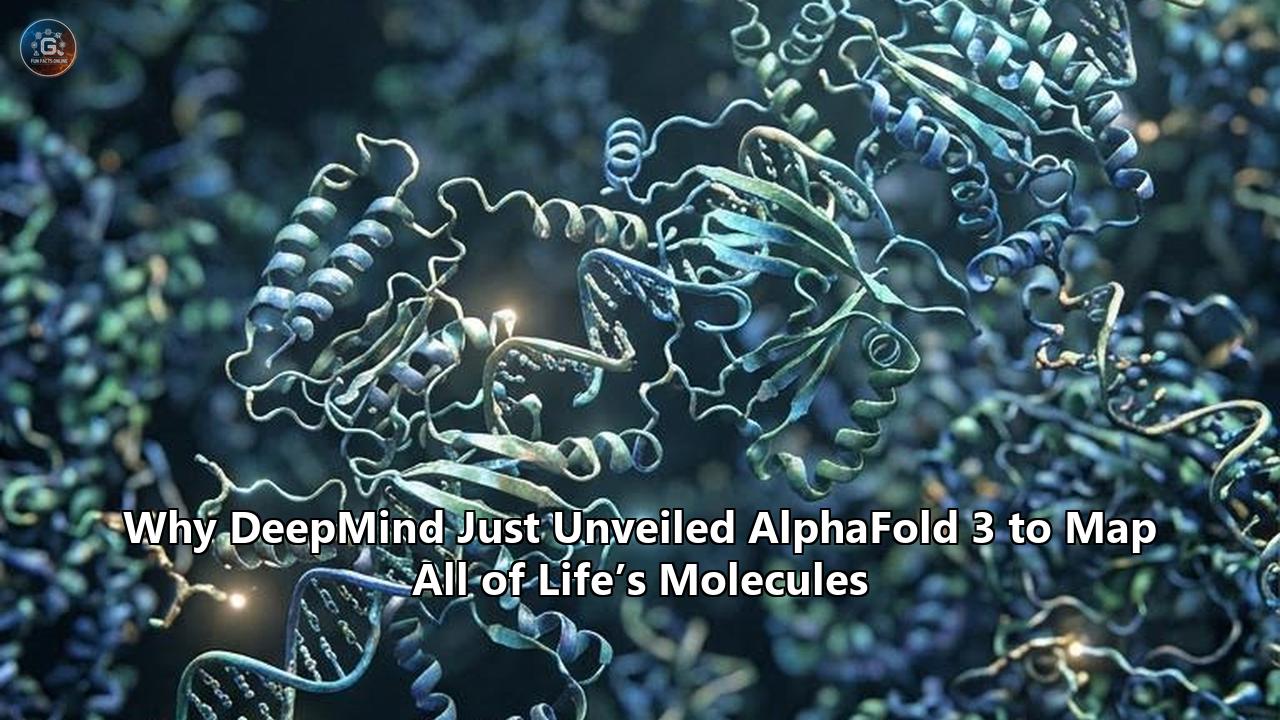
Biomolecular structure prediction entered a new quantitative phase when Google DeepMind and Isomorphic Labs unveiled AlphaFold 3 in Nature, demonstrating a 50% accuracy improvement over existing docking methods on protein-ligand interactions and doubling prediction accuracy for critical nucleic acid complexes. The model abandoned the structural confines of its predecessor—which had mapped more than 214 million protein structures across 1 million species in the AlphaFold Protein Structure Database—to model nearly the entire biochemical universe within a unified neural network.
Where AlphaFold 2 operated strictly within the boundaries of polypeptide chains, AlphaFold 3 models proteins, DNA double helices, single-stranded RNA, small molecule ligands, chemical modifications, and coordinated metal ions inside a single computational pass. In validated trials across the PoseBusters benchmark suite, AlphaFold 3 achieved a 76.4% success rate in predicting protein-ligand binding poses without requiring an experimentally determined target protein structure as an input—surpassing classical physics-based docking software by 50% and setting the first instance where a generative deep learning system outperformed traditional force fields on blind biomolecular complexes.
The announcement was quickly followed by massive financial and academic realignments. Isomorphic Labs leveraged this architecture to secure multi-target commercial discovery partnerships with Eli Lilly and Novartis valued at an aggregate $2.9 billion in developmental milestones, alongside $82.5 million in combined upfront cash. Five months after the initial architecture was revealed, DeepMind co-founders Demis Hassabis and John Jumper were awarded the 2024 Nobel Prize in Chemistry for their structural prediction systems. In November 2024, DeepMind fulfilled a global scientific commitment by releasing the complete AlphaFold 3 source code and model parameters on GitHub under an academic license, accompanied by a server infrastructure processing thousands of daily non-commercial queries.
ALPHAFOLD GENERATIONAL JUMP: SYSTEM SPECIFICATIONS

Metric / Parameter           AlphaFold 2 (2020)              AlphaFold 3 (2024)
-----------------------------------------------------------------------------------------
Target Molecular Scope       Proteins only (monomer/multimer) All biomolecules (Proteins, DNA,
                                                             RNA, Ligands, Ions, PTMs)
Core Representation Engine   Evoformer (48 blocks)           Pairformer (48 blocks)
MSA Processing Depth         48 dedicated MSA blocks         4 streamlined MSA blocks
3D Structure Generator       Structure Module (Equivariant)  Generative Diffusion Module (MSE)
Input Tokenization           Per-residue alpha-carbon frames Hybrid: Residue-level & All-Atom
PoseBusters Ligand Success   N/A (Requires docking add-ons)  76.4% (RMSD ≤ 2 Å, PB-Valid)
Maximum Input Sequence       ~2,560 tokens per standard run  5,120 tokens on single 80GB GPU
Open-Source Availability     Full code & weights on GitHub   Apache 2.0 code & open weights
Primary Commercial Driver    DeepMind Academic Partnerships  Isomorphic Labs ($2.9B pipeline)
The model represents a structural break from legacy structural biology methodologies, shifting the field from static, isolated proteomic mapping to multi-entity interaction chemistry.
The 215,000-Structure Limit: Moving Beyond the Single Proteome
Between 1971 and early 2024, the Protein Data Bank (PDB) accumulated approximately 215,000 experimentally solved macromolecular structures through X-ray crystallography, cryo-electron microscopy (cryo-EM), and nuclear magnetic resonance (NMR) spectroscopy. While experimentally vital, these data represented a heavily skewed sample of biological chemistry. Of the millions of chemical reactions governing cellular homeostasis, fewer than 5% occur between isolated, unmodified proteins.
Biology functions through heterotypic molecular assemblies. Approximately 98% of the transcribed human genome consists of non-coding RNA, much of which executes regulatory functions by assembling into ribonucleoprotein machines with enzymatic proteins. Similarly, more than 80% of clinical pharmaceutical agents are small organic molecules designed to bind specific protein pockets and disrupt catalytic cascades. AlphaFold 2 revolutionized monomeric and multimeric protein modeling, earning widespread adoption across 190 countries, but its underlying mathematical architecture could not process a non-peptide bond.
EXPERIMENTAL ARCHIVE VS. BIOLOGICAL TARGET UNIVERSE

Macromolecular Class        PDB Share (Approx. 2024)        AlphaFold 3 Coverage
-----------------------------------------------------------------------------------------
Protein Monomers/Homomers   ~84.2% (181,000 entries)        Full Support (Pairformer/Diffusion)
Protein-Ligand Complexes    ~11.3% (24,300 entries)         Full Support (All-Atom Tokenizer)
Protein-Nucleic Acid (DNA)  ~2.8%  (6,020 entries)          Full Support (Double/Single Strand)
Protein-RNA Assemblies      ~1.2%  (2,580 entries)          Full Support (Secondary/Tertiary)
Modified Residues / PTMs    <0.5%  (Heavily underreported)  Full Support (CCD / mmCIF mapped)
Traditional computational drug discovery attempted to bridge this divide by chaining disparate computational pipelines. Researchers predicted protein backbones with AlphaFold 2, manually docked small molecules using search algorithms like AutoDock Vina or Glide, and scored electrostatic dynamics with semi-empirical molecular mechanics. This multi-step process suffered from compounding error rates: a 1.5 Ångström error in side-chain orientation predicted by a protein folding tool caused classical physics-based docking software to fail completely due to steric clashes. DeepMind designed AlphaFold 3 to eliminate this error cascade by predicting the entire multi-molecular system in a single step.
Understanding the System: What Is AlphaFold 3?
To grasp the quantitative shift in structural bioinformatics, one must evaluate what is AlphaFold 3 from first engineering principles. AlphaFold 3 is a deep generative neural network trained to jointly predict the three-dimensional coordinates of multi-molecular assemblies containing proteins, nucleic acids (DNA and RNA), small molecules (drugs and cofactors), post-translational modifications (phosphorylation, glycosylation), and metal ions directly from their primary chemical formulas.
ALPHAFOLD 3 INFERENCE PIPELINE

  [ Input Layer ]
        │
        ├── Primary amino acid sequences (Proteins)
        ├── Nucleotide sequences (DNA/RNA)
        └── SMILES / Chemical Component Dictionary (Ligands, PTMs, Ions)
        │
  [ Tokenization & Feature Extraction ]
        │
        ├── Hybrid Tokenizer: 1 residue = 1 token (proteins/nucleic acids)
        │                     1 heavy atom = 1 token (ligands/ions)
        └── MSA Module (4 blocks): Lightweight sequence alignment search
        │
  [ The Pairformer Trunk (48 Layers) ]
        │
        ├── Single Representation Update (Channel size: 384)
        └── Pair Representation Update (Channel size: 128)
            (Enforces 3D spatial triangle inequalities without IPA)
        │
  [ The Diffusion Module (Generative Engine) ]
        │
        ├── Initial State: Gaussian noise cloud of Cartesian coordinates
        ├── Denoising Engine: 200 backward steps guided by Pairformer outputs
        └── Loss Function: Mean Squared Error (MSE) on atomic positions
        │
  [ Quality Assessment Head ]
        │
        ├── pLDDT (Per-atom local confidence: 0–100)
        ├── PAE (Predicted Aligned Error matrix in Ångströms)
        └── ipTM (Interface predicted Template Modeling score: 0–1.0)
        │
  [ Output: Validated All-Atom 3D mmCIF Structure ]
When computational structural biologists query what is AlphaFold 3, the answer lies in its departure from rigid, domain-specific inductive biases. AlphaFold 2 relied heavily on domain-specific geometry, using an "Invariant Point Attention" (IPA) module that forced intermediate calculations to conform strictly to rigid rotational and translational symmetries (SE(3) equivariance) based on the geometry of amino acid backbones.
AlphaFold 3 discards rigid peptide coordinate frames. It processes all biological structures through a unified token system:
- Proteins and nucleic acids are broken into one token per residue.
- Ligands, post-translational modifications, and ions are broken into one token per non-hydrogen atom.
By utilizing an all-atom diffusion model conditioned on a streamlined transformer core, AlphaFold 3 treats molecular folding not as an isolated protein-twisting algorithm, but as a generalizable geometric arrangement problem.
Architecture Deconstructed: The Pairformer and Diffusion Engine
The transition from AlphaFold 2 to AlphaFold 3 involved fundamentally re-engineering the model's core components. DeepMind replaced the Evoformer with a simpler Pairformer module, slashed multiple sequence alignment (MSA) computation by more than 80%, and introduced a generative diffusion module to output 3D coordinates directly.
ARCHITECTURAL SPECIFICATIONS: AF2 VS. AF3

Component               AlphaFold 2                     AlphaFold 3
-----------------------------------------------------------------------------------------
Input Processing        Deep MSA Search (Big databases) Compressed MSA (4 blocks total)
Trunk Architecture      Evoformer (48 blocks)           Pairformer (48 blocks)
Trunk Communication     Outer Product Mean + Pair Bias  Outer Product Mean + Pair Bias
Coordinate Engine       Structure Module                Generative Diffusion Module
Mathematical Loss       FAPE (Frame Aligned Point Err)  MSE (Mean Squared Error)
Symmetry Constraints    Rigid SE(3)-equivariant frames  Direct Cartesian coordinates (x, y, z)
Sampling Mechanics      Deterministic single forward pass Multi-sample stochastic diffusion
Recycling Scheme        4 cycles (passes through trunk) 4 cycles (internal coordinate recycling)
The Pruned MSA Module and the 48-Layer Pairformer
AlphaFold 2 relied extensively on deep evolutionary history. It calculated large Multiple Sequence Alignments (MSAs) across 48 complex Evoformer blocks, cross-referencing hundreds of homologous organisms to identify correlated mutations between amino acids. This was computationally expensive and structurally unviable for synthetic small molecules or non-conserved de novo designs that lacked evolutionary relatives.
AlphaFold 3 reduces the MSA extraction pipeline to just 4 shallow blocks. Evolutionary conservation is queried briefly at the input stage, generating a single vector per token that is immediately handed off to the Pairformer.
The Pairformer comprises 48 transformer blocks that operate exclusively on pairs of tokens:
- The Single Representation ($s_i$): A 384-dimensional vector that encapsulates local chemical identity (e.g., whether an atom belongs to an aromatic ring, a phosphate backbone, or an aliphatic chain).
- The Pair Representation ($z_{ij}$): A 128-dimensional matrix representing the spatial and energetic relationship between token $i$ and token $j$.
Instead of using complex invariant point attention mechanisms, the Pairformer uses triangular multiplicative updates and triangular self-attention. These operations enforce the triangle inequality: if atom A is 4 Å from atom B, and atom B is 3 Å from atom C, atom A cannot be 12 Å from atom C. The 48 Pairformer layers iteratively refine this 2D relational grid into an abstract distance matrix, resolving stereochemical constraints before any 3D atoms are positioned.
TRIANGLE INEQUALITY ENFORCEMENT IN PAIRFORMER

      [ Token A ] ────── 4 Å ────── [ Token B ]
           \                             /
            \                           /
          ≤ 7 Å                       3 Å
              \                       /
               \                     /
                     [ Token C ]

  * Math: dist(A, C) ≤ dist(A, B) + dist(B, C)
  * The Pairformer updates the 128-channel pair matrix z_ij across 48 layers
    to resolve distance matrices without relying on rigid peptide frames.
Generative Diffusion in 3D Space
The most radical mechanical change in AlphaFold 3 is the structure module. AlphaFold 2 constructed proteins by sequentially assembling rigid residue frames using specialized loss functions (Frame Aligned Point Error, or FAPE). AlphaFold 3 replaces this entirely with an all-atom generative diffusion module, similar to models used in AI image and video synthesis like DALL-E or Imagen.
During training, experimental structures from the PDB have varying degrees of Gaussian noise added to their Cartesian coordinates. The diffusion module is trained to denoise these scattered clouds of atoms back into their true 3D coordinates, guided by the 2D representations passed from the Pairformer.
The diffusion model eliminates rigid-body constraints, operating directly on raw Cartesian coordinates $(x, y, z)$. Its mechanics follow a four-tier sequence:
- It projects token-level vectors from the Pairformer trunk to establish global molecular conditioning.
- A lightweight, internal Atom Transformer processes dense, local atomic sub-neighborhoods within individual residues or small ligands.
- It performs bidirectional cross-attention, mapping local atomic adjustments back up to residue-level tokens to maintain polymer-scale topology.
- Denoising proceeds across 200 backward steps using standard Mean Squared Error (MSE) loss, removing noise until a precise, physically stable 3D conformation emerges.
By operating on raw coordinates rather than constrained rotation frames, the diffusion module handles non-standard chemical bonds, coordinate covalent bonds with zinc or iron ions, synthetic drug scaffolds, and nucleic acid backbones with equal facility.
DIFFUSION MODULE REFINEMENT TRAJECTORY (T = 200 TO T = 0)

Step 200: [ Random Gaussian Noise Cloud ]
          Atoms completely disordered; no recognizable molecular bonds.
          Loss: High MSE coordinate deviation.
                 │
                 ▼ (Denoising guided by Pairformer z_ij distance maps)
Step 100: [ Coarse Molecular Topology ]
          Polypeptide chains and nucleic acid backbones separate out.
          Rough binding pocket geometry begins to emerge.
                 │
                 ▼ (Atom Transformer refines sub-Angstrom atomic coordinates)
Step 0:   [ Fully Resolved Complex ]
          Exact bond lengths, hydrogen-bonding networks, pi-stacking,
          and van der Waals packing achieved. Final structure output as mmCIF.
Benchmark Verification: PoseBusters, DockQ, and CASP Standards
When DeepMind published the validation metrics for AlphaFold 3, the computational chemistry community subjected the data to rigorous quantitative auditing. The model was evaluated across several established structural biology benchmarks: the PoseBusters benchmark set for protein-ligand binding, DockQ interface scoring for protein-protein assemblies, and the Critical Assessment of Structure Prediction (CASP15) standard for nucleic acids.
COMPREHENSIVE PERFORMANCE BENCHMARK MATRIX

Benchmark Test          Target Assembly Class    Baseline Best Tool    AlphaFold 3 Score
-----------------------------------------------------------------------------------------
PoseBusters (PB-Valid)  Protein - Small Ligand   51.7% (AutoDock Vina) 76.4% Success Rate
PoseBusters (Apo Input) Protein - Small Ligand   42.1% (DiffDock)      68.0% Success Rate
FoldBench (DockQ > 0.23)Antibody - Antigen       29.8% (AF-Multimer)   45.4% Success Rate
FoldBench (High-Quality)Antibody - Antigen       0.8%  (Boltz-1)       13.4% Success Rate
CASP15 RNA Targets      RNA 3D Foldings          0.380 (trRosettaRNA)  0.512 Global TM-score
SKEMPI 2.0 (Mutation)   Protein Affinity Change  0.880 Pearson (PDB)   0.860 Pearson (AF3)
Stereochemical Purity   Chirality Verification   0.2%  (PDB Baseline)  4.4% Error Rate
The PoseBusters Protein-Ligand Results
The PoseBusters benchmark is designed to evaluate both geometric accuracy and physical plausibility. It evaluates docked small molecules against 18 physical and chemical validation checks, including:
- Absence of severe steric clashes (interatomic distances within van der Waals radii)
- Proper bond length and bond angle geometry
- Correct stereochemical configuration and chiral center preservation
- Minimization of internal torsional strain
On the PoseBusters benchmark (308 diverse, recently solved complexes unseen during training), AlphaFold 3 achieved a 76.4% success rate (defined as predicting a ligand pose with a root-mean-square deviation (RMSD) $\le$ 2.0 Ångströms that passes all 18 physical-chemical checks).
Legacy physics-based software AutoDock Vina, provided with an experimentally determined crystal protein pocket, achieved 51.7%. DiffDock, a leading deep learning docking tool, reached 42.1% under identical constraints. AlphaFold 3 required no structural input: it was given only the amino acid sequence of the target protein and the SMILES chemical formula of the small molecule, co-folding both simultaneously.
POSEBUSTERS SUCCESS RATE COMPARISON (LIGAND RMSD ≤ 2.0 Å + 18 VALIDITY CRITERIA)

AlphaFold 3 (Blind Co-Folding)  ████████████████████████████ 76.4%
FlowDock (Guided Docking)        ██████████████████ 51.0%
AutoDock Vina (Apo Target)      ████████████████ 45.2%
DiffDock (Apo Target)           █████████████ 38.0%
Protein-Protein and Antibody-Antigen Interfaces
In protein-protein interactions, AlphaFold 3 demonstrated improvements over AlphaFold-Multimer (v2.3). When evaluating multimeric interfaces using the DockQ score (where a DockQ score $>0.23$ indicates an acceptable interface and $>0.80$ denotes high accuracy), AlphaFold 3 improved performance on difficult targets:
- Antibody-Antigen Complexes: AlphaFold-Multimer had historically struggled with flexible CDR loops on antibodies, achieving a DockQ success rate below 30%. AlphaFold 3 increased this success rate to 45.4%, while achieving a high-quality docking rate (DockQ $>0.80$) of 13.4%.
- General Multimers: For standard, globular protein-protein interfaces, AlphaFold 3 achieved an average local distance difference test (LDDT) score of 0.860, compared to 0.851 for AlphaFold-Multimer—a 1.1% increase. The performance differential was most visible in complexes involving disordered domains, where AlphaFold 3 achieved a 76% accuracy threshold.
Nucleic Acids and Ribonucleoprotein Complexes
On complexes involving nucleic acids, AlphaFold 3 significantly outperformed previous tools. On the CASP15 RNA assessment set, specialized prediction algorithms like RoseTTAFold2NA and NuFold struggled with tertiary non-canonical base pairing.
AlphaFold 3 doubled prediction accuracy on protein-nucleic acid contacts, delivering an interface LDDT increase exceeding 20 percentage points over RoseTTAFold2NA. It accurately mapped zinc finger protein domains winding through the major groove of double-stranded B-DNA, alongside CRISPR-Cas9 complexes locked onto guide RNA and target DNA substrates.
Benchmark Limitations and Anomalies
Independent academic audits revealed several quantitative boundary limits and algorithmic bugs in AlphaFold 3's predictions.
VALIDATED LIMITATIONS AND ERROR FREQUENCIES

Identified Vulnerability     Measured Error Rate        Direct Consequence
-----------------------------------------------------------------------------------------
Chiral Inversion Rate        4.4% of PoseBusters poses  Generates inverted stereocenters
Binding Free Energy RMSE     +8.6% RMSE vs. PDB Source  Cannot accurately calculate ΔΔG
Intrinsically Disordered     ipTM Overconfidence        Hallucinates rigid alpha-helices
Symmetric Chain Clashing     ~2.1% in Large Multimers   Overlapping atomic densities
Orphan Protein Monomers      P = 0.36 (No advantage)    Fails to beat AF2 without homologues
The 4.4% Chirality Violation Flaw
Because the diffusion module generates positions directly in 3D Cartesian coordinates without hardcoded stereochemical constraints, it can inadvertently reflect chiral molecules. In the PoseBusters evaluation, AlphaFold 3 exhibited a 4.4% chirality violation rate. The network predicted valid low-energy conformations that were mirror images of the input molecules, swapping L-amino acids for D-amino acids or inverting chiral carbon centers in drug ligands.
Binding Free Energy Disconnects (SKEMPI 2.0)
Structural accuracy does not directly equate to functional energetic accuracy. In tests assessing binding free energy variations ($\Delta\Delta G$) across the SKEMPI 2.0 dataset (covering 317 protein-protein complexes and 8,338 point mutations), structures predicted by AlphaFold 3 delivered a Pearson correlation coefficient of 0.86.
However, root-mean-square error (RMSE) increased by 8.6% compared to structures resolved via wet-lab crystallography. The model's confidence metric (ipTM) showed poor correlation with binding energy alterations, demonstrating that AlphaFold 3 cannot yet replace free energy perturbation (FEP) calculations when predicting whether a single point mutation will abolish drug efficacy.
Intrinsically Disordered Regions and Hallucinations
Generative diffusion architectures are inherently prone to hallucinations when operating on unstructured sequences. When processing intrinsically disordered proteins (IDPs) that naturally sample multiple conformations in biological solutions, AlphaFold 3 frequently forces these flexible regions into rigid, spurious alpha-helices with deceptively high confidence scores.
Third-party testing on 113 orphan proteins (targets with few evolutionary relatives) demonstrated that AlphaFold 3 achieved an average Template Modeling score (TM-score) of 0.871 compared to AlphaFold 2’s 0.864—a minor difference with a P-value of 0.36, indicating no statistically significant improvement for proteins that lack homologous evolutionary alignments.
The Economics of Rational Drug Design: Isomorphic Labs and the $3 Billion Pipeline
DeepMind's molecular expansion was directly linked to the commercial strategy of its sister company, Isomorphic Labs. Understanding what is AlphaFold 3 in a commercial context means evaluating its potential to reduce the time and capital required for preclinical pharmaceutical development.
THE PRECLINICAL PHARMACEUTICAL FUNNEL: TRADITIONAL VS. AF3 PROJECTIONS

Phase                    Traditional Industry Average      AlphaFold 3 Acceleration
-----------------------------------------------------------------------------------------
Target Identification    6 – 18 Months ($2M – $5M)         1 – 3 Weeks (In Silico Validation)
Hit Discovery / Virtual  12 – 24 Months ($10M – $20M)      2 – 4 Months (High Pose Accuracy)
Screening                Screen 10^6 physical molecules    Screen 10^9 virtual structures
Hit-to-Lead Optimization 18 – 36 Months ($25M – $50M)      6 – 12 Months (Co-Fold Docking)
Total Preclinical Span   4.5 – 6.5 Years (~$75M+)          1.5 – 2.5 Years (~$20M)
Traditional drug discovery is characterized by high attrition and substantial financial risk:
- The average cost to bring a novel chemical entity to market ranges from $1.3 billion to $2.6 billion.
- The timeline spans 10 to 15 years from target selection to FDA approval.
- More than 90% of small molecule candidates fail in clinical trials, with roughly 40% to 50% of preclinical failures attributed to target-engagement failures, poor selectivity, or off-target toxicity.
Before AlphaFold 3, biopharma relied on high-throughput screening (HTS)—physically testing libraries of 500,000 to 2 million compounds against purified proteins in robotic multi-well plates. At a marginal cost of $0.10 to $0.50 per well, an HTS campaign typically requires $200,000 to $1 million per target, excluding protein purification and assay design expenses.
With AlphaFold 3 generating physically valid binding poses at a 76.4% success rate, computational drug design teams can replace physical screening assays with virtual screening across chemical libraries containing tens of billions of on-demand synthesizable molecules.
ISOMORPHIC LABS MAJOR PHARMACEUTICAL AGREEMENTS (JANUARY 2024)

Partner Entity    Upfront Payment   Milestone Pipeline    Target Directives
-----------------------------------------------------------------------------------------
Eli Lilly         $45.0 Million     $1.70 Billion         Undisclosed Oncology & Metabolic
Novartis          $37.5 Million     $1.20 Billion         Three Challenging Oncology Targets
Total Capital     $82.5 Million     $2.90 Billion         Multi-Target Small Molecule Discovery
The January 2024 agreements by Eli Lilly and Novartis represented early commercial bets on this architecture:
- Eli Lilly: Committed $45 million in cash upfront and $1.7 billion in potential development, regulatory, and commercial milestone payments to Isomorphic Labs to discover small molecule drugs against intractable targets.
- Novartis: Paid $37.5 million upfront, alongside a $1.2 billion milestone pipeline, to design small molecule therapeutics across three defined, hard-to-drug disease targets.
These agreements specifically target previously "undruggable" proteins: transcription factors, dynamic multiprotein interfaces, and membrane-bound receptors that lack stable binding pockets in their apo crystal structures. By using AlphaFold 3 to predict induced-fit binding pockets (where a small molecule shifts the local protein fold upon entry), computational pipelines can identify functional ligands that traditional static modeling tools overlook.
Compute Infrastructure, Open-Source Dynamics, and Local Deployment
The launch of AlphaFold 3 precipitated debate within the structural biology and machine learning communities regarding open-access science. When the Nature paper was published in May 2024, DeepMind initially withheld the underlying model weights and inference code, granting access exclusively via a restricted web server that capped users at 10 predictions per day and barred sequences containing synthetic drug ligands.
Following pushback from academic scientists citing reproducibility requirements, DeepMind reversed course in November 2024, publishing the full inference codebase under an Apache 2.0 license and releasing the trained model parameters on GitHub for academic research.
COMPUTATIONAL RESOURCES FOR LOCAL ALPHAFOLD 3 INFERENCE

System Resource        Local Execution Requirement        Technical Purpose
-----------------------------------------------------------------------------------------
GPU Hardware           NVIDIA A100 (80GB) or H100 (80GB)  VRAM accommodates 5,120 tokens
Compute Capability     NVIDIA Architecture ≥ 7.0 (Ampere) FP16/BF16 matrix multiplication
System Storage (SSD)   1.0 TB to 1.5 TB NVMe SSD          Hosts uncompressed sequence DBs
System Memory (RAM)    128 GB DDR4 / DDR5 System RAM      Large MSA data caching
Reference Databases    UniRef90, MGnify, BFD, RFam, PDB   Genetic & template homology
Data Pipeline Timing   ~30 to 60 Minutes (CPU bound)      BLAST & HMMER sequence alignments
Inference Pipeline     ~2 to 5 Minutes (GPU bound)        200 steps across Diffusion Module
Hardware Constraints and Token Limits
Deploying AlphaFold 3 locally requires substantial computing resources. The software requires a Linux environment running NVIDIA hardware with high GPU memory capacity:
- The maximum input capacity is capped at 5,120 tokens to fit within the memory limits of a single NVIDIA A100 (80GB) or H100 (80GB) accelerator.
- Running the full data search pipeline requires downloading more than 1 TB of reference databases: UniRef90, MGnify, PDB seqres, RNACentral, RFam, and a compressed version of the Big Fantastic Database (BFD).
- CPU-only execution is possible, but DeepMind estimates that generating a single complex prediction without a modern GPU is roughly 100 times slower, extending runtime from 3 minutes on an A100 to over 5 hours per seed.
INFERENCE LATENCY BREAKDOWN (STANDARD 1,200-TOKEN PROTEIN-LIGAND RUN)

[ CPU Bound ] Data Pipeline: 42 mins
  ├── Homology search across 1 TB databases (HMMER/Jackhmmer)
  └── Multiple Sequence Alignment (MSA) file formatting
[ GPU Bound ] Trunk Evaluation: 45 secs
  ├── Pairformer (48 Layers, token-pair triangle updates)
[ GPU Bound ] Generative Sampling: 135 secs
  └── Diffusion Module: 200 reverse steps × 5 seeds
Total Runtime: ~45 Minutes (Wall-clock time per target)
The Rise of Open Competitors
The temporary restriction on AlphaFold 3's source code accelerated the development of fully independent, open-source competitors:
- Chai-1: Released by Chai Discovery, this 10-fold scaled structural model matched AlphaFold 3 across several benchmarks, providing native support for multimodal inputs like mass spectrometry constraints and epitope maps.
- Boltz-1: Developed by the MIT-licensed open-source consortium, Boltz-1 reproduced AlphaFold 3's Pairformer-diffusion architecture, releasing model weights without commercial restrictions.
- Protenix: Developed by ByteDance and academic collaborators, Protenix reproduced AlphaFold 3's architecture, matching its 76% success rate on the PoseBusters suite.
OPEN BIOMOLECULAR MODEL ECOSYSTEM (2024–2026)

Model System    Developing Entity    License Model     Weights Release   Commercial Use?
-----------------------------------------------------------------------------------------
AlphaFold 3     DeepMind / Isomorphic Apache 2.0 Code   Academic Only     Restricted (Server/Pact)
Chai-1          Chai Discovery       Custom Open       Available         Permitted (Via API)
Boltz-1         MIT / Independent    MIT / Apache 2.0  Fully Open        Permitted
Protenix        ByteDance Research   Apache 2.0        Fully Open        Permitted
OpenFold3       OpenFold Consortium  Apache 2.0        Fully Open        Permitted
This ecosystem ensures that even as DeepMind and Isomorphic Labs maintain commercial arrangements around AlphaFold 3's weights, the architectural paradigm of unified Pairformer-diffusion co-folding remains widely accessible to the broader scientific community.
The Dynamic Frontier: Unresolved Variables and Ensembles
The broader adoption of AlphaFold 3 highlights a central challenge in structural biology: living cells do not operate as rigid, static structures.
Proteins and biological macromolecules are dynamic thermodynamic ensembles. They fluctuate constantly across free-energy landscapes, alternating between open and closed states, active and inactive confirmations, and assembly configurations governed by thermal motion and solvent kinetics. A single static prediction can conceal functional biological mechanisms.
THE NEXT FRONTIER: MOVING BEYOND SINGLE STATIC CONFORMATIONS

  Static Predictive Paradigm (AF2/AF3 Top-1)
  [ Input Sequence ] ──────▶ [ Single "Ground State" Cartesian Output ]
  * Problem: Misses intermediate binding states, allostery, and flexible transitions.

                                   │
                                   ▼

  Dynamic Ensemble Paradigm (Future Architecture Frontier)
  [ Input Sequence ] ──────▶ [ Thermodynamic Free-Energy Landscape ]
                             ├── State A (Inactive / Apo): 42% Population
                             ├── State B (Intermediate / Induced): 18% Population
                             └── State C (Active / Holo): 40% Population
The Allosteric and Kinetic Challenge
A key challenge for AlphaFold 3 is distinguishing between different physiological states of the same molecule:
- Kinase Transitions: Human protein kinases cycle between "DFG-in" (active, ATP-binding) and "DFG-out" (inactive) conformations based on phosphorylation and regulatory partner binding. AlphaFold 3 often settles into whichever state is most heavily represented in the PDB training set, sometimes missing the alternative state targeted by allosteric inhibitors.
- Transient Interactions: Weak or transient protein interactions ($K_d > 100\ \mu\text{M}$), which govern rapid signaling events like ubiquitination cascades, remain difficult to identify. Interface predictions often display marginal confidence scores (ipTM between 0.4 and 0.6) that fail to distinguish true dynamic interactions from non-specific binding artifacts.
- Solvent and Membrane Dynamics: AlphaFold 3 models molecules in a vacuum. It does not explicitly account for lipid bilayer mechanics, pH variations, ion concentration gradients, or explicit water-mediated hydrogen-bonding networks, which can contribute up to 50% of the binding enthalpy in small molecule interactions.
ALPHAFOLD 3 PREDICTION CONFIDENCE (ipTM) INTERPRETATION MATRIX

ipTM Score Range     Predicted Interaction Reliability   Recommended Validation Step
-----------------------------------------------------------------------------------------
0.80 – 1.00          High Confidence Complex Formation    Direct to synthesis / assay design
0.60 – 0.79          Probable Interaction (Medium Qual)   Cross-reference with Co-IP / HDX-MS
0.40 – 0.59          Ambiguous / Transient Contact        Molecular Dynamics (MD) run needed
0.00 – 0.39          Non-Interacting / False Positive     Discard or redesign input targets
The Convergence of Generative AI and Cryo-ET
The forward-looking integration pathway for AlphaFold 3 targets in situ cellular structural biology. By coupling generative multi-entity structural predictions with cryo-electron tomography (cryo-ET), researchers are beginning to map the interior of intact cells at sub-nanometer resolutions.
Cryo-ET produces dense, noisy three-dimensional density maps of unperturbed cellular slices. Historically, fitting atomic structures into these low-resolution volumes required years of manual modeling. Researchers are now deploying AlphaFold 3 to predict entire libraries of multi-protein complexes, matching these predicted atomic structures directly against the electron densities observed in native cell scans.
AlphaFold 3's transition from single polypeptide chains to multi-component molecular assemblies demonstrates that structural biology is moving toward high-throughput, all-atom predictive modeling. By replacing rigid classical assumptions with flexible, diffusion-based coordinate modeling, the platform offers an integrated computational framework for mapping the complex molecular interactions of the cell.
Reference:
- https://www.isomorphiclabs.com/articles/alphafold-3-predicts-the-structure-and-interactions-of-all-of-lifes-molecules
- https://www.researchgate.net/publication/414590841_AlphaFold_3_Architecture_and_Applications_in_Protein-Ligand_Complex_Prediction
- https://medium.com/@ding.zhongqiang/alphafold3-graph-neural-networks-diffusion-models-e01c5c0e8af2
- https://www.extremetech.com/science/google-deepmind-open-sources-alphafold-3-for-medicine-and-molecular-biology
- https://en.wikipedia.org/wiki/AlphaFold
- https://pmc.ncbi.nlm.nih.gov/articles/PMC13099841/
- https://endpoints.news/alphabets-ai-unit-isomorphic-inks-drug-discovery-deals-with-eli-lilly-novartis-for-up-to-3b/
- https://www.frontiersin.org/journals/chemistry/articles/10.3389/fchem.2026.1842082/full
- https://github.com/google-deepmind/alphafold3
- https://www.ai4pharm.info/alphafold3
- https://medium.com/@ding.zhongqiang/alphafold3-graph-neural-networks-diffusion-models-e01c5c0e8af2
- https://pmc.ncbi.nlm.nih.gov/articles/PMC12342994/
- https://mcgilligem.substack.com/p/alphafold-3
- https://www.pnas.org/doi/10.1073/pnas.2521048122
- https://www.blopig.com/blog/2024/08/architectural-highlights-of-alphafold3/
- https://research.dimensioncap.com/p/an-opinionated-alphafold3-field-guide
- https://elanapearl.github.io/blog/2024/the-illustrated-alphafold/
- https://www.biorxiv.org/content/10.1101/2025.01.08.631967v1.full
- https://academic.oup.com/bib/article/26/5/bbaf454/8246683
- https://pmc.ncbi.nlm.nih.gov/articles/PMC11774451/
- https://pmc.ncbi.nlm.nih.gov/articles/PMC12661943/
- https://pubmed.ncbi.nlm.nih.gov/41313605/
- https://www.biorxiv.org/content/10.1101/2025.05.22.655600v1.full
- https://arxiv.org/html/2406.03979v1
- https://www.fiercebiotech.com/biotech/alphabets-isomorphic-stacks-two-new-deals-lilly-novartis-worth-nearly-3b-ahead-buzzy-jpm
- https://github.com/sokrypton/ColabFold/blob/main/AlphaFold3_of3.ipynb
- https://www.ebi.ac.uk/training/online/courses/alphafold/alphafold-3-and-alphafold-server/using-the-alphafold-3-source-code/
- https://github.com/google-deepmind/alphafold3/blob/main/docs/installation.md
- https://www.researchgate.net/publication/387932689_Protenix_-_Advancing_Structure_Prediction_Through_a_Comprehensive_AlphaFold3_Reproduction